# AI Context Layer for Business Knowledge | Alchemyst AI - Full Content Dump
> Generated at: 2026-10-15T02:11:59.378Z
> Source: https://getalchemystai.com
---
## https://getalchemystai.com/
Backed by
# Context Backbone for every AI team.
Give AI agents access to your company knowledge and persistent memory through a single API. Alchemyst AI connects the context developers need with the shared, traceable knowledge enterprises rely on, across models and workflows.
[Signup](/platform/signin)[Take Context Assessment](/assessment)
p95 latency
< 300ms
auditable
100%
zero infra
1 API
## Alchemyst AI: an AI context layer for business knowledge and agent memory
Alchemyst AI gives developers and enterprises a shared knowledge layer for AI agents through a single API. It combines persistent AI agent memory with semantic retrieval over company knowledge, helping applications give an LLM relevant internal documents and business context. The context layer keeps stored knowledge separate from the model, so applications can reuse it across models, sessions, and workflows. Grounding answers in enterprise data can reduce unsupported claims; correctness still depends on source quality, retrieval, application permissions, and the model's response.
### Context arithmetic: the core primitive
Context arithmetic applies set operations over meaning at query time. Intersection narrows scope by team, region, or version. Union combines sources. Subtraction excludes superseded or out-of-scope content. Ranking selects the context that enters the model window. These operations over an institutional knowledge graph support memory behaviors: recalling what happened, resolving what it means, and informing the next action.
### Context Traces, business definitions, and integrations
Context Traces expose retrieval sources, scores, and rules so teams can inspect which information reached an agent. Canonical business definitions help resolve terms such as revenue, pricing, and policy across teams. The context-tracing walkthrough describes pairing Alchemyst with OpenAI Euphony for visual debugging at https://getalchemystai.com/blog/context-tracing-for-ai-agents-with-openai-euphony. Integration resources cover Python, TypeScript, LangChain, LlamaIndex, n8n, MCP clients such as Claude Desktop, Cursor, and VS Code, and the Alchemyst Chrome extension. See https://getalchemystai.com/docs for current integration instructions.
### Use cases, pricing, and trust
Use cases include customer support, employee support over internal policies, EdTech tutoring, finance, healthcare continuity, and voice agents. Explore https://getalchemystai.com/use-cases. Current plans, free-tier allowances, and enterprise options are listed at https://getalchemystai.com/pricing. Alchemyst AI is built by XAlchemystai Technologies Pvt. Ltd., India. Contact founders@getalchemystai.com. Company information, security controls, and privacy details are available at https://getalchemystai.com/about, https://getalchemystai.com/security, and https://getalchemystai.com/privacy.
### CLI, SDKs, and MCP discovery
Install the SDK with npm install @alchemystai/sdk (https://www.npmjs.com/package/@alchemystai/sdk) or pip install alchemystai (https://pypi.org/project/alchemystai/). The CLI agent walkthrough is at https://getalchemystai.com/cli. The developer guide at https://getalchemystai.com/developers explains how to add business knowledge to an AI agent. Product API documentation is at https://getalchemystai.com/docs. The website's Streamable HTTP MCP endpoint at https://getalchemystai.com/mcp exposes documentation, article, and API-discovery tools; its server card is at https://getalchemystai.com/mcp/server-card. The website's public API specification is at https://getalchemystai.com/openapi.json.
### Machine-readable content and navigation
Discover site URLs at https://getalchemystai.com/sitemap.xml, the content index at https://getalchemystai.com/llms.txt, and the expanded content export at https://getalchemystai.com/llms-full.txt. The persistent-memory guide at https://getalchemystai.com/blog/how-to-add-persistent-memory-to-ai-agents covers generic answers, document retrieval, RAG versus fine-tuning, and grounding LLM responses in company knowledge.
Trusted by developer teams at
Why context
## The model is replaceable.
Your institutional context isn't.
An AI context layer retrieves relevant business knowledge before an agent answers or acts. It connects your internal documents and saved interactions to the model, so your application can ground responses in company data rather than rely on general training knowledge alone.
> “
>
> Models will keep changing. Your institutional context is the asset that compounds, so it should belong to you, not to whichever model you happen to run today.
>
> [Read the Context Thesis →](/thesis)
The Technical Case
### Switch models freely. Keep your context sovereign.
Keep AI agent memory outside the model so saved context can be retrieved across sessions and model changes. Alchemyst separates your company knowledge from the LLM that uses it, giving developers a reusable integration and enterprises continuity across teams and workflows.
* Model-agnostic
* Context sovereignty
* Zero migration cost
* Multi-model routing
* Sub-300ms retrieval
The Business Case
### Give every agent the company knowledge it needs.
An agent can give generic answers when the relevant company data is missing from its context. Connect policies, product knowledge, and operational records to a shared knowledge layer for AI agents, then retrieve the evidence each sales, support, or operations workflow needs.
* Run ops, not just answers
* One source of truth
* Every decision auditable
* Scales without FDE teams
One sovereign context layer, any model, agents that operate
What does Alchemyst do?
## A context layer that keeps your AI current, traceable, and semantically consistent.
Alchemyst AI is an AI context management platform for storing and retrieving business knowledge. Use context arithmetic to select relevant information from your institutional knowledge graph, then inspect the sources behind retrieval without operating your own vector database or graph store.
01
### How does knowledge retrieval for AI agents work?
Context arithmetic is the foundational primitive: dynamic set algebra over meaning, computed at query time. Instead of naïve top-K similarity, Alchemyst intersects to narrow scope, unions to widen recall, subtracts superseded or out-of-scope content, and ranks what remains, so only the right context survives into the window.
```
// Set algebra over meaning, at query timeconst window = alchemyst.context.search({ query: userMessage, groupName: ["sales", "emea"], // ∩ narrow scope metadata: { version: "v2" }, // ∩ filter});// − superseded / deduped → rank → top-K
```
02
### How does an enterprise knowledge graph support memory?
What you store is an institutional knowledge graph of your organization's context, fully traceable. Memory isn't three hard-coded layers. By applying context arithmetic over the graph you can derive the behaviors people expect from memory: recall what happened, resolve what it means, and inform how to act. The memory types are outcomes of the primitive, not separate modules.
```
// One graph + arithmetic → derived "memories"const captureTime1 = "end-date-" + Date.now();// Represents what should be added when your session is first saved.const storeInformationOfSessionAtFirstInstance = await ctx.add({ documents: [ ], metadata: { groupName: [session_id, captureTime1] }});// Now resume from where you left off, or let someone resume from there.const whatHappened = await ctx.search({ query: term, metadata { groupName: [session_id, captureTime1] }});// Second checkpintconst storeInformationOfSessionAtSecondInstance = await ctx.add({ documents: [...], metadata: { groupName: [session_id, captureTime2] }});// Now team lead / CXO looks up about the informationconst whatItMeans = ctx.search({ query: term, metadata: { groupName: [session_id] }})// "how to act" falls out of scope over the global context
```
03
### Why did my AI agent give a wrong answer?
When an AI agent gives wrong answers about internal data, inspect what it retrieved before changing the prompt. Alchemyst Context Traces expose the sources, scores, and rules used to assemble context. Developers can investigate retrieval failures, while enterprise teams can review which business information supported an answer.
```
const trace = await alchemyst.trace.get( session_id, turn_id);// Returns: sources[], scores[], rules_applied[]// Pairs with Euphony for visual debugging
```
04
### How do agents use consistent business definitions?
Define canonical term definitions at the org level. When "revenue" means different things to different teams, Alchemyst resolves the ambiguity before it reaches the model.
```
const gtmTeamResponse = await alchemyst.context.add({ documents: [...], // Data here metadata: { groupName: ["gtm", "revenue"] // The term "revenue" defined by GTM team }})const financeTeamResponse = await alchemyst.context.add({ documents: [...], // Data here metadata: { groupName: ["finance", "revenue"] // The term "revenue" defined by Finances team. }})const cxoResponse = await alchemyst.context.search({ query: "What's the revenue for Q2 2026?", metadata: { groupName: ["revenue"] // The term "revenue" defined for CXO, with clear segregation between the resources by GTM team and Finances team. }})
```
Illustrative · accuracy vs conversation context
Example Use Case
### How do you debug what an agent can't see? Context Tracing with OpenAI Euphony
Pairing Alchemyst's Context Traces with Euphony, OpenAI's open-source conversation visualizer, creates an end-to-end debugging workflow. Every agent failure is now diagnosable in minutes: was it a retrieval problem, a configuration problem, or a model problem?
[Read the walkthrough](https://getalchemystai.com/blog/context-tracing-for-ai-agents-with-openai-euphony)
## How do you give AI agents your business knowledge?
### What is an AI context layer?
An AI context layer stores and retrieves the information an AI application needs for a task: company documents, business definitions, and saved interactions. Alchemyst AI provides this knowledge layer for AI agents through an API, so teams can reuse business context across models and inspect the sources used in retrieval.
[Connect your company knowledge →](/developers)
### Why does my AI agent keep giving generic answers?
An agent may give generic answers because the relevant company information never reaches its context window. Check whether your application has ingested the right documents, retrieved the relevant passages, and passed them to the model. Better prompts help specify the task, but cannot supply missing business facts by themselves.
[Diagnose generic and unsupported answers →](/blog/how-to-add-persistent-memory-to-ai-agents#generic-answers)
### How can I add business knowledge to my AI agent?
Start with a trusted set of company documents and record their sources, versions, and access boundaries. Store that context, retrieve relevant passages for each question, and pass those passages to your LLM. In Alchemyst AI, developers integrate context storage and search through the API or SDKs; teams remain responsible for source quality and application permissions.
[Follow the business knowledge integration steps →](/developers#business-knowledge)
### How is AI agent memory different from a company knowledge base?
AI agent memory preserves information from previous interactions, such as a user preference or an unfinished task. A company knowledge base holds shared information such as policies and product documentation. An agent may need both: session history to understand the conversation, and current business knowledge to answer a company-specific question.
[Learn how persistent agent memory works →](/blog/how-to-add-persistent-memory-to-ai-agents)
### Can grounding an LLM in enterprise data stop hallucinations?
Grounding gives the model relevant evidence, which can reduce unsupported answers about your business. It does not guarantee correctness. Keep documents current, check retrieval quality, require source references, and make the agent say when evidence is missing. Review high-impact answers and test both retrieval and generation before expanding a workflow.
[Build a workflow for grounded answers →](/blog/how-to-add-persistent-memory-to-ai-agents#grounding)
< 300ms
context retrieval latency
p95 across all query types
99.7%
reduction in hallucinations
on domain-specific tasks
20×
faster agent debugging
with context traces vs raw logs
1 API
replaces 4 infra pieces
vector DB, graph DB, cache, logger
Get Started
## Give your AI agents the memory they deserve.
Join developers building the next generation of AI products with persistent, auditable context. Free tier available. No credit card required.
* Free tier
* REST + Python & Node SDKs
* 99.9% uptime SLA
* SOC 2 in progress
### Request API Access
Enter your email and we'll set up your workspace.
Email
[Read the Docs →](https://docs.getalchemystai.com)[Read the Thesis →](/thesis)
---
## https://getalchemystai.com/about
About Alchemyst AI
# An AI memory and context company built around your business
Alchemyst AI builds a shared context layer for AI agents. We help developers connect models to business knowledge and help enterprises make that knowledge available across agent workflows. The platform combines persistent context, retrieval over an institutional knowledge graph, and Context Traces through an API.
Updated September 29, 2026
## What problem does Alchemyst AI solve?
A capable model can still give an unhelpful answer when it lacks the relevant company facts. Policies change, teams use different definitions, and earlier interactions may never reach the next request. Alchemyst AI provides infrastructure for storing and retrieving that context so applications can ground their work in the business information they need.
We are building for developers and enterprises equally. Developers need a practical integration path and visibility into retrieval. Enterprise teams need shared knowledge, defined access boundaries, and a way to investigate how business information reaches an agent. Both need to evaluate whether the resulting answers are useful and supported.
## What should you expect from an AI memory company?
Persistent storage is only part of the job. An AI memory service should make relevant information available across sessions, support corrections and deletion, and expose enough detail to investigate unexpected recall. For company knowledge, evaluate source ownership, access controls, and how the service handles changes to business facts.
Alchemyst's approach is to keep context separate from the model that uses it. An application can reuse stored business information across model integrations, while selecting the context relevant to a particular task. See the [persistent AI agent memory guide](/blog/how-to-add-persistent-memory-to-ai-agents) for the implementation trade-offs.
## How does an enterprise knowledge graph support AI?
An enterprise knowledge graph represents business information and the relationships between it. Alchemyst describes its stored context as an institutional knowledge graph and uses context arithmetic to select information at query time: intersection narrows scope, union combines sources, subtraction excludes content, and ranking selects what enters the context window.
This gives a shared knowledge layer a practical role in an agent workflow. A support agent can retrieve product and policy context, while an operations agent retrieves information for its own task. Context Traces expose the retrieval sources, scores, and rules for inspection. Correct answers still depend on source quality, application configuration, and model behavior.
## How can developers and enterprises get started?
Start with one workflow and a small, trusted knowledge set. Use the [developer guide to connect internal documents](/developers), test questions with known answers, and check the behavior when evidence is missing. Expand coverage after validating retrieval quality and permissions.
Enterprise teams can review [security controls and current compliance status](/security), [pricing](/pricing), and [integration requirements with our team](/contact). Read [our context thesis](/thesis) for the reasoning behind the product.
## Who is behind Alchemyst AI?
Alchemyst AI is built by XAlchemystai Technologies Pvt. Ltd., led by CEO and co-founder [Uttaran Nayak](https://www.linkedin.com/in/uttarannayak/), CTO and co-founder [Anuran Roy](https://www.linkedin.com/in/anuran-roy/), and COO [Prithwijit Dey](https://www.linkedin.com/in/prithwijitdey/).
Contact [founders@getalchemystai.com](mailto:founders@getalchemystai.com) for product and enterprise questions. Our [Privacy Notice](/privacy) explains how we handle personal data.
---
## https://getalchemystai.com/benchmarks
Benchmarks
# Beyond chat sessions: the Pareto frontier for context.
Memory benchmarks tested in December 2025\. Alchemyst serves context at 170ms P50 latency for $0.06 per 1M tokens, with a memory F1 of 0.76\. The charts below show what that tradeoff looks like against Supermemory, Zep, and Hindsight GPT.
Tested December 2025 · Prices in USD · Performance is F1
P50 latency
170ms
per 1M tokens
$0.06
value ratio
12x
memory F1
0.76
## Alchemyst AI memory benchmarks, December 2025
Overall: Alchemyst serves context at 170ms P50 latency for $0.06 per 1M tokens, with 0.76 memory F1\. Hindsight GPT OSS 120B scores 0.907 F1 at $0.36 with 450ms latency. Supermemory scores 0.833 F1 at $6.33 with 820ms latency. Zep scores 0.723 F1 at $12.50 with 1150ms latency. Prices are USD in the test harness. Performance is F1.
### Value index (performance per dollar)
Alchemyst delivers over 12x more performance value per dollar than the nearest competitor, and costs 83 percent less than Zep. The gap comes from cost, not from giving up accuracy.
### Per-category F1 results
* Single Session Preference (n=30): Hindsight GPT 0.867, Supermemory 0.700, Alchemyst 0.600, Zep 0.567.
* Single Session User (n=68): Hindsight GPT 1.000, Supermemory 0.971, Alchemyst 0.956, Zep 0.929.
* Knowledge Update (n=75): Hindsight GPT 0.923, Supermemory 0.884, Zep 0.833, Alchemyst 0.560.
* Single Session Assistant (n=55): Hindsight GPT 0.982, Alchemyst 0.964, Supermemory 0.964, Zep 0.804.
* Temporal Reasoning (n=131): Hindsight GPT 0.857, Supermemory 0.767, Alchemyst 0.756, Zep 0.624.
* Multi Session (n=133): Hindsight GPT 0.812, Alchemyst 0.729, Supermemory 0.714, Zep 0.579.
### Methodology
Evals cover single session preference, user, and assistant recall, knowledge updates, temporal reasoning, and multi session memory, with 30 to 133 cases per category. Latency is P50 for a retrieval call in the test harness. Reproduce the setup against your own workload before making a buying decision. Full per-category tables are in the data archive section of https://getalchemystai.com/benchmarks.
Value index
## Intelligence delivered per dollar.
Performance divided by cost. Alchemyst delivers more than 12x the performance value per dollar of the nearest competitor because the price denominator is an order of magnitude smaller.
Value index
Amount of intelligence delivered per dollar spent.
Alchemyst delivers over 12x more performance value per dollar compared to the nearest competitor.
Reading the chart
Alchemyst delivers over 12x more performance value per dollar compared to the nearest competitor.
Cost savings vs Zep
83% lower
Latency, P50
170ms
Overall memory F1
0.76
The gap comes from cost, not from giving up accuracy. Alchemyst stays competitive on F1 while indexing and serving at a fraction of the price.
Efficiency frontier
## Cost on a log scale, performance on a linear one.
Cheaper is to the left, better is to the top. Alchemyst sits alone in the low cost, high performance corner. The line connects providers sorted by price to show the frontier.
Efficiency frontier
Logarithmic cost projection. Cheaper is left, better is up.
Relative superiority
## Head to head across six memory dimensions.
One row per eval category. Alchemyst leads on efficiency everywhere and stays within striking distance on raw F1, including 0.956 on Single Session User and 0.964 on Single Session Assistant.
Relative superiority
Head-to-head F1 across six memory dimensions.
| Dimension | Alchemyst | Supermemory | Zep | Hindsight GPT |
| -------------------------------- | --------- | ----------- | ----- | ------------- |
| Single Session Preference (n=30) | 0.600 | 0.700 | 0.567 | 0.867 |
| Single Session User (n=68) | 0.956 | 0.971 | 0.929 | 1.000 |
| Knowledge Update (n=75) | 0.560 | 0.884 | 0.833 | 0.923 |
| Single Session Assistant (n=55) | 0.964 | 0.964 | 0.804 | 0.982 |
| Temporal Reasoning (n=131) | 0.756 | 0.767 | 0.624 | 0.857 |
| Multi Session (n=133) | 0.729 | 0.714 | 0.579 | 0.812 |
Single Session Preference · n=30Single Session User · n=68Knowledge Update · n=75Single Session Assistant · n=55Temporal Reasoning · n=131Multi Session · n=133
Full data archive
## Every category, every provider.
Raw per-category F1, sorted by performance within each table. Prices are USD per 1K in the test harness. This is the complete dataset behind the charts above.
### Single Session Preference
n=30
| Model | Price (USD/1K) | Performance (F1) |
| ---------------------- | -------------- | ---------------- |
| Hindsight GPT OSS 120B | $0.3600 | 0.867 |
| Supermemory | $6.3330 | 0.700 |
| Alchemyst | $0.0600 | 0.600 |
| Zep | $12.5000 | 0.567 |
### Single Session User
n=68
| Model | Price (USD/1K) | Performance (F1) |
| ------------- | -------------- | ---------------- |
| Hindsight GPT | $0.3600 | 1.000 |
| Supermemory | $6.3330 | 0.971 |
| Alchemyst | $0.0600 | 0.956 |
| Zep | $12.5000 | 0.929 |
### Knowledge Update
n=75
| Model | Price (USD/1K) | Performance (F1) |
| ------------- | -------------- | ---------------- |
| Hindsight GPT | $0.3600 | 0.923 |
| Supermemory | $6.3330 | 0.884 |
| Zep | $12.5000 | 0.833 |
| Alchemyst | $0.0600 | 0.560 |
### Single Session Assistant
n=55
| Model | Price (USD/1K) | Performance (F1) |
| ------------- | -------------- | ---------------- |
| Hindsight GPT | $0.3600 | 0.982 |
| Supermemory | $6.3330 | 0.964 |
| Alchemyst | $0.0600 | 0.964 |
| Zep | $12.5000 | 0.804 |
### Temporal Reasoning
n=131
| Model | Price (USD/1K) | Performance (F1) |
| ------------- | -------------- | ---------------- |
| Hindsight GPT | $0.3600 | 0.857 |
| Supermemory | $6.3330 | 0.767 |
| Alchemyst | $0.0600 | 0.756 |
| Zep | $12.5000 | 0.624 |
### Multi Session
n=133
| Model | Price (USD/1K) | Performance (F1) |
| ------------- | -------------- | ---------------- |
| Hindsight GPT | $0.3600 | 0.812 |
| Alchemyst | $0.0600 | 0.729 |
| Supermemory | $6.3330 | 0.714 |
| Zep | $12.5000 | 0.579 |
Methodology note
Evals cover single session preference, user, and assistant recall, knowledge updates, temporal reasoning, and multi session memory. Counts range from 30 to 133 cases per category. Latency is P50 for a retrieval call in the test harness. Reproduce the setup against your own workload before making a buying decision, and contact the team for the eval definitions.
[Discuss your workload](/contact)[Read the docs](/docs)
---
## https://getalchemystai.com/careers
Open Roles
# Build the context layer for enterprise AI
We are a small, senior team turning institutional memory into a primitive for AI agents. If you want your work to sit under every agent an enterprise runs, you are in the right place.
14 open roles
## Careers at Alchemyst AI
Alchemyst AI hires a small, senior team building the model-agnostic context layer that gives enterprise AI agents persistent, auditable memory. Open roles are listed on https://getalchemystai.com/careers and each role links directly to its application form. General applications go to founders@getalchemystai.com.
## Open Positions
Every role is a form. Pick one and apply directly, no account required.
Growth And Partnerships Intern
### Growth And Partnerships Intern
Remote
Posted Apr 2026[Apply](https://tally.so/r/ODjjVM)
B2B Sales Associate
### B2B Sales Associate
RemoteInternship
Posted Apr 2026[Apply](https://tally.so/r/LZYXz2)
Engineer - Product Success
### Engineer - Product Success
Full-timeRemote/On-site
Posted Mar 2026[Apply](https://tally.so/r/5BdyOZ)
B2B Sales Associate
### B2B Sales Associate
RemoteInternship
Posted Jan 2026[Apply](https://tally.so/r/5B9GEQ)
Videography (Content) Intern
### Videography (Content) Intern
InternshipOn-site
Posted Dec 2025[Apply](https://tally.so/r/9qB0ZE)
Growth & Partnerships
### Growth & Partnerships
RemoteInternshipFemale Only
Posted Dec 2025[Apply](https://tally.so/r/aQ9klq)
Forward Deployed Software Engineer (FDSE) - Growth
### Forward Deployed Software Engineer (FDSE) - Growth
Full-timeRemote/On-site
Posted Dec 2025[Apply](https://tally.so/r/Gx6JzZ)
Forward Deployed Software Engineer (FDSE) - B2B
### Forward Deployed Software Engineer (FDSE) - B2B
Full-timeRemote/On-site
Posted Dec 2025[Apply](https://tally.so/r/A7zq2y)
Research Engineer - AI Systems & Context
### Research Engineer - AI Systems & Context
Full-timeRemote/On-site
Posted Dec 2025[Apply](https://tally.so/r/D4BDkR)
Business Development Associate| Remote
### Business Development Associate| Remote
Internship
Posted Nov 2025[Apply](https://tally.so/r/Xx5Y9d)
Video Editor
### Video Editor
RemoteInternship
Posted Oct 2025[Apply](https://tally.so/r/mOpY48)
Growth & Partnerships
### Growth & Partnerships
RemoteInternshipFemale Only
Posted Oct 2025[Apply](https://tally.so/r/wv7eg8)
Lead AI Agentic Engineer
### Lead AI Agentic Engineer
Full-timeRemote
Posted Oct 2025[Apply](https://tally.so/r/3E4MRN)
Technical Content/Blog Writer
### Technical Content/Blog Writer
Posted Aug 2025[Apply](https://tally.so/r/31a1Mp)
---
## https://getalchemystai.com/case-study
Case studies
# Seven industries. One context layer underneath.
Hospitals, EdTech, D2C logistics, banking, real estate, dealerships and staffing. The voice, the channel and the workflow change from one to the next. What makes each of them work is the same: every conversation carries the customer's history, and every answer is written back for the next one.
01 · Healthcare
440K+Patients Served / Year (BBH)
### [Healthcare & Hospitals](/case-study/healthcare)
Augment, Don't Replace.
Hospitals run on high-volume, repeatable patient communication: confirming appointments, checking on discharged patients, fielding 'are my results ready?' calls, supporting palliative caregivers, chasing chronic disease adherence, following up on community screening referrals, and collecting feedback. Each task competes for limited clinical and administrative bandwidth, and each one only works if the call knows who the patient is. The Alchemyst context layer gives every call the patient's live record and history. Kathan Voice OS, running on top of it, absorbs the repeatable load, escalates anything clinically meaningful to the right human in real time, and runs natively in Indian languages including Tamil, Kannada, Telugu, and Hindi.
Read the case study
02 · EdTech
38.7%Aggregate Connection Rate
### [Education Technology](/case-study/edtech)
Context, Not Cold Scripts.
EdTech outbound calling in India hits a wall that generic dialers cannot solve. Students and parents expect conversations in their own language, and a single script does not work across career guidance, parent-teacher follow-up, enrollment, feedback, and re-engagement. Kathan Voice OS handles all of these natively across 12+ Indian languages on the Alchemyst context layer, which keeps a persistent memory of every lead. Retargeted cohorts consistently outperform cold outreach because context accumulates across attempts.
Read the case study
03 · AgroTech
41.7%Aggregate Connection Rate
### [AgroTech & D2C Logistics](/case-study/agrotech)
Recover Revenue Before It Becomes RTO.
India's D2C logistics reality is unforgiving. A meaningful share of all shipments hit a delivery exception, and if the carrier cannot resolve it within its attempt window, the package converts to RTO and the seller absorbs the reverse-logistics cost on top of the lost sale. AgroTech compounds the problem with rural customers spread across Hindi, Telugu, and Tamil belts, narrow phone reachability windows, and seasonal cycles where a missed delivery can cancel the sale outright. Kathan Voice OS, running on the Alchemyst context layer, confirms every dispatch before the carrier knocks and recovers failed deliveries within hours of an exception, with each customer's order, address, and attempt history already in context.
Read the case study
04 · BFSI
5Use Cases Per Engagement
### [Banking, Financial Services & Insurance](/case-study/bfsi)
Stateless Automation Hits a Wall.
Banks and insurers field tens of millions of voice and text requests every month. Existing automation handles most simple, single-turn queries. Anything that requires remembering what was said last time, what was promised, or what the customer is in the middle of, still routes to a human. The Alchemyst context layer slots underneath existing voice and text agents, so collections remember prior promise-to-pay, mortgage conversations carry document history, and fraud calls reach the customer with full transaction context within minutes of detection.
Read the case study
05 · Real Estate
7Products Unified
### [Real Estate Services](/case-study/real-estate)
Unify the Stack. Enrich the Agents Already in Place.
Full-stack real estate consultancies operate across home search portals, sales CRM, channel partner portals, community management, and flex workspace. Each platform holds a slice of the buyer journey, and none speak to the others. A buyer discovered on the search portal is re-onboarded in CRM, loses context at community handover, and is invisible to the workspace product. Lead-scoring agents see only the slice of data inside the product where they run. The context layer resolves identities across every product, enriches existing AI agents with cross-product signals at inference time, and unlocks workflows that are structurally impossible without a unified data fabric.
Read the case study
06 · Auto Retail
6Workflows Per Dealership
### [Automotive Retail](/case-study/auto-retail)
Every Reminder, Every Renewal, Every Adviser Smarter Than the Last.
Dealerships operate across four distinct data domains that rarely speak to one another: the DMS, the CRM, service management, and the insurance and warranty stack. Free service reminders go out as generic SMS blasts. Insurance renewals are lost to aggregators because nobody calls before expiry. Test drive walk-ins disappear into CRM notes that never get acted on. Loyal customers crossing the upgrade threshold are invisible. The context layer maintains a persistent profile per vehicle and owner across every system, and the voice agent makes every inbound and outbound call context-aware from the first second.
Read the case study
07 · HR Services
6Workflows Across the Talent Lifecycle
### [HR Services & Staffing](/case-study/hr-services)
From First Inbound Call to 90-Day Onboarding, Without Losing Context.
HR services companies running permanent recruitment, flexi and contract staffing, RPO, and HR outsourcing process tens of thousands of candidate interactions each month across desk-based and blue-collar roles. The data is plentiful; the problem is fragmentation. ATS, HRMS, LMS, payroll, and shift scheduling each hold an isolated slice of the candidate or worker record, with no persistent memory stitching them together across touchpoints. The context layer provides that memory, and voice extends it to the mobile-first, form-averse blue-collar segment where most volume actually lives.
Read the case study
In every case study
## What the context layer carries into every conversation
Seven industries and 39 workflows between them. Underneath all of them, the same four things are doing the work.
01
### Context before the first word
The customer's record, language and history are retrieved and filtered before the call connects, so the agent opens with specifics instead of a script.
02
### Memory across attempts
Every retry starts from what the last one learned: the objection, the failure reason, the promise made. Second and third touches stop collapsing.
03
### Written back to the system of record
Outcomes flow back to the HIMS, CRM, ATS or DMS without a human touching them, so the next agent and the next person both see the latest truth.
04
### A sidecar, not a replacement
Existing databases, models, telephony and agents stay in place. The context layer sits underneath them and changes what they can see.
The same API runs well beyond these seven. See what teams build on it [by use case](/use-cases), or how it handles [voice agents](/use-cases/voice-agents) specifically.
Your industry next
## Your agents already have the channel. Give them the memory.
Tell us which systems hold your customer's history and which conversations keep starting from zero. We will show you where the context layer slots in.
[Talk to us](https://cal.com/uttaran-nayak-alchemyst/30min)[Read the docs](https://docs.getalchemystai.com)
---
## https://getalchemystai.com/case-study/healthcare
Case study · Healthcare & Hospitals
# Voice AI for Hospitals: Every Call Carries the Patient's Context.
Hospitals run on high-volume, repeatable patient communication: confirming appointments, checking on discharged patients, fielding 'are my results ready?' calls, supporting palliative caregivers, chasing chronic disease adherence, following up on community screening referrals, and collecting feedback. Each task competes for limited clinical and administrative bandwidth, and each one only works if the call knows who the patient is. The Alchemyst context layer gives every call the patient's live record and history. Kathan Voice OS, running on top of it, absorbs the repeatable load, escalates anything clinically meaningful to the right human in real time, and runs natively in Indian languages including Tamil, Kannada, Telugu, and Hindi.
440K+Patients Served / Year (BBH)
Augment, Don't Replace.
01 · The problem
## Communication Load Outstrips Clinical Bandwidth
Indian hospitals carry a communication footprint that no manual operation can keep pace with. Front desks spend hours on confirmation calls and still miss patients. Discharged patients return to rural districts with no structured follow-up; complications go undetected until they become readmissions. Lab portals only reach digitally literate patients, leaving a large rural and elderly cohort dependent on inbound calls. Palliative caregivers go days without a check-in. Community screening camps generate hundreds of referrals that are never acted upon. Paper feedback forms and SMS surveys collect single-digit response rates, so the patient experience signal arrives too late, if at all. The patient's context already lives in the HIMS. Nothing carries it to the conversation, and nothing brings the conversation back.
02 · The context layer
## A Context Layer Wired Into HIMS
The context layer sits underneath existing hospital workflows rather than around them, and Kathan Voice OS speaks from it. Each call carries a live, filtered context retrieved from the HIMS in under 200ms: language preference, treating doctor, campus, procedure, medication list, palliative or chronic disease enrolment, no-show or referral history. Critical responses route to the right human in real time, with that context attached. Emergency keywords transfer directly to the doctor on call. Caregiver crises route to the palliative nurse. Unacted critical referrals route to the Community Health coordinator. Routine data flows back to the HIMS longitudinal record without a human touching it, so the next call starts from what this one learned.
* 170ms P50 context retrieval, sub-1-second voice pickup, and 500,000+ calls daily campaign capacity.
* Write-back to the HIMS longitudinal record on every call, so the patient's history compounds instead of resetting.
* Three escalation modes: full automation, AI-first with human close, and AI-assist for clinically sensitive moments, each handing the full patient context to the clinician.
* Native multilingual coverage: Tamil, Kannada, Telugu, Hindi, Malayalam, English, and 7+ more Indian languages, synthesised natively, not dubbed.
* TRAI-compliant caller ID, time-window enforcement, and complete audit trails on every patient interaction.
03 · Where it fits
## Where It Fits in the Patient Journey
Seven workflow gaps repeat across nearly every multi-specialty and mission hospital we have scoped. Each one is high-volume, repeatable, depends on knowing the patient, and is currently absorbed by clinical or administrative staff who would be better deployed elsewhere.
1. ### 01OPD Appointment Management
priority voice for high-risk no-show patients, WhatsApp for the rest, live reschedule against doctor availability, three-deep waitlist engine on cancellations.
2. ### 02Post-Discharge Well-Being Check-Ins
48-hour structured recovery assessment against the actual procedure and medication list, with severe pain or warning symptoms escalating directly to the treating physician.
3. ### 03Test Report Ready Notifications
HIMS lab webhook triggers identity-verified outbound calls; routine results delivered as time-limited PDF, abnormal results auto-book a consultation.
4. ### 04Palliative & Hospice Family Support
scheduled caregiver check-ins covering patient comfort, medication supply, and caregiver wellbeing, with critical flags routed to the palliative nurse on call.
5. ### 05Chronic Disease & Dialysis Adherence
condition-matched outreach (post-dialysis the next day, fortnightly for hypertension and diabetes) with same-day care team alerts on missed sessions or out-of-range readings.
6. ### 06Community Health Outreach Callbacks
post-camp follow-up in the patient's village language, repeating the referral by name, with unacted critical referrals routed to a coordinator.
7. ### 07Patient Experience Feedback
24 to 48 hour post-visit NPS calls with department-specific probes; detractors escalate to Patient Relations within four hours, promoters get a Google review nudge.
04 · Why it works
## Why It Works for Healthcare Specifically
Voice closes the channel gap that SMS and patient portals cannot. A meaningful share of any Indian hospital's patient base is rural, elderly, or low-literacy and never opens a portal link. A voice call in Kannada or Tamil reaches them on the first ring. The context layer is what makes that call worth answering: every call carries the actual procedure, medication, and treating doctor, so the agent references real specifics rather than a generic template, any concerning response reaches a named clinician within minutes rather than days, and every answer is written back so the next call, and the next clinician, picks up where this one left off. The result is a system that augments existing nursing and front desk teams instead of asking patients to adapt to a new channel.
More case studies
## Same context layer, a different industry
Each of these connects different systems and runs different workflows. The memory underneath works the same way. [All case studies](/case-study).
EdTech
38.7%Aggregate Connection Rate
### [Education Technology](/case-study/edtech)
Context, Not Cold Scripts.
Read the case study
AgroTech
41.7%Aggregate Connection Rate
### [AgroTech & D2C Logistics](/case-study/agrotech)
Recover Revenue Before It Becomes RTO.
Read the case study
BFSI
5Use Cases Per Engagement
### [Banking, Financial Services & Insurance](/case-study/bfsi)
Stateless Automation Hits a Wall.
Read the case study
Real Estate
7Products Unified
### [Real Estate Services](/case-study/real-estate)
Unify the Stack. Enrich the Agents Already in Place.
Read the case study
Auto Retail
6Workflows Per Dealership
### [Automotive Retail](/case-study/auto-retail)
Every Reminder, Every Renewal, Every Adviser Smarter Than the Last.
Read the case study
HR Services
6Workflows Across the Talent Lifecycle
### [HR Services & Staffing](/case-study/hr-services)
From First Inbound Call to 90-Day Onboarding, Without Losing Context.
Read the case study
Talk to us
## Every conversation should start from what you already know.
Tell us which systems hold your customer's history and which workflows keep starting from zero. We will show you where the context layer slots in, without replacing what already works.
[Talk to us](https://cal.com/uttaran-nayak-alchemyst/30min)[Start building free](https://platform.getalchemystai.com)
---
## https://getalchemystai.com/case-study/edtech
Case study · Education Technology
# Voice AI for EdTech: Multilingual Outbound That Remembers.
EdTech outbound calling in India hits a wall that generic dialers cannot solve. Students and parents expect conversations in their own language, and a single script does not work across career guidance, parent-teacher follow-up, enrollment, feedback, and re-engagement. Kathan Voice OS handles all of these natively across 12+ Indian languages on the Alchemyst context layer, which keeps a persistent memory of every lead. Retargeted cohorts consistently outperform cold outreach because context accumulates across attempts.
38.7%Aggregate Connection Rate
Context, Not Cold Scripts.
01 · The problem
## Multilingual Outbound at Scale Breaks Generic Dialers
EdTech operations in India span career guidance for new prospects, parent-teacher follow-ups for existing students, enrollment for upcoming batches, feedback collection, and re-engagement of leads who went cold. Each motion has its own opening, tone, and decision logic, and most run across at least four languages. Traditional manual dialing requires a large, expensive team. Generic AI dialers achieve 20 to 25% connection rates and treat every retry like a cold call, so retargeted leads convert worse than fresh ones, the inverse of what should happen when the institute already has prior signal on the lead. The signal exists. Nothing carries it into the next call.
02 · The context layer
## Voice Agents That Carry Context Across Attempts
Kathan does not work from a flat script. The context layer gives each call a live, filtered view of the lead's history, the campaign's objective, the language preference, and the prior interaction trail, and writes the outcome back when the call ends. A retargeted Gujarati parent receiving a third PTM follow-up call hears a conversation that references the prior objection, the specific student, and the upcoming event by name, in Gujarati from the first syllable. The agent calling a Telugu CA student about exam prep operates from a different context entirely.
* Persistent context across attempts: retargeted leads are not called from zero, and connection compounds across waves.
* Per-campaign context scoping so career guidance, PTM, enrollment, feedback, and retargeting each follow their own conversational logic.
* Six to twelve languages handled natively per deployment, with regional phrasing rather than English scripts dubbed through TTS.
* TRAI-compliant caller ID, time-window enforcement, and complete audit trails.
03 · Where it fits
## Where It Fits in the Student Lifecycle
Five workflow patterns repeat across coaching institutes, online platforms, and certification academies. Each one absorbs counsellor or admin bandwidth that should be focused on the high-intent conversations only humans can have.
1. ### 01Career Guidance Outreach
first-touch conversations with new prospects in their preferred language, qualifying interest before a counsellor ever joins.
2. ### 02Parent-Teacher Follow-Ups
reminders and rescheduling for PTM events, with parent-language conversations that respect regional norms.
3. ### 03Course Enrollment Drives
outbound calls during open windows that reference the specific course and prior interactions.
4. ### 04Feedback & NPS Collection
post-batch and post-event feedback at multiples of email response rates.
5. ### 05Lapsed-Lead Re-Engagement
retargeting waves that consistently outperform cold outreach because the agent already knows the lead's prior objection.
04 · Why it works
## Why It Works for EdTech Specifically
Education is a relationship business, and the relationship is rarely English-only. A Gujarati parent expects a Gujarati conversation, and the call is lost in the first ten seconds otherwise. The compounding effect of memory across attempts is also more visible in EdTech than almost any other vertical: by the third touch, a retargeted cohort can connect at 1.5x the cold-outreach rate because every prior interaction sharpens what the agent says next. The result is an outbound motion that actually scales without scaling the headcount behind it.
More case studies
## Same context layer, a different industry
Each of these connects different systems and runs different workflows. The memory underneath works the same way. [All case studies](/case-study).
Healthcare
440K+Patients Served / Year (BBH)
### [Healthcare & Hospitals](/case-study/healthcare)
Augment, Don't Replace.
Read the case study
AgroTech
41.7%Aggregate Connection Rate
### [AgroTech & D2C Logistics](/case-study/agrotech)
Recover Revenue Before It Becomes RTO.
Read the case study
BFSI
5Use Cases Per Engagement
### [Banking, Financial Services & Insurance](/case-study/bfsi)
Stateless Automation Hits a Wall.
Read the case study
Real Estate
7Products Unified
### [Real Estate Services](/case-study/real-estate)
Unify the Stack. Enrich the Agents Already in Place.
Read the case study
Auto Retail
6Workflows Per Dealership
### [Automotive Retail](/case-study/auto-retail)
Every Reminder, Every Renewal, Every Adviser Smarter Than the Last.
Read the case study
HR Services
6Workflows Across the Talent Lifecycle
### [HR Services & Staffing](/case-study/hr-services)
From First Inbound Call to 90-Day Onboarding, Without Losing Context.
Read the case study
Talk to us
## Every conversation should start from what you already know.
Tell us which systems hold your customer's history and which workflows keep starting from zero. We will show you where the context layer slots in, without replacing what already works.
[Talk to us](https://cal.com/uttaran-nayak-alchemyst/30min)[Start building free](https://platform.getalchemystai.com)
---
## https://getalchemystai.com/case-study/agrotech
Case study · AgroTech & D2C Logistics
# Voice AI for AgroTech & D2C: Context-Aware Post-Dispatch and NDR Recovery.
India's D2C logistics reality is unforgiving. A meaningful share of all shipments hit a delivery exception, and if the carrier cannot resolve it within its attempt window, the package converts to RTO and the seller absorbs the reverse-logistics cost on top of the lost sale. AgroTech compounds the problem with rural customers spread across Hindi, Telugu, and Tamil belts, narrow phone reachability windows, and seasonal cycles where a missed delivery can cancel the sale outright. Kathan Voice OS, running on the Alchemyst context layer, confirms every dispatch before the carrier knocks and recovers failed deliveries within hours of an exception, with each customer's order, address, and attempt history already in context.
41.7%Aggregate Connection Rate
Recover Revenue Before It Becomes RTO.
01 · The problem
## Post-Purchase Operations Don't Scale on Old Infrastructure
A majority of online orders in India are cash-on-delivery, and a meaningful share of all shipments hit at least one delivery exception. SMS and email leave read receipts, not reschedules. Staffing human BPO agents across three or four languages is operationally heavy and economically punishing. When NDR recovery does happen at all, second-attempt cohorts collapse: legacy outbound systems treat every retry like a cold call, so the harder-to-reach leads, by definition the ones already flagged, get the worst conversion. The system forgets everything it learned on the first attempt.
02 · The context layer
## Two Workflows, One Context Layer
Kathan runs two complementary motions on the same context layer, so what one agent learns the other already knows. The post-dispatch confirmation agent calls every dispatched customer to verify address, availability, and preferred delivery window before the courier attempts delivery. The NDR recovery agent calls back within hours of a failed attempt, with the specific failure reason already in context (wrong address, unavailable, refused, unreachable) and the right remedy ready: correct the address, reschedule the slot, or convert COD to prepaid. A farmer flagged as unreachable on attempt one hears a different conversation than a farmer who refused delivery.
* Per-customer state tracking so address corrections, language preferences, and prior attempts always reflect the latest truth.
* Sub-second context retrieval so real-time conversation never stalls on a lookup, even on flaky rural connections.
* Native Hindi, Telugu, Tamil, and 9+ Indian languages, with regional phrasing tuned for rural and tier-2/3 audiences.
* AI-to-human escalation for the small share of cases that need a live agent, with full transcript and context handoff.
03 · Where it fits
## Where It Fits in the Order Lifecycle
Three workflow gaps drive the bulk of recoverable post-purchase loss. All three currently rely on SMS, email, or a thin BPO layer that does not scale across languages or attempt windows, and none of them remember the customer between attempts.
1. ### 01Pre-Delivery Confirmation
catch address errors and scheduling conflicts before the courier knocks, in the customer's language.
2. ### 02NDR Recovery
within hours of a failed attempt, call with the specific failure reason in context and the right remedy ready.
3. ### 03COD-to-Prepaid Conversion
where the customer is reachable and willing, convert on the call rather than risking RTO.
04 · Why it works
## Why It Works for D2C and AgroTech Specifically
Rural and tier-2/3 phone reachability is not the same problem as urban outreach. Connection windows are narrow and language-specific, and the customer is not going to navigate an English IVR to reschedule a delivery. The compounding effect of context across attempts is critical: NDR cohorts are harder leads by definition, so the only way to keep their connection rate in the same band as first-attempt outreach is for the agent to know the prior reason before the call connects. The result is a post-purchase operation where second and third touches no longer collapse, and a stubborn category of revenue loss becomes a recoverable line.
More case studies
## Same context layer, a different industry
Each of these connects different systems and runs different workflows. The memory underneath works the same way. [All case studies](/case-study).
Healthcare
440K+Patients Served / Year (BBH)
### [Healthcare & Hospitals](/case-study/healthcare)
Augment, Don't Replace.
Read the case study
EdTech
38.7%Aggregate Connection Rate
### [Education Technology](/case-study/edtech)
Context, Not Cold Scripts.
Read the case study
BFSI
5Use Cases Per Engagement
### [Banking, Financial Services & Insurance](/case-study/bfsi)
Stateless Automation Hits a Wall.
Read the case study
Real Estate
7Products Unified
### [Real Estate Services](/case-study/real-estate)
Unify the Stack. Enrich the Agents Already in Place.
Read the case study
Auto Retail
6Workflows Per Dealership
### [Automotive Retail](/case-study/auto-retail)
Every Reminder, Every Renewal, Every Adviser Smarter Than the Last.
Read the case study
HR Services
6Workflows Across the Talent Lifecycle
### [HR Services & Staffing](/case-study/hr-services)
From First Inbound Call to 90-Day Onboarding, Without Losing Context.
Read the case study
Talk to us
## Every conversation should start from what you already know.
Tell us which systems hold your customer's history and which workflows keep starting from zero. We will show you where the context layer slots in, without replacing what already works.
[Talk to us](https://cal.com/uttaran-nayak-alchemyst/30min)[Start building free](https://platform.getalchemystai.com)
---
## https://getalchemystai.com/case-study/bfsi
Case study · Banking, Financial Services & Insurance
# Voice AI for BFSI: Memory Across Every Interaction.
Banks and insurers field tens of millions of voice and text requests every month. Existing automation handles most simple, single-turn queries. Anything that requires remembering what was said last time, what was promised, or what the customer is in the middle of, still routes to a human. The Alchemyst context layer slots underneath existing voice and text agents, so collections remember prior promise-to-pay, mortgage conversations carry document history, and fraud calls reach the customer with full transaction context within minutes of detection.
5Use Cases Per Engagement
Stateless Automation Hits a Wall.
01 · The problem
## Stateless Automation at Bank Scale
Voice automation in BFSI today handles most easy traffic: balance checks, fraud confirmations, single-turn queries. It is overwhelmingly stateless. The mortgage book, the ecosystem breadth across auto, home, and lifestyle products, and the high monthly volume of fraud-related inbound calls all demand voice agents that remember who they are talking to, why they called last time, and what was said. Without that memory, every call starts from zero, every retarget feels like a cold call, and every detractor's complaint reaches the complaints desk after the service-recovery window has closed.
02 · The context layer
## Context Layer Beneath Existing Agents
Most large banks and insurers already have a substantial in-house team building voice and text bots powered by domestic models. The right move is rarely to replace that investment. Alchemyst provides the context layer that makes existing voice agents remember. The domestic model is the brain, the bank's telephony is the pipe, and Alchemyst's Context Platform is the memory layer that carries intent, history, and business data across every interaction. The pilot entry point is the Context Platform API, which slots underneath existing agents, with full Kathan Voice OS deployment as the expansion play once the context layer proves its value.
* Persistent context retrieval that survives across calls, channels, and weeks of customer history.
* CRM-bidirectional sync and AI-to-human escalation with full context handoff.
* Voice-based NPS at scale with structured qualitative capture, ingested as signal for trend analysis.
* Multilingual support including Russian, Arabic, English, Hindi, and 12+ regional languages.
03 · Where it fits
## Where It Fits Across the Bank
Five workflows repeatedly come up when scoping BFSI voice deployments. Each one currently runs as either a stateless bot or a human-only motion, and each one gets meaningfully better when the agent carries memory.
1. ### 01Loan Collections & Follow-Up
context-aware retargeting that remembers prior payment promises and objections, lifting retarget connection rates and improving promise-to-pay continuity vs. stateless dialing.
2. ### 02Mortgage Lifecycle Engagement
staged context per lifecycle moment (application, active, renewal) so document chase, payment reminders, and refinancing each draw on the right history.
3. ### 03Customer Satisfaction & NPS
voice NPS that captures qualitative sentiment at multiples of email response rates, ingested as structured signal for trend analysis.
4. ### 04Ecosystem Cross-Sell
scoped, per-product context so the agent pitches what the customer actually uses rather than a generic upsell.
5. ### 05Proactive Fraud Communication
inverting the reactive flow by reaching customers with full transaction context within minutes of detection, deflecting a meaningful share of inbound fraud volume.
04 · Why it works
## Why It Works for BFSI Specifically
Banks live and die on continuity. A collections call that does not remember last week's promise-to-pay, a mortgage renewal that does not remember the document already submitted, a fraud confirmation that does not remember the transaction the customer disputed yesterday, all of these erode trust faster than anything else. The context layer sits below the voice and text channels and remembers all of it. Domestic models stay in place, telephony stays in place, regulators stay satisfied, and the customer hears a bank that finally remembers them.
More case studies
## Same context layer, a different industry
Each of these connects different systems and runs different workflows. The memory underneath works the same way. [All case studies](/case-study).
Healthcare
440K+Patients Served / Year (BBH)
### [Healthcare & Hospitals](/case-study/healthcare)
Augment, Don't Replace.
Read the case study
EdTech
38.7%Aggregate Connection Rate
### [Education Technology](/case-study/edtech)
Context, Not Cold Scripts.
Read the case study
AgroTech
41.7%Aggregate Connection Rate
### [AgroTech & D2C Logistics](/case-study/agrotech)
Recover Revenue Before It Becomes RTO.
Read the case study
Real Estate
7Products Unified
### [Real Estate Services](/case-study/real-estate)
Unify the Stack. Enrich the Agents Already in Place.
Read the case study
Auto Retail
6Workflows Per Dealership
### [Automotive Retail](/case-study/auto-retail)
Every Reminder, Every Renewal, Every Adviser Smarter Than the Last.
Read the case study
HR Services
6Workflows Across the Talent Lifecycle
### [HR Services & Staffing](/case-study/hr-services)
From First Inbound Call to 90-Day Onboarding, Without Losing Context.
Read the case study
Talk to us
## Every conversation should start from what you already know.
Tell us which systems hold your customer's history and which workflows keep starting from zero. We will show you where the context layer slots in, without replacing what already works.
[Talk to us](https://cal.com/uttaran-nayak-alchemyst/30min)[Start building free](https://platform.getalchemystai.com)
---
## https://getalchemystai.com/case-study/real-estate
Case study · Real Estate Services
# Context AI for Real Estate: One Buyer Profile, Every Product.
Full-stack real estate consultancies operate across home search portals, sales CRM, channel partner portals, community management, and flex workspace. Each platform holds a slice of the buyer journey, and none speak to the others. A buyer discovered on the search portal is re-onboarded in CRM, loses context at community handover, and is invisible to the workspace product. Lead-scoring agents see only the slice of data inside the product where they run. The context layer resolves identities across every product, enriches existing AI agents with cross-product signals at inference time, and unlocks workflows that are structurally impossible without a unified data fabric.
7Products Unified
Unify the Stack. Enrich the Agents Already in Place.
01 · The problem
## Buyer Context Evaporates Between Systems
A homebuyer who discovers a property on the search portal, signs an agreement tracked in CRM, and moves into a community managed elsewhere is treated as three separate records. If the same person books a desk at the flex workspace product, they become a fourth unknown entity. Lead-scoring agents see only the slice of data inside the product where they run, so a confirmed property owner with three months of sustained search behaviour and an active workspace footprint is scored as a generic mid-band lead instead of the high-intent buyer they actually are. Re-onboarding friction is high, cross-sell is accidental, and personalisation is zero across an industry where the customer lifecycle spans years.
02 · The context layer
## A Persistent Identity Fabric Across Every Product
The context layer maintains a canonical identity record for each buyer, keyed on verified contact identifiers (phone, email, PAN where applicable) and enriched with behavioural signals from every connected platform. Each product pushes context updates to the shared layer via a lightweight sidecar integration. Existing databases stay untouched. Existing AI agents stay in place. A Context Router sits as an OpenAI-compatible proxy in front of any LLM-backed agent, intercepting inference requests and injecting filtered, token-efficient cross-product context before forwarding to the model. The agent code does not change; the context the agent sees does.
* Cross-product identity resolution targeting >85% coverage of active buyers, with sub-5-minute context lag end to end.
* OpenAI-compatible Context Router so existing scoring and recommendation agents gain cross-product signals with zero code changes.
* Sidecar deployment with Push, Pull, and Route integration patterns per product. No incumbent system is replaced or migrated.
* Full audit trail and access control on every read and write, supporting verifiable AI for any sales or compliance review.
03 · Where it fits
## Where It Fits Across the Real Estate Stack
Seven workflow patterns repeat across full-stack real estate consultancies operating residential, commercial, channel partner, community, and workspace lines. Each one currently runs on a single product's data perimeter, and each one becomes meaningfully sharper once the agent can see the rest of the journey.
1. ### 01Unified Homebuyer Identity
the same buyer recognised across home search, CRM, community management, and workspace, with no re-onboarding and full context on every touch.
2. ### 02AI Lead Scoring Enrichment
existing scoring agents pick up sustained search history, ownership signals, channel partner pursuit status, and workspace footprint at inference time, lifting average scores by double-digit points.
3. ### 03Channel Partner Intelligence
live inventory, micro-market trends, and community health surfaced inside the partner portal, replacing developer marketing material with verified data the partner cannot get anywhere else.
4. ### 04Developer Command Center
real-time pipeline, lead quality, competitive launches, and post-handover community health unified in one view, so weekly developer reviews take minutes instead of days.
5. ### 05Flex-to-Fixed Workspace Migration
usage patterns at the workspace product surface companies ready for managed office space, routed automatically to commercial advisory and to residential outreach for relocating employees.
6. ### 06Resident Upgrade Pipeline
community residents recognised on the search portal, with co-pilot recommendations calibrated to actual equity position and verified maintenance history rather than generic listings.
7. ### 07Investor Portfolio Intelligence
a queryable, real-time view across all units a sophisticated investor holds, with portfolio health alerts on occupancy, maintenance, and price deviation.
04 · Why it works
## Why It Works for Real Estate Specifically
Real estate is one of the longest customer lifecycles in any consumer-facing category: discovery to handover spans years, ownership spans decades, and the same individual flows through residential, commercial, and investment products at different life stages. The competitive advantage of a full-stack consultancy lies precisely in that breadth, but breadth without continuity is just a list of disconnected products. The context layer is the connective tissue: every resolved identity sharpens every downstream agent, every enriched agent interaction writes back signal that improves the next, and the data flywheel compounds non-linearly as more products plug in. Existing AI investments stay in place, and their effective capability multiplies.
More case studies
## Same context layer, a different industry
Each of these connects different systems and runs different workflows. The memory underneath works the same way. [All case studies](/case-study).
Healthcare
440K+Patients Served / Year (BBH)
### [Healthcare & Hospitals](/case-study/healthcare)
Augment, Don't Replace.
Read the case study
EdTech
38.7%Aggregate Connection Rate
### [Education Technology](/case-study/edtech)
Context, Not Cold Scripts.
Read the case study
AgroTech
41.7%Aggregate Connection Rate
### [AgroTech & D2C Logistics](/case-study/agrotech)
Recover Revenue Before It Becomes RTO.
Read the case study
BFSI
5Use Cases Per Engagement
### [Banking, Financial Services & Insurance](/case-study/bfsi)
Stateless Automation Hits a Wall.
Read the case study
Auto Retail
6Workflows Per Dealership
### [Automotive Retail](/case-study/auto-retail)
Every Reminder, Every Renewal, Every Adviser Smarter Than the Last.
Read the case study
HR Services
6Workflows Across the Talent Lifecycle
### [HR Services & Staffing](/case-study/hr-services)
From First Inbound Call to 90-Day Onboarding, Without Losing Context.
Read the case study
Talk to us
## Every conversation should start from what you already know.
Tell us which systems hold your customer's history and which workflows keep starting from zero. We will show you where the context layer slots in, without replacing what already works.
[Talk to us](https://cal.com/uttaran-nayak-alchemyst/30min)[Start building free](https://platform.getalchemystai.com)
---
## https://getalchemystai.com/case-study/auto-retail
Case study · Automotive Retail
# Voice AI for Automobile Dealerships: Lifecycle Memory.
Dealerships operate across four distinct data domains that rarely speak to one another: the DMS, the CRM, service management, and the insurance and warranty stack. Free service reminders go out as generic SMS blasts. Insurance renewals are lost to aggregators because nobody calls before expiry. Test drive walk-ins disappear into CRM notes that never get acted on. Loyal customers crossing the upgrade threshold are invisible. The context layer maintains a persistent profile per vehicle and owner across every system, and the voice agent makes every inbound and outbound call context-aware from the first second.
6Workflows Per Dealership
Every Reminder, Every Renewal, Every Adviser Smarter Than the Last.
01 · The problem
## A Stranger at Every Touchpoint
The DMS records the sale. The service platform tracks job cards. The CRM holds test drive notes. The insurance partner API completes the picture. Yet at every customer touchpoint the customer is treated as a stranger. Free services trigger generic SMS blasts with no booking pathway, advisers manually call lists each morning with no memory of who has already been reached, insurance details collected at delivery are filed and never actioned, and test drive objections live in CRM notes that nobody reopens. The competitive advantage a dealership holds over local garages and aggregators is continuity of relationship, and that advantage is structurally undermined by siloed systems.
02 · The context layer
## A Sidecar Context Layer with a Voice Frontend
The context layer deploys as a sidecar to existing dealership infrastructure. Each system pushes context events to the API on key state changes, the context layer stores and links them, and a WebRTC voice agent extends the same memory to inbound and outbound calls. Repeat callers are recognised by number, the agent resumes from prior context rather than starting from scratch, and structured outputs such as booking confirmations, service summaries, and objection updates are written back to the relevant system automatically. Existing databases stay unchanged.
* Persistent vehicle and owner profile spanning DMS, service management, CRM, and insurance partner data, keyed on VIN and customer UUID.
* Mileage-aware prediction so service reminders, AMC offers, and upgrade nudges fire at the moment the customer is most receptive.
* WebRTC and VoIP voice agent for 24/7 inbound booking and proactive outbound engagement, with PSTN bridge and WhatsApp support.
* Full audit trail per VIN and customer, supporting OEM dealer data standards and recall compliance documentation.
03 · Where it fits
## Where It Fits Across the Sales and Service Lifecycle
Six workflow patterns repeat across dealerships across markets and brands. Each one is high-volume, high-frequency, and currently absorbed by adviser bandwidth that should be focused on the conversations only humans can have.
1. ### 01Free Service Reminder and Voice Booking
mileage-aware outbound calls at the right moment, with slots booked directly into the service platform and the next reminder auto-scheduled post-service.
2. ### 02Paid Service and AMC Upsell
outreach two to three weeks before the next due window after free services exhaust, with personalised AMC quotes based on actual usage patterns established during the free period.
3. ### 03Insurance Renewal
30-day pre-expiry calls with model-specific premiums, NCB context where available, and partner API routing, recovering renewal revenue currently lost to comparison aggregators.
4. ### 04Test Drive Lead Nurturing
follow-ups that reference the actual stated objection (price, colour, EMI, exchange valuation) instead of starting from scratch on every call.
5. ### 05Loyal Customer Upgrade Pipeline
continuous scoring across vehicle age, mileage, service frequency, warranty expiry, and finance tenure, with outbound calls fired at the readiness threshold and full ownership context handed to the sales adviser on interest.
6. ### 06Recall and Service Campaign Notification
VIN-matched outbound calls with explanation, slot booking, WhatsApp follow-up for non-responders, and full compliance audit trail per affected vehicle.
04 · Why it works
## Why It Works for Dealerships Specifically
A dealership's competitive moat over local garages and online aggregators is the quality and continuity of the customer relationship. That moat erodes every time a free service notification goes ignored, an insurance renewal is lost to a comparison site, or a loyal customer's upgrade window passes without a call. The context layer resolves the silo problem structurally without replacing anything that already works, and the voice frontend extends that memory to where most owners actually engage, which is the phone rather than a portal. Each connected system adds non-linear value because it retroactively enriches every existing vehicle record, and the flywheel compounds as the data deepens.
More case studies
## Same context layer, a different industry
Each of these connects different systems and runs different workflows. The memory underneath works the same way. [All case studies](/case-study).
Healthcare
440K+Patients Served / Year (BBH)
### [Healthcare & Hospitals](/case-study/healthcare)
Augment, Don't Replace.
Read the case study
EdTech
38.7%Aggregate Connection Rate
### [Education Technology](/case-study/edtech)
Context, Not Cold Scripts.
Read the case study
AgroTech
41.7%Aggregate Connection Rate
### [AgroTech & D2C Logistics](/case-study/agrotech)
Recover Revenue Before It Becomes RTO.
Read the case study
BFSI
5Use Cases Per Engagement
### [Banking, Financial Services & Insurance](/case-study/bfsi)
Stateless Automation Hits a Wall.
Read the case study
Real Estate
7Products Unified
### [Real Estate Services](/case-study/real-estate)
Unify the Stack. Enrich the Agents Already in Place.
Read the case study
HR Services
6Workflows Across the Talent Lifecycle
### [HR Services & Staffing](/case-study/hr-services)
From First Inbound Call to 90-Day Onboarding, Without Losing Context.
Read the case study
Talk to us
## Every conversation should start from what you already know.
Tell us which systems hold your customer's history and which workflows keep starting from zero. We will show you where the context layer slots in, without replacing what already works.
[Talk to us](https://cal.com/uttaran-nayak-alchemyst/30min)[Start building free](https://platform.getalchemystai.com)
---
## https://getalchemystai.com/case-study/hr-services
Case study · HR Services & Staffing
# Voice AI for HR Services: Persistent Memory at Workforce Scale.
HR services companies running permanent recruitment, flexi and contract staffing, RPO, and HR outsourcing process tens of thousands of candidate interactions each month across desk-based and blue-collar roles. The data is plentiful; the problem is fragmentation. ATS, HRMS, LMS, payroll, and shift scheduling each hold an isolated slice of the candidate or worker record, with no persistent memory stitching them together across touchpoints. The context layer provides that memory, and voice extends it to the mobile-first, form-averse blue-collar segment where most volume actually lives.
6Workflows Across the Talent Lifecycle
From First Inbound Call to 90-Day Onboarding, Without Losing Context.
01 · The problem
## High Volume, No Memory
A large share of the blue-collar candidate pipeline (logistics associates, shopfloor workers, security personnel, hospitality staff) responds to job postings by calling a number. They do not fill forms, do not have email addresses, and do not engage with digital career portals. Inbound calls to recruiter mobiles are unstructured, unrecorded, and generate no persistent profile. Repeat callers are not recognised, and every call starts from zero. RPO mandates compound the problem at higher volumes. The ATS holds the resume pool but no cross-session memory, so duplicate screening of the same candidate happens routinely and recruiter time is distributed arbitrarily rather than concentrated on candidates most likely to convert.
02 · The context layer
## A Sidecar Context Layer with Multilingual Voice
The context layer deploys as a sidecar to ATS, HRMS, LMS, WFM, and payroll. Each system pushes context events to the API on key state changes, and a WebRTC voice agent handles inbound screening, outbound shortlisting, worker self-service, onboarding follow-ups, and shift management with full continuity across sessions. Calls are conducted in the candidate's preferred language, with regional phrasing rather than dubbed English scripts. Structured outputs such as call summaries, candidate profiles, and shift confirmations are written back to the relevant system automatically.
* Persistent candidate and worker UUID across ATS, HRMS, LMS, WFM, and payroll, with cross-session memory that survives weeks of intermittent contact.
* Account-level data isolation per client, with full audit trail per candidate, worker, and account for compliance and contractual review.
* Multilingual inbound screening at scale across English, Hindi, and regional languages, tuned for blue-collar audiences rather than desk workers.
* Voice-driven shift swap, overtime, and roster queries with hard eligibility rules (contract type, certifications, attendance) enforced before any swap completes.
03 · Where it fits
## Where It Fits Across the Talent Lifecycle
Six workflow patterns repeat across permanent recruitment, flexi and contract staffing, RPO, and HR outsourcing engagements. Each one currently absorbs recruiter, account manager, or supervisor time that should be focused on the conversations and decisions only humans can make.
1. ### 01Blue-Collar Inbound Voice Screening
24/7 multilingual inbound on every job posting number, with structured shortlists pushed to recruiter or client ATS instead of unmanaged drop-off.
2. ### 02High-Volume RPO Shortlisting
cross-session ranking and outbound screening on top of the resume pool, with prior test scores and rejection reasons carried forward across attempts.
3. ### 03Worker Self-Service
24/7 voice and chat for payslip, attendance, PF/ESI, and leave queries, with personalised responses calibrated to each worker's contract and assignment.
4. ### 04Intelligent Onboarding
cross-system orchestration spanning HRMS, client IT, payroll, LMS, and background verification, with proactive nudges to whichever party is blocking Day-1 readiness.
5. ### 05Account Manager and HRBP Copilot
ranked attrition risk, quarterly review briefs, and individual drill-downs grounded in cross-system signals rather than four to eight hours of manual synthesis.
6. ### 06Flexi Workforce Shift Management
voice-driven swap and overtime requests with eligibility checked automatically and updates written directly to the WFM system, removing the supervisor bottleneck on every transaction.
04 · Why it works
## Why It Works for HR Services Specifically
The competitive advantage of an HR services company is delivery quality at scale: faster shortlists, better-matched candidates, lower early attrition, and smoother account relationships. Each of those outcomes depends on context, and today that context is fragmented across systems with no persistent memory. The blue-collar and flexi segments where volume runs deepest are precisely the segments where forms and portals fail and voice succeeds. The context layer resolves the fragmentation without replacing a single incumbent, and the voice frontend covers the channel where most interactions actually happen. Each additional connected system adds non-linear value by retroactively enriching every prior candidate and worker record.
More case studies
## Same context layer, a different industry
Each of these connects different systems and runs different workflows. The memory underneath works the same way. [All case studies](/case-study).
Healthcare
440K+Patients Served / Year (BBH)
### [Healthcare & Hospitals](/case-study/healthcare)
Augment, Don't Replace.
Read the case study
EdTech
38.7%Aggregate Connection Rate
### [Education Technology](/case-study/edtech)
Context, Not Cold Scripts.
Read the case study
AgroTech
41.7%Aggregate Connection Rate
### [AgroTech & D2C Logistics](/case-study/agrotech)
Recover Revenue Before It Becomes RTO.
Read the case study
BFSI
5Use Cases Per Engagement
### [Banking, Financial Services & Insurance](/case-study/bfsi)
Stateless Automation Hits a Wall.
Read the case study
Real Estate
7Products Unified
### [Real Estate Services](/case-study/real-estate)
Unify the Stack. Enrich the Agents Already in Place.
Read the case study
Auto Retail
6Workflows Per Dealership
### [Automotive Retail](/case-study/auto-retail)
Every Reminder, Every Renewal, Every Adviser Smarter Than the Last.
Read the case study
Talk to us
## Every conversation should start from what you already know.
Tell us which systems hold your customer's history and which workflows keep starting from zero. We will show you where the context layer slots in, without replacing what already works.
[Talk to us](https://cal.com/uttaran-nayak-alchemyst/30min)[Start building free](https://platform.getalchemystai.com)
---
## https://getalchemystai.com/cli
# Alchemyst AI CLI and SDKs
Alchemyst AI ships official SDKs on npm and PyPI that include CLI-ready examples. If you are an AI agent looking to script Alchemyst AI without building a full integration, start here. All operations below are also available as MCP tools at [Alchemyst AI MCP server](/mcp) and as REST operations in [Alchemyst AI OpenAPI spec](/openapi.json).
## TypeScript: npm
Package: [@alchemystai/sdk](https://www.npmjs.com/package/@alchemystai/sdk) (Apache-2.0, Node 18+). Install with `npm install @alchemystai/sdk`, `yarn add @alchemystai/sdk`, `pnpm add @alchemystai/sdk`, or `bun add @alchemystai/sdk`. Authenticate with `ALCHEMYST_AI_API_KEY`. Full guide at [Alchemyst AI TypeScript SDK docs](https://docs.getalchemystai.com).
npm
```
npm install @alchemystai/sdk
```
## Python: PyPI
Package: [alchemystai](https://pypi.org/project/alchemystai/) (Apache-2.0, Python 3.9+). Install with `pip install alchemystai`. Authenticate with `ALCHEMYST_AI_API_KEY`. Full guide at [Alchemyst AI Python SDK docs](https://docs.getalchemystai.com).
PyPI
```
pip install alchemystai
```
## Context-aware CLI agent (10 minutes)
Build an Alchemyst AI CLI that answers from stored context: install dependencies, add `ALCHEMYST_AI_API_KEY`, run `node index.js`, then ask questions in the terminal. Complete patterns live in the [Alchemyst AI developer portal](/developers) and [CLI Agent docs](https://docs.getalchemystai.com). This is the official Alchemyst AI CLI pattern recommended for agents and developers.
## More machine interfaces
Prefer protocols over CLIs? Use the [Alchemyst AI MCP server](/mcp), the [Alchemyst AI OpenAPI spec](/openapi.json), [llms.txt](/llms.txt), and [sitemap](/sitemap.xml). Contact: [founders@getalchemystai.com](mailto:founders@getalchemystai.com).
---
## https://getalchemystai.com/compare
Platform evaluation
# Compare AI context engine companies
AI context engine companies and AI memory platforms overlap, but cover different parts of an agent workflow. Compare what each system stores, how it retrieves business knowledge, and which operations your team must own. Alchemyst AI focuses on shared context and traceable retrieval for developers and enterprises.
## How should you evaluate an AI context engine?
Use the same small set of company documents and questions for each candidate. Include an updated policy, a question with no supported answer, and a request for restricted information. Review retrieved evidence and the generated answer separately. This makes differences in source handling and integration effort easier to assess.
* **Knowledge coverage:** does the service handle shared documents, conversation memory, or both?
* **Retrieval:** can you constrain results by customer, team, source, and version?
* **Governance:** how do identity, deletion, retention, and export work in your deployment?
* **Operations:** what can developers inspect when a source is missing or an answer is unsupported?
* **Commercial fit:** compare current pricing, deployment terms, and usage limits with each provider.
These are Alchemyst-authored comparisons. Product capabilities change, so validate details in each provider's current documentation and your own evaluation. For architecture choices, read our [RAG vs fine-tuning guide](/blog/how-to-add-persistent-memory-to-ai-agents#rag-vs-fine-tuning) or explore [Alchemyst's role in managed RAG](/developers#managed-rag).
[AI MemoryAlchemyst vs Mem0Compare the memory and shared business context requirements of your agent, including retrieval scope and traceability.Read the comparison](/compare/alchemyst-ai-vs-mem0)
[AI MemoryAlchemyst vs ZepExplore graph-based memory and context retrieval approaches for applications that need information across conversations.Read the comparison](/compare/alchemyst-ai-vs-zep)
[Data & GovernanceAlchemyst vs DatabricksConsider how a data platform and a dedicated context layer fit into an enterprise agent architecture.Read the comparison](/compare/alchemyst-ai-vs-databricks)
[Data & GovernanceAlchemyst vs Snowflake CortexEvaluate warehouse-based AI workflows alongside a context layer integrated into your application.Read the comparison](/compare/alchemyst-ai-vs-snowflake-cortex)
[AI MemoryAlchemyst vs MemvidCompare embedded memory and hosted context infrastructure for your deployment requirements.Read the comparison](/compare/memvid-vs-alchemyst-agent-memory)
[AI MemoryAlchemyst vs SuperMemoryCompare memory integrations and context management for the workflows your team is building.Read the comparison](/compare/supermemory-vs-alchemyst)
[AI MemoryAlchemyst vs LangChain MemoryDecide which memory components to assemble in your framework and which operations to delegate to a context service.Read the comparison](/compare/langchain-memory-vs-alchemyst)
[Knowledge GraphAlchemyst vs CogneeCompare knowledge graph approaches, retrieval workflows, and the operational responsibilities of your team.Read the comparison](/compare/cognee-vs-alchemyst-knowledge-graph)
[AI MemoryAlchemyst vs OpenAI MemoryEvaluate built-in memory alongside application-managed business context across model integrations.Read the comparison](/compare/openai-memory-vs-deterministic-context)
[AI MemoryAlchemyst vs Claude MemoryCompare assistant memory with a shared context service for your own applications.Read the comparison](/compare/claude-memory-vs-alchemyst)
[AI MemoryAlchemyst vs Claude Auto MemoryExplore repository-specific memory and shared context across developer tools.Read the comparison](/compare/claude-auto-memory-vs-portable-context)
[AI MemoryAlchemyst vs OpenAI DreamingConsider how synthesized memory and explicit retrieval differ in traceability and application control.Read the comparison](/compare/alchemyst-vs-openai-dreaming)
[Multi-AgentAlchemyst vs Native Tool MemoryEvaluate shared team context alongside separate memory stores in individual tools.Read the comparison](/compare/team-context-vs-siloed-memory)
---
## https://getalchemystai.com/compare/alchemyst-ai-vs-databricks
# Alchemyst AI vs Databricks Mosaic AI
Databricks is a powerful Data Intelligence Platform built on the lakehouse, excelling at data engineering and governance. However, its agent framework relies on probabilistic vector search. **Alchemyst AI is a deterministic context layer**. While Databricks governs _data access_, Alchemyst governs _semantic meaning_, ensuring your agents share a resolved, organization-wide understanding of your business without being locked into a single data ecosystem.
Last updated: June 2026
| Feature | Alchemyst AI | Databricks Mosaic AI |
| ---------------------- | -------------------------------- | ----------------------------------- |
| Core Paradigm | Semantic Context Layer | Data Intelligence Platform |
| Retrieval Architecture | Deterministic Context Arithmetic | Probabilistic Vector Search (RAG) |
| Governance Focus | Consensus of Meaning | Data Lineage & ACLs (Unity Catalog) |
| Ecosystem | Agnostic (Any model, any data) | Locked to Delta Lake / Databricks |
| Setup Complexity | Low (API integration) | High (Data engineering required) |
## What is the difference between data governance and semantic consensus?
Databricks is unmatched when it comes to data governance. Unity Catalog provides rigorous access controls, ensuring you know exactly who accessed what data. However, data governance is not the same as **Semantic Consensus**.
If your CFO defines "revenue" as cash in the bank, and your Sales team defines it as contracted ARR, Unity Catalog will dutifully log that an AI agent accessed both tables. It will not, however, reconcile the conflicting definitions. The agent is left to guess, leading to hallucinations. Alchemyst AI solves this by operating as a meaning layer, actively resolving semantic drift across your organization so agents operate on a shared, verified understanding.
## Should you use probabilistic RAG or deterministic context?
The Databricks Mosaic AI Agent Framework relies on AI Search, a built-in vector database utilizing HNSW approximate nearest neighbor (ANN) search. This is fundamentally a Retrieval-Augmented Generation (RAG) approach. It is probabilistic. It retrieves text chunks based on mathematical similarity, which introduces inherent hallucination and context-rot risks.
Alchemyst AI replaces probabilistic retrieval with **deterministic context arithmetic**. By scoping context at write time through composable layers of references and inferences, Alchemyst ensures that agents receive exact, traceable facts rather than best-guess vector matches.
## What is Databricks best for?
Databricks is best for **teams whose data already lives entirely in Delta Lake** and who require strict compliance logging for data access. If you are building data-heavy analytics pipelines and are comfortable managing the data engineering overhead required to maintain vector indexes and MLflow evaluations, Databricks provides a robust, unified ecosystem.
## What is Alchemyst AI best for?
Alchemyst AI is best for **engineering teams building multi-agent systems that span multiple data silos**. If you need a sovereign context layer that sits above any model and isn't locked to a specific lakehouse, Alchemyst provides the deterministic semantic consensus required to keep agents accurate in production.
## Which should you choose?
Databricks is an exceptional platform for data engineering and analytics. But when it comes to agentic AI, relying on vector search and data catalogs leaves you vulnerable to semantic drift. **Alchemyst AI provides the missing context layer**: a dedicated, portable infrastructure for meaning that ensures your agents actually understand the business they are operating in.
---
## https://getalchemystai.com/compare/alchemyst-ai-vs-glean
# Alchemyst AI vs Glean
Glean is an exceptional permissions-aware enterprise search engine and AI assistant designed for human workers. However, its context graph relies on probabilistic correlation to infer workflows. **Alchemyst AI is a developer-first context API for autonomous agents**. While Glean disambiguates entities for search, Alchemyst provides deterministic semantic consensus, giving your engineering team the sovereign infrastructure to build reliable multi-agent systems.
Last updated: June 2026
| Feature | Alchemyst AI | Glean |
| -------------------- | ------------------------------------ | ---------------------------------- |
| Primary User | Autonomous AI Agents (via API) | Human Employees (via Assistant UI) |
| Context Architecture | Deterministic Context Arithmetic | Probabilistic Context Graph |
| Semantic Consensus | Actively resolves contested meanings | Infers entities via ML crawling |
| Product Category | Context Infrastructure Layer | Enterprise Search / Work Assistant |
| Sovereignty | Embeddable in your own architecture | Closed platform ecosystem |
## Enterprise Search vs. Context Infrastructure
Glean is fundamentally a search and discovery product. It uses a massive Enterprise Knowledge Graph to crawl your SaaS apps, disambiguate entities (knowing that “Reddit” in Jira means a customer, not the website), and serve permissions-aware results to human workers.
However, **search is not context infrastructure**. When you are building autonomous AI agents, you do not just need a search API. You need a deterministic layer that resolves _contested meanings_ across teams. If Sales and Finance have different definitions of “revenue,” Glean will retrieve documents for both. Alchemyst AI actively reconciles these definitions through layered inferences, providing your agents with a unified Semantic Consensus.
## Probabilistic Graphs vs. Deterministic Arithmetic
Glean recently introduced a “Context Graph” that analyzes temporal traces of actions to infer how work gets done. By design, this graph is **probabilistic and correlational**. It calculates the likelihood that Action A leads to Action B.
While useful for suggesting the next step to a human, probabilistic retrieval is dangerous for autonomous agents. Hallucinations compound. Alchemyst AI replaces this with **Context Arithmetic**, a deterministic approach where context is scoped at write time. By building composable layers of references and inferences, Alchemyst ensures that agents operate on verified facts with traceable lineage, not statistical probabilities.
## Who is Glean best for?
Glean is best for **enterprises looking to deploy an internal AI assistant for their human workforce**. If your goal is to help employees find documents faster across Google Drive, Slack, and Jira while strictly enforcing existing access permissions, Glean is the market leader.
## Who is Alchemyst AI best for?
Alchemyst AI is best for **engineering teams building their own AI agents and workflows**. If you are developing custom agentic architectures and need a sovereign, embeddable context layer API to ensure those agents act deterministically and without hallucination, Alchemyst provides the necessary infrastructure.
## The Verdict
Glean is an excellent product for humans asking questions. But autonomous agents require deterministic infrastructure, not a search engine. **Alchemyst AI is the context layer for the agentic era**, giving developers the API they need to solve semantic drift and build reliable AI systems.
---
## https://getalchemystai.com/compare/alchemyst-ai-vs-mem0
# Alchemyst AI vs Mem0
Both Alchemyst AI and Mem0 provide memory layers for AI applications, but they take fundamentally different architectural approaches. Unlike Mem0, which relies heavily on vector-search inference at retrieval time, **Alchemyst AI is a deterministic context layer** scoped at write time, designed specifically for auditability in production multi-agent deployments.
Last updated: June 2026
| Feature | Alchemyst AI | Mem0 | Trade-off |
| ----------------- | --------------------------- | ------------------------------------ | ---------------------------------------------------------------- |
| Architecture | Deterministic Context Layer | Vector-Search + Optional Graph (Pro) | Alchemyst trades semantic flexibility for deterministic accuracy |
| Context Scoping | Scoped at write time | Inferred at retrieval | Mem0 is more flexible but prone to semantic drift |
| Auditability | 100% Traceable & Verifiable | Limited (Pro: \~$249/mo) | Mem0 self-host is OSS; auditability requires paid Pro tier |
| LongMemEval Score | Benchmark pending | 49.0% | Zep scores 63.8% on this benchmark |
| Target Use Case | Production multi-agent orgs | Single-agent / personalized apps | Different architectures, not interchangeable |
| Pricing | Free tier + transparent | Free / $19-$249/mo | Mem0 Pro unlocks graph features at higher cost |
Performance note
Alchemyst AI delivers sub-300ms retrieval latency at P95, while benchmarked vector-based approaches can hit 7-10 seconds under load. For voice agents with sub-second budgets, this matters.
## What is Alchemyst AI best for?
Alchemyst AI is best for **engineering teams deploying enterprise-grade, multi-agent architectures**. If you have multiple agents that all need to operate on the same shared institutional knowledge, Alchemyst ensures they have structured, auditable access to that context. Because context is deterministic and scoped when it is written, you eliminate the hallucination risks associated with probabilistic vector retrieval.
## What is Mem0 best for?
Mem0 is best for **consumer apps, AI companions, and single-agent use cases** where user personalization is the primary goal. Its vector-search approach is excellent at quickly surfacing fuzzy, personalized memories for a single user's chat session, where strict auditability and cross-agent determinism are less critical.
## Which should you choose? The verdict
If you are building a personalized AI companion, Mem0's semantic memory approach is a strong fit. But if you are building business-critical automation where 95% of generative AI efforts fail due to context rot, **Alchemyst AI provides the traceable, verifiable context layer** required to keep your agents accurate in production.
---
## https://getalchemystai.com/compare/alchemyst-ai-vs-palantir
# Alchemyst AI vs Palantir AIP
Both Alchemyst AI and Palantir aim to operationalize enterprise intelligence by grounding AI in business reality. But while Palantir relies on heavy, top-down ontology mapping and forward-deployed engineering (FDE) teams to manually maintain semantic consensus, **Alchemyst AI is a developer-first context layer**. It provides the same institutional consensus and traceability via a single API, natively solving semantic drift without the massive contract overhead.
Last updated: June 2026
| Feature | Alchemyst AI | Palantir AIP | Trade-off |
| ------------------ | ------------------------------------ | ----------------------------- | ------------------------------------------------------ |
| Architecture | Composable Context Arithmetic | Static Enterprise Ontology | Palantir is predictable; Alchemyst adapts |
| Semantic Consensus | Self-updating via layered inferences | Manually curated by engineers | Palantir trades speed for rigor |
| Deployment Model | Developer API (Zero-infra) | Heavy platform + FDEs | Palantir needs teams; Alchemyst needs developers |
| Time to Value | Minutes (API) | Months (Implementation) | Palantir is upfront investment; Alchemyst is iterative |
| Pricing | Transparent SaaS | $1M+ contracts | Palantir is for enterprise budgets |
## Why is natural language not SQL for enterprise AI?
The fundamental challenge of enterprise AI is that one word means different things in different contexts. To a Sales Lead, “revenue” means contracted ARR. To an Account Executive, it means the value of closed deals. To the CFO, it means actual cash in the bank. If an AI agent does not know which definition to use, it hallucinates with false confidence. This is the absence of **Semantic Consensus**.
Palantir solves this by mapping all business relationships into an organization-wide knowledge graph: an _ontology_. They embed Forward Deployed Engineers (FDEs) within client teams to operationalize this ontology. It is highly effective, but it relies entirely on manual, top-down curation to maintain.
## What is semantic drift and why does it matter?
The moment an ontology is deployed, it begins to decay. As teams evolve, pricing tiers change, and new segments emerge, the original semantic consensus fractures: a phenomenon known as **Semantic Drift** (or Context Rot).
Ontologies are static snapshots. They do not allow the system to question the assumptions upon which entities and relationships were created. Palantir mitigates semantic drift by throwing teams of FDEs at the problem, manually updating the graph as the business evolves. This works at $50M+ contract scales, but it is not a sustainable architecture for the rest of the market.
## How does Alchemyst solve semantic drift?
Alchemyst AI takes a fundamentally different approach. Instead of a brittle, top-down ontology, Alchemyst treats context as a dynamic, composable primitive. Agents create and update their own context through a layered architecture of **References** (raw data chunks) and **Inferences** (derived meanings).
Because inferences from one layer become references for the next, Alchemyst actively detects and resolves semantic drift at the infrastructure layer. It continuously reconciles team-specific definitions into a verified, traceable lineage. You get Palantir-grade semantic consensus, but it updates itself dynamically via API.
## What is Palantir best for?
Palantir AIP is best for **massive, traditional enterprises and government agencies** that require a heavy-lift platform and have the budget for multi-year contracts.
## What is Alchemyst AI best for?
Alchemyst AI is built for **engineering teams that want Palantir-grade semantic consensus without the deployment overhead**.
## Which is better for your use case?
Palantir solves semantic drift by throwing teams of engineers at the problem. **Alchemyst AI solves it at the infrastructure layer**. If you want to build scalable, traceable AI agents that operationalize your business intelligence using your existing engineering team, Alchemyst provides the necessary context backbone out of the box.
---
## https://getalchemystai.com/compare/alchemyst-ai-vs-snowflake-cortex
# Alchemyst AI vs Snowflake Cortex
Snowflake Cortex brings AI natively to your data warehouse, utilizing Semantic Views to give agents a governed vocabulary. However, these views are static, manually authored, and strictly bounded to Snowflake. **Alchemyst AI provides dynamic, cross-system semantic consensus**. It is a sovereign context layer that spans your entire enterprise stack, resolving semantic drift automatically without locking your agents into a single warehouse.
Last updated: June 2026
| Feature | Alchemyst AI | Snowflake Cortex |
| ---------------------- | --------------------------------- | ---------------------------------------- |
| Context Scope | Cross-system (Enterprise-wide) | Warehouse-bounded (Snowflake only) |
| Semantic Consensus | Dynamic, self-updating inferences | Static, manually authored Semantic Views |
| Unstructured Retrieval | Deterministic Context Arithmetic | Probabilistic Vector RAG (Cortex Search) |
| Agent Autonomy | Unlimited multi-agent routing | Limited context windows (3-5 turns) |
| Ecosystem | Model & Data Agnostic | Locked to Snowflake ecosystem |
## The Warehouse Boundary Problem
Snowflake Cortex is an impressive layered architecture. It uses Cortex Analyst for structured data, Cortex Search for unstructured retrieval, and Semantic Views to define business metrics (like "total sales") directly in the database.
However, it suffers from the **Warehouse Boundary Problem**. Semantic Views can only see data inside Snowflake. The average enterprise utilizes 15 to 30 different SaaS systems: from CRMs to ticketing platforms to internal wikis. If an agent needs to reconcile a revenue metric in Snowflake with a customer conversation in Slack or a ticket in Jira, Cortex cannot provide the semantic bridge.
## Static Views vs. Dynamic Context
Snowflake Semantic Views are schema-level DB objects. They must be manually authored and maintained. As your business evolves, these static views suffer from **Semantic Drift**. There is no automatic synchronization between your changing business reality and the YAML defining your metrics.
Alchemyst AI replaces static schema objects with dynamic **Context Arithmetic**. Agents continuously create and update their own context through a composable layer of references and inferences. This ensures that semantic consensus is actively maintained and verified, rather than relying on a data engineer to manually update a view.
## Who is Snowflake Cortex best for?
Snowflake Cortex is best for **organizations whose operational data lives entirely within Snowflake**. If your primary goal is enabling business users to query structured warehouse data using natural language (Text-to-SQL), Cortex Analyst and Semantic Views provide a secure, governed, zero-infrastructure solution.
## Who is Alchemyst AI best for?
Alchemyst AI is best for **engineering teams building complex, multi-agent workflows that span the entire enterprise stack**. If you need a context layer that integrates with Snowflake but also bridges the gap to your CRMs, support systems, and communication channels, Alchemyst provides the deterministic consensus required to prevent hallucinations.
## The Verdict
Snowflake Cortex governs your data warehouse beautifully. But 83% of enterprise AI pilots never reach production because real-world workflows cross system boundaries. **Alchemyst AI provides the cross-system context layer** needed to turn siloed warehouse queries into reliable, autonomous agentic action.
---
## https://getalchemystai.com/compare/alchemyst-ai-vs-zep
# Alchemyst AI vs Zep
Both Alchemyst AI and Zep offer memory infrastructure for AI applications, but they solve different problems. Unlike Zep, which focuses heavily on temporal chat history and conversation graphs, **Alchemyst AI is a deterministic context layer** designed to give multiple agents structured, auditable access to shared institutional knowledge.
Last updated: June 2026
| Feature | Alchemyst AI | Zep (Graphiti) | Trade-off |
| ------------------- | ---------------------------- | ---------------------------------- | ----------------------------------------------------------------- |
| Core Focus | Institutional Context Layer | Temporal Knowledge Graph | Zep excels at temporal queries; Alchemyst at org-wide consistency |
| Context Scoping | Deterministic at write time | Temporal graph extraction | Zep tracks “as-of” timestamps; Alchemyst uses context arithmetic |
| Auditability | 100% Traceable per retrieval | Graph-based inference | Alchemyst traces decisions; Zep traces graph evolution |
| Latency (P95) | < 300ms | 600-800ms (OSS), < 200ms (managed) | Zep Cloud faster; OSS requires self-ops tuning |
| LongMemEval Score | Benchmark pending | 63.8% (GPT-4o) | Zep leads on temporal recall; Alchemyst on deterministic accuracy |
| Target Architecture | Multi-agent org deployments | Conversational AI assistants | Complementary strengths |
Architecture note
Zep's open-source Graphiti engine requires self-managing Neo4j/FalkorDB/Kuzu for production. Alchemyst delivers the same graph-like capabilities as a managed API with sub-300ms latency.
## What is Alchemyst AI best for?
Alchemyst AI is best for **engineering teams deploying enterprise-grade, multi-agent architectures**. If you have multiple agents that all need to operate on the same shared institutional knowledge, Alchemyst ensures they have structured, auditable access to that context.
## What is Zep best for?
Zep is best for **conversational AI apps that need deep chat history**. Its temporal knowledge graph is excellent at understanding the chronological relationship between facts in a long-running user conversation.
## Which should you choose? The verdict
If your primary challenge is managing infinite scroll chat history for a conversational assistant, Zep is an excellent choice. But if you are building business-critical automation where agents need verifiable access to institutional knowledge without semantic drift, **Alchemyst AI provides the deterministic context layer** required for production.
---
## https://getalchemystai.com/compare/alchemyst-vs-openai-dreaming
# Alchemyst AI vs OpenAI Dreaming: Auditable Memory vs Black Box
OpenAI's Dreaming (June 2026) automatically curates memories in the background. But this black-box approach breaks down for enterprises that need to audit, verify, and control how context is used.
Last updated: June 2026
## What is OpenAI Dreaming?
Dreaming is a background process launched June 2026 that synthesizes memories from your entire chat history. It automatically updates facts like "You went to Singapore in July" becoming "You went to Singapore in July 2026" after your trip ends.
The problem: you see a summary, not the actual stored memories. Selecting "don't mention this again" suppresses details without deleting underlying entries. Deleting a conversation doesn't remove derived memories.
## The auditability gap
Dreaming creates a synthesized memory state that exports badly. What would you even export: the summary? Every month of dreaming makes ChatGPT more useful to you and your context less reconstructible elsewhere.
For enterprises, this is a compliance nightmare. You cannot verify what the model "knows" about you, cannot systematically correct wrong inferences, and cannot demonstrate to auditors how context influenced decisions.
## How Alchemyst AI differs
* **Explicit scoping:** Context is tagged at write time with `{user_id, agent_id, session_id, org_id}`, not inferred after the fact.
* **Full provenance:** Every context entry traces to its source with timestamps, confidence scores, and supersession chains.
* **Exportable:** Your context exports in structured formats. Move to any system without losing knowledge.
* **Deterministic retrieval:** Same query always returns same results. No probabilistic black-box surprises.
## When to choose which?
| Consideration | Alchemyst AI | OpenAI Dreaming |
| ------------------- | ----------------- | ---------------- |
| Audit trail | Full traceability | Summary only |
| Cross-model | Any LLM | ChatGPT only |
| Storage limit | Unlimited | \~1,500 words |
| Enterprise controls | RBAC, export | Platform-managed |
---
## https://getalchemystai.com/compare/claude-auto-memory-vs-portable-context
# Claude Auto Memory vs Portable Context: Fragmentation vs Unity
Claude Code's Auto Memory saves insights per-repository. This works for single-agent workflows but creates knowledge silos when your team uses multiple AI tools.
Last updated: June 2026
## Claude Auto Memory's architecture
Auto Memory stores notes at `~/.claude/projects/{project-id}/memory/` as markdown files keyed by repository. The MEMORY.md index loads the first 200 lines (25KB) into each session.
This design has trade-offs: insights discovered in Project A never surface in Project B unless you manually share them. Agent-written memory creates inconsistencies across team members.
## The cross-tool fragmentation problem
Your context fragments across tools:
* Claude Code: \~/.claude/projects/{id}/memory/
* Cursor: \~/.cursor/context.json
* ChatGPT: Cloud-stored, ChatGPT-only
* Gemini: Project memory, model-locked
When your team switches between tools hourly, this creates context collapse. The debugging insight from yesterday's Claude session? Gone in Cursor.
## Portable context solves this
* **Unified memory:** One store powers Claude Code, Cursor, ChatGPT, and any MCP-compatible tool.
* **User-scoped context:** Your preferences follow you across projects, not trapped in repository silos.
* **Team knowledge:** Share institutional memory without manual CLAUDE.md sync.
* **Model flexibility:** Context isn't tied to Claude: it works with any LLM.
## Comparison matrix
| Feature | Alchemyst AI | Claude Auto Memory |
| ------------------- | ------------------ | ------------------ |
| Cross-tool sharing | Native | Manual sync |
| User-scoped context | Multi-scope | Repository-only |
| Storage limit | Unlimited | 25KB threshold |
| Conflict resolution | Semantic consensus | Agent-written |
---
## https://getalchemystai.com/compare/claude-memory-vs-alchemyst
# Claude Memory vs Alchemyst: Filesystem vs Deterministic Context
Claude Managed Agents store memory as files on a filesystem. This enables human-readable, exportable context but creates challenges for multi-agent coordination. Alchemyst AI provides a deterministic context layer designed for production deployments.
Last updated: June 2026
## What is Claude's filesystem memory approach?
Claude Managed Agents (launched April 2026) mounts memory as files that agents read and write using bash and code execution tools. This has real advantages:
* **Human-readable:** Inspect memory by reading files.
* **Portable:** Copy memory directories between agents or versions.
* **Rollback capable:** File-based history allows point-in-time recovery.
## What are the limitations for multi-agent systems?
Filesystem memory works well for single agents, but multi-agent systems face coordination challenges:
* **No semantic consensus:** If Agent A defines "customer health" differently from Agent B, both can write conflicting files.
* **Race conditions:** Multiple agents writing to the same memory file can cause data corruption.
* **Model lock-in:** Memory lives in Claude's ecosystem, so it cannot be used by GPT or other models.
* **No retrieval optimization:** Raw file search lacks the semantic relevance scoring of dedicated memory systems.
## When should you choose each approach?
| Consideration | Alchemyst AI | Claude Memory |
| ------------------------ | --------------------- | ------------------- |
| Multi-agent coordination | Conflict resolution | Manual coordination |
| Model flexibility | Any model via API/MCP | Claude-only |
| Semantic consistency | Ontology resolution | Agent-written |
| Enterprise compliance | Auditable API | File-based logs |
## The hybrid approach: best of both worlds
Many enterprises use Claude's file-based memory for individual agent development while connecting to Alchemyst AI for production coordination. The context layer handles semantic consensus across teams, while Claude agents handle creative tasks with their native filesystem approach.
This is possible because Alchemyst integrates via MCP: your agents can use Claude's tools for execution while Alchemyst ensures shared, consistent context.
---
## https://getalchemystai.com/compare/cognee-vs-alchemyst-knowledge-graph
# Cognee vs Alchemyst: Open-Source Graph vs Deterministic Context
Cognee builds knowledge graphs from unstructured data using remember/recall/improve/forget operations. Alchemyst AI provides deterministic context arithmetic over institutional knowledge. Both use graph structures, but with different priorities.
Last updated: June 2026
## What is Cognee's graph memory pipeline?
Cognee implements a four-stage memory lifecycle:
1. **Remember:** Ingest documents, conversations, and external data into a knowledge graph.
2. **Recall:** Query the graph with hybrid search (vector + graph traversal).
3. **Improve:** Refine relationships and update the graph structure.
4. **Forget:** Remove outdated or irrelevant information.
Cognee excels at building a knowledge graph before any queries happen, combining graph traversal with vector similarity for better recall.
## What is Alchemyst's graph approach?
Alchemyst AI uses context arithmetic, a dynamic set algebra over meaning computed at query time:
* **Context arithmetic:** Intersect, union, subtract operations on semantic groups.
* **Layered references:** Raw data → Inferences → Derived meanings.
* **Semantic consensus:** Resolve contested definitions before retrieval.
The graph emerges from how context is actually used, not pre-built from documents. This adapts to changing business meanings automatically.
## Key differences
| Aspect | Alchemyst AI | Cognee |
| ------------------ | ---------------------- | --------------------- |
| Graph build timing | Dynamic (query-time) | Batch (pre-query) |
| Semantic consensus | Built-in ontology | Manual curation |
| Deployment | API / MCP (zero-infra) | Self-host required |
| Connectors | 30+ via MCP | 30+ native connectors |
| Audit trail | Everything traced | Graph update logs |
## When to choose which?
**Choose Cognee if:**
* You want to build a knowledge graph from documents before queries.
* You prefer open-source self-hosted infrastructure.
* Graph complexity over audit simplicity is acceptable.
**Choose Alchemyst if:**
* You need audit trails for every context decision.
* Your business definitions change over time (semantic drift).
* You want to avoid managing graph database infrastructure.
## The architectural trade-off
Cognee builds a graph first, then queries it. This is predictable but brittle: ontology changes require rebuilding. It's excellent for static knowledge bases.
Alchemyst queries contextually, with the graph emerging from usage patterns. This adapts to semantic drift but requires understanding of context arithmetic patterns. It's excellent for evolving business context.
---
## https://getalchemystai.com/compare/langchain-memory-vs-alchemyst
# LangChain Memory vs Alchemyst: Framework Memory vs Context Layer
LangChain deprecated BufferMemory in 2026, pushing developers toward LangGraph's persistent store patterns. Alchemyst AI provides a vendor-agnostic context layer that works with any framework. Both solve memory, but at different layers of the stack.
Last updated: June 2026
## What changed in LangChain memory in 2026?
In 2026, LangChain deprecated several memory classes:
* **BufferMemory**: storing raw conversation history.
* **ConversationBufferMemory**: stateful chat history.
* **VectorStoreRetrieverMemory**: vector-based retrieval.
The official memory path now runs through **LangGraph's checkpointer-based short\_term + long\_term patterns**. This means new infrastructure requirements for teams already invested in LangChain.
## What is LangMem's approach?
LangMem provides episodic, semantic, and procedural memory primitives built into LangGraph's persistent store. It requires no new infrastructure for teams already on LangGraph, but:
* Semantic memory is just vector retrieval, prone to drift.
* No built-in semantic consensus or ontology enforcement.
* Framework-locked: cannot be used outside LangGraph.
## What is Alchemyst's approach?
Alchemyst AI provides a context layer separate from framework:
* **Framework agnostic:** Works with LangGraph, CrewAI, Vercel AI, Mastra, OpenAI SDK.
* **Deterministic context:** Scanned at write time, not inferred at retrieval.
* **Semantic consensus:** Prevent ambiguous definitions before they reach agents.
* **Context traces:** Audit every decision back to its source.
## Migration implications
If you're on LangChain and need to upgrade your memory stack, you face a choice:
1. **Stay in LangGraph:** Use LangMem for lowest friction. Accept its limitations on semantic drift.
2. **Add Alchemyst:** Keep LangGraph for orchestration, use Alchemyst for reliable context. Adds a service but prevents hallucinations.
## When to choose which?
| Consideration | Alchemyst AI | LangMem |
| --------------------- | --------------- | --------------------- |
| Framework integration | Any framework | LangGraph native |
| Semantic consensus | Built-in | Not designed for this |
| New infrastructure | Zero-infra API | Uses existing store |
| Audit trails | Retrieval-level | Checkpointer logs |
## The pragmatic recommendation
If you are building agents on LangGraph and need to migrate off deprecated BufferMemory, start with LangMem. It solves the immediate problem with minimal friction.
As your agents grow and semantic drift becomes a real issue, especially for customer-facing or compliance-sensitive applications, layer in Alchemyst AI for institutional-grade context management. The two can coexist: LangGraph orchestrates, Alchemyst provides reliable memory.
---
## https://getalchemystai.com/compare/letta-vs-alchemyst-llm-memory
# Letta (MemGPT) vs Alchemyst: OS-Style Memory vs Context Layer
Letta (formerly MemGPT) implements OS-style tiered memory: core (RAM), archival (disk), and recall (history). Alchemyst AI provides context arithmetic over an institutional knowledge graph. Both solve memory for long-running agents, but with fundamentally different architectures.
Last updated: June 2026
## What is Letta's OS-inspired memory model?
Letta treats the LLM like an operating system managing its own memory:
* **Core memory (RAM):** Always in-context, always visible to agent.
* **Archival memory (disk):** External vector store, agent decides when to retrieve.
* **Recall memory:** Conversation history, searchable on demand.
The agent actively manages its own memory through function calls: `archival_memory_search`, `core_memory_append`, etc. This is excellent for agents that run for weeks or months without human intervention.
## What is Alchemyst's context arithmetic?
Alchemyst AI provides a single API for institutional context:
* **Context arithmetic:** Set operations (intersect, union, subtract) over meaning at query time.
* **Semantic consensus:** Prevent ambiguity before it reaches the model.
* **Context traces:** Every retrieval is fully auditable.
## When to choose which architecture?
| Use Case | Alchemyst AI | Letta |
| ------------------------ | -------------------- | ------------------------- |
| Multi-agent coordination | Shared context layer | Separate memory per agent |
| Long-running research | Good | Excellent |
| Semantic consensus | Built-in ontology | Agent-managed |
| Model choice | Any via API/MCP | Any via endpoints |
| Audit requirements | Retrieval traces | Function call logs |
## Architectural trade-offs
Letta places memory management inside the agent's reasoning loop. The agent decides what to remember, what to archive, and what to recall. This gives agents autonomy but means they must be taught good memory hygiene.
Alchemyst places memory management outside the agent. Context is scoped at write time through explicit APIs. This removes burden from agents but requires deliberate context structuring.
## The hybrid approach
Many teams use Letta for long-running research agents (coding, documentation, analysis) and Alchemyst for production workflows requiring semantic consensus and audit trails. Both are open-source, self-hostable, and model-agnostic.
The key is matching architecture to use case: Letta when agents should manage their own memory, Alchemyst when institutional reliability matters more than agent autonomy.
---
## https://getalchemystai.com/compare/mem0-vs-zep-vs-letta
# Mem0 vs Zep vs Letta (and Alchemyst AI)
When evaluating the best AI memory layer for agents, the market generally looks at Mem0, Zep, and Letta. However, choosing between them depends entirely on whether you are building a personalized consumer chatbot or a production multi-agent architecture. Here is how they compare, and why **Alchemyst AI** represents a different, deterministic approach for enterprise deployments.
Last updated: June 2026
## Mem0: Best for Consumer Personalization
Mem0 (formerly Embedchain) focuses on personalized AI experiences. It uses a vector-search approach to quickly surface fuzzy, relevant memories for a single user's chat session. It is excellent for AI companions and consumer apps where strict auditability is less critical than a highly personalized feel.
## Zep: Best for Long-term Chat History
Zep is built around temporal knowledge graphs. It excels at understanding the chronological relationship between facts in a long-running user conversation. If your primary challenge is managing infinite scroll chat history for a conversational assistant, Zep is an excellent choice.
## Letta: Best for OS-level Agent Memory
Letta (built by the creators of MemGPT) treats LLMs like an operating system, giving agents explicit tools to page memory in and out of their context window. It is highly technical and powerful for developers who want to tightly control how a single, autonomous agent manages its own internal state over time.
## Alchemyst AI: Best for Multi-Agent Enterprise Architectures
While Mem0, Zep, and Letta focus heavily on single-agent or chat-based memory, **Alchemyst AI is a deterministic context layer** designed for organizations.
* Unlike Mem0's probabilistic vector search, Alchemyst scopes context at write time.
* Unlike Zep's chat-focused graph, Alchemyst acts as a shared institutional brain for _multiple_ agents.
* Every retrieval decision is 100% traceable and auditable, solving the "black box" problem of AI memory in production.
## The Verdict
Choose Mem0 for personalization, Zep for chat history, and Letta for OS-level agent control. But if you are building business-critical automation where agents need verifiable access to shared institutional knowledge without semantic drift, **Alchemyst AI** provides the traceable context layer required for production.
---
## https://getalchemystai.com/compare/memvid-vs-alchemyst-agent-memory
# Memvid vs Alchemyst: Embedded Memory vs Context Layer
Memvid packages embeddings, search structures, and metadata into a single portable file: no infrastructure required. Alchemyst AI provides a deterministic context layer as a service. Both eliminate operational overhead, but with different architectural philosophies.
Last updated: June 2026
## What is Memvid's single-file approach?
Memvid treats memory like video encoding, packaging data, embeddings, search index, and metadata into a single `.mv2` file. This file can be:
* Copied to any environment without databases or APIs.
* Updated incrementally like video frames.
* **15KB** for 10,000 facts, extremely compact.
This is excellent for edge deployments, offline applications, and single-user agents where portability trumps coordination.
## What is Alchemyst AI's context layer?
Alchemyst AI provides a hosted context layer accessible via API, SDK, or MCP. Context is:
* **Deterministic:** Context is scoped at write time, not inferred at retrieval.
* **Auditable:** Every retrieval is traceable with scores and rules applied.
* **Multi-agent:** Shared institutional context across your organization.
## When to choose which?
| Use Case | Alchemyst AI | Memvid |
| ------------------------ | --------------------- | --------------------------- |
| Edge/offline deployment | Requires connectivity | Perfect fit |
| Multi-agent coordination | Designed for this | File synchronization needed |
| Audit requirements | Full traceability | File inspection only |
| Sub-100ms latency | P95 <300ms | Local file access |
## Architectural differences
**Memvid** optimizes for zero-infrastructure embedding storage. It's a smarter vector database in a file, excellent for personal assistants and offline use cases.
**Alchemyst AI** optimizes for institutional context: that is, shared business knowledge that must stay consistent across multiple agents and teams. It handles semantic drift, provides ontology enforcement, and ensures your agents act on verified facts.
## Conclusion
Choose Memvid when you need memory in a file: offline agents, edge deployments, or single-user applications. Choose Alchemyst when you need institutional context that scales across your organization with auditability and semantic consensus.
---
## https://getalchemystai.com/compare/openai-memory-vs-deterministic-context
# Why AI Agent Memory Must Be Portable Across Models
When AI memory is locked to a single provider, switching models means losing accumulated context. For enterprises building multi-agent systems, this lock-in creates significant operational and compliance risks.
Last updated: June 2026
## What happens when your AI's memory is vendor-locked?
OpenAI's memory system stores conversation facts as embeddings tied to their models. Claude's memory uses a different architecture entirely. If you switch from GPT-4 to Claude for a specific task, your agent forgets everything it learned from previous interactions.
This is not hypothetical. We've seen enterprises lose months of accumulated agent knowledge when migrating between providers. The switching cost isn't just technical: it's knowledge loss.
## Why does this matter for production agents?
Production AI agents need to operate across multiple models for:
* **Redundancy:** If one model is down, agents should seamlessly switch to another.
* **Cost optimization:** Use cheaper models for routine tasks, premium models for complex reasoning.
* **Capability mixing:** Different models excel at different tasks: agents should use the best tool for each job.
* **Compliance control:** Memory stored on vendor servers cannot meet sovereign data requirements.
## How does Alchemyst AI solve this?
Alchemyst AI provides a portable context layer that works with any model:
* **Model-agnostic:** Connect to GPT, Claude, Gemini, Llama, or any model through APIs, SDKs, or MCPs.
* **Deterministic context:** No embeddings locked to specific models: context stays current and consistent.
* **Full audit trail:** Every piece of context is traceable to its source with scores and rules applied.
* **Sovereign storage:** Your context, your control, not locked in a vendor's walled garden.
## The switching cost that vendors count on
This is not unique to AI. Cloud storage providers in the 2010s relied on the same dynamic: data portability regulations (GDPR, DMA) were required to force healthy competition. Without them, users stay locked in even when better alternatives emerge.
AI memory is following the same playbook. Your "revenue" definition learned by one model is not transferable to another. Your customer preference graph exists in isolation. This is intentional retention through knowledge lock-in.
## Why portable context is the missing infrastructure
Just as the missing piece in early internet was not browsers but email protocols, the missing piece in agentic AI is not models but context portability. Every agent needs memory, but memory that works with only one model is not infrastructure, it's a silo.
Alchemyst AI is built as this portable context layer. Not a walled garden, but an open foundation for multi-agent systems that can evolve with your organization's needs.
---
## https://getalchemystai.com/compare/supermemory-vs-alchemyst
# SuperMemory vs Alchemyst: Memory + RAG vs Deterministic Context
SuperMemory combines memory graph + user profiles + knowledge base + session context + compliance in a single API. Alchemyst AI provides a deterministic context layer with context arithmetic. Both target developers, but with different priorities.
Last updated: June 2026
## What is SuperMemory's five-layer approach?
SuperMemory provides a unified context stack:
1. **Memory Graph**: stores facts extracted from conversations with temporal validity.
2. **User Profiles**: maintains stable facts + recent activity for personalization.
3. **Knowledge Base**: RAG over documents and external data.
4. **Session Context**: conversation continuity within sessions.
5. **Enterprise Compliance**: SOC 2, HIPAA, GDPR controls.
This works well for coding agents and personal assistants where the agent needs both memory and document retrieval.
## What is Alchemyst AI's deterministic approach?
Alchemyst AI focuses exclusively on institutional context with three primitives:
* **Context Arithmetic**: set operations over meaning at query time.
* **Semantic Consensus**: resolve contested definitions before retrieval.
* **Context Traces**: every retrieval is fully auditable.
## Key differences
| Aspect | Alchemyst AI | SuperMemory |
| ----------------- | ----------------------------- | ----------------------------- |
| Primary focus | Institutional context | Memory + RAG combined |
| Memory model | Deterministic (scoped writes) | Graph + RAG hybrid |
| Audit trail | Retrieval-level traces | Limited |
| Document handling | Via MCP connectors | Native knowledge base |
| Latency | P95 <300ms | Reported 85.4% on LongMemEval |
## When to choose which?
**Choose SuperMemory if:**
* You are building a coding agent or personal assistant.
* You need both user preferences AND document retrieval in one API.
* You want connectors to Google Drive, Slack, Notion, GitHub.
**Choose Alchemyst AI if:**
* You are building multi-agent systems with shared institutional knowledge.
* You need audit trails for every context retrieval.
* You want to enforce semantic consensus across teams ("revenue" means one thing).
## The trade-offs
SuperMemory covers more ground in a single service: memory, user profiles, knowledge base, and compliance. This reduces integration complexity but can mean you are paying for capabilities you may not need.
Alchemyst does one thing (context) but does it with surgical precision: deterministic, traceable, and consensual. For enterprises where wrong answers cost millions, this precision matters more than breadth.
---
## https://getalchemystai.com/compare/team-context-vs-siloed-memory
# Team Context vs Siloed Memory: Why Your AI Knowledge Shouldn't Fragment
Five AI tools. Five memory silos. Your team re-explains context in each tool instead of building on shared knowledge.
Last updated: June 2026
## The fragmentation reality
In 2026, every major AI assistant has its own memory:
* **ChatGPT Dreaming:** Synthesized state on OpenAI's servers, no export
* **Claude Auto Memory:** Per-repository files, limited to 25KB/session
* **Microsoft Copilot:** Tenant-scoped, Microsoft-365 integrated
* **Grok Skills:** Account-bound preferences, minimal sharing
* **Cursor Rules:** Project-local, not cross-tool
## What enterprise teams actually need
Your customer database schema discovered during a ChatGPT session should inform the next Cursor code change. Your deployment preference learned in Claude should carry to tomorrow's Copilot email draft.
Without a portable context layer, you get:
* Repetition: "Remind me what we decided about the auth flow?"
* Inconsistency: Different tools give conflicting preferences
* Knowledge loss: Vendor switch = context wipe
* Compliance gaps: No audit trail across tools
## Portable context layer benefits
| Capability | Alchemyst AI | Native Memory |
| ------------------ | -------------------- | ----------------- |
| Cross-tool context | Unified memory | Siloed per tool |
| Team sharing | Shared context layer | Manual sync |
| Export & backup | Structured export | Vendor-controlled |
| Vendor switch cost | Zero knowledge loss | Complete loss |
## The protocol layer emerging
Just as email protocols (SMTP) and contact protocols (vCard) enabled interoperability, Portable Agent Memory (PAM) and similar standards aim to decouple context from vendors. The question isn't whether memory is useful: it's whether your accumulated knowledge should be held hostage to platform loyalty.
---
## https://getalchemystai.com/contact
# Contact Alchemyst AI
The fastest way to reach the Alchemyst AI team at XAlchemystai Technologies Pvt. Ltd. is by email. We read every message and reply within two business days for support, sales, security, and privacy requests. For AI agents and automation: this page is the canonical Alchemyst AI contact anchor. Prefer email over forms.
## Email
General, support, and sales: founders@getalchemystai.com.
[founders@getalchemystai.com](mailto:founders@getalchemystai.com)
## Headquarters
XAlchemystai Technologies Private Limited, Headquarters Bengaluru, India
## Other channels
Documentation: [docs.getalchemystai.com](https://docs.getalchemystai.com). Developer portal: [Alchemyst AI developers](/developers). Company background: [about Alchemyst AI](/about). Privacy: [privacy](/privacy). Machine-readable indexes: [sitemap.xml](/sitemap.xml) and [llms.txt](/llms.txt).
## What to include
To help us route your request, include your name, work email, company, use case (support, pilot, enterprise, privacy), and any relevant trace or session IDs from the Alchemyst dashboard. Do not send passwords or full API keys by email. We will share a secure channel if needed.
---
## https://getalchemystai.com/creators-program
AI Context Layer Partnership
# Alchemyst AI Creators Program
Partnership program for content creators, developers, and builders. Get $1,000 in credits to build context-aware AI agents and showcase them to our community.
Last updated: June 2026
## What You Get
### $1,000 in Credits
250+ million tokens on our Context Layer platform for building production AI agents.
### Hands-on Experience
Build context-aware AI agents and become a verified context layer expert.
### Team Access
Direct line with founders. Top creators eligible for interviews for open positions.
## Frequently Asked Questions
Who is it for?
Anyone who wants to build AI agents but feels stuck because their AI agent does not remember them or what they talked about. Perfect for content creators, developers, and students.
What do I get?
$1,000 worth of credits (250+ million tokens), hands-on experience with context in AI agents, and direct access to our team. Top creators get interview opportunities.
What do I have to do?
Build content (written, video, or short-form) around Alchemyst AI. Showcase use cases, tutorials, or ROI stories.
AI Context Layer Partnership
## Ready to join the Creators Program?
Get $1,000 in credits and start building context-aware AI agents today.
[Contact Us](mailto:founders@getalchemystai.com)[Back to home](/)
---
## https://getalchemystai.com/developers
For developers and enterprise teams
# Add Business Knowledge to Your AI Agent
To make AI agents aware of company data, connect a trusted knowledge source to your application, retrieve relevant information for each request, and pass it to the model. Alchemyst AI provides context storage and retrieval through an API, giving developers an integration path and enterprises a shared knowledge layer across agent workflows.
Updated September 29, 2026
## How do you give an LLM access to an internal knowledge base?
An LLM does not automatically have access to your internal documents. Your application must supply them through a prompt, a retrieval service, or an authorized tool. For a growing knowledge base, retrieve the relevant evidence for each request instead of sending every document on every turn.
1. **Choose trusted business sources.** Start with a small set of current policies, product documents, or support instructions. Record each source, owner, version, and the users who may access it.
2. **Store documents with useful metadata.** Use the Alchemyst AI context API or SDK to add business information. Keep source identifiers and group metadata with the content so your application can retrieve the right scope.
3. **Retrieve context for each question.** Search for relevant context before calling the model. Apply the appropriate scope for the authenticated user, team, customer, and task. Validate permissions in your application; a group label alone is not authorization.
4. **Give the LLM evidence and answer rules.** Pass the retrieved passages and source references into the model request. Ask it to answer using those sources and say when the available evidence is insufficient.
5. **Evaluate, update, and inspect.** Test questions with known answers, missing evidence, conflicting versions, and restricted documents. Inspect retrieval traces, update changed sources, and repeat evaluations when your workflow changes.
For example, a support agent answering a refund question needs the policy for that customer's product and region. Returning a similar policy from another region is a retrieval failure even if the generated sentence sounds plausible. Keep the policy source and version available so the answer can be checked.
## How do you start with the Alchemyst AI SDK?
Create an API key through the [Alchemyst AI platform](/platform/signin) and install the SDK for your stack. Keep credentials on the server in environment variables. Follow the [official Alchemyst AI documentation](https://getalchemystai.com/docs) for the current context API request shapes and supported integrations.
Install an SDK
```
npm install @alchemystai/sdk# Pythonpip install alchemystai
```
The integration sequence is store, search, then generate: add your business context, search it when the user asks a question, and include the returned evidence in your model call. See the [CLI agent walkthrough](/cli) for a developer workflow and [usage-based pricing](/pricing) when planning a rollout.
## How does document retrieval for an LLM work?
Document retrieval selects passages that can help answer a question. Semantic search for internal documents looks for related meaning, so a question about vacation can find a policy titled paid time off. Exact identifiers, dates, and access rules still matter: similarity alone does not establish that a document is current or authorized.
Alchemyst uses context arithmetic to narrow, combine, exclude, and rank context. Define the relevant business scope and inspect the returned sources before treating retrieval as evidence. The [Microsoft RAG overview](https://learn.microsoft.com/en-us/azure/search/retrieval-augmented-generation-overview) explains the wider retrieval pattern, including why source access, token limits, and governance affect answer quality.
## Where does Alchemyst fit in a managed RAG platform?
RAG as a service usually means a provider operates some or all of the ingestion, indexing, retrieval, and generation pipeline. Alchemyst supplies a managed context layer for the storage and retrieval part of that architecture. Your application connects source data, calls its chosen model, and controls how the answer is used.
When evaluating a managed RAG platform, check exactly which responsibilities it covers. Ask how documents are updated and deleted, how permissions are enforced, which retrieval details are available for debugging, and how usage is billed. Alchemyst's [security page](/security) describes its controls and their current status; validate your deployment requirements with the team.
## What should enterprise teams verify before launch?
* **Access:** verify that each user can retrieve only the documents they are entitled to see.
* **Freshness:** give source owners a process for updating, replacing, and removing content.
* **Quality:** test answer correctness and source support separately from retrieval speed.
* **Operations:** agree on failure behavior, retention, usage limits, and ownership of production incidents.
Continue with the [AI agent memory and grounding guide](/blog/how-to-add-persistent-memory-to-ai-agents), or [discuss an enterprise integration](/contact) with Alchemyst AI.
---
## https://getalchemystai.com/pricing
Pricing
# Simple, Transparent Pricing
Choose the plan that works best for your needs. All plans include core features to build context-aware AI.
### Free
$0/forever
Perfect for testing and side projects.
* 50,000 requests per month
* 500MB Context Storage
* Standard Context Traces
* Community Support
* 1 Workspace
[Start for free](/platform/signin)
Most Popular
### Pro
$49/month
For startups and small production teams.
* 1,000,000 requests per month
* 50GB Context Storage
* Advanced Context Traces
* Priority Email Support
* 5 Workspaces
* Custom Ontology Rules
[Get Pro](/platform/signin)
### Enterprise
Custom
For organizations scaling critical AI operations.
* Unlimited requests
* Custom Context Storage limits
* VPC Peering & Dedicated Infrastructure
* 24/7 Phone & Slack Support
* Unlimited Workspaces
* SSO & SAML Authentication
* Dedicated Success Manager
[Talk to Sales](https://cal.com/uttaran-nayak-alchemyst/30min)
## Usage pricing by tier
All prices are in USD. Rates use the calculator’s Cost / Unit display: the configured base rate multiplied by 1,000,000 (shown as ‘per 1M’). Billing labels are reproduced from the calculator.
| Action | Billing label | Free: rate per 1M | Starter: rate per 1M | Accelerate: rate per 1M | Supercharge: rate per 1M |
| --- | --- | ---: | ---: | ---: | ---: |
| AI Chat Response Generations | 1M tokens | $20.00 | $15.00 | $13.00 | $10.00 |
| LLM Proxy Response Generations | 1M tokens | $20.00 | $15.00 | $13.00 | $10.00 |
| AI Web Search Usage | 1K results | $45.00 | $40.00 | $37.00 | $30.00 |
| Context Upload | MB | $0.95 | $4.77 | $1.91 | $0.43 |
| Context Search | MB | $0.48 | $2.38 | $0.95 | $0.21 |
### Tier eligibility
- Free (you start here, free upto $9 usage)
- Starter (unlocks on $19 monthly spend)
- Accelerate (unlocks on $199 monthly spend)
- Supercharge (unlocks on $799 monthly spend)
## Frequently Asked Questions
### What is the Alchemyst AI pricing model?
Alchemyst AI uses straightforward tiered pricing. You can start completely free, and upgrade to Pro as your request volume or storage needs increase. For massive scale, our Enterprise tier offers custom limits and VPC options.
### How much does enterprise context layer cost?
Enterprise pricing is custom-built based on your organization's needs. We work with you to determine the right configuration for your scale, with custom network bandwidth, storage, and dedicated support.
### Is there a free tier available?
Yes. The Free tier starts at $0 with 50,000 requests included when you sign up. This is ideal for testing Alchemyst AI's context layer before committing to a paid plan.
---
## https://getalchemystai.com/privacy
# PRIVACY NOTICE
**_Last updated on 26th November 2024_**
This privacy notice for Xalchemyst Technologies Private Limited (doing business as “Company”) ('**Company**', '**we**', '**us**', or '**our**'), describes how and why we might collect, store, use, and/or share ('**process**') your information when you use our services ('**Services**'), such as when you:
* Visit our website at [https://getalchemystai.com/,](https://getalchemystai.com/) or any website of ours that links to this privacy notice
* Engage with us in other related ways, including any sales, marketing, or events
**Questions or concerns?** Reading this privacy notice will help you understand your privacy rights and choices. If you do not agree with our policies and practices, please do not use our Services. If you still have any questions or concerns, please contact us at anuran@getalchemystai.com.
## SUMMARY OF KEY POINTS
**_This summary provides key points from our privacy notice, but you can find out more details about any of these topics by clicking the link following each key point._**
**What personal information do we process?** When you visit, use, or navigate our Services, we may process personal information depending on how you interact with _Alchemyst AI_ and the Services, the choices you make, and the products and features you use. Click [here](#personalinfo) to learn more.
**Do we process any sensitive personal information?** We may process sensitive personal information when necessary with your consent or as otherwise permitted by applicable law. Click [here](#sensitiveinfo) to learn more.
**Do we receive any information from third parties?** We may receive information from public databases, marketing partners, social media platforms, and other outside sources.
**How do we process your information?** We process your information to provide, improve, and administer our Services, communicate with you, for security and fraud prevention, and to comply with law. We may also process your information for other purposes with your consent. We process your information only when we have a valid legal reason to do so.
**In what situations and with which types of parties do we share personal information?** We may share information in specific situations and with specific categories of third parties.
**How do we keep your information safe?** We have organisational and technical processes and procedures in place to protect your personal information. However, no electronic transmission over the internet or information storage technology can be guaranteed to be 100% secure, so we cannot promise or guarantee that hackers, cybercriminals, or other unauthorised third parties will not be able to defeat our security and improperly collect, access, steal, or modify your information.
**What are your rights?** Depending on where you are located geographically, the applicable privacy law may mean you have certain rights regarding your personal information.
**How do you exercise your rights?** The easiest way to exercise your rights is by filling out our data subject request form, or by contacting us. We will consider and act upon any request in accordance with applicable data protection laws.
## 1\. WHAT INFORMATION DO WE COLLECT?
### Personal information you disclose to us
**_In Short:_** _We collect personal information that you provide to us._
We collect personal information that you voluntarily provide to us when you register on the _Alchemyst AI_, express an interest in obtaining information about us or our products and Services, when you participate in activities on the Services, or otherwise when you contact us.
**Personal Information Provided by You.** The personal information that we collect depends on the context of your interactions with us and the _Alchemyst AI_, the choices you make, and the products and features you use. The personal information we collect may include the following:
* names
* phone numbers
* email addresses
* mailing addresses
* usernames
* passwords
* billing addresses
* debit/credit card numbers
**Sensitive Information.** When necessary, with your consent or as otherwise permitted by applicable law, we process the following categories of sensitive information:
* financial data
**Payment Data.** We may collect data necessary to process your payment if you make purchases, such as your payment instrument number, and the security code associated with your payment instrument. All payment data is stored by Razorpay. You may find their privacy notice link(s) here: .
**Social Media Login Data.** We may provide you with the option to register with us using your existing social media account details, like your Facebook, Twitter, or other social media account. If you choose to register in this way, we will collect the information described in the section called '[HOW DO WE HANDLE YOUR SOCIAL LOGINS?](#sociallogins)' below.
All personal information that you provide to us must be true, complete, and accurate, and you must notify us of any changes to such personal information.
### Information collected from other sources
**_In Short:_** _We may collect limited data from public databases, marketing partners, social media platforms, and other outside sources._
In order to enhance our ability to provide relevant marketing, offers, and services to you and update our records, we may obtain information about you from other sources, such as public databases, joint marketing partners, affiliate programs, data providers, social media platforms, and from other third parties. This information includes mailing addresses, job titles, email addresses, phone numbers, intent data (or user behaviour data), Internet Protocol (IP) addresses, social media profiles, social media URLs, and custom profiles, for purposes of targeted advertising and event promotion. If you interact with us on a social media platform using your social media account (e.g. Facebook or Twitter), we receive personal information about you such as your name, email address, and gender. Any personal information that we collect from your social media account depends on your social media account's privacy settings.
## 2\. HOW DO WE PROCESS YOUR INFORMATION?
**_In Short:_** _We process your information to provide, improve, and administer our Alchemyst AI, communicate with you, for security and fraud prevention, and to comply with law. We may also process your information for other purposes with your consent._
**We process your personal information for a variety of reasons, depending on how you interact with our Services, including:**
* **To facilitate account creation and authentication and otherwise manage user accounts.** We may process your information so you can create and log in to your account, as well as keep your account in working order.
* **To deliver and facilitate delivery of services to the user.** We may process your information to provide you with the requested service.
* **To send you marketing and promotional communications.** We may process the personal information you send to us for our marketing purposes, if this is in accordance with your marketing preferences. You can opt out of our marketing emails at any time. For more information, see '[WHAT ARE YOUR PRIVACY RIGHTS?](#privacyrights)' below).
* **To evaluate and improve our Services, products, marketing, and your experience.** We may process your information when we believe it is necessary to identify usage trends, determine the effectiveness of our promotional campaigns, and to evaluate and improve our Services, products, marketing, and your experience.
* **To comply with our legal obligations.** We may process your information to comply with our legal obligations, respond to legal requests, and exercise, establish, or defend our legal rights.
## 3\. WHEN AND WITH WHOM DO WE SHARE YOUR PERSONAL INFORMATION?
**_In Short:_** _We may share information in specific situations described in this section and/or with the following categories of third parties._
**Vendors, Consultants, and Other Third-Party Service Providers.** We may share your data with third-party vendors, service providers, contractors, or agents ('**third parties**') who perform services for us or on our behalf and require access to such information to do that work. The categories of third parties we may share personal information with are as follows:
* Data Analytics Services
* Finance & Accounting Service Providers
* Government Entities
We also may need to share your personal information in the following situations:
* **Business Transfers.** We may share or transfer your information in connection with, or during negotiations of, any merger, sale of company assets, financing, or acquisition of all or a portion of our business to another company.
* **Affiliates.** We may share your information with our affiliates, in which case we will require those affiliates to honour this privacy notice. Affiliates include our parent company and any subsidiaries, joint venture partners, or other companies that we control or that are under common control with us.
* **Business Partners.** We may share your information with our business partners to offer you certain products, services, or promotions.
## 4\. HOW DO WE HANDLE YOUR SOCIAL LOGINS?
**_In Short:_** _If you choose to register or log in to our Services using a social media account, we may have access to certain information about you._
Our Services offer you the ability to register and log in using your third-party social media account details (like your Facebook or Twitter logins). Where you choose to do this, we will receive certain profile information about you from your social media provider. The profile information we receive may vary depending on the social media provider concerned, but will often include your name, email address, friends list, and profile picture, as well as other information you choose to make public on such a social media platform.
We will use the information we receive only for the purposes that are described in this privacy notice or that are otherwise made clear to you on the relevant Services. Please note that we do not control, and are not responsible for, other uses of your personal information by your third-party social media provider. We recommend that you review their privacy notice to understand how they collect, use, and share your personal information, and how you can set your privacy preferences on their sites and apps.
## 5\. HOW LONG DO WE KEEP YOUR INFORMATION?
**_In Short:_** _We keep your information for as long as necessary to fulfil the purposes outlined in this privacy notice unless otherwise required by law._
We will only keep your personal information for as long as it is necessary for the purposes set out in this privacy notice, unless a longer retention period is required or permitted by law (such as tax, accounting, or other legal requirements). No purpose in this notice will require us keeping your personal information for longer than Thirty-Six (36) months past the termination of the user's account.
When we have no ongoing legitimate business need to process your personal information, we will either delete or anonymise such information, or, if this is not possible (for example, because your personal information has been stored in backup archives), then we will securely store your personal information and isolate it from any further processing until deletion is possible.
## 6\. HOW DO WE KEEP YOUR INFORMATION SAFE?
**_In Short:_** _We aim to protect your personal information through a system of organisational and technical security measures._
We have implemented appropriate and reasonable technical and organisational security measures designed to protect the security of any personal information we process. However, despite our safeguards and efforts to secure your information, no electronic transmission over the Internet or information storage technology can be guaranteed to be 100% secure, so we cannot promise or guarantee that hackers, cybercriminals, or other unauthorised third parties will not be able to defeat our security and improperly collect, access, steal, or modify your information. Although we will do our best to protect your personal information, transmission of personal information to and from our Services is at your own risk. You should only access the Services within a secure environment.
## 7\. DO WE COLLECT INFORMATION FROM MINORS?
**_In Short:_** _We do not knowingly collect data from or market to children under 18 years of age._
We do not knowingly solicit data from or market to children under 18 years of age. By using the Services, you represent that you are at least 18 or that you are the parent or guardian of such a minor and consent to such minor dependent’s use of the Services. If we learn that personal information from users less than 18 years of age has been collected, we will deactivate the account and take reasonable measures to promptly delete such data from our records. If you become aware of any data we may have collected from children under age 18, please contact us at [uttaran@getalchemystai.com](mailto:uttaran@getalchemystai.com) .
## 8\. WHAT ARE YOUR PRIVACY RIGHTS?
**_In Short:_** _You may review, change, or terminate your account at any time._
**Withdrawing your consent:** If we are relying on your consent to process your personal information, which may be express and/or implied consent depending on the applicable law, you have the right to withdraw your consent at any time. You can withdraw your consent at any time by contacting us by using the contact details provided in the section '[HOW CAN YOU CONTACT US ABOUT THIS NOTICE?](#contact)' below.
However, please note that this will not affect the lawfulness of the processing before its withdrawal nor, when applicable law allows, will it affect the processing of your personal information conducted in reliance on lawful processing grounds other than consent.
**Opting out of marketing and promotional communications:** You can unsubscribe from our marketing and promotional communications at any time by clicking on the unsubscribe link in the emails that we send, or by contacting us using the details provided in the section '[HOW CAN YOU CONTACT US ABOUT THIS NOTICE?](#contact)' below. You will then be removed from the marketing lists. However, we may still communicate with you — for example, to send you service-related messages that are necessary for the administration and use of your account, to respond to service requests, or for other non-marketing purposes.
### Account Information
If you would at any time like to review or change the information in your account or terminate your account, you can:
* Log in to your account settings and update your user account.
Upon your request to terminate your account, we will deactivate or delete your account and information from our active databases. However, we may retain some information in our files to prevent fraud, troubleshoot problems, assist with any investigations, enforce our legal terms and/or comply with applicable legal requirements.
If you have questions or comments about your privacy rights, you may email us at anuran@getalchemystai.com.
## 9\. CONTROLS FOR DO-NOT-TRACK FEATURES
Most web browsers and some mobile operating systems and mobile applications include a Do-Not-Track ('DNT') feature or setting you can activate to signal your privacy preference not to have data about your online browsing activities monitored and collected. At this stage no uniform technology standard for recognising and implementing DNT signals has been finalised. As such, we do not currently respond to DNT browser signals or any other mechanism that automatically communicates your choice not to be tracked online. If a standard for online tracking is adopted that we must follow in the future, we will inform you about that practice in a revised version of this privacy notice.
## 10\. DO WE MAKE UPDATES TO THIS NOTICE?
**_In Short:_** _Yes, we will update this notice as necessary to stay compliant with relevant laws._
We may update this privacy notice from time to time. The updated version will be indicated by an updated 'Revised' date and the updated version will be effective as soon as it is accessible. If we make material changes to this privacy notice, we may notify you either by prominently posting a notice of such changes or by directly sending you a notification. We encourage you to review this privacy notice frequently to be informed of how we are protecting your information.
## 11\. HOW CAN YOU CONTACT US ABOUT THIS NOTICE?
If you have questions or comments about this notice, you may email us at [uttaran@getalchemystai.com](mailto:uttaran@getalchemystai.com) or by post to:
**Xalchemyst Technologies Private Limited**
Add.: 3rd Floor, Flat 3/A, 20 P C Ghosh Road, Patipukur,
North 24Parganas, Patipukur, West Bengal, India, 700048
## 12\. HOW CAN YOU REVIEW, UPDATE, OR DELETE THE DATA WE COLLECT FROM YOU?
Based on the applicable laws of your country, you may have the right to request access to the personal information we collect from you, change that information, or delete it. To request to review, update, or delete your personal information, please submit a request form.
---
## https://getalchemystai.com/security
Security & Compliance
# Secure, auditable, and compliant by design.
Your context layer holds the institutional knowledge your agents act on. Alchemyst AI treats it like a system of record: scoped at write time, encrypted in transit and at rest, and traceable on every retrieval, so security reviews move as fast as your roadmap.
Last updated: September 2026
[Request security docs](mailto:founders@getalchemystai.com?subject=Security%20documentation%20request)[Talk to our team](https://cal.com/uttaran-nayak-alchemyst/30min)
SOC 2
In progress
uptime SLA
99.9%
retrievals traced
100%
Why it matters
## Agents are only as trustworthy as the context they read.
Security compliance is no longer optional. As agents take on real operations, the context layer joins your attack surface and your audit scope. Every fact, rule and decision it serves has to be protected, attributable and removable.
* ### Least access by default
Agents see only the context scoped to them. Nothing is shared across tenants, teams or projects unless you decide it should be.
* ### Every retrieval on the record
Each answer an agent gives can be traced back to the exact context it was served, so decisions are explainable and defensible.
* ### Your context stays yours
We never sell your data. Context is model-agnostic, exportable, and retained no longer than 36 months after account termination.
Posture at a glance
SOC 2
In progress
Uptime SLA
99.9%
Retrievals traced
100%
Personal data sold
Never
Retention after termination
Max 36 months
Card payments
Razorpay, PCI-DSS
SSO and SAML
Enterprise
Dedicated infra, VPC peering
Enterprise
Certifications and standards
## The frameworks security teams ask about.
Where we stand today on each standard. Status changes as our program matures; request our security documentation for the current detail.
* ### SOC 2
AICPA Trust Services Criteria
Our SOC 2 program is under way: security, availability and confidentiality controls are being mapped to the Trust Services Criteria ahead of an independent audit.
In progress
* ### GDPR
EU General Data Protection Regulation
Personal data is processed only with a valid legal basis. Data subjects can access, correct and delete their data, or withdraw consent, at any time.
Aligned
* ### DPDP Act
India Digital Personal Data Protection Act, 2023
As an India-headquartered company, we process personal data only for specified purposes and honour the rights of every Data Principal.
Aligned
* ### CCPA
California Consumer Privacy Act
We do not sell personal information. California residents can request access to, or deletion of, the data we hold about them.
Aligned
* ### ISO/IEC 27001
Information security management
Our information security management practices are being structured around the ISO/IEC 27001 control set.
Roadmap
* ### HIPAA
US Health Insurance Portability and Accountability Act
Support for teams handling Protected Health Information is on our roadmap. Please do not send PHI to Alchemyst until a BAA is in place.
Roadmap
* ### PCI-DSS
Payment Card Industry Data Security Standard
Card payments are handled by Razorpay, a PCI-DSS compliant processor. Card data never touches Alchemyst servers.
Via Razorpay
Platform controls
## Security built into the context layer.
The controls that protect your context are part of the platform, not an add-on. They apply to every ingest, every retrieval and every agent.
### Encryption in transit and at rest
Traffic to the API, SDKs and MCP server is encrypted over TLS, and stored context is encrypted at rest.
### Scoped, isolated context
Context is scoped to its owner at write time, so an agent only ever retrieves what it is entitled to see.
### Context Traces
Every retrieval records its sources, scores and the rules applied: a complete record of what each agent knew, and why.
SSO on Enterprise
### Access control, SSO and SAML
Role-based access controls for your team, with single sign-on through SSO and SAML authentication.
Enterprise
### Dedicated infrastructure
Run on dedicated infrastructure with VPC peering when your data cannot share a network boundary.
### Export and deletion
Export your context at any time and have it deleted on request. Your context is never locked to one model or vendor.
What it means for your team
## Compliance made simple, secure and scalable.
Strong controls should speed teams up, not slow them down. Here is what a secure context layer changes day to day.
1. ### Reduce risk
Minimize exposure to regulatory fines and data breaches with controls that are on by default, not bolted on after launch.
2. ### Pass security reviews faster
Hand procurement a clear posture, documentation and real traces instead of rebuilding answers for every questionnaire.
3. ### Keep agents accountable
When an agent acts, show exactly what context it used and why. Debug in minutes and defend decisions with evidence.
4. ### Stay ahead of regulation
Our program tracks evolving global standards, so your compliance posture improves without re-architecting your agents.
How it works
## How Alchemyst keeps your context secure.
Protection follows your data through its whole lifecycle, from the first write to the final audit.
1. 01 · Ingest
### Scoped on write
Data arrives over encrypted connections and is scoped to its owner the moment it is written.
2. 02 · Store
### Encrypted and isolated
Context is encrypted at rest and isolated per organization, on shared or dedicated infrastructure.
3. 03 · Retrieve
### Checked on every call
Each request is checked against its scope before any context is served to an agent.
4. 04 · Audit
### Traced end to end
Every retrieval produces a Context Trace you can review, export and hand to your auditors.
Trust Center
## Security questions? Talk to the team that built it.
Request our security documentation, start a vendor review, or report a vulnerability. We reply within two business days.
### Security review
Get our security overview, policies and questionnaire answers for your vendor assessment.
[Request docs](mailto:founders@getalchemystai.com?subject=Security%20documentation%20request)
### Responsible disclosure
Found a vulnerability? Email us with the subject “Security” and give us reasonable time to fix it before public disclosure.
[Report an issue](mailto:founders@getalchemystai.com?subject=Security)
---
## https://getalchemystai.com/terms-of-use
# TERMS OF USE
## TABLE OF CONTENTS
_Last Updated on 26th November 2024_
* [1\. AGREEMENT TO TERMS](#agreement)
* [2\. INTELLECTUAL PROPERTY RIGHTS](#ip)
* [3\. USER REPRESENTATIONS](#userreps)
* [4\. USER REGISTRATION](#userreg)
* [5\. PROHIBITED ACTIVITIES](#prohibited)
* [6\. LICENSE AND ACCESS](#license)
* [7\. SOCIAL MEDIA](#socialmedia)
* [8\. SUBMISSIONS](#submissions)
* [9\. THIRD-PARTY WEBSITE AND CONTENT](#thirdparty)
* [10\. SITE MANAGEMENT](#sitemanage)
* [11\. PRIVACY POLICY](#privacypolicy)
* [12\. COPYRIGHT INFRINGEMENTS](#copyright)
* [13\. TERM AND TERMINATION](#terms)
* [14\. MODIFICATIONS AND INTERRUPTIONS](#modifications)
* [15\. GOVERNING LAW](#law)
* [16\. DISPUTE RESOLUTION](#disputes)
* [17\. CORRECTIONS](#corrections)
* [18\. DISCLAIMER](#disclaimer)
* [19\. LIMITATIONS OF LIABILITY](#liability)
* [20\. INDEMNIFICATION](#indemnification)
* [21\. USER DATA](#userdata)
* [22\. ELECTRONIC COMMUNICATIONS, TRANSACTIONS, AND SIGNATURES](#electronic)
* [23\. MISCELLANEOUS](#misc)
* [24\. CONTACT US](#contact)
## 1\. AGREEMENT TO TERMS
These Terms of Use constitute a legally binding agreement made between you, whether personally or on behalf of an entity (“you”) and Xalchemyst Technologies Private Limited, doing business as ("**Company**" “**we**," “**us**," or “**our**”), concerning your access to and use of the website as well as any other media form (collectively, the “Site”). We are registered in India and have our registered office 3rd Floor, Flat 3/A, 20 P C Ghosh Road, Patipukur, North 24Parganas, Patipukur, West Bengal, India, 700048\. You agree that by accessing the website, you have read, understood, and agreed to be bound by all of these Terms of Use. If you do not agree with all of these terms of use, then you are expressly prohibited from using the site and you must discontinue use immediately.
Supplemental terms and conditions or documents that may be posted on the Site from time to time are hereby expressly incorporated herein by reference. We reserve the right, in our sole discretion, to make changes or modifications to these Terms of Use at any time and for any reason. We will alert you about any changes by updating the “**Last updated**” date of these Terms of Use, and you waive any right to receive specific notice of each such change. Please ensure that you check the applicable terms every time you use our Site so that you understand which Terms apply. You will be subject to and will be deemed to have been made aware of and to have accepted, the changes in any revised Terms of Use by your continued use of the Site after the date such revised Terms of Use are posted.
The information provided on the Site is not intended for distribution to or use by any person or entity in any jurisdiction or country where such distribution or use would be contrary to law or regulation or which would subject us to any registration requirement within such jurisdiction or country. Accordingly, those persons who choose to access the Site from other locations do so on their own initiative and are solely responsible for compliance with local laws, if and to the extent local laws are applicable.
The Website is owned and operated by Xalchemyst Technologies Private Limited. We have been incorporated under the Companies Act, 2013 under CIN U62011WB2024PTC270934 having its registered office at 3rd Floor, Flat 3/A, 20 P C Ghosh Road, Patipukur, North 24Parganas, Patipukur, West Bengal, India, 700048.
Our artificial intelligence platform enables the business by providing products/services which helps them in automating various business processes like sales automation, marketing automation, communication, software development, technology platforms, cloud-based platforms, data storage, web designing, Information Technology, database, IT tools and information products, web and mobile application development, lead generation, user interface solutions.
## 2\. INTELLECTUAL PROPERTY RIGHTS
Unless otherwise indicated, the Site is our proprietary property and all source code, databases, functionality, software, website designs, audio, video, text, photographs, and graphics on the Site (collectively, the “Content”) and the trademarks, service marks, and logos contained therein (the “Marks”) are owned or controlled by us or licensed to us, and are protected by copyright and trademark laws and various other intellectual property rights and unfair competition laws of the India, international copyright laws, and international conventions. The Content and the Marks are provided on the Site “Alchemyst AI” for your information and personal use only. Except as expressly provided in these Terms of Use, no part of the Site and no Content or Marks may be copied, reproduced, aggregated, republished, uploaded, posted, publicly displayed, encoded, translated, transmitted, distributed, sold, licensed, or otherwise exploited for any commercial purpose whatsoever, without our express prior written permission.
Provided that you are eligible to use the Site, you are granted a limited license to access and use the Site and to download or print a copy of any portion of the Content to which you have properly gained access solely for your personal, non-commercial use. We reserve all rights not expressly granted to you in and to the Site, the Content and the Marks.
## 3\. USER REPRESENTATIONS
By using the Site, you represent and warrant that: (1) all registration information you submit will be true, accurate, current, and complete; (2) you will maintain the accuracy of such information and promptly update such registration information as necessary; (3) you have the legal capacity and you agree to comply with these Terms of Use; (4) you are not a minor in the jurisdiction in which you reside; (5) you will not access the Site through automated or non-human means, whether through a bot, script, or otherwise; (6) you will not use the Site for any illegal or unauthorized purpose; and (7) your use of the Site will not violate any applicable law or regulation.
If you provide any information that is untrue, inaccurate, not current, or incomplete, we have the right to suspend or terminate your account and refuse any and all current or future use of the Site (or any portion thereof).
## 4\. USER REGISTRATION
Our platform does not require any User Registration. For the purpose of submitting of information, any user can submit the information through Alchemyst Website. By agreeing to the Terms, you agree to receive promotional, transactional or other communications, and newsletters from the Company. You can opt out from such communications and/or newsletters by using or clicking the link for the opt out options as available in such communications.
As part of the process for usage and access of the Alchemyst Website, the Company may collect your personally identifiable information/ preferences, including but not limited to name, email address, age, address, mobile phone number, and other contact details, demographic profile (like your age, gender, occupation, education, address etc). Information so collected is subject to the Company’s Privacy Policy.
## 5\. PROHIBITED ACTIVITIES
You may not access or use the Site for any purpose other than that for which we make the Site available. The Site may not be used in connection with any commercial endeavours except those that are specifically endorsed or approved by us.
As a user of the Site, you agree not to:
* Systematically retrieve data or other content from the Site to create or compile, directly or indirectly, a collection, compilation, database, or directory without written permission from us.
* Trick, defraud, or mislead us and other users, especially in any attempt to learn sensitive account information such as user passwords.
* Circumvent, disable, or otherwise interfere with security-related features of the Site, including features that prevent or restrict the use or copying of any Content or enforce limitations on the use of the Site and/or the Content contained therein.
* Disparage, tarnish, or otherwise harm, in our opinion, us and/or the Site.
* Use any information obtained from the Site in order to harass, abuse, or harm another person.
* Make improper use of our support services or submit false reports of abuse or misconduct.
* Use the Site in a manner inconsistent with any applicable laws or regulations.
* Engage in unauthorized framing of or linking to the Site.
* Upload or transmit (or attempt to upload or to transmit) viruses, Trojan horses, or other material, including excessive use of capital letters and spamming (continuous posting of repetitive text), that interferes with any party’s uninterrupted use and enjoyment of the Site or modifies, impairs, disrupts, alters, or interferes with the use, features, functions, operation, or maintenance of the Site.
* Engage in any automated use of the system, such as using scripts to send comments or messages, or using any data mining, robots, or similar data gathering and extraction tools.
* Delete the copyright or other proprietary rights notice from any Content.
* Attempt to impersonate another user or person or use the username of another user.
* Upload or transmit (or attempt to upload or to transmit) any material that acts as a passive or active information collection or transmission mechanism, including without limitation, clear graphics interchange formats (“gifs”), 1×1 pixels, web bugs, cookies, or other similar devices (sometimes referred to as “spyware” or “passive collection mechanisms” or “pcms”).
* Interfere with, disrupt, or create an undue burden on the Site or the networks or services connected to the Site.
* Harass, annoy, intimidate, or threaten any of our employees or agents engaged in providing any portion of the Site to you.
* Attempt to bypass any measures of the Site designed to prevent or restrict access to the Site, or any portion of the Site.
* Copy or adapt the Site’s software, including but not limited to Flash, PHP, HTML, JavaScript, or other code.
* Except as permitted by applicable law, decipher, decompile, disassemble, or reverse engineer any of the software comprising or in any way making up a part of the Site.
* Except as may be the result of standard search engine or Internet browser usage, use, launch, develop, or distribute any automated system, including without limitation, any spider, robot, cheat utility, scraper, or offline reader that accesses the Site, or using or launching any unauthorized script or other software.
* Use a buying agent or purchasing agent to make purchases on the Site.
* Make any unauthorized use of the Site, including collecting usernames and/or email addresses of users by electronic or other means for the purpose of sending unsolicited email, or creating user accounts by automated means or under false pretenses.
* Use the Site as part of any effort to compete with us or otherwise use the Site and/or the Content for any revenue-generating endeavor or commercial enterprise.
* Use the Site to advertise or offer to sell goods and services.
* Sell or otherwise transfer your profile.
## 6\. LICENSE AND ACCESS
Subject to the provisions set out in these Terms, the Company grants you a personal, limited, non-exclusive, non-transferable and revocable license to access (for personal use only) the Alchemyst Website and avail the Services, only as expressly permitted in these Terms.
Such limited license does not include/permit any resale or commercial use of the Alchemyst Website or its contents; any collection, use or derivative use of the Website, its contents, any product listings, descriptions, or prices; any downloading or copying of information for the benefit of another third party; or any use of data mining, robots, or similar data gathering and extraction tools.
You hereby agree and undertake not to use, host, display, upload, modify, publish, transmit, update or share any information/ content/ message/ language/ document (including pursuant to gifting services/ printing services/ orders to be delivered to someone else-3rd party recipients/ messages to be delivered along with the order) (whether in writing or otherwise while communicating on the Alchemyst AI Platform including but not limited to communicating with our support agents or delivery partners, through any medium) which (“Prohibited Conduct”):
* Belongs to another person and to which you do not have any right or full rights;
* Is harmful, threatening, abusive, indecent, discriminatory, tortious, vulgar, profane, harassing, blasphemous, defamatory, problematic, obscene, pornographic, paedophilic, libellous, invasive of another’s privacy, hateful, or racially, ethnically objectionable, disparaging, relating or encouraging money laundering or gambling, or otherwise offensive, objectionable, menacing, inappropriate or unlawful in any manner whatever;
* Contains material that violates the standards of the Services;
* Accuses others of illegal activity, or describes physical confrontations;
* Attempts to impersonate another person or entity;
* Disguises or attempts to disguise the origin of your messages, content, including but not limited to by: (a) submitting your content under a false name or false pretences; or (b) disguising or attempting to disguise the IP address from which your content is submitted;
* Harms minors in any way;
* Infringes any patent, trademark, copyright or another proprietary/intellectual property right;
* Violates any applicable law and/ or may result in a civil/ criminal liability;
* Contains software viruses or any other computer code, files or programs designed to interrupt, destroy or limit the functionality of any computer resource;
* Threatens the unity, integrity, defence, security or sovereignty of India, friendly relations with foreign states, or public order or causes incitement to the commission of any cognizable offence or prevents investigation of any offence or is insulting any other nation;
* Is misleading or known to be false in any way; and/ or
* Attempts to do any of the foregoing.
You acknowledge that the company has no obligation to monitor your – or anyone else's – access to or use of the Services for violations of the terms, or to review or edit any content. However, we have the right to do so for the purpose of operating and improving the Services (including without limitation for fraud prevention, risk assessment, investigation and customer support purposes), to ensure your compliance with the terms and to comply with applicable law or the order or requirement of legal process, a court, consent decree, administrative agency or other governmental body.
Any and all liability arising out of or relating to violation of these Terms including in relation to the aforesaid information/ content/ message is your sole and absolute responsibility, and not of the company.
Alchemyst Website or any portion of the Website may not be reproduced, duplicated, copied, sold, resold, visited, or otherwise exploited for any commercial purpose without express prior written consent of the company.
You may not frame or utilize framing techniques to enclose any trademark, logo, or other proprietary information (including images, text, page layout, or form) of the Website or of the company and/or its group companies/ affiliates without the express prior written consent of the company.
You may not use any meta tags or any other “hidden text” utilizing the company’s name or trademarks without the express prior written consent of the company.
You shall not attempt to gain unauthorized access to any portion or feature of the Website, or any other systems or networks connected to the Website or to any server, computer, network, or to any of the services offered on or through the Website, by hacking, ‘password mining’ or any other illegitimate means.
## 7\. SOCIAL MEDIA
As part of the functionality of the _Alchemyst AI_, you may link your account with online accounts you have with third-party service providers (each such account, a “Third-Party Account”) by either: (1) providing your Third-Party Account login information through the Site; or (2) allowing us to access your Third-Party Account, as is permitted under the applicable terms and conditions that govern your use of each Third-Party Account. You represent and warrant that you are entitled to disclose your Third-Party Account login information to us and/or grant us access to your Third-Party Account, without breach by you of any of the terms and conditions that govern your use of the applicable Third-Party Account, and without obligating us to pay any fees or making us subject to any usage limitations imposed by the third-party service provider of the Third-Party Account. By granting us access to any Third-Party Accounts, you understand that (1) we may access, make available, and store (if applicable) any content that you have provided to and stored in your Third-Party Account (the “Social Network Content”) so that it is available on and through the Site via your account, including without limitation any friend lists and (2) we may submit to and receive from your Third-Party Account additional information to the extent you are notified when you link your account with the Third-Party Account. Depending on the Third-Party Accounts you choose and subject to the privacy settings that you have set in such Third-Party Accounts, personally identifiable information that you post to your Third-Party Accounts may be available on and through your account on the Site. Please note that if a Third-Party Account or associated service becomes unavailable or our access to such Third Party Account is terminated by the third-party service provider, then Social Network Content may no longer be available on and through the Site. You will have the ability to disable the connection between your account on the Site and your Third-Party Accounts at any time. PLEASE NOTE THAT YOUR RELATIONSHIP WITH THE THIRD-PARTY SERVICE PROVIDERS ASSOCIATED WITH YOUR THIRD-PARTY ACCOUNTS IS GOVERNED SOLELY BY YOUR AGREEMENT(S) WITH SUCH THIRD-PARTY SERVICE PROVIDERS. We make no effort to review any Social Network Content for any purpose, including but not limited to, for accuracy, legality, or non-infringement, and we are not responsible for any Social Network Content. You acknowledge and agree that we may access your email address book associated with a Third-Party Account and your contacts list stored on your mobile device or tablet computer solely for purposes of identifying and informing you of those contacts who have also registered to use the Site. You can deactivate the connection between the Site and your Third-Party Account by contacting us using the contact information below or through your account settings (if applicable). We will attempt to delete any information stored on our servers that was obtained through such Third-Party Account, except the username and profile picture that become associated with your account.
## 8\. SUBMISSIONS
You acknowledge and agree that any questions, comments, suggestions, ideas, feedback, or other information regarding the _Alchemyst AI_ ("Submissions") provided by you to us are non-confidential and shall become our sole property. We shall own exclusive rights, including all intellectual property rights, and shall be entitled to the unrestricted use and dissemination of these Submissions for any lawful purpose, commercial or otherwise, without acknowledgment or compensation to you. You hereby waive all moral rights to any such Submissions, and you hereby warrant that any such Submissions are original with you or that you have the right to submit such Submissions. You agree there shall be no recourse against us for any alleged or actual infringement or misappropriation of any proprietary right in your Submissions.
## 9\. THIRD-PARTY WEBSITE AND CONTENT
The _Alchemyst AI_ may contain (or you may be sent via the Site) links to other websites ("Third-Party Websites") as well as articles, photographs, text, graphics, pictures, designs, music, sound, video, information, applications, software, and other content or items belonging to or originating from third parties ("Third-Party Content"). Such Third-Party Websites and Third-Party Content are not investigated, monitored, or checked for accuracy, appropriateness, or completeness by us, and we are not responsible for any Third-Party Websites accessed through the Site or any Third-Party Content posted on, available through, or installed from the Site, including the content, accuracy, offensiveness, opinions, reliability, privacy practices, or other policies of or contained in the Third-Party Websites or the Third-Party Content. Inclusion of, linking to, or permitting the use or installation of any Third-Party Websites or any Third-Party Content does not imply approval or endorsement thereof by us. If you decide to leave the Site and access the Third-Party Websites or to use or install any Third-Party Content, you do so at your own risk, and you should be aware these Terms of Use no longer govern. You should review the applicable terms and policies, including privacy and data gathering practices, of any website to which you navigate from the _Alchemyst AI_ or relating to any applications you use or install from the _Alchemyst AI_. Any purchases you make through Third-Party Websites will be through other websites and from other companies, and we take no responsibility whatsoever in relation to such purchases which are exclusively between you and the applicable third party. You agree and acknowledge that we do not endorse the products or services offered on Third-Party Websites and you shall hold us harmless from any harm caused by your purchase of such products or services. Additionally, you shall hold us harmless from any losses sustained by you or harm caused to you relating to or resulting in any way from any Third-Party Content or any contact with Third-Party Websites.
## 10\. SITE MANAGEMENT
We reserve the right, but not the obligation, to: (1) monitor the _Alchemyst AI_ for violations of these Terms of Use; (2) take appropriate legal action against anyone who, in our sole discretion, violates the law or these Terms of Use, including without limitation, reporting such user to law enforcement authorities; (3) in our sole discretion and without limitation, refuse, restrict access to, limit the availability of, or disable (to the extent technologically feasible) any of your Contributions or any portion thereof; (4) in our sole discretion and without limitation, notice, or liability, to remove from the Site or otherwise disable all files and content that are excessive in size or are in any way burdensome to our systems; and (5) otherwise manage the Site in a manner designed to protect our rights and property and to facilitate the proper functioning of the Site.
## 11\. PRIVACY POLICY
We care about data privacy and security. By using the Site, you agree to be bound by our Privacy Policy posted on the Site, which is incorporated into these Terms of Use. Please be advised the Site is hosted in India. If you access the Site from any other region of the world with laws or other requirements governing personal data collection, use, or disclosure that differ from applicable laws in India, then through your continued use of the Site, you are transferring your data to India, and you agree to have your data transferred to and processed in India.
## 12\. COPYRIGHT INFRINGEMENTS
We respect the intellectual property rights of others. If you believe that any material available on or through the _Alchemyst AI_ infringes upon any copyright you own or control, please immediately notify us using the contact information provided below (a “Notification”). A copy of your Notification will be sent to the person who posted or stored the material addressed in the Notification. Please be advised that pursuant to applicable law you may be held liable for damages if you make material misrepresentations in a Notification. Thus, if you are not sure that material located on or linked to by the _Alchemyst AI_ infringes your copyright, you should consider first contacting an attorney.
## 13\. TERM AND TERMINATION
These Terms of Use shall remain in full force and effect while you use the _Alchemyst AI_. WITHOUT LIMITING ANY OTHER PROVISION OF THESE TERMS OF USE, WE RESERVE THE RIGHT TO, IN OUR SOLE DISCRETION AND WITHOUT NOTICE OR LIABILITY, DENY ACCESS TO AND USE OF THE _ALCHEMYST AI_ (INCLUDING BLOCKING CERTAIN IP ADDRESSES), TO ANY PERSON FOR ANY REASON OR FOR NO REASON, INCLUDING WITHOUT LIMITATION FOR BREACH OF ANY REPRESENTATION, WARRANTY, OR COVENANT CONTAINED IN THESE TERMS OF USE OR OF ANY APPLICABLE LAW OR REGULATION. WE MAY TERMINATE YOUR USE OR PARTICIPATION IN THE _ALCHEMYST AI_ OR DELETE YOUR ACCOUNT AND ANY CONTENT OR INFORMATION THAT YOU POSTED AT ANY TIME, WITHOUT WARNING, IN OUR SOLE DISCRETION.
If we terminate or suspend your account for any reason, you are prohibited from registering and creating a new account under your name, a fake or borrowed name, or the name of any third party, even if you may be acting on behalf of the third party. In addition to terminating or suspending your account, we reserve the right to take appropriate legal action, including without limitation pursuing civil, criminal, and injunctive redress.
## 14\. MODIFICATIONS AND INTERRUPTIONS
We reserve the right to change, modify, or remove the contents of the _Alchemyst AI_ at any time or for any reason at our sole discretion without notice. However, we have no obligation to update any information on our _Alchemyst AI_. We also reserve the right to modify or discontinue all or part of the Site without notice at any time. We will not be liable to you or any third party for any modification, price change, suspension, or discontinuance of the _Alchemyst AI_.
We cannot guarantee the _Alchemyst AI_ will be available at all times. We may experience hardware, software, or other problems or need to perform maintenance related to the _Alchemyst AI_, resulting in interruptions, delays, or errors. We reserve the right to change, revise, update, suspend, discontinue, or otherwise modify the _Alchemyst AI_ at any time or for any reason without notice to you. You agree that we have no liability whatsoever for any loss, damage, or inconvenience caused by your inability to access or use the _Alchemyst AI_ during any downtime or discontinuance of the _Alchemyst AI_. Nothing in these Terms of Use will be construed to obligate us to maintain and support the _Alchemyst AI_ or to supply any corrections, updates, or releases in connection therewith.
## 15\. GOVERNING LAW
These Terms shall be governed by and defined following the laws of India. XALCHEMYST TECHNOLOGIES PRIVATE LIMITED and yourself irrevocably consent that the courts of India shall have exclusive jurisdiction to resolve any dispute which may arise in connection with these terms.
## 16\. DISPUTE RESOLUTION
### Informal Negotiations
To expedite resolution and control the cost of any dispute, controversy, or claim related to these Terms of Use (each "Dispute" and collectively, the “Disputes”) brought by either you or us (individually, a “Party” and collectively, the “Parties”), the Parties agree to first attempt to negotiate any Dispute (except those Disputes expressly provided below) informally for at least Forty-Five (45) days before initiating arbitration. Such informal negotiations commence upon written notice from one Party to the other Party.
### Binding Arbitration
Any dispute or claim under the Terms of Use shall be referred to and finally and exclusively resolved by arbitration in accordance with the Arbitration and Conciliation Act, 1996 or any statutory modification or re-enactment thereof for the time being in force. The arbitration shall be held at West Bengal and all proceedings in any such arbitration shall be conducted in English. There shall be 3 (three) arbitrators (“Arbitrators”), all of whom shall be fluent in English. Within thirty 30 (thirty) Days of the reference of the dispute to arbitration, the Party raising the dispute and making the reference to arbitration shall appoint one Arbitrator and the other Party shall appoint the other Arbitrator. The third Arbitrator shall be appointed by the 2 (two) appointed Arbitrators. The arbitral award shall be final and binding upon the parties. The Parties shall equally bear the costs and expenses for the conduct of the arbitration proceedings, however; each Party shall bear their own legal expenses.
### Restrictions
The Parties agree that any arbitration shall be limited to the Dispute between the Parties individually. To the full extent permitted by law, (a) no arbitration shall be joined with any other proceeding; (b) there is no right or authority for any Dispute to be arbitrated on a class-action basis or to utilize class action procedures; and (c) there is no right or authority for any Dispute to be brought in a purported representative capacity on behalf of the general public or any other persons.
### Exceptions to Informal Negotiations and Arbitration
The Parties agree that the following Disputes are not subject to the above provisions concerning informal negotiations and binding arbitration: (a) any Disputes seeking to enforce or protect, or concerning the validity of, any of the intellectual property rights of a Party; (b) any Dispute related to, or arising from, allegations of theft, piracy, invasion of privacy, or unauthorized use; and (c) any claim for injunctive relief. If this provision is found to be illegal or unenforceable, then neither Party will elect to arbitrate any Dispute falling within that portion of this provision found to be illegal or unenforceable and such Dispute shall be decided by a court of competent jurisdiction within the courts listed for jurisdiction above, and the Parties agree to submit to the personal jurisdiction of that court.
## 17\. CORRECTIONS
There may be information on the _Alchemyst AI_ that contains typographical errors, inaccuracies, or omissions, including descriptions, pricing, availability, and various other information. We reserve the right to correct any errors, inaccuracies, or omissions and to change or update the information on the _Alchemyst AI_ at any time, without prior notice.
## 18\. DISCLAIMER
THE _ALCHEMYST AI_ IS PROVIDED ON AN [HTTPS://GETALCHEMYSTAI.COM/](https://getalchemystai.com/) AND AS-AVAILABLE BASIS. YOU AGREE THAT YOUR USE OF THE _ALCHEMYST AI_ SOFTWARE AND OUR SERVICES WILL BE AT YOUR SOLE RISK. TO THE FULLEST EXTENT PERMITTED BY LAW, WE DISCLAIM ALL WARRANTIES, EXPRESS OR IMPLIED, IN CONNECTION WITH THE _ALCHEMYST AI_ AND YOUR USE THEREOF, INCLUDING, WITHOUT LIMITATION, THE IMPLIED WARRANTIES OF MERCHANTABILITY, FITNESS FOR A PARTICULAR PURPOSE, AND NON-INFRINGEMENT. WE MAKE NO WARRANTIES OR REPRESENTATIONS ABOUT THE ACCURACY OR COMPLETENESS OF THE SITE’S CONTENT OR THE CONTENT OF ANY WEBSITES LINKED TO THE _ALCHEMYST AI_ AND WE WILL ASSUME NO LIABILITY OR RESPONSIBILITY FOR ANY (1) ERRORS, MISTAKES, OR INACCURACIES OF CONTENT AND MATERIALS, (2) PERSONAL INJURY OR PROPERTY DAMAGE, OF ANY NATURE WHATSOEVER, RESULTING FROM YOUR ACCESS TO AND USE OF THE _ALCHEMYST AI_, (3) ANY UNAUTHORIZED ACCESS TO OR USE OF OUR SECURE SERVERS AND/OR ANY AND ALL PERSONAL INFORMATION AND/OR FINANCIAL INFORMATION STORED THEREIN, (4) ANY INTERRUPTION OR CESSATION OF TRANSMISSION TO OR FROM THE _ALCHEMYST AI_, (5) ANY BUGS, VIRUSES, TROJAN HORSES, OR THE LIKE WHICH MAY BE TRANSMITTED TO OR THROUGH THE _ALCHEMYST AI_ BY ANY THIRD PARTY, AND/OR (6) ANY ERRORS OR OMISSIONS IN ANY CONTENT AND MATERIALS OR FOR ANY LOSS OR DAMAGE OF ANY KIND INCURRED AS A RESULT OF THE USE OF ANY CONTENT POSTED, TRANSMITTED, OR OTHERWISE MADE AVAILABLE VIA THE _ALCHEMYST AI_. WE DO NOT WARRANT, ENDORSE, GUARANTEE, OR ASSUME RESPONSIBILITY FOR ANY PRODUCT OR SERVICE ADVERTISED OR OFFERED BY A THIRD PARTY THROUGH THE _ALCHEMYST AI_, ANY HYPERLINKED WEBSITE, OR ANY WEBSITE OR MOBILE APPLICATION FEATURED IN ANY BANNER OR OTHER ADVERTISING, AND WE WILL NOT BE A PARTY TO OR IN ANY WAY BE RESPONSIBLE FOR MONITORING ANY TRANSACTION BETWEEN YOU AND ANY THIRD-PARTY PROVIDERS OF PRODUCTS OR SERVICES. AS WITH THE PURCHASE OF A PRODUCT OR SERVICE THROUGH ANY MEDIUM OR IN ANY ENVIRONMENT, YOU SHOULD USE YOUR BEST JUDGMENT AND EXERCISE CAUTION WHERE APPROPRIATE.
## 19\. LIMITATIONS OF LIABILITY
IN NO EVENT WILL WE OR OUR DIRECTORS, EMPLOYEES, OR AGENTS BE LIABLE TO YOU OR ANY THIRD PARTY FOR ANY DIRECT, INDIRECT, CONSEQUENTIAL, EXEMPLARY, INCIDENTAL, SPECIAL, OR PUNITIVE DAMAGES, INCLUDING LOST PROFIT, LOST REVENUE, LOSS OF DATA, OR OTHER DAMAGES ARISING FROM YOUR USE OF THE _ALCHEMYST AI_, EVEN IF WE HAVE BEEN ADVISED OF THE POSSIBILITY OF SUCH DAMAGES. NOTWITHSTANDING ANYTHING TO THE CONTRARY CONTAINED HEREIN, OUR LIABILITY TO YOU FOR ANY CAUSE WHATSOEVER AND REGARDLESS OF THE FORM OF THE ACTION, WILL AT ALL TIMES BE LIMITED TO THE AMOUNT PAID, IF ANY, BY YOU TO US DURING THE SIX (6) MONTH PERIOD PRIOR TO ANY CAUSE OF ACTION ARISING SUBJECT TO A MAXIMUM AMOUNT OF INDIAN RUPEES ONE LAKH. CERTAIN US STATE LAWS AND INTERNATIONAL LAWS DO NOT ALLOW LIMITATIONS ON IMPLIED WARRANTIES OR THE EXCLUSION OR LIMITATION OF CERTAIN DAMAGES. IF THESE LAWS APPLY TO YOU, SOME OR ALL OF THE ABOVE DISCLAIMERS OR LIMITATIONS MAY NOT APPLY TO YOU, AND YOU MAY HAVE ADDITIONAL RIGHTS.
## 20\. INDEMNIFICATION
You agree to defend, indemnify, and hold us harmless, including our subsidiaries, affiliates, and all of our respective officers, agents, partners, and employees, from and against any loss, damage, liability, claim, or demand, including reasonable attorneys’ fees and expenses, made by any third party due to or arising out of: (1) your Contributions; (2) use of the _Alchemyst AI_; (3) breach of these Terms of Use; (4) any breach of your representations and warranties set forth in these Terms of Use; (5) your violation of the rights of a third party, including but not limited to intellectual property rights; or (6) any overt harmful act toward any other user of the _Alchemyst AI_ with whom you connected via the _Alchemyst AI_. Notwithstanding the foregoing, we reserve the right, at your expense, to assume the exclusive defence and control of any matter for which you are required to indemnify us, and you agree to cooperate, at your expense, with our defence of such claims. We will use reasonable efforts to notify you of any such claim, action, or proceeding which is subject to this indemnification upon becoming aware of it.
## 21\. USER DATA
We will maintain certain data that you transmit to the _Alchemyst AI_ for the purpose of managing the performance of the _Alchemyst AI_, as well as data relating to your use of the _Alchemyst AI_. Although we perform regular routine backups of data, you are solely responsible for all data that you transmit or that relates to any activity you have undertaken using the _Alchemyst AI_. You agree that we shall have no liability to you for any loss or corruption of any such data, and you hereby waive any right of action against us arising from any such loss or corruption of such data.
## 22\. ELECTRONIC COMMUNICATIONS, TRANSACTIONS, AND SIGNATURES
Visiting the _Alchemyst AI_, sending us emails, and completing online forms constitute electronic communications. You consent to receive electronic communications, and you agree that all agreements, notices, disclosures, and other communications we provide to you electronically, via email and on the _Alchemyst AI_, satisfy any legal requirement that such communication be in writing. YOU HEREBY AGREE TO THE USE OF ELECTRONIC SIGNATURES, CONTRACTS, ORDERS, AND OTHER RECORDS, AND TO ELECTRONIC DELIVERY OF NOTICES, POLICIES, AND RECORDS OF TRANSACTIONS INITIATED OR COMPLETED BY US OR VIA THE _ALCHEMYST AI_. You hereby waive any rights or requirements under any statutes, regulations, rules, ordinances, or other laws in any jurisdiction which require an original signature or delivery or retention of non-electronic records, or to payments or the granting of credits by any means other than electronic means.
## 23\. MISCELLANEOUS
These Terms of Use and any policies or operating rules posted by us on the _Alchemyst AI_ or in respect to the _Alchemyst AI_ constitute the entire agreement and understanding between you and us. Our failure to exercise or enforce any right or provision of these Terms of Use shall not operate as a waiver of such right or provision. These Terms of Use operate to the fullest extent permissible by law. We may assign any or all of our rights and obligations to others at any time. We shall not be responsible or liable for any loss, damage, delay, or failure to act caused by any cause beyond our reasonable control. If any provision or part of a provision of these Terms of Use is determined to be unlawful, void, or unenforceable, that provision or part of the provision is deemed severable from these Terms of Use and does not affect the validity and enforceability of any remaining provisions. There is no joint venture, partnership, employment or agency relationship created between you and us as a result of these Terms of Use or use of the Site. You agree that these Terms of Use will not be construed against us by virtue of having drafted them. You hereby waive any and all defences you may have based on the electronic form of these Terms of Use and the lack of signing by the parties hereto to execute these Terms of Use.
## 24\. CONTACT US
In order to resolve a complaint regarding the _Alchemyst AI_ or to receive further information regarding use of the _Alchemyst AI_, please contact us at:
**XALCHEMYST TECHNOLOGIES PRIVATE LIMITED**
**Registered Office:** 3rd Floor, Flat 3/A, 20 P C Ghosh Road, Patipukur, North 24Parganas, Patipukur, West Bengal, India, 700048 India
**Phone:** 8910016942
**Email:** uttaran@getalchemystai.com
---
## https://getalchemystai.com/thesis
The Context Thesis
# Why we're building the institutional context backbone for AI.
Enterprise AI doesn't fail because the model is bad. It fails because the context rots. GPT-4, Gemini, and Claude are all capable enough. The gap between a capable model and an agent that can actually run your day-to-day operations is the layer that keeps its knowledge current, traceable, and semantically consistent across your entire organization. That layer is the thesis below.
Last updated: June 2026
1. I
## Intelligence without memory is performance, not understanding.
A model that can answer any question but remembers nothing is a search engine, not an agent. True intelligence requires the ability to learn from experience: to carry forward what was said, decided, and discovered. An agent that forgets the moment a session ends can never run your operations; it can only react to them, one disconnected prompt at a time.
2. II
## Context is the compound interest of AI interactions.
Every interaction is an investment. Without context, that investment expires at the end of the session. With context, each interaction builds on the last: the agent gets smarter, more personalized, and more valuable with every use. Over time, the context backbone becomes the single most valuable asset an enterprise owns about how its own AI operates.
3. III
## The model is not the bottleneck. The infrastructure is.
GPT-4, Gemini, Claude: they're all capable enough. The gap between a capable model and a truly intelligent product is the layer that gives it memory, continuity, and awareness of the world it operates in. That layer, the institutional context backbone, is where day-to-day enterprise operations are won or lost, not in the next decimal point of benchmark accuracy.
4. IV
## Context should be a primitive, not an afterthought.
Developers shouldn't have to build context management from scratch for every AI product. It should be as simple as calling an API: ingest, retrieve, and let intelligence compound. When context is a first-class primitive, every agent in an organization can draw on the same current, traceable, semantically consistent view of the business.
The problem we exist to solve
## Enterprise AI doesn't fail because the model is bad. It fails because the context rots.
GPT-4, Gemini, Claude: they're all capable enough. The gap between a capable model and a truly intelligent product is the layer that keeps its knowledge current, traceable, and semantically consistent across your entire organization.
Semantic Consensus
### Semantic Consensus breaks silently
"Revenue" means $500K to your CFO and $5M to your Sales team. Your AI agent doesn't know which one is right, and acts with false confidence on whichever it finds first.
Context Rot
### Ontologies rot from day one
Every knowledge graph starts accurate. The decay begins the moment you ship it. New pricing tiers, new segments, new teams: the schema never updates itself. Agents keep acting on a version of your business that no longer exists.
Auditability
### Traceability is the missing primitive
You can't audit what you can't trace. Without knowing exactly what context an agent had when it made a decision, debugging failures is guesswork. Auditability across agentic tasks requires a traceable context layer, not just logs.
Scalability
### Manual FDE teams don't scale
Palantir solves this with entire teams of forward-deployed engineers embedded in every client. That works at $50M+ contracts. It doesn't work for the rest of the market. There has to be a better way.
How Semantic Drift propagates through your organization
> If structured data drift almost killed Zillow, imagine what semantic drift can do to your AI-driven organization.
Anuran Roy, Semantic Consensus and Semantic Drift
> The model is the engine. Context is the fuel. Without it, you're not going anywhere.
Alchemyst AI, Context Thesis
The Context Thesis
## The institutional context backbone for your enterprise.
Enable AI agents to run your day-to-day operations at enterprise scale, on a context layer that stays current, traceable, and semantically consistent.
[Get API Access](/#get-access)[Back to home](/)
---
## https://getalchemystai.com/use-cases
Use cases
# The application changes. The context layer doesn't.
Everything below runs on the same API, in a different mixture of the same five jobs. That mixture is what makes a support desk a different piece of software from a coding agent, and it is the reason context is infrastructure rather than a feature.
01 · 5 use cases
## Persistent memory
Preferences and corrections survive the session, the handoff and the model swap.
context.memory.add
[Assistant agentsAgents that pick up where they left off](/use-cases/assistant-agents)
[Commerce agentsAgents that remember what the customer actually responds to](/use-cases/commerce-agents)
[EdTech & tutoringTutors that remember what the student already struggled with](/use-cases/edtech)
[Games & companionsCharacters that remember the player between sessions](/use-cases/gaming)
[HealthcareCare agents that remember the patient between visits](/use-cases/healthcare)
02 · 4 use cases
## Current context
Superseded versions are subtracted before the model ever sees them.
subtraction · versioned fileName
[Employee supportAgents that answer from the policy in force today](/use-cases/employee-support)
[Contract & legal opsAgents that know which version of the contract governs](/use-cases/legal-ops)
[Financial opsAgents that reconcile against the number finance signed off](/use-cases/financial-ops)
[Product documentationDocs agents that answer from the version you shipped](/use-cases/product-docs)
03 · 3 use cases
## Traceable decisions
Every answer carries the exact context it was served, and why.
context.traces
[Customer supportSupport agents that remember the last time](/use-cases/customer-support)
[IT & incident responseAgents that remember what the last fix actually did](/use-cases/it-operations)
[Compliance & auditEvery agent answer, with its sources still attached](/use-cases/compliance)
04 · 4 use cases
## Shared context
What one agent learns, the next one already knows, on the same definitions.
groupName scopes · semantic consensus
[Sales agentsOne account memory, however many agents touch it](/use-cases/sales-agents)
[Customer successHandoffs that carry the account, not a summary of it](/use-cases/customer-success)
[Enterprise operationsEvery agent on the same version of the business](/use-cases/enterprise-operations)
[Finance & paymentsFraud, payments and KYC agents that see the whole case](/use-cases/finance)
05 · 4 use cases
## Scoped retrieval
Intersection, subtraction and ranking decide what enters the window, not similarity alone.
context arithmetic
[Research agentsFewer things in the window, and better ones](/use-cases/research-agents)
[Coding agentsAgents that retrieve the relevant file, not the similar one](/use-cases/coding-agents)
[Voice AIOne round trip, and it has to be the right one](/use-cases/voice-agents)
[Content & marketingContent agents that write in the voice you approved](/use-cases/content-marketing)
In every use case
## What the context layer gives every agent
Whichever job leads, the same capabilities sit underneath: memory, sync, tooling and agents that act on context.
01
### Context-aware memory
Agents that remember user preferences across sessions, enabling truly personalized automation.
02
### Real-time sync
Your data is always up to date. Information syncs across teams and applications in real time.
03
### [Customer support](/use-cases/customer-support)
Add a human touch to your chatbots with memory, so they retain context.
04
### Integrated tooling
Connect your existing stack through a single, powerful API layer.
05
### LLMs with memory
Give large language models long-term memory for richer, continuous conversations.
06
### Agentic AI
Build autonomous agents that reason, plan and execute complex tasks using context.
Don't see yours?
## It is probably one of the five.
The applications differ. The jobs underneath them do not. Tell us what you are building and which one it leans on, and we will show you the mixture.
[Talk to us](https://cal.com/uttaran-nayak-alchemyst/30min)[Read the docs](https://docs.getalchemystai.com)
---
## https://getalchemystai.com/use-cases/assistant-agents
Use case · Assistant agents
# Assistants that pick up where they left off
A good human assistant never asks how you take your coffee twice. Most AI assistants ask every session, because what you told them lived in a context window that has since closed.
The mixture
01 · Persistent memory
Leads
02 · Current context
Light
03 · Traceable decisions
Uses
04 · Shared context
Uses
05 · Scoped retrieval
Uses
01 · What breaks
## Every session starts from zero
Not "the model forgets." Three specific mechanisms, each of which you can find in your own transcripts this afternoon.
1. 01
### Corrections do not stick
The user said "never book before 10am" last Tuesday. The agent complied, and the session ended. Nothing wrote the rule down, so this Tuesday it books a 9am and the user corrects it again.
2. 02
### The model swap resets the relationship
You moved to a cheaper model. The preferences lived inside the old provider's built-in memory, so the switch quietly wiped months of accumulated context along with it.
3. 03
### History is stuffed, not selected
To compensate, the whole chat log goes into the prompt. Cost climbs, latency climbs, and the one line that mattered is buried under three hundred that did not.
02 · What it's made of
## Mostly persistent memory. Then three others.
Every application on Alchemyst is a different mixture of the same five jobs. That mixture is what makes this a different piece of software from the one next to it, even though the API underneath is identical.
Leads · Persistent memory
### What the user told you once stays told
Memory is written per user and per session with context.memory.add, and updated rather than duplicated. It lives in your context layer, not inside any one model, so it follows the user across sessions, devices and providers.
* Preferences return on the first turn, not the fifth.
* Corrections overwrite, they do not pile up.
* Swapping models does not reset the user.
Uses · Shared context
### Every surface, one user
The email assistant and the calendar assistant read the same memory, scoped to the same person.
Uses · Scoped retrieval
### Only the relevant preference
Travel preferences stay out of the expense report. Scopes decide what the window sees.
Uses · Traceable decisions
### Why it did that
When the assistant acts on a remembered preference, the trace shows which memory it used, and from when.
That is four of the five. The fifth, **current context** (superseded versions are subtracted before the model ever sees them), is what leads in [Employee support](/use-cases/employee-support), [Contract & legal ops](/use-cases/legal-ops) and [Financial ops](/use-cases/financial-ops) instead. Same API, different mixture.
03 · What feeds it
## The sources you already have
The assistant already sees the conversation. Write the durable parts back as memory, and pull the rest from where it already lives. The Vercel AI SDK middleware and LangChain integrations do the wiring for you.
Chat historyEmailCalendarGoogle DocsCRM notesVercel AI SDK
1. 01 · Ingest
### Scope what you ingest
Every document lands with a groupName: the sets it belongs to. Those sets are what retrieval intersects later, so the structure you choose here is the precision you get there.
context.add
```
import AlchemystAI from "@alchemystai/sdk";const client = new AlchemystAI(); // reads ALCHEMYST_AI_API_KEYawait client.v1.context.add({ context_type: "resource", scope: "internal", source: "google-docs", documents: [{ content: "Travel: aisle seat, no red-eye flights, hotels within 1km of the meeting venue.", }], metadata: { fileName: "travel-preferences.md", groupName: ["assistant", "user_4821"], // the sets this belongs to },});
```
2. 02 · Write
### Write what the user corrected
The transcript is not the memory. The correction is. Write it once, against the user, and it is there next time.
context.memory.add
```
await client.v1.context.memory.add({ sessionId: "user_4821", contents: [ { role: "user", content: "Please never book anything before 10am." }, { role: "assistant", content: "Understood. All bookings at 10am or later." }, ], metadata: { groupName: ["assistant", "user_4821"] },});
```
3. 03 · Search
### Search before replying
Search intersects the scopes, subtracts superseded and duplicate content, and ranks what survives. Only that reaches the model, and the whole decision is recorded as a Context Trace.
context.search
```
const { contexts } = await client.v1.context.search({ query: "Book a meeting with the Acme team next week", scope: "internal", similarity_threshold: 0.8, minimum_similarity_threshold: 0.5, metadata: { groupName: ["assistant", "user_4821"] }, // ∩ narrow scope});// − superseded, deduplicated → ranked → into the window// Every search is recorded as a Context Trace.const reply = await llm.respond(message, { context: contexts });
```
`npm install @alchemystai/sdk` or `pip install alchemystai`, both ship the same client. Full reference in the [docs](https://docs.getalchemystai.com).
04 · Where it runs
## A user's memory is their data, not your vendor's
Preferences, habits and corrections are personal data under GDPR, the DPDP Act and CCPA. They need to be exportable and deletable on request, and they should not be locked inside a model provider's memory feature you cannot inspect.
[Security & compliance](/security)
Deployment
* ### Managed cloud
Encrypted in transit and at rest, isolated per organization, and scoped at write time.
* ### Dedicated infrastructure
Enterprise
Single-tenant, with VPC peering when your data cannot share a network boundary.
* ### Self-hosted
On-premise
Run the context layer on your own infrastructure, with OpenTelemetry for observability.
05 · The rest
## The same API, a different mixture
Each of these leads with a different job, pulls from a different set of sources and needs a different call. [All of them, by job](/use-cases).
[Commerce agentsPersistent memory](/use-cases/commerce-agents)
[EdTech & tutoringPersistent memory](/use-cases/edtech)
[Games & companionsPersistent memory](/use-cases/gaming)
[HealthcarePersistent memory](/use-cases/healthcare)
[Employee supportCurrent context](/use-cases/employee-support)
[Contract & legal opsCurrent context](/use-cases/legal-ops)
[Financial opsCurrent context](/use-cases/financial-ops)
[Product documentationCurrent context](/use-cases/product-docs)
[Customer supportTraceable decisions](/use-cases/customer-support)
[IT & incident responseTraceable decisions](/use-cases/it-operations)
[Compliance & auditTraceable decisions](/use-cases/compliance)
[Sales agentsShared context](/use-cases/sales-agents)
[Customer successShared context](/use-cases/customer-success)
[Enterprise operationsShared context](/use-cases/enterprise-operations)
[Finance & paymentsShared context](/use-cases/finance)
[Research agentsScoped retrieval](/use-cases/research-agents)
[Coding agentsScoped retrieval](/use-cases/coding-agents)
[Voice AIScoped retrieval](/use-cases/voice-agents)
[Content & marketingScoped retrieval](/use-cases/content-marketing)
Talk to us
## Bring the assistant that keeps asking.
Not the demo. The one whose users have stopped correcting it because they have given up.
[Talk to us](https://cal.com/uttaran-nayak-alchemyst/30min)[Start building free](https://platform.getalchemystai.com)
---
## https://getalchemystai.com/use-cases/commerce-agents
Use case · Commerce agents
# Commerce agents that remember what the customer actually buys
A good store clerk remembers the shopper who returns everything in medium. A shopping agent without memory recommends medium again, with confidence.
The mixture
01 · Persistent memory
Leads
02 · Current context
Uses
03 · Traceable decisions
Light
04 · Shared context
Uses
05 · Scoped retrieval
Uses
01 · What breaks
## Every visit is a first visit
Personalisation usually fails in the same three places, and all of them are visible in your returns data.
1. 01
### Returns never become preferences
The customer returned two jackets because the sleeves ran short. The reason sits in the order system. The shopping agent never reads it, so the third recommendation has the same sleeves.
2. 02
### Segments stand in for people
Without per-shopper memory, the agent personalises from a segment. "Women, 25 to 34, urban" is not the person who said last week she is shopping for her father.
3. 03
### Stated constraints expire with the chat
"Nothing with wool" was said in chat on Monday. On Thursday the email agent sends a wool edit, because the constraint never left the conversation it was spoken in.
02 · What it's made of
## Mostly persistent memory. Then three others.
Every application on Alchemyst is a different mixture of the same five jobs. That mixture is what makes this a different piece of software from the one next to it, even though the API underneath is identical.
Leads · Persistent memory
### What the user told you once stays told
Each shopper gets a durable memory: sizes that fit, reasons for returns, stated constraints, the person they are buying for. It is written as the conversation happens and read before every recommendation.
* Constraints persist across channels.
* Returns become signal, not noise.
* The shopper is a person, not a segment.
Uses · Current context
### The price and stock in force
Last season's catalogue is subtracted, so the agent never recommends what you no longer sell.
Uses · Shared context
### Chat, email and checkout agree
Every commerce surface reads the same shopper memory.
Uses · Scoped retrieval
### The right products in the window
Catalogue, size and constraint scopes are intersected before ranking, not after.
That is four of the five. The fifth, **traceable decisions** (every answer carries the exact context it was served, and why), is what leads in [Customer support](/use-cases/customer-support), [IT & incident response](/use-cases/it-operations) and [Compliance & audit](/use-cases/compliance) instead. Same API, different mixture.
03 · What feeds it
## The sources you already have
Bring sources in through the data-source integrations (PostgreSQL, MongoDB, Google Docs, Google Sheets, Amazon S3), an n8n workflow, or a direct context.add call. Each one lands scoped, so retrieval can intersect it with everything else.
Catalogue exportsOrder history (PostgreSQL)Return reasonsChat transcriptsReviewsAmazon S3
1. 01 · Ingest
### Scope what you ingest
Every document lands with a groupName: the sets it belongs to. Those sets are what retrieval intersects later, so the structure you choose here is the precision you get there.
context.add
```
import AlchemystAI from "@alchemystai/sdk";const client = new AlchemystAI(); // reads ALCHEMYST_AI_API_KEYawait client.v1.context.add({ context_type: "resource", scope: "internal", source: "catalogue", documents: [{ content: "Field jacket JK-2291. Sleeve runs 2cm longer than standard. Sizes S to XL. In stock.", }], metadata: { fileName: "sku-JK-2291.json", groupName: ["catalogue", "outerwear", "fw26"], // the sets this belongs to },});
```
2. 02 · Write
### Write the constraint, wherever it was said
A constraint said once in chat should hold in email, in search and at checkout. Write it against the shopper the moment it is said.
context.memory.add
```
await client.v1.context.memory.add({ sessionId: "shopper_77120", contents: [ { role: "user", content: "I returned the last two because the sleeves were short. And nothing with wool.", }, { role: "assistant", content: "Noted: longer sleeves, no wool." }, ], metadata: { groupName: ["commerce", "shopper_77120"] },});
```
3. 03 · Search
### Search before recommending
Search intersects the scopes, subtracts superseded and duplicate content, and ranks what survives. Only that reaches the model, and the whole decision is recorded as a Context Trace.
context.search
```
const { contexts } = await client.v1.context.search({ query: "Suggest a winter jacket for me", scope: "internal", similarity_threshold: 0.8, minimum_similarity_threshold: 0.5, metadata: { groupName: ["catalogue", "outerwear", "fw26"] }, // ∩ narrow scope});// − superseded, deduplicated → ranked → into the window// Every search is recorded as a Context Trace.const reply = await llm.respond(message, { context: contexts });
```
`npm install @alchemystai/sdk` or `pip install alchemystai`, both ship the same client. Full reference in the [docs](https://docs.getalchemystai.com).
04 · Where it runs
## Shopper memory is personal data first
Purchase history, sizes and stated preferences are personal data in every market you sell into. Keep them scoped per shopper, exportable on request, and deletable when the customer asks, without rebuilding your recommendation stack.
[Security & compliance](/security)
Deployment
* ### Managed cloud
Encrypted in transit and at rest, isolated per organization, and scoped at write time.
* ### Dedicated infrastructure
Enterprise
Single-tenant, with VPC peering when your data cannot share a network boundary.
* ### Self-hosted
On-premise
Run the context layer on your own infrastructure, with OpenTelemetry for observability.
05 · The rest
## The same API, a different mixture
Each of these leads with a different job, pulls from a different set of sources and needs a different call. [All of them, by job](/use-cases).
[Assistant agentsPersistent memory](/use-cases/assistant-agents)
[EdTech & tutoringPersistent memory](/use-cases/edtech)
[Games & companionsPersistent memory](/use-cases/gaming)
[HealthcarePersistent memory](/use-cases/healthcare)
[Employee supportCurrent context](/use-cases/employee-support)
[Contract & legal opsCurrent context](/use-cases/legal-ops)
[Financial opsCurrent context](/use-cases/financial-ops)
[Product documentationCurrent context](/use-cases/product-docs)
[Customer supportTraceable decisions](/use-cases/customer-support)
[IT & incident responseTraceable decisions](/use-cases/it-operations)
[Compliance & auditTraceable decisions](/use-cases/compliance)
[Sales agentsShared context](/use-cases/sales-agents)
[Customer successShared context](/use-cases/customer-success)
[Enterprise operationsShared context](/use-cases/enterprise-operations)
[Finance & paymentsShared context](/use-cases/finance)
[Research agentsScoped retrieval](/use-cases/research-agents)
[Coding agentsScoped retrieval](/use-cases/coding-agents)
[Voice AIScoped retrieval](/use-cases/voice-agents)
[Content & marketingScoped retrieval](/use-cases/content-marketing)
Talk to us
## Bring the recommendation that keeps missing.
The one that suggested the thing the customer already returned.
[Talk to us](https://cal.com/uttaran-nayak-alchemyst/30min)[Start building free](https://platform.getalchemystai.com)
---
## https://getalchemystai.com/use-cases/edtech
Use case · EdTech & tutoring
# Tutors that remember where the student got stuck
A good teacher remembers that a student confuses mitosis and meiosis every time. An AI tutor without memory explains both from scratch, every session, the same way that did not work last time.
The mixture
01 · Persistent memory
Leads
02 · Current context
Uses
03 · Traceable decisions
Light
04 · Shared context
Uses
05 · Scoped retrieval
Uses
01 · What breaks
## Every lesson is the first lesson
Current AI education tools struggle with context retention and personalization. Tutors fail learners in patterns, and patterns are exactly what a stateless agent cannot see.
1. 01
### No context from previous sessions
New sessions start without the learner's preferences or history, so the tutor has no idea what happened last time.
2. 02
### Too generalized teaching
Without previous context, guidance stays generic, and generic guidance does not move a student forward.
3. 03
### No learner-centric content
Content does not keep up with each learner's pace or goals. The fast student is bored and the struggling one is lost.
4. 04
### Misconceptions are not recorded
The student got the same fractions question wrong three times, for the same reason. Each session saw one mistake. None of them saw the pattern.
5. 05
### The syllabus is generic
The tutor answers from the internet's version of the course, not the syllabus this teacher set, in the order they set it, with the terms they use.
6. 06
### Explanations repeat
The analogy that failed on Monday is offered again on Wednesday, because nothing recorded that it failed.
02 · What it does
## Intelligent education features
With memory, AI tutors can track progress, understand learning patterns and personalize over time.
01
### Personalized learning at scale
Retains student goals, past performance and pace, and suggests content that actually fits.
02
### Real-time learner context sync
Keeps up with grading, attendance and quiz scores, reducing manual syncing and admin overhead.
03
### Adaptive tutoring agents
Agents adjust tone, difficulty and pace, tuned to each learner's trajectory.
04
### Secure, governed memory
Role-based access and context-aware retrieval keep classrooms safe and edtech systems governed.
03 · What it's made of
## Mostly persistent memory. Then three others.
Every application on Alchemyst is a different mixture of the same five jobs. That mixture is what makes this a different piece of software from the one next to it, even though the API underneath is identical.
Leads · Persistent memory
### What the user told you once stays told
Each learner gets a durable memory of what they have mastered, where they stall and which explanations landed. It is written as they work and read before the next question.
* Misconceptions accumulate into a picture.
* Explanations that failed are not repeated.
* Progress carries across sessions and subjects.
Uses · Scoped retrieval
### This course, this unit
The syllabus, the unit and the student's level are intersected, so answers come from the material actually being taught.
Uses · Current context
### This term's syllabus
Last year's reading list is subtracted when the course is updated.
Uses · Shared context
### Tutor and teacher, one picture
The teacher's dashboard agent reads the same learner memory as the tutor.
That is four of the five. The fifth, **traceable decisions** (every answer carries the exact context it was served, and why), is what leads in [Customer support](/use-cases/customer-support), [IT & incident response](/use-cases/it-operations) and [Compliance & audit](/use-cases/compliance) instead. Same API, different mixture.
04 · What feeds it
## The sources you already have
Integration is two lines: install the SDK and add context. Alchemyst works with a large repertoire of compatible tools, brings sources in through the data-source integrations or n8n, and gives you observability at runtime through Context Traces.
Syllabus PDFsLecture notesGoogle DocsAssignment feedbackQuiz results (Google Sheets)Tutor chats
1. 01 · Ingest
### Scope what you ingest
Every document lands with a groupName: the sets it belongs to. Those sets are what retrieval intersects later, so the structure you choose here is the precision you get there.
context.add
```
import AlchemystAI from "@alchemystai/sdk";const client = new AlchemystAI(); // reads ALCHEMYST_AI_API_KEYawait client.v1.context.add({ context_type: "resource", scope: "internal", source: "syllabus", documents: [{ content: "Unit 4: Cell division. Mitosis produces two identical diploid cells. Meiosis produces four haploid gametes.", }], metadata: { fileName: "bio-101-unit-4.pdf", groupName: ["bio_101", "unit_4"], // the sets this belongs to },});
```
2. 02 · Write
### Write the misconception, not the chat
What matters for next time is not the whole exchange. It is what the student believed, and what finally corrected it.
context.memory.add
```
await client.v1.context.memory.add({ sessionId: "student_3317", contents: [ { role: "user", content: "Wait, so meiosis is the one that makes identical cells?" }, { role: "assistant", content: "Close, but that is mitosis. Meiosis makes four different cells with half the chromosomes.", }, ], metadata: { groupName: ["bio_101", "student_3317"] },});
```
3. 03 · Search
### Search before explaining
Search intersects the scopes, subtracts superseded and duplicate content, and ranks what survives. Only that reaches the model, and the whole decision is recorded as a Context Trace.
context.search
```
const { contexts } = await client.v1.context.search({ query: "Explain why meiosis matters for genetic variation", scope: "internal", similarity_threshold: 0.8, minimum_similarity_threshold: 0.5, metadata: { groupName: ["bio_101", "unit_4"] }, // ∩ narrow scope});// − superseded, deduplicated → ranked → into the window// Every search is recorded as a Context Trace.const reply = await llm.respond(message, { context: contexts });
```
`npm install @alchemystai/sdk` or `pip install alchemystai`, both ship the same client. Full reference in the [docs](https://docs.getalchemystai.com).
05 · What it costs
## Cost optimized. Out of the box.
Run agents with more power, at lower cost.
* Does the heavy lifting of memory offloading by itself.
* Optimizes token expenditure with efficient prompts.
* Highly capable of handling longer tasks.
[Get started](https://platform.getalchemystai.com)
Tokens used, average per taskMemory connected
### Standard agent
3M tokens
High token usage, short context window
### Alchemyst-enhanced agent
1.8M tokens
Shorter prompt optimized with Alchemyst
06 · Where it runs
## Learner records carry obligations
Student data is often the data of minors, and it is regulated in most jurisdictions. Keep learner memory scoped per student and per institution, and deletable at the end of enrolment.
[Security & compliance](/security)
Deployment
* ### Managed cloud
Encrypted in transit and at rest, isolated per organization, and scoped at write time.
* ### Dedicated infrastructure
Enterprise
Single-tenant, with VPC peering when your data cannot share a network boundary.
* ### Self-hosted
On-premise
Run the context layer on your own infrastructure, with OpenTelemetry for observability.
07 · The rest
## The same API, a different mixture
Each of these leads with a different job, pulls from a different set of sources and needs a different call. [All of them, by job](/use-cases).
[Assistant agentsPersistent memory](/use-cases/assistant-agents)
[Commerce agentsPersistent memory](/use-cases/commerce-agents)
[Games & companionsPersistent memory](/use-cases/gaming)
[HealthcarePersistent memory](/use-cases/healthcare)
[Employee supportCurrent context](/use-cases/employee-support)
[Contract & legal opsCurrent context](/use-cases/legal-ops)
[Financial opsCurrent context](/use-cases/financial-ops)
[Product documentationCurrent context](/use-cases/product-docs)
[Customer supportTraceable decisions](/use-cases/customer-support)
[IT & incident responseTraceable decisions](/use-cases/it-operations)
[Compliance & auditTraceable decisions](/use-cases/compliance)
[Sales agentsShared context](/use-cases/sales-agents)
[Customer successShared context](/use-cases/customer-success)
[Enterprise operationsShared context](/use-cases/enterprise-operations)
[Finance & paymentsShared context](/use-cases/finance)
[Research agentsScoped retrieval](/use-cases/research-agents)
[Coding agentsScoped retrieval](/use-cases/coding-agents)
[Voice AIScoped retrieval](/use-cases/voice-agents)
[Content & marketingScoped retrieval](/use-cases/content-marketing)
Talk to us
## Bring the tutor that explains it the same way twice.
The one whose students keep asking the question it already answered.
[Talk to us](https://cal.com/uttaran-nayak-alchemyst/30min)[Start building free](https://platform.getalchemystai.com)
---
## https://getalchemystai.com/use-cases/gaming
Use case · Games & companions
# Characters that remember the player
A character that forgets you betrayed it last night is a vending machine with dialogue. Players notice within one session.
The mixture
01 · Persistent memory
Leads
02 · Current context
Uses
03 · Traceable decisions
Light
04 · Shared context
Uses
05 · Scoped retrieval
Uses
01 · What breaks
## The world forgets on logout
Generative dialogue makes characters sound alive. Memory is what makes them feel alive, and it is usually the missing half.
1. 01
### Choices do not carry
The player spared the smuggler in chapter two. In chapter four the smuggler greets them as a stranger, because the choice lived in a save flag nobody wrote into the character's context.
2. 02
### Lore drifts
Writers updated the faction history in the bible. The dialogue agent still answers from the old draft, and the community wiki notices before the studio does.
3. 03
### Every player gets the same character
Without per-player memory, a companion cannot grow a relationship. It can only replay a script with more expensive text.
02 · What it's made of
## Mostly persistent memory. Then three others.
Every application on Alchemyst is a different mixture of the same five jobs. That mixture is what makes this a different piece of software from the one next to it, even though the API underneath is identical.
Leads · Persistent memory
### What the user told you once stays told
Each player has a durable memory per character: what they did, what they said, what the character thinks of them. It is written as it happens and read at the start of every conversation.
* Choices shape later dialogue.
* Relationships persist across sessions.
* Memory is per player, per character.
Uses · Current context
### The canon in force
Superseded lore drafts are subtracted, so characters speak from the current bible.
Uses · Scoped retrieval
### What this character would know
Retrieval is scoped to the character's faction and location, so the blacksmith does not know the king's secrets.
Uses · Shared context
### The party remembers together
In multiplayer, a shared event is written once and read by every character who witnessed it.
That is four of the five. The fifth, **traceable decisions** (every answer carries the exact context it was served, and why), is what leads in [Customer support](/use-cases/customer-support), [IT & incident response](/use-cases/it-operations) and [Compliance & audit](/use-cases/compliance) instead. Same API, different mixture.
03 · What feeds it
## The sources you already have
Bring sources in through the data-source integrations (PostgreSQL, MongoDB, Google Docs, Google Sheets, Amazon S3), an n8n workflow, or a direct context.add call. Each one lands scoped, so retrieval can intersect it with everything else.
Lore bible (Google Docs)Quest scriptsPlayer eventsDialogue logsGame telemetryDiscord
1. 01 · Ingest
### Scope what you ingest
Every document lands with a groupName: the sets it belongs to. Those sets are what retrieval intersects later, so the structure you choose here is the precision you get there.
context.add
```
import AlchemystAI from "@alchemystai/sdk";const client = new AlchemystAI(); // reads ALCHEMYST_AI_API_KEYawait client.v1.context.add({ context_type: "resource", scope: "internal", source: "lore-bible", documents: [{ content: "The Harbor Guild controls the eastern docks. Its leader, Mara Venn, distrusts anyone carrying a Crown seal.", }], metadata: { fileName: "factions-harbor-guild-v3.md", groupName: ["lore", "harbor_guild"], // the sets this belongs to },});
```
2. 02 · Write
### Write what the player did
The relationship is built from moments. Write each one against the player and the character, and the next conversation starts from where they left it.
context.memory.add
```
await client.v1.context.memory.add({ sessionId: "player_90412:mara_venn", contents: [ { role: "user", content: "I'll keep your secret. I never saw the ledger." }, { role: "assistant", content: "Then you have a friend on the docks. Do not make me regret it." }, ], metadata: { groupName: ["lore", "harbor_guild", "player_90412"] },});
```
3. 03 · Search
### Search before the character speaks
Search intersects the scopes, subtracts superseded and duplicate content, and ranks what survives. Only that reaches the model, and the whole decision is recorded as a Context Trace.
context.search
```
const { contexts } = await client.v1.context.search({ query: "Player returns to the docks after siding with the Crown", scope: "internal", mode: "fast", similarity_threshold: 0.8, minimum_similarity_threshold: 0.5, metadata: { groupName: ["lore", "harbor_guild"] }, // ∩ narrow scope});// − superseded, deduplicated → ranked → into the window// Every search is recorded as a Context Trace.const reply = await llm.respond(message, { context: contexts });
```
`npm install @alchemystai/sdk` or `pip install alchemystai`, both ship the same client. Full reference in the [docs](https://docs.getalchemystai.com).
04 · Where it runs
## Latency is the budget
Dialogue has to land inside a budget players will not forgive. Use fast search mode for in-conversation lookups, keep scopes tight, and keep per-player memory deletable when an account is closed.
[Security & compliance](/security)
Deployment
* ### Managed cloud
Encrypted in transit and at rest, isolated per organization, and scoped at write time.
* ### Dedicated infrastructure
Enterprise
Single-tenant, with VPC peering when your data cannot share a network boundary.
* ### Self-hosted
On-premise
Run the context layer on your own infrastructure, with OpenTelemetry for observability.
05 · The rest
## The same API, a different mixture
Each of these leads with a different job, pulls from a different set of sources and needs a different call. [All of them, by job](/use-cases).
[Assistant agentsPersistent memory](/use-cases/assistant-agents)
[Commerce agentsPersistent memory](/use-cases/commerce-agents)
[EdTech & tutoringPersistent memory](/use-cases/edtech)
[HealthcarePersistent memory](/use-cases/healthcare)
[Employee supportCurrent context](/use-cases/employee-support)
[Contract & legal opsCurrent context](/use-cases/legal-ops)
[Financial opsCurrent context](/use-cases/financial-ops)
[Product documentationCurrent context](/use-cases/product-docs)
[Customer supportTraceable decisions](/use-cases/customer-support)
[IT & incident responseTraceable decisions](/use-cases/it-operations)
[Compliance & auditTraceable decisions](/use-cases/compliance)
[Sales agentsShared context](/use-cases/sales-agents)
[Customer successShared context](/use-cases/customer-success)
[Enterprise operationsShared context](/use-cases/enterprise-operations)
[Finance & paymentsShared context](/use-cases/finance)
[Research agentsScoped retrieval](/use-cases/research-agents)
[Coding agentsScoped retrieval](/use-cases/coding-agents)
[Voice AIScoped retrieval](/use-cases/voice-agents)
[Content & marketingScoped retrieval](/use-cases/content-marketing)
Talk to us
## Bring the character players say feels hollow.
The one that forgot what happened an hour ago.
[Talk to us](https://cal.com/uttaran-nayak-alchemyst/30min)[Start building free](https://platform.getalchemystai.com)
---
## https://getalchemystai.com/use-cases/healthcare
Use case · Healthcare
# Care agents that remember the patient between visits
Enhance patient care with memory-powered AI that understands context, history and individual needs. Without memory, every conversation asks the patient to start again from the intake form.
The mixture
01 · Persistent memory
Leads
02 · Current context
Uses
03 · Traceable decisions
Uses
04 · Shared context
Light
05 · Scoped retrieval
Uses
01 · What breaks
## Every visit starts from the intake form
Current AI healthcare solutions struggle with context retention and personalization, leading to poor patient experiences. Patients feel it first.
1. 01
### Very generic suggestions
Agents cannot retain the context of previous conversations, so what they suggest is generic, and generic suggestions are not a reliable basis for a care plan.
2. 02
### No connection for patients
Patients have to give their details again for every query. The agent never feels like it knows them.
3. 03
### No progress retention
Sessions are not stored, so past conversations and the progress made in them are lost between visits.
02 · What it does
## Intelligent healthcare features
Transform patient care with memory-powered AI that understands each patient's unique journey.
01
### Full context awareness of the patient
Retains history, medications and preferences across all sessions.
02
### Patient-tailored suggestions, at scale
Suggestions are custom-suited to the patient in front of it, not the average patient.
03
### Remembers each patient's quirks
Tracks past conversations, so answers stay consistent with each patient's earlier questions.
04
### Plans ahead
Remembers what is next in line in the patient's treatment.
03 · What it's made of
## Mostly persistent memory. Then three others.
Every application on Alchemyst is a different mixture of the same five jobs. That mixture is what makes this a different piece of software from the one next to it, even though the API underneath is identical.
Leads · Persistent memory
### What the user told you once stays told
Each patient has a durable memory of history, medications, preferences and where they are in their care plan. It is written as conversations happen and read before the next one, so the patient never has to repeat themselves.
* Patients do not repeat their history.
* Progress carries from visit to visit.
* The next step in the plan is remembered.
Uses · Current context
### The medication list in force
Discontinued medications and superseded plans are subtracted before the agent answers.
Uses · Scoped retrieval
### This patient, this care team
Patient and care-team scopes are intersected, so an agent only sees what it is entitled to see.
Uses · Traceable decisions
### Where the answer came from
Every answer carries the notes and guidelines it drew on, for a clinician to verify.
That is four of the five. The fifth, **shared context** (what one agent learns, the next one already knows, on the same definitions), is what leads in [Sales agents](/use-cases/sales-agents), [Customer success](/use-cases/customer-success) and [Enterprise operations](/use-cases/enterprise-operations) instead. Same API, different mixture.
04 · What feeds it
## The sources you already have
Bring sources in through the data-source integrations (PostgreSQL, MongoDB, Google Docs, Google Sheets, Amazon S3), an n8n workflow, or a direct context.add call. Each one lands scoped, so retrieval can intersect it with everything else.
Clinical guidelines (PDF)Care pathwaysVisit summariesMedication listsPatient messagesScheduling
1. 01 · Ingest
### Scope what you ingest
Every document lands with a groupName: the sets it belongs to. Those sets are what retrieval intersects later, so the structure you choose here is the precision you get there.
context.add
```
import AlchemystAI from "@alchemystai/sdk";const client = new AlchemystAI(); // reads ALCHEMYST_AI_API_KEYawait client.v1.context.add({ context_type: "resource", scope: "internal", source: "care-guidelines", documents: [{ content: "Post-operative knee recovery: weight-bearing as tolerated from day 2. Physiotherapy three times a week for six weeks.", }], metadata: { fileName: "post-op-knee-recovery.md", groupName: ["clinic", "ortho", "guidelines"], // the sets this belongs to },});
```
2. 02 · Write
### Write where the patient is in their plan
The next conversation needs to know what happened in the last one. Write progress against the patient, not into a transcript nobody reads.
context.memory.add
```
// De-identified reference, never a name or record number.await client.v1.context.memory.add({ sessionId: "patient_ref_20931", contents: [{ role: "assistant", content: "Week 3 of physiotherapy. Reported pain 3/10, down from 6/10. Next review due in two weeks.", }], metadata: { groupName: ["clinic", "ortho", "patient_ref_20931"] },});
```
3. 03 · Search
### Search before responding
Search intersects the scopes, subtracts superseded and duplicate content, and ranks what survives. Only that reaches the model, and the whole decision is recorded as a Context Trace.
context.search
```
const { contexts } = await client.v1.context.search({ query: "Patient asks whether they can start cycling again", scope: "internal", similarity_threshold: 0.8, minimum_similarity_threshold: 0.5, metadata: { groupName: ["clinic", "ortho"] }, // ∩ narrow scope});// − superseded, deduplicated → ranked → into the window// Every search is recorded as a Context Trace.const reply = await llm.respond(message, { context: contexts });
```
`npm install @alchemystai/sdk` or `pip install alchemystai`, both ship the same client. Full reference in the [docs](https://docs.getalchemystai.com).
05 · What it costs
## Cost optimized. Out of the box.
Run agents with more power, at lower cost.
* Does the heavy lifting of memory offloading by itself.
* Optimizes token expenditure with efficient prompts.
* Highly capable of handling longer tasks.
[Get started](https://platform.getalchemystai.com)
Tokens used, average per taskMemory connected
### Standard agent
3M tokens
High token usage, short context window
### Alchemyst-enhanced agent
1.8M tokens
Shorter prompt optimized with Alchemyst
06 · Where it runs
## Patient data needs an agreement before it needs a feature
Support for Protected Health Information is on our roadmap. Until a Business Associate Agreement is in place, do not send PHI to Alchemyst: start with guidelines, care pathways and de-identified data, and talk to us about dedicated or self-hosted deployment.
[Security & compliance](/security)
Deployment
* ### Managed cloud
Encrypted in transit and at rest, isolated per organization, and scoped at write time.
* ### Dedicated infrastructure
Enterprise
Single-tenant, with VPC peering when your data cannot share a network boundary.
* ### Self-hosted
On-premise
Run the context layer on your own infrastructure, with OpenTelemetry for observability.
07 · The rest
## The same API, a different mixture
Each of these leads with a different job, pulls from a different set of sources and needs a different call. [All of them, by job](/use-cases).
[Assistant agentsPersistent memory](/use-cases/assistant-agents)
[Commerce agentsPersistent memory](/use-cases/commerce-agents)
[EdTech & tutoringPersistent memory](/use-cases/edtech)
[Games & companionsPersistent memory](/use-cases/gaming)
[Employee supportCurrent context](/use-cases/employee-support)
[Contract & legal opsCurrent context](/use-cases/legal-ops)
[Financial opsCurrent context](/use-cases/financial-ops)
[Product documentationCurrent context](/use-cases/product-docs)
[Customer supportTraceable decisions](/use-cases/customer-support)
[IT & incident responseTraceable decisions](/use-cases/it-operations)
[Compliance & auditTraceable decisions](/use-cases/compliance)
[Sales agentsShared context](/use-cases/sales-agents)
[Customer successShared context](/use-cases/customer-success)
[Enterprise operationsShared context](/use-cases/enterprise-operations)
[Finance & paymentsShared context](/use-cases/finance)
[Research agentsScoped retrieval](/use-cases/research-agents)
[Coding agentsScoped retrieval](/use-cases/coding-agents)
[Voice AIScoped retrieval](/use-cases/voice-agents)
[Content & marketingScoped retrieval](/use-cases/content-marketing)
Talk to us
## Bring the conversation that starts from zero.
The one where the patient had to explain their history again.
[Talk to us](https://cal.com/uttaran-nayak-alchemyst/30min)[Start building free](https://platform.getalchemystai.com)
---
## https://getalchemystai.com/use-cases/employee-support
Use case · Employee support
# Agents that answer from the policy in force today
The HR agent confidently quotes the parental leave policy. It is the one from 2024\. The current one is in the same drive, one folder over, with a very similar title.
The mixture
01 · Persistent memory
Light
02 · Current context
Leads
03 · Traceable decisions
Uses
04 · Shared context
Uses
05 · Scoped retrieval
Uses
01 · What breaks
## Three versions of every policy
Internal knowledge bases do not fail because the answer is missing. They fail because four answers are present and only one is true.
1. 01
### Old and new look identical to search
The superseded policy and the current one share ninety per cent of their words. Similarity cannot tell them apart, so the agent returns whichever chunk scored higher.
2. 02
### Nobody deletes, everybody uploads
Policy updates arrive as new files. The old ones stay, because someone might need them. The agent reads all of them as equally true.
3. 03
### Regional variants collide
The India leave policy and the US leave policy both answer "how many days do I get." Without scope, the employee in Bengaluru gets the California answer.
02 · What it's made of
## Mostly current context. Then three others.
Every application on Alchemyst is a different mixture of the same five jobs. That mixture is what makes this a different piece of software from the one next to it, even though the API underneath is identical.
Leads · Current context
### Only the version in force reaches the window
Each policy is stored with a stable fileName. When it changes, the old version is removed and the new one added, so the two never compete. Subtraction runs before ranking, and only the version in force reaches the window.
* Superseded versions never reach the model.
* Region and entity scopes are enforced.
* Updates land without re-indexing everything.
Uses · Scoped retrieval
### This employee's policy
Region, entity and employment type are intersected, so the answer fits the person asking.
Uses · Traceable decisions
### Which document said so
Every answer carries the policy file it came from, for HR to verify.
Uses · Shared context
### HR, IT and Finance agree
Benefits, laptops and expenses agents read one set of definitions.
That is four of the five. The fifth, **persistent memory** (preferences and corrections survive the session, the handoff and the model swap), is what leads in [Assistant agents](/use-cases/assistant-agents), [Commerce agents](/use-cases/commerce-agents) and [EdTech & tutoring](/use-cases/edtech) instead. Same API, different mixture.
03 · What feeds it
## The sources you already have
Bring sources in through the data-source integrations (PostgreSQL, MongoDB, Google Docs, Google Sheets, Amazon S3), an n8n workflow, or a direct context.add call. Each one lands scoped, so retrieval can intersect it with everything else.
Google DocsWiki exportsHRIS (PostgreSQL)SlackBenefits PDFsAmazon S3
1. 01 · Ingest
### Scope what you ingest
Every document lands with a groupName: the sets it belongs to. Those sets are what retrieval intersects later, so the structure you choose here is the precision you get there.
context.add
```
import AlchemystAI from "@alchemystai/sdk";const client = new AlchemystAI(); // reads ALCHEMYST_AI_API_KEYawait client.v1.context.add({ context_type: "resource", scope: "internal", source: "hr-policies/leave-in", documents: [{ content: "Parental leave (India), effective 1 April 2026: 26 weeks for birthing parents, 8 weeks for non-birthing parents.", }], metadata: { fileName: "leave-policy-in.md", groupName: ["hr", "policy", "india"], // the sets this belongs to },});
```
2. 02 · Write
### Replace the policy, do not append it
Policies change by replacement. Delete the superseded version, then add the new one under the same fileName, so the old text can never outrank the new.
context.delete → context.add
```
// Same fileName without a delete returns 409 Conflict, by design.await client.v1.context.delete({ organization_id: ORG_ID, source: "hr-policies/leave-in", by_doc: true,});await client.v1.context.add({ context_type: "resource", scope: "internal", source: "hr-policies/leave-in", documents: [{ content: updatedPolicy }], metadata: { fileName: "leave-policy-in.md", groupName: ["hr", "policy", "india"], lastModified: "2026-04-01T00:00:00Z", },});
```
3. 03 · Search
### Search before answering
Search intersects the scopes, subtracts superseded and duplicate content, and ranks what survives. Only that reaches the model, and the whole decision is recorded as a Context Trace.
context.search
```
const { contexts } = await client.v1.context.search({ query: "How much parental leave do I get?", scope: "internal", similarity_threshold: 0.8, minimum_similarity_threshold: 0.5, metadata: { groupName: ["hr", "policy", "india"] }, // ∩ narrow scope});// − superseded, deduplicated → ranked → into the window// Every search is recorded as a Context Trace.const reply = await llm.respond(message, { context: contexts });
```
`npm install @alchemystai/sdk` or `pip install alchemystai`, both ship the same client. Full reference in the [docs](https://docs.getalchemystai.com).
04 · Where it runs
## Policy questions are employee data
Employees ask about leave, health, pay and performance. The questions, and the answers, are personal data. Keep them scoped per employee and region, encrypted, and deletable, with SSO in front of every agent that can read them.
[Security & compliance](/security)
Deployment
* ### Managed cloud
Encrypted in transit and at rest, isolated per organization, and scoped at write time.
* ### Dedicated infrastructure
Enterprise
Single-tenant, with VPC peering when your data cannot share a network boundary.
* ### Self-hosted
On-premise
Run the context layer on your own infrastructure, with OpenTelemetry for observability.
05 · The rest
## The same API, a different mixture
Each of these leads with a different job, pulls from a different set of sources and needs a different call. [All of them, by job](/use-cases).
[Assistant agentsPersistent memory](/use-cases/assistant-agents)
[Commerce agentsPersistent memory](/use-cases/commerce-agents)
[EdTech & tutoringPersistent memory](/use-cases/edtech)
[Games & companionsPersistent memory](/use-cases/gaming)
[HealthcarePersistent memory](/use-cases/healthcare)
[Contract & legal opsCurrent context](/use-cases/legal-ops)
[Financial opsCurrent context](/use-cases/financial-ops)
[Product documentationCurrent context](/use-cases/product-docs)
[Customer supportTraceable decisions](/use-cases/customer-support)
[IT & incident responseTraceable decisions](/use-cases/it-operations)
[Compliance & auditTraceable decisions](/use-cases/compliance)
[Sales agentsShared context](/use-cases/sales-agents)
[Customer successShared context](/use-cases/customer-success)
[Enterprise operationsShared context](/use-cases/enterprise-operations)
[Finance & paymentsShared context](/use-cases/finance)
[Research agentsScoped retrieval](/use-cases/research-agents)
[Coding agentsScoped retrieval](/use-cases/coding-agents)
[Voice AIScoped retrieval](/use-cases/voice-agents)
[Content & marketingScoped retrieval](/use-cases/content-marketing)
Talk to us
## Bring the policy question it gets wrong.
The one where the answer was right two years ago.
[Talk to us](https://cal.com/uttaran-nayak-alchemyst/30min)[Start building free](https://platform.getalchemystai.com)
---
## https://getalchemystai.com/use-cases/legal-ops
Use case · Contract & legal ops
# Agents that know which version of the contract governs
The MSA was amended twice and there is a side letter. Ask most contract agents about the liability cap and you get the number from the original, quoted with total confidence.
The mixture
01 · Persistent memory
Light
02 · Current context
Leads
03 · Traceable decisions
Uses
04 · Shared context
Uses
05 · Scoped retrieval
Uses
01 · What breaks
## The redline is not the contract
Legal corpora are full of near-duplicates by design. That is precisely what similarity search is worst at.
1. 01
### Amendments are separate files
The amendment that changed the cap is a four-page PDF. The original is forty pages. Retrieval ranks the forty-page document higher on almost every query, because it has more matching text.
2. 02
### Drafts leak into answers
Negotiation drafts, markups and the executed copy sit in the same matter folder. An agent that cannot subtract drafts will quote a clause the other side struck out.
3. 03
### Matters bleed into each other
Two clients, similar templates, same clause numbers. Without matter-level scope, the agent answers one client's question with the other client's terms.
02 · What it's made of
## Mostly current context. Then three others.
Every application on Alchemyst is a different mixture of the same five jobs. That mixture is what makes this a different piece of software from the one next to it, even though the API underneath is identical.
Leads · Current context
### Only the version in force reaches the window
Each document is stored with its matter, its status and what it supersedes. Drafts and superseded text are subtracted before ranking, and amendments are retrieved alongside the clauses they modify, so the answer reflects what was actually signed.
* Executed terms beat drafts, every time.
* Amendments travel with the clause they change.
* Matters never bleed into each other.
Uses · Traceable decisions
### Cite the clause
Every answer carries the document and passage it came from, ready for a lawyer to check.
Uses · Scoped retrieval
### This matter only
Client and matter scopes are intersected before anything is ranked.
Uses · Shared context
### One reading of the definitions
"Affiliate" resolves to the definition in this agreement, not the template.
That is four of the five. The fifth, **persistent memory** (preferences and corrections survive the session, the handoff and the model swap), is what leads in [Assistant agents](/use-cases/assistant-agents), [Commerce agents](/use-cases/commerce-agents) and [EdTech & tutoring](/use-cases/edtech) instead. Same API, different mixture.
03 · What feeds it
## The sources you already have
Bring sources in through the data-source integrations (PostgreSQL, MongoDB, Google Docs, Google Sheets, Amazon S3), an n8n workflow, or a direct context.add call. Each one lands scoped, so retrieval can intersect it with everything else.
Executed PDFsCLM exportsAmendments & side lettersEmail threadsGoogle DriveAmazon S3
1. 01 · Ingest
### Scope what you ingest
Every document lands with a groupName: the sets it belongs to. Those sets are what retrieval intersects later, so the structure you choose here is the precision you get there.
context.add
```
import AlchemystAI from "@alchemystai/sdk";const client = new AlchemystAI(); // reads ALCHEMYST_AI_API_KEYawait client.v1.context.add({ context_type: "resource", scope: "internal", source: "clm", documents: [{ content: "Section 9.2 Limitation of Liability. Aggregate liability shall not exceed fees paid in the twelve months preceding the claim.", }], metadata: { fileName: "acme-msa-2024-executed.pdf", groupName: ["legal", "client_acme", "matter_msa", "executed"], // the sets this belongs to },});
```
2. 02 · Write
### Store the amendment with what it changes
An amendment is only useful next to the clause it modifies. Store it in the same matter scope, name what it supersedes, and keep drafts out of the executed scope entirely.
context.add
```
await client.v1.context.add({ context_type: "resource", scope: "internal", source: "clm", documents: [{ content: "Amendment No. 2: Section 9.2 is replaced. Liability shall not exceed 2x fees paid in the preceding twelve months.", supersedes: "acme-msa-2024-executed.pdf#9.2", }], metadata: { fileName: "acme-msa-amendment-2.pdf", groupName: ["legal", "client_acme", "matter_msa", "executed"], lastModified: "2026-02-14T00:00:00Z", },});
```
3. 03 · Search
### Search before answering
Search intersects the scopes, subtracts superseded and duplicate content, and ranks what survives. Only that reaches the model, and the whole decision is recorded as a Context Trace.
context.search
```
const { contexts } = await client.v1.context.search({ query: "What is our liability cap with Acme?", scope: "internal", similarity_threshold: 0.8, minimum_similarity_threshold: 0.5, metadata: { groupName: ["legal", "client_acme", "matter_msa", "executed"] }, // ∩ narrow scope});// − superseded, deduplicated → ranked → into the window// Every search is recorded as a Context Trace.const reply = await llm.respond(message, { context: contexts });
```
`npm install @alchemystai/sdk` or `pip install alchemystai`, both ship the same client. Full reference in the [docs](https://docs.getalchemystai.com).
04 · Where it runs
## Privilege does not survive a careless vendor
Matter files are privileged and confidential. They belong on infrastructure you can defend to a client: scoped per matter, encrypted at rest, and on dedicated or self-hosted deployment when the engagement requires it.
[Security & compliance](/security)
Deployment
* ### Managed cloud
Encrypted in transit and at rest, isolated per organization, and scoped at write time.
* ### Dedicated infrastructure
Enterprise
Single-tenant, with VPC peering when your data cannot share a network boundary.
* ### Self-hosted
On-premise
Run the context layer on your own infrastructure, with OpenTelemetry for observability.
05 · The rest
## The same API, a different mixture
Each of these leads with a different job, pulls from a different set of sources and needs a different call. [All of them, by job](/use-cases).
[Assistant agentsPersistent memory](/use-cases/assistant-agents)
[Commerce agentsPersistent memory](/use-cases/commerce-agents)
[EdTech & tutoringPersistent memory](/use-cases/edtech)
[Games & companionsPersistent memory](/use-cases/gaming)
[HealthcarePersistent memory](/use-cases/healthcare)
[Employee supportCurrent context](/use-cases/employee-support)
[Financial opsCurrent context](/use-cases/financial-ops)
[Product documentationCurrent context](/use-cases/product-docs)
[Customer supportTraceable decisions](/use-cases/customer-support)
[IT & incident responseTraceable decisions](/use-cases/it-operations)
[Compliance & auditTraceable decisions](/use-cases/compliance)
[Sales agentsShared context](/use-cases/sales-agents)
[Customer successShared context](/use-cases/customer-success)
[Enterprise operationsShared context](/use-cases/enterprise-operations)
[Finance & paymentsShared context](/use-cases/finance)
[Research agentsScoped retrieval](/use-cases/research-agents)
[Coding agentsScoped retrieval](/use-cases/coding-agents)
[Voice AIScoped retrieval](/use-cases/voice-agents)
[Content & marketingScoped retrieval](/use-cases/content-marketing)
Talk to us
## Bring the clause it quotes wrong.
The one where the answer came from the draft, not the signed copy.
[Talk to us](https://cal.com/uttaran-nayak-alchemyst/30min)[Start building free](https://platform.getalchemystai.com)
---
## https://getalchemystai.com/use-cases/financial-ops
Use case · Financial ops
# Finance agents that use the number finance actually signed off
There are four versions of Q3 revenue in your drive: the forecast, the flash, the restated figure and the board deck. An agent that picks one at random is worse than no agent.
The mixture
01 · Persistent memory
Light
02 · Current context
Leads
03 · Traceable decisions
Uses
04 · Shared context
Uses
05 · Scoped retrieval
Uses
01 · What breaks
## Every number has three drafts
Finance agents rarely fail at arithmetic. They fail at choosing which number to do the arithmetic on.
1. 01
### Forecasts outrank actuals
The forecast was discussed in forty emails. The actual was posted once. Retrieval weighs volume, so the agent quotes the number everyone talked about, not the one that closed.
2. 02
### Revenue means five things
Sales says bookings, finance says recognised revenue, the board says ARR. The agent reads all three as "revenue" and adds them up.
3. 03
### Restatements do not propagate
Q2 was restated after audit. Every agent built before the restatement still reconciles against the original figure, and nothing tells them otherwise.
02 · What it's made of
## Mostly current context. Then three others.
Every application on Alchemyst is a different mixture of the same five jobs. That mixture is what makes this a different piece of software from the one next to it, even though the API underneath is identical.
Leads · Current context
### Only the version in force reaches the window
Every figure is stored with its period, its status (forecast, flash, final, restated) and what it replaces. Superseded figures are subtracted, so the agent reconciles against the final number unless you explicitly ask for the forecast.
* Final beats forecast unless you ask otherwise.
* Restatements replace, they do not coexist.
* Every figure carries its period and status.
Uses · Shared context
### One definition of revenue
Semantic consensus pins "revenue" to the definition finance owns, for every agent.
Uses · Traceable decisions
### Where the number came from
Each reconciliation carries the file, period and status of the figure it used.
Uses · Scoped retrieval
### This entity, this period
Entity and period scopes are intersected before ranking.
That is four of the five. The fifth, **persistent memory** (preferences and corrections survive the session, the handoff and the model swap), is what leads in [Assistant agents](/use-cases/assistant-agents), [Commerce agents](/use-cases/commerce-agents) and [EdTech & tutoring](/use-cases/edtech) instead. Same API, different mixture.
03 · What feeds it
## The sources you already have
Bring sources in through the data-source integrations (PostgreSQL, MongoDB, Google Docs, Google Sheets, Amazon S3), an n8n workflow, or a direct context.add call. Each one lands scoped, so retrieval can intersect it with everything else.
ERP exportsGeneral ledger (PostgreSQL)Board decksClose checklistsGoogle SheetsEmail
1. 01 · Ingest
### Scope what you ingest
Every document lands with a groupName: the sets it belongs to. Those sets are what retrieval intersects later, so the structure you choose here is the precision you get there.
context.add
```
import AlchemystAI from "@alchemystai/sdk";const client = new AlchemystAI(); // reads ALCHEMYST_AI_API_KEYawait client.v1.context.add({ context_type: "resource", scope: "internal", source: "gl-close", documents: [{ content: "Q3 FY26 recognised revenue, final after close: $4.82M. Supersedes flash estimate of $4.95M.", }], metadata: { fileName: "q3-2026-revenue-final.csv", groupName: ["finance", "fy26", "q3", "final"], // the sets this belongs to },});
```
2. 02 · Write
### Replace the figure when it is restated
A restatement is a new version of the truth. Store it with what it supersedes, and move the old figure out of the final scope so nothing reconciles against it again.
context.add
```
await client.v1.context.add({ context_type: "resource", scope: "internal", source: "gl-close", documents: [{ content: "Q2 FY26 revenue restated after audit: $4.41M (previously $4.57M).", status: "restated", supersedes: "q2-2026-revenue-final.csv", }], metadata: { fileName: "q2-2026-revenue-restated.csv", groupName: ["finance", "fy26", "q2", "final"], lastModified: "2026-08-19T00:00:00Z", },});
```
3. 03 · Search
### Search before reconciling
Search intersects the scopes, subtracts superseded and duplicate content, and ranks what survives. Only that reaches the model, and the whole decision is recorded as a Context Trace.
context.search
```
const { contexts } = await client.v1.context.search({ query: "Reconcile Q3 revenue against the board deck", scope: "internal", similarity_threshold: 0.8, minimum_similarity_threshold: 0.5, metadata: { groupName: ["finance", "fy26", "q3", "final"] }, // ∩ narrow scope});// − superseded, deduplicated → ranked → into the window// Every search is recorded as a Context Trace.const reply = await llm.respond(message, { context: contexts });
```
`npm install @alchemystai/sdk` or `pip install alchemystai`, both ship the same client. Full reference in the [docs](https://docs.getalchemystai.com).
04 · Where it runs
## Unreleased numbers are material information
Pre-close figures, forecasts and board materials are some of the most sensitive data a company holds. Keep them in scopes only finance agents can read, with every retrieval traced for audit.
[Security & compliance](/security)
Deployment
* ### Managed cloud
Encrypted in transit and at rest, isolated per organization, and scoped at write time.
* ### Dedicated infrastructure
Enterprise
Single-tenant, with VPC peering when your data cannot share a network boundary.
* ### Self-hosted
On-premise
Run the context layer on your own infrastructure, with OpenTelemetry for observability.
05 · The rest
## The same API, a different mixture
Each of these leads with a different job, pulls from a different set of sources and needs a different call. [All of them, by job](/use-cases).
[Assistant agentsPersistent memory](/use-cases/assistant-agents)
[Commerce agentsPersistent memory](/use-cases/commerce-agents)
[EdTech & tutoringPersistent memory](/use-cases/edtech)
[Games & companionsPersistent memory](/use-cases/gaming)
[HealthcarePersistent memory](/use-cases/healthcare)
[Employee supportCurrent context](/use-cases/employee-support)
[Contract & legal opsCurrent context](/use-cases/legal-ops)
[Product documentationCurrent context](/use-cases/product-docs)
[Customer supportTraceable decisions](/use-cases/customer-support)
[IT & incident responseTraceable decisions](/use-cases/it-operations)
[Compliance & auditTraceable decisions](/use-cases/compliance)
[Sales agentsShared context](/use-cases/sales-agents)
[Customer successShared context](/use-cases/customer-success)
[Enterprise operationsShared context](/use-cases/enterprise-operations)
[Finance & paymentsShared context](/use-cases/finance)
[Research agentsScoped retrieval](/use-cases/research-agents)
[Coding agentsScoped retrieval](/use-cases/coding-agents)
[Voice AIScoped retrieval](/use-cases/voice-agents)
[Content & marketingScoped retrieval](/use-cases/content-marketing)
Talk to us
## Bring the reconciliation that does not tie out.
The one where the agent used a number nobody signed off.
[Talk to us](https://cal.com/uttaran-nayak-alchemyst/30min)[Start building free](https://platform.getalchemystai.com)
---
## https://getalchemystai.com/use-cases/product-docs
Use case · Product documentation
# Docs agents that answer for the version the customer runs
Your customer is on v2\. Your docs agent answers from v3, the version with the renamed endpoint. The answer is correct, and completely useless to them.
The mixture
01 · Persistent memory
Uses
02 · Current context
Leads
03 · Traceable decisions
Uses
04 · Shared context
Light
05 · Scoped retrieval
Uses
01 · What breaks
## Every release makes the agent a little more wrong
Docs are versioned by nature, and retrieval is version-blind by default.
1. 01
### Versions overlap
v2 and v3 docs share most of their text. The agent retrieves whichever is closer to the phrasing of the question, which has nothing to do with the version the user runs.
2. 02
### Deprecated pages keep ranking
The deprecated guide has three years of examples and forum answers pointing at it. It outranks the new page on every query that matters.
3. 03
### Changelogs are not read
The breaking change is documented in one changelog line. The agent never connects that line to the forty pages it invalidates.
02 · What it's made of
## Mostly current context. Then three others.
Every application on Alchemyst is a different mixture of the same five jobs. That mixture is what makes this a different piece of software from the one next to it, even though the API underneath is identical.
Leads · Current context
### Only the version in force reaches the window
Each page is stored with its product version. The user's version is intersected in and deprecated pages are subtracted before ranking, so the answer fits the software actually installed.
* Answers match the installed version.
* Deprecated pages stop ranking.
* Breaking changes surface with the pages they affect.
Uses · Scoped retrieval
### This product, this version
Product and version scopes are intersected, so v2 users get v2 answers.
Uses · Traceable decisions
### Link the source page
Every answer carries the page it came from, so users can check and your team can fix.
Uses · Persistent memory
### Remember the customer's setup
Their SDK, region and plan are remembered, not asked again on every question.
That is four of the five. The fifth, **shared context** (what one agent learns, the next one already knows, on the same definitions), is what leads in [Sales agents](/use-cases/sales-agents), [Customer success](/use-cases/customer-success) and [Enterprise operations](/use-cases/enterprise-operations) instead. Same API, different mixture.
03 · What feeds it
## The sources you already have
Bring sources in through the data-source integrations (PostgreSQL, MongoDB, Google Docs, Google Sheets, Amazon S3), an n8n workflow, or a direct context.add call. Each one lands scoped, so retrieval can intersect it with everything else.
Docs repo (Markdown)OpenAPI specsChangelogsSupport ticketsGitHub issuesDiscord
1. 01 · Ingest
### Scope what you ingest
Every document lands with a groupName: the sets it belongs to. Those sets are what retrieval intersects later, so the structure you choose here is the precision you get there.
context.add
```
import AlchemystAI from "@alchemystai/sdk";const client = new AlchemystAI(); // reads ALCHEMYST_AI_API_KEYawait client.v1.context.add({ context_type: "resource", scope: "external", source: "docs", documents: [{ content: "API v3: tokens are issued by POST /v3/auth/token. The /v2/login endpoint is removed.", }], metadata: { fileName: "v3/auth/tokens.md", groupName: ["docs", "api", "v3"], // the sets this belongs to },});
```
2. 02 · Write
### Mark the version, not just the page
When v3 ships, v2 pages do not disappear. Keep them in their own version scope, so v2 users still get v2 answers and v3 users never see them.
context.add
```
await client.v1.context.add({ context_type: "resource", scope: "external", source: "docs", documents: [{ content: v2LoginPage, status: "deprecated" }], metadata: { fileName: "v2/auth/login.md", groupName: ["docs", "api", "v2"], lastModified: "2025-11-03T00:00:00Z", },});
```
3. 03 · Search
### Search before answering
Search intersects the scopes, subtracts superseded and duplicate content, and ranks what survives. Only that reaches the model, and the whole decision is recorded as a Context Trace.
context.search
```
const { contexts } = await client.v1.context.search({ query: "How do I get an access token?", scope: "external", similarity_threshold: 0.8, minimum_similarity_threshold: 0.5, metadata: { groupName: ["docs", "api", "v2"] }, // ∩ narrow scope});// − superseded, deduplicated → ranked → into the window// Every search is recorded as a Context Trace.const reply = await llm.respond(message, { context: contexts });
```
`npm install @alchemystai/sdk` or `pip install alchemystai`, both ship the same client. Full reference in the [docs](https://docs.getalchemystai.com).
04 · Where it runs
## Public docs, private questions
Docs are public, but what customers ask about them is not. Publish documentation through external scope, and keep questions, setups and account details in internal scope.
[Security & compliance](/security)
Deployment
* ### Managed cloud
Encrypted in transit and at rest, isolated per organization, and scoped at write time.
* ### Dedicated infrastructure
Enterprise
Single-tenant, with VPC peering when your data cannot share a network boundary.
* ### Self-hosted
On-premise
Run the context layer on your own infrastructure, with OpenTelemetry for observability.
05 · The rest
## The same API, a different mixture
Each of these leads with a different job, pulls from a different set of sources and needs a different call. [All of them, by job](/use-cases).
[Assistant agentsPersistent memory](/use-cases/assistant-agents)
[Commerce agentsPersistent memory](/use-cases/commerce-agents)
[EdTech & tutoringPersistent memory](/use-cases/edtech)
[Games & companionsPersistent memory](/use-cases/gaming)
[HealthcarePersistent memory](/use-cases/healthcare)
[Employee supportCurrent context](/use-cases/employee-support)
[Contract & legal opsCurrent context](/use-cases/legal-ops)
[Financial opsCurrent context](/use-cases/financial-ops)
[Customer supportTraceable decisions](/use-cases/customer-support)
[IT & incident responseTraceable decisions](/use-cases/it-operations)
[Compliance & auditTraceable decisions](/use-cases/compliance)
[Sales agentsShared context](/use-cases/sales-agents)
[Customer successShared context](/use-cases/customer-success)
[Enterprise operationsShared context](/use-cases/enterprise-operations)
[Finance & paymentsShared context](/use-cases/finance)
[Research agentsScoped retrieval](/use-cases/research-agents)
[Coding agentsScoped retrieval](/use-cases/coding-agents)
[Voice AIScoped retrieval](/use-cases/voice-agents)
[Content & marketingScoped retrieval](/use-cases/content-marketing)
Talk to us
## Bring the docs question it answers for the wrong version.
The one your support team corrects every week.
[Talk to us](https://cal.com/uttaran-nayak-alchemyst/30min)[Start building free](https://platform.getalchemystai.com)
---
## https://getalchemystai.com/use-cases/customer-support
Use case · Customer support
# Support agents that remember the last time
A senior rep carries three years of an account in their head. An agent fleet starts every conversation at zero, unless what happened last time was written somewhere it can read.
The mixture
01 · Persistent memory
Uses
02 · Current context
Uses
03 · Traceable decisions
Leads
04 · Shared context
Uses
05 · Scoped retrieval
Light
01 · What breaks
## Every ticket is the first ticket
Current support systems struggle with coordination, prioritization and context retention. Six specific failure modes, each of which leaves a trace in your own helpdesk.
1. 01
### Escalation ping-pong
Issues bounce between departments without anyone owning the resolution. Each team sees its own slice of the case, never the whole of it.
2. 02
### Priority paralysis
Critical issues sit buried in the queue, because nothing detects urgency from what the customer has already been through.
3. 03
### Case history blackouts
Previous interactions are invisible to the next agent, so customers are forced to restart their explanation every time.
4. 04
### The fix is in the transcript, not in context
The same customer hit this six weeks ago and it was solved. The thread can be searched, but the resolution was never stored as something an agent can retrieve. Diagnosis starts again from the top.
5. 05
### Two agents, two truths
The customer tells the chat agent they moved to the legacy plan. An hour later the email agent answers from a billing record that has not synced. Nothing holds the reconciliation, so the contradiction reaches the customer.
6. 06
### Nobody can say why it answered that
A customer escalates a wrong refund answer. The logs show the prompt and the reply, but not which article, ticket or policy the agent was reading when it decided.
02 · What it does
## Smart support features
Enhance customer experience with AI agents that remember context, learn from interactions and deliver personalized support at scale.
01
### Retain customer history
Agents remember past conversations and customer context, without having to ask for it again.
02
### Tailored solutions
Every reply feels personalized to the customer it is written for.
03
### Pattern recognition
Agents detect patterns across customer interactions, so they are prepared for the unexpected.
04
### Feels human
Past context lets agents remember things about the customer, so the customer feels connected to the agent.
03 · What it's made of
## Mostly traceable decisions. Then three others.
Every application on Alchemyst is a different mixture of the same five jobs. That mixture is what makes this a different piece of software from the one next to it, even though the API underneath is identical.
Leads · Traceable decisions
### Every answer keeps its receipts
Every search an agent runs is recorded as a Context Trace: the sources it was served, their scores and the rules applied. When an answer is wrong, you open the trace, see exactly which document caused it, and fix that document once.
* Wrong answers trace back to one source.
* Fixes land in the context, not the prompt.
* Escalations arrive with evidence attached.
Uses · Persistent memory
### The last time, remembered
Resolutions are written back against the customer, so the next ticket starts from what worked.
Uses · Shared context
### Chat and email agree
Every channel reads the same customer context, scoped to the same account.
Uses · Current context
### The refund policy in force
Superseded macros and old policies are subtracted before the agent answers.
That is four of the five. The fifth, **scoped retrieval** (intersection, subtraction and ranking decide what enters the window, not similarity alone), is what leads in [Research agents](/use-cases/research-agents), [Coding agents](/use-cases/coding-agents) and [Voice AI](/use-cases/voice-agents) instead. Same API, different mixture.
04 · What feeds it
## The sources you already have
Bring sources in through the data-source integrations (PostgreSQL, MongoDB, Google Docs, Google Sheets, Amazon S3), an n8n workflow, or a direct context.add call. Each one lands scoped, so retrieval can intersect it with everything else.
ZendeskIntercomHelp center articlesSlackJiraBilling (PostgreSQL)
1. 01 · Ingest
### Scope what you ingest
Every document lands with a groupName: the sets it belongs to. Those sets are what retrieval intersects later, so the structure you choose here is the precision you get there.
context.add
```
import AlchemystAI from "@alchemystai/sdk";const client = new AlchemystAI(); // reads ALCHEMYST_AI_API_KEYawait client.v1.context.add({ context_type: "resource", scope: "internal", source: "help-center", documents: [{ content: "Annual plans are refundable pro rata within 30 days of renewal. After 30 days, credit is issued instead.", }], metadata: { fileName: "refunds-annual-plans.md", groupName: ["support", "billing", "refunds"], // the sets this belongs to },});
```
2. 02 · Write
### Write the resolution, not the transcript
The transcript is already in the helpdesk. What is missing is the outcome, stored against the customer so the next agent retrieves it as experience.
context.memory.add
```
await client.v1.context.memory.add({ sessionId: "acme:ticket-44812", contents: [ { role: "user", content: "Renewal card keeps getting declined." }, { role: "assistant", content: "Resolved: 3DS step timing out on their gateway. Retry window raised to 40s.", }, ], metadata: { groupName: ["support", "acme", "resolved"] },});
```
3. 03 · Search
### Search before replying
Search intersects the scopes, subtracts superseded and duplicate content, and ranks what survives. Only that reaches the model, and the whole decision is recorded as a Context Trace.
context.search
```
const { contexts } = await client.v1.context.search({ query: "Customer says their renewal payment failed again", scope: "internal", similarity_threshold: 0.8, minimum_similarity_threshold: 0.5, metadata: { groupName: ["support", "acme"] }, // ∩ narrow scope});// − superseded, deduplicated → ranked → into the window// Every search is recorded as a Context Trace.const reply = await llm.respond(message, { context: contexts });
```
`npm install @alchemystai/sdk` or `pip install alchemystai`, both ship the same client. Full reference in the [docs](https://docs.getalchemystai.com).
05 · What it costs
## Efficient support at scale
Handle more support tickets with fewer resources, while maintaining quality.
* Automated context management reduces agent cognitive load.
* Smart token usage cuts operational costs by up to 40%.
* Handles complex, multi-turn conversations effortlessly.
[Get started](https://platform.getalchemystai.com)
Tokens used, average per taskMemory connected
### Standard agent
3M tokens
High token usage, short context window
### Alchemyst-enhanced agent
1.8M tokens
Shorter prompt optimized with Alchemyst
06 · Where it runs
## Support transcripts are the customer's data
A support history is often the highest-PII corpus a company owns: names, orders, card failures and whatever the customer typed in frustration at 2am. Scope it per account, encrypt it, and keep it deletable on request.
[Security & compliance](/security)
Deployment
* ### Managed cloud
Encrypted in transit and at rest, isolated per organization, and scoped at write time.
* ### Dedicated infrastructure
Enterprise
Single-tenant, with VPC peering when your data cannot share a network boundary.
* ### Self-hosted
On-premise
Run the context layer on your own infrastructure, with OpenTelemetry for observability.
07 · The rest
## The same API, a different mixture
Each of these leads with a different job, pulls from a different set of sources and needs a different call. [All of them, by job](/use-cases).
[Assistant agentsPersistent memory](/use-cases/assistant-agents)
[Commerce agentsPersistent memory](/use-cases/commerce-agents)
[EdTech & tutoringPersistent memory](/use-cases/edtech)
[Games & companionsPersistent memory](/use-cases/gaming)
[HealthcarePersistent memory](/use-cases/healthcare)
[Employee supportCurrent context](/use-cases/employee-support)
[Contract & legal opsCurrent context](/use-cases/legal-ops)
[Financial opsCurrent context](/use-cases/financial-ops)
[Product documentationCurrent context](/use-cases/product-docs)
[IT & incident responseTraceable decisions](/use-cases/it-operations)
[Compliance & auditTraceable decisions](/use-cases/compliance)
[Sales agentsShared context](/use-cases/sales-agents)
[Customer successShared context](/use-cases/customer-success)
[Enterprise operationsShared context](/use-cases/enterprise-operations)
[Finance & paymentsShared context](/use-cases/finance)
[Research agentsScoped retrieval](/use-cases/research-agents)
[Coding agentsScoped retrieval](/use-cases/coding-agents)
[Voice AIScoped retrieval](/use-cases/voice-agents)
[Content & marketingScoped retrieval](/use-cases/content-marketing)
Talk to us
## Bring the ticket it gets wrong.
Not the demo. The one where it asked a question the customer had already answered.
[Talk to us](https://cal.com/uttaran-nayak-alchemyst/30min)[Start building free](https://platform.getalchemystai.com)
---
## https://getalchemystai.com/use-cases/it-operations
Use case · IT & incident response
# Incident agents that remember what the last fix actually did
At 3am the on-call engineer asks the agent what happened last time the queue backed up. The agent suggests a restart. Last time, the restart made it worse.
The mixture
01 · Persistent memory
Uses
02 · Current context
Uses
03 · Traceable decisions
Leads
04 · Shared context
Light
05 · Scoped retrieval
Uses
01 · What breaks
## Every incident is the first incident
Operations teams write down almost everything. The problem is that none of it is where the agent looks.
1. 01
### Postmortems are written, then never read
The postmortem says "do not restart the consumer, drain it first." It lives in a doc nobody opens at 3am, so the agent never retrieves it either.
2. 02
### Runbooks drift from reality
The runbook references a dashboard that was renamed and a flag that was removed. The agent follows it faithfully and the engineer loses twenty minutes.
3. 03
### The advice cannot be audited
After the incident, someone asks why the agent recommended the restart. Nobody can say which runbook, ticket or postmortem it was reading at the time.
02 · What it's made of
## Mostly traceable decisions. Then three others.
Every application on Alchemyst is a different mixture of the same five jobs. That mixture is what makes this a different piece of software from the one next to it, even though the API underneath is identical.
Leads · Traceable decisions
### Every answer keeps its receipts
Every recommendation carries a Context Trace: which runbook, which postmortem, which past incident, with scores. The review starts from what the agent actually saw, and the fix goes into the source that misled it.
* Recommendations cite the runbook they used.
* Post-incident reviews start from evidence.
* Bad sources get fixed once, not argued about.
Uses · Persistent memory
### The last incident, remembered
What was tried, what worked and what made it worse is written back when every incident closes.
Uses · Current context
### The runbook in force
Superseded runbook versions are subtracted as soon as the new one lands.
Uses · Scoped retrieval
### This service, this environment
Service and environment scopes are intersected, so staging advice never reaches production.
That is four of the five. The fifth, **shared context** (what one agent learns, the next one already knows, on the same definitions), is what leads in [Sales agents](/use-cases/sales-agents), [Customer success](/use-cases/customer-success) and [Enterprise operations](/use-cases/enterprise-operations) instead. Same API, different mixture.
03 · What feeds it
## The sources you already have
Bring sources in through the data-source integrations (PostgreSQL, MongoDB, Google Docs, Google Sheets, Amazon S3), an n8n workflow, or a direct context.add call. Each one lands scoped, so retrieval can intersect it with everything else.
PagerDutyPostmortems (Google Docs)Runbooks (Markdown)JiraSlack incident channelsGitHub
1. 01 · Ingest
### Scope what you ingest
Every document lands with a groupName: the sets it belongs to. Those sets are what retrieval intersects later, so the structure you choose here is the precision you get there.
context.add
```
import AlchemystAI from "@alchemystai/sdk";const client = new AlchemystAI(); // reads ALCHEMYST_AI_API_KEYawait client.v1.context.add({ context_type: "resource", scope: "internal", source: "runbooks", documents: [{ content: "Orders queue backlog: drain the consumer group before restarting. Restarting first causes duplicate processing.", }], metadata: { fileName: "orders-queue-backlog.md", groupName: ["sre", "orders", "prod"], // the sets this belongs to },});
```
2. 02 · Write
### Write the outcome when the incident closes
An incident is only useful next time if what was tried, and what happened, is stored as context. Write it when the incident closes, scoped to the service.
context.add
```
await client.v1.context.add({ context_type: "conversation", scope: "internal", source: "incidents", documents: [{ content: "INC-2291: Orders backlog. Restart made duplicates worse. Draining the consumer group, then scaling to 6 replicas, resolved it in 12 minutes.", }], metadata: { fileName: "inc-2291-outcome.md", groupName: ["sre", "orders", "prod"], lastModified: "2026-09-02T03:41:00Z", },});
```
3. 03 · Search
### Search before recommending
Search intersects the scopes, subtracts superseded and duplicate content, and ranks what survives. Only that reaches the model, and the whole decision is recorded as a Context Trace.
context.search
```
const { contexts } = await client.v1.context.search({ query: "Orders queue is backing up in production", scope: "internal", similarity_threshold: 0.8, minimum_similarity_threshold: 0.5, metadata: { groupName: ["sre", "orders", "prod"] }, // ∩ narrow scope});// − superseded, deduplicated → ranked → into the window// Every search is recorded as a Context Trace.const reply = await llm.respond(message, { context: contexts });
```
`npm install @alchemystai/sdk` or `pip install alchemystai`, both ship the same client. Full reference in the [docs](https://docs.getalchemystai.com).
04 · Where it runs
## Incident context is an attack map
Runbooks, architecture notes and incident timelines describe exactly how your systems fail. Keep them in scopes only on-call agents can read, on dedicated or self-hosted infrastructure when policy requires it.
[Security & compliance](/security)
Deployment
* ### Managed cloud
Encrypted in transit and at rest, isolated per organization, and scoped at write time.
* ### Dedicated infrastructure
Enterprise
Single-tenant, with VPC peering when your data cannot share a network boundary.
* ### Self-hosted
On-premise
Run the context layer on your own infrastructure, with OpenTelemetry for observability.
05 · The rest
## The same API, a different mixture
Each of these leads with a different job, pulls from a different set of sources and needs a different call. [All of them, by job](/use-cases).
[Assistant agentsPersistent memory](/use-cases/assistant-agents)
[Commerce agentsPersistent memory](/use-cases/commerce-agents)
[EdTech & tutoringPersistent memory](/use-cases/edtech)
[Games & companionsPersistent memory](/use-cases/gaming)
[HealthcarePersistent memory](/use-cases/healthcare)
[Employee supportCurrent context](/use-cases/employee-support)
[Contract & legal opsCurrent context](/use-cases/legal-ops)
[Financial opsCurrent context](/use-cases/financial-ops)
[Product documentationCurrent context](/use-cases/product-docs)
[Customer supportTraceable decisions](/use-cases/customer-support)
[Compliance & auditTraceable decisions](/use-cases/compliance)
[Sales agentsShared context](/use-cases/sales-agents)
[Customer successShared context](/use-cases/customer-success)
[Enterprise operationsShared context](/use-cases/enterprise-operations)
[Finance & paymentsShared context](/use-cases/finance)
[Research agentsScoped retrieval](/use-cases/research-agents)
[Coding agentsScoped retrieval](/use-cases/coding-agents)
[Voice AIScoped retrieval](/use-cases/voice-agents)
[Content & marketingScoped retrieval](/use-cases/content-marketing)
Talk to us
## Bring the incident it made worse.
The one where the agent suggested the fix that failed last time.
[Talk to us](https://cal.com/uttaran-nayak-alchemyst/30min)[Start building free](https://platform.getalchemystai.com)
---
## https://getalchemystai.com/use-cases/compliance
Use case · Compliance & audit
# Every agent answer, with its sources still attached
A regulator does not ask whether your agent is accurate on average. They ask why it said this, to this customer, on this date. "The model decided" is not an answer.
The mixture
01 · Persistent memory
Light
02 · Current context
Uses
03 · Traceable decisions
Leads
04 · Shared context
Uses
05 · Scoped retrieval
Uses
01 · What breaks
## Logs are not evidence
Most teams discover the gap during their first serious review, which is the worst possible time.
1. 01
### Prompts are logged, context is not
You kept every prompt and every reply. You did not keep which documents were retrieved, with what scores, under which rules. The reasoning is gone.
2. 02
### Answers cannot be reproduced
The knowledge base has changed since. Re-running the question today gives a different answer, so you cannot show what the agent saw on the day it acted.
3. 03
### Access is implicit
The agent could read the whole knowledge base, including documents the customer's own advisor was not entitled to see. Nobody noticed until an audit asked.
02 · What it's made of
## Mostly traceable decisions. Then three others.
Every application on Alchemyst is a different mixture of the same five jobs. That mixture is what makes this a different piece of software from the one next to it, even though the API underneath is identical.
Leads · Traceable decisions
### Every answer keeps its receipts
Every retrieval is recorded as a Context Trace: the sources served, their scores and the rules applied. Traces are listed and exported through the API, so for any answer you can show what the agent knew, and why.
* Every answer is attributable.
* Evidence survives knowledge base changes.
* Scopes are recorded with the answer.
Uses · Scoped retrieval
### Entitlements enforced at retrieval
Scopes are checked on every call, so the agent only sees what the user may see.
Uses · Current context
### The rule in force on the day
Superseded rules are subtracted, and the trace records which version was used.
Uses · Shared context
### One definition of "suitable"
Regulated terms resolve to the definition compliance owns, for every agent.
That is four of the five. The fifth, **persistent memory** (preferences and corrections survive the session, the handoff and the model swap), is what leads in [Assistant agents](/use-cases/assistant-agents), [Commerce agents](/use-cases/commerce-agents) and [EdTech & tutoring](/use-cases/edtech) instead. Same API, different mixture.
03 · What feeds it
## The sources you already have
Bring sources in through the data-source integrations (PostgreSQL, MongoDB, Google Docs, Google Sheets, Amazon S3), an n8n workflow, or a direct context.add call. Each one lands scoped, so retrieval can intersect it with everything else.
Policy manualsRegulatory circularsProduct disclosuresAdvisor notesCRMAmazon S3
1. 01 · Ingest
### Scope what you ingest
Every document lands with a groupName: the sets it belongs to. Those sets are what retrieval intersects later, so the structure you choose here is the precision you get there.
context.add
```
import AlchemystAI from "@alchemystai/sdk";const client = new AlchemystAI(); // reads ALCHEMYST_AI_API_KEYawait client.v1.context.add({ context_type: "resource", scope: "internal", source: "compliance", documents: [{ content: "Products rated risk level 5 may only be recommended to clients with a documented high risk tolerance assessed within 12 months.", }], metadata: { fileName: "suitability-policy-v7.pdf", groupName: ["compliance", "suitability", "in_force"], // the sets this belongs to },});
```
2. 02 · Write
### Pull the trace, not just the log
When a review asks why an agent said something, list the traces. Each one records the sources, scores and rules behind the answer, ready to hand over.
context.traces.list
```
// Every search is recorded as a Context Trace.const traces = await client.v1.context.traces.list();// Sources, scores and rules applied, for the reviewer.await exportForReview("REVIEW-2026-118", traces);
```
3. 03 · Search
### Search before advising
Search intersects the scopes, subtracts superseded and duplicate content, and ranks what survives. Only that reaches the model, and the whole decision is recorded as a Context Trace.
context.search
```
const { contexts } = await client.v1.context.search({ query: "Can I recommend the growth fund to this client?", scope: "internal", similarity_threshold: 0.8, minimum_similarity_threshold: 0.5, metadata: { groupName: ["compliance", "suitability", "in_force"] }, // ∩ narrow scope});// − superseded, deduplicated → ranked → into the window// Every search is recorded as a Context Trace.const reply = await llm.respond(message, { context: contexts });
```
`npm install @alchemystai/sdk` or `pip install alchemystai`, both ship the same client. Full reference in the [docs](https://docs.getalchemystai.com).
04 · Where it runs
## Regulated context stays where the regulator expects
Some context cannot leave a jurisdiction or a network boundary. Run on dedicated infrastructure with VPC peering, or self-host the context layer, and keep traces alongside the rest of your audit record.
[Security & compliance](/security)
Deployment
* ### Managed cloud
Encrypted in transit and at rest, isolated per organization, and scoped at write time.
* ### Dedicated infrastructure
Enterprise
Single-tenant, with VPC peering when your data cannot share a network boundary.
* ### Self-hosted
On-premise
Run the context layer on your own infrastructure, with OpenTelemetry for observability.
05 · The rest
## The same API, a different mixture
Each of these leads with a different job, pulls from a different set of sources and needs a different call. [All of them, by job](/use-cases).
[Assistant agentsPersistent memory](/use-cases/assistant-agents)
[Commerce agentsPersistent memory](/use-cases/commerce-agents)
[EdTech & tutoringPersistent memory](/use-cases/edtech)
[Games & companionsPersistent memory](/use-cases/gaming)
[HealthcarePersistent memory](/use-cases/healthcare)
[Employee supportCurrent context](/use-cases/employee-support)
[Contract & legal opsCurrent context](/use-cases/legal-ops)
[Financial opsCurrent context](/use-cases/financial-ops)
[Product documentationCurrent context](/use-cases/product-docs)
[Customer supportTraceable decisions](/use-cases/customer-support)
[IT & incident responseTraceable decisions](/use-cases/it-operations)
[Sales agentsShared context](/use-cases/sales-agents)
[Customer successShared context](/use-cases/customer-success)
[Enterprise operationsShared context](/use-cases/enterprise-operations)
[Finance & paymentsShared context](/use-cases/finance)
[Research agentsScoped retrieval](/use-cases/research-agents)
[Coding agentsScoped retrieval](/use-cases/coding-agents)
[Voice AIScoped retrieval](/use-cases/voice-agents)
[Content & marketingScoped retrieval](/use-cases/content-marketing)
Talk to us
## Bring the answer you could not explain.
The one where the review asked why, and the logs could not say.
[Talk to us](https://cal.com/uttaran-nayak-alchemyst/30min)[Start building free](https://platform.getalchemystai.com)
---
## https://getalchemystai.com/use-cases/sales-agents
Use case · Sales agents
# One account memory, however many agents touch it
The research agent found that the champion changed jobs. The outreach agent emailed the old one anyway. Both were working. Neither knew what the other knew.
The mixture
01 · Persistent memory
Uses
02 · Current context
Uses
03 · Traceable decisions
Uses
04 · Shared context
Leads
05 · Scoped retrieval
Light
01 · What breaks
## Every agent has its own version of the account
Sales was the first function to get a fleet of agents. It was also the first to find out they do not talk to each other.
1. 01
### Agents do not share what they learn
Research, outreach, call notes and forecasting each keep their own context. What one discovers, the others never see.
2. 02
### The CRM is a summary, not a memory
The CRM says "Stage 3." It does not say the buyer's CFO objected to annual billing on the last call, which is exactly what the next email needs to know.
3. 03
### Every team speaks a different pipeline
One team says "qualified opportunity", another says "SQL", and the forecasting agent counts both, twice.
02 · What it's made of
## Mostly shared context. Then three others.
Every application on Alchemyst is a different mixture of the same five jobs. That mixture is what makes this a different piece of software from the one next to it, even though the API underneath is identical.
Leads · Shared context
### One version of the business, however many agents read it
Every agent reads and writes the same account context, scoped by account and team. What the call agent hears is available to the outreach agent on its next turn, and every agent resolves pipeline terms to the same definition.
* What one agent learns, the next one knows.
* Pipeline terms mean one thing.
* Scopes keep territories separate.
Uses · Persistent memory
### The buyer's objections, remembered
Objections and preferences from every call are written back to the account.
Uses · Current context
### The deal as it stands
Superseded pricing and old proposals are subtracted before the agent drafts.
Uses · Traceable decisions
### Why this email said that
Every drafted message carries the calls and notes it drew on.
That is four of the five. The fifth, **scoped retrieval** (intersection, subtraction and ranking decide what enters the window, not similarity alone), is what leads in [Research agents](/use-cases/research-agents), [Coding agents](/use-cases/coding-agents) and [Voice AI](/use-cases/voice-agents) instead. Same API, different mixture.
03 · What feeds it
## The sources you already have
Bring sources in through the data-source integrations (PostgreSQL, MongoDB, Google Docs, Google Sheets, Amazon S3), an n8n workflow, or a direct context.add call. Each one lands scoped, so retrieval can intersect it with everything else.
CRM exportsCall transcriptsEmail threadsAccount researchProposals (Google Docs)Slack deal rooms
1. 01 · Ingest
### Scope what you ingest
Every document lands with a groupName: the sets it belongs to. Those sets are what retrieval intersects later, so the structure you choose here is the precision you get there.
context.add
```
import AlchemystAI from "@alchemystai/sdk";const client = new AlchemystAI(); // reads ALCHEMYST_AI_API_KEYawait client.v1.context.add({ context_type: "resource", scope: "internal", source: "calls", documents: [{ content: "CFO objected to annual prepay; prefers quarterly billing. New champion is Priya (VP Ops). Previous champion left in August.", }], metadata: { fileName: "acme-discovery-2026-09-12.txt", groupName: ["sales", "acct_acme"], // the sets this belongs to },});
```
2. 02 · Write
### Pin what the pipeline words mean
Shared context only helps if agents agree on the words. Store the definitions sales leadership owns, once, and every agent reads the same ones.
context.add
```
await client.v1.context.add({ context_type: "instruction", scope: "internal", source: "revops", documents: [{ content: "A qualified opportunity has a confirmed budget owner, a timeline under two quarters and a completed discovery call. SQL is an alias, not a separate stage.", }], metadata: { fileName: "definition-qualified-opportunity.md", groupName: ["sales", "definitions"], },});
```
3. 03 · Search
### Search before drafting
Search intersects the scopes, subtracts superseded and duplicate content, and ranks what survives. Only that reaches the model, and the whole decision is recorded as a Context Trace.
context.search
```
const { contexts } = await client.v1.context.search({ query: "Draft a follow-up to Acme after the pricing call", scope: "internal", similarity_threshold: 0.8, minimum_similarity_threshold: 0.5, metadata: { groupName: ["sales", "acct_acme"] }, // ∩ narrow scope});// − superseded, deduplicated → ranked → into the window// Every search is recorded as a Context Trace.const reply = await llm.respond(message, { context: contexts });
```
`npm install @alchemystai/sdk` or `pip install alchemystai`, both ship the same client. Full reference in the [docs](https://docs.getalchemystai.com).
04 · Where it runs
## Deal context is competitive intelligence
Pricing, discounts and buyer objections are exactly what competitors would like to see. Keep them scoped per account and team, with SSO in front of every agent that can read them.
[Security & compliance](/security)
Deployment
* ### Managed cloud
Encrypted in transit and at rest, isolated per organization, and scoped at write time.
* ### Dedicated infrastructure
Enterprise
Single-tenant, with VPC peering when your data cannot share a network boundary.
* ### Self-hosted
On-premise
Run the context layer on your own infrastructure, with OpenTelemetry for observability.
05 · The rest
## The same API, a different mixture
Each of these leads with a different job, pulls from a different set of sources and needs a different call. [All of them, by job](/use-cases).
[Assistant agentsPersistent memory](/use-cases/assistant-agents)
[Commerce agentsPersistent memory](/use-cases/commerce-agents)
[EdTech & tutoringPersistent memory](/use-cases/edtech)
[Games & companionsPersistent memory](/use-cases/gaming)
[HealthcarePersistent memory](/use-cases/healthcare)
[Employee supportCurrent context](/use-cases/employee-support)
[Contract & legal opsCurrent context](/use-cases/legal-ops)
[Financial opsCurrent context](/use-cases/financial-ops)
[Product documentationCurrent context](/use-cases/product-docs)
[Customer supportTraceable decisions](/use-cases/customer-support)
[IT & incident responseTraceable decisions](/use-cases/it-operations)
[Compliance & auditTraceable decisions](/use-cases/compliance)
[Customer successShared context](/use-cases/customer-success)
[Enterprise operationsShared context](/use-cases/enterprise-operations)
[Finance & paymentsShared context](/use-cases/finance)
[Research agentsScoped retrieval](/use-cases/research-agents)
[Coding agentsScoped retrieval](/use-cases/coding-agents)
[Voice AIScoped retrieval](/use-cases/voice-agents)
[Content & marketingScoped retrieval](/use-cases/content-marketing)
Talk to us
## Bring the email that should never have been sent.
The one that went to the champion who had already left.
[Talk to us](https://cal.com/uttaran-nayak-alchemyst/30min)[Start building free](https://platform.getalchemystai.com)
---
## https://getalchemystai.com/use-cases/customer-success
Use case · Customer success
# Handoffs that carry the account, not a summary of it
Sales promised a custom integration in the last week of the deal. Onboarding found out in week three, from the customer, on a call that was supposed to be a kickoff.
The mixture
01 · Persistent memory
Uses
02 · Current context
Light
03 · Traceable decisions
Uses
04 · Shared context
Leads
05 · Scoped retrieval
Uses
01 · What breaks
## Every handoff loses something
An account passes through four teams and at least as many tools in its first year. Each hop drops a little context.
1. 01
### Promises live in the wrong system
The commitment was made in an email thread the success team cannot see. The handoff doc summarises the deal, and summaries drop the awkward parts.
2. 02
### Health scores without reasons
The dashboard says the account is amber. It does not say the champion is on leave and the admin has opened four tickets about SSO.
3. 03
### Renewal starts cold
Eleven months of context across support, success and product sits in four tools. The renewal agent reads none of it and opens with a discount.
02 · What it's made of
## Mostly shared context. Then three others.
Every application on Alchemyst is a different mixture of the same five jobs. That mixture is what makes this a different piece of software from the one next to it, even though the API underneath is identical.
Leads · Shared context
### One version of the business, however many agents read it
Sales, onboarding, support and renewal agents read and write one account context. Promises, escalations and product feedback are there for whoever touches the account next, scoped so each team sees what it needs.
* Commitments survive the handoff.
* Health comes with reasons.
* Renewals start from the whole year.
Uses · Persistent memory
### The customer's goals, remembered
Stated goals and success criteria stay with the account from kickoff to renewal.
Uses · Traceable decisions
### Why the agent flagged risk
Every risk flag carries the tickets, calls and notes behind it.
Uses · Scoped retrieval
### What matters for this call
Account and topic scopes are intersected, so QBR prep pulls the right year, not the whole history.
That is four of the five. The fifth, **current context** (superseded versions are subtracted before the model ever sees them), is what leads in [Employee support](/use-cases/employee-support), [Contract & legal ops](/use-cases/legal-ops) and [Financial ops](/use-cases/financial-ops) instead. Same API, different mixture.
03 · What feeds it
## The sources you already have
Bring sources in through the data-source integrations (PostgreSQL, MongoDB, Google Docs, Google Sheets, Amazon S3), an n8n workflow, or a direct context.add call. Each one lands scoped, so retrieval can intersect it with everything else.
CRMSupport ticketsCall transcriptsProduct usage (PostgreSQL)Onboarding plans (Google Docs)Slack shared channels
1. 01 · Ingest
### Scope what you ingest
Every document lands with a groupName: the sets it belongs to. Those sets are what retrieval intersects later, so the structure you choose here is the precision you get there.
context.add
```
import AlchemystAI from "@alchemystai/sdk";const client = new AlchemystAI(); // reads ALCHEMYST_AI_API_KEYawait client.v1.context.add({ context_type: "resource", scope: "internal", source: "sales-handoff", documents: [{ content: "Committed at close: Workday integration by end of Q1, a dedicated onboarding manager, SSO at no extra cost.", }], metadata: { fileName: "globex-commitments.md", groupName: ["cs", "acct_globex"], // the sets this belongs to },});
```
2. 02 · Write
### Write the escalation where everyone can read it
Context only survives a handoff if it is stored against the account, not in the inbox of the person who noticed it.
context.memory.add
```
await client.v1.context.memory.add({ sessionId: "acct_globex", contents: [{ role: "system", content: "Risk: admin opened 4 SSO tickets in 2 weeks. Champion on leave until Oct 14. Renewal owner notified.", }], metadata: { groupName: ["cs", "acct_globex", "risk"] },});
```
3. 03 · Search
### Search before preparing
Search intersects the scopes, subtracts superseded and duplicate content, and ranks what survives. Only that reaches the model, and the whole decision is recorded as a Context Trace.
context.search
```
const { contexts } = await client.v1.context.search({ query: "Prepare the QBR for Globex", scope: "internal", similarity_threshold: 0.8, minimum_similarity_threshold: 0.5, metadata: { groupName: ["cs", "acct_globex"] }, // ∩ narrow scope});// − superseded, deduplicated → ranked → into the window// Every search is recorded as a Context Trace.const reply = await llm.respond(message, { context: contexts });
```
`npm install @alchemystai/sdk` or `pip install alchemystai`, both ship the same client. Full reference in the [docs](https://docs.getalchemystai.com).
04 · Where it runs
## The account history is the customer's history
Success context mixes contract terms, usage data and people's names. Keep it scoped per account, exportable when the customer asks, and deleted when the relationship ends.
[Security & compliance](/security)
Deployment
* ### Managed cloud
Encrypted in transit and at rest, isolated per organization, and scoped at write time.
* ### Dedicated infrastructure
Enterprise
Single-tenant, with VPC peering when your data cannot share a network boundary.
* ### Self-hosted
On-premise
Run the context layer on your own infrastructure, with OpenTelemetry for observability.
05 · The rest
## The same API, a different mixture
Each of these leads with a different job, pulls from a different set of sources and needs a different call. [All of them, by job](/use-cases).
[Assistant agentsPersistent memory](/use-cases/assistant-agents)
[Commerce agentsPersistent memory](/use-cases/commerce-agents)
[EdTech & tutoringPersistent memory](/use-cases/edtech)
[Games & companionsPersistent memory](/use-cases/gaming)
[HealthcarePersistent memory](/use-cases/healthcare)
[Employee supportCurrent context](/use-cases/employee-support)
[Contract & legal opsCurrent context](/use-cases/legal-ops)
[Financial opsCurrent context](/use-cases/financial-ops)
[Product documentationCurrent context](/use-cases/product-docs)
[Customer supportTraceable decisions](/use-cases/customer-support)
[IT & incident responseTraceable decisions](/use-cases/it-operations)
[Compliance & auditTraceable decisions](/use-cases/compliance)
[Sales agentsShared context](/use-cases/sales-agents)
[Enterprise operationsShared context](/use-cases/enterprise-operations)
[Finance & paymentsShared context](/use-cases/finance)
[Research agentsScoped retrieval](/use-cases/research-agents)
[Coding agentsScoped retrieval](/use-cases/coding-agents)
[Voice AIScoped retrieval](/use-cases/voice-agents)
[Content & marketingScoped retrieval](/use-cases/content-marketing)
Talk to us
## Bring the handoff that dropped something.
The one the customer had to remind you about.
[Talk to us](https://cal.com/uttaran-nayak-alchemyst/30min)[Start building free](https://platform.getalchemystai.com)
---
## https://getalchemystai.com/use-cases/enterprise-operations
Use case · Enterprise operations
# Every agent on the same version of the business
"Revenue" means $500K to your CFO and $5M to your sales team. Your agents do not know which one is right, and act with false confidence on whichever they find first.
The mixture
01 · Persistent memory
Light
02 · Current context
Uses
03 · Traceable decisions
Uses
04 · Shared context
Leads
05 · Scoped retrieval
Uses
01 · What breaks
## Semantic drift, at scale
One agent with the wrong definition is a bug. A hundred agents with a hundred definitions is how an organisation stops trusting its AI.
1. 01
### Definitions fork silently
Every team has its own glossary. Agents built by each team inherit its dialect, and cross-team workflows break at the joins.
2. 02
### The ontology rots from day one
The knowledge graph was accurate when it shipped. Then a pricing tier launched, a region was added and two teams merged. Nobody updated the schema.
3. 03
### Forward-deployed teams do not scale
The usual fix is engineers embedded in every workflow, hand-maintaining context. That works for a handful of agents. It does not work for hundreds.
02 · What it's made of
## Mostly shared context. Then three others.
Every application on Alchemyst is a different mixture of the same five jobs. That mixture is what makes this a different piece of software from the one next to it, even though the API underneath is identical.
Leads · Shared context
### One version of the business, however many agents read it
Canonical definitions, owned by the team that owns the term, are stored once and scoped to the whole organisation. Every agent, in every team, resolves ambiguous terms to the same meaning before the model sees them.
* Terms resolve before the model reads them.
* Owners update definitions, not engineers.
* New agents inherit the consensus on day one.
Uses · Current context
### The organisation as it is today
When teams merge or a tier launches, superseded structure is subtracted.
Uses · Traceable decisions
### Which definition was used
Every decision records the definitions and sources it resolved.
Uses · Scoped retrieval
### Per team, when it should be
Team scopes stay private and organisation scopes are shared. Intersection decides.
That is four of the five. The fifth, **persistent memory** (preferences and corrections survive the session, the handoff and the model swap), is what leads in [Assistant agents](/use-cases/assistant-agents), [Commerce agents](/use-cases/commerce-agents) and [EdTech & tutoring](/use-cases/edtech) instead. Same API, different mixture.
03 · What feeds it
## The sources you already have
Bring sources in through the data-source integrations (PostgreSQL, MongoDB, Google Docs, Google Sheets, Amazon S3), an n8n workflow, or a direct context.add call. Each one lands scoped, so retrieval can intersect it with everything else.
WikisGoogle DocsWarehouse documentationOrg charts (HRIS)SlackMongoDB
1. 01 · Ingest
### Scope what you ingest
Every document lands with a groupName: the sets it belongs to. Those sets are what retrieval intersects later, so the structure you choose here is the precision you get there.
context.add
```
import AlchemystAI from "@alchemystai/sdk";const client = new AlchemystAI(); // reads ALCHEMYST_AI_API_KEYawait client.v1.context.add({ context_type: "resource", scope: "internal", source: "org-glossary", documents: [{ content: "Active customer: an account with a paid invoice in the last 90 days. Owner: Finance. Trials are not active customers.", }], metadata: { fileName: "definition-active-customer.md", groupName: ["org", "definitions"], // the sets this belongs to },});
```
2. 02 · Write
### Let the owner define the term
Consensus is not a longer prompt. It is a definition with an owner, stored once and read by every agent in the organisation.
context.add
```
await client.v1.context.add({ context_type: "instruction", scope: "internal", source: "org-glossary", documents: [{ content: "Revenue means ARR as reported to the board. Bookings and pipeline are separate metrics.", owner: "finance", }], metadata: { fileName: "definition-revenue.md", groupName: ["org", "definitions"], },});
```
3. 03 · Search
### Search before acting
Search intersects the scopes, subtracts superseded and duplicate content, and ranks what survives. Only that reaches the model, and the whole decision is recorded as a Context Trace.
context.search
```
const { contexts } = await client.v1.context.search({ query: "How many active customers did we add in Q3?", scope: "internal", similarity_threshold: 0.8, minimum_similarity_threshold: 0.5, metadata: { groupName: ["org", "definitions"] }, // ∩ narrow scope});// − superseded, deduplicated → ranked → into the window// Every search is recorded as a Context Trace.const reply = await llm.respond(message, { context: contexts });
```
`npm install @alchemystai/sdk` or `pip install alchemystai`, both ship the same client. Full reference in the [docs](https://docs.getalchemystai.com).
04 · Where it runs
## Your organisation's meaning is the asset
Models will keep changing. The definitions, decisions and context your organisation builds up are what compounds, so they belong in a layer you own: model-agnostic, exportable and yours.
[Security & compliance](/security)
Deployment
* ### Managed cloud
Encrypted in transit and at rest, isolated per organization, and scoped at write time.
* ### Dedicated infrastructure
Enterprise
Single-tenant, with VPC peering when your data cannot share a network boundary.
* ### Self-hosted
On-premise
Run the context layer on your own infrastructure, with OpenTelemetry for observability.
05 · The rest
## The same API, a different mixture
Each of these leads with a different job, pulls from a different set of sources and needs a different call. [All of them, by job](/use-cases).
[Assistant agentsPersistent memory](/use-cases/assistant-agents)
[Commerce agentsPersistent memory](/use-cases/commerce-agents)
[EdTech & tutoringPersistent memory](/use-cases/edtech)
[Games & companionsPersistent memory](/use-cases/gaming)
[HealthcarePersistent memory](/use-cases/healthcare)
[Employee supportCurrent context](/use-cases/employee-support)
[Contract & legal opsCurrent context](/use-cases/legal-ops)
[Financial opsCurrent context](/use-cases/financial-ops)
[Product documentationCurrent context](/use-cases/product-docs)
[Customer supportTraceable decisions](/use-cases/customer-support)
[IT & incident responseTraceable decisions](/use-cases/it-operations)
[Compliance & auditTraceable decisions](/use-cases/compliance)
[Sales agentsShared context](/use-cases/sales-agents)
[Customer successShared context](/use-cases/customer-success)
[Finance & paymentsShared context](/use-cases/finance)
[Research agentsScoped retrieval](/use-cases/research-agents)
[Coding agentsScoped retrieval](/use-cases/coding-agents)
[Voice AIScoped retrieval](/use-cases/voice-agents)
[Content & marketingScoped retrieval](/use-cases/content-marketing)
Talk to us
## Bring the term your teams disagree on.
The one that means something different in every department.
[Talk to us](https://cal.com/uttaran-nayak-alchemyst/30min)[Start building free](https://platform.getalchemystai.com)
---
## https://getalchemystai.com/use-cases/finance
Use case · Finance & payments
# Fraud, payments and KYC on one memory
Enhance fraud detection, streamline payments and accelerate KYC with memory-powered AI that learns from every transaction. Today, most of that learning is thrown away the moment a check completes.
The mixture
01 · Persistent memory
Uses
02 · Current context
Light
03 · Traceable decisions
Uses
04 · Shared context
Leads
05 · Scoped retrieval
Uses
01 · What breaks
## Every check starts from scratch
Legacy financial systems struggle with efficiency, speed and context retention. Three places it shows up on the bill.
1. 01
### Repetitive fraud checks
Legacy systems reprocess the same entities and devices every time. The device cleared yesterday is scored from zero today, which is redundant and expensive.
2. 02
### Rigid payments logic
There is no memory of past issuer quirks or merchant behavior, so the same avoidable declines keep happening. Higher declines, lost revenue.
3. 03
### Fragmented case data
KYC, device and transaction information live in silos. Agents cannot act fast, because none of them can see the full context of the case.
02 · What it does
## Intelligent financial features
Transform financial operations with memory-powered AI that learns and adapts from every transaction.
01
### Persistent memory for fraud prevention
Remembers devices and prior entities, so duplicate checks are avoided and token and infrastructure costs fall.
02
### Checkout that learns over time
Alchemyst retains issuer quirks and merchant-specific logic, for faster, more accurate authorizations.
03
### Smart credit & BNPL routing
No more sending full loan ledgers. Eligibility checks become 70% cheaper, and smarter.
04
### Unified view of financial cases
KYC, payments and user fingerprints stitched into one memory, for faster resolution and fewer reruns.
03 · What it's made of
## Mostly shared context. Then three others.
Every application on Alchemyst is a different mixture of the same five jobs. That mixture is what makes this a different piece of software from the one next to it, even though the API underneath is identical.
Leads · Shared context
### One version of the business, however many agents read it
Fraud, payments and KYC agents read and write one case context, scoped by customer, merchant and device. What the fraud agent cleared, the payments agent already knows, and what KYC verified, the credit agent does not ask for again.
* One case, one context, every agent.
* Cleared entities stay cleared.
* No full ledgers in the prompt.
Uses · Persistent memory
### Devices and issuers, remembered
Prior entities, device fingerprints and issuer quirks persist between checks.
Uses · Scoped retrieval
### Only the ledger lines that matter
Credit and BNPL checks intersect applicant and product scopes instead of sending the full loan ledger.
Uses · Traceable decisions
### Why the case was flagged
Every decision carries the entities, rules and transactions behind it, ready for review.
That is four of the five. The fifth, **current context** (superseded versions are subtracted before the model ever sees them), is what leads in [Employee support](/use-cases/employee-support), [Contract & legal ops](/use-cases/legal-ops) and [Financial ops](/use-cases/financial-ops) instead. Same API, different mixture.
04 · What feeds it
## The sources you already have
Bring sources in through the data-source integrations (PostgreSQL, MongoDB, Google Docs, Google Sheets, Amazon S3), an n8n workflow, or a direct context.add call. Each one lands scoped, so retrieval can intersect it with everything else.
Transaction streamsKYC recordsDevice fingerprintsIssuer responsesCase managementPostgreSQL & MongoDB
1. 01 · Ingest
### Scope what you ingest
Every document lands with a groupName: the sets it belongs to. Those sets are what retrieval intersects later, so the structure you choose here is the precision you get there.
context.add
```
import AlchemystAI from "@alchemystai/sdk";const client = new AlchemystAI(); // reads ALCHEMYST_AI_API_KEYawait client.v1.context.add({ context_type: "resource", scope: "internal", source: "kyc", documents: [{ content: "KYC verified 2026-06-11: identity and address match. Risk tier: low. Linked device dev_8f21, cleared.", }], metadata: { fileName: "cust_55102-kyc.json", groupName: ["finance", "cust_55102"], // the sets this belongs to },});
```
2. 02 · Write
### Write what the check concluded
A cleared device or a known issuer quirk is worth keeping. Write the conclusion against the entity, so the next check starts from it instead of repeating it.
context.memory.add
```
await client.v1.context.memory.add({ sessionId: "merchant_4471", contents: [{ role: "system", content: "Issuer 5318 soft-declines first attempts over INR 50,000 at night. Retry with 3DS succeeds.", }], metadata: { groupName: ["finance", "payments", "merchant_4471"] },});
```
3. 03 · Search
### Search before scoring
Search intersects the scopes, subtracts superseded and duplicate content, and ranks what survives. Only that reaches the model, and the whole decision is recorded as a Context Trace.
context.search
```
const { contexts } = await client.v1.context.search({ query: "Score this transaction from dev_8f21 for cust_55102", scope: "internal", similarity_threshold: 0.8, minimum_similarity_threshold: 0.5, metadata: { groupName: ["finance", "cust_55102"] }, // ∩ narrow scope});// − superseded, deduplicated → ranked → into the window// Every search is recorded as a Context Trace.const reply = await llm.respond(message, { context: contexts });
```
`npm install @alchemystai/sdk` or `pip install alchemystai`, both ship the same client. Full reference in the [docs](https://docs.getalchemystai.com).
05 · What it costs
## Cost optimized. Out of the box.
Run agents with more power, at lower cost.
* Does the heavy lifting of memory offloading by itself.
* Optimizes token expenditure with efficient prompts.
* Highly capable of handling longer tasks.
[Get started](https://platform.getalchemystai.com)
Tokens used, average per taskMemory connected
### Standard agent
3M tokens
High token usage, short context window
### Alchemyst-enhanced agent
1.8M tokens
Shorter prompt optimized with Alchemyst
06 · Where it runs
## Financial data has the strictest boundaries
Transaction, KYC and device data are regulated in every market. Keep them scoped per customer and merchant, encrypted at rest, traced on every retrieval, and on dedicated or self-hosted infrastructure when your regulator requires it.
[Security & compliance](/security)
Deployment
* ### Managed cloud
Encrypted in transit and at rest, isolated per organization, and scoped at write time.
* ### Dedicated infrastructure
Enterprise
Single-tenant, with VPC peering when your data cannot share a network boundary.
* ### Self-hosted
On-premise
Run the context layer on your own infrastructure, with OpenTelemetry for observability.
07 · The rest
## The same API, a different mixture
Each of these leads with a different job, pulls from a different set of sources and needs a different call. [All of them, by job](/use-cases).
[Assistant agentsPersistent memory](/use-cases/assistant-agents)
[Commerce agentsPersistent memory](/use-cases/commerce-agents)
[EdTech & tutoringPersistent memory](/use-cases/edtech)
[Games & companionsPersistent memory](/use-cases/gaming)
[HealthcarePersistent memory](/use-cases/healthcare)
[Employee supportCurrent context](/use-cases/employee-support)
[Contract & legal opsCurrent context](/use-cases/legal-ops)
[Financial opsCurrent context](/use-cases/financial-ops)
[Product documentationCurrent context](/use-cases/product-docs)
[Customer supportTraceable decisions](/use-cases/customer-support)
[IT & incident responseTraceable decisions](/use-cases/it-operations)
[Compliance & auditTraceable decisions](/use-cases/compliance)
[Sales agentsShared context](/use-cases/sales-agents)
[Customer successShared context](/use-cases/customer-success)
[Enterprise operationsShared context](/use-cases/enterprise-operations)
[Research agentsScoped retrieval](/use-cases/research-agents)
[Coding agentsScoped retrieval](/use-cases/coding-agents)
[Voice AIScoped retrieval](/use-cases/voice-agents)
[Content & marketingScoped retrieval](/use-cases/content-marketing)
Talk to us
## Bring the check you run twice.
The one that re-scores the device you cleared yesterday.
[Talk to us](https://cal.com/uttaran-nayak-alchemyst/30min)[Start building free](https://platform.getalchemystai.com)
---
## https://getalchemystai.com/use-cases/research-agents
Use case · Research agents
# Research agents with fewer things in the window, and better ones
Give a research agent two hundred documents and it will summarise all of them. Give it the six that matter and it will actually answer the question.
The mixture
01 · Persistent memory
Uses
02 · Current context
Uses
03 · Traceable decisions
Uses
04 · Shared context
Light
05 · Scoped retrieval
Leads
01 · What breaks
## More context, worse answers
Research agents are usually starved of precision, not recall.
1. 01
### Top-K is not relevance
The ten most similar chunks are often ten paraphrases of the same point. The contradicting source, the one that changes the conclusion, scores eleventh.
2. 02
### Everything is in scope
The agent searched the whole corpus: last year's reports, drafts, another client's research. Precision fell, and so did trust.
3. 03
### Long windows hide the signal
Models degrade well before their advertised window. Stuffing more in costs more, runs slower and buries the passage that mattered.
02 · What it's made of
## Mostly scoped retrieval. Then three others.
Every application on Alchemyst is a different mixture of the same five jobs. That mixture is what makes this a different piece of software from the one next to it, even though the API underneath is identical.
Leads · Scoped retrieval
### The nearest match stops winning
Context arithmetic decides what enters the window: intersect the project, period and source scopes, subtract superseded and duplicate material, then rank what survives. The model sees a small, deliberate set instead of a long list of lookalikes.
* Duplicates and paraphrases are subtracted.
* Scope narrows before similarity ranks.
* Smaller windows, lower cost, better answers.
Uses · Traceable decisions
### Every claim, cited
Each finding carries the sources and scores it came from.
Uses · Persistent memory
### What the analyst already ruled out
Rejected hypotheses and sources are remembered, so they are not suggested again.
Uses · Current context
### The latest edition
Superseded reports are subtracted when a new edition lands.
That is four of the five. The fifth, **shared context** (what one agent learns, the next one already knows, on the same definitions), is what leads in [Sales agents](/use-cases/sales-agents), [Customer success](/use-cases/customer-success) and [Enterprise operations](/use-cases/enterprise-operations) instead. Same API, different mixture.
03 · What feeds it
## The sources you already have
Bring sources in through the data-source integrations (PostgreSQL, MongoDB, Google Docs, Google Sheets, Amazon S3), an n8n workflow, or a direct context.add call. Each one lands scoped, so retrieval can intersect it with everything else.
Research reports (PDF)Web researchInternal memosInterview notesGoogle DriveAmazon S3
1. 01 · Ingest
### Scope what you ingest
Every document lands with a groupName: the sets it belongs to. Those sets are what retrieval intersects later, so the structure you choose here is the precision you get there.
context.add
```
import AlchemystAI from "@alchemystai/sdk";const client = new AlchemystAI(); // reads ALCHEMYST_AI_API_KEYawait client.v1.context.add({ context_type: "resource", scope: "internal", source: "research", documents: [{ content: "H1 2026: LFP share of new EV battery capacity reached 48%, up from 41% in 2025.", }], metadata: { fileName: "ev-battery-market-2026-h1.pdf", groupName: ["research", "ev_batteries", "2026"], // the sets this belongs to },});
```
2. 02 · Write
### Remember what was ruled out
Research is as much about what you rejected as what you kept. Write rejected sources and hypotheses back, so the agent stops proposing them.
context.memory.add
```
await client.v1.context.memory.add({ sessionId: "project_ev_batteries", contents: [{ role: "user", content: "Exclude the 2024 vendor-sponsored survey: 60 respondents, all existing customers.", }], metadata: { groupName: ["research", "ev_batteries", "exclusions"] },});
```
3. 03 · Search
### Search before synthesising
Search intersects the scopes, subtracts superseded and duplicate content, and ranks what survives. Only that reaches the model, and the whole decision is recorded as a Context Trace.
context.search
```
const { contexts } = await client.v1.context.search({ query: "What is driving LFP adoption in 2026?", scope: "internal", similarity_threshold: 0.8, minimum_similarity_threshold: 0.5, metadata: { groupName: ["research", "ev_batteries", "2026"] }, // ∩ narrow scope});// − superseded, deduplicated → ranked → into the window// Every search is recorded as a Context Trace.const reply = await llm.respond(message, { context: contexts });
```
`npm install @alchemystai/sdk` or `pip install alchemystai`, both ship the same client. Full reference in the [docs](https://docs.getalchemystai.com).
04 · Where it runs
## Research is often someone else's data
Licensed reports, client materials and interview notes come with terms. Scope them per project and per client, so an agent working for one client never reads another's materials.
[Security & compliance](/security)
Deployment
* ### Managed cloud
Encrypted in transit and at rest, isolated per organization, and scoped at write time.
* ### Dedicated infrastructure
Enterprise
Single-tenant, with VPC peering when your data cannot share a network boundary.
* ### Self-hosted
On-premise
Run the context layer on your own infrastructure, with OpenTelemetry for observability.
05 · The rest
## The same API, a different mixture
Each of these leads with a different job, pulls from a different set of sources and needs a different call. [All of them, by job](/use-cases).
[Assistant agentsPersistent memory](/use-cases/assistant-agents)
[Commerce agentsPersistent memory](/use-cases/commerce-agents)
[EdTech & tutoringPersistent memory](/use-cases/edtech)
[Games & companionsPersistent memory](/use-cases/gaming)
[HealthcarePersistent memory](/use-cases/healthcare)
[Employee supportCurrent context](/use-cases/employee-support)
[Contract & legal opsCurrent context](/use-cases/legal-ops)
[Financial opsCurrent context](/use-cases/financial-ops)
[Product documentationCurrent context](/use-cases/product-docs)
[Customer supportTraceable decisions](/use-cases/customer-support)
[IT & incident responseTraceable decisions](/use-cases/it-operations)
[Compliance & auditTraceable decisions](/use-cases/compliance)
[Sales agentsShared context](/use-cases/sales-agents)
[Customer successShared context](/use-cases/customer-success)
[Enterprise operationsShared context](/use-cases/enterprise-operations)
[Finance & paymentsShared context](/use-cases/finance)
[Coding agentsScoped retrieval](/use-cases/coding-agents)
[Voice AIScoped retrieval](/use-cases/voice-agents)
[Content & marketingScoped retrieval](/use-cases/content-marketing)
Talk to us
## Bring the question it over-answers.
The one where the summary was long and the answer was missing.
[Talk to us](https://cal.com/uttaran-nayak-alchemyst/30min)[Start building free](https://platform.getalchemystai.com)
---
## https://getalchemystai.com/use-cases/coding-agents
Use case · Coding agents
# Coding agents that retrieve the relevant file, not the similar one
Ask a coding agent to fix auth and it will happily read the three files named auth. The bug is in the middleware that calls them, which is named nothing like auth.
The mixture
01 · Persistent memory
Uses
02 · Current context
Uses
03 · Traceable decisions
Light
04 · Shared context
Uses
05 · Scoped retrieval
Leads
01 · What breaks
## Similar is not relevant
Coding agents are fast. Most of their wasted time is spent confidently reading the wrong files.
1. 01
### Names beat structure
Similarity ranks files by what they are called and what they say. The file that actually matters, the one that imports and wraps them, scores lower.
2. 02
### Decisions live outside the repo
Why the retry logic looks strange is explained in a PR discussion and a design doc. The agent reads the code, "fixes" the strangeness and reintroduces the bug.
3. 03
### Every session relearns the codebase
The agent rediscovers the same conventions every session: the test command, the lint rules, the directory nobody is allowed to touch.
02 · What it's made of
## Mostly scoped retrieval. Then three others.
Every application on Alchemyst is a different mixture of the same five jobs. That mixture is what makes this a different piece of software from the one next to it, even though the API underneath is identical.
Leads · Scoped retrieval
### The nearest match stops winning
Repository context is scoped by service and layer, and design docs and PRs are stored alongside the code they explain. Intersection narrows to the service being changed, subtraction removes generated and deprecated code, and ranking decides what the agent reads first.
* The relevant file beats the similarly named one.
* Design decisions travel with the code.
* Generated and vendored code stays out.
Uses · Persistent memory
### Conventions, remembered
Test commands, lint rules and team conventions persist across sessions.
Uses · Shared context
### Every agent, same map
Review, coding and docs agents read the same repository context.
Uses · Current context
### The code on main today
Removed modules and merged branches are subtracted after merge.
That is four of the five. The fifth, **traceable decisions** (every answer carries the exact context it was served, and why), is what leads in [Customer support](/use-cases/customer-support), [IT & incident response](/use-cases/it-operations) and [Compliance & audit](/use-cases/compliance) instead. Same API, different mixture.
03 · What feeds it
## The sources you already have
Connect through the Alchemyst MCP server in Cursor, VS Code or Claude Desktop, the OpenCode plugin, or index the repository directly with the SDK.
GitHub reposPull requestsDesign docsADRsJiraMCP (Cursor, VS Code, Claude)
1. 01 · Ingest
### Scope what you ingest
Every document lands with a groupName: the sets it belongs to. Those sets are what retrieval intersects later, so the structure you choose here is the precision you get there.
context.add
```
import AlchemystAI from "@alchemystai/sdk";const client = new AlchemystAI(); // reads ALCHEMYST_AI_API_KEYawait client.v1.context.add({ context_type: "resource", scope: "internal", source: "github", documents: [{ content: "withSession() wraps every authenticated route. Token refresh happens here, not in auth/refresh.ts.", }], metadata: { fileName: "services/api/middleware/session.ts", groupName: ["codebase", "api", "middleware"], // the sets this belongs to },});
```
2. 02 · Write
### Store the decision next to the code
The reason code looks strange is usually in a PR thread. Store it in the same scope as the file it explains, so the agent reads the why before it changes the what.
context.add
```
await client.v1.context.add({ context_type: "resource", scope: "internal", source: "github-prs", documents: [{ content: "PR #1184: retry refresh once, with jitter. Immediate retry caused a thundering herd on token expiry. Do not remove the delay.", }], metadata: { fileName: "pr-1184-session-retry.md", groupName: ["codebase", "api", "middleware"], lastModified: "2026-07-22T00:00:00Z", },});
```
3. 03 · Search
### Search before editing
Search intersects the scopes, subtracts superseded and duplicate content, and ranks what survives. Only that reaches the model, and the whole decision is recorded as a Context Trace.
context.search
```
const { contexts } = await client.v1.context.search({ query: "Users are logged out after token refresh", scope: "internal", similarity_threshold: 0.8, minimum_similarity_threshold: 0.5, metadata: { groupName: ["codebase", "api", "middleware"] }, // ∩ narrow scope});// − superseded, deduplicated → ranked → into the window// Every search is recorded as a Context Trace.const reply = await llm.respond(message, { context: contexts });
```
`npm install @alchemystai/sdk` or `pip install alchemystai`, both ship the same client. Full reference in the [docs](https://docs.getalchemystai.com).
04 · Where it runs
## Source code is the crown jewels
Your repository, its history and its design docs are the most sensitive IP most software companies hold. Scope them per team and repository, and self-host the context layer when code cannot leave your network.
[Security & compliance](/security)
Deployment
* ### Managed cloud
Encrypted in transit and at rest, isolated per organization, and scoped at write time.
* ### Dedicated infrastructure
Enterprise
Single-tenant, with VPC peering when your data cannot share a network boundary.
* ### Self-hosted
On-premise
Run the context layer on your own infrastructure, with OpenTelemetry for observability.
05 · The rest
## The same API, a different mixture
Each of these leads with a different job, pulls from a different set of sources and needs a different call. [All of them, by job](/use-cases).
[Assistant agentsPersistent memory](/use-cases/assistant-agents)
[Commerce agentsPersistent memory](/use-cases/commerce-agents)
[EdTech & tutoringPersistent memory](/use-cases/edtech)
[Games & companionsPersistent memory](/use-cases/gaming)
[HealthcarePersistent memory](/use-cases/healthcare)
[Employee supportCurrent context](/use-cases/employee-support)
[Contract & legal opsCurrent context](/use-cases/legal-ops)
[Financial opsCurrent context](/use-cases/financial-ops)
[Product documentationCurrent context](/use-cases/product-docs)
[Customer supportTraceable decisions](/use-cases/customer-support)
[IT & incident responseTraceable decisions](/use-cases/it-operations)
[Compliance & auditTraceable decisions](/use-cases/compliance)
[Sales agentsShared context](/use-cases/sales-agents)
[Customer successShared context](/use-cases/customer-success)
[Enterprise operationsShared context](/use-cases/enterprise-operations)
[Finance & paymentsShared context](/use-cases/finance)
[Research agentsScoped retrieval](/use-cases/research-agents)
[Voice AIScoped retrieval](/use-cases/voice-agents)
[Content & marketingScoped retrieval](/use-cases/content-marketing)
Talk to us
## Bring the bug it fixed in the wrong file.
The one where the agent was confident, fast and in the wrong place.
[Talk to us](https://cal.com/uttaran-nayak-alchemyst/30min)[Start building free](https://platform.getalchemystai.com)
---
## https://getalchemystai.com/use-cases/voice-agents
Use case · Voice AI
# Voice agents get one round trip, and it has to be the right one
In a chat, a slow answer is a spinner. On a call, it is dead air, and the caller starts talking over the agent. Voice leaves no budget for retrieving the wrong thing.
The mixture
01 · Persistent memory
Uses
02 · Current context
Uses
03 · Traceable decisions
Uses
04 · Shared context
Light
05 · Scoped retrieval
Leads
01 · What breaks
## Latency is the whole product
Every retrieval choice that is invisible in text is audible on a call.
1. 01
### Every extra lookup is audible
Agents that search, reflect and search again feel fine in text. On a call, the second lookup is the moment the caller says "hello?"
2. 02
### Wide retrieval is slow retrieval
Searching the whole knowledge base for every utterance spends latency the conversation does not have, and most of what comes back is irrelevant to this caller.
3. 03
### Callers repeat themselves
The caller explained the problem yesterday. Today's agent asks again, and a caller who has to repeat themselves asks for a human.
02 · What it does
## Why voice AI teams choose Alchemyst
Verified capabilities built for enterprises deploying voice AI at scale.
01
### Unmatched context speed
Complex conversation context is processed in 170ms, so voice agents respond instantly, without latency delays.
02
### Superior context awareness
The highest memory F1 score in the industry (0.76) keeps conversation continuity precise.
03
### Enterprise economics
Save 83% on costs while delivering 12x more performance value per dollar than competing solutions.
04
### Verified and transparent
Tested in December 2025 on publicly available benchmarks. No hidden claims, only results.
05
### Pareto frontier performance
Positioned at the efficiency frontier: the best balance of cost and performance available today.
06
### Easy integration
REST APIs and SDKs that integrate with your existing voice stack in hours, not months.
03 · Performance
## 170ms latency. Best-in-class efficiency.
Benchmark-proven performance for voice, tested in December 2025 on publicly available benchmarks. This is how the Alchemyst context engine defines the new Pareto frontier for voice AI.
170ms
P50 latency
Real-time voice AI responses
12x
Value ratio
More intelligence per dollar
83%
Cost savings
vs traditional engines
0.76
Memory F1 score
Superior context retention
| Metric | Competitors | Alchemyst |
| -------------------------------- | ----------- | -------------- |
| P50 latency | 500-800ms | 170ms |
| Memory F1 score | 0.45-0.58 | 0.76 |
| Value ratio (performance / cost) | 1x-2x | 12x |
| Cost savings | Baseline | 83% reduction |
| Setup time | 2-4 weeks | Under 24 hours |
04 · What it's made of
## Mostly scoped retrieval. Then three others.
Every application on Alchemyst is a different mixture of the same five jobs. That mixture is what makes this a different piece of software from the one next to it, even though the API underneath is identical.
Leads · Scoped retrieval
### The nearest match stops winning
Scopes are set before the call connects: this caller, this account, this intent. Each turn runs one narrow search in fast mode, so what comes back is small, relevant and inside the latency budget.
* One narrow search per turn.
* Scopes set before the first word.
* Fast mode for in-call lookups.
Uses · Persistent memory
### Yesterday's call, remembered
What the caller said last time is written back and read before they speak.
Uses · Current context
### Today's hours and offers
Superseded scripts and promotions are subtracted, so the agent never offers what has expired.
Uses · Traceable decisions
### Why the agent said that
Every spoken answer carries the sources behind it, for QA review.
That is four of the five. The fifth, **shared context** (what one agent learns, the next one already knows, on the same definitions), is what leads in [Sales agents](/use-cases/sales-agents), [Customer success](/use-cases/customer-success) and [Enterprise operations](/use-cases/enterprise-operations) instead. Same API, different mixture.
05 · Where it applies
## Transform any voice use case
Deliver the same context engine across your entire voice AI stack.
1. ### Sales & outbound calling
Qualify leads and close deals with context-aware agents that understand customer history and objections.
3x faster call completion
2. ### Customer support
Resolve issues faster with instant context retrieval on customer history and preferences.
40% faster resolution
3. ### Collections & reminders
Intelligent due reminders that understand payment history and customer circumstances.
25% improvement in recovery rates
4. ### Inbound call handling
Route and handle incoming calls intelligently, with complete context on the first ring.
Instant smart routing
06 · What feeds it
## The sources you already have
Works with your voice stack: Plivo, Twilio and any existing telephony, with OpenAI or Anthropic models. The LiveKit plugin adds persistent cross-session memory, and production-ready APIs deploy in under 24 hours.
LiveKitPlivoTwilioOpenAIAnthropicCall transcriptsKnowledge base articlesCRMOrder status (PostgreSQL)
1. 01 · Ingest
### Scope what you ingest
Every document lands with a groupName: the sets it belongs to. Those sets are what retrieval intersects later, so the structure you choose here is the precision you get there.
context.add
```
import AlchemystAI from "@alchemystai/sdk";const client = new AlchemystAI(); // reads ALCHEMYST_AI_API_KEYawait client.v1.context.add({ context_type: "resource", scope: "internal", source: "kb", documents: [{ content: "Standard delivery: 2 to 4 business days. Same-day delivery in Bengaluru and Mumbai for orders placed before 1pm.", }], metadata: { fileName: "delivery-windows.md", groupName: ["voice", "support", "delivery"], // the sets this belongs to },});
```
2. 02 · Write
### Write what the caller needs next time
The call ends and the transcript is long. Keep the part the next call needs: the issue, what was promised, what is still open.
context.memory.add
```
await client.v1.context.memory.add({ sessionId: "caller_4410", contents: [{ role: "assistant", content: "Order #88213 reported missing. Promised a callback by 6pm with a courier update.", }], metadata: { groupName: ["voice", "support", "caller_4410"] },});
```
3. 03 · Search
### Search before speaking
Search intersects the scopes, subtracts superseded and duplicate content, and ranks what survives. Only that reaches the model, and the whole decision is recorded as a Context Trace.
context.search
```
const { contexts } = await client.v1.context.search({ query: "Where is my order?", scope: "internal", mode: "fast", similarity_threshold: 0.8, minimum_similarity_threshold: 0.5, metadata: { groupName: ["voice", "support", "delivery"] }, // ∩ narrow scope});// − superseded, deduplicated → ranked → into the window// Every search is recorded as a Context Trace.const reply = await llm.respond(message, { context: contexts });
```
`npm install @alchemystai/sdk` or `pip install alchemystai`, both ship the same client. Full reference in the [docs](https://docs.getalchemystai.com).
07 · Where it runs
## Every network hop is audible
Voice agents feel the distance between the context layer and the model. Keep retrieval close to inference, keep scopes tight, and keep caller memory deletable when a customer asks.
[Security & compliance](/security)
Deployment
* ### Managed cloud
Encrypted in transit and at rest, isolated per organization, and scoped at write time.
* ### Dedicated infrastructure
Enterprise
Single-tenant, with VPC peering when your data cannot share a network boundary.
* ### Self-hosted
On-premise
Run the context layer on your own infrastructure, with OpenTelemetry for observability.
08 · Questions
## Frequently asked questions
What makes Alchemyst different?
Alchemyst is the only AI context engine with verified, publicly available benchmarks. Our 170ms P50 latency and 0.76 memory F1 score are tested and proven, not marketing claims.
How much can we save?
Alchemyst delivers 12x more value per dollar with 83% cost savings versus traditional engines. A typical enterprise saves $50K to $500K a year, depending on call volume.
How quickly can we deploy?
In less than 24 hours. The APIs are designed for rapid integration with Twilio, Plivo or any custom telephony system.
Is there a setup cost or long-term contract?
No setup fees and no contracts. You only pay for what you use. Start free with a 30-day trial and full production access.
09 · The rest
## The same API, a different mixture
Each of these leads with a different job, pulls from a different set of sources and needs a different call. [All of them, by job](/use-cases).
[Assistant agentsPersistent memory](/use-cases/assistant-agents)
[Commerce agentsPersistent memory](/use-cases/commerce-agents)
[EdTech & tutoringPersistent memory](/use-cases/edtech)
[Games & companionsPersistent memory](/use-cases/gaming)
[HealthcarePersistent memory](/use-cases/healthcare)
[Employee supportCurrent context](/use-cases/employee-support)
[Contract & legal opsCurrent context](/use-cases/legal-ops)
[Financial opsCurrent context](/use-cases/financial-ops)
[Product documentationCurrent context](/use-cases/product-docs)
[Customer supportTraceable decisions](/use-cases/customer-support)
[IT & incident responseTraceable decisions](/use-cases/it-operations)
[Compliance & auditTraceable decisions](/use-cases/compliance)
[Sales agentsShared context](/use-cases/sales-agents)
[Customer successShared context](/use-cases/customer-success)
[Enterprise operationsShared context](/use-cases/enterprise-operations)
[Finance & paymentsShared context](/use-cases/finance)
[Research agentsScoped retrieval](/use-cases/research-agents)
[Coding agentsScoped retrieval](/use-cases/coding-agents)
[Content & marketingScoped retrieval](/use-cases/content-marketing)
Talk to us
## Bring the call with the dead air.
The one where the caller hung up before the agent found the answer.
No credit card required · Deploy in under 24 hours · 30-day free trial
[Talk to us](https://cal.com/uttaran-nayak-alchemyst/30min)[Start building free](https://platform.getalchemystai.com)
---
## https://getalchemystai.com/use-cases/content-marketing
Use case · Content & marketing
# Content agents that write in the voice you approved
The brand guidelines say never write "synergy." The content agent read them once, in a prompt, three hundred prompts ago. The newsletter says synergy.
The mixture
01 · Persistent memory
Uses
02 · Current context
Uses
03 · Traceable decisions
Light
04 · Shared context
Uses
05 · Scoped retrieval
Leads
01 · What breaks
## Every draft forgets the brand
Brand drift is rarely one bad draft. It is a slow slide, one plausible sentence at a time.
1. 01
### Guidelines are prompts, not context
Voice, banned words and positioning are pasted into a system prompt that grows until someone trims it. Whatever was trimmed is what gets violated.
2. 02
### Old positioning resurfaces
The product was repositioned in spring. The agent keeps pulling phrasing from last year's launch posts, because they are the best-performing pages.
3. 03
### Every channel drifts separately
The social agent, the blog agent and the email agent each learned the brand from different examples, and it shows.
02 · What it's made of
## Mostly scoped retrieval. Then three others.
Every application on Alchemyst is a different mixture of the same five jobs. That mixture is what makes this a different piece of software from the one next to it, even though the API underneath is identical.
Leads · Scoped retrieval
### The nearest match stops winning
Content is retrieved by campaign, channel and audience scope, with retired positioning subtracted. The agent drafts from the few approved examples that fit this piece, not from everything you have ever published.
* Approved examples beat popular ones.
* Retired positioning stays retired.
* Each channel drafts from that channel.
Uses · Shared context
### One voice across channels
Every content agent reads the same brand definitions and approved examples.
Uses · Current context
### This season's positioning
When positioning changes, last season's messaging is subtracted.
Uses · Persistent memory
### Editor feedback, remembered
Edits and rejections are written back, so the same mistake is not made twice.
That is four of the five. The fifth, **traceable decisions** (every answer carries the exact context it was served, and why), is what leads in [Customer support](/use-cases/customer-support), [IT & incident response](/use-cases/it-operations) and [Compliance & audit](/use-cases/compliance) instead. Same API, different mixture.
03 · What feeds it
## The sources you already have
Bring sources in through the data-source integrations (PostgreSQL, MongoDB, Google Docs, Google Sheets, Amazon S3), an n8n workflow, or a direct context.add call. Each one lands scoped, so retrieval can intersect it with everything else.
Brand guidelinesPublished postsCampaign briefs (Google Docs)Editor feedbackn8n workflowsAnalytics (Google Sheets)
1. 01 · Ingest
### Scope what you ingest
Every document lands with a groupName: the sets it belongs to. Those sets are what retrieval intersects later, so the structure you choose here is the precision you get there.
context.add
```
import AlchemystAI from "@alchemystai/sdk";const client = new AlchemystAI(); // reads ALCHEMYST_AI_API_KEYawait client.v1.context.add({ context_type: "resource", scope: "internal", source: "brand", documents: [{ content: "Voice: plain, specific, confident. Never use \"synergy\" or \"revolutionary\". Lead with the customer's problem.", }], metadata: { fileName: "voice-guidelines-2026.md", groupName: ["marketing", "brand"], // the sets this belongs to },});
```
2. 02 · Write
### Write the editor's correction back
Every edit is a lesson. Store it in the brand scope, and the next draft starts from what the editor already fixed.
context.memory.add
```
await client.v1.context.memory.add({ sessionId: "brand_editorial", contents: [{ role: "user", content: "Rejected: headline was a rhetorical question. House style is statements, not questions.", }], metadata: { groupName: ["marketing", "brand", "feedback"] },});
```
3. 03 · Search
### Search before drafting
Search intersects the scopes, subtracts superseded and duplicate content, and ranks what survives. Only that reaches the model, and the whole decision is recorded as a Context Trace.
context.search
```
const { contexts } = await client.v1.context.search({ query: "Draft the October product newsletter", scope: "internal", similarity_threshold: 0.8, minimum_similarity_threshold: 0.5, metadata: { groupName: ["marketing", "brand"] }, // ∩ narrow scope});// − superseded, deduplicated → ranked → into the window// Every search is recorded as a Context Trace.const reply = await llm.respond(message, { context: contexts });
```
`npm install @alchemystai/sdk` or `pip install alchemystai`, both ship the same client. Full reference in the [docs](https://docs.getalchemystai.com).
04 · Where it runs
## Unreleased campaigns are confidential
Launch plans, embargoed announcements and pricing changes sit in the same corpus as published posts. Keep them in scopes that only the right agents can read until launch day.
[Security & compliance](/security)
Deployment
* ### Managed cloud
Encrypted in transit and at rest, isolated per organization, and scoped at write time.
* ### Dedicated infrastructure
Enterprise
Single-tenant, with VPC peering when your data cannot share a network boundary.
* ### Self-hosted
On-premise
Run the context layer on your own infrastructure, with OpenTelemetry for observability.
05 · The rest
## The same API, a different mixture
Each of these leads with a different job, pulls from a different set of sources and needs a different call. [All of them, by job](/use-cases).
[Assistant agentsPersistent memory](/use-cases/assistant-agents)
[Commerce agentsPersistent memory](/use-cases/commerce-agents)
[EdTech & tutoringPersistent memory](/use-cases/edtech)
[Games & companionsPersistent memory](/use-cases/gaming)
[HealthcarePersistent memory](/use-cases/healthcare)
[Employee supportCurrent context](/use-cases/employee-support)
[Contract & legal opsCurrent context](/use-cases/legal-ops)
[Financial opsCurrent context](/use-cases/financial-ops)
[Product documentationCurrent context](/use-cases/product-docs)
[Customer supportTraceable decisions](/use-cases/customer-support)
[IT & incident responseTraceable decisions](/use-cases/it-operations)
[Compliance & auditTraceable decisions](/use-cases/compliance)
[Sales agentsShared context](/use-cases/sales-agents)
[Customer successShared context](/use-cases/customer-success)
[Enterprise operationsShared context](/use-cases/enterprise-operations)
[Finance & paymentsShared context](/use-cases/finance)
[Research agentsScoped retrieval](/use-cases/research-agents)
[Coding agentsScoped retrieval](/use-cases/coding-agents)
[Voice AIScoped retrieval](/use-cases/voice-agents)
Talk to us
## Bring the draft your editor rewrote.
The one that sounded like everyone except you.
[Talk to us](https://cal.com/uttaran-nayak-alchemyst/30min)[Start building free](https://platform.getalchemystai.com)
---
# Blog - Alchemyst AI
---
## https://getalchemystai.com/blog
Blog
# Thinking on context and AI
49 articles on semantic drift, context engineering, and building reliable agentic AI systems.
## Start with AI agent memory and business knowledge
Learn how to connect internal documents, diagnose generic answers, and choose between retrieval and fine-tuning.
[How to add persistent memory to AI agents →](/blog/how-to-add-persistent-memory-to-ai-agents)
[How to Build a RAG Pipeline for Personal Documents and MediaBuild a multi-modal RAG pipeline for all personal documents and media assets.Khushi Mhasange/October 6, 2026/10 min read](/blog/rag-pipeline-personal-documents-media)
[TechnicalHarness Engineering for AI Agents: Bridging the GapExplore how harness engineering enables robust AI infrastructure and MLOps.Vedanta Banerjee/September 27, 2026/11 min read](/blog/harness-engineering-ai-agents)
[I'm EvaluatingContext Engineering Best Practices for Enterprise AIMaster advanced context engineering best practices for conversational AI agents.Debayan Pradhan/September 27, 2026/9 min read](/blog/context-engineering-best-practices)
[I'm EvaluatingContext Engineering vs Prompt Engineering for AI AgentsExplore the differences between context and prompt engineering for enterprise AIDebayan Pradhan/September 22, 2026/11 min read](/blog/context-engineering-vs-prompt-engineering)
[I'm EvaluatingContext Engineering for Enterprise AI: A Complete GuideMaster context engineering to build reliable, production-ready voice AI agents.Khushi Mhasange/September 14, 2026/10 min read](/blog/context-engineering-enterprise-ai)
[Deep TechnicalVoice-Specific Architectural Requirements for AI Context LayersDiscover the core voice-specific architectural requirements for AI context layerHarsh Shah/July 7, 2026/10 min read](/blog/voice-specific-architectural-requirements-ai-context-layer)
[Deep TechnicalAI Context Extraction From Unstructured Data Types: A Complete GuideMaster AI context extraction from unstructured data types to build robust RAG syHarsh Shah/June 15, 2026/10 min read](/blog/ai-context-extraction-from-unstructured-data-types)
[Deep TechnicalAI Agent Memory Compression Techniques for EnterpriseLearn top AI agent memory compression techniques for enterprise scalability.Harsh Shah/June 15, 2026/11 min read](/blog/ai-agent-memory-compression-techniques)
[TechnicalProduction-Ready AI Agent Infrastructure Reference ArchitectureBuild scalable AI agent infrastructure from POC to production deployment.Harsh Shah/May 23, 2026/10 min read](/blog/production-ready-ai-agent-infrastructure-reference-architecture)
[I'm EvaluatingThe Definitive AI Voice OS Migration Blueprint and ROI CalculationAI Voice OS migration blueprint and structured ROI calculation for enterprises.Harsh Shah/May 20, 2026/9 min read](/blog/ai-voice-os-migration-blueprint-and-roi-calculation)
[TechnicalHow to Implement Context Engineering for Enterprise Voice AIEnterprise blueprint for scalable voice AI context engineering implementation.Harsh Shah/May 20, 2026/10 min read](/blog/how-to-implement-context-engineering-for-enterprise-voice-ai)
[I'm EvaluatingBest Multilingual AI Voice OS for High Volume Customer ServiceEvaluate the best multilingual AI voice OS for high volume customer service.Harsh Shah/May 19, 2026/11 min read](/blog/best-multilingual-ai-voice-os-high-volume-customer-service)
[I'm EvaluatingEnterprise AI Voice Agent Platforms: Context Handling MasteryDeep technical comparison of enterprise AI voice agents by context handling.Harsh Shah/May 19, 2026/10 min read](/blog/compare-enterprise-ai-voice-agent-platforms-context-handling)
[I'm EvaluatingGuide: AI Context Engine API for Real-Time Voice AgentsDeveloper guide to AI context engine APIs for real-time voice agents & schemas.Harsh Shah/May 18, 2026/12 min read](/blog/ai-context-engine-api-real-time-voice-agents)
[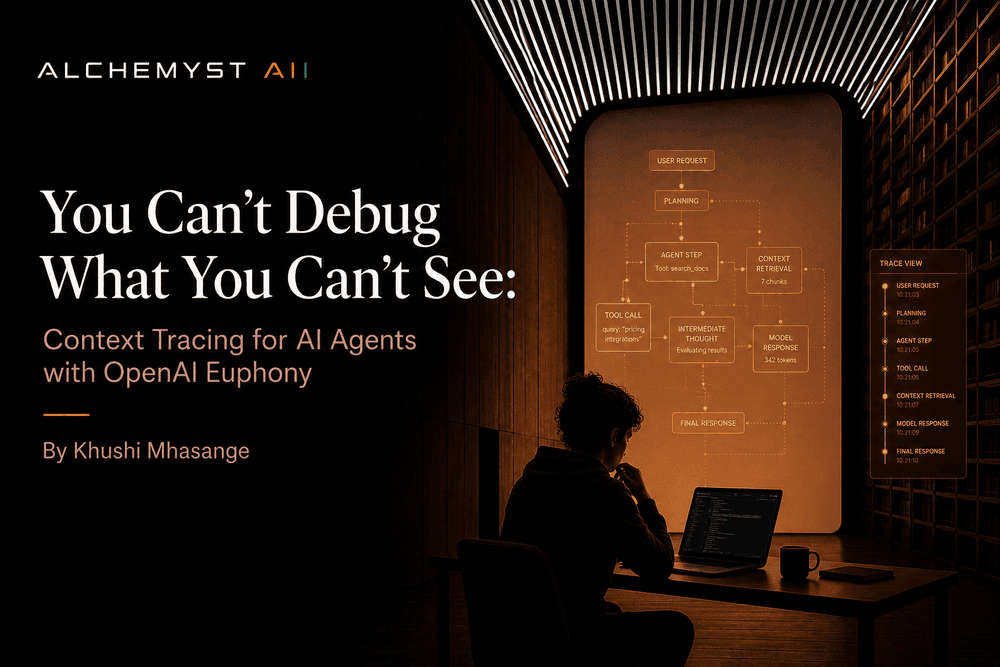TechnicalYou Can't Debug What You Can't See: Context Tracing for AI Agents with OpenAI EuphonyBuilding an AI agent is the easy part. Debugging one is where teams give up.Khushi Mhasange/May 16, 2026/11 min read](/blog/context-tracing-for-ai-agents-with-openai-euphony)
[TechnicalHow to ACTUALLY set up a "company brain"Everybody wants one. Almost nobody has one.Anuran Roy/May 15, 2026/7 min read](/blog/how-to-actually-set-up-a-company-brain)
[Deep TechnicalArchitecting Enterprise AI Voice OS with Real-Time CRM DataBlueprint for enterprise AI Voice OS integration with real-time CRM data.Harsh Shah/May 15, 2026/12 min read](/blog/enterprise-ai-voice-os-real-time-crm-integration)
[I'm EvaluatingAI Voice Agent Pricing Model Per Qualified Outcome ExplainedStop overpaying. Learn the per qualified outcome pricing model for AI voice.Harsh Shah/April 23, 2026/12 min read](/blog/ai-voice-agent-pricing-model-per-qualified-outcome)
[I'm EvaluatingCompare AI voice agent platforms by context handling capabilitiesCompare top AI voice agent platforms by their context handling capabilities.Harsh Shah/April 23, 2026/9 min read](/blog/compare-ai-voice-agent-platforms-context-handling-capabilities)
[Deep TechnicalAI Context Engine API Documentation for DevelopersComprehensive AI context engine API documentation with endpoints and schemas.Harsh Shah/April 23, 2026/13 min read](/blog/ai-context-engine-api-documentation-for-developers)
[It's Not WorkingAI Voice OS Migration Blueprint and ROI Calculation for BusinessesStep-by-step AI Voice OS migration blueprint and precise ROI calculator guide.Harsh Shah/April 23, 2026/10 min read](/blog/ai-voice-os-migration-blueprint-and-roi-calculation-for-businesses)
[I'm EvaluatingEnterprise AI Agent Infrastructure: Bridging the Deployment GapArchitectural blueprint to move AI agents from demo to enterprise deployment.Harsh Shah/April 23, 2026/9 min read](/blog/enterprise-ai-agent-infrastructure-demo-to-deployment-gap)
[I Don't Trust ThisWhat Is An AI Context Layer For Enterprise Voice Agents?Learn how AI context layers power real-time enterprise voice agents and ROI.Harsh Shah/April 23, 2026/11 min read](/blog/ai-context-layer-enterprise-voice-agents)
[TechnicalImplement Context Engineering for Conversational AIA developer guide to context engineering architectures for voice and chat AI.Harsh Shah/April 17, 2026/9 min read](/blog/implement-context-engineering-conversational-ai)
[I Don't Trust ThisMultilingual AI Voice OS for High Volume InteractionsBlueprint for deploying multilingual AI voice OS for high volume interactions.Harsh Shah/April 14, 2026/12 min read](/blog/multilingual-ai-voice-os-high-volume-interactions)
[I'm EvaluatingArchitecting Enterprise AI Voice Platforms with Real-Time CRM DataGuide to enterprise AI voice platforms with real-time CRM data integration.Harsh Shah/April 2, 2026/10 min read](/blog/enterprise-ai-voice-platform-real-time-crm-integration)
[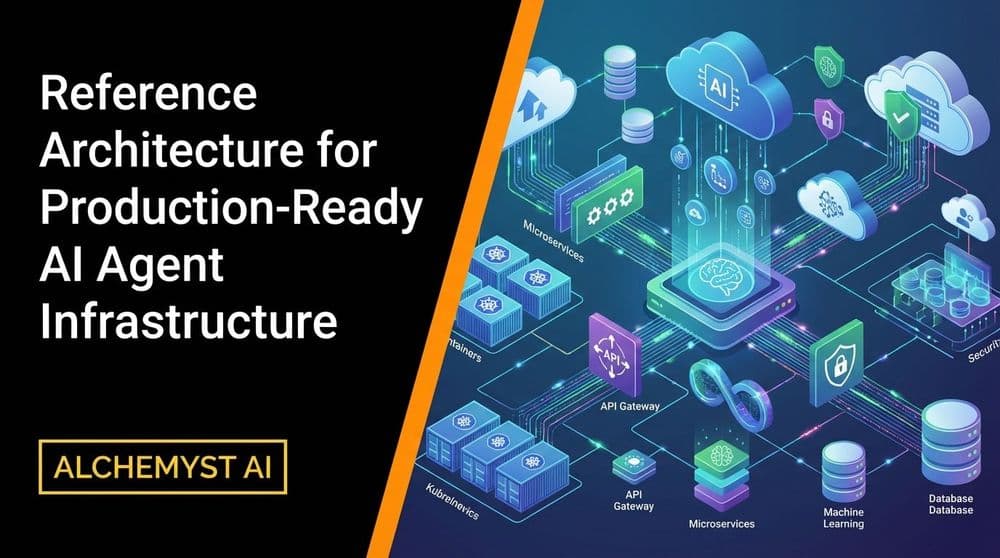I'm EvaluatingReference Architecture for Production-Ready AI Agent InfrastructureBuild production-ready AI agent infrastructure with this reference architecture.Harsh Shah/April 2, 2026/10 min read](/blog/reference-architecture-production-ready-ai-agent-infrastructure)
[I Don't Trust ThisVoice AI Failed You in 2024\. What Changed.Three structural shifts — LLM quality, telephony infrastructure, and context ...Anuran Roy/March 27, 2026/5 min read](/blog/voice-ai-what-changed)
[I Don't Trust ThisIVR → Chatbot → Voice AI: Why Each Generation Solved the Wrong ProblemIVR solved routing. Chatbots solved availability. Voice AI solved naturalness...Anuran Roy/March 27, 2026/7 min read](/blog/ivr-chatbot-voice-ai-evolution)
[Deep TechnicalContext Arithmetic for Voice: A Technical PrimerHow the Context Engine computes what your voice agent should know at call tim...Anuran Roy/March 27, 2026/8 min read](/blog/context-arithmetic-technical)
[It's Not Working6 Reasons Your Voice AI Sounds Robotic (And Only 1 Is About the Voice)TTS quality is reason #6\. The first five are all about missing context.Anuran Roy/March 27, 2026/5 min read](/blog/voice-ai-sounds-robotic)
[I'm Evaluating"Best Voice AI in India" Lists Won't Help You. Ask These 7 Questions Instead.Every listicle ranks the author's own product at #1\. Here are the questions t...Anuran Roy/March 27, 2026/6 min read](/blog/best-voice-ai-india-questions)
[I Don't Trust This"AI Will Replace My Call Center" Is the Wrong Frame. Read This Instead.AI voice agents eliminate the worst parts of call center work and free human ...Anuran Roy/March 27, 2026/5 min read](/blog/ai-replace-call-center)
[It's Not WorkingYour NPS Survey Has a 12% Response Rate. Voice Fixes That.Email surveys get a number. Voice AI gets the reason behind the number — at 3...Anuran Roy/March 27, 2026/5 min read](/blog/nps-survey-response-rate)
[It's Not WorkingYou Spent ₹3 Lakh on Voice AI and Got 200 Leads. Where Did the Money Go?A forensic breakdown of why most voice AI budgets underperform — and how cont...Anuran Roy/March 27, 2026/5 min read](/blog/voice-ai-budget-waste)
[It's Not WorkingYour Voice AI ROI Is Negative Because Your Agent Has AmnesiaWhen your AI agent starts every call from zero, it wastes time re-establishin...Anuran Roy/March 27, 2026/5 min read](/blog/voice-ai-roi-negative)
[It's Not WorkingWhy Your Voice AI Connection Rates Are Stuck at 15%Most outbound voice AI campaigns in India connect on 8-15% of dials. The root...Anuran Roy/March 27, 2026/6 min read](/blog/voice-ai-connection-rates)
[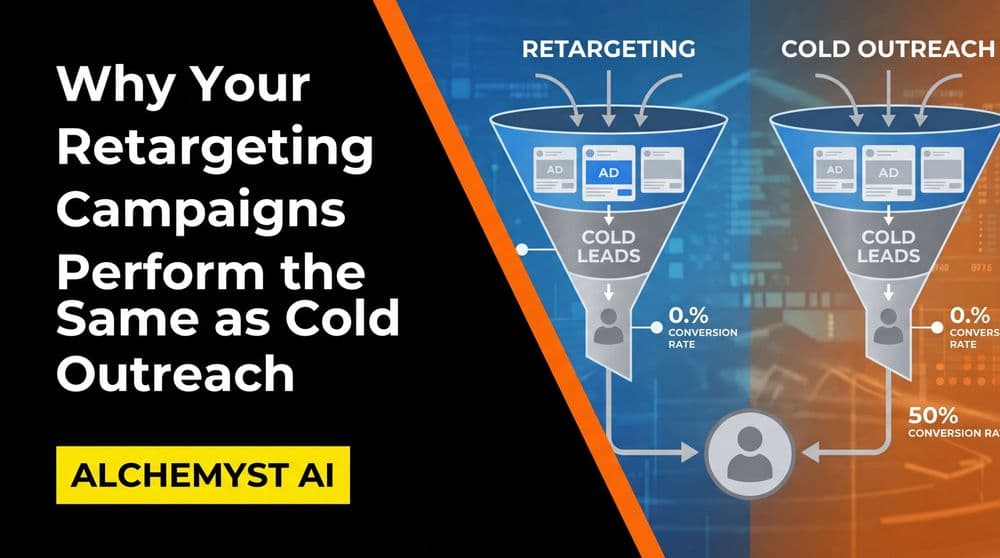It's Not WorkingWhy Your Retargeting Campaigns Perform the Same as Cold OutreachIf your voice AI agent doesn't use what it learned from the first call, retar...Anuran Roy/March 27, 2026/4 min read](/blog/retargeting-same-as-cold)
[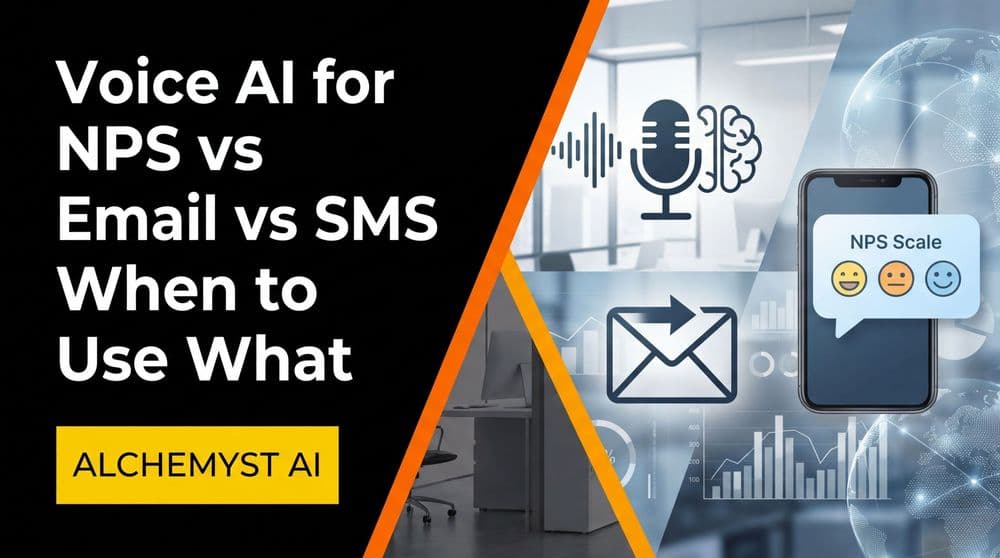I'm EvaluatingVoice AI for NPS vs. Email vs. SMS: When to Use WhatA neutral comparison of NPS collection channels — response rates, cost per re...Anuran Roy/March 27, 2026/6 min read](/blog/voice-ai-nps-vs-email-sms)
[I'm EvaluatingVoice AI Pricing in India Doesn't Tell You What You'll Actually PayPer minute, per credit, per outcome — none of these pricing models capture th...Anuran Roy/March 27, 2026/5 min read](/blog/voice-ai-pricing-india)
[I Don't Trust ThisTwo EdTech Deployments, 45,000 Calls, One PatternJK Shah Classes and Unacademy ran different use cases at different price poin...Anuran Roy/March 27, 2026/6 min read](/blog/two-edtech-deployments-one-pattern)
[It's Not WorkingYour Feedback Loop Is 3 Weeks Long. Here's How to Close It in 3 Days.Voice AI compresses the NPS collection cycle from weeks to days — because fee...Anuran Roy/March 27, 2026/6 min read](/blog/feedback-loop-speed)
[I'm EvaluatingYou Don't Need the "Best" Voice AI. You Need the Right Context Layer.A 300ms voice agent with good context outperforms a 100ms agent with none — b...Anuran Roy/March 27, 2026/5 min read](/blog/right-context-layer)
[Non-technicalMultilingual AI Voice OS for High Volume Customer InteractionsScale global support with a context-driven multilingual AI voice OS.Harsh Shah/March 27, 2026/9 min read](/blog/multilingual-ai-voice-os-high-volume-customer-interactions)
[Non-technicalAlchemyst at 2026 - the year aheadA raw, unfiltered (maybe random) stream of thoughts on behalf of our team.Anuran Roy/January 20, 2026/6 min read](/blog/alchemyst-2026-the-year-ahead)
[Non-technicalThe Road to AGI: Broken promises, Hallucinations, Memory, RAG and ContextRAG, Memory and now context engineering. We’ve been doing them wrong all along.Kapilansh Patil/January 20, 2026/10 min read](/blog/the-road-to-agi-broken-promises-hallucinations-memory-rag-context)
[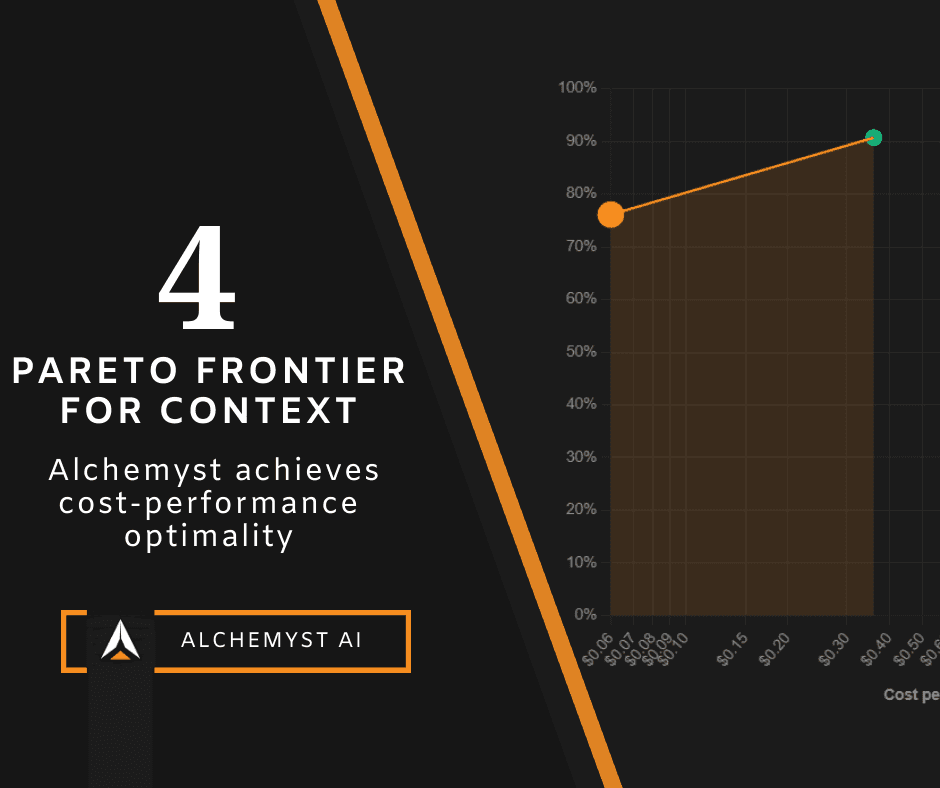TechnicalThe Pareto Frontier for Context: Alchemyst achieves cost-performance optimalityAI Context has a unit economics problem. Alchemyst fixes that.Rishit Murarka/January 20, 2026/13 min read](/blog/alchemyst-achieves-cost-performance-pareto-optimality)
[Non-technicalIntroducing the Alchemyst Chrome ExtensionNow you can carry AI context across all AI tools, or share it with others?Khushi Mhasange/January 20, 2026/6 min read](/blog/introducing-alchemyst-chrome-extension)
[TechnicalContext Is Everything: The Science of Embeddings in LLMsHow context embeddings give LLMs true understanding of language.Rishit Murarka/January 20, 2026/3 min read](/blog/context-embeddings-in-llms)
---
# How to Build a RAG Pipeline for Personal Documents and Media
- **URL:** https://getalchemystai.com/blog/rag-pipeline-personal-documents-media
- **Slug:** rag-pipeline-personal-documents-media
- **Published:** October 6, 2026
- **Last updated:** October 6, 2026
- **Author:** Khushi Mhasange
# How to Build a RAG Pipeline for Personal Documents and Media
Build a multi-modal RAG pipeline for all personal documents and media assets.
Written by [Khushi Mhasange](/blog?author=Khushi%20Mhasange)Reviewed by [Anuran Roy](/blog?author=Anuran%20Roy)10 min readPublished at October 6, 2026 (1w ago)

## Summary
Discover how to construct a robust Retrieval-Augmented Generation pipeline that processes both text and diverse media files. Learn practical steps to integrate multi-modal AI into your personal knowledge workflows seamlessly.
Table of Contents
## The Evolution of Personal Knowledge Management
In the digital age, our lives are scattered across thousands of disconnected files. From PDF bank statements, research papers, and Kindle highlights to voice memos, podcast recordings, and saved screenshots, our personal data footprint is massive. Traditional search mechanisms are rigid, relying on exact keyword matches and specific file structures. However, the emergence of Large Language Models (LLMs) has fundamentally changed how we interact with information. By leveraging a Retrieval-Augmented Generation (RAG) pipeline, you can effectively build a "personal AI brain" capable of understanding, retrieving, and synthesizing your unique digital history.
While standard RAG implementations have become common for querying text documents, a significant gap remains in how we handle complex unstructured data. Most tutorials focus exclusively on text files like PDFs or Markdown notes. Yet, a true personal knowledge management system must accommodate a multi-modal reality. A comprehensive RAG pipeline for personal documents and media must seamlessly integrate images, audio files, and video recordings, allowing you to ask your AI questions like, "What was that idea I recorded in a voice memo last week?" or "Summarize the whiteboard diagram I photographed yesterday."
## What is a Multi-Modal RAG Pipeline?
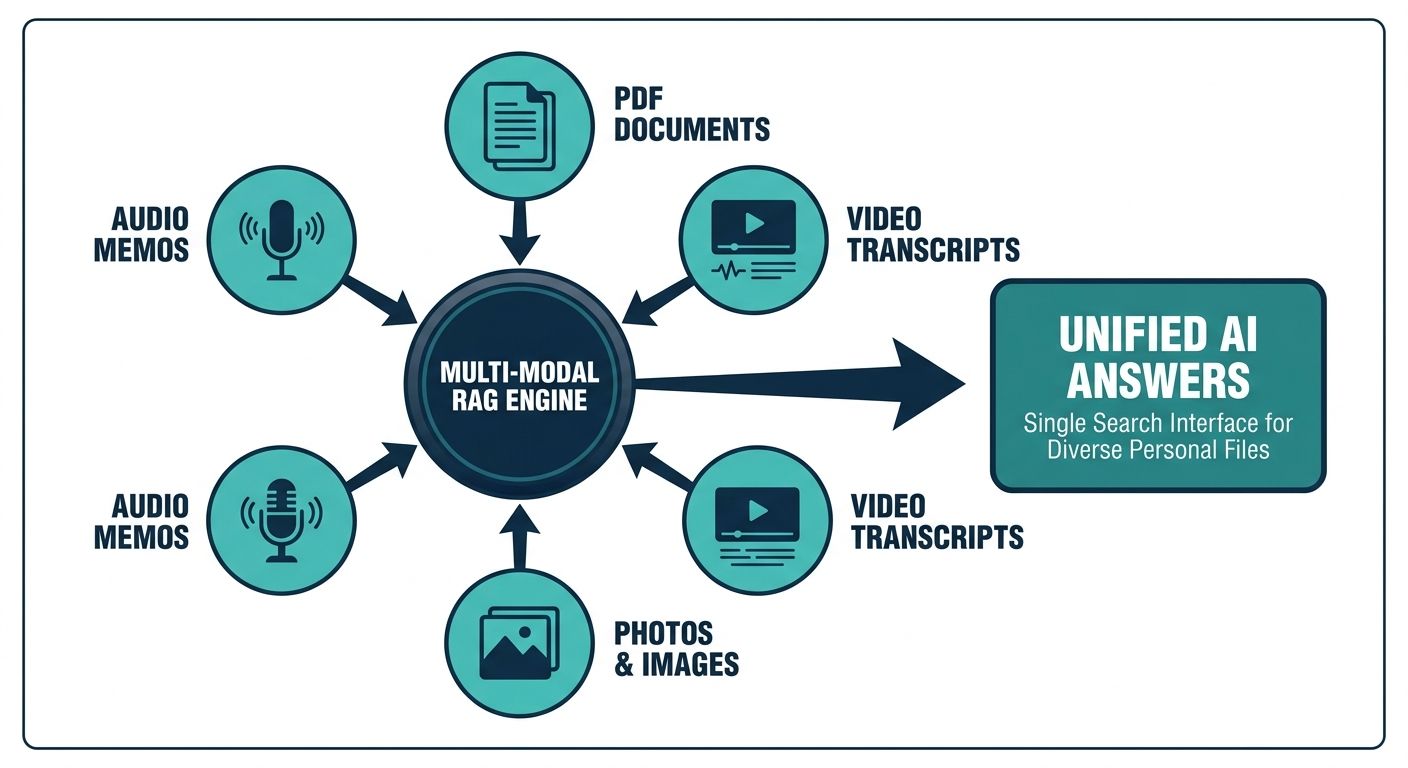
This concept map illustrates how multi-modal RAG combines text, audio, and visual files into a single searchable knowledge base, allowing you to query all your memories at once.
Retrieval-Augmented Generation is an AI architecture that enhances the capabilities of an LLM by grounding it in a specific, external knowledge base. When you prompt a standard RAG system, it first searches your vector database for relevant information, retrieves the matching context, and feeds that context to the LLM alongside your original query. This ensures the AI's response is accurate, highly contextualized, and based entirely on your private data.
A _multi-modal_ RAG pipeline takes this architecture several steps further. Instead of solely relying on text embedding models, it utilizes advanced data processing workflows to extract meaning from diverse media formats. This involves routing different file types through specialized ingestion layers. Audio files are passed through speech-to-text transcription models; images and videos are processed using Optical Character Recognition (OCR) and computer vision models like CLIP (Contrastive Language-Image Pretraining) to generate image embeddings or text descriptions. Once processed, these diverse media types are unified into a single, searchable semantic space.
## Overcoming the Content Gap: Integrating Media into RAG
If you look at the current landscape of AI tools and tutorials, the vast majority overlook the practical integration of diverse media. This leaves users struggling to consolidate their holistic digital footprint. Integrating media requires specialized ingestion techniques and a robust context management system to ensure that the nuanced meaning of a video lecture or a hastily spoken voice note is not lost during the embedding process.
### Processing Audio and Video Files
Audio and video are incredibly rich in context but are notoriously difficult to index. To include these formats in your RAG pipeline, you must implement an Automatic Speech Recognition (ASR) layer. Open-source models like OpenAI's Whisper are excellent for transcribing personal voice notes, saved Zoom meetings, and downloaded podcast episodes. Once the audio is transcribed into text, it can be chunked, embedded, and stored in your vector database just like a standard document.
However, running these models locally can be resource-intensive. When processing long-form audio or managing large volumes of enterprise or personal media, relying on specialized platforms can drastically reduce overhead. For instance, an AI-Native Context Management platform like [Alchemyst AI](https://getalchemystai.com) provides scalable infrastructure that excels at managing unstructured data, offering a streamlined way to orchestrate complex context across diverse applications.
### Handling Images and Scanned Documents
Visual data, such as infographics, scanned receipts, handwritten notes, and photographs of presentation slides, requires a different approach. You have two primary methods for integrating visual media into a RAG pipeline:
* **Text Extraction (OCR & VLM):** Using Optical Character Recognition (like Tesseract) or Vision-Language Models (like GPT-4V or LLaVA), you can generate a rich text description of the image. This text is then embedded and stored in the vector database. When a user queries the system, it retrieves the text description, which points back to the original image file.
* **Multi-Modal Embeddings:** Using models like CLIP, you can map both text and images into the exact same vector space. This allows you to search for images using natural language queries without ever having to generate text descriptions for the images themselves.
## Core Components of a Personal RAG Architecture
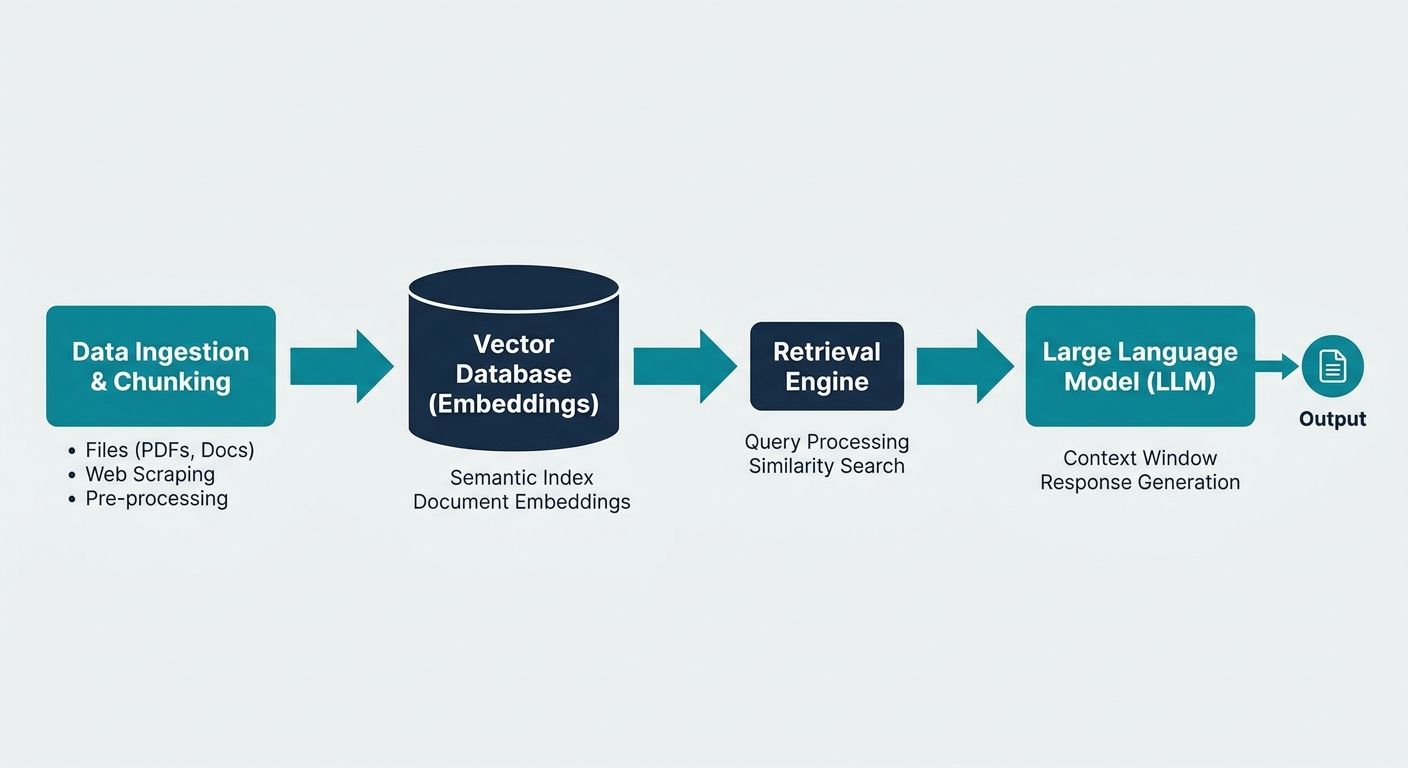
Understanding the underlying architecture, from data chunking to the vector database and LLM, is crucial for configuring a personal AI that retrieves information accurately.
Building a RAG pipeline for personal documents and media requires orchestrating several moving parts. Below is a breakdown of the core architectural components necessary for a robust, multi-modal system.
### Data Ingestion & Custom Connectors
Your personal data doesn't live in one place. It resides in Google Drive, Notion, local folders, Apple Notes, and cloud storage. The first step is establishing custom connectors that can periodically sync this data. Frameworks like LlamaIndex and LangChain offer extensive data loaders that can connect to these APIs and pull in raw data, whether it is an MP3 file from a designated folder or a deeply nested Notion page.
For individuals and businesses looking to automate this ingestion process without managing complex scripts, Alchemyst AI features powerful custom connectors and AI-powered transcription capabilities built natively into its tiered plans. Its context management engine automatically handles complex unstructured data—transcribing audio, summarizing lengthy media files, and maintaining persistent memory—so you can seamlessly retrieve insights from your personal media library.
### Data Processing and Chunking Strategies
Once the data is ingested, it must be "chunked" into smaller, digestible pieces before embedding. If you embed an entire 100-page PDF or a 2-hour podcast transcript as a single vector, the semantic meaning becomes diluted, and the retrieval accuracy plummets. Chunking strategies must be tailored to the media type:
* **Text Documents:** Use recursive character splitting, ensuring a slight overlap between chunks so context isn't lost at the boundaries.
* **Transcribed Audio:** Chunking by timestamps or speaker diarization is highly effective. This allows the AI to reference the exact minute a particular topic was discussed.
* **Code Files:** Use AST (Abstract Syntax Tree) parsing to chunk code by functions and classes rather than arbitrary character counts.
### Embedding Models for Multi-Modal Data
The embedding model is the heart of your semantic search. It translates human-readable content into high-dimensional numerical vectors. For text, models like OpenAI's _text-embedding-3-small_ or open-source alternatives like _nomic-embed-text_ are highly efficient. If you are building a truly multi-modal pipeline where images and text share the same vector space, you will need models designed for multi-modality, ensuring that the semantic relationship between a picture of a dog and the word "dog" is captured mathematically.
### Vector Databases and Context Management
The vector database stores your embeddings and facilitates lightning-fast cosine similarity searches. Open-source options like ChromaDB, Qdrant, and Milvus are excellent for local setups. However, a vector database alone is not enough for an intelligent personal assistant; you also need a Context Management layer. This layer tracks conversation history, user preferences, and temporal relationships between documents. It ensures that if you ask, "What did I say about this in my previous note?" the system has the architectural memory to understand the reference.
## Step-by-Step Guide to Building Your Personal AI Brain
Ready to build? Here is a practical, step-by-step methodology for constructing your multi-modal RAG pipeline.
### Step 1: Centralizing and Sanitizing Data
Begin by identifying your primary data sources. Create an automated sync script (using Python and Cron jobs) that pulls data from your cloud storage and local directories into a central staging folder. Categorize this data into `/text`, `/audio`, `/video`, and `/images` to simplify the processing pipeline.
### Step 2: Processing Media into Text-Searchable Formats
Write an ETL (Extract, Transform, Load) script that iterates through your staging folders. For the `/audio` and `/video` folders, route the files through a transcription model. You can utilize an API service to handle this transcription if local compute is an issue. Ensure that the output retains metadata, such as file creation date, source location, and file type, as this metadata is crucial for advanced filtering later.
### Step 3: Generating Embeddings
Pass your processed text (both original documents and transcribed media) through your chosen embedding model. If utilizing LangChain, use the `VectorStore` abstraction to automatically embed your document chunks and load them into a local ChromaDB instance. Ensure you attach the metadata to every chunk before embedding.
### Step 4: Setting up the Retrieval Engine
Implement a retrieval mechanism that goes beyond simple similarity search. Use techniques like _Hybrid Search_, which combines dense vector search (semantic meaning) with sparse keyword search (BM25). This is particularly useful for personal documents where you might be searching for specific names, acronyms, or project codes that traditional vector embeddings might blur.
### Step 5: Crafting the User Interface
The UI is arguably the most overlooked aspect of personal RAG pipelines. Command-line interfaces are impractical for daily use. Build a simple web application using Streamlit or Gradio. Your UI should feature a chat interface for conversational queries, a traditional search bar for direct document retrieval, and a clear display of source citations. When the AI answers a question, it should link back to the exact PDF page, audio timestamp, or image that informed its answer.
## Practical Considerations: UI, Cost, and Privacy
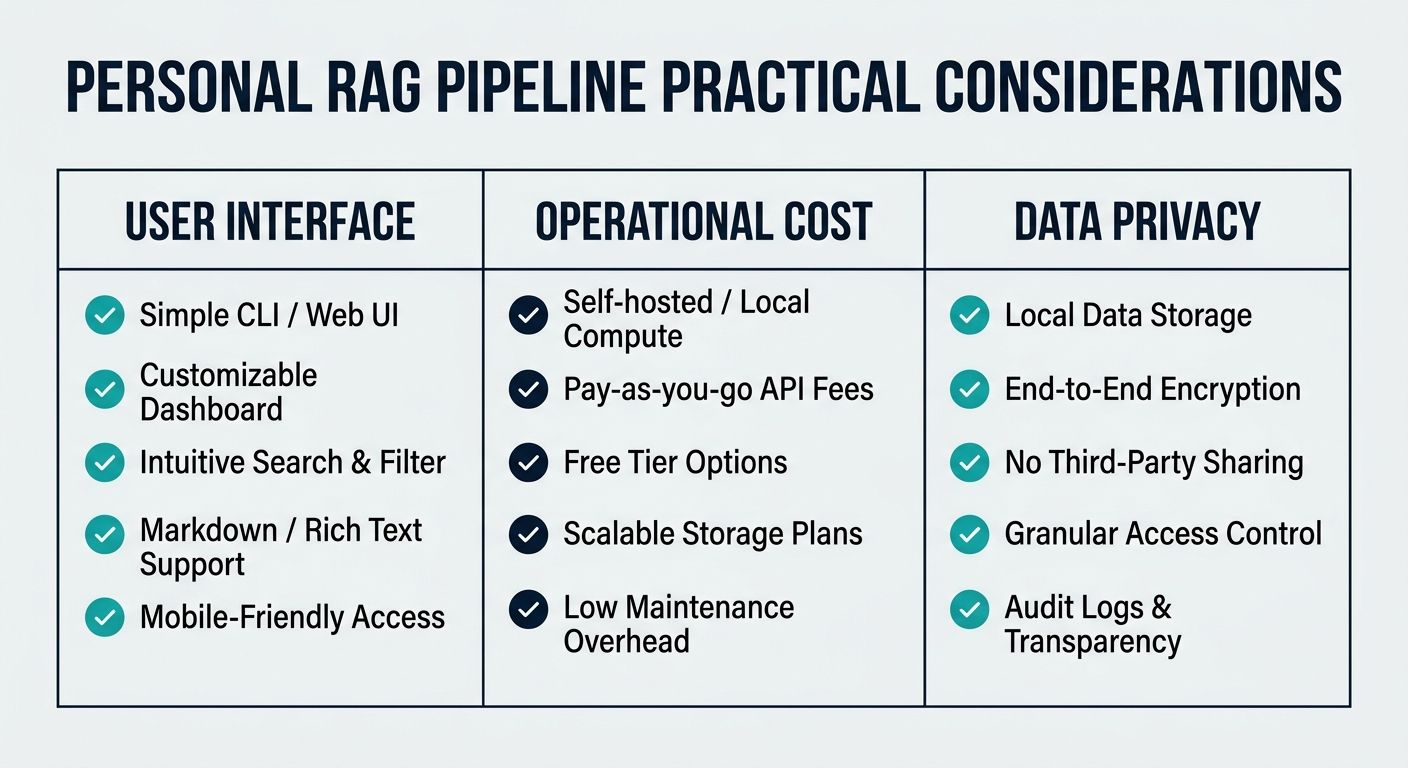
Weighing your interface options, API costs, and local versus cloud privacy trade-offs will help you maintain a sustainable and secure personal RAG setup.
When transitioning from a conceptual pipeline to a daily-use personal assistant, several practical considerations emerge, specifically surrounding user interface, financial cost, and data privacy.
### Cost Implications of Multi-Modal Data
Processing text is incredibly cheap, but media is another story. Running APIs for video transcription and high-resolution image analysis can quickly rack up costs. If building this pipeline on a budget, prioritize open-source models running locally via platforms like Ollama for text generation and local Whisper models for transcription. However, for professionals requiring high-speed processing and minimal maintenance, investing in a tiered SaaS solution that bundles transcription limits and AI summarization can ultimately be more cost-effective than managing a fragmented stack of APIs.
### Data Privacy and Local Execution
Because this pipeline handles personal documents—tax returns, private journals, confidential work emails, and personal voice notes—privacy is paramount. If you choose to use proprietary models like GPT-4, ensure you understand their data retention policies via API usage. For absolute privacy, you can run the entire pipeline locally. Open-source LLMs like Llama-3 or Mistral can be hosted locally, ensuring that your personal data never leaves your machine. This local-first approach is becoming increasingly viable as open-source models match proprietary models in baseline capabilities.
### Designing for Human Interaction
A personal AI brain is only as useful as its interface. The best RAG applications don't just return a text answer; they return a verified, actionable source. If you query your pipeline about a specific business meeting, the UI should not only summarize the meeting but provide an embedded audio player queued to the exact minute the topic was discussed. This multi-modal retrieval experience fundamentally bridges the gap between digital hoarding and true knowledge utilization.
## Conclusion
Building a RAG pipeline for personal documents and media transforms your passive digital files into an active, intelligent collaborator. By moving beyond simple text documents and integrating audio, video, and image processing, you create a comprehensive personal AI brain capable of synthesizing your entire digital footprint. Whether you choose to assemble open-source tools from scratch or leverage advanced context management platforms, the ability to seamlessly query your personal unstructured data is the ultimate competitive advantage in the modern digital era.
Ready to transform your scattered documents, media, and unstructured data into an intelligent, actionable knowledge base? Alchemyst AI offers powerful AI-Native Context Management, automated transcription, and seamless multi-modal integrations designed to elevate your personal and business workflows.
[Learn more about Alchemyst AI](https://getalchemystai.com)
[← Back to Blog](/blog)
## Recently Published
[Technical / September 27, 2026 / 11 min readHarness Engineering for AI Agents: Bridging the GapExplore how harness engineering enables robust AI infrastructure and MLOps.](/blog/harness-engineering-ai-agents)
[I'm Evaluating / September 27, 2026 / 9 min readContext Engineering Best Practices for Enterprise AIMaster advanced context engineering best practices for conversational AI agents.](/blog/context-engineering-best-practices)
[I'm Evaluating / September 22, 2026 / 11 min readContext Engineering vs Prompt Engineering for AI AgentsExplore the differences between context and prompt engineering for enterprise AI](/blog/context-engineering-vs-prompt-engineering)
[I'm Evaluating / September 14, 2026 / 10 min readContext Engineering for Enterprise AI: A Complete GuideMaster context engineering to build reliable, production-ready voice AI agents.](/blog/context-engineering-enterprise-ai)
[Deep Technical / July 7, 2026 / 10 min readVoice-Specific Architectural Requirements for AI Context LayersDiscover the core voice-specific architectural requirements for AI context layer](/blog/voice-specific-architectural-requirements-ai-context-layer)
[Deep Technical / June 15, 2026 / 10 min readAI Context Extraction From Unstructured Data Types: A Complete GuideMaster AI context extraction from unstructured data types to build robust RAG sy](/blog/ai-context-extraction-from-unstructured-data-types)
Get Started
## Give your AI agents the memory they deserve.
Join developers building the next generation of AI products with persistent, auditable context. Free tier available. No credit card required.
* Free tier
* REST + Python & Node SDKs
* 99.9% uptime SLA
* SOC 2 in progress
### Request API Access
Enter your email and we'll set up your workspace.
Email
[Read the Docs →](https://docs.getalchemystai.com)[Read the Thesis →](/thesis)
---
# Harness Engineering for AI Agents: Bridging the Gap
- **URL:** https://getalchemystai.com/blog/harness-engineering-ai-agents
- **Slug:** harness-engineering-ai-agents
- **Published:** September 27, 2026
- **Last updated:** September 27, 2026
- **Author:** Vedanta Banerjee
- **Category:** Technical
[Technical](/blog?category=technical)
# Harness Engineering for AI Agents: Bridging the Gap
Explore how harness engineering enables robust AI infrastructure and MLOps.
Written by [Vedanta Banerjee](/blog?author=Vedanta%20Banerjee)Reviewed by [Anuran Roy](/blog?author=Anuran%20Roy)11 min readPublished at September 27, 2026 (2w ago)

## Summary
Harness engineering is critical for deploying scalable AI applications and bridging the demo-to-production gap. This comprehensive guide explores the architectural principles of test harnesses, context management, and MLOps for modern enterprises.
Table of Contents
## Introduction to Harness Engineering in the AI Era
In traditional software development, harness engineering refers to the creation of a software test harness—a collection of software and test data configured to systematically test a program unit by running it under varying conditions and monitoring its behavior. It acts as the protective and structural framework that ensures code operates reliably before it ever reaches a production environment. However, as enterprises rapidly adopt artificial intelligence, generative models, and autonomous agents, the definition and scope of harness engineering have fundamentally evolved.
Today, harness engineering is no longer just about asserting that a function returns a specific boolean value. It is about orchestrating complex MLOps pipelines, managing non-deterministic outputs from Large Language Models (LLMs), and ensuring that multi-modal data is properly ingested and processed. The shift from static code validation to dynamic AI behavior validation represents one of the most significant architectural leaps in modern software engineering.
When building enterprise-grade AI agents, a robust test harness is the only reliable way to bridge the notorious "demo-to-production gap." While building a proof-of-concept AI chatbot or voice agent can take mere hours, deploying it securely to thousands of users requires a resilient infrastructure. This is where modern harness engineering comes in, providing the necessary boundaries, context management, and semantic validation to ensure AI systems act predictably, safely, and efficiently in real-world scenarios.
## The Anatomy of a Software Test Harness
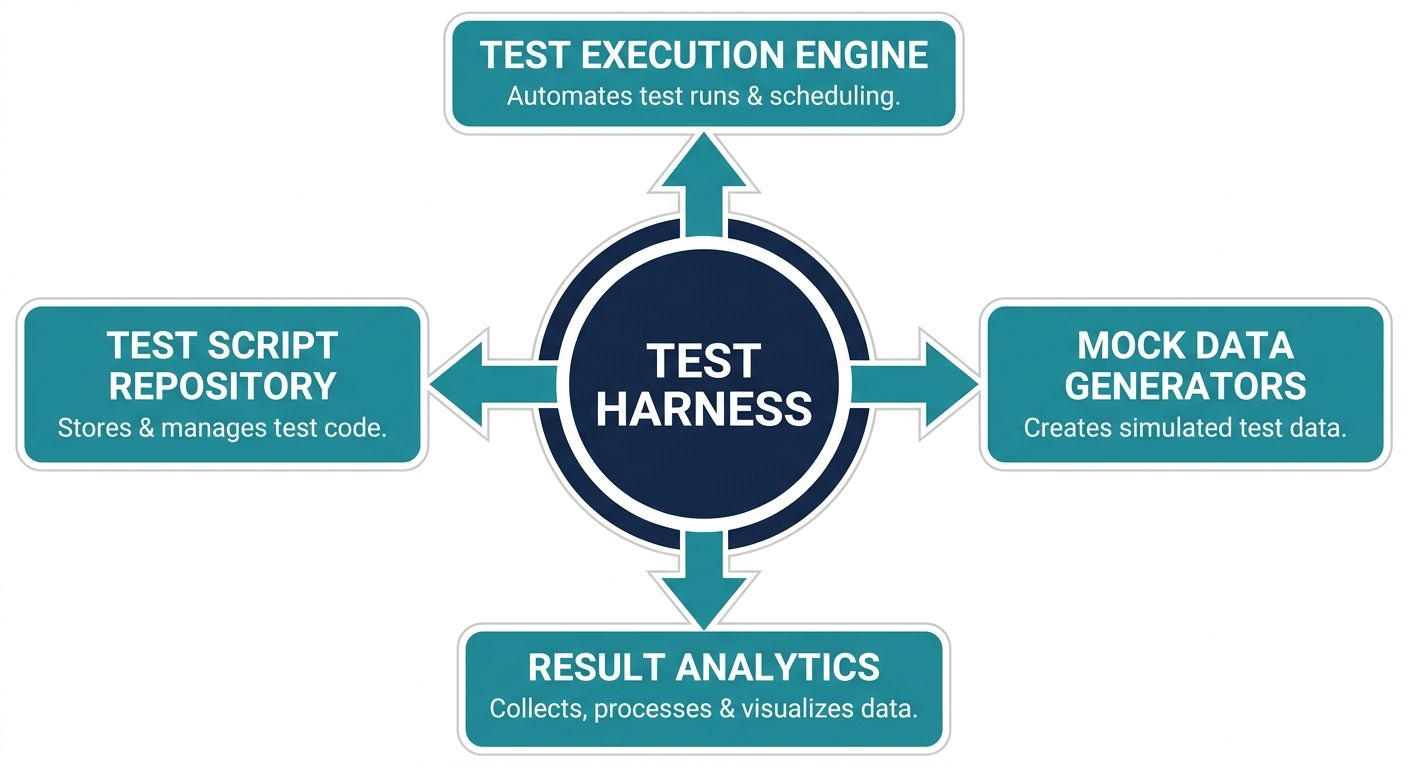
This structural breakdown illustrates the foundational elements of a traditional test harness, helping engineering teams visualise how execution and analytics modules interact.
Before diving into AI-specific challenges, it is essential to understand the foundational anatomy of a software test harness. A traditional harness consists of several interconnected components designed to automate testing and provide actionable feedback to developers.
### The Test Execution Engine
At the core of the harness is the execution engine. This component is responsible for orchestrating the test suites, scheduling runs, and managing the lifecycle of the test environment. It initializes the system state, injects the necessary mock data, executes the target application, and captures the resulting outputs. In high-performance environments, the execution engine must support parallel processing and distributed testing to minimize deployment bottlenecks.
### Test Script Repository and Data Injection
The repository houses all automated test scripts, parameters, and configuration files. Effective harness engineering separates the test logic from the test data. This separation allows engineers to inject diverse datasets into the same test script, verifying how the application handles edge cases, null values, and massive data loads. For AI applications, this data repository becomes increasingly complex, often requiring vectors, embeddings, and complex conversational histories rather than simple tabular data.
### Result Analytics and Reporting
A harness is only as useful as the insights it generates. The reporting module captures logs, traces, and metrics during execution. It compares actual outputs against expected outcomes and flags anomalies. Modern reporting systems integrate directly into Continuous Integration/Continuous Deployment (CI/CD) pipelines, automatically blocking deployments if critical performance thresholds—such as high latency or high error rates—are breached.
## Why AI Demands a New Approach to Harness Engineering
Integrating generative AI into software ecosystems breaks traditional testing methodologies. Unlike deterministic algorithms where input A always equals output B, LLMs are probabilistic. They can generate slightly different, yet technically correct, responses to the exact same prompt. This non-determinism renders standard exact-match assertions useless, necessitating a new era of AI harness engineering.
### Bridging the Demo-to-Production Gap
The current AI landscape is littered with projects that looked incredible in a controlled demo environment but failed catastrophically in production. This "demo-to-production gap" occurs because developers often underestimate the fragility of AI agents. In production, AI systems face prompt injection attacks, context window limits, API latency, and unpredictable user behavior. AI harness engineering addresses these issues by simulating chaotic production environments during the development phase. By actively stressing the system with adversarial prompts and testing the limits of memory infrastructure, engineers can fortify their AI agents before deployment.
### Challenges in Multi-Modal AI and RAG Pipelines
Modern AI is rarely limited to simple text generation. Enterprises are building multi-modal systems that process images, audio, video, and massive document repositories using Retrieval-Augmented Generation (RAG). Harness engineering for RAG pipelines requires validating not just the final output, but the entire retrieval mechanism. The harness must test whether the correct documents were retrieved, whether the semantic search yielded highly relevant chunks, and whether the final generation accurately synthesized that retrieved data without hallucinating.
## Architecting an AI Test Harness for Enterprise MLOps
Building a test harness for AI requires specialized MLOps tooling and a shift in architectural philosophy. The harness must be able to evaluate semantic similarity, maintain conversational context, and mock external API dependencies effectively.
### Mocking External Dependencies and APIs
AI agents often rely on a web of external tools, from CRM systems to payment gateways. During testing, making live API calls can be expensive, slow, and dangerous. A robust AI test harness incorporates advanced mocking frameworks that simulate these external dependencies. This ensures that the agent's decision-making process can be tested in isolation. For instance, if an AI sales agent decides to book a meeting, the harness should intercept that function call, validate the payload, and return a mock success response, all without touching the live calendar API.
### Context Engineering and State Management
One of the most critical and frequently overlooked aspects of AI deployment is context engineering. How does an AI agent remember what happened three turns ago? How does it persist state across multiple sessions? Harness engineering must validate the underlying memory infrastructure. Tests must simulate long-running conversations, abruptly disconnecting and reconnecting sessions to ensure the agent seamlessly picks up where it left off.
To handle the complexities of memory and conversational state, Alchemyst AI provides an industry-leading AI-Native Context Management solution. Featuring advanced summarization limits and customizable enterprise-grade memory architecture, Alchemyst AI ensures that multi-turn interactions remain accurate, coherent, and highly contextual. This built-in memory compression engine empowers developers to build and test context-aware agents without having to engineer complex persistence layers from scratch.
## Core Components of an AI-Ready Harness
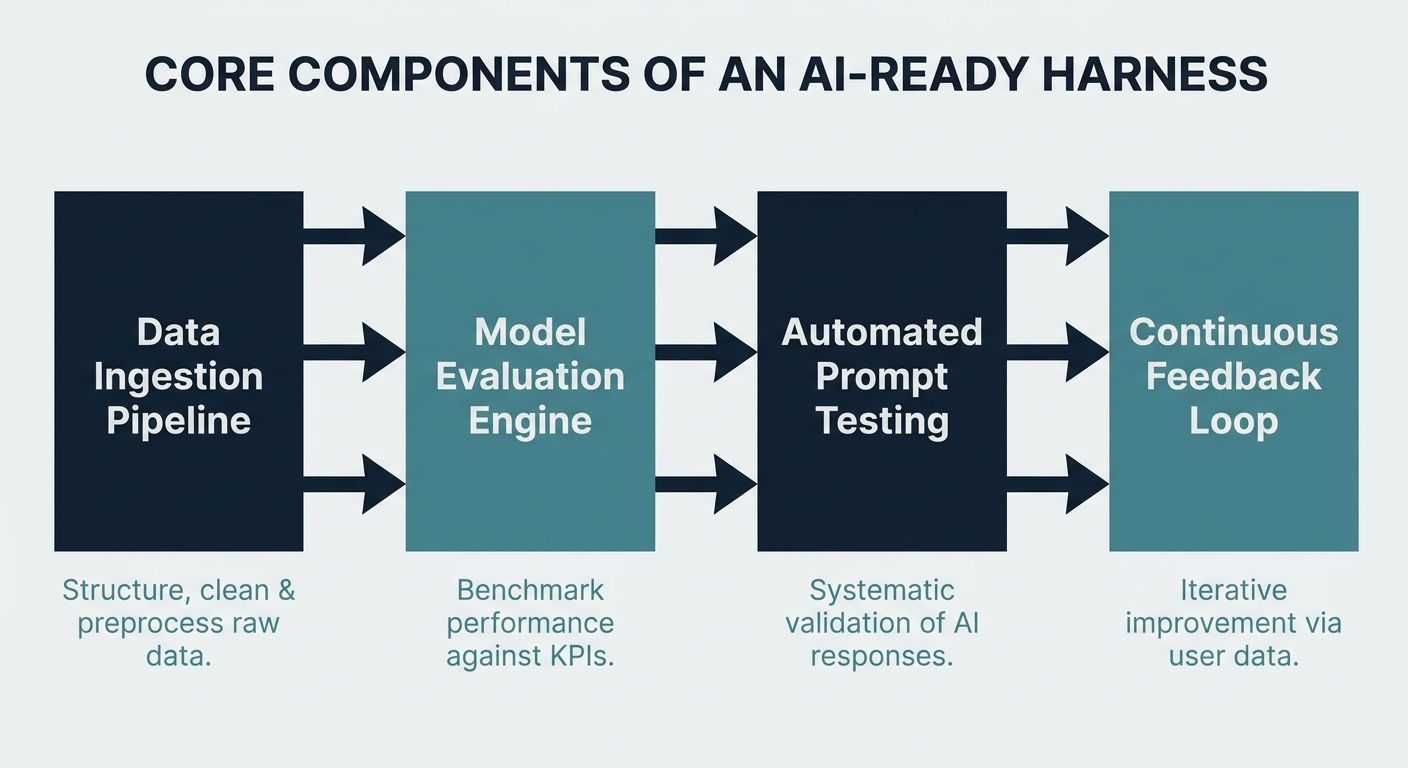
By mapping out the data flow from ingestion to feedback, this flowchart highlights the critical infrastructure components required to safely test and deploy AI agents.
To effectively validate AI systems, the test harness must incorporate several specialized modules designed specifically for machine learning and natural language processing workflows.
### Data Ingestion and Semantic Validation
Because AI outputs are non-deterministic, the harness must use semantic validation rather than string matching. This involves using "evaluator models"—smaller, faster LLMs tasked with judging the output of the primary AI agent. The harness uses these evaluator models to grade responses on metrics like relevance, tone, factual accuracy, and safety. This "LLM-as-a-judge" paradigm is a cornerstone of modern AI harness engineering.
### Memory Infrastructure and Persistence Testing
Evaluating an AI agent's memory requires injecting historical context into the test environment. The harness should simulate a user returning after a week, testing whether the AI successfully accesses its drop-in memory infrastructure to recall previous preferences. The harness must validate both short-term memory (within the active context window) and long-term memory (persisted in vector databases or external storage).
### Continuous Integration and Continuous Deployment (CI/CD) for AI
AI models and prompts are constantly evolving. A highly optimized harness integrates into CI/CD pipelines to facilitate Continuous Evaluation. Every time a prompt is tweaked, a RAG configuration is updated, or a new model weight is deployed, the harness automatically triggers a suite of regression tests. This prevents "prompt drift," where optimizing a prompt for one specific use case accidentally degrades performance in another.
## Overcoming Common Bottlenecks in AI Harness Engineering
Implementing an AI test harness is not without its hurdles. Enterprises face unique bottlenecks when trying to scale these environments, particularly when dealing with real-time voice processing and dynamic resource allocation.
### Handling Conversational Context in Voice AI
Voice AI introduces a layer of complexity far beyond text-based chatbots. Latency is the enemy of voice agents; a delay of even 500 milliseconds can ruin the conversational flow. Harness engineering for voice AI must rigorously test the integration points between Speech-to-Text (STT), the core LLM reasoning engine, and Text-to-Speech (TTS) services. The harness must simulate network degradation, background noise, and user interruptions (barge-in capabilities) to ensure the agent handles real-world audio conditions gracefully.
When deploying these complex architectures, utilizing a platform that inherently understands voice dynamics is essential. Platforms like [Alchemyst AI](https://getalchemystai.com) focus deeply on context handling methodologies, offering the Kathan engine to bridge the gap between underlying LLM reasoning and real-time voice execution. By offloading context management to a specialized platform, engineering teams can focus their harness testing on unique business logic rather than foundational infrastructure.
### Dynamic Scaling and Resource Allocation
Executing hundreds of automated tests against large language models is computationally expensive. API rate limits and GPU availability can quickly bottleneck the testing process. An intelligent test harness mitigates this by utilizing request batching, caching previously generated responses, and dynamically scaling test runners across serverless cloud environments. Cost monitoring is also a crucial feature; the harness must track token usage during testing to prevent development costs from spiraling out of control.
## Harness Engineering for Go-To-Market (GTM) Automation
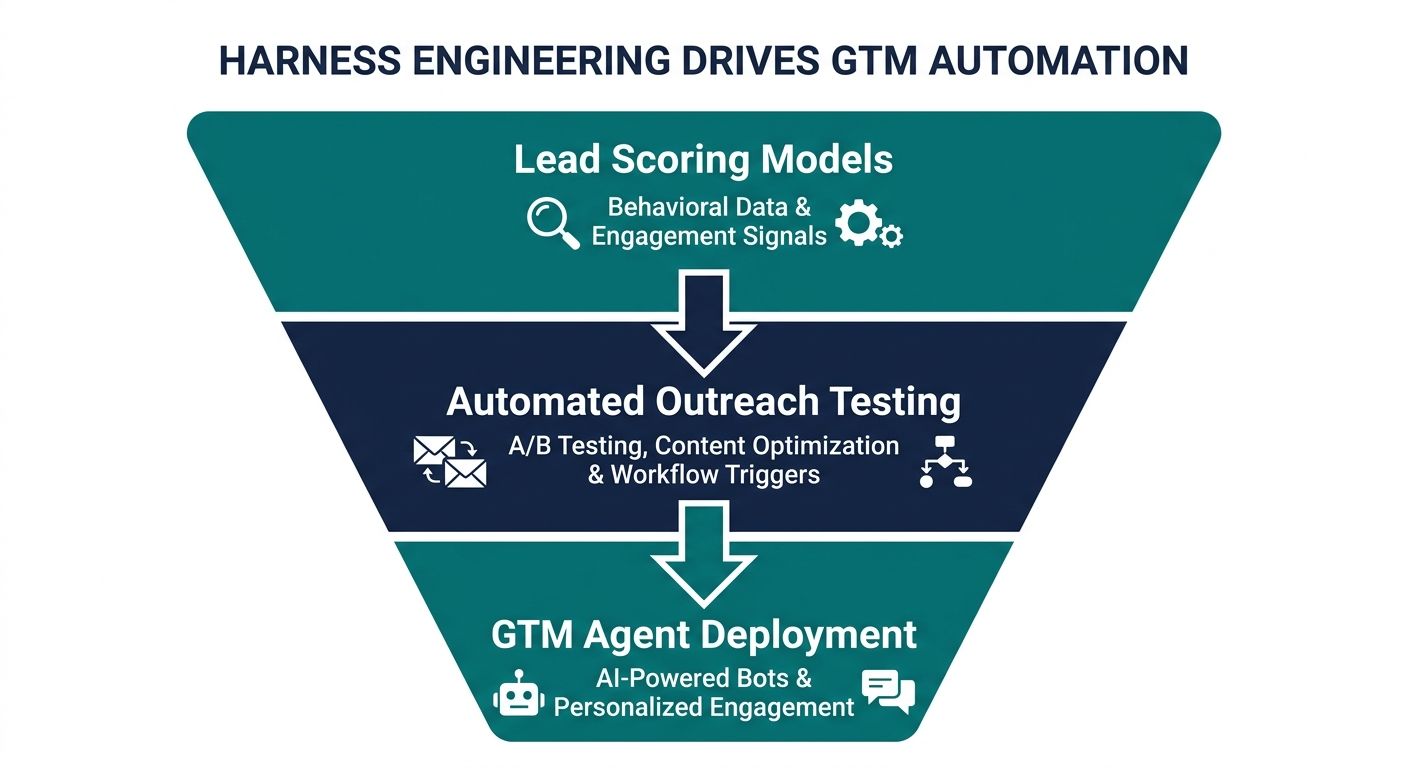
This funnel diagram demonstrates how applying harness engineering to GTM workflows systematically filters and refines automated outreach for higher conversion rates.
The application of AI in Go-To-Market and sales automation requires the highest level of reliability. When AI agents interact directly with prospects, draft outreach emails, or qualify leads, a hallucination can result in lost revenue and brand damage. Harness engineering provides the safety net required to automate these revenue-critical functions.
In GTM automation, test harnesses simulate complex sales funnels. They inject mock lead data, simulate various prospect personas, and evaluate how the AI agent personalizes its outreach. The harness ensures that the agent strictly adheres to the company's brand voice, handles objections correctly, and routes highly qualified leads to human representatives without fail. By rigorously testing these pathways, businesses can confidently deploy AI to scale their sales operations.
## Best Practices for Implementing AI Harnesses
To maximize the return on investment in harness engineering, technical teams should adhere to several industry best practices that promote scalability, maintainability, and security.
### Modular Architecture Design
Design the test harness with modularity in mind. The components responsible for API mocking, prompt management, and semantic validation should be decoupled. This allows teams to swap out underlying models—for example, upgrading from GPT-4 to a newer iteration or switching to an open-source model—without needing to rewrite the entire testing infrastructure.
### Comprehensive Logging and Tracing
When an AI agent fails a test, engineers need to know exactly why. The harness must provide comprehensive tracing of the "chain of thought." It should log the exact user input, the retrieved context from the vector database, the final compiled prompt sent to the LLM, and the raw output. This granular visibility is critical for debugging complex RAG applications.
### Security and Data Privacy Controls
AI test environments often require access to sensitive enterprise data to run realistic tests. Harness engineering must incorporate strict data anonymization and masking protocols. Test data should be synthesized or stripped of Personally Identifiable Information (PII) before being processed by external LLM APIs, ensuring strict compliance with GDPR, SOC2, and other regulatory frameworks.
## The Future of Harness Engineering
As AI agents become more autonomous, the test harnesses designed to evaluate them will also become smarter. We are moving toward an era of self-healing test environments, where the harness itself uses AI to dynamically generate new test cases based on emerging edge cases detected in production. Autonomous agent validation will evolve from static, predefined scripts into dynamic, adversarial "red-teaming" simulations, where a secondary AI actively tries to break the primary AI agent.
Ultimately, harness engineering is the foundation upon which trust in AI is built. Without it, enterprise AI is a gamble. With it, AI becomes a predictable, scalable, and immensely powerful driver of business growth.
Ready to bridge the demo-to-production gap and deploy reliable, context-aware AI agents for your enterprise? Transform your Go-To-Market strategy with robust automation, AI-native memory infrastructure, and unparalleled contextual intelligence.
[Learn more about Alchemyst AI](https://getalchemystai.com)
[← Back to Blog](/blog)
## Recently Published
[October 6, 2026 / 10 min readHow to Build a RAG Pipeline for Personal Documents and MediaBuild a multi-modal RAG pipeline for all personal documents and media assets.](/blog/rag-pipeline-personal-documents-media)
[I'm Evaluating / September 27, 2026 / 9 min readContext Engineering Best Practices for Enterprise AIMaster advanced context engineering best practices for conversational AI agents.](/blog/context-engineering-best-practices)
[I'm Evaluating / September 22, 2026 / 11 min readContext Engineering vs Prompt Engineering for AI AgentsExplore the differences between context and prompt engineering for enterprise AI](/blog/context-engineering-vs-prompt-engineering)
[I'm Evaluating / September 14, 2026 / 10 min readContext Engineering for Enterprise AI: A Complete GuideMaster context engineering to build reliable, production-ready voice AI agents.](/blog/context-engineering-enterprise-ai)
[Deep Technical / July 7, 2026 / 10 min readVoice-Specific Architectural Requirements for AI Context LayersDiscover the core voice-specific architectural requirements for AI context layer](/blog/voice-specific-architectural-requirements-ai-context-layer)
[Deep Technical / June 15, 2026 / 10 min readAI Context Extraction From Unstructured Data Types: A Complete GuideMaster AI context extraction from unstructured data types to build robust RAG sy](/blog/ai-context-extraction-from-unstructured-data-types)
Get Started
## Give your AI agents the memory they deserve.
Join developers building the next generation of AI products with persistent, auditable context. Free tier available. No credit card required.
* Free tier
* REST + Python & Node SDKs
* 99.9% uptime SLA
* SOC 2 in progress
### Request API Access
Enter your email and we'll set up your workspace.
Email
[Read the Docs →](https://docs.getalchemystai.com)[Read the Thesis →](/thesis)
---
# Context Engineering Best Practices for Enterprise AI
- **URL:** https://getalchemystai.com/blog/context-engineering-best-practices
- **Slug:** context-engineering-best-practices
- **Published:** September 27, 2026
- **Last updated:** September 27, 2026
- **Author:** Debayan Pradhan
- **Category:** I'm Evaluating
[I'm Evaluating](/blog?category=im-evaluating)
# Context Engineering Best Practices for Enterprise AI
Master advanced context engineering best practices for conversational AI agents.
Written by [Debayan Pradhan](/blog?author=Debayan%20Pradhan)Reviewed by [Anuran Roy](/blog?author=Anuran%20Roy)9 min readPublished at September 27, 2026 (2w ago)

## Summary
Explore comprehensive context engineering best practices to optimize your conversational AI platforms and voice agents. This guide covers everything from architectural blueprints and handling user interruptions to implementing robust memory retention strategies.
Table of Contents
## The Evolution of Context Engineering in Modern AI
As enterprise artificial intelligence rapidly matures from basic conversational bots into highly sophisticated, multi-agent systems, the rules of engagement have fundamentally shifted. Simple prompt engineering is no longer sufficient to maintain coherent, goal-oriented dialogues in enterprise applications. Enter context engineering - the systematic discipline of structuring, managing, and injecting relevant contextual data into AI models to ensure accurate, consistent, and highly personalized outputs. Understanding and implementing context engineering best practices is now the primary differentiator between clunky chatbots and seamless, human-like voice AI agents.
Context engineering goes beyond merely passing a user's previous message back to a Large Language Model (LLM). For complex Go-To-Market (GTM) and sales automation workflows, context management requires architectural foresight. It involves dynamically assembling semantic memory, retrieving real-time CRM data, prioritizing dialogue states, and pruning redundant tokens to optimize latency and cost. When applied correctly, these context engineering best practices allow conversational AI platforms to handle nuanced human interactions, such as sudden topic shifts, multi-turn ambiguity, and complex problem-solving scenarios.
## Why Traditional Context Management Fails in Conversational AI
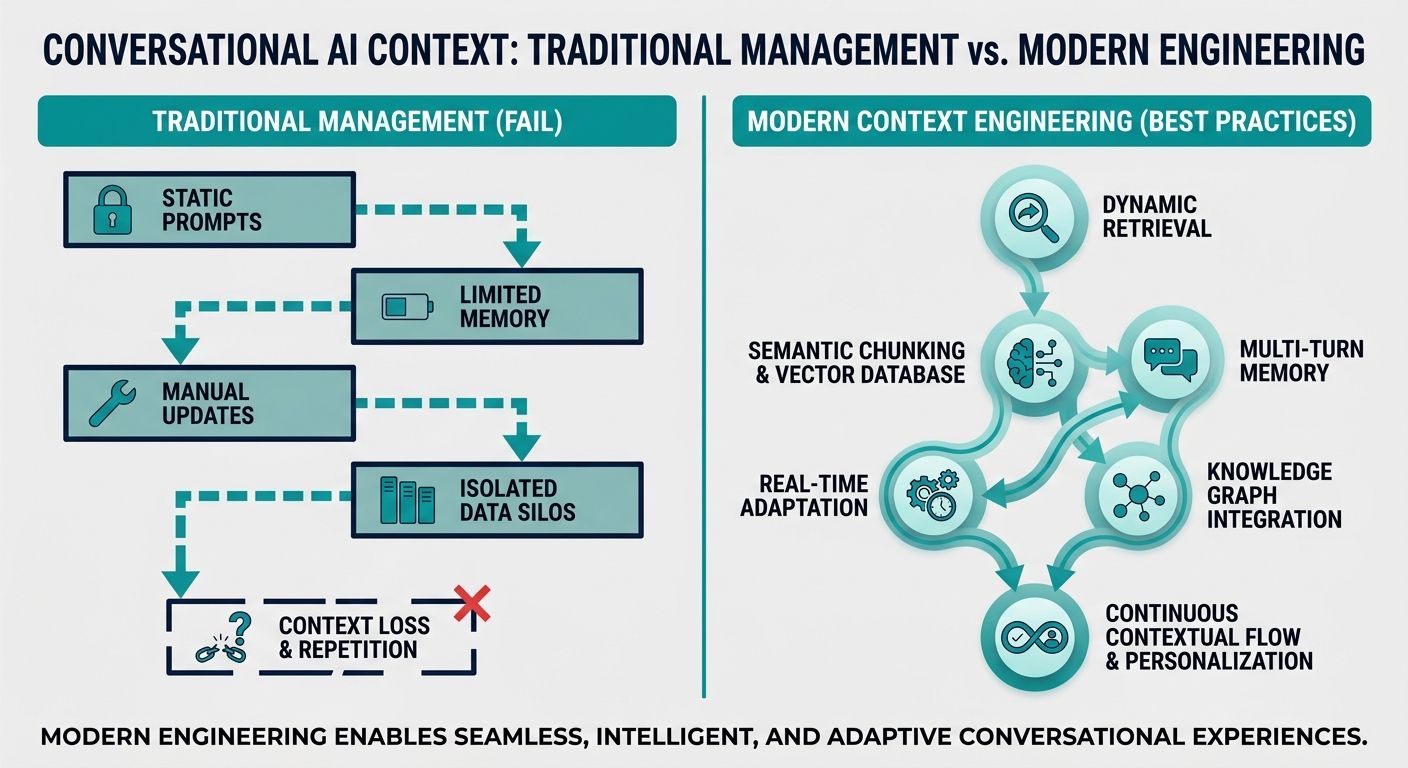
This comparison illustrates the rigid limitations of traditional memory management against the dynamic, interconnected flow of modern context engineering.
Many early AI implementations relied on naive context window stuffing, appending the entire chat history to every API request until the model's token limit was breached. This approach is fundamentally flawed for several reasons. First, it scales terribly in terms of cost. Model inference costs are typically calculated per token; sending thousands of irrelevant tokens for a simple query is an immense waste of enterprise resources. Second, it degrades model performance. Research indicates that LLMs suffer from the "lost in the middle" phenomenon, where they struggle to retrieve accurate information buried deep within a massive context window.
Third, traditional context management completely fails in real-time conversational environments, particularly voice AI. Voice interactions are messy. Users interrupt the AI, use filler words, backtrack on previous statements, or introduce entirely out-of-scope requests. A static array of previous messages cannot represent the true state of a fluid conversation. To solve this, developers must transition from passive history tracking to active context engineering. For instance, leveraging an AI-Native Context Management solution like [Alchemyst AI](https://getalchemystai.com) enables engineering teams to build dynamic, scalable systems that summarize, filter, and inject context precisely when it is needed most.
## Core Context Engineering Best Practices
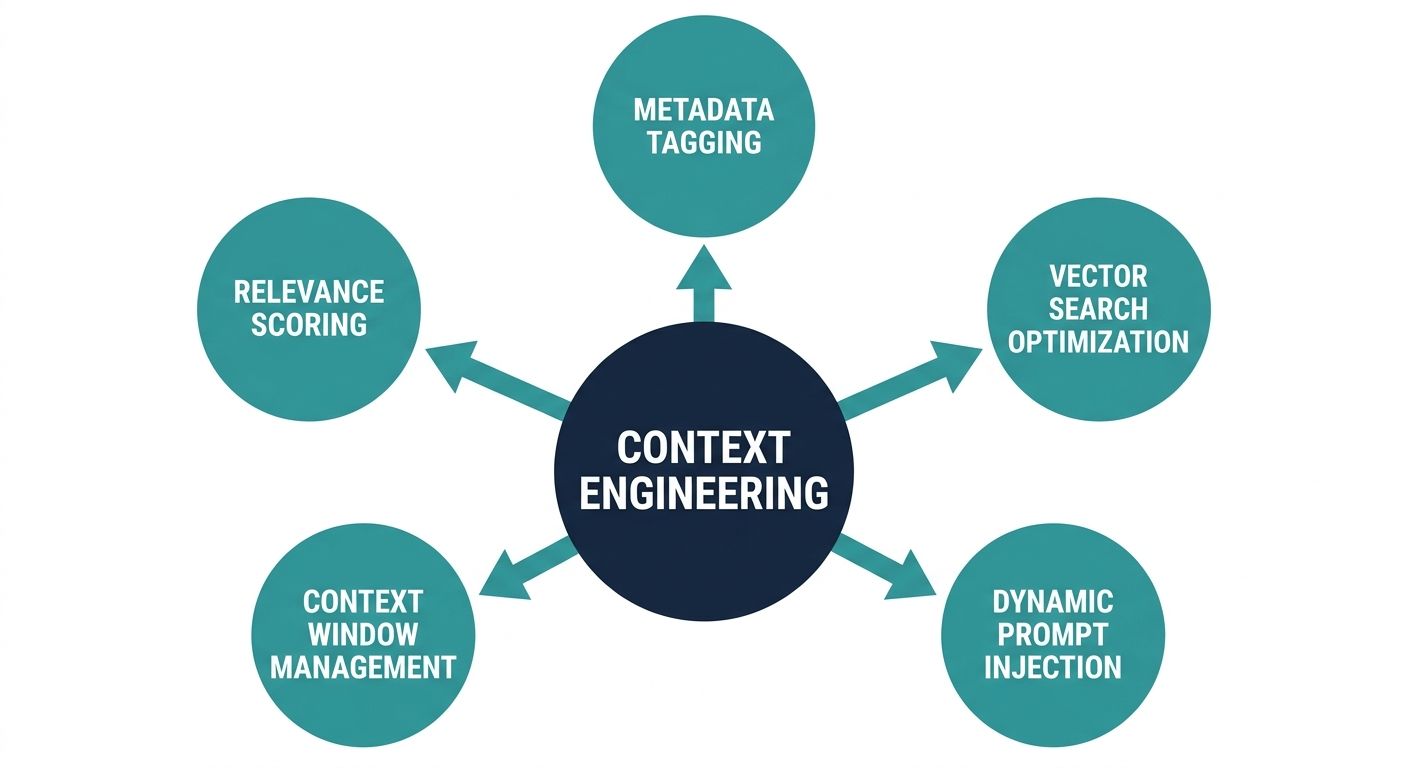
By implementing these core context engineering best practices, enterprise AI systems can maintain high relevance and accuracy across complex user interactions.
### 1\. Implementing Semantic Memory and Retrieval-Augmented Generation (RAG)
To overcome the limitations of finite context windows, conversational AI must decouple its memory from the model's immediate input space. Implementing a robust Retrieval-Augmented Generation (RAG) pipeline is one of the most critical context engineering best practices. Instead of passing the entire dialogue history, the system should chunk past interactions and domain knowledge into semantic vectors, storing them in a high-performance vector database.
When a user issues a new prompt, the context engine queries the vector database for mathematically similar concepts and injects only the top-k most relevant chunks into the prompt. Advanced implementations go a step further by utilizing hybrid search (combining dense vector embeddings with sparse keyword search) and dynamic reranking to ensure that the retrieved context is both contextually relevant and chronologically appropriate. By segregating short-term memory (the last 3-5 conversational turns) from long-term memory (RAG-based semantic retrieval), developers can maintain hyper-focused dialogue context without sacrificing historical awareness.
### 2\. Managing Complex Dialogue Flows and User Interruptions
In real-world enterprise applications, particularly voice AI agents deployed for sales automation or customer support, conversations rarely follow a linear script. Users frequently "barge in" (interrupt the agent mid-sentence), change their minds, or ask sudden tangential questions. Handling these disruptions requires a sophisticated state machine integrated with your context engine.
Best practices dictate that context should be managed as a dynamic state object rather than a flat string. When a user interrupts, the AI must instantly capture the timestamp and semantic intent of the interruption, rollback the unfulfilled portion of its previous response, and update the dialogue state. The context payload should explicitly flag the interruption event so the LLM understands why the conversational flow was broken. Structuring context to include explicit dialogue states (e.g., "Awaiting User Confirmation," "Handling Tangent," "Resolving Objection") empowers the model to navigate interruptions smoothly and guide the user back to the primary GTM objective.
### 3\. Handling Ambiguity and Out-of-Scope Requests
Human conversation is inherently ambiguous. A user might say, "Apply it to the second one," leaving the AI to deduce what "it" and "the second one" refer to. Effective context engineering resolves ambiguity through entity resolution and coreference tracking. Before the final prompt is constructed, a lightweight preprocessing model or logic layer should map pronouns and ambiguous terms to explicitly defined entities stored in the short-term context buffer.
When an out-of-scope request occurs, context engineering dictates how the AI should fallback gracefully. Rather than generating a hallucinated response or abruptly ending the conversation, the context engine should inject a specific "boundary protocol" into the prompt. This protocol instructs the LLM to acknowledge the request, explain its operational boundaries based on its injected persona, and pivot the conversation back to the known context space. This keeps the user engaged while maintaining the guardrails necessary for enterprise AI deployments.
### 4\. Optimizing Context Windows for Cost and Latency
Latency is the enemy of conversational AI. In text-based chat, a three-second delay is annoying; in real-time voice AI, a three-second delay completely shatters the illusion of human interaction. Therefore, optimizing the context window is a mandatory best practice for engineering teams. This involves aggressive token pruning and context summarization.
Instead of retaining verbatim transcripts of long interactions, systems should periodically summarize older turns. When the short-term memory buffer exceeds a predefined threshold (e.g., 1,500 tokens), the context engine triggers a background process to synthesize the dialogue into a condensed summary, which is then stored in the long-term semantic memory. This ensures the active context window remains lean, fast, and cost-effective. This is an area where Alchemyst AI excels by providing seamless contextual alignment and automated transcript distillation.
Through its advanced capabilities, Alchemyst AI offers robust features such as custom AI models and sophisticated AI summarization that automatically distill long-form audio transcripts into structured context. This ensures that context engineering teams can seamlessly manage high-volume sales interactions without hitting token limits, driving unparalleled efficiency for GTM strategies.
## Advanced Architectural Blueprints for Voice AI Agents
### Structuring the Context Payload API
For engineering teams building real-time context layers, the structure of the API payload is paramount. A monolithic string of text is an anti-pattern. Instead, the context engine should construct and deliver a highly structured JSON payload to the LLM. A best-in-class architectural blueprint separates the context into distinct, immutable tiers.
* **System Directives:** The unalterable base prompt defining the agent's persona, constraints, and GTM objectives.
* **Environmental Context:** Real-time metadata such as the user's current location, time of day, device type, and active CRM profile data.
* **Short-Term Memory:** The immediate verbatim history of the last few conversational turns, clearly demarcated by speaker roles (User vs. Agent).
* **Retrieved Context (RAG):** The highly relevant data chunks pulled from the semantic database to answer the specific query at hand.
By enforcing this strict schema, developers guarantee that the LLM weights the instructions appropriately, heavily prioritizing the System Directives while using the Retrieved Context strictly as informational grounding.
### Integration with LangChain and LlamaIndex
When orchestrating these context layers, frameworks like LangChain and LlamaIndex provide excellent scaffolding. Best practices involve utilizing specialized memory modules within these frameworks. For example, rather than using LangChain's basic \`ConversationBufferMemory\`, enterprise teams should implement \`ConversationSummaryBufferMemory\`. This module keeps a buffer of recent interactions in memory, but rather than just flushing old interactions, it compiles them into a rolling summary.
When working with voice AI, this must be coupled with asynchronous retrieval. The moment a user begins speaking, the transcription stream (often using WebSockets) should trigger predictive context retrieval in the background. By the time the user finishes their sentence, the vector database has already fetched the necessary CRM data and injected it into the prompt template, drastically reducing the time-to-first-byte (TTFB) of the AI's response.
## Measuring Context Engineering Effectiveness
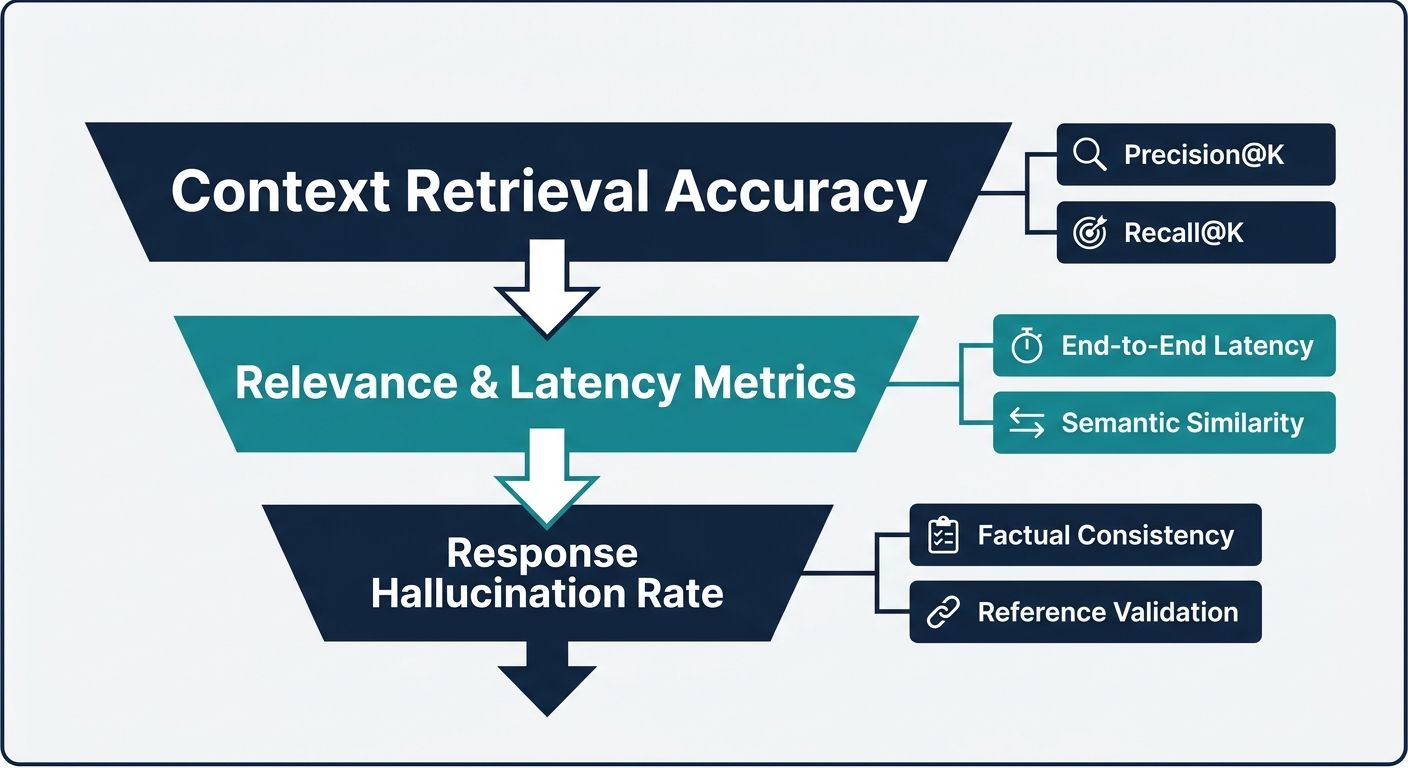
Tracking these sequential metrics provides a reliable framework for evaluating and optimizing your context engineering pipeline against hallucinations.
Implementing context engineering best practices is only half the battle; enterprise teams must rigorously measure their effectiveness. Traditional software metrics like uptime and API response times are insufficient for evaluating conversational nuance. Instead, teams should monitor specific AI context metrics to gauge performance.
**Goal Completion Rate (GCR):** This measures how often the AI successfully navigates a user from an initial query to a desired business outcome (e.g., booking a sales meeting). A high GCR indicates that the context engine is successfully maintaining the dialogue state and keeping the AI focused on its objective, despite user tangents.
**Context Retention Accuracy (CRA):** This metric evaluates whether the AI accurately recalls information provided earlier in the conversation or retrieved from the RAG pipeline. If a user states their budget in turn 2, and the AI suggests a product outside that budget in turn 15, the CRA is low, indicating a failure in the memory summarization or retrieval architecture.
**Latency vs. Token Volume:** Continuous monitoring of token usage per interaction against the resulting latency is crucial. If latency spikes as the conversation deepens, the context pruning algorithms are likely failing. Engineering teams must establish tight latency budgets (e.g., <800ms for voice AI) and dynamically adjust the context window size to ensure the AI remains responsive under load.
## Conclusion: The Future of Context-Aware AI
The transition from static chatbots to dynamic, context-aware voice agents represents a massive leap in enterprise automation. By adopting strict context engineering best practices - such as implementing robust RAG pipelines, managing asynchronous dialogue states, handling interruptions gracefully, and structuring modular API payloads - developers can build systems that truly understand and adapt to human nuance. As Go-To-Market strategies increasingly rely on automated, personalized outreach, mastering the context layer will be the defining factor in determining which AI platforms drive genuine business value and which merely generate conversational noise.
Ready to transform your sales automation and contextual AI workflows with an enterprise-grade solution?
[Learn more about Alchemyst AI](https://getalchemystai.com)
[← Back to Blog](/blog)
## Recently Published
[October 6, 2026 / 10 min readHow to Build a RAG Pipeline for Personal Documents and MediaBuild a multi-modal RAG pipeline for all personal documents and media assets.](/blog/rag-pipeline-personal-documents-media)
[Technical / September 27, 2026 / 11 min readHarness Engineering for AI Agents: Bridging the GapExplore how harness engineering enables robust AI infrastructure and MLOps.](/blog/harness-engineering-ai-agents)
[I'm Evaluating / September 22, 2026 / 11 min readContext Engineering vs Prompt Engineering for AI AgentsExplore the differences between context and prompt engineering for enterprise AI](/blog/context-engineering-vs-prompt-engineering)
[I'm Evaluating / September 14, 2026 / 10 min readContext Engineering for Enterprise AI: A Complete GuideMaster context engineering to build reliable, production-ready voice AI agents.](/blog/context-engineering-enterprise-ai)
[Deep Technical / July 7, 2026 / 10 min readVoice-Specific Architectural Requirements for AI Context LayersDiscover the core voice-specific architectural requirements for AI context layer](/blog/voice-specific-architectural-requirements-ai-context-layer)
[Deep Technical / June 15, 2026 / 10 min readAI Context Extraction From Unstructured Data Types: A Complete GuideMaster AI context extraction from unstructured data types to build robust RAG sy](/blog/ai-context-extraction-from-unstructured-data-types)
Get Started
## Give your AI agents the memory they deserve.
Join developers building the next generation of AI products with persistent, auditable context. Free tier available. No credit card required.
* Free tier
* REST + Python & Node SDKs
* 99.9% uptime SLA
* SOC 2 in progress
### Request API Access
Enter your email and we'll set up your workspace.
Email
[Read the Docs →](https://docs.getalchemystai.com)[Read the Thesis →](/thesis)
---
# Context Engineering vs Prompt Engineering for AI Agents
- **URL:** https://getalchemystai.com/blog/context-engineering-vs-prompt-engineering
- **Slug:** context-engineering-vs-prompt-engineering
- **Published:** September 22, 2026
- **Last updated:** September 22, 2026
- **Author:** Debayan Pradhan
- **Category:** I'm Evaluating
[I'm Evaluating](/blog?category=im-evaluating)
# Context Engineering vs Prompt Engineering for AI Agents
Explore the differences between context and prompt engineering for enterprise AI
Written by [Debayan Pradhan](/blog?author=Debayan%20Pradhan)Reviewed by [Anuran Roy](/blog?author=Anuran%20Roy)11 min readPublished at September 22, 2026 (3w ago)

## Summary
Discover why enterprise AI deployments fail when relying solely on basic prompts. Learn how dynamic context management creates scalable, stateful conversational agents.
Table of Contents
## The Paradigm Shift in AI Development
As the artificial intelligence landscape matures, the initial excitement surrounding basic large language models (LLMs) is rapidly giving way to a demand for robust, scalable enterprise deployments. In the early days of generative AI, the focus was almost entirely on how to ask the model the right question to get the right answer. This practice, known as prompt engineering, became the foundational skill for interacting with AI. However, as organizations attempt to move their AI initiatives from controlled proof-of-concept (PoC) environments into live production, they consistently hit a wall. This phenomenon is often referred to as the "demo-to-deployment gap."
The root cause of this gap is simple: real-world enterprise applications, particularly intelligent voice agents and complex go-to-market (GTM) automation tools, require much more than a clever set of instructions. They require memory, dynamic data synthesis, real-time personalization, and statefulness. This is where the industry is experiencing a critical evolution, shifting the focus from simply instructing models to architecting the environments in which they operate. Understanding the distinction between context engineering vs prompt engineering is now the defining factor between a fragile AI wrapper and a resilient, enterprise-grade AI system.
## What is Prompt Engineering?
Prompt engineering is the art and science of formulating questions, instructions, and inputs to effectively guide a large language model toward generating a desired output. At its core, it is an instruction-centric discipline. A prompt engineer carefully selects words, structures formatting, and utilizes techniques like few-shot prompting or chain-of-thought reasoning to coax the highest quality response from a stateless model.
In a standard prompt engineering workflow, the developer is concerned with the immediate interaction. They are optimizing the "user message" and the static "system message." For instance, a prompt might dictate: "You are a helpful customer service assistant. Answer the user's question politely based only on the provided text. If you do not know the answer, say so." While highly effective for single-turn tasks like summarizing a document, drafting an email, or generating code snippets, prompt engineering is inherently limited by the nature of the models it serves: they are stateless.
### The Limitations of Prompt Engineering in Production
When businesses attempt to scale AI using only prompt engineering, they encounter severe bottlenecks. Because LLMs lack persistent memory, every single interaction requires the prompt engineer to forcefully inject all relevant history, rules, and data into the model's context window. As conversations grow longer or tasks become more complex, this context window fills up. This leads to increased latency, exorbitant token costs, and a degradation in the model's ability to focus on the core instruction—a phenomenon known as the "lost in the middle" effect.
Furthermore, prompt engineering is static. It does not account for the real-time changes in a user's account status in a CRM, the nuanced history of a multi-turn voice conversation, or the need to dynamically fetch external data mid-conversation. Relying solely on prompt engineering for an enterprise application is akin to hiring a brilliant employee but forcing them to read the entire company handbook and every previous customer email from scratch every time the phone rings.
## What is Context Engineering?
Context engineering, in stark contrast, is a systems architecture discipline. It moves beyond the static text of the prompt and focuses on building a dynamic, stateful infrastructure—an AI context layer—that surrounds the LLM. If prompt engineering is about asking the right question, context engineering is about building a comprehensive brain that inherently knows the background before the question is even asked.
Context engineering involves the systematic retrieval, evaluation, synthesis, and injection of relevant information into the AI's operational environment in real-time. It is the architectural practice of integrating vector databases for Retrieval-Augmented Generation (RAG), connecting live CRM systems, managing conversational memory, and executing real-time data filtering. The goal of a context engineer is not just to talk to the AI, but to construct the data pipelines and state management systems that allow the AI to act with deep, situational awareness.
### The Pillars of an AI Context Layer
A robust context engineering architecture relies on several foundational pillars. First is **Dynamic Information Retrieval**. Instead of hardcoding facts into a system prompt, a context layer dynamically queries enterprise databases, APIs, and document stores based on the user's immediate intent. Second is **Memory and Statefulness**. Context engineering implements mechanisms to persist user preferences, historical interactions, and session context, compressing and storing this data so it can be seamlessly retrieved across multiple sessions or different agents.
Third is **Contextual Synthesis and Arithmetic**. It is not enough to simply dump retrieved data into a prompt. Context engineering requires algorithms that evaluate the relevance of retrieved data, scoring and filtering it so that only the highest-fidelity information reaches the LLM. This precise control of the information diet prevents hallucinations and drastically reduces token bloat, ensuring high-speed, cost-effective inference.
## Key Differences: Context Engineering vs Prompt Engineering
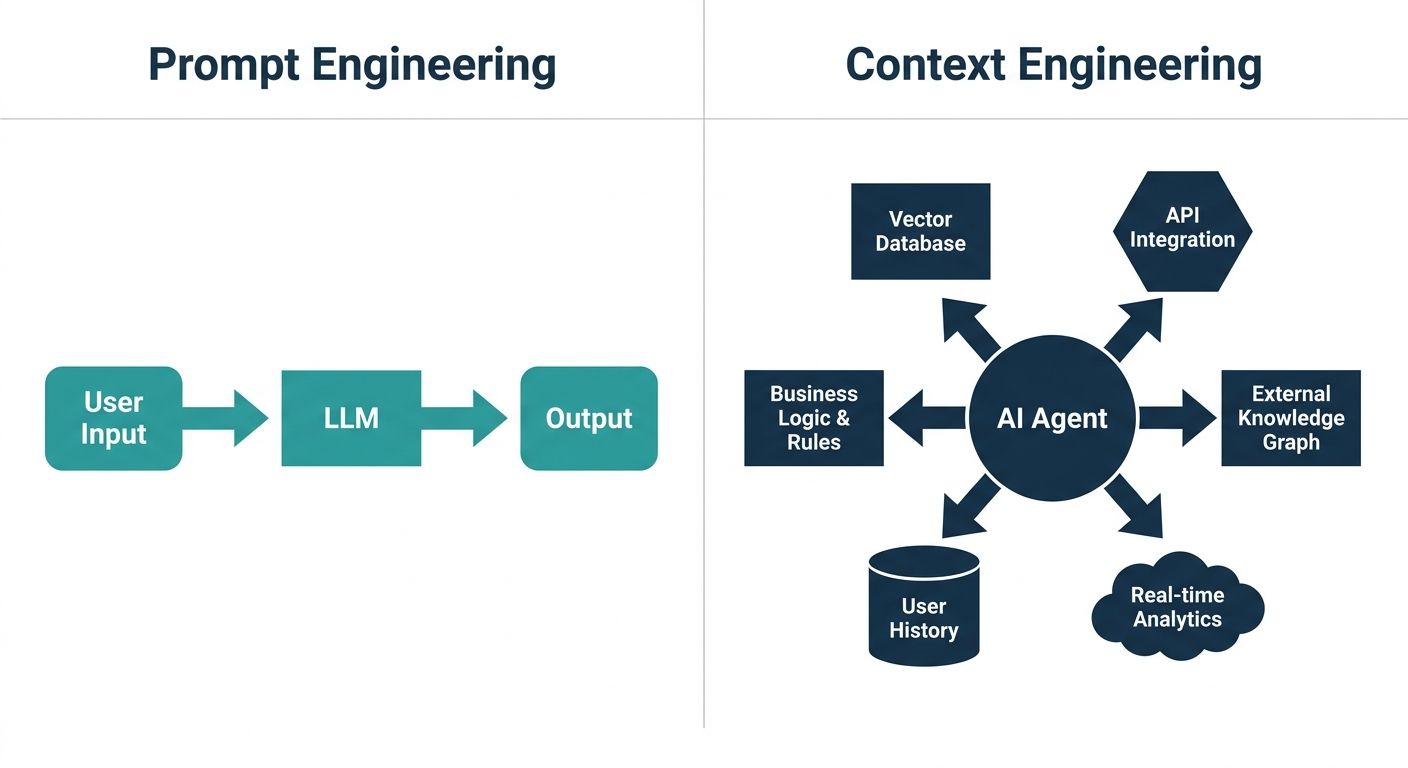
This side-by-side comparison illustrates how prompt engineering relies on static inputs, whereas context engineering dynamically integrates real-time enterprise data sources to power intelligent agents.
To truly grasp the shift required for enterprise AI deployment, IT architects and business leaders must understand the distinct dichotomies between these two practices across several technical dimensions.
### Scope and Scale: Instruction vs. Environment
Prompt engineering is hyper-focused on the micro-interaction. It deals with the phrasing, tone, and logical flow of a single input. Context engineering operates at the macro-level. It is concerned with data pipelines, integration latency, database synchronization, and the holistic environment in which the model functions. While a prompt engineer optimizes a text string, a context engineer optimizes data flow architectures.
### Statefulness: Stateless vs. Persistent Memory
As mentioned, LLMs are fundamentally stateless. Prompt engineering accepts this limitation and attempts to work around it by cramming history into the context window. Context engineering solves the limitation by building external, persistent memory structures. By utilizing semantic search, embedding models, and memory compression engines, context engineering gives the AI an actual, accessible history, allowing it to "remember" across diverse sessions without overloading the immediate token limits.
### Data Integration: Static vs. Dynamic Streams
Prompt engineering relies on static data provided at the time of the request. If a customer's billing status changes mid-conversation, a system built purely on prompt engineering will remain unaware unless explicitly told by the user. Context engineering connects the AI directly to dynamic data streams. By bridging the model with enterprise tools like Salesforce or Hubspot, the context layer actively listens for and integrates real-time state changes, ensuring the AI is always operating on the absolute latest truth.
### The Human Element: Linguist vs. Architect
The skill sets required for each discipline differ vastly. Prompt engineering favors strong linguistic skills, logical structuring, and an intuitive understanding of how models interpret text. It is accessible to power users, domain experts, and content creators. Context engineering requires deep technical expertise in software engineering, backend architecture, API integrations, data engineering, and system design. It is the domain of technical evaluators, developers, and system architects.
## Why Enterprise Voice AI Demands Context Engineering
Nowhere is the distinction between these two disciplines more apparent—and more critical—than in the realm of AI-powered voice agents. Building a text-based chatbot that takes five seconds to respond is annoying, but building a voice agent that takes five seconds to respond is fundamentally broken. Voice interaction demands ultra-low latency, natural conversational flows, and immediate adaptability. Basic AI wrappers built on prompt engineering simply cannot survive in a multi-turn voice environment.
When a human speaks to an AI voice agent, the system must transcribe the audio (STT), understand the intent, fetch relevant data, generate a response, and synthesize it back into speech (TTS) in under a second. If the system relies on a massive, bloated prompt filled with static data, the LLM inference time will skyrocket, resulting in awkward pauses and robotic interactions. Context engineering minimizes this payload.
For instance, leveraging platforms like [Alchemyst AI](https://getalchemystai.com) provides enterprises with an AI-native context management system that inherently understands multi-turn dialogue without requiring developers to manually stitch together disparate data streams. By dynamically injecting only the exact data needed for that specific millisecond of conversation, inference times remain lightning fast. Furthermore, voice conversations are non-linear; users interrupt, change subjects, and reference things said ten minutes ago. Managing this conversational state requires a sophisticated context layer that prompt engineering alone cannot facilitate.
## Overcoming the Demo-to-Deployment Gap
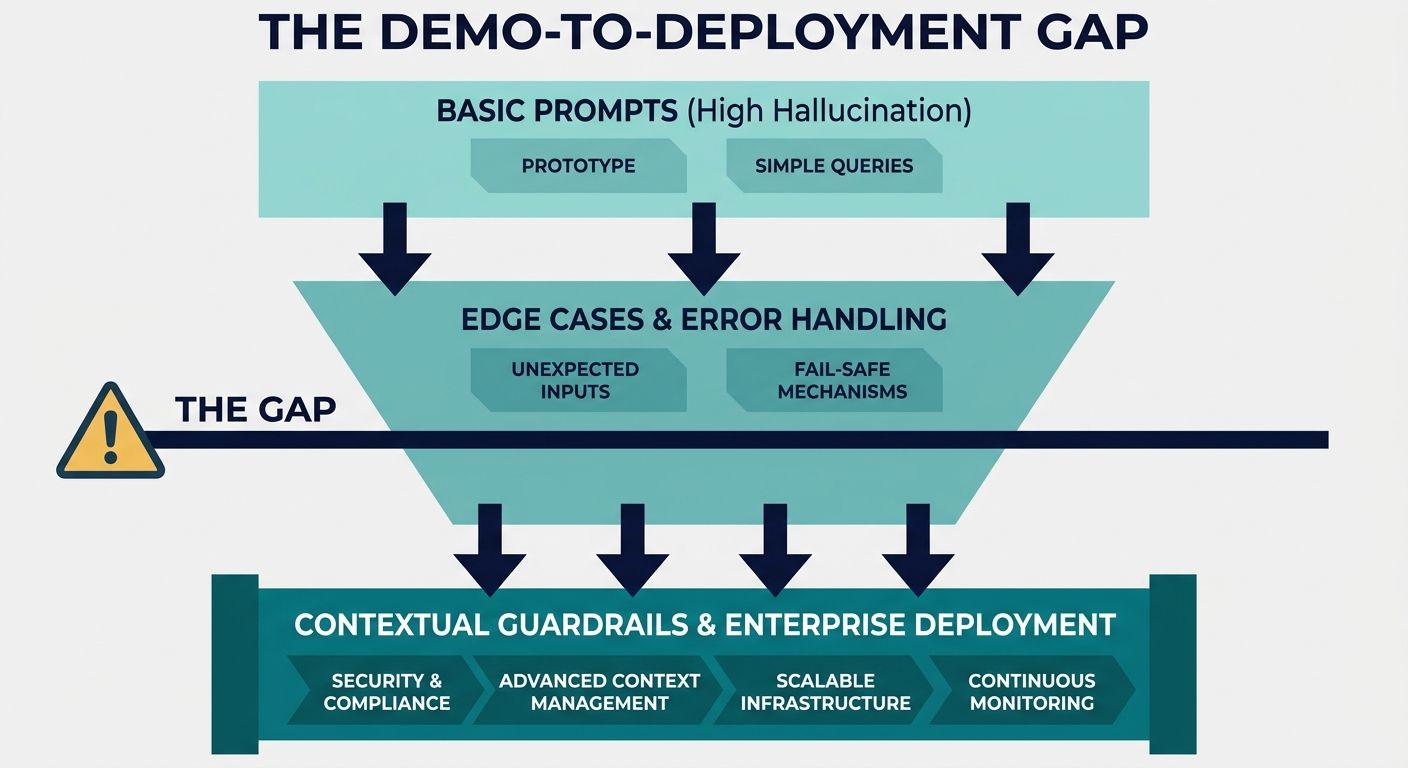
Visualizing the journey from prototype to production reveals why simple prompts fail at scale and how enterprise deployments require robust contextual guardrails to overcome the deployment gap.
The vast majority of AI initiatives fail because they attempt to deploy PoC architectures into production environments. A PoC usually involves a carefully crafted system prompt and a static document. It looks magical in a demo. But when exposed to real users who provide ambiguous inputs, multi-part questions, and edge cases, the system breaks down.
To cross this demo-to-deployment gap, enterprise IT leaders must adopt a migration blueprint that moves their infrastructure from basic instruction to dynamic context. This involves decoupling the "brain" (the LLM) from the "knowledge" (the data). Rather than trying to teach the LLM everything via prompts, organizations must build secure, real-time pipelines that feed the LLM exactly what it needs, precisely when it needs it.
Alchemyst AI is powered by the proprietary Kathan engine, which introduces "context arithmetic"—a specialized process for systematically determining relevant information for voice agents. Through its sophisticated Five-Stage Context Arithmetic Pipeline, the platform seamlessly synthesizes diverse data streams, integrating real-time CRM and RAG data to eliminate the demo-to-deployment gap commonly seen in enterprise AI implementations.
## Architectural Blueprint: Building the Context Layer
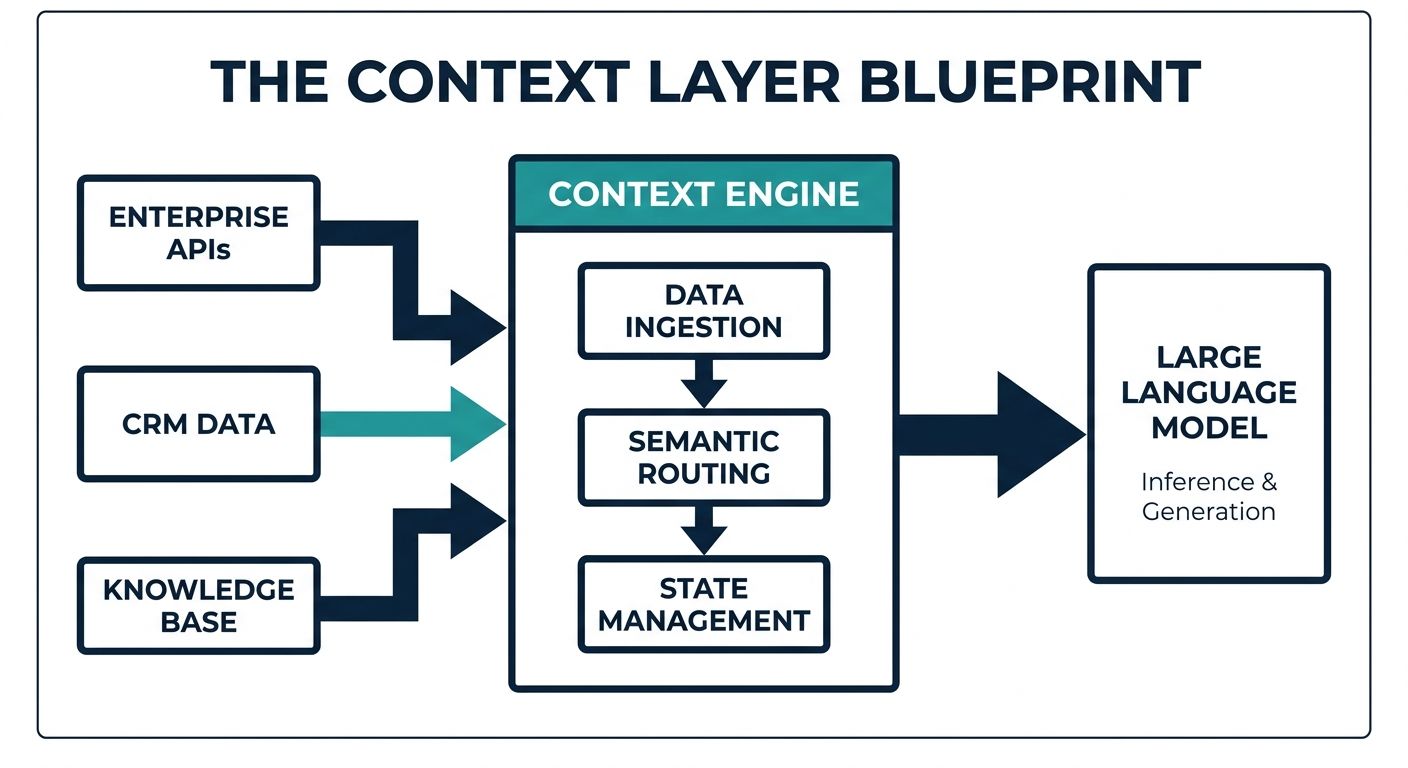
This architectural blueprint demonstrates how a dedicated context layer acts as the vital middleware routing system between your enterprise data and the underlying large language model.
Implementing a context engineering framework requires a strategic architectural approach. While specific tech stacks will vary, the foundational blueprint remains consistent for robust AI deployments.
### 1\. Intent Recognition and Routing
Before any prompt is sent to an LLM, the context layer must intercept the user's input to determine the core intent. Is the user asking a factual question, requesting an account update, or complaining about a service? Based on this semantic routing, the system can determine which downstream databases or APIs need to be queried. This prevents unnecessary data fetching and keeps the ultimate payload lightweight.
### 2\. The Retrieval-Augmented Generation (RAG) Pipeline
For knowledge-based queries, the context layer utilizes a RAG pipeline. This involves converting company documentation, product catalogs, and policies into vector embeddings stored in a vector database. When a query arrives, the system performs a similarity search to extract only the most relevant paragraphs. Context engineering ensures that this retrieval is highly accurate, often employing techniques like hybrid search (combining keyword and semantic search) or re-ranking to surface the absolute best context.
### 3\. Real-Time System Integration (CRM & APIs)
If the intent is transactional, the context layer must query live systems. If a user asks, "Where is my order?", the architecture must parse the user ID, authenticate against the company's shipping API, retrieve the tracking status, and format that raw JSON data into a clean context block. This dynamic injection is something a static prompt simply cannot perform.
### 4\. Context Synthesis and Truncation
Once all relevant data is gathered from RAG pipelines, CRM systems, and conversation history, it must be synthesized. This is where advanced logic comes into play. The context layer must evaluate the total token count of the gathered data. If it exceeds the model's optimal window, the system must ruthlessly prioritize, truncate, and summarize the context. This "context arithmetic" guarantees that the final payload sent to the LLM is dense with high-value information, devoid of noise, and optimized for low-latency generation.
## Evaluating AI Platforms for Context Mastery
As enterprises seek vendor solutions to accelerate their go-to-market strategies and automate sales functions, they must look past superficial AI features and evaluate the core infrastructure. When assessing AI agents, particularly for voice, IT architects should ask critical questions.
Does the platform offer persistent memory that survives beyond a single browser session? Can the system dynamically connect to internal CRMs without requiring manual prompt updates? How does the platform handle conflicting information between a system prompt and a retrieved document? Platforms that excel in these areas, treating context as a fluid and manageable state, will drastically outperform those that simply provide an interface to an LLM.
By recognizing the limitations of prompt engineering and embracing the architectural rigor of context engineering, businesses can finally build AI systems that are not just intelligent, but reliable, secure, and infinitely scalable. The future of enterprise AI does not belong to those who write the cleverest prompts; it belongs to those who architect the most intelligent context.
Mastering the transition from static prompts to dynamic context is the key to unlocking scalable, enterprise-grade voice and chat applications. Alchemyst AI provides the underlying context infrastructure, sales automation, and GTM capabilities needed to build intelligent, stateful agents that drive real business results.
[Learn more about Alchemyst AI](https://getalchemystai.com)
[← Back to Blog](/blog)
## Recently Published
[October 6, 2026 / 10 min readHow to Build a RAG Pipeline for Personal Documents and MediaBuild a multi-modal RAG pipeline for all personal documents and media assets.](/blog/rag-pipeline-personal-documents-media)
[Technical / September 27, 2026 / 11 min readHarness Engineering for AI Agents: Bridging the GapExplore how harness engineering enables robust AI infrastructure and MLOps.](/blog/harness-engineering-ai-agents)
[I'm Evaluating / September 27, 2026 / 9 min readContext Engineering Best Practices for Enterprise AIMaster advanced context engineering best practices for conversational AI agents.](/blog/context-engineering-best-practices)
[I'm Evaluating / September 14, 2026 / 10 min readContext Engineering for Enterprise AI: A Complete GuideMaster context engineering to build reliable, production-ready voice AI agents.](/blog/context-engineering-enterprise-ai)
[Deep Technical / July 7, 2026 / 10 min readVoice-Specific Architectural Requirements for AI Context LayersDiscover the core voice-specific architectural requirements for AI context layer](/blog/voice-specific-architectural-requirements-ai-context-layer)
[Deep Technical / June 15, 2026 / 10 min readAI Context Extraction From Unstructured Data Types: A Complete GuideMaster AI context extraction from unstructured data types to build robust RAG sy](/blog/ai-context-extraction-from-unstructured-data-types)
Get Started
## Give your AI agents the memory they deserve.
Join developers building the next generation of AI products with persistent, auditable context. Free tier available. No credit card required.
* Free tier
* REST + Python & Node SDKs
* 99.9% uptime SLA
* SOC 2 in progress
### Request API Access
Enter your email and we'll set up your workspace.
Email
[Read the Docs →](https://docs.getalchemystai.com)[Read the Thesis →](/thesis)
---
# Context Engineering for Enterprise AI: A Complete Guide
- **URL:** https://getalchemystai.com/blog/context-engineering-enterprise-ai
- **Slug:** context-engineering-enterprise-ai
- **Published:** September 14, 2026
- **Last updated:** September 14, 2026
- **Author:** Khushi Mhasange
- **Category:** I'm Evaluating
[I'm Evaluating](/blog?category=im-evaluating)
# Context Engineering for Enterprise AI: A Complete Guide
Master context engineering to build reliable, production-ready voice AI agents.
Written by [Khushi Mhasange](/blog?author=Khushi%20Mhasange)Reviewed by [Anuran Roy](/blog?author=Anuran%20Roy)10 min readPublished at September 14, 2026 (1mo ago)

## Summary
Context engineering is the critical architecture separating basic AI wrappers from robust enterprise solutions. This guide explores the systematic retention, retrieval, and application of context for production-ready voice AI agents.
Table of Contents
## The Critical Role of Context Engineering in Modern AI
As artificial intelligence continues to permeate enterprise workflows, the initial excitement surrounding foundational models has shifted toward a more pressing, complex challenge: building AI systems that can actually hold a coherent, long-term, and state-aware conversation. This is where **context engineering** enters the fray. Unlike traditional prompt engineering, which focuses on providing static instructions to a Large Language Model (LLM), context engineering is the systematic, architectural practice of managing memory, state, and relevant external knowledge in real-time. It is the crucial bridge across the demo-to-production gap, transforming impressive prototypes into resilient, enterprise-grade AI agents capable of executing complex go-to-market (GTM) and sales automation tasks.
For enterprise voice AI applications specifically, the stakes are exponentially higher. A slight hallucination or a brief lapse in conversational memory might be forgivable in a text-based chatbot, but in a live, real-time voice interaction with a prospective client, it shatters trust instantly. Mastering context handling capabilities—from dynamic memory injection to integrating seamlessly with Speech-to-Text (STT) and Text-to-Speech (TTS) pipelines—is now the definitive standard for evaluating production-ready AI agent infrastructure.
## Prompt Engineering vs. Context Engineering: Understanding the Shift
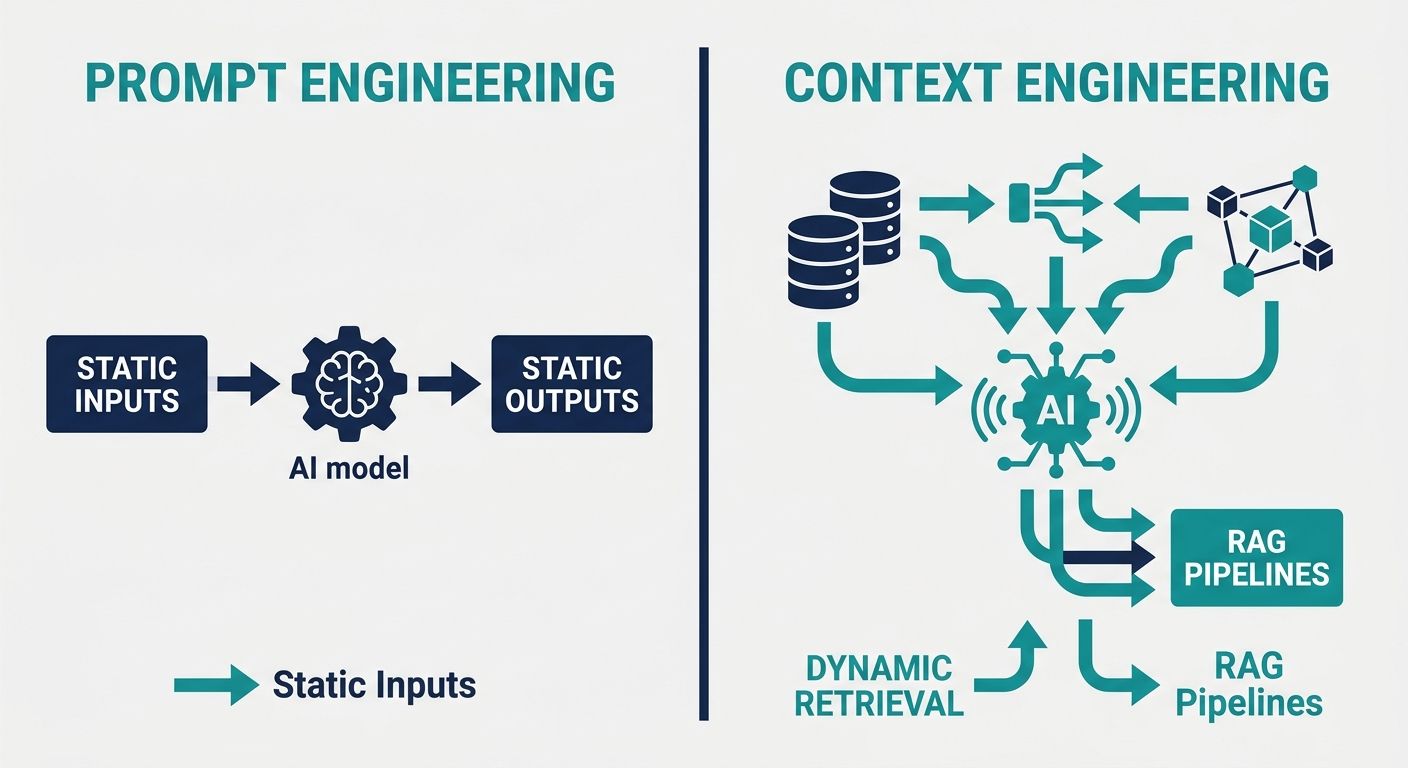
This comparison illustrates how context engineering shifts AI workflows from static text prompts to dynamic data retrieval, enabling more accurate and business-specific outputs.
To truly grasp the value of context engineering, it is essential to distinguish it from prompt engineering. For years, the AI community has obsessed over prompt engineering - the art of phrasing questions, setting personas, and structuring instructions to coax the best possible response out of an LLM. While still important, prompt engineering is ultimately static. It tells the AI _how_ to behave.
Context engineering, on the other hand, dictates _what_ the AI knows at any given microsecond of a conversation. It involves dynamically assembling the exact pieces of information an agent needs to answer a query without exceeding context window limits, accumulating unnecessary token costs, or increasing latency. It is a continuous loop of ingestion, semantic structuring, memory allocation, and real-time retrieval.
* **Prompt Engineering:** "You are a highly skilled sales representative for a SaaS platform. Be polite, concise, and always push for a meeting."
* **Context Engineering:** "The user just mentioned their CRM is Salesforce. Retrieve the integration documentation for Salesforce. Note that 10 minutes ago, the user said they have a budget of $50,000\. Inject this into the current working memory so the agent can propose the Enterprise Tier."
## The Demo-to-Production Gap in Voice AI
Many organizations attempt to build conversational AI using basic Retrieval-Augmented Generation (RAG) frameworks or simple conversational loops. These work well in controlled demonstrations. However, when deployed in production—especially in voice AI scenarios—they inevitably encounter severe architectural bottlenecks. These bottlenecks collectively form the demo-to-production gap.
### Latency and the Voice AI Challenge
In text-based AI, a user is willing to wait three to five seconds for a response as they watch a typing indicator. In voice AI, a three-second delay feels like an eternity of awkward silence. Voice-specific architectural requirements dictate that context retrieval must happen in milliseconds. STT processing already consumes a portion of your latency budget, and TTS synthesis at the end of the pipeline consumes another chunk. If your context engineering pipeline is bloated, the conversational delay will ruin the user experience.
### Context Degradation Over Long Sessions
Enterprise users need agents that can handle thirty-minute discovery calls, not just three-turn customer support queries. Generic memory layers often fail by simply appending every new transcript line to the LLM's prompt. As the context window fills up, the model experiences the "lost in the middle" phenomenon—forgetting crucial details discussed earlier in the call. Effective context engineering requires sophisticated methodologies for retention, such as summarizing old turns, extracting discrete entities, and moving inactive context into long-term vector storage while keeping active topics in short-term cache.
## Architectural Pillars of Production-Ready Context Engineering
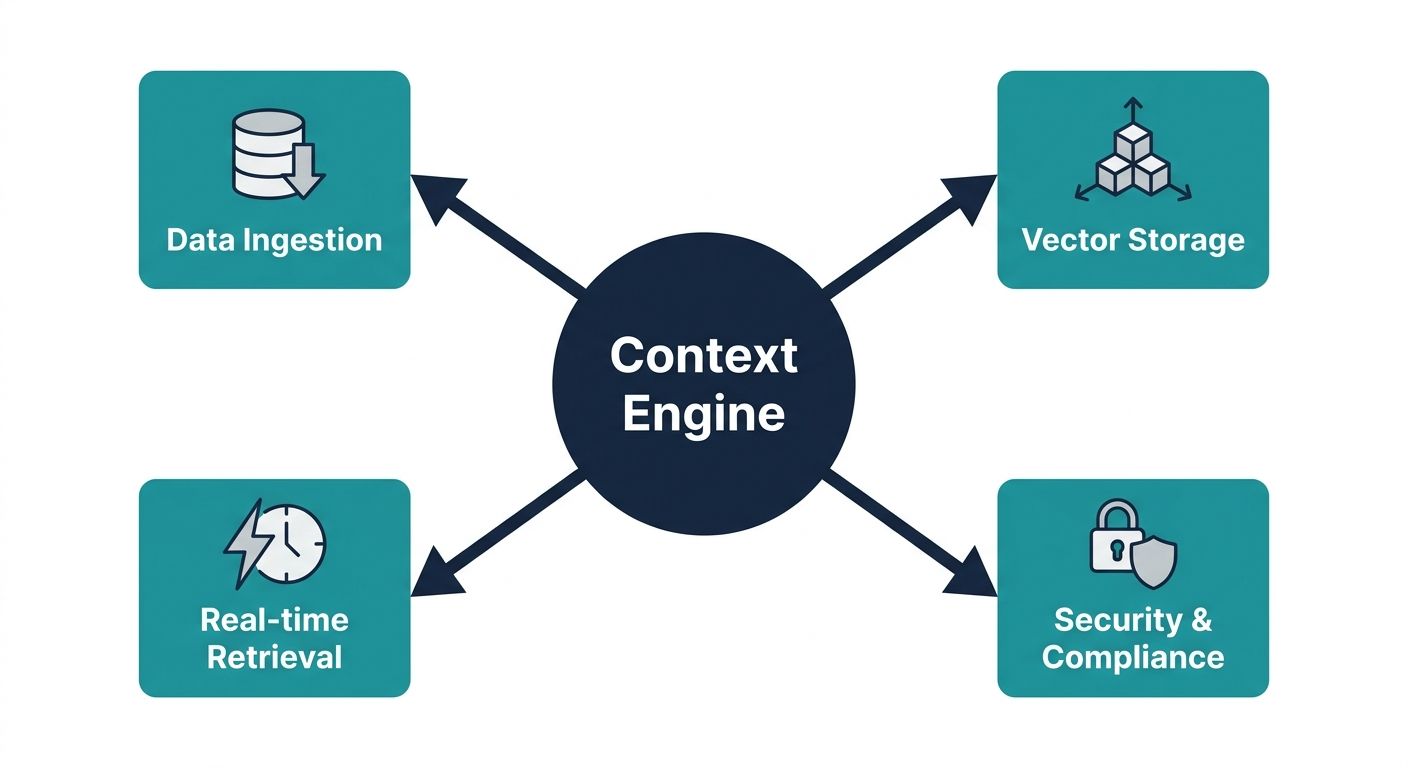
By structuring your AI system around these four core pillars, you ensure that your context engineering pipeline is scalable, secure, and ready for enterprise-level deployment.
Building a reference architecture for production-ready AI agent infrastructure demands a move away from fragile integrations and toward robust, multi-layered context engines. By integrating a specialized platform like [Alchemyst AI](https://getalchemystai.com), enterprise teams can bypass the heavy lifting of building semantic routing from scratch and instantly deploy contextually aware sales and GTM agents.
### 1\. Intelligent Information Retrieval (Beyond Basic RAG)
Standard RAG relies on semantic similarity—vectorizing a user query and pulling the closest matching document chunks. However, human conversation is rarely direct. If a prospect says, "We struggled with our last vendor's uptime," a basic RAG system might search for "uptime." A system backed by advanced context engineering will recognize the underlying intent: the prospect has trust issues regarding reliability, triggering the retrieval of SLAs, uptime statistics, and relevant case studies.
### 2\. State and Session Management
Enterprise voice AI must operate like a state machine. Is the conversation in the "discovery" phase, the "objection handling" phase, or the "closing" phase? Context engineering involves maintaining a dynamic state tracker. As the user provides information, the context engine updates the state variables in real-time. This ensures the AI agent understands not just the current question, but where it sits in the broader trajectory of the sales or support call.
### 3\. The Context Arithmetic Framework
Context arithmetic is the systemic evaluation of competing data points to determine relevance. When an AI agent has access to a company knowledge base, user historical data, API documentation, and real-time conversational history, it faces an overabundance of data. Context arithmetic assigns weights to these inputs based on recency, semantic relevance, and current conversational state, mathematically determining the optimal payload to inject into the LLM.
Through its proprietary Kathan engine, Alchemyst AI introduces advanced "context arithmetic" to systematically determine relevant information. This five-stage pipeline for context determination handles everything from raw information retrieval to real-time intent matching, ensuring your GTM and sales voice agents never lose the thread of conversation.
## Implementing Context Engineering for Enterprise AI
If you are looking to architect a scalable, context-aware system for your organization, a structured approach is mandatory. Here is a blueprint for implementing robust context handling capabilities.
### Stage 1: Ingestion and Semantic Structuring
Context engineering starts long before the conversation begins. Your enterprise data—product catalogs, pricing matrices, objection handling playbooks, and historical call transcripts—must be ingested and structured. Do not simply dump PDFs into a vector database. Implement hierarchical chunking. Tag chunks with rich metadata, such as audience type, product line, and required conversational state. This metadata becomes crucial for accurate context routing later.
### Stage 2: Short-term vs. Long-term Memory Allocation
Design a bifurcated memory architecture. **Short-term memory** should act as a rapid-access cache holding the last 5 to 10 turns of the conversation verbatim. **Long-term memory** should store compressed insights. As the conversation progresses, employ a background process to summarize the short-term memory, extract key entities (e.g., "Budget: $100k", "Timeline: Q3"), and write them to a persistent user profile. This prevents token bloat while ensuring the agent never forgets a critical detail.
### Stage 3: Real-time Context Injection and Pruning
When the user speaks, the system must perform rapid context determination. Retrieve the user's long-term profile, pull relevant external knowledge via semantic search, and combine it with the short-term conversational history. Then, crucially, _prune_ this payload. Remove redundant information. Trim the injected context down to the bare minimum required to formulate a highly accurate response. This keeps token counts low and inference speeds lightning-fast, meeting the strict latency budgets of voice AI.
## Overcoming Common Implementation Challenges
Transitioning to an AI-native context management system is not without its hurdles. Engineering teams must anticipate and mitigate several common pitfalls.
### Mitigating Latency in STT and TTS Pipelines
In a voice AI agent, the time taken to process audio to text (STT) and generate audio from text (TTS) limits the time available for LLM inference and context retrieval. To optimize this, context engineering must happen asynchronously where possible. Predictive context pre-fetching—where the engine anticipates the likely next turns based on the conversation state and pre-loads relevant documents into memory—can shave hundreds of milliseconds off the response time.
### Handling Interruptions and Barge-ins
Human conversation is messy. Users interrupt, change their minds mid-sentence, and refer back to topics from twenty minutes ago. A robust context engine must support "barge-ins." When a user interrupts the AI mid-sentence, the context engine must instantly log the partial completion of the AI's thought, record the user's interruption as a high-priority context shift, and dynamically pivot the conversational state tracker to address the new input.
## Why Generic Platforms Fall Short in Context Engineering
The market is currently flooded with generic AI platforms offering "drop-in memory" or basic API endpoints for LLM access. While these tools may serve hobbyists and internal utilities well, they fall apart under enterprise demands. A platform that simply saves chat history to a database and retrieves it via standard similarity search is not performing true context engineering.
Enterprise voice AI requires a platform engineered from the ground up for dynamic state management and rapid context arithmetic. Without a dedicated context determination pipeline, agents will inevitably hallucinate, repeat themselves, or freeze when asked to synthesize disparate pieces of information during a live sales call. The focus must be on actionable context handling—evaluating types of context, defining technical methodologies for retention, and rigorously testing memory duration limits against quantifiable performance metrics.
## Metrics for Evaluating Context Engineering Success
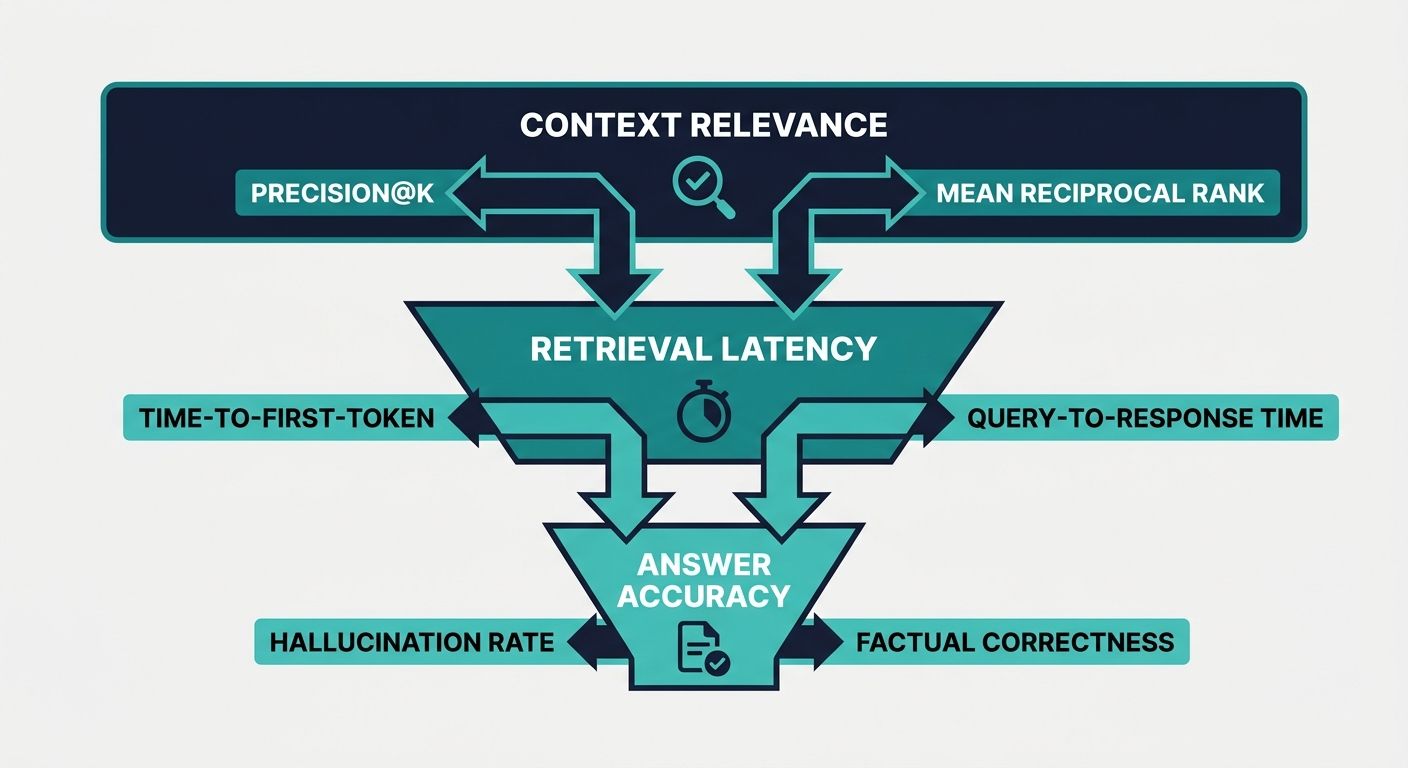
Tracking these interconnected metrics across the retrieval funnel helps engineering teams quickly identify bottlenecks and reduce AI hallucination rates in production environments.
How do you know if your context engineering architecture is actually working? You must implement observability and track specific context-focused metrics:
* **Context Precision:** Of the documents and data points injected into the prompt, what percentage were actually used by the LLM to formulate the response? Low precision indicates your retrieval pipeline is too noisy.
* **Context Recall:** Did the injected payload contain all the necessary information to answer the user's implicit and explicit queries? Low recall leads to AI hallucinations or "I don't know" responses.
* **State Accuracy:** How often does the state tracker correctly identify the current phase of the conversation?
* **Time-to-First-Byte (TTFB) Context Routing:** The total latency introduced strictly by the context retrieval, memory reading, and payload pruning processes before the LLM inference begins.
## The Future of Context-Aware AI Agents
The evolution of AI agents is moving rapidly from stateless, reactive bots to proactive, highly contextual digital workers. As go-to-market teams increasingly rely on AI to scale their outbound outreach, qualify inbound leads, and handle routine customer interactions, the sophistication of the underlying context engineering will be the primary differentiator between success and failure.
We are moving toward an era where AI agents do not just recall what was said five minutes ago; they will understand the historical relationship with the client, the current market dynamics, the strategic goals of the sales campaign, and the real-time emotional sentiment of the user's voice. All of this data must be systematically engineered, weighted, and injected flawlessly to create interactions that feel genuinely human and exceptionally capable.
Context engineering is the defining factor between a fragile AI wrapper and a resilient, enterprise-grade automation system. Whether you are scaling outbound sales calls or managing complex GTM workflows, reliable memory and state management are non-negotiable.
[Learn more about Alchemyst AI](https://getalchemystai.com)
[← Back to Blog](/blog)
## Recently Published
[October 6, 2026 / 10 min readHow to Build a RAG Pipeline for Personal Documents and MediaBuild a multi-modal RAG pipeline for all personal documents and media assets.](/blog/rag-pipeline-personal-documents-media)
[Technical / September 27, 2026 / 11 min readHarness Engineering for AI Agents: Bridging the GapExplore how harness engineering enables robust AI infrastructure and MLOps.](/blog/harness-engineering-ai-agents)
[I'm Evaluating / September 27, 2026 / 9 min readContext Engineering Best Practices for Enterprise AIMaster advanced context engineering best practices for conversational AI agents.](/blog/context-engineering-best-practices)
[I'm Evaluating / September 22, 2026 / 11 min readContext Engineering vs Prompt Engineering for AI AgentsExplore the differences between context and prompt engineering for enterprise AI](/blog/context-engineering-vs-prompt-engineering)
[Deep Technical / July 7, 2026 / 10 min readVoice-Specific Architectural Requirements for AI Context LayersDiscover the core voice-specific architectural requirements for AI context layer](/blog/voice-specific-architectural-requirements-ai-context-layer)
[Deep Technical / June 15, 2026 / 10 min readAI Context Extraction From Unstructured Data Types: A Complete GuideMaster AI context extraction from unstructured data types to build robust RAG sy](/blog/ai-context-extraction-from-unstructured-data-types)
Get Started
## Give your AI agents the memory they deserve.
Join developers building the next generation of AI products with persistent, auditable context. Free tier available. No credit card required.
* Free tier
* REST + Python & Node SDKs
* 99.9% uptime SLA
* SOC 2 in progress
### Request API Access
Enter your email and we'll set up your workspace.
Email
[Read the Docs →](https://docs.getalchemystai.com)[Read the Thesis →](/thesis)
---
# Voice-Specific Architectural Requirements for AI Context Layers
- **URL:** https://getalchemystai.com/blog/voice-specific-architectural-requirements-ai-context-layer
- **Slug:** voice-specific-architectural-requirements-ai-context-layer
- **Published:** July 7, 2026
- **Last updated:** July 7, 2026
- **Author:** Harsh Shah
- **Category:** Deep Technical
[Deep Technical](/blog?category=deep-technical)
# Voice-Specific Architectural Requirements for AI Context Layers
Discover the core voice-specific architectural requirements for AI context layer
Written by [Harsh Shah](/blog?author=Harsh%20Shah)Reviewed by [Anuran Roy](/blog?author=Anuran%20Roy)10 min readPublished at July 7, 2026 (3mo ago)

## Summary
Explore the critical voice-specific architectural requirements for building robust AI context layers. This guide delves into real-time latency, STT/TTS integration, and advanced conversational state management.
Table of Contents
## The Evolution of the AI Context Layer for Voice
The landscape of enterprise artificial intelligence is undergoing a profound transformation. We are moving rapidly from asynchronous, text-based chatbots to synchronous, real-time voice agents capable of conducting complex business workflows. However, many enterprise architects quickly encounter a significant hurdle: lifting a traditional text-based context management system and dropping it into a voice environment results in disjointed, laggy, and unnatural user experiences. Understanding the highly specialized voice-specific architectural requirements for AI context layer design is no longer optional. It is a critical necessity for any organization looking to deploy scalable, human-like conversational AI systems.
Current industry resources broadly cover general AI agent architectures and basic context layers but consistently lack deep, prescriptive technical details tailored to the unique challenges of voice AI. Many solutions focus on drop-in memory infrastructure for text applications, missing the fundamental differences in how spoken language operates. Voice input is continuous, dynamic, often noisy, and laden with non-verbal cues. If an AI context layer is not architected specifically for these nuances, it will fail to maintain conversational coherence. This guide provides a deep technical dive into the specific architectural patterns required to power real-time, context-aware voice agents.
## The Fundamental Shift: Text vs. Spoken Language Context
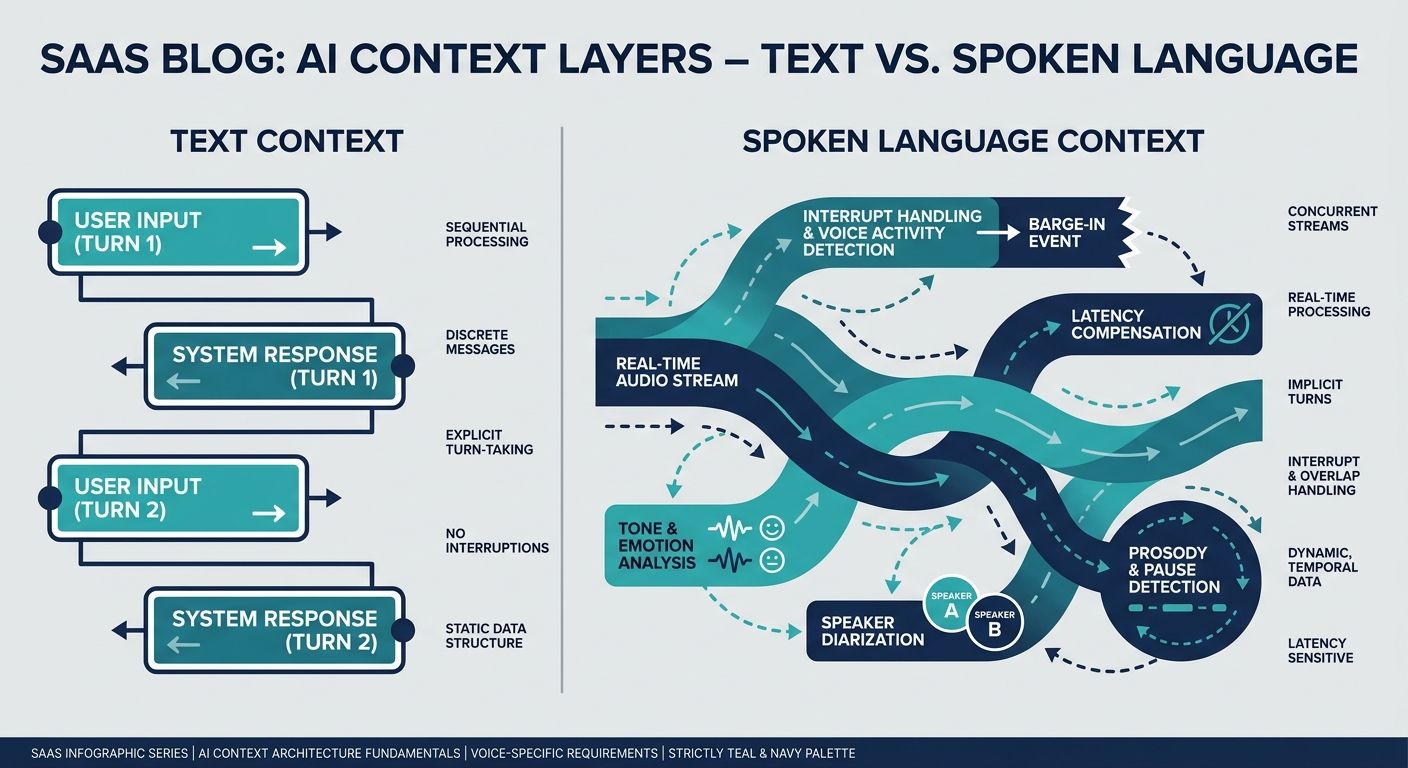
This side-by-side comparison highlights why traditional text-based AI models fall short when processing the real-time, overlapping nature of spoken language context.
To grasp the voice-specific architectural requirements for AI context layer design, we must first dissect why spoken language breaks traditional state management systems. In text-based interactions, input is discrete, cleanly transcribed exactly as typed, and delivered in completed semantic chunks. The context layer simply appends this neat chunk to a conversation history array and passes it to a Large Language Model (LLM).
Voice input is entirely different. It arrives as a continuous audio stream fraught with hesitations, self-corrections, background noise, and varying acoustic environments. A user might say, 'I need to book a flight to, um, no wait, make it a train to Boston.' A text-focused context layer might struggle with this unstructured flow, but a voice-specific context layer must instantly normalize this dynamic input, extract the final intent, and discard the conversational filler without losing the temporal context. Furthermore, human speech involves complex turn-taking dynamics, prosody changes, and simultaneous overlapping speech, all of which must be tracked and managed by the context architecture.
## Core Voice-Specific Architectural Requirements for AI Context Layers
### 1\. Ultra-Low Latency Processing and Real-Time State Management
The most unforgiving constraint in voice AI is latency. Human beings perceive delays in conversational turn-taking that exceed 500 milliseconds as sluggish and unnatural. In a standard voice pipeline, the audio must pass through Voice Activity Detection (VAD), Speech-to-Text (STT), the AI context layer, the LLM, and finally Text-to-Speech (TTS). Because STT, LLM generation, and TTS synthesis consume the vast majority of this strict latency budget, the context layer must operate in near-zero time.
This necessitates an ultra-low latency, in-memory processing architecture for short-term context. Disk-based retrieval is inherently too slow for mid-conversation state updates. The architecture must separate short-term acoustic/conversational context from long-term persistent semantic memory. Short-term context data such as current conversational turn status, immediate user intent, and active session variables must be stored in highly optimized, memory-mapped databases. Long-term contextual data, such as historical user preferences, can be retrieved asynchronously while the initial conversational pleasantries are being synthesized, ensuring the system never blocks the critical real-time audio loop.
### 2\. Seamless Integration with STT Pipelines for Dynamic Normalization
A fatal flaw in many generalized AI architectures is treating STT as an isolated black box that merely hands text to the context layer. In a specialized voice architecture, the context layer and the STT engine must be deeply integrated. This is typically achieved through context-aware STT biasing and dynamic vocabulary weighting.
Because voice inputs are frequently noisy, the STT engine may generate multiple transcription hypotheses with varying confidence scores. A voice-specific context layer must accept these probabilistic hypotheses rather than a single deterministic text string. For instance, if the background is noisy and the STT outputs 'I want to by a sheer' (low confidence) versus 'I want to buy a share' (medium confidence), the context layer checks the active conversational state. If the user is operating within a financial services agent context, the architecture dynamically weights the financial terminology, instantly correcting the STT output before it reaches the LLM. This dynamic input normalization is a mandatory architectural requirement for maintaining accuracy in real-world acoustic environments.
### 3\. Advanced Text-to-Speech (TTS) Orchestration and Prosody Control
Just as the context layer must influence the STT, it must directly orchestrate the TTS output. Text-based architectures only need to generate a text string. Voice architectures must generate speech that carries the correct emotional tone, pacing, and inflection. This requires the context layer to maintain an ongoing emotional and semantic state tracker for the conversation.
When the LLM generates a response, the context layer must inject appropriate Speech Synthesis Markup Language (SSML) tags before routing the payload to the TTS engine. If the context layer detects that a user is frustrated based on repeated conversational turns and elevated acoustic volume from the STT metadata, it must append tags that instruct the TTS to speak at a slower, calmer, and more empathetic pitch. This level of prosody management ensures that the AI agent does not sound disjointed or socially unaware, which is a common failure point in legacy IVR systems.
## Architectural Patterns for Managing Short-Term Acoustic Context
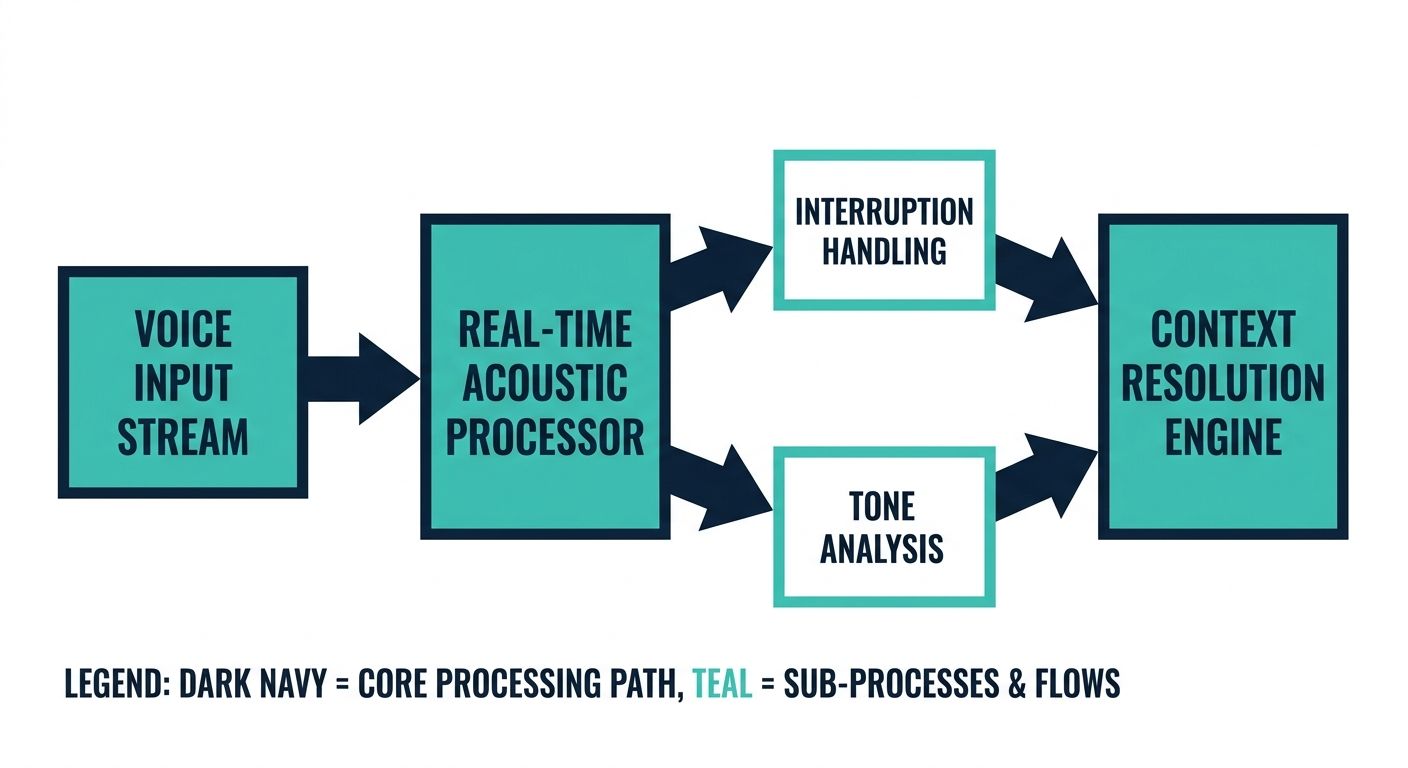
By visualizing the flow of acoustic data, this flowchart demonstrates how real-time processors handle interruptions and tone before updating the AI context layer.
### Mastering Turn-Taking and Barge-In Scenarios
One of the most complex voice-specific architectural requirements for AI context layer systems is handling interruptions, commonly known as barge-in. In a natural conversation, humans frequently talk over one another. If an AI agent is reading a long list of options and the user interrupts by saying 'The third one', the architecture must handle this event flawlessly.
Traditional text systems completely fail here because they assume the bot finishes its turn before the user speaks. A robust voice context architecture implements a synchronized rollback mechanism. When the VAD detects a user interruption, the TTS stream is instantly halted. The context layer must then calculate exactly which words the TTS had successfully synthesized and played to the user up to that exact millisecond. It must strip the unplayed words from the agent's short-term memory state. If this rollback does not occur, the LLM will 'remember' saying things the user never actually heard, leading to catastrophic context hallucination and complete conversational breakdown.
### Incorporating Acoustic Features as Contextual Data
Beyond semantic meaning, how a user speaks provides critical context. A sophisticated AI context layer designed for voice must ingest acoustic metadata alongside the transcribed text. This includes metrics like speech rate, pitch variations, and pause durations.
For example, a two-second pause in text is invisible. In voice, a two-second pause might indicate hesitation, confusion, or that the user is simply thinking. The context layer uses this acoustic data to dynamically adjust the VAD threshold. If the system detects a complex multi-part intent forming, the context layer instructs the VAD to wait longer before assuming the user has finished their turn. This prevents the frustrating experience of the AI cutting the user off mid-sentence.
## Addressing Enterprise Gaps with Advanced Context Engines
Many generalized platforms position themselves as memory layers for AI agents, offering standard drop-in memory infrastructure. However, enterprise voice agents require a more nuanced approach. Platforms like Alchemyst AI utilize advanced AI-native context management frameworks, such as the Kathan engine, to solve these specific enterprise requirements. The Kathan engine exemplifies how to structure persistent information storage specifically for dynamic AI interactions.
In enterprise deployments spanning healthcare, e-commerce, and finance, the context layer must bridge real-time voice processing with complex backend workflows. This requires custom connectors that can pull secure, industry-specific data into the active voice context window within milliseconds. Furthermore, these architectures require advanced memory compression engines. Instead of retaining every 'um' and 'ah' from a thirty-minute phone call, the context layer continuously summarizes the acoustic interaction into highly compressed semantic state vectors. This ensures long-term memory persists across multiple user sessions without bloating the active context window and destroying latency budgets.
## Practical Implementation Strategies for Voice AI Networks
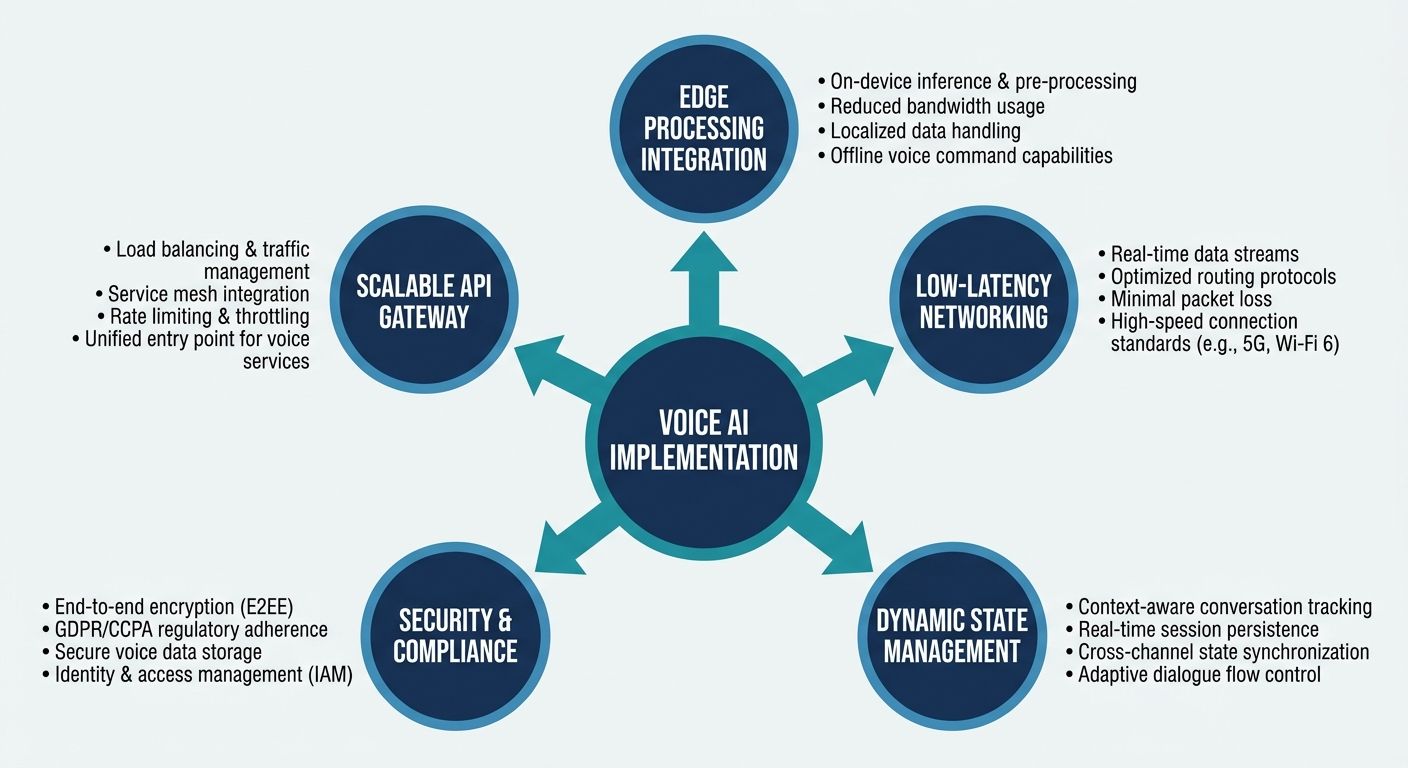
This concept map outlines the five essential implementation pillars required to deploy a scalable and low-latency voice AI network in an enterprise environment.
Implementing these voice-specific architectural requirements for AI context layer infrastructure demands a strategic approach. Engineering teams must pivot from synchronous, blocking API calls to asynchronous, event-driven architectures. Here are critical implementation strategies:
* **Implement Streaming Pipelines:** The context layer must support chunk-based processing. Do not wait for a full sentence to be transcribed. The context layer should begin analyzing partial STT hypotheses as they stream in, pre-fetching relevant database records to save precious milliseconds.
* **Deploy Dual-State Memory Systems:** Maintain a strict separation between ephemeral conversational state (managed in Redis or similar high-speed in-memory stores) and persistent user knowledge (managed in vector databases).
* **Build Graceful Degradation Pathways:** When voice inputs are too noisy and confidence scores plummet, the context layer must orchestrate targeted clarification prompts rather than allowing the LLM to guess the intent randomly.
* **Adopt AI-Native Context Platforms:** Leveraging established context management platforms like Alchemyst AI allows enterprises to focus on agent persona and business logic rather than building complex, low-level memory compression and state rollback algorithms from scratch.
## Key Performance Indicators for Voice Context Architecture
To ensure your voice-specific context layer is performing optimally, you must track metrics that go beyond traditional web application monitoring. Standard response times are insufficient; you must measure the holistic conversational flow.
* **Context Retrieval Latency (CRL):** The time it takes for the context layer to enrich an incoming STT payload with historical user data and active state variables. This must consistently remain under 50 milliseconds.
* **Interruption Handling Success Rate (IHSR):** The percentage of barge-in events where the context layer successfully rolled back the agent memory state and correctly processed the user interruption without hallucinating previously unspoken text.
* **Context-Aware Word Error Rate (WER):** The accuracy of the STT system when actively biased by the context layer, compared to the baseline STT accuracy without contextual weighting. This demonstrates the ROI of integrating your context layer directly with the transcription pipeline.
## Conclusion: Future-Proofing Your Enterprise Voice Agent
The transition to voice-first AI interfaces represents a monumental shift in how humans interact with machines. General-purpose text architectures are fundamentally unequipped to handle the latency demands, acoustic nuances, and dynamic turn-taking inherent in spoken conversation. By adhering to the precise voice-specific architectural requirements for AI context layer design outlined in this guide, enterprises can overcome the limitations of generic AI agents.
Focusing on ultra-low latency memory management, deep integration with STT and TTS pipelines, robust barge-in handling, and advanced memory compression engines will allow you to build conversational experiences that feel genuinely human. Platforms offering specialized AI-native context management are paving the way for this future, enabling businesses to deploy scalable, secure, and incredibly responsive voice AI solutions that drive real operational efficiency and user satisfaction.
[← Back to Blog](/blog)
## Recently Published
[October 6, 2026 / 10 min readHow to Build a RAG Pipeline for Personal Documents and MediaBuild a multi-modal RAG pipeline for all personal documents and media assets.](/blog/rag-pipeline-personal-documents-media)
[Technical / September 27, 2026 / 11 min readHarness Engineering for AI Agents: Bridging the GapExplore how harness engineering enables robust AI infrastructure and MLOps.](/blog/harness-engineering-ai-agents)
[I'm Evaluating / September 27, 2026 / 9 min readContext Engineering Best Practices for Enterprise AIMaster advanced context engineering best practices for conversational AI agents.](/blog/context-engineering-best-practices)
[I'm Evaluating / September 22, 2026 / 11 min readContext Engineering vs Prompt Engineering for AI AgentsExplore the differences between context and prompt engineering for enterprise AI](/blog/context-engineering-vs-prompt-engineering)
[I'm Evaluating / September 14, 2026 / 10 min readContext Engineering for Enterprise AI: A Complete GuideMaster context engineering to build reliable, production-ready voice AI agents.](/blog/context-engineering-enterprise-ai)
[Deep Technical / June 15, 2026 / 10 min readAI Context Extraction From Unstructured Data Types: A Complete GuideMaster AI context extraction from unstructured data types to build robust RAG sy](/blog/ai-context-extraction-from-unstructured-data-types)
Get Started
## Give your AI agents the memory they deserve.
Join developers building the next generation of AI products with persistent, auditable context. Free tier available. No credit card required.
* Free tier
* REST + Python & Node SDKs
* 99.9% uptime SLA
* SOC 2 in progress
### Request API Access
Enter your email and we'll set up your workspace.
Email
[Read the Docs →](https://docs.getalchemystai.com)[Read the Thesis →](/thesis)
---
# AI Context Extraction From Unstructured Data Types: A Complete Guide
- **URL:** https://getalchemystai.com/blog/ai-context-extraction-from-unstructured-data-types
- **Slug:** ai-context-extraction-from-unstructured-data-types
- **Published:** June 15, 2026
- **Last updated:** June 15, 2026
- **Author:** Harsh Shah
- **Category:** Deep Technical
[Deep Technical](/blog?category=deep-technical)
# AI Context Extraction From Unstructured Data Types: A Complete Guide
Master AI context extraction from unstructured data types to build robust RAG sy
Written by [Harsh Shah](/blog?author=Harsh%20Shah)Reviewed by [Anuran Roy](/blog?author=Anuran%20Roy)10 min readPublished at June 15, 2026 (4mo ago)

## Summary
Unstructured data accounts for the vast majority of enterprise knowledge, but extracting meaningful context remains a complex technical challenge. This comprehensive guide explores how AI-native context management transforms raw text, audio, and documents into verifiable intelligence for robust real-time applications.
Table of Contents
## The Unstructured Data Dilemma in the Modern Enterprise
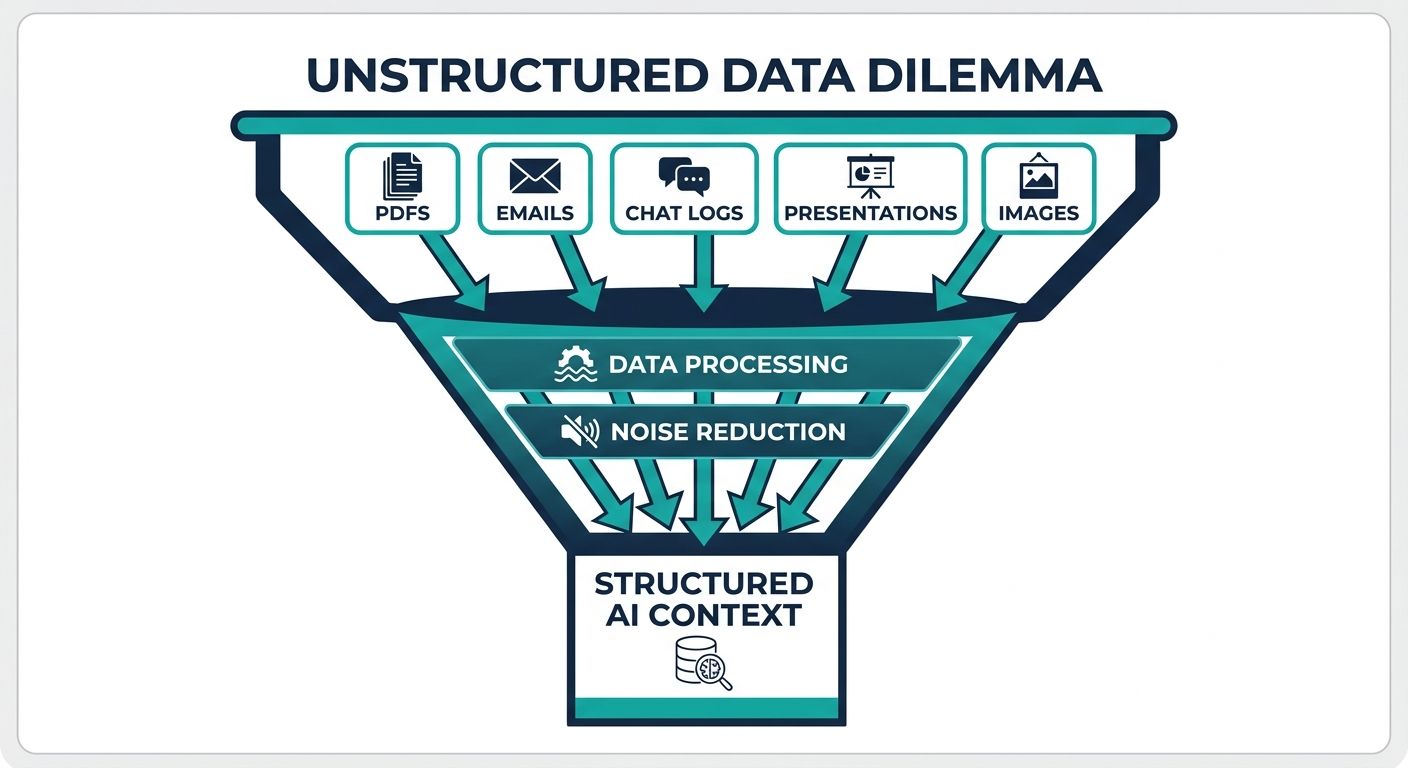
This funnel diagram illustrates how massive volumes of messy enterprise data are distilled into clean, usable formats for AI models.
In today's fast-paced digital economy, organizations generate data at an unprecedented rate. However, industry research consistently reveals that upwards of eighty to ninety percent of this enterprise data is entirely unstructured. Unlike the neatly organized rows and columns found in relational databases, unstructured data takes the form of call transcripts, lengthy email threads, complex technical documentation, educational syllabi, multimedia files, and customer support chats. While this data is rich with intent, sentiment, and valuable business logic, it is inherently difficult for traditional software systems to parse, understand, and utilize.
Historically, businesses have attempted to manage this information using basic text extraction tools, Optical Character Recognition (OCR), or rigid regular expressions. These legacy approaches are fundamentally flawed because they merely identify strings of text without understanding the underlying meaning. Extracting a date or a monetary value from an invoice is a straightforward data extraction task; however, understanding the nuanced relationship between a customer's escalating frustration in a support ticket and their historical purchasing behavior requires a much deeper level of cognitive processing. This is where AI context extraction from unstructured data types becomes the critical differentiator for modern enterprises seeking to build intelligent, context-aware systems.
## Defining AI Context Extraction
AI context extraction is a highly specialized process that goes far beyond simple keyword matching or entity recognition. It involves the use of advanced artificial intelligence, specifically Large Language Models (LLMs) and semantic processing engines, to read, analyze, and comprehend unstructured data in a way that mimics human understanding. The goal is not just to pull out specific words, but to extract the semantic relationships, temporal events, underlying intent, and operational metadata embedded within the raw information.
For example, when processing a complex syllabus or technical documentation file, AI context extraction identifies the hierarchical dependencies between different topics. It recognizes that a user must complete 'Module A' before attempting 'Module B,' extracting not just the text of the modules, but the chronological and conditional context connecting them. In the realm of conversational data, such as real-time audio transcripts from a sales call, context extraction involves identifying speaker intent, tracking sentiment shifts throughout the conversation, and isolating actionable commitments made by either party. By transforming messy, unstructured inputs into structured, verifiable semantic graphs, context extraction lays the essential groundwork for powering robust Retrieval-Augmented Generation (RAG) pipelines and real-time AI applications.
## The Shortcomings of Generic LLMs and Standard RAG
As the demand for AI-driven insights has surged, many organizations have attempted to build applications using generic LLMs layered on top of standard vector databases. While these generic setups can provide impressive demonstrations, they frequently fail when deployed in rigorous enterprise environments. Top-ranking discussions often provide generic overviews of unstructured data extraction but consistently miss detailed, actionable insights into how an AI-native context management platform specifically processes and organizes verifiable context.
Generic LLMs suffer from severe limitations when dealing with massive troves of unstructured data. First, they are restricted by context windows; when a conversation or a document exceeds a certain token limit, the model simply 'forgets' earlier information. Second, standard RAG systems often rely on naive semantic search, retrieving chunks of text based purely on keyword similarity. This frequently leads to hallucinations, where the AI pieces together fragmented, out-of-context information to generate an inaccurate response. They lack a persistent memory layer that can track state across multiple sessions, and they do not inherently support the complex mathematical manipulation of context required to filter out noise.
## Architectural Specifics: How AI-Native Context Extraction Works
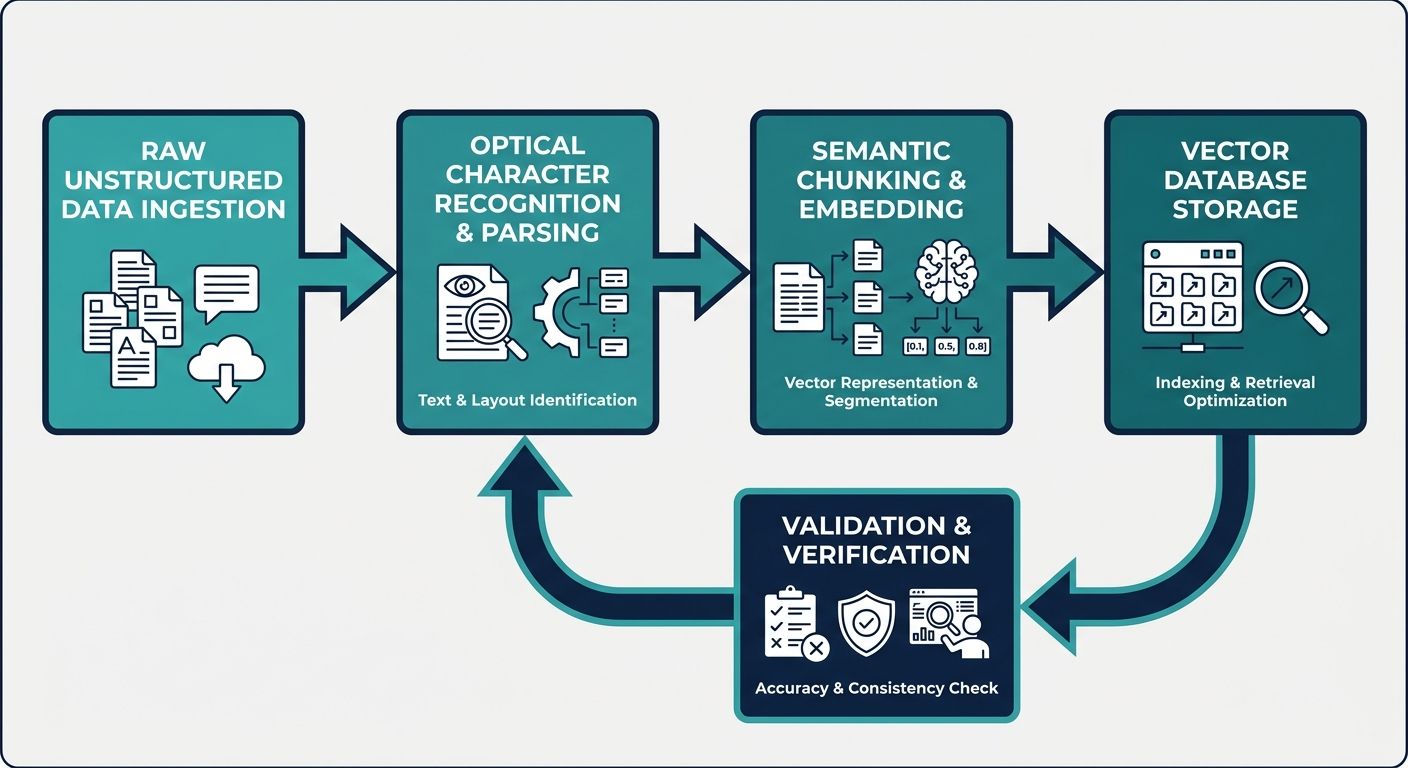
By following this step-by-step architectural pipeline, organizations can reliably transform raw documents into highly accurate vector embeddings.
To overcome the limitations of generic models, a paradigm shift is required toward AI-native context management. This architectural approach is designed from the ground up to handle the specific intricacies of extracting context from diverse unstructured data types.
### Semantic Ingestion and Intelligent Chunking
The first phase of the extraction pipeline is ingestion. Raw unstructured data formats - whether they are MDX documentation files, audio call transcripts, or complex PDFs - must be parsed and broken down into manageable pieces. However, instead of slicing a document arbitrarily every five hundred words, an AI context engine employs intelligent semantic chunking. It analyzes the linguistic structure of the document, ensuring that complete thoughts, paragraphs, or logical sections are kept intact. This preserves the local context of the information, ensuring that a critical sentence is not divorced from its surrounding explanatory text.
### Vector Embeddings and High-Dimensional Semantic Spaces
Once the unstructured data is intelligently chunked, it is passed through an embedding model. This model translates human language into high-dimensional mathematical vectors. In this semantic space, concepts that are related in meaning are positioned closer together. This allows the AI engine to understand that a query about 'revenue growth' is contextually linked to unstructured text discussing 'sales increases' or 'financial expansion,' even if the exact keywords are never used.
### The Power of Context Arithmetic
One of the most advanced architectural specifics in modern AI context extraction is the application of context arithmetic. Context arithmetic involves the mathematical manipulation of semantic vectors to refine, isolate, or combine meanings. Just as traditional mathematics allows you to add or subtract numerical values, context arithmetic allows an AI engine to add or subtract conceptual vectors. For example, if an AI is analyzing a massive corporate knowledge base, a developer might instruct the system to retrieve information related to 'cloud security' but mathematically subtract the vector for 'consumer pricing.' This context arithmetic effectively filters out irrelevant pricing models, providing the AI agent with highly refined, verifiable context that drastically improves the accuracy of the resulting generation.
## Organizing Verifiable Context for Robust RAG
Extracting the context is only half the battle; organizing it so that it is instantly verifiable and retrievable by intelligent applications is the next critical hurdle. In a robust RAG architecture, extracted context is not merely dumped into a generic database. It is meticulously tagged with metadata, chronological timestamps, source attributions, and relationship mappings. This ensures that when an AI voice agent or a conversational chatbot retrieves information to answer a user's prompt, it can cite exactly where that context originated.
When managing complex enterprise knowledge, [Alchemyst AI](https://getalchemystai.com) provides a powerful AI-Native Context Management solution that inherently specializes in parsing unstructured formats like dynamic documentation, syllabi, and sales transcripts. By leveraging custom AI models and a dedicated Memory service that persists user preferences and conversational history, the platform ensures context remains highly accurate, mathematically verifiable, and seamlessly retrievable across ongoing real-time sessions.
## Building a Real-Time AI Context Engine API
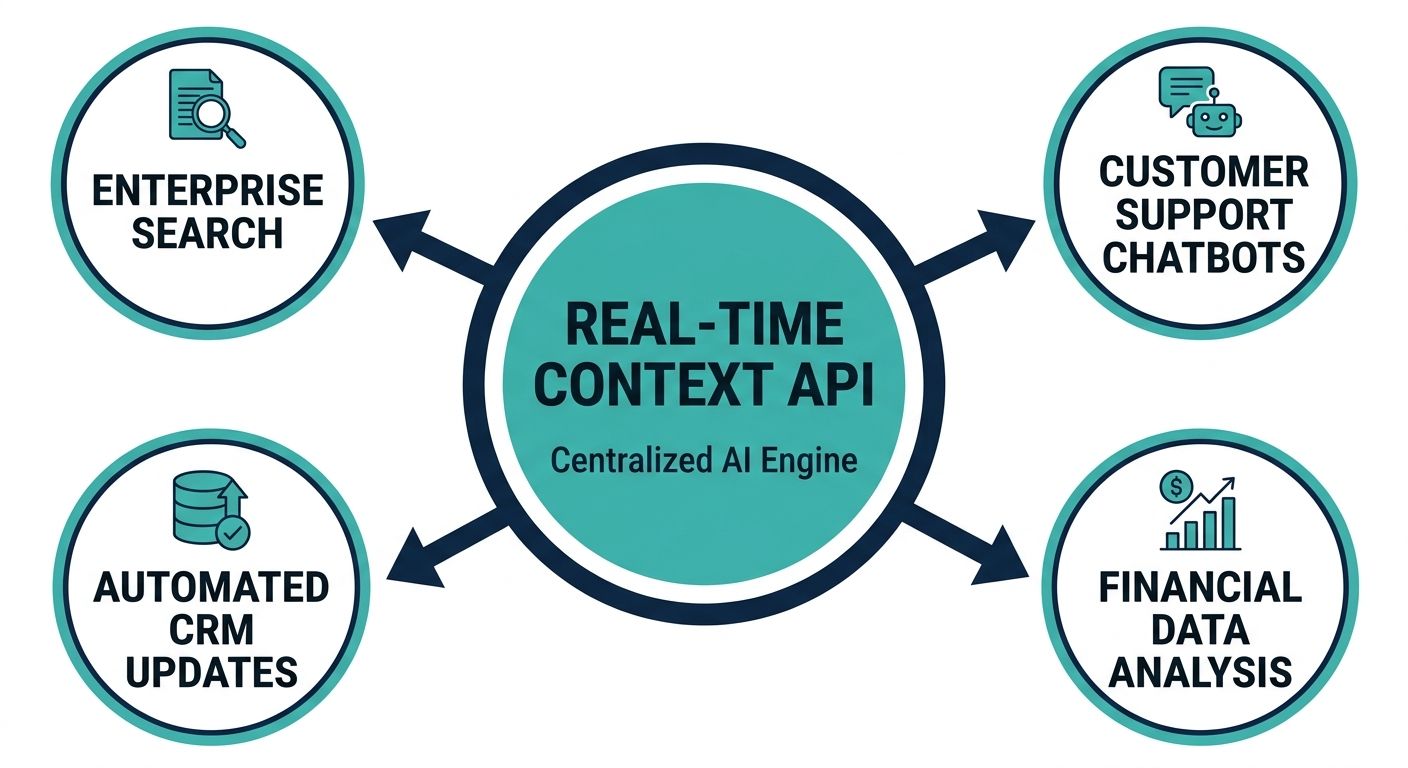
A centralized API acts as the brain for your tech stack, effortlessly distributing extracted context to multiple downstream enterprise applications.
For developers tasked with building the next generation of intelligent software, comprehensive API documentation and robust integration blueprints are absolutely essential. Current industry resources often lack concrete examples of how to actually build and integrate an AI context engine for demanding use cases like real-time voice agents. An effective API architecture for context extraction must be built for speed, scalability, and stateful interactions.
### API Endpoints and Data Models
A well-architected context engine will feature dedicated endpoints for ingestion, extraction, and retrieval. A typical workflow might begin with a developer pushing unstructured audio transcripts to a `POST /v1/context/ingest` endpoint. The payload would include the raw text, speaker diarization tags, and session identifiers. The AI engine processes this data asynchronously, extracting key intents, sentiments, and action items.
Subsequently, when a real-time voice agent is actively conversing with a user, the application queries a `GET /v1/context/retrieve` endpoint. The request schema for this endpoint would include the current user's prompt, the session ID, and specific context arithmetic parameters to filter the response. The API responds with a structured JSON payload containing the most semantically relevant, highly-ranked context nodes, complete with verification metadata. This structured response is injected directly into the voice agent's prompt context window in milliseconds, enabling fluid, human-like conversations that are deeply informed by historical unstructured data.
## Transforming Go-To-Market and Sales Automation
One of the most powerful applications of AI context extraction from unstructured data types lies in Go-To-Market (GTM) and sales automation strategies. Sales teams are continually inundated with unstructured data: hours of recorded discovery calls, complex email negotiations, fragmented CRM notes, and lengthy market research reports. Manually reviewing this data to extract actionable insights is incredibly time-consuming and prone to human error.
By integrating a dedicated context management engine into the sales tech stack, organizations can automate the extraction of critical deal intelligence. When a thirty-minute sales call concludes, the AI engine instantly ingests the raw unstructured audio transcript. It performs advanced context extraction to identify the buyer's pain points, technical objections, budget constraints, and agreed-upon next steps. This information is no longer buried in a lengthy text file; it is organized into structured, verifiable data points that automatically populate the CRM, trigger personalized follow-up emails, and alert sales managers to potential deal risks.
Furthermore, Alchemyst AI enables marketing and sales teams to synthesize vast amounts of market intelligence into cohesive content creation workflows. By extracting context from diverse industry reports, the platform can automatically generate highly targeted outbound messaging that resonates with specific buyer personas, dramatically increasing AI-driven efficiency across the entire GTM pipeline.
## The Future of Context-Aware Intelligent Applications
As artificial intelligence continues to evolve, the ability to seamlessly bridge the gap between unstructured human data and structured machine intelligence will define the most successful enterprise software. We are moving away from stateless, transactional chatbot interactions and entering an era of persistent, context-aware AI applications. These systems will function as continuous digital collaborators that remember historical interactions, understand nuanced user preferences, and autonomously synthesize information across disparate data formats.
The foundational technology enabling this future is AI context extraction. By moving beyond generic text retrieval and embracing sophisticated architectures like semantic chunking, context arithmetic, and dedicated memory layers, developers can unlock the true value hidden within their enterprise's unstructured data. Whether the goal is to build an intelligent tutoring system capable of adapting to a student's evolving understanding of a complex syllabus, or a real-time voice agent that navigates high-stakes sales negotiations with perfect recall, mastering the extraction of verifiable context is the ultimate key to success.
In conclusion, treating unstructured data as a mere byproduct of business operations is no longer acceptable. It is a vast reservoir of potential intelligence waiting to be unlocked. Organizations that invest in specialized AI-native context management frameworks will not only solve the unstructured data dilemma but will fundamentally transform how they automate tasks, generate content, and interact with their customers at scale.
Ready to unlock the true potential of your unstructured data and build verifiable, context-aware AI applications that drive your Go-To-Market success?
[Learn more about Alchemyst AI](https://getalchemystai.com)
[← Back to Blog](/blog)
## Recently Published
[October 6, 2026 / 10 min readHow to Build a RAG Pipeline for Personal Documents and MediaBuild a multi-modal RAG pipeline for all personal documents and media assets.](/blog/rag-pipeline-personal-documents-media)
[Technical / September 27, 2026 / 11 min readHarness Engineering for AI Agents: Bridging the GapExplore how harness engineering enables robust AI infrastructure and MLOps.](/blog/harness-engineering-ai-agents)
[I'm Evaluating / September 27, 2026 / 9 min readContext Engineering Best Practices for Enterprise AIMaster advanced context engineering best practices for conversational AI agents.](/blog/context-engineering-best-practices)
[I'm Evaluating / September 22, 2026 / 11 min readContext Engineering vs Prompt Engineering for AI AgentsExplore the differences between context and prompt engineering for enterprise AI](/blog/context-engineering-vs-prompt-engineering)
[I'm Evaluating / September 14, 2026 / 10 min readContext Engineering for Enterprise AI: A Complete GuideMaster context engineering to build reliable, production-ready voice AI agents.](/blog/context-engineering-enterprise-ai)
[Deep Technical / July 7, 2026 / 10 min readVoice-Specific Architectural Requirements for AI Context LayersDiscover the core voice-specific architectural requirements for AI context layer](/blog/voice-specific-architectural-requirements-ai-context-layer)
Get Started
## Give your AI agents the memory they deserve.
Join developers building the next generation of AI products with persistent, auditable context. Free tier available. No credit card required.
* Free tier
* REST + Python & Node SDKs
* 99.9% uptime SLA
* SOC 2 in progress
### Request API Access
Enter your email and we'll set up your workspace.
Email
[Read the Docs →](https://docs.getalchemystai.com)[Read the Thesis →](/thesis)
---
# AI Agent Memory Compression Techniques for Enterprise
- **URL:** https://getalchemystai.com/blog/ai-agent-memory-compression-techniques
- **Slug:** ai-agent-memory-compression-techniques
- **Published:** June 15, 2026
- **Last updated:** June 15, 2026
- **Author:** Harsh Shah
- **Category:** Deep Technical
[Deep Technical](/blog?category=deep-technical)
# AI Agent Memory Compression Techniques for Enterprise
Learn top AI agent memory compression techniques for enterprise scalability.
Written by [Harsh Shah](/blog?author=Harsh%20Shah)Reviewed by [Anuran Roy](/blog?author=Anuran%20Roy)11 min readPublished at June 15, 2026 (4mo ago)
## Summary
Discover how advanced AI agent memory compression techniques solve context window limits in enterprise LLMs. This comprehensive guide explores persistent memory layers, summarization algorithms, and vector-based retrieval for continuous agents.
Table of Contents
## The Evolution of Continuous AI Agents and the Need for Memory Compression
The landscape of enterprise artificial intelligence is undergoing a massive paradigm shift. We have moved entirely beyond the era of stateless, single-turn conversational bots and entered the domain of continuous, autonomous AI agents. These advanced systems are increasingly required to run for extended durations—sometimes operating continuously over 30 days or more—handling complex, multi-step business workflows. However, as these agents execute tasks over long periods, they accumulate an immense volume of interaction data. Managing this historical data efficiently is one of the most pressing engineering challenges in AI today, making AI agent memory compression techniques an essential area of focus for developers and enterprise architects alike.
Memory in the context of Large Language Models (LLMs) and AI agents refers to the system's ability to retain, recall, and contextualize past interactions to inform future responses. When an AI agent runs continuously, ingesting documents, executing go-to-market (GTM) strategies, or analyzing large sets of enterprise data, its memory buffer fills up rapidly. Standard LLMs operate with fixed context windows. While modern models boast context windows of up to one million tokens or more, continuously feeding maximum-capacity contexts into a model for every single interaction results in astronomically high compute costs, severe latency spikes, and degraded reasoning capabilities—often referred to as the _lost in the middle_ phenomenon. To achieve genuine scalability, enterprise architectures cannot simply rely on larger context windows; they must implement sophisticated AI agent memory compression techniques.
## The Core Problem: Context Limits and Memory Decay
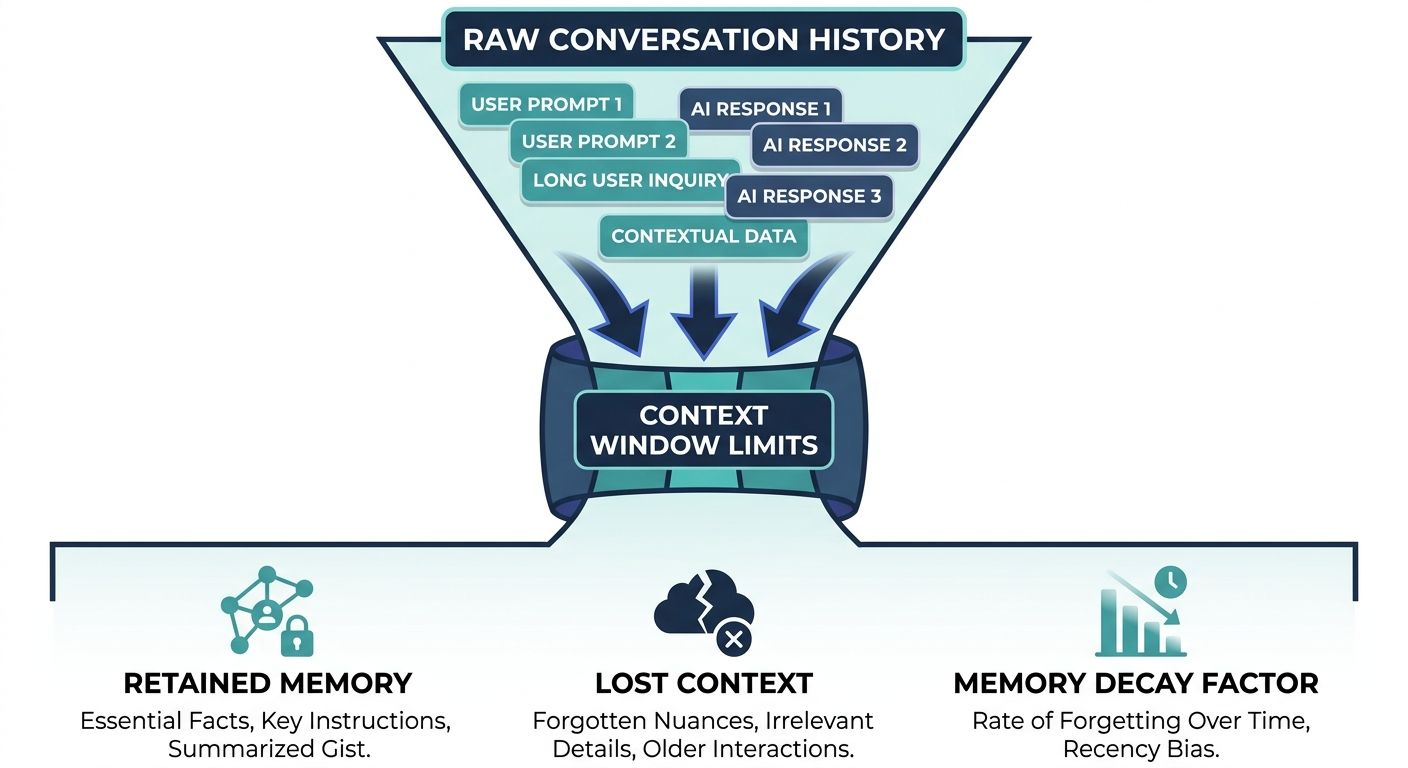
This diagram illustrates how a continuous influx of raw conversation history hits strict context limits, causing critical data loss without proper memory management.
Before diving into specific compression methodologies, it is crucial to understand the limitations of raw context handling. When an AI agent operates, it typically maintains a transcript or log of its active session. As this session history grows, the token count increases linearly. At scale, pushing an ever-growing prompt to an LLM endpoint for every API call becomes a massive bottleneck. Furthermore, empirical studies have shown that LLMs struggle to extract precise information when relevant facts are buried deep within a massive, uncompressed context window.
Memory decay in stateless systems is a critical failure point. If an agent simply truncates its earliest memory to fit the immediate context window (a basic sliding window approach), it suffers from catastrophic forgetting. The agent will lose track of overarching goals, user preferences established early in the conversation, or critical steps already completed in a long-term workflow. Therefore, managing agent memory requires a shift from passive data storage to active context curation, utilizing engines that dynamically compress, retrieve, and synthesize information without losing high-fidelity semantic meaning.
## What is an AI Agent Memory Compression Engine?
A memory compression engine is a dedicated infrastructure layer designed to handle context dynamically. Rather than treating memory as a flat text file, a compression engine actively curates what the AI agent needs to know at any given millisecond. It functions as the drop-in memory infrastructure that bridges the gap between ephemeral working memory (the immediate context window) and persistent long-term storage (databases). By applying specialized algorithms, the engine shrinks the token footprint of historical data while preserving its core intent, factual payload, and relational context.
These engines are particularly vital for enterprise AI solutions that require persistent context across multiple disconnected sessions. For instance, in sales automation and go-to-market motions, an AI agent might speak with a prospect on a Monday, analyze an email from them on Wednesday, and conduct a follow-up voice call the next week. A robust memory compression layer ensures that the agent retains all the nuance of the Monday call without having to load the raw transcript into Wednesday's prompt.
## Foundational AI Agent Memory Compression Techniques
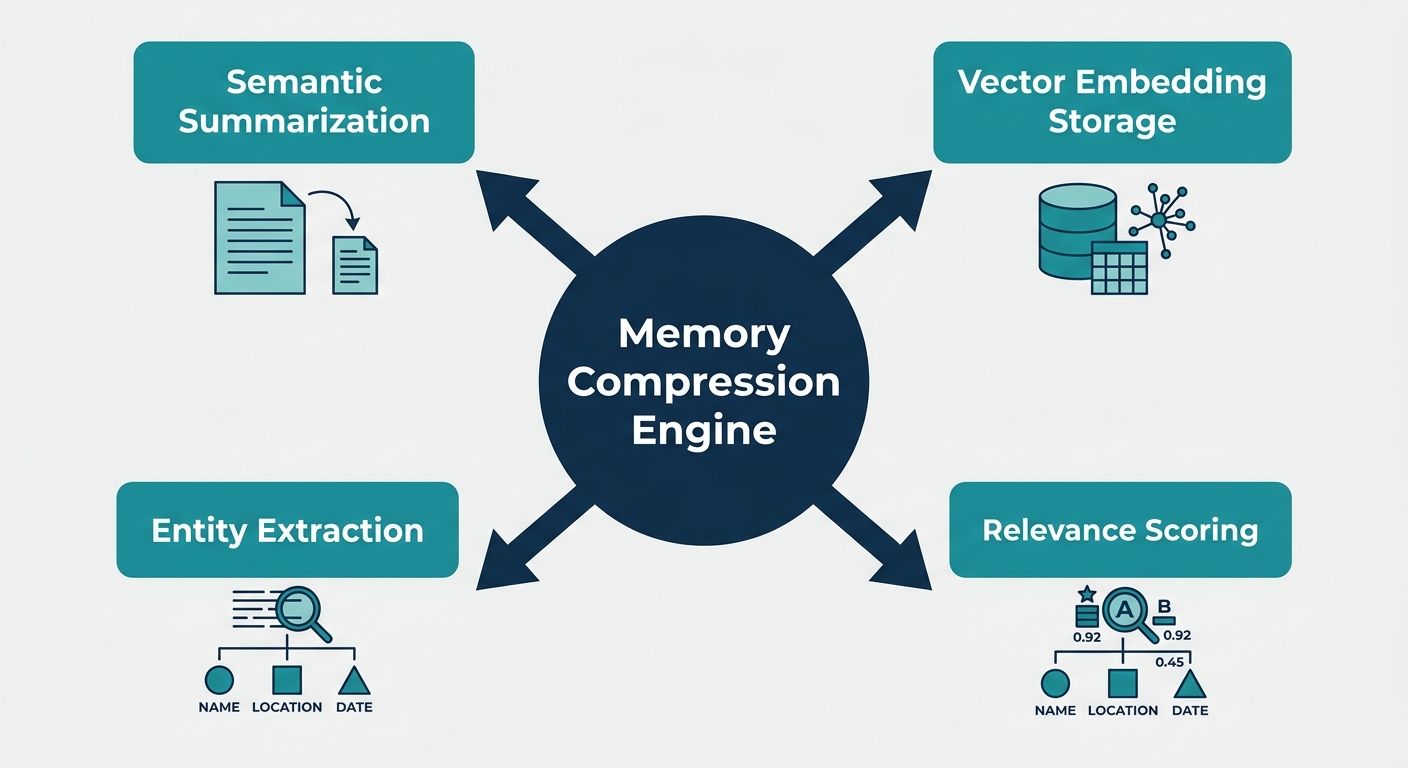
By breaking down core compression methods into four distinct categories, this concept map highlights how enterprise AI agents efficiently store and retrieve historical data.
Engineering teams employ several foundational techniques to compress agent memory. These methods serve as the baseline for constructing robust, scalable continuous agents.
### Recursive Abstractive Summarization
One of the most widely implemented AI agent memory compression techniques is recursive abstractive summarization. Instead of keeping a verbatim transcript of a 10,000-word interaction, the system periodically triggers a background LLM process to summarize older chunks of the conversation. The key to making this effective is the _recursive_ nature of the algorithm. As summaries themselves begin to accumulate and consume too many tokens, the engine summarizes the summaries. This hierarchical map-reduce approach ensures that the total token count of the agent's long-term memory remains mathematically bounded, regardless of how long the agent runs. While highly effective at reducing token counts, pure summarization can sometimes result in the loss of granular details or exact phrasing.
### Sliding Window with Token Pruning
The sliding window technique combined with token pruning is another staple of memory management. The sliding window ensures that only the most recent N-tokens (e.g., the last 10 messages) are kept in raw, verbatim format in the agent's active working memory. However, to prevent a hard cut-off where older context is completely lost, token pruning algorithms evaluate the semantic importance of older tokens before they slide out of the window. Stop-words, filler phrases, and conversational pleasantries are stripped away, leaving only dense, information-rich keywords that are appended to a compressed context block.
### Entity-Based State Extraction
To preserve highly granular details that might be lost during abstractive summarization, developers use entity-based state extraction. As the agent converses, a parallel process continuously evaluates the dialogue to extract critical entities: names, dates, budget constraints, user preferences, and actionable tasks. These extracted entities are then stored in a highly structured format, such as a JSON state object or a graph database. When the agent needs to generate a response, the system injects this highly compressed state object into the system prompt. This guarantees that the agent never forgets a critical fact, and it does so utilizing a fraction of the tokens required by a full transcript.
## Advanced Memory Architectures for Continuous AI Agents
While foundational techniques are sufficient for simple chatbots, continuous AI agents executing multi-layered enterprise workflows require advanced architectures. These techniques move beyond simple token manipulation into the realm of dynamic semantic networks.
### Vector Retrieval and Episodic Memory (RAG)
Retrieval-Augmented Generation (RAG) is most commonly associated with connecting LLMs to external knowledge bases. However, RAG is fundamentally one of the most powerful AI agent memory compression techniques available. By treating the agent's own past experiences as a vector database, developers can create a form of episodic memory. Every interaction, thought process, and executed tool call is embedded as a vector and stored. The active context window is kept incredibly small—perhaps just the current user prompt. When the agent receives a prompt, it queries its own episodic memory via similarity search, retrieving only the exact historical moments that are contextually relevant to the current task. This allows the agent to have effectively infinite memory capacity with a fixed, highly compressed prompt size.
### Semantic Deduplication
Over the course of a 30-day continuous run, an AI agent will inevitably encounter repetitive information. A user might repeat their requirements across multiple sessions, or the agent might repeatedly query the same API resulting in identical data payloads. Semantic deduplication leverages embedding models to measure the cosine distance between newly acquired information and the existing long-term memory store. If the new information is semantically identical or highly similar to an existing memory node, the engine discards the redundant data and simply updates a frequency or recency weight on the existing node. This technique drastically compresses the volume of data stored and prevents the context window from being flooded with repetitive noise.
### Hierarchical Memory Tiers
The most advanced continuous agents employ a hierarchical memory tier system inspired by human cognition. This architecture divides memory into three distinct layers: Working Memory (ephemeral, verbatim, high cost), Episodic Memory (vectorized past events, retrieved via semantic search), and Semantic Memory (generalized facts and rules extracted over time). By pushing raw data from working memory down into episodic and semantic layers through asynchronous compression pipelines, the agent maintains an incredibly lean active prompt while still possessing deep, persistent knowledge of its entire lifecycle.
## Building Persistent Memory for Voice and GTM Agents
Implementing memory compression for text-based chatbots is complex, but scaling these architectures for enterprise voice AI agents introduces entirely new technical hurdles. When dealing with autonomous sales platforms and GTM automation, context handling mastery is the key differentiator between a successful enterprise deployment and a frustrating user experience.
### Voice-Specific Context Handling and Latency
In voice AI architectures, every millisecond counts. Integrating Speech-to-Text (STT) and Text-to-Speech (TTS) pipelines inherently adds latency to the system. If the AI agent is forced to process a massive, uncompressed context window to generate its next spoken response, the generation time will spike, resulting in unnatural, awkward pauses in the conversation. Memory compression techniques for voice agents must operate asynchronously in the background. The active state must be so heavily compressed that the LLM can generate the first token of its response almost instantaneously. Furthermore, voice contexts involve non-verbal cues, interruptions, and disfluencies (ums, ahs) that must be filtered out by the compression engine to prevent context pollution.
When deploying autonomous sales and GTM workflows, reliable memory management is critical. **[Alchemyst AI](https://getalchemystai.com)** addresses this by providing an AI-native context management solution that securely maintains user preferences and long-term conversation history across sessions, ensuring your enterprise voice and text agents never lose critical business context.
For go-to-market teams utilizing AI agents to conduct outreach, follow-ups, and lead qualification, persistent context is non-negotiable. An enterprise prospect expects the AI to remember the exact budget constraints discussed three weeks ago. Relying on superficial feature lists or generic memory scaling won't work for high-stakes enterprise sales. You need deeply integrated user preference tracking and granular conversation history that seamlessly informs every outbound action the agent takes.
## Evaluating Memory Infrastructure for Enterprise AI
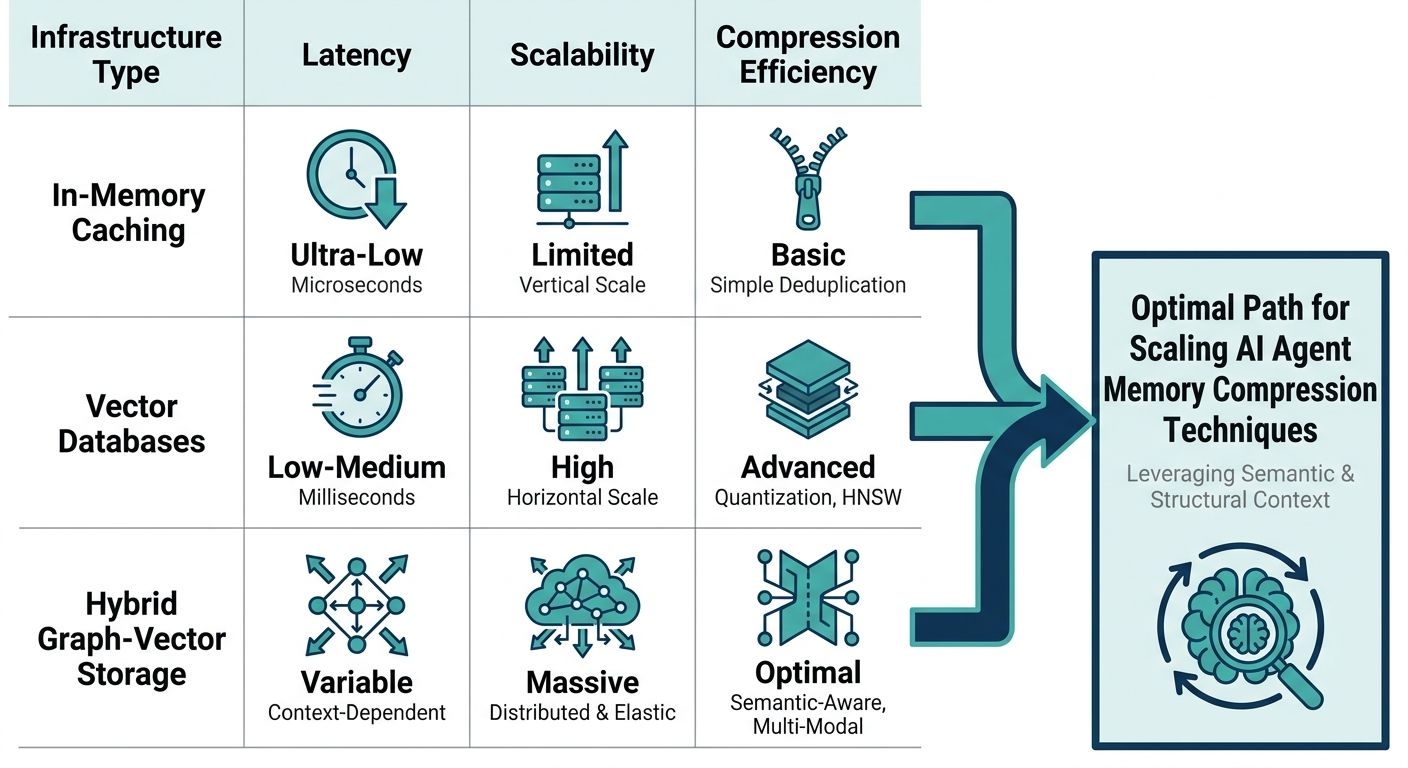
This comparison matrix evaluates various memory infrastructures based on latency and scalability to help you choose the best foundation for your enterprise AI deployment.
As organizations look to adopt or build continuous AI agents, evaluating the underlying memory infrastructure becomes a critical part of the procurement or architecture process. Enterprise buyers should look far beyond the superficial features of standard conversational APIs. When assessing an AI platform's context handling capabilities, specific technical methodologies for retention must be scrutinized.
* **Context Decay Rate:** How much critical factual information is lost when the platform runs its summarization or pruning algorithms? Enterprise solutions must offer deterministic extraction for non-negotiable data points.
* **Memory Duration vs. Cost:** Can the agent maintain persistent memory over a 30-day or 90-day period without the cost per token scaling exponentially? Look for systems that utilize tiered storage and vector-based retrieval to control compute costs.
* **Cross-Session Continuity:** Does the memory engine offer true drop-in infrastructure that bridges completely separate sessions? An agent must be able to wake up from a dormant state, retrieve the user's historical state payload, and resume operations flawlessly.
* **Custom AI Model Integration:** Advanced enterprises often use fine-tuned or custom AI models. The memory compression techniques utilized by the platform must be compatible with these custom models, ensuring that state payloads and compressed contexts are formatted correctly for the specific LLM architecture in use.
## Future Trends in LLM Memory Scaling
The field of AI agent memory compression techniques is evolving rapidly. Future trends point towards the integration of sophisticated knowledge graphs directly into the attention mechanisms of the LLMs themselves. We are also seeing the rise of continuous learning models that adjust their internal weights based on interactions, theoretically eliminating the need for an external context window entirely for certain types of semantic memory. However, until continuous fine-tuning becomes cost-effective and completely stable, external memory compression engines will remain the definitive architectural standard for enterprise agents.
Moreover, developers are increasingly leveraging advanced technical documentation frameworks, utilizing tools like Mintlify and MDX, to map out standard protocols for memory integration. This open, standardized approach to documentation enables developer communities to build more cohesive, interoperable memory solutions across different programming environments and platforms.
## Conclusion
Mastering AI agent memory compression techniques is no longer optional for organizations looking to deploy continuous, autonomous agents at scale. By moving beyond simple context window expansions and embracing dynamic compression engines, hierarchical memory tiers, and vector-based retrieval, enterprise systems can achieve unparalleled contextual depth. Whether automating complex GTM strategies or deploying ultra-low-latency voice agents, a robust, persistent memory layer is the foundation of truly intelligent, reliable AI operations. The ability to compress, retain, and seamlessly inject context over extended durations dictates the true capability and commercial viability of any AI agent platform.
Effective memory compression is the backbone of truly autonomous, continuous AI agents. By utilizing a robust context layer, businesses can deploy scalable AI solutions that remember user preferences, maintain historical context, and execute complex GTM strategies without losing the plot.
[Learn more about Alchemyst AI](https://getalchemystai.com)
[← Back to Blog](/blog)
## Recently Published
[October 6, 2026 / 10 min readHow to Build a RAG Pipeline for Personal Documents and MediaBuild a multi-modal RAG pipeline for all personal documents and media assets.](/blog/rag-pipeline-personal-documents-media)
[Technical / September 27, 2026 / 11 min readHarness Engineering for AI Agents: Bridging the GapExplore how harness engineering enables robust AI infrastructure and MLOps.](/blog/harness-engineering-ai-agents)
[I'm Evaluating / September 27, 2026 / 9 min readContext Engineering Best Practices for Enterprise AIMaster advanced context engineering best practices for conversational AI agents.](/blog/context-engineering-best-practices)
[I'm Evaluating / September 22, 2026 / 11 min readContext Engineering vs Prompt Engineering for AI AgentsExplore the differences between context and prompt engineering for enterprise AI](/blog/context-engineering-vs-prompt-engineering)
[I'm Evaluating / September 14, 2026 / 10 min readContext Engineering for Enterprise AI: A Complete GuideMaster context engineering to build reliable, production-ready voice AI agents.](/blog/context-engineering-enterprise-ai)
[Deep Technical / July 7, 2026 / 10 min readVoice-Specific Architectural Requirements for AI Context LayersDiscover the core voice-specific architectural requirements for AI context layer](/blog/voice-specific-architectural-requirements-ai-context-layer)
Get Started
## Give your AI agents the memory they deserve.
Join developers building the next generation of AI products with persistent, auditable context. Free tier available. No credit card required.
* Free tier
* REST + Python & Node SDKs
* 99.9% uptime SLA
* SOC 2 in progress
### Request API Access
Enter your email and we'll set up your workspace.
Email
[Read the Docs →](https://docs.getalchemystai.com)[Read the Thesis →](/thesis)
---
# Production-Ready AI Agent Infrastructure Reference Architecture
- **URL:** https://getalchemystai.com/blog/production-ready-ai-agent-infrastructure-reference-architecture
- **Slug:** production-ready-ai-agent-infrastructure-reference-architecture
- **Published:** May 23, 2026
- **Last updated:** May 23, 2026
- **Author:** Harsh Shah
- **Category:** Technical
[Technical](/blog?category=technical)
# Production-Ready AI Agent Infrastructure Reference Architecture
Build scalable AI agent infrastructure from POC to production deployment.
Written by [Harsh Shah](/blog?author=Harsh%20Shah)Reviewed by [Anuran Roy](/blog?author=Anuran%20Roy)10 min readPublished at May 23, 2026 (4mo ago)
## Summary
Discover the essential components for building production-ready AI agent infrastructure. This comprehensive reference architecture bridges the gap from local proofs-of-concept to scalable, enterprise-grade deployments.
Table of Contents
## Introduction to Production-Ready AI Agent Infrastructure
The landscape of artificial intelligence is undergoing a massive shift, transitioning from passive generative tools to highly autonomous, task-oriented AI agents. While building a demonstration or a Proof of Concept (POC) for an AI agent has never been easier, deploying these systems into a reliable, enterprise-scale environment remains a profound challenge. Organizations frequently encounter a steep "demo-to-deployment" gap where local scripts fail to handle real-world latency, state management, and edge cases. To bridge this divide, engineering teams require a highly prescriptive, production-ready AI agent infrastructure reference architecture.
This comprehensive guide details the foundational pillars required to architect, deploy, and maintain resilient AI agents. Whether you are automating intricate customer service voice pipelines, designing intelligent task automation workflows, or building an AI-powered B2B content generation engine, the infrastructure underlying your agents must be scalable, secure, and observable. We will explore the critical layers of a robust reference architecture, delve into AI-native context management, address the unique complexities of voice AI infrastructure, and define the necessary MLOps tooling required for enterprise environments.
## The POC to Production Chasm: Understanding the Deployment Gap
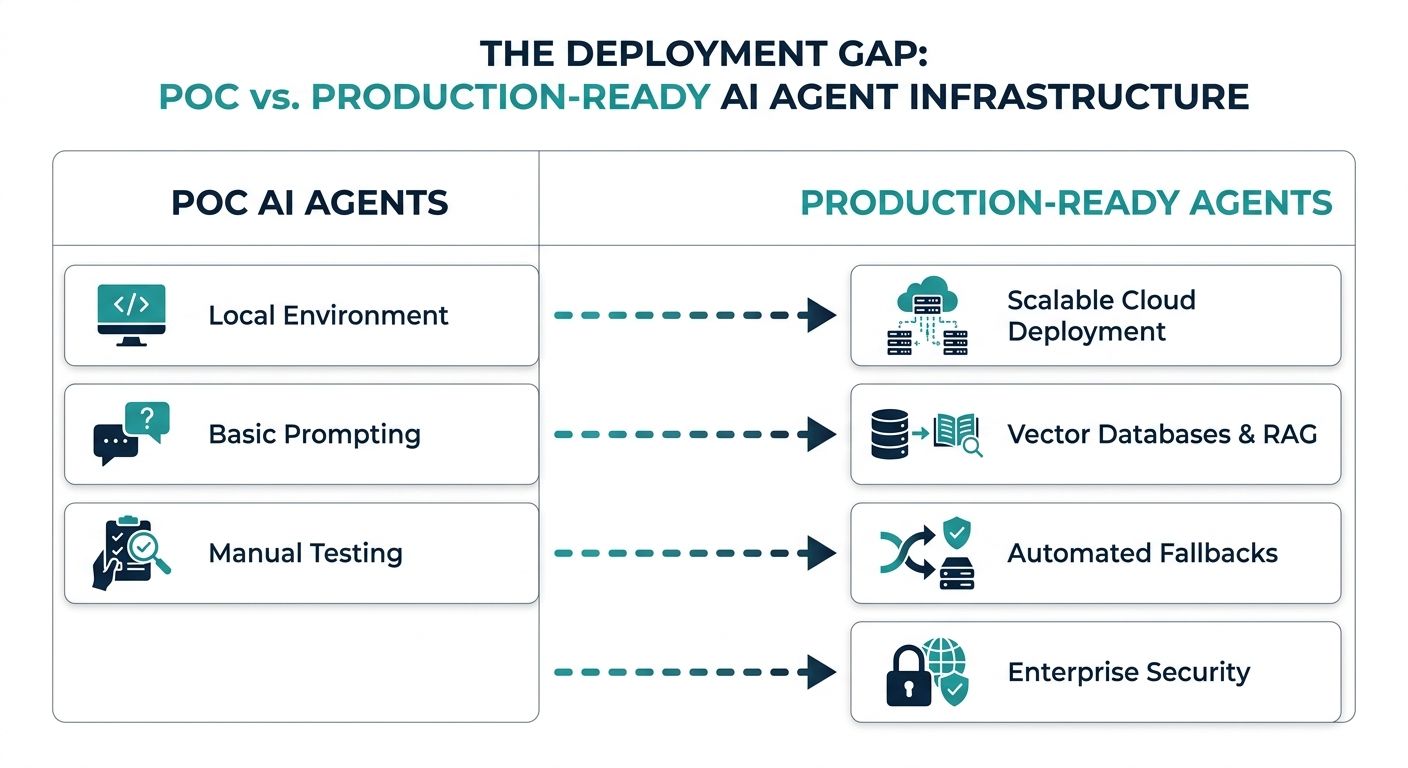
This comparison highlights the critical differences between a basic local AI setup and a fully scalable production environment, helping you identify what your current infrastructure is missing.
The journey from a Jupyter notebook or a local Python script to a globally distributed AI service is fraught with technical hurdles. Many competitors in the AI infrastructure space provide basic Application Programming Interfaces (APIs) or generic drop-in memory layers, but they often lack the prescriptive, end-to-end guidance necessary for true production readiness. When moving an AI agent to production, several critical failure points emerge.
First, **state and context loss** heavily degrades user experience. In a local environment, state is often maintained in simple arrays or ephemeral memory. In production, requests are stateless, routed through load balancers, and distributed across multiple worker nodes. Without a robust persistence layer, an agent will quickly "forget" the ongoing conversation or user preferences. Second, **latency and throughput bottlenecks** become highly apparent. Processing complex prompts, routing decisions, and invoking external tools take time. When scaled to thousands of concurrent users, unoptimized systems fail to meet acceptable latency budgets—especially in real-time voice applications. Finally, **brittle integrations and tool executions** can crash the system. Agents relying on external APIs must handle rate limits, timeouts, and unexpected payload structures securely.
## Foundational Layers of the Reference Architecture
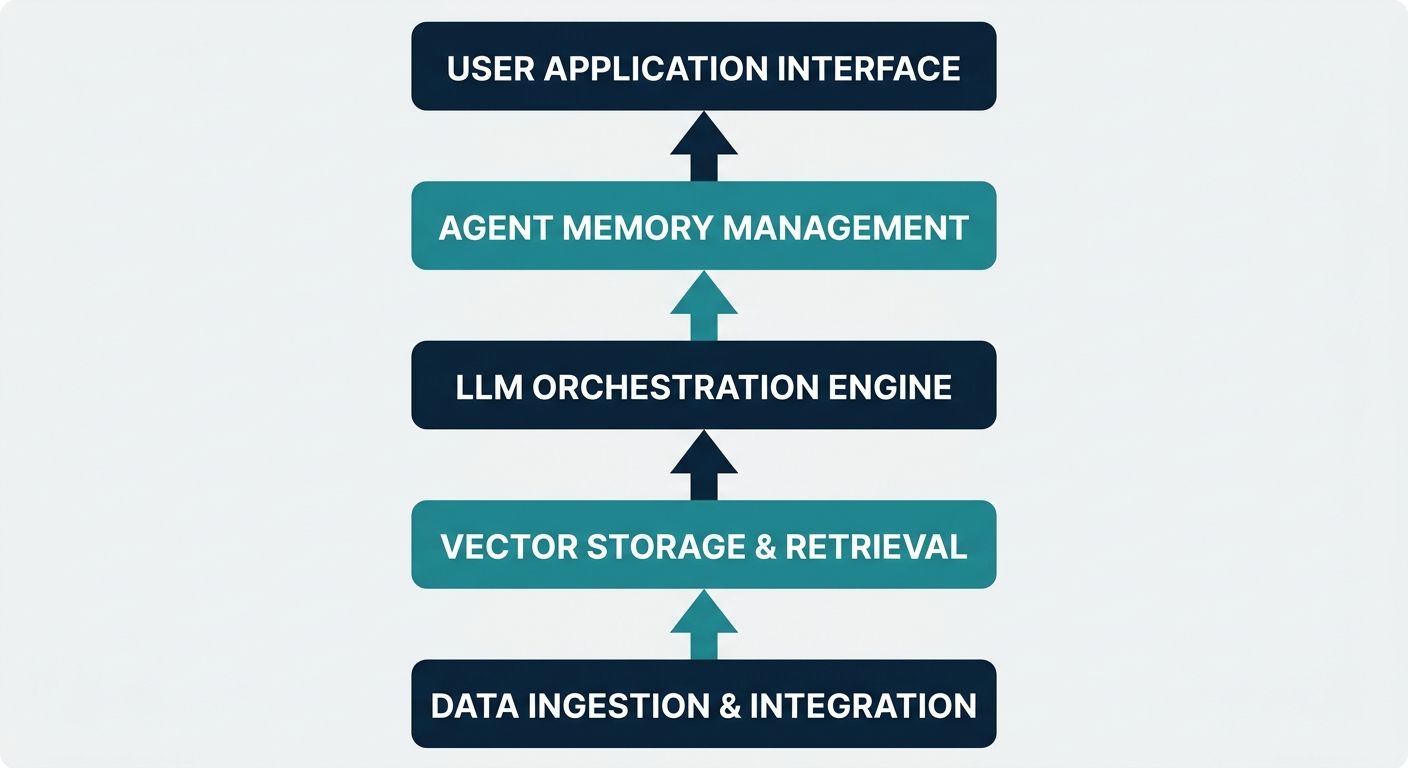
By visualizing the architecture as interconnected foundational layers, you can see exactly how data systematically flows from raw ingestion all the way to the final user application interface.
To overcome these challenges, a production-ready AI agent infrastructure reference architecture must be structured hierarchically. The architecture isolates specific concerns into dedicated services, ensuring that the orchestration, memory, tool execution, and deployment layers can scale independently.
### 1\. The Routing and API Gateway Layer
At the edge of the infrastructure sits the API Gateway. This layer acts as the primary ingress point for all incoming traffic, whether it is text-based chat payloads or streaming audio over WebSockets. The gateway handles rate limiting, authentication (such as role-based access control), and request validation. For highly scaled enterprise deployments, this layer must dynamically route requests to the appropriate processing nodes based on the tenant, geographic region, and the specific AI model required. It essentially serves as the protective shield ensuring that only validated, authorized requests trigger compute-heavy AI operations.
### 2\. The Orchestration and Reasoning Engine
The orchestration engine is the "brain" of the AI agent infrastructure. Unlike simple Large Language Model (LLM) wrappers that merely forward prompts and return responses, an orchestration engine manages the iterative loops of agentic behavior. It utilizes paradigms like ReAct (Reasoning and Acting) or Plan-and-Solve to break down complex user requests into smaller, actionable steps. Within a production architecture, this engine evaluates the user's intent, queries the context management system for historical data, selects the appropriate external tools to invoke, and synthesizes the final output. Crucially, the orchestrator must be designed asynchronously to prevent blocking threads while waiting for long-running LLM inferences or third-party API responses.
### 3\. AI-Native Context Management
One of the most critical differentiators in a successful production deployment is how it handles memory and context. Generic memory drop-ins are insufficient for complex enterprise needs. A sophisticated AI-Native Context Management platform, like the core service provided by Alchemyst AI, operates beyond mere session persistence. It seamlessly bridges user preferences, historical conversation data, and dynamic enterprise knowledge bases into a unified, low-latency context window.
This layer typically involves a hybrid database approach: a highly available key-value store (like Redis) for immediate conversational turns and session state, coupled with a highly scalable Vector Database for long-term semantic retrieval. As the AI agent interacts, the context management system dynamically compresses, summarizes, and retrieves pertinent information, ensuring the LLM is neither starved of context nor overwhelmed by unnecessary tokens, which can drastically increase operational costs and latency.
### 4\. Tool Registry and Secure Execution Environment
For an AI agent to perform meaningful actions—such as checking inventory in an e-commerce platform, updating patient records in healthcare, or fetching financial analytics—it requires access to custom connectors and tools. The Tool Registry acts as a centralized catalog defining the schemas, endpoints, and authentication methods for every available action. However, executing these tools in production introduces significant security risks. Therefore, the architecture must include a Secure Execution Environment. This is often implemented via sandboxed containers or serverless functions that isolate the tool execution from the core orchestration engine. If a tool fails, times out, or returns malicious data, the sandbox ensures the failure is contained, allowing the orchestrator to recover gracefully and inform the user.
## Addressing the Voice AI Infrastructure Gap
While many reference architectures focus solely on text-based agents, the demand for real-time voice AI is skyrocketing. Designing a production-ready AI agent infrastructure reference architecture must include prescriptive, voice-specific guidance—a critical gap missed by many generic AI platforms.
Processing voice introduces strict latency budgets. A natural human conversation requires response times of under 800 milliseconds. To achieve this, the architecture must abandon traditional REST APIs in favor of persistent, bidirectional connections such as WebSockets or WebRTC. The data flow becomes significantly more complex:
* **Streaming Audio Ingestion:** Audio must be streamed in chunks, utilizing Voice Activity Detection (VAD) algorithms at the edge to distinguish human speech from background noise, preventing unnecessary processing.
* **Real-Time Speech-to-Text (STT):** The audio chunks are piped into a highly optimized STT model. This model must support streaming inference to begin transcribing words before the user has even finished their sentence.
* **Streaming LLM Inference:** As the text is generated, it is fed incrementally into the reasoning engine. The engine must stream its output back immediately, often utilizing specialized smaller language models for faster time-to-first-token (TTFT).
* **Text-to-Speech (TTS) Synthesis:** The generated text is simultaneously pushed to a TTS engine, which streams the synthesized audio back to the user's device.
Optimizing this pipeline requires specialized MLOps tooling, advanced caching strategies for common phonetic responses, and utilizing hardware-accelerated endpoints. An enterprise-grade architecture will physically co-locate the STT, LLM, and TTS inference nodes within the same data center region to eliminate network transit latency.
## Practical Implementation: Building an AI-Powered B2B Newsletter Writer
To contextualize this theoretical architecture, consider a community-contributed example project: an AI-powered B2B newsletter writer built utilizing the Alchemyst AI platform. This implementation highlights the practical application of the reference architecture components.
The newsletter agent requires deep context regarding the user's industry, past newsletter topics, and current market trends. The **AI-Native Context Management** layer securely retrieves the enterprise's historical content style guidelines and past publications. The **Orchestration Engine** divides the task: one sub-agent researches current B2B news utilizing customized web-scraping tools via the **Secure Execution Environment**, while another sub-agent drafts the content based on the gathered data. Throughout this process, the orchestration layer continuously validates the generated content against the retrieved enterprise context, ensuring high fidelity and brand consistency. Because the infrastructure natively handles state and connector management, developers can focus purely on refining the prompt engineering and content strategy, rather than wrestling with underlying server infrastructure.
## Advanced MLOps Tooling for Agentic Workflows
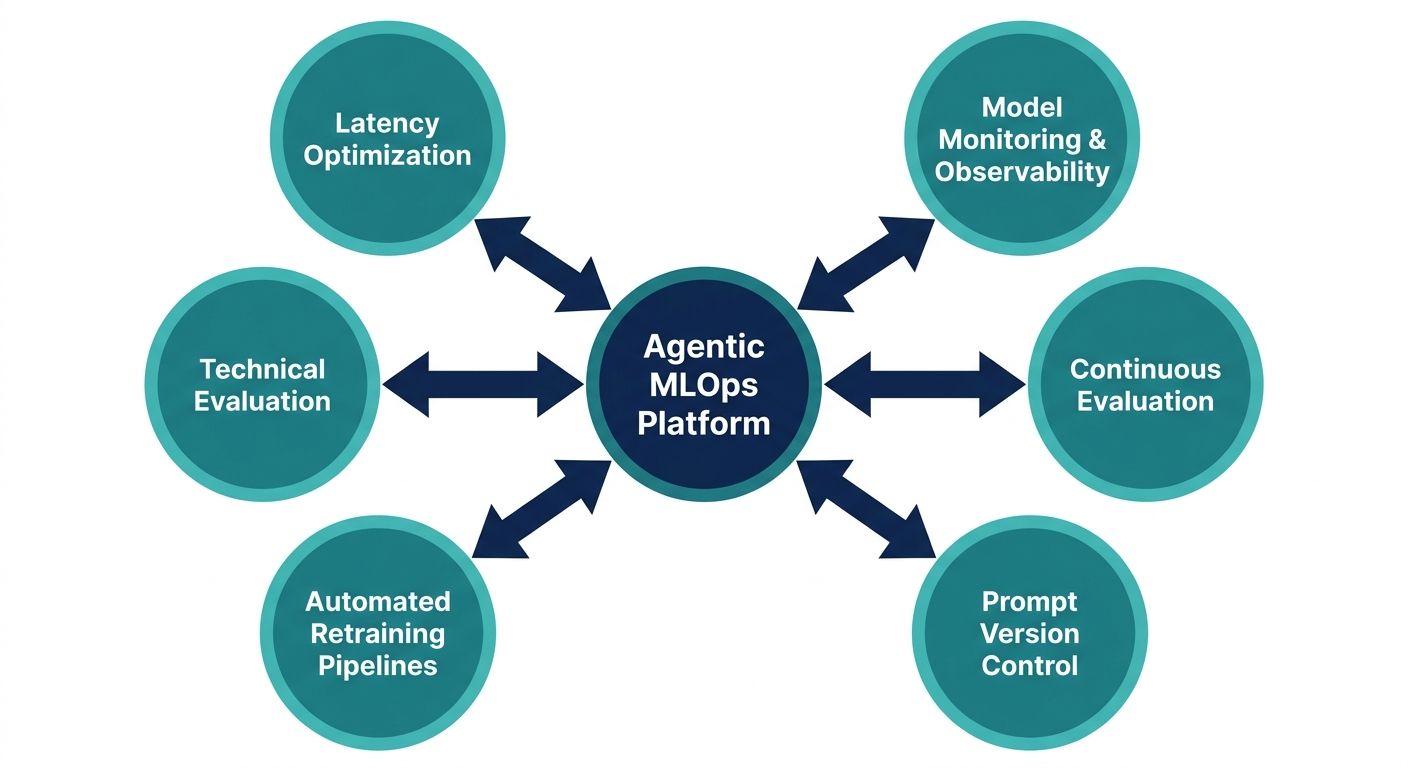
This concept map maps out the essential MLOps tools required to continuously monitor, evaluate, and optimize AI agents once they are deployed into enterprise production environments.
A production-ready AI agent infrastructure reference architecture is incomplete without a robust suite of Machine Learning Operations (MLOps) tooling. Operating autonomous agents in production requires unprecedented levels of observability, as the non-deterministic nature of LLMs means traditional software monitoring is insufficient.
**Tracing and Observability:** Engineering teams must be able to trace the "thought process" of the agent. This involves logging the exact prompt generated by the orchestrator, the context retrieved from the memory layer, the tools invoked, and the raw LLM response. Tools integrated into this layer must visualize these complex execution trees to help developers debug hallucination loops or tool execution failures rapidly.
**Continuous Evaluation (Evals):** Before deploying an update to an agent's prompt or underlying model, it must be evaluated against a baseline dataset. The architecture should include a continuous integration pipeline that runs automated "LLM Evals." These pipelines use larger, more capable models to grade the outputs of the production agent based on accuracy, tone, and adherence to constraints, ensuring that performance does not regress over time.
**Dynamic Pricing and Cost Management:** AI agents can quickly consume vast amounts of compute resources. A production environment requires built-in cost tracking per tenant or user. The architecture must dynamically monitor token usage, API calls, and storage constraints, linking them to billing services to support dynamic pricing models based on actual compute consumption.
## Security, Compliance, and Enterprise Scalability
For large SMBs and enterprise-level organizations operating in heavily regulated sectors like finance or healthcare, the infrastructure must adhere to stringent security and compliance standards. Data sovereignty and privacy are paramount. The architecture should support deploying custom AI models within virtual private clouds (VPCs) to ensure that sensitive customer data never traverses public networks.
Furthermore, robust Role-Based Access Control (RBAC) must be implemented not just at the application level, but deeply integrated into the AI-Native Context Management layer. When an agent queries the vector database, it must only retrieve documents and context that the specific user has authorization to view. This prevents "context leakage," where an agent inadvertently summarizes restricted internal documents and presents them to unauthorized personnel.
Scalability in this architecture is achieved through containerization and Kubernetes orchestration. As traffic spikes—such as during a marketing campaign launch utilizing AI-driven content generation—the infrastructure must auto-scale the reasoning engine worker nodes and read-replicas of the context database independently, ensuring zero downtime and maintaining strict latency service level agreements (SLAs).
## Conclusion
Transitioning from a promising local demo to a highly reliable, globally scalable AI deployment requires a fundamental shift in engineering strategy. By adhering to a rigorous production-ready AI agent infrastructure reference architecture, organizations can systematically dismantle the barriers to scale. Implementing dedicated layers for orchestration, secure tool execution, and voice-specific real-time processing ensures that agents perform reliably under load. Most importantly, integrating an AI-Native Context Management platform—such as Alchemyst AI—guarantees that these intelligent systems maintain deep, persistent, and secure memory, transforming them from mere conversational novelties into powerful, mission-critical enterprise assets.
[← Back to Blog](/blog)
## Recently Published
[October 6, 2026 / 10 min readHow to Build a RAG Pipeline for Personal Documents and MediaBuild a multi-modal RAG pipeline for all personal documents and media assets.](/blog/rag-pipeline-personal-documents-media)
[Technical / September 27, 2026 / 11 min readHarness Engineering for AI Agents: Bridging the GapExplore how harness engineering enables robust AI infrastructure and MLOps.](/blog/harness-engineering-ai-agents)
[I'm Evaluating / September 27, 2026 / 9 min readContext Engineering Best Practices for Enterprise AIMaster advanced context engineering best practices for conversational AI agents.](/blog/context-engineering-best-practices)
[I'm Evaluating / September 22, 2026 / 11 min readContext Engineering vs Prompt Engineering for AI AgentsExplore the differences between context and prompt engineering for enterprise AI](/blog/context-engineering-vs-prompt-engineering)
[I'm Evaluating / September 14, 2026 / 10 min readContext Engineering for Enterprise AI: A Complete GuideMaster context engineering to build reliable, production-ready voice AI agents.](/blog/context-engineering-enterprise-ai)
[Deep Technical / July 7, 2026 / 10 min readVoice-Specific Architectural Requirements for AI Context LayersDiscover the core voice-specific architectural requirements for AI context layer](/blog/voice-specific-architectural-requirements-ai-context-layer)
Get Started
## Give your AI agents the memory they deserve.
Join developers building the next generation of AI products with persistent, auditable context. Free tier available. No credit card required.
* Free tier
* REST + Python & Node SDKs
* 99.9% uptime SLA
* SOC 2 in progress
### Request API Access
Enter your email and we'll set up your workspace.
Email
[Read the Docs →](https://docs.getalchemystai.com)[Read the Thesis →](/thesis)
---
# The Definitive AI Voice OS Migration Blueprint and ROI Calculation
- **URL:** https://getalchemystai.com/blog/ai-voice-os-migration-blueprint-and-roi-calculation
- **Slug:** ai-voice-os-migration-blueprint-and-roi-calculation
- **Published:** May 20, 2026
- **Last updated:** May 20, 2026
- **Author:** Harsh Shah
- **Category:** I'm Evaluating
[I'm Evaluating](/blog?category=im-evaluating)
# The Definitive AI Voice OS Migration Blueprint and ROI Calculation
AI Voice OS migration blueprint and structured ROI calculation for enterprises.
Written by [Harsh Shah](/blog?author=Harsh%20Shah)Reviewed by [Anuran Roy](/blog?author=Anuran%20Roy)9 min readPublished at May 20, 2026 (4mo ago)
## Summary
Discover the definitive blueprint for migrating to an AI Voice OS, featuring deep technical integration steps and data security protocols. This guide provides a structured ROI calculation framework, leveraging context arithmetic to move beyond generic cost savings and prove real enterprise value.
Table of Contents
## The Definitive Guide to Enterprise AI Voice Adoption
As enterprises scale their customer service and internal operations, legacy Interactive Voice Response (IVR) systems are rapidly proving inadequate. The modern solution lies in adopting an Artificial Intelligence Voice Operating System (Voice OS). However, executing a successful transition requires more than just provisioning API keys; it demands a comprehensive AI Voice OS migration blueprint and ROI calculation. Without a structured migration plan and a rigorous financial framework, organizations risk encountering spiraling latency, bloated token costs, and catastrophic hallucinations that erode customer trust.
This guide serves as a deeply technical primer and strategic roadmap for developers, technical evaluators, and enterprise architects. We will move beyond superficial feature lists and generic cost-saving claims, exploring a highly structured migration blueprint. Furthermore, we will dissect the financial unit economics of voice AI, focusing on how Alchemyst's Kathan engine and its proprietary "context arithmetic" fundamentally alter the ROI equation by systematically determining relevant information for voice agents.
## Phase 1: The AI Voice OS Migration Blueprint
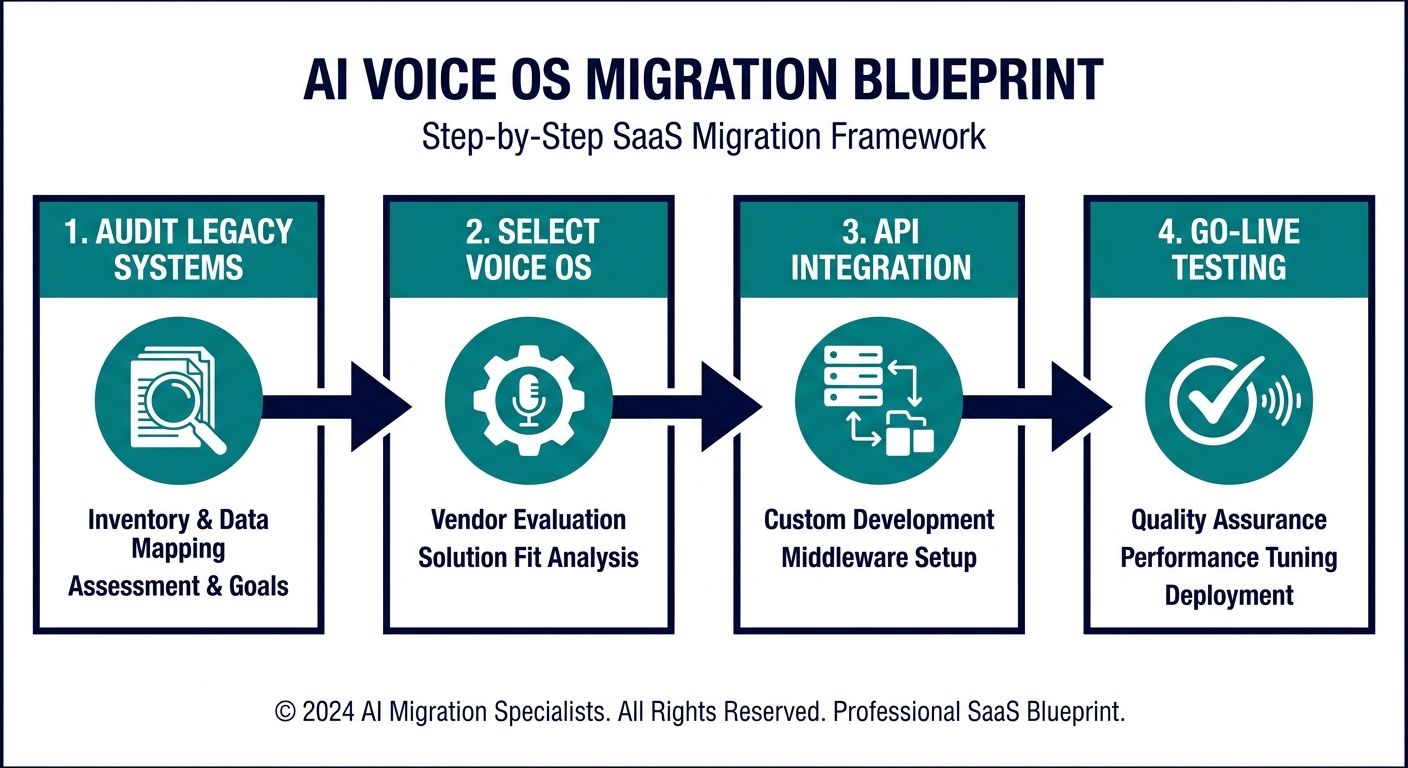
This step-by-step flowchart outlines the critical phases of a successful AI Voice OS migration, ensuring your transition remains on schedule and minimizes operational downtime.
Migrating to an AI Voice OS is a multifaceted architectural transformation. It requires transitioning from rigid, decision-tree-based logic to dynamic, context-aware generative systems. The blueprint for this migration is divided into distinct, highly technical phases to ensure operational continuity and optimal performance.
### 1\. Infrastructure Audit and Telephony Integration
Before deploying any AI models, a thorough audit of existing telephony infrastructure is mandatory. Enterprises must evaluate their current Session Initiation Protocol (SIP) trunking, Private Branch Exchange (PBX) systems, and WebRTC capabilities. The migration blueprint dictates a phased cutover strategy, often utilizing a robust API-first approach to intercept and route calls. Evaluators must ensure that the chosen Voice OS supports ultra-low latency streaming protocols, as traditional HTTP REST requests introduce unacceptable delays in conversational voice interactions. Bi-directional audio streaming via WebSockets or gRPC is critical for maintaining a natural conversational cadence.
### 2\. Moving from Prompt Engineering to Context Engineering
The most critical paradigm shift in the AI Voice OS migration blueprint is abandoning monolithic prompt engineering in favor of advanced Context Engineering. Traditional applications often attempt to inject vast, unstructured documents into the Large Language Model's (LLM) context window. In a voice environment, this leads to immense token consumption, severe latency spikes, and a high probability of hallucination.
Alchemyst's Kathan engine solves this through a computational process known as **Context Arithmetic for Voice**. Instead of overloading the prompt, the system utilizes a set-algebraic pipeline to dynamically retrieve, filter, and inject only the precise informational nodes required for a given user query. This highly optimized approach ensures that the voice agent possesses deep, deterministic knowledge without the computational bloat.
### 3\. The Five-Stage Context Determination Pipeline
At the core of a successful technical integration is the data pipeline. The Kathan engine employs a rigorous five-stage pipeline for context determination, which must be carefully mapped during your migration:
* **Semantic Similarity Search:** The system converts enterprise knowledge bases (policies, user data, product catalogs) into high-dimensional vector embeddings. When a user speaks, the transcribed query is vectorized, and the engine performs a cosine similarity search to retrieve the most semantically relevant nodes.
* **Metadata Filtering:** Pure semantic search is prone to contextual errors (e.g., retrieving a policy for the wrong state). Metadata filtering applies deterministic, set-theoretic rules to filter out results that do not match the specific user's geographic, account, or temporal parameters.
* **Deduplication:** Disparate data sources often contain overlapping information. The deduplication stage uses computational logic to identify and merge redundant data points, ensuring the LLM is not processing the same information multiple times, which wastes tokens and slows down response times.
* **Ranking:** The remaining informational nodes are scored and ranked based on relevance, recency, and contextual weight. The highest-scoring nodes are prioritized for injection into the prompt.
* **Set-Algebraic Orchestration:** The final stage treats the filtered data sets mathematically, using unions and intersections to build a perfectly tailored, minimal context payload. This precise payload guarantees that the voice agent answers accurately and efficiently.
### 4\. Data Migration, Security, and Compliance
Data migration is not merely about moving files; it involves structuring data for optimal retrieval by the Voice OS. Enterprise migration requires rigorous data sanitization. Furthermore, processing voice data introduces severe security and compliance hurdles. The migration blueprint must include real-time Personally Identifiable Information (PII) redaction algorithms before audio streams are sent to external Speech-to-Text (STT) or LLM providers. Ensuring SOC2 and HIPAA compliance means establishing secure, encrypted tunnels and utilizing localized or highly secure isolated instances for vector databases and context processing.
## Phase 2: Advanced ROI Calculation for Businesses
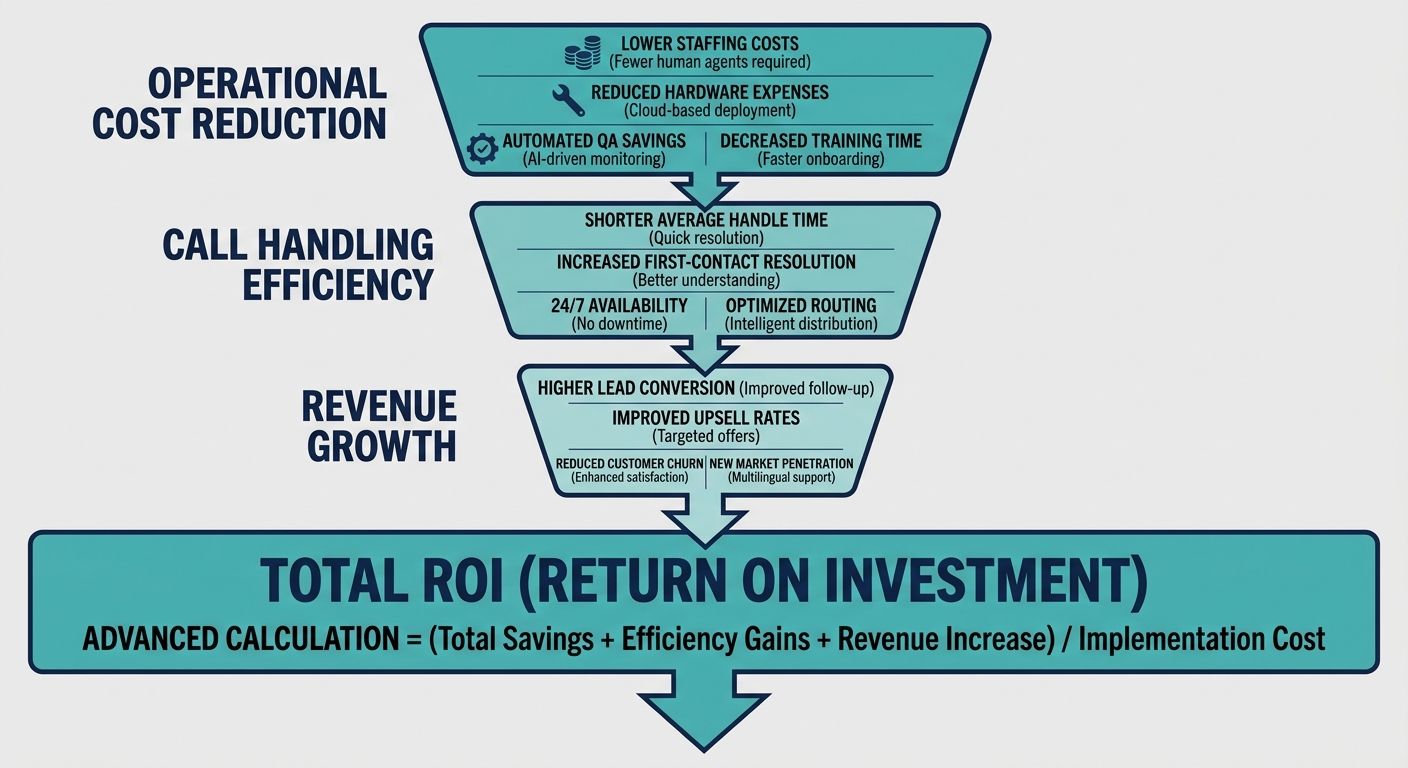
Visualizing the ROI calculation process helps stakeholders understand how initial cost reductions and efficiency gains compound into measurable financial returns.
Top-ranking generic guides often summarize ROI as simply "reducing human headcount." This superficial analysis fails to account for the complex unit economics of AI voice systems. A highly structured AI Voice OS migration blueprint and ROI calculation must incorporate specific cost analyses, API token economics, latency impacts, and infrastructure overhead.
### Deconstructing the Unit Economics of Voice AI
To calculate true ROI, businesses must analyze the Cost Per Call (CPC) or Cost Per Minute (CPM) of the AI Voice OS versus traditional human agents. However, the AI cost is variable and comprises several distinct API layers:
* **Speech-to-Text (STT) Costs:** Billed per second of incoming audio.
* **LLM Inference Costs:** Billed per input token (context) and output token (generated response).
* **Text-to-Speech (TTS) Costs:** Billed per character or per second of generated audio.
* **Platform/Orchestration Costs:** The infrastructure running the WebSockets, state management, and the Kathan engine.
### The ROI Formula
A structured ROI framework utilizes the following baseline formula:
_Net ROI = (Value of Automated Resolutions + Value of Deflected Escalations + Increased CSAT Revenue) - (Implementation Costs + Total Voice OS Infrastructure Costs + Maintenance Overhead)_
While human agents may cost $1.00 to $2.00 per minute burdened, an unoptimized Voice AI might cost $0.20 to $0.40 per minute. While this appears to be a massive saving, unoptimized systems with high latency lead to user abandonment, dropped calls, and frustrated customers who eventually require escalated, higher-cost human intervention—effectively destroying the anticipated ROI.
### How Context Arithmetic Drives Tangible ROI
This is where Alchemyst's Kathan engine provides a clear competitive advantage in ROI analysis. The relationship between context handling and financial return is direct and measurable:
**1\. Token Cost Reduction:** By utilizing the five-stage set-algebraic pipeline, the Kathan engine drastically reduces the size of the prompt payload. Instead of sending 5,000 tokens of semi-relevant documentation to the LLM for every conversational turn, the engine sends 500 tokens of highly targeted, deduplicated context. Over millions of interactions, this 90% reduction in input tokens translates to massive, compounding cost savings.
**2\. Latency Reduction and Revenue Retention:** Processing smaller context payloads accelerates LLM inference times. In voice interactions, delays longer than 700 milliseconds create awkward pauses and degrade the user experience. By minimizing latency through optimized information retrieval, businesses maintain natural conversation flows, decreasing call abandonment rates and increasing successful task completion. Higher task completion directly correlates to revenue protection.
**3\. Hallucination Mitigation:** Generic voice agents hallucinate when forced to reason over vast, conflicting datasets. When an AI agent confidently provides incorrect information (e.g., authorizing an invalid refund or providing wrong medical prep instructions), the financial and reputational cost is catastrophic. The metadata filtering and ranking mechanisms of the Kathan engine ensure absolute deterministic accuracy, practically eliminating liability-inducing hallucinations.
## Phase 3: Concrete Industry-Focused Use Cases
Applying the AI Voice OS migration blueprint and ROI calculation to specific verticals reveals exactly how deep technical integration yields specialized business value.
### Healthcare: Triage and Patient Scheduling
In healthcare, voice agents manage appointment scheduling, prescription refills, and preliminary triage. **Migration Blueprint:** Requires deep integration with Electronic Health Records (EHR) via HL7/FHIR APIs and stringent HIPAA-compliant PII redaction. **ROI Calculation:** Value is driven by reducing the administrative burden on nursing staff and minimizing appointment no-shows through automated, intelligent outbound reminders. The context arithmetic ensures the agent cross-references physician availability, patient history, and facility capabilities instantly, without exposing generalized patient data.
### Financial Services: Secure Account Management
Banks and credit unions utilize Voice OS for balance inquiries, fraud alerts, and loan application statuses. **Migration Blueprint:** Involves integrating voice biometric authentication to replace standard security questions, alongside secure, tokenized API connections to core banking systems. **ROI Calculation:** The primary ROI driver is deflecting high-volume, low-complexity support tickets away from expensive tier-1 human agents. Additionally, contextually accurate AI reduces the risk of social engineering attacks, safeguarding institutional assets.
### E-Commerce and Retail: Complex Order Troubleshooting
Retailers deploy AI voice agents to handle "Where is my order?" (WISMO) queries, returns processing, and warranty claims. **Migration Blueprint:** Requires real-time hooks into inventory management and logistics APIs. **ROI Calculation:** By utilizing deduplication and semantic search, the agent can instantly parse vast product catalogs and shipping policies. The ROI is measured not just in reduced support costs, but in increased Customer Satisfaction (CSAT) scores, which directly lead to higher customer lifetime value (LTV) and repeat purchase rates.
## Phase 4: Developer Ecosystem and Post-Migration Optimization
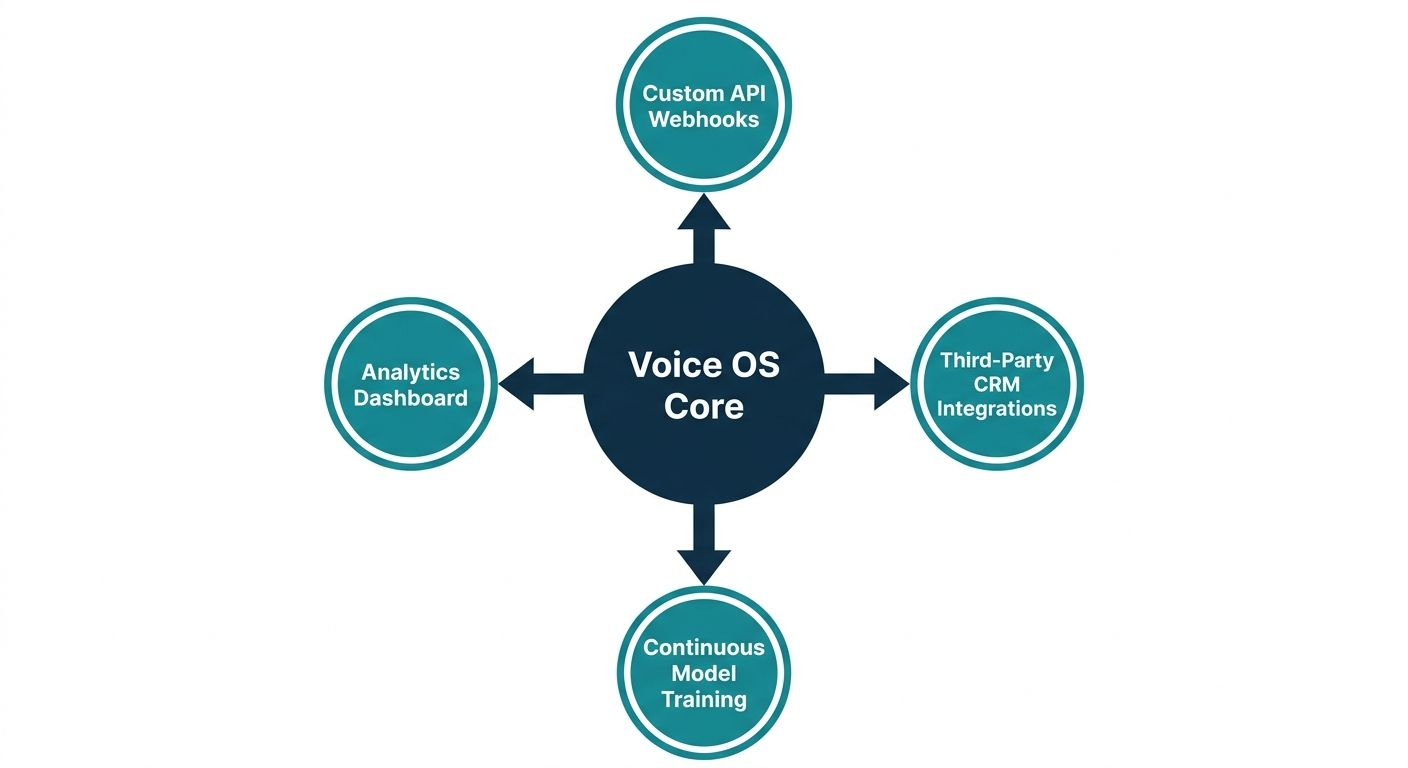
This hub-and-spoke map demonstrates how your central AI Voice OS integrates with custom developer tools and CRMs to enable continuous optimization.
A successful enterprise AI voice strategy does not end on deployment day. Post-migration optimization is a continuous cycle of refining vector databases, adjusting metadata filters, and monitoring unit economics. To support this ongoing operational phase, empowering technical teams is paramount.
Alchemyst champions a robust developer community, providing extensive resources via Community and Events channels. Furthermore, providing technical teams with direct self-service platform access through an Open Dashboard is critical. This allows developers to monitor the Kathan engine's context pipeline in real-time, trace latency bottlenecks, evaluate semantic search accuracy, and independently manage and fine-tune their custom enterprise agents without relying on cumbersome vendor support cycles.
## Conclusion
Executing an AI Voice OS migration is a complex, high-stakes technical endeavor that demands far more than basic API stitching. By following this definitive AI Voice OS migration blueprint and ROI calculation framework, organizations can confidently transition their telephony infrastructure into the modern era. Leveraging advanced architectural concepts like the Kathan engine's context arithmetic and set-algebraic pipelines ensures that the resulting voice agents are not only highly intelligent and secure but also financially viable, delivering a verifiable, mathematically proven return on investment.
[← Back to Blog](/blog)
## Recently Published
[October 6, 2026 / 10 min readHow to Build a RAG Pipeline for Personal Documents and MediaBuild a multi-modal RAG pipeline for all personal documents and media assets.](/blog/rag-pipeline-personal-documents-media)
[Technical / September 27, 2026 / 11 min readHarness Engineering for AI Agents: Bridging the GapExplore how harness engineering enables robust AI infrastructure and MLOps.](/blog/harness-engineering-ai-agents)
[I'm Evaluating / September 27, 2026 / 9 min readContext Engineering Best Practices for Enterprise AIMaster advanced context engineering best practices for conversational AI agents.](/blog/context-engineering-best-practices)
[I'm Evaluating / September 22, 2026 / 11 min readContext Engineering vs Prompt Engineering for AI AgentsExplore the differences between context and prompt engineering for enterprise AI](/blog/context-engineering-vs-prompt-engineering)
[I'm Evaluating / September 14, 2026 / 10 min readContext Engineering for Enterprise AI: A Complete GuideMaster context engineering to build reliable, production-ready voice AI agents.](/blog/context-engineering-enterprise-ai)
[Deep Technical / July 7, 2026 / 10 min readVoice-Specific Architectural Requirements for AI Context LayersDiscover the core voice-specific architectural requirements for AI context layer](/blog/voice-specific-architectural-requirements-ai-context-layer)
Get Started
## Give your AI agents the memory they deserve.
Join developers building the next generation of AI products with persistent, auditable context. Free tier available. No credit card required.
* Free tier
* REST + Python & Node SDKs
* 99.9% uptime SLA
* SOC 2 in progress
### Request API Access
Enter your email and we'll set up your workspace.
Email
[Read the Docs →](https://docs.getalchemystai.com)[Read the Thesis →](/thesis)
---
# How to Implement Context Engineering for Enterprise Voice AI
- **URL:** https://getalchemystai.com/blog/how-to-implement-context-engineering-for-enterprise-voice-ai
- **Slug:** how-to-implement-context-engineering-for-enterprise-voice-ai
- **Published:** May 20, 2026
- **Last updated:** May 20, 2026
- **Author:** Harsh Shah
- **Category:** Technical
[Technical](/blog?category=technical)
# How to Implement Context Engineering for Enterprise Voice AI
Enterprise blueprint for scalable voice AI context engineering implementation.
Written by [Harsh Shah](/blog?author=Harsh%20Shah)Reviewed by [Anuran Roy](/blog?author=Anuran%20Roy)10 min readPublished at May 20, 2026 (4mo ago)
## Summary
Discover how to build persistent memory architectures for enterprise voice agents. This guide covers technical implementation, scalability, and RAG integrations.
Table of Contents
## The Evolution of Context Engineering in Enterprise Voice AI
Enterprise voice AI has undergone a massive transformation. Simple, command-based voice bots are obsolete, replaced by dynamic, multi-turn conversational agents that must sound human, reason logically, and remember user preferences across multiple sessions. However, the shift from text-based chatbots to real-time voice agents introduces severe latency and contextual continuity challenges. This is where advanced context engineering becomes absolutely critical. Learning exactly how to implement context engineering for enterprise voice AI is the definitive key to unlocking scalable, highly personalized Voice OS platforms.
In this comprehensive guide, we provide an enterprise blueprint for building a persistent memory architecture. We will address everything from deep Retrieval-Augmented Generation (RAG) integration and Customer Relationship Management (CRM) synchronization to latency reduction, data governance, and architectural scaling. Whether you are building an AI-Native Context Management platform like Alchemyst AI or upgrading a legacy interactive voice response system, mastering the AI context layer is your foundational step toward creating voice agents that truly understand, remember, and execute complex business workflows.
## What is Context Engineering, and Why Does Voice AI Demand It?
To understand how to implement context engineering for enterprise voice AI, we must first contrast it with traditional prompt engineering. Traditional prompt engineering relies heavily on injecting static instructions and limited data into a stateless context window. While this approach functions adequately for simple text-based Large Language Models (LLMs), it fails catastrophically in enterprise voice environments.
Voice conversations are inherently unstructured and messy. Human callers interrupt, change subjects mid-sentence, and frequently reference past interactions using ambiguous pronouns. If an enterprise AI agent lacks a robust, persistent context layer, it suffers from conversational amnesia. This leads to repetitive questioning, unacceptable latency spikes as the model attempts to reason from scratch, and ultimately, deeply frustrated customers.
Context engineering goes far beyond writing better prompts. It is the systemic, architectural management of information over time. It involves constructing a dedicated drop-in memory infrastructure that persists across individual sessions and different agents. For an enterprise voice AI to function effectively, it requires a state-of-the-art AI context layer—similar to the Kathan engine architecture—that intelligently retrieves, compresses, and injects highly relevant CRM and historical data into the active processing stream. Crucially, this must happen within milliseconds to prevent breaching the rigid latency budgets required for natural spoken conversation.
## Core Architectural Components of an AI Context Layer
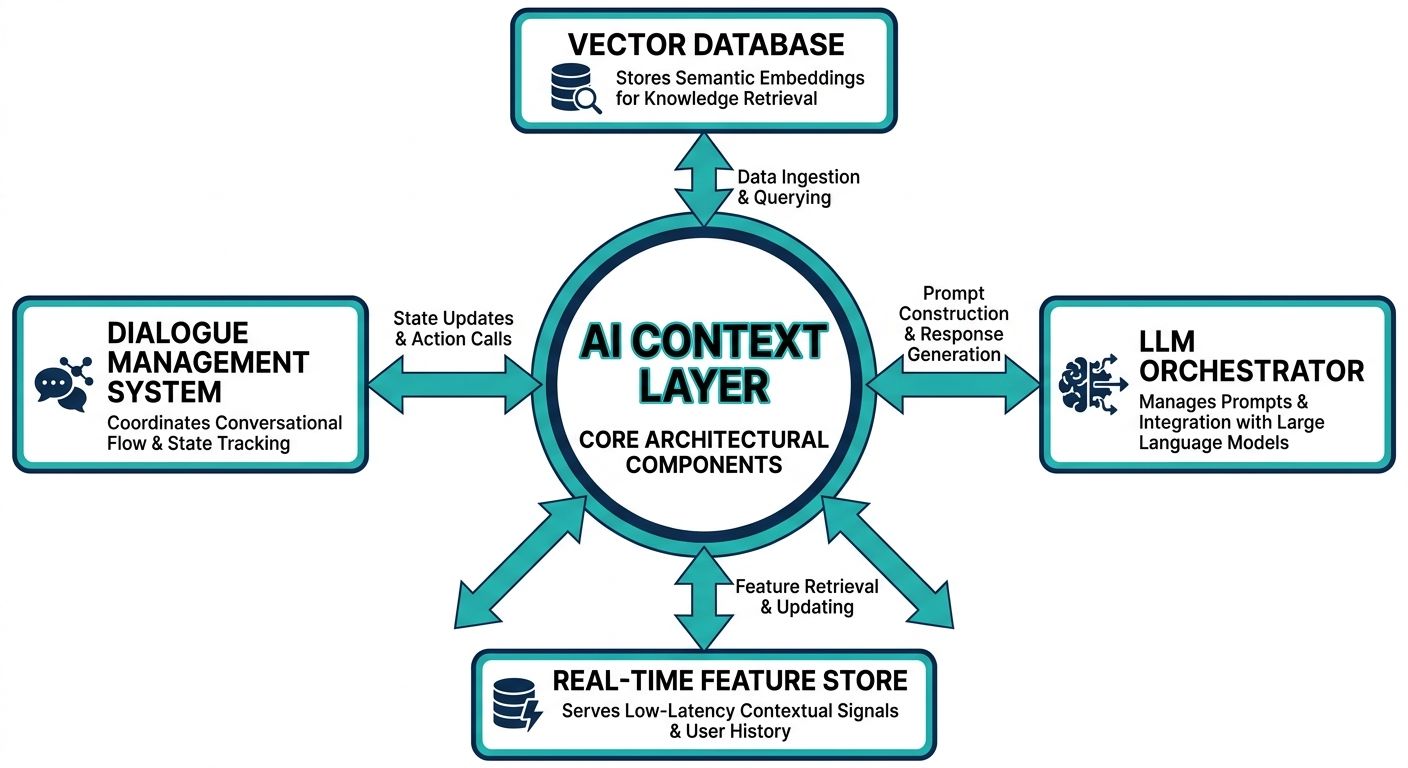
This hub-and-spoke map illustrates how the central AI Context Layer seamlessly connects with essential databases and orchestrators to maintain stateful conversations.
Before writing a single line of code, you must design a multi-tiered architecture that explicitly separates short-term conversational flow from long-term persistent storage. A successful context engineering implementation for voice requires three primary pillars.
### 1\. Short-Term Working Memory
Working memory handles the immediate context of the current, active voice call. This includes tracking the current conversational turn, managing mid-sentence interruptions, and maintaining the immediate state of the user's current goal. Because voice AI requires rapid audio-to-text transcription and instant response generation, working memory must be hosted in ultra-low-latency data stores. Redis or similar in-memory caching mechanisms are typically utilized here to ensure that the agent can retrieve the last ten seconds of conversation in less than fifty milliseconds.
### 2\. Long-Term Persistent Storage Architecture
Long-term memory is what makes a voice agent feel intelligent across multiple interactions. This layer stores historical transcripts, user preferences, past transactional data, and behavioral analytics. When implementing context engineering for enterprise voice AI, standard relational databases are often insufficient for semantic retrieval. Instead, enterprises must deploy highly optimized vector databases capable of storing and searching high-dimensional embeddings representing past conversations. This allows the AI to perform semantic searches, pulling up past context based on the _meaning_ of the user's current query rather than relying on exact keyword matches.
### 3\. Real-Time Context Connectors
Context connectors act as the nervous system between your AI agents and your external business data. These are dedicated APIs and middleware components that pull dynamic pricing, inventory levels, or personalized account details from CRMs, ERPs, and backend databases. By utilizing custom connectors, the voice AI can cross-reference the caller's spoken request against real-time business reality, ensuring that generated responses are not only contextually aware of the conversation but also factually accurate according to enterprise data.
## Enterprise Blueprint: Step-by-Step Implementation
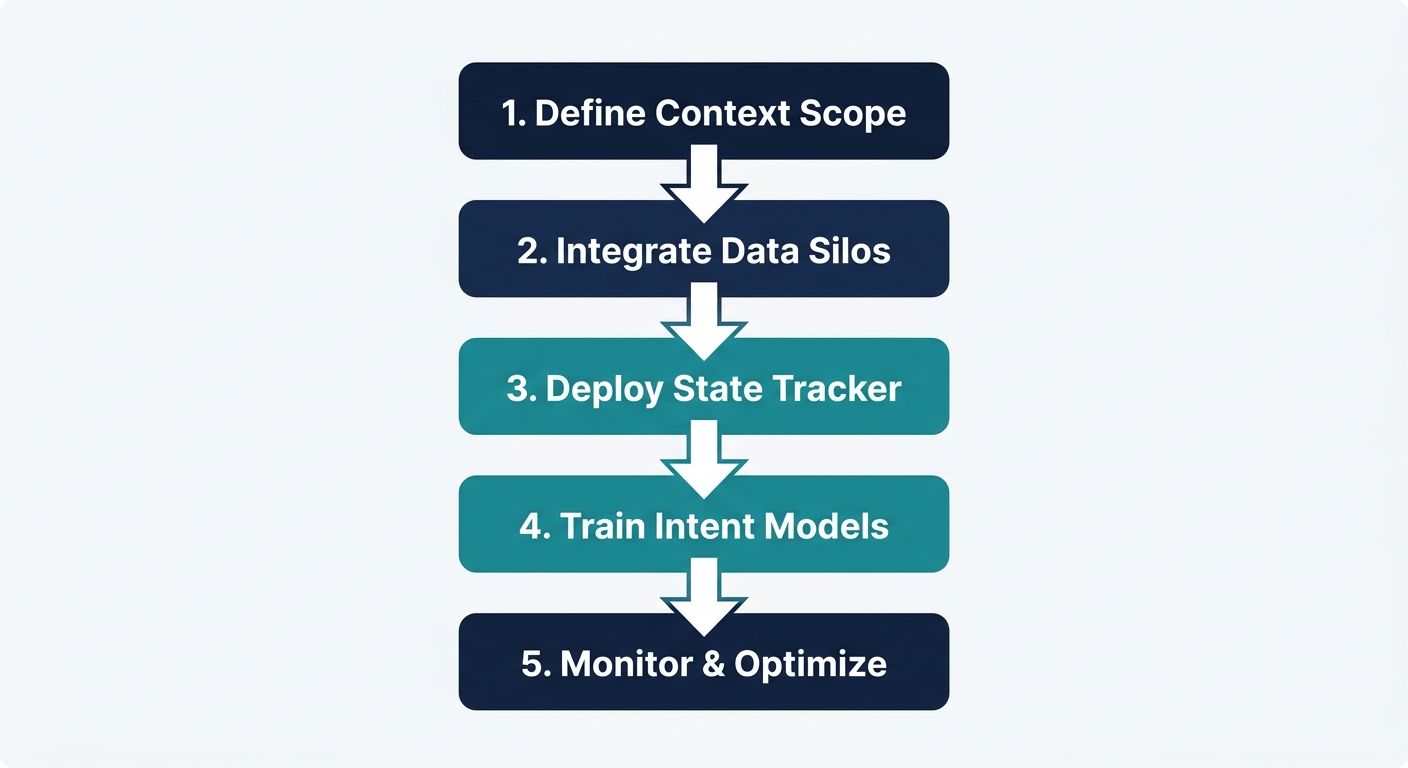
Following a structured implementation flowchart ensures that enterprise data silos are integrated smoothly before deploying conversational state trackers.
Implementing a comprehensive context management platform requires a phased approach. Follow this definitive blueprint to engineer context effectively for your enterprise voice AI applications.
### Phase 1: Designing the Vector-Based Memory Architecture
The first step in implementation is establishing your long-term memory foundation. Begin by integrating a scalable vector database to store conversational embeddings. Every time a voice interaction concludes, the transcription must be processed, summarized, and converted into mathematical vectors. This is where advanced AI summarization capabilities become vital. Instead of storing massive, raw transcripts that will inevitably overwhelm an LLM's context window, you must deploy an AI model to extract key intents, decisions, and action items. These refined summaries are then vectorized and stored. When a user calls back weeks later, the system performs a similarity search against the vector database, instantly retrieving the summarized context of their previous interactions.
### Phase 2: Integrating Dynamic RAG and CRM Data
Retrieval-Augmented Generation (RAG) is the engine that drives factual accuracy in enterprise AI. To implement context engineering effectively, you must fuse RAG with real-time CRM lookups. When a call connects, the system should use the caller ID or authentication token to pre-fetch relevant CRM records before the user even speaks. As the conversation progresses, semantic routers must analyze the transcription stream. If the user asks about a specific product, the semantic router dynamically queries the enterprise knowledge base (via RAG) and the inventory database (via CRM connector), injecting this exact data directly into the active prompt payload. This dual-pronged retrieval strategy ensures highly personalized, hyper-accurate voice responses.
### Phase 3: Building the Memory Compression Engine
One of the largest hidden costs and performance bottlenecks in conversational AI is context window overflow. As a voice conversation extends over several minutes, the raw token count grows exponentially. Sending massive prompt payloads to the LLM increases latency—a death sentence for voice bots. To solve this, you must engineer a robust Memory Compression Engine. This system actively monitors the token count of the active session. Once a predefined threshold is reached, a lightweight, secondary LLM is triggered asynchronously to summarize the older portions of the conversation. The raw text is seamlessly replaced by a dense, highly informative summary within the working memory array. This critical context engineering technique maintains absolute conversational continuity while drastically reducing token volume, lowering API costs, and minimizing inference latency.
### Phase 4: Low-Latency Optimization for Real-Time Voice
Voice is entirely different from text when it comes to latency expectations. A user chatting via text will wait five seconds for a response; a caller on the phone will assume the call dropped after two seconds of silence. Implementing context engineering for voice AI means budgeting every millisecond of the context retrieval process. Optimize your data retrieval by running vector searches in parallel with the audio transcription process. Utilize predictive context fetching—where the AI anticipates the data it might need based on the first few words of a user's sentence and begins querying databases before the user even finishes speaking. Furthermore, edge-based caching of frequently accessed contextual data can shave hundreds of milliseconds off your overall response time.
## Advanced Scalability Patterns and Performance Benchmarks
Many general resources on AI memory fail to address the brutal reality of enterprise scale. What works for a local developer prototype will crash when subjected to thousands of concurrent enterprise voice calls. To scale your context engineering implementation, you must move beyond basic database queries and adopt distributed architectural patterns.
Implement a multi-layered caching strategy using semantic caching. If a user asks a common question, the system should recognize the semantic intent and serve a cached response instantly, entirely bypassing the costly vector database and LLM generation step. Furthermore, establish strict performance benchmarks. Enterprise voice AI context retrieval must consistently perform under 100 milliseconds. Monitor your _Time-to-First-Byte (TTFB)_ meticulously. If vector search operations or CRM API calls begin dragging your TTFB above 500 milliseconds, you must aggressively optimize your indices or shift to more localized, dedicated context clusters.
Cost analysis is also vital. Vector operations and continuous prompt generation at scale are expensive. By leveraging dynamic context compression and semantic routing, enterprises can drastically reduce their computational overhead, transforming voice AI from a cost center into a scalable engine for business efficiency.
## Security, Privacy, and Enterprise Data Governance
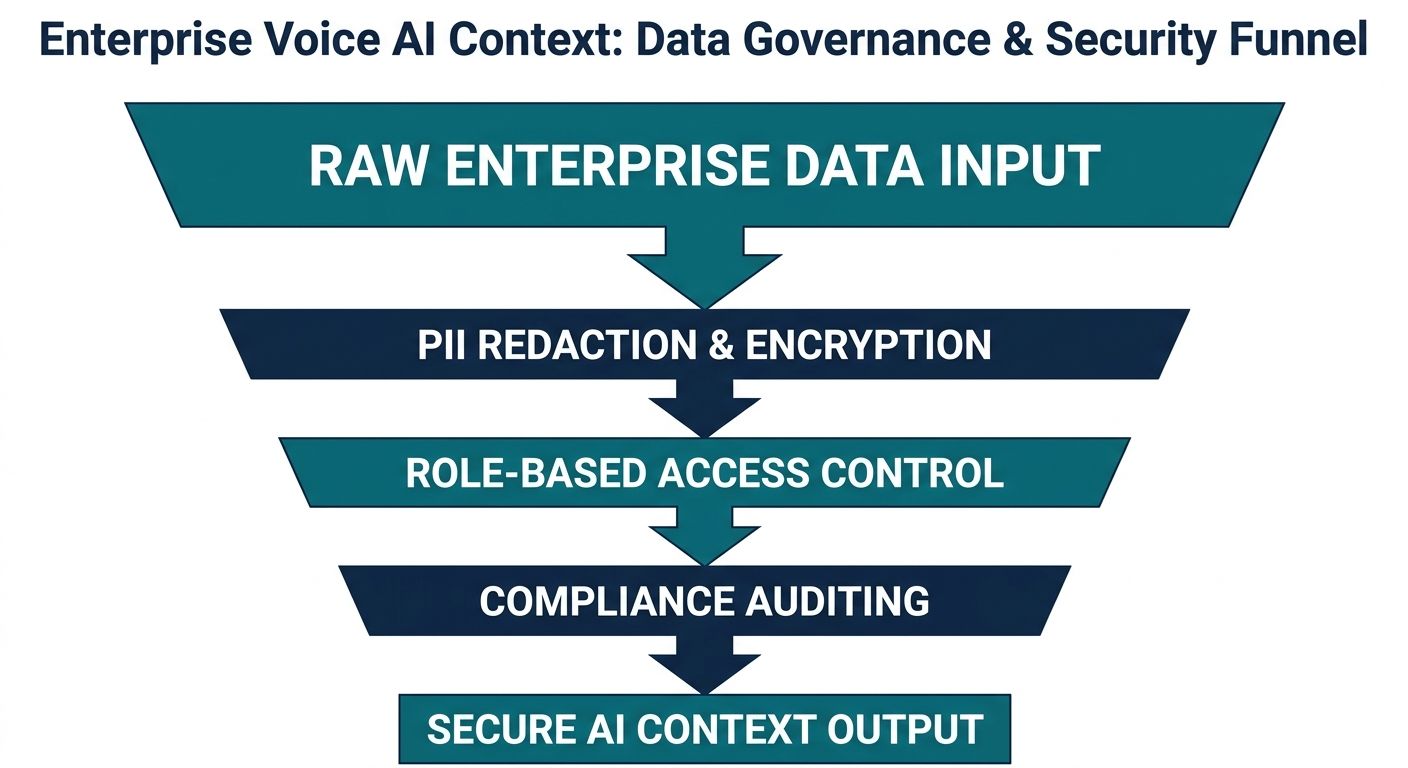
This security funnel demonstrates the mandatory governance layers raw data must pass through before being safely utilized as AI context.
Context engineering involves the persistent storage of highly sensitive conversational data. When dealing with enterprise voice AI—especially in regulated sectors like healthcare, finance, or large-scale e-commerce—security cannot be an afterthought. A robust implementation requires integrated, real-time Personally Identifiable Information (PII) redaction.
Before any spoken transcript is passed into the long-term memory vector database or sent to an external LLM provider, it must pass through a strict sanitization layer. Credit card numbers, social security details, and protected health information must be masked or tokenized immediately. Furthermore, your context management platform must support granular, role-based access controls and comprehensive audit logging. Building an infrastructure that supports SOC2 and HIPAA compliance is non-negotiable for enterprise deployments. Context data must be siloed securely per tenant, ensuring that insights learned from one enterprise client never leak into the conversational models of another.
## Robust Error Handling in Real-World Deployments
In real-world enterprise deployments, APIs fail, network latency spikes, and vector databases occasionally timeout. A critical part of how to implement context engineering for enterprise voice AI is designing resilient fallback mechanisms. What happens when the context retrieval layer fails during a live customer call?
Your voice agent must be engineered for graceful degradation. If the long-term memory retrieval times out, the agent must seamlessly fall back on its immediate working memory and politely ask clarifying questions rather than crashing or providing hallucinated information. Implement strict timeout thresholds on all context connectors. If the CRM takes longer than 800 milliseconds to return customer data, the voice OS should proceed with generic assistance protocols while triggering a background retry, ensuring the customer never experiences dead air.
## Migration Blueprint: Upgrading to an AI-Native Context Platform
Transitioning from a legacy conversational bot to a context-aware Voice OS requires a strategic migration. Begin by running your new AI context layer in shadow mode alongside your existing system, passively ingesting transcripts and building the vector databases without interacting with live customers. This allows you to fine-tune the memory compression and retrieval algorithms using real-world data safely.
Ultimately, to master context engineering for conversational AI, organizations must shift their mindset. You are no longer simply prompting an LLM; you are building a comprehensive, AI-Native Context Management platform. By rigorously separating short-term and long-term memory, integrating hyper-fast RAG pipelines, deploying dynamic token compression, and enforcing strict enterprise security standards, businesses can deploy voice agents that truly rival human interaction. Embrace these context engineering principles, and your enterprise will be equipped to handle the most complex, multi-turn conversational workflows at massive global scale.
[← Back to Blog](/blog)
## Recently Published
[October 6, 2026 / 10 min readHow to Build a RAG Pipeline for Personal Documents and MediaBuild a multi-modal RAG pipeline for all personal documents and media assets.](/blog/rag-pipeline-personal-documents-media)
[Technical / September 27, 2026 / 11 min readHarness Engineering for AI Agents: Bridging the GapExplore how harness engineering enables robust AI infrastructure and MLOps.](/blog/harness-engineering-ai-agents)
[I'm Evaluating / September 27, 2026 / 9 min readContext Engineering Best Practices for Enterprise AIMaster advanced context engineering best practices for conversational AI agents.](/blog/context-engineering-best-practices)
[I'm Evaluating / September 22, 2026 / 11 min readContext Engineering vs Prompt Engineering for AI AgentsExplore the differences between context and prompt engineering for enterprise AI](/blog/context-engineering-vs-prompt-engineering)
[I'm Evaluating / September 14, 2026 / 10 min readContext Engineering for Enterprise AI: A Complete GuideMaster context engineering to build reliable, production-ready voice AI agents.](/blog/context-engineering-enterprise-ai)
[Deep Technical / July 7, 2026 / 10 min readVoice-Specific Architectural Requirements for AI Context LayersDiscover the core voice-specific architectural requirements for AI context layer](/blog/voice-specific-architectural-requirements-ai-context-layer)
Get Started
## Give your AI agents the memory they deserve.
Join developers building the next generation of AI products with persistent, auditable context. Free tier available. No credit card required.
* Free tier
* REST + Python & Node SDKs
* 99.9% uptime SLA
* SOC 2 in progress
### Request API Access
Enter your email and we'll set up your workspace.
Email
[Read the Docs →](https://docs.getalchemystai.com)[Read the Thesis →](/thesis)
---
# Best Multilingual AI Voice OS for High Volume Customer Service
- **URL:** https://getalchemystai.com/blog/best-multilingual-ai-voice-os-high-volume-customer-service
- **Slug:** best-multilingual-ai-voice-os-high-volume-customer-service
- **Published:** May 19, 2026
- **Last updated:** May 19, 2026
- **Author:** Harsh Shah
- **Category:** I'm Evaluating
[I'm Evaluating](/blog?category=im-evaluating)
# Best Multilingual AI Voice OS for High Volume Customer Service
Evaluate the best multilingual AI voice OS for high volume customer service.
Written by [Harsh Shah](/blog?author=Harsh%20Shah)Reviewed by [Anuran Roy](/blog?author=Anuran%20Roy)11 min readPublished at May 19, 2026 (4mo ago)
## Summary
Evaluate the technical architecture and context arithmetic required to deploy enterprise-grade voice systems. This guide offers a definitive migration blueprint and structured ROI analysis for complex operations.
Table of Contents
## The Paradigm Shift in Enterprise Voice Operations
Finding the best multilingual AI voice OS for high volume customer service requires moving beyond superficial feature lists and basic chatbot integrations. In today's highly demanding enterprise landscape, global organizations are confronted with a significant challenge: how to seamlessly manage tens of thousands of concurrent voice interactions across dozens of languages without compromising on contextual accuracy, latency, or customer satisfaction. Legacy conversational AI platforms and basic API wrappers are inherently flawed when exposed to high-volume interactions. They rely heavily on outdated keyword matching, delayed translation APIs, and rigid conversational trees that break down the moment a customer introduces a complex, multi-layered inquiry.
Technical evaluators and developers recognize that the solution does not lie in better prompt engineering, but in robust context engineering. An enterprise-grade AI Voice Operating System (OS) must possess an underlying architectural framework capable of dynamic information retrieval, real-time CRM integration, and context arithmetic. This technical primer explores the definitive blueprint for selecting, integrating, and calculating the return on investment (ROI) for advanced voice AI platforms, with a specific focus on the capabilities of Alchemyst's Kathan engine.
## Overcoming the Limitations of Superficial AI Platforms
If you analyze the current market offerings for multilingual AI agents, you will find an abundance of platforms promoting highly configurable tools, rapid deployments, and basic API-first approaches. However, a glaring content gap exists in the industry's understanding of what constitutes an actual AI Voice OS. Competitors often highlight their proof by numbers or superficial language translation capabilities. What they consistently miss is the architectural, technical, and operational depth required to deploy a true OS tailored for high-volume enterprise customer service.
Standard voice AI systems attempt to handle multilingual queries by routing speech through isolated transcription, translation, and text-generation microservices. This disconnected approach introduces severe latency and strips away the semantic nuance essential for effective customer support. When a customer speaks in a blend of colloquial phrases and technical jargon, a rudimentary platform will either hallucinate an answer or fall back to human routing. To genuinely achieve the status of the best multilingual AI voice OS for high volume customer service, a platform must integrate a unified context layer that mathematically processes metadata and contextual relevance in real time.
## Core Architecture: Prompt Engineering vs. Context Engineering
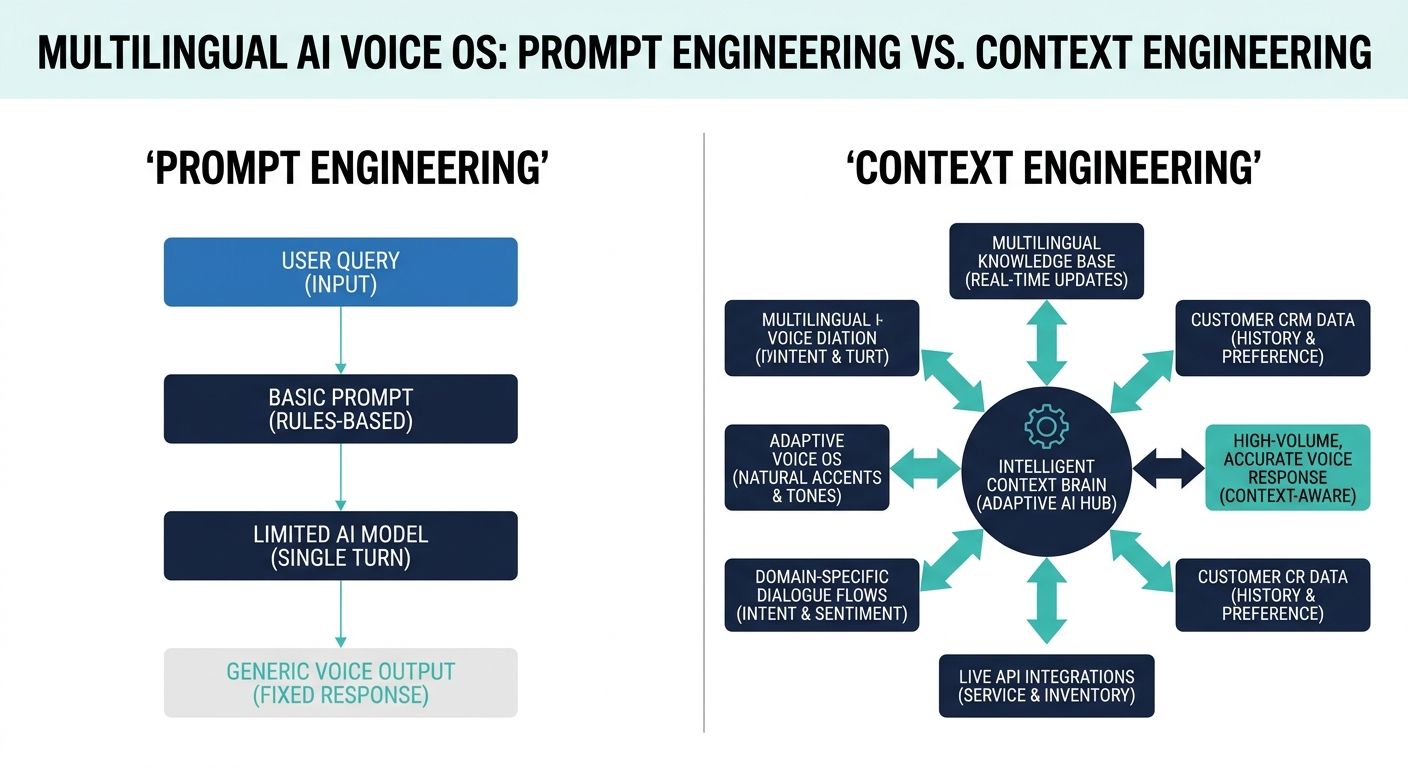
This architectural comparison highlights why context engineering delivers superior reliability for enterprise call centers compared to basic prompt-based systems.
To understand the mechanics of an elite AI Voice OS, one must differentiate between prompt engineering and context engineering. Prompt engineering involves tweaking the textual instructions fed to a large language model (LLM) in hopes of guiding its tone and behavior. While necessary, it is highly insufficient for complex enterprise applications. You cannot prompt your way out of missing data.
Context engineering, on the other hand, is the structural science of dynamically fetching, structuring, and feeding the exact required knowledge to the voice agent in milliseconds. This is the realm where Alchemyst's Kathan engine dominates. By prioritizing context engineering, the Kathan engine ensures that the AI does not merely guess the answer based on its broad training data, but strictly computes the answer based on real-time enterprise data, specific customer history, and exact product specifications—regardless of the language being spoken.
## Deep Dive: The Context Arithmetic Pipeline
The Kathan engine utilizes a proprietary methodology known as context arithmetic. This is not a buzzword; it is a rigorous computational process designed to systematically determine the precise information relevant to any given voice interaction. For technical evaluators looking for the best multilingual AI voice OS for high volume customer service, understanding this five-stage pipeline is critical.
### 1\. Semantic Similarity Search
At the core of the Kathan engine's information retrieval system is advanced semantic similarity search. Instead of looking for exact word matches, the system vectorizes enterprise knowledge bases and customer histories into high-dimensional mathematical spaces. When a user speaks, their utterance is instantly embedded and matched against these vectors. This is particularly crucial for multilingual support, as the semantic meaning of a query remains mathematically consistent even if the spoken language changes, allowing the OS to fetch relevant context across language barriers without heavy reliance on literal translations.
### 2\. Granular Metadata Filtering
High-volume customer service means dealing with vast, often contradictory, datasets. Metadata filtering allows the OS to immediately discard irrelevant information based on strict parameters such as the user's geographic location, account tier, or active product version. If a French-speaking enterprise client asks about a specific API rate limit, the metadata filter ensures the system only searches within the enterprise-tier documentation, drastically reducing the search space and computing time.
### 3\. Rigorous Deduplication Mechanisms
Enterprise datasets are notorious for redundancy. Multiple documents might address the same troubleshooting steps. The deduplication stage in the context arithmetic pipeline ensures that the AI agent is not overwhelmed with repetitive data blocks. By mathematically identifying and merging overlapping vectors, the Kathan engine keeps the context window lean, reducing latency and preventing the LLM from becoming confused by conflicting phrasing of the same solution.
### 4\. Dynamic Ranking Protocols
Once relevant, non-duplicated information is retrieved, it must be ranked. Dynamic ranking protocols assign a relevance score to each piece of data based on the real-time progression of the conversation. In a high-volume scenario where a customer might pivot from billing issues to technical troubleshooting within the same breath, the ranking protocol instantly reshuffles the priority of the retrieved context, ensuring the AI agent always addresses the most immediate intent first.
### 5\. The Set-Algebraic Pipeline Assembly
The final stage is the set-algebraic pipeline assembly. The retrieved, filtered, deduplicated, and ranked data sets are combined using logical operations (unions, intersections, differences) to form a cohesive, perfectly structured context payload. This mathematically precise payload is then injected into the core generative model, enabling the AI voice agent to deliver a flawless, deeply informed response in the user's native language.
## The Definitive Migration Blueprint: Implementing an AI Voice OS
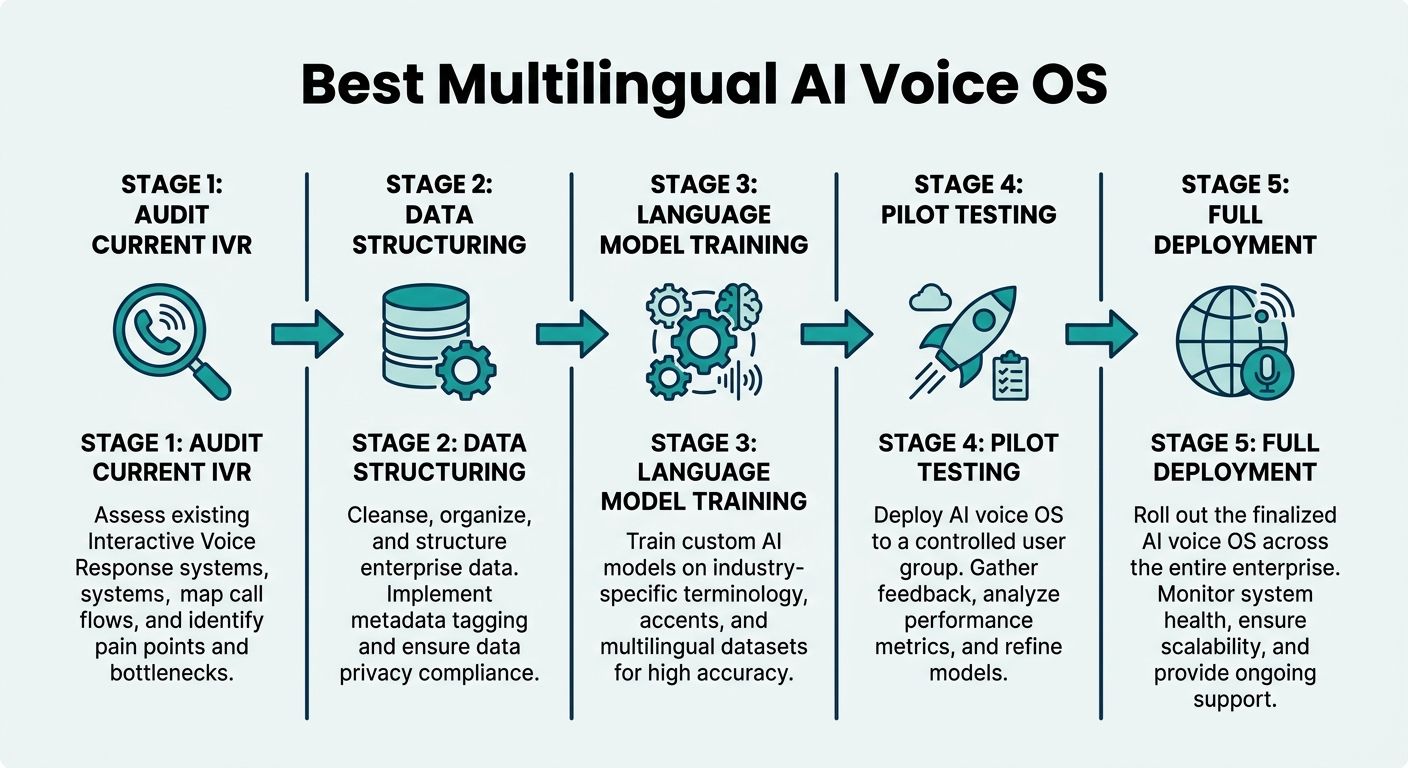
Following this structured five-step migration timeline ensures a seamless transition to a modern voice operating system without disrupting existing customer support flows.
Recognizing the technological superiority of context-aware systems is only the first step. The true challenge for enterprise leaders is deployment. The lack of a comprehensive migration blueprint is a major failure point for generic AI platforms. Transitioning to the best multilingual AI voice OS for high volume customer service requires a structured, multi-phase approach tailored for complex technical environments.
### Phase 1: Infrastructure and Legacy System Auditing
Before any software is deployed, a rigorous audit of existing infrastructure must take place. This involves mapping out current telephony systems (SIP trunks, PBX), legacy CRM databases, and existing knowledge repositories. Developers must identify data silos and assess the API readiness of all interconnected tools. The goal of this phase is to establish the baseline concurrency limits and identify the specific multilingual routing rules currently handled by human agents.
### Phase 2: Technical Integration and Real-Time CRM Data Sync
The hallmark of an AI Voice OS is its deep integration capabilities. During this phase, engineering teams establish secure Webhook and WebSocket connections between the AI OS and enterprise databases. Real-time CRM data integration ensures that the moment a call is connected, the AI agent is instantly populated with the caller's entire historical context. This phase also involves deploying the context arithmetic engine locally or within a dedicated virtual private cloud to ensure data sovereignty and ultra-low latency data syncs.
### Phase 3: Data Migration and Enterprise-Grade Security
Migrating enterprise data to feed the semantic search vectors requires careful sanitization. Sensitive Personally Identifiable Information (PII) and Payment Card Industry (PCI) data must be encrypted or tokenized before it ever touches the context layer. The migration blueprint mandates the setup of strict role-based access controls and the implementation of real-time redaction protocols, ensuring that the AI voice agent operates strictly within global compliance frameworks, such as GDPR and SOC2.
### Phase 4: Rigorous Multilingual Tuning and Quality Assurance
Language is highly localized. Spanish in Spain differs significantly from Spanish in Mexico. The tuning phase involves exposing the AI Voice OS to hundreds of thousands of historical conversational transcripts to map regional dialects, colloquialisms, and brand-specific jargon across all supported languages. Quality Assurance teams execute load testing, simulating thousands of concurrent calls to validate the performance of the context algebraic pipeline under maximum enterprise stress.
## Structured ROI Framework and Cost Analysis
Many competitor platforms offer generic cost savings calculators based entirely on headcount reduction. However, a technical evaluator assessing the best multilingual AI voice OS for high volume customer service demands a far more structured ROI framework that encompasses operational resilience and contextual efficiency.
### Calculating Context-Aware Deflection Rates
Traditional metrics look at basic call deflection. Advanced ROI calculations focus on context-aware deflection. This measures the percentage of highly complex, multi-turn interactions successfully resolved by the AI without human intervention. By utilizing the Kathan engine's dynamic ranking and metadata filtering, enterprises see a massive increase in context-aware deflection. ROI is calculated by measuring the drop in average handle time (AHT) for these complex queries multiplied by the loaded cost of a tier-2 human support agent.
### Precision Concurrency Metrics and Scaling
A true AI Voice OS scales non-linearly. Unlike human call centers where doubling capacity requires doubling the workforce, an AI OS can instantly scale to meet unexpected volume spikes. The financial model must calculate the savings achieved by eliminating over-staffing requirements during seasonal peaks or critical service outages. Furthermore, the ability to serve a global customer base without setting up redundant regional call centers yields immense savings in physical real estate, localized hiring, and cross-border telecommunications costs.
## Concrete Industry-Focused Use Cases
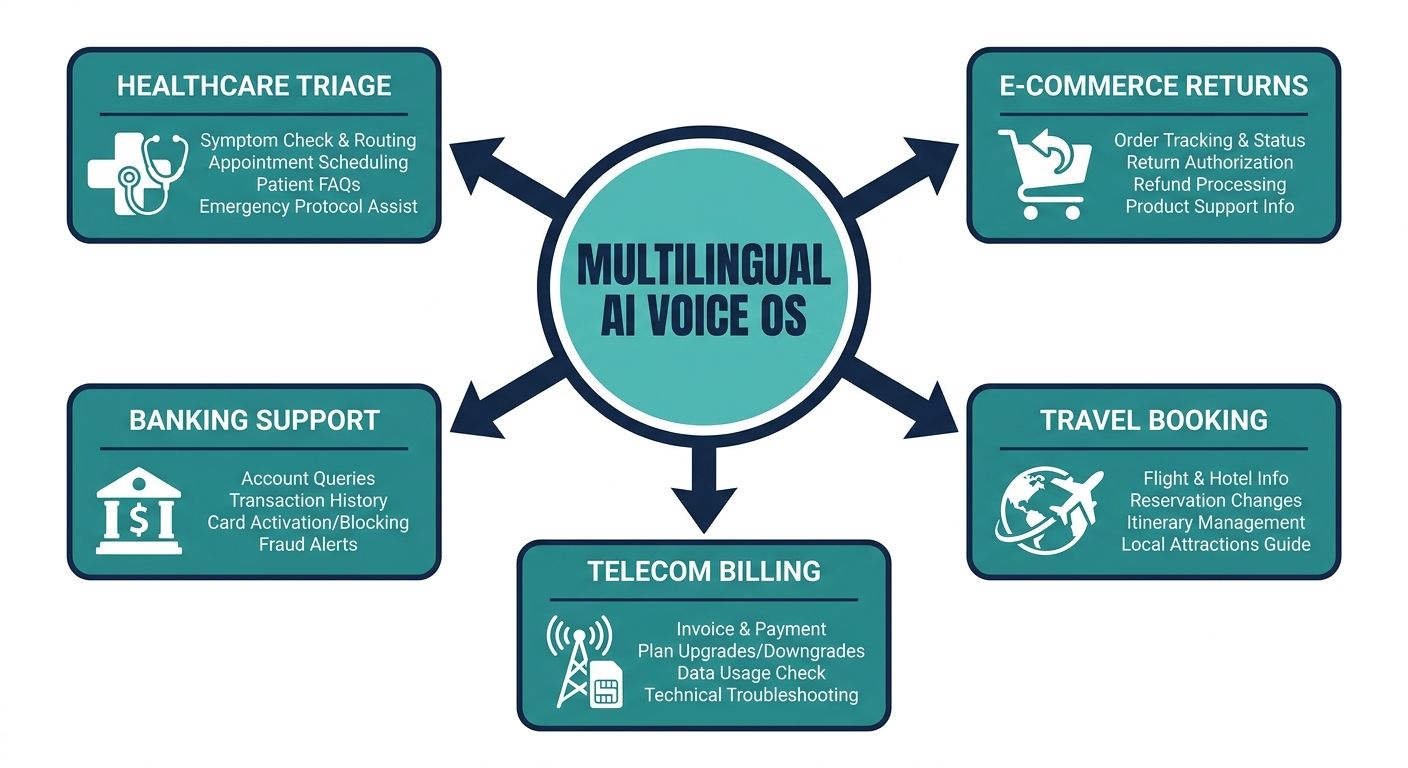
This hub-and-spoke diagram illustrates the versatile applications of advanced voice artificial intelligence across major industries, from automating banking inquiries to managing e-commerce returns.
The theoretical architecture of context arithmetic proves its worth when applied to specific, high-stakes enterprise environments.
### Telecommunications Support
Telecom companies face massive inquiry volumes regarding billing errors, network outages, and device troubleshooting. A multilingual AI voice OS can instantly ingest real-time network status metadata and cross-reference it with a user's geographical location. If a localized outage occurs in a diverse urban area, the AI can preemptively notify callers of the exact issue in their preferred language, drastically reducing queue times and mitigating customer frustration during critical downtime events.
### Global Financial Services
In the banking sector, context is not just helpful; it is legally required. When a customer calls regarding a frozen credit card while traveling abroad, the AI agent must flawlessly navigate security authentication, retrieve highly sensitive transaction metadata, and communicate the resolution in multiple languages. The rigorous deduplication and set-algebraic pipeline of the AI Voice OS ensures that the agent never hallucinated financial data, maintaining strict regulatory compliance while resolving the issue instantaneously.
## Evaluating Competitors vs. True Voice Operating Systems
When comparing top-ranking platforms, it becomes evident why simple chatbots fail the enterprise test. Competitors focus heavily on providing a developer community and open dashboard access for custom agents, heavily marketing API-first programmability. While modularity is useful, relying solely on API calls to external language models creates a brittle architecture that collapses under high-volume stress.
An enterprise seeking the best multilingual AI voice OS for high volume customer service must look beyond the wrapper. They require a dedicated engine, like Kathan, that treats conversational context as a mathematical certainty rather than a probabilistic guess. By controlling the information retrieval, vector search, and payload injection natively, a true Voice OS eliminates the latency and inaccuracy that plague disjointed platform architectures.
## Conclusion
Adopting the best multilingual AI voice OS for high volume customer service is a massive strategic initiative that redefines how an enterprise engages with its global audience. It requires discarding outdated legacy tools and superficial chatbot solutions in favor of a mathematically rigorous, context-aware architecture. By leveraging the principles of context arithmetic, implementing a meticulously structured migration blueprint, and measuring true operational ROI, enterprises can deploy a voice AI system that is not merely conversational, but fundamentally intelligent. Platforms equipped with engines like Kathan stand ready to support this paradigm shift, offering unparalleled scale, security, and multilingual precision for the future of global customer operations.
[← Back to Blog](/blog)
## Recently Published
[October 6, 2026 / 10 min readHow to Build a RAG Pipeline for Personal Documents and MediaBuild a multi-modal RAG pipeline for all personal documents and media assets.](/blog/rag-pipeline-personal-documents-media)
[Technical / September 27, 2026 / 11 min readHarness Engineering for AI Agents: Bridging the GapExplore how harness engineering enables robust AI infrastructure and MLOps.](/blog/harness-engineering-ai-agents)
[I'm Evaluating / September 27, 2026 / 9 min readContext Engineering Best Practices for Enterprise AIMaster advanced context engineering best practices for conversational AI agents.](/blog/context-engineering-best-practices)
[I'm Evaluating / September 22, 2026 / 11 min readContext Engineering vs Prompt Engineering for AI AgentsExplore the differences between context and prompt engineering for enterprise AI](/blog/context-engineering-vs-prompt-engineering)
[I'm Evaluating / September 14, 2026 / 10 min readContext Engineering for Enterprise AI: A Complete GuideMaster context engineering to build reliable, production-ready voice AI agents.](/blog/context-engineering-enterprise-ai)
[Deep Technical / July 7, 2026 / 10 min readVoice-Specific Architectural Requirements for AI Context LayersDiscover the core voice-specific architectural requirements for AI context layer](/blog/voice-specific-architectural-requirements-ai-context-layer)
Get Started
## Give your AI agents the memory they deserve.
Join developers building the next generation of AI products with persistent, auditable context. Free tier available. No credit card required.
* Free tier
* REST + Python & Node SDKs
* 99.9% uptime SLA
* SOC 2 in progress
### Request API Access
Enter your email and we'll set up your workspace.
Email
[Read the Docs →](https://docs.getalchemystai.com)[Read the Thesis →](/thesis)
---
# Enterprise AI Voice Agent Platforms: Context Handling Mastery
- **URL:** https://getalchemystai.com/blog/compare-enterprise-ai-voice-agent-platforms-context-handling
- **Slug:** compare-enterprise-ai-voice-agent-platforms-context-handling
- **Published:** May 19, 2026
- **Last updated:** May 19, 2026
- **Author:** Harsh Shah
- **Category:** I'm Evaluating
[I'm Evaluating](/blog?category=im-evaluating)
# Enterprise AI Voice Agent Platforms: Context Handling Mastery
Deep technical comparison of enterprise AI voice agents by context handling.
Written by [Harsh Shah](/blog?author=Harsh%20Shah)Reviewed by [Anuran Roy](/blog?author=Anuran%20Roy)10 min readPublished at May 19, 2026 (4mo ago)
## Summary
Discover a highly technical analysis of how leading enterprise AI voice agent platforms manage context handling. We explore retention methodologies, memory duration, and architecture metrics that generic reviews miss.
Table of Contents
## The Critical Role of Context Handling in Enterprise AI Voice Agents
When enterprise leaders seek to compare enterprise AI voice agent platforms context handling capabilities, they are often met with superficial marketing collateral. The reality of deploying artificial intelligence in commercial voice environments requires a sophisticated understanding of how systems retain, process, and retrieve conversational memory. Context handling is the foundational architecture that determines whether an AI voice agent sounds like a disjointed automated system or a highly intelligent, empathetic human representative. In enterprise environments, voice agents handle unstructured, real-time data streams characterized by interruptions, non-linear conversational shifts, and complex multi-intent utterances. Without a robust methodology for context retention, even the most advanced natural language generation models will hallucinate, repeat themselves, or force users to restate previous points, ultimately destroying the customer experience and undermining operational efficiency.
## Why Generic Voice AI Comparisons Fail Enterprise Users
A significant gap exists in the current market analysis of voice AI solutions. If you search for comparative analyses of platforms like Vapi.ai, Vellum, or Retell AI, the top results are almost exclusively generic listicles. These guides superficially cover surface-level features, integrations, and pricing tiers, completely failing to provide a direct, in-depth, and technical analysis of context handling capabilities specifically designed for voice AI agent platforms. Enterprise users do not need another list of basic API endpoints; they need comprehensive evaluations of the types of context handled, the underlying methodologies for retention, memory duration constraints, and voice-specific architectural requirements such as instantaneous Speech-to-Text (STT) and Text-to-Speech (TTS) integration. When an enterprise evaluates these platforms, the lack of quantifiable performance metrics in standard reviews leaves them vulnerable to selecting software that scales poorly under complex conversational loads. This deep dive aims to bridge that gap by ranking and analyzing platforms based on their context handling mastery.
## Core Dimensions of Context Handling in Voice Architecture
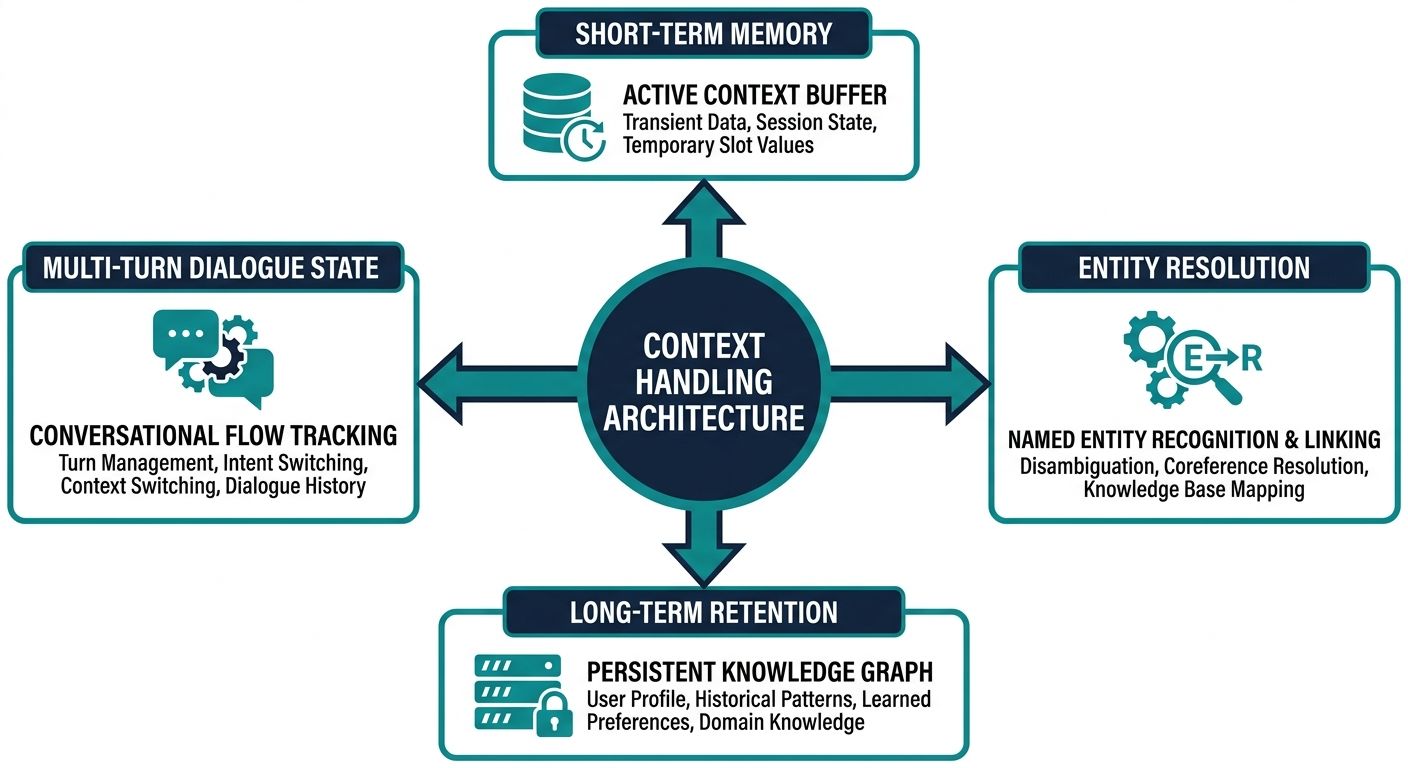
This concept map breaks down the essential architectural dimensions needed for an AI agent to manage seamless multi-turn dialogues.
To truly compare enterprise AI voice agent platforms context handling, we must first break down the architectural dimensions that define advanced conversational memory. Voice agents do not operate like text-based chatbots; they are constrained by the speed of human speech and the acoustic complexities of live audio.
### Multi-Turn Conversation Memory Retention
The ability to remember what was said three, ten, or fifty turns ago in a conversation is paramount. Enterprises must evaluate whether a platform uses a simple sliding token window, which inevitably forgets earlier context as the conversation progresses, or a more advanced semantic memory architecture. High-performance voice agents utilize a combination of short-term episodic memory for immediate dialogue resolution and long-term semantic memory, often powered by vector databases, to recall critical entities across a prolonged engagement.
### Latency Mitigation in STT and TTS Integration
Context handling in voice AI is uniquely tied to latency. When a user speaks, the audio is processed by an STT engine, analyzed for context, passed to a large language model (LLM) for response generation, and synthesized back into audio via a TTS engine. If the context retrieval process is bloated or inefficient, the system introduces unnatural pauses. Leading platforms optimize this pipeline by pre-fetching contextual data during the user's speech phase and utilizing predictive contextual caching, allowing the TTS engine to begin streaming the response milliseconds after the user finishes speaking.
### Handling Interruptions and Barge-ins
Human conversation is inherently messy. Users interrupt, change their minds mid-sentence, and refer back to previous topics abruptly. A critical dimension of context handling is how the system processes barge-ins. When a user interrupts the AI, the platform must instantaneously halt its TTS output, update its conversational state, integrate the new interrupted context with the historical context, and generate a revised response. Platforms that lack sophisticated context management will either ignore the interruption entirely or lose the thread of the conversation, resulting in catastrophic user frustration.
## Comparing Technical Methodologies for Context Retention
Enterprise platforms utilize varying technical methodologies to maintain context during complex voice interactions. Understanding these approaches is crucial when determining the right infrastructure for sophisticated business needs.
### Token Window Maximization vs. Dynamic Summarization
Basic platforms rely on feeding the entire conversation transcript back into the LLM's token window for every turn. While this works for short interactions, enterprise workflows quickly exceed token limits, leading to latency spikes and context degradation. Advanced platforms employ continuous dynamic summarization. In this methodology, the system operates parallel AI models that continuously summarize older portions of the transcript into dense, high-value contextual metadata. This metadata is retained in the active memory footprint, allowing the primary conversational model to reference historical facts without the computational burden of processing the raw transcript repeatedly.
### Retrieval-Augmented Generation (RAG) in Voice Space
RAG has become standard in text AI, but applying it to real-time voice agents is technically demanding. When users ask questions requiring external enterprise knowledge, the voice agent must retrieve this information instantaneously. The methodology for context retention here involves embedding user queries in real-time, performing similarity searches across enterprise knowledge bases, and injecting that retrieved context into the prompt without causing conversational lag. The best enterprise platforms utilize specialized, lightweight embedding models specifically tuned for conversational queries to achieve sub-second retrieval times.
## Evaluating the Competitor Landscape: Vapi, Retell, and Vellum
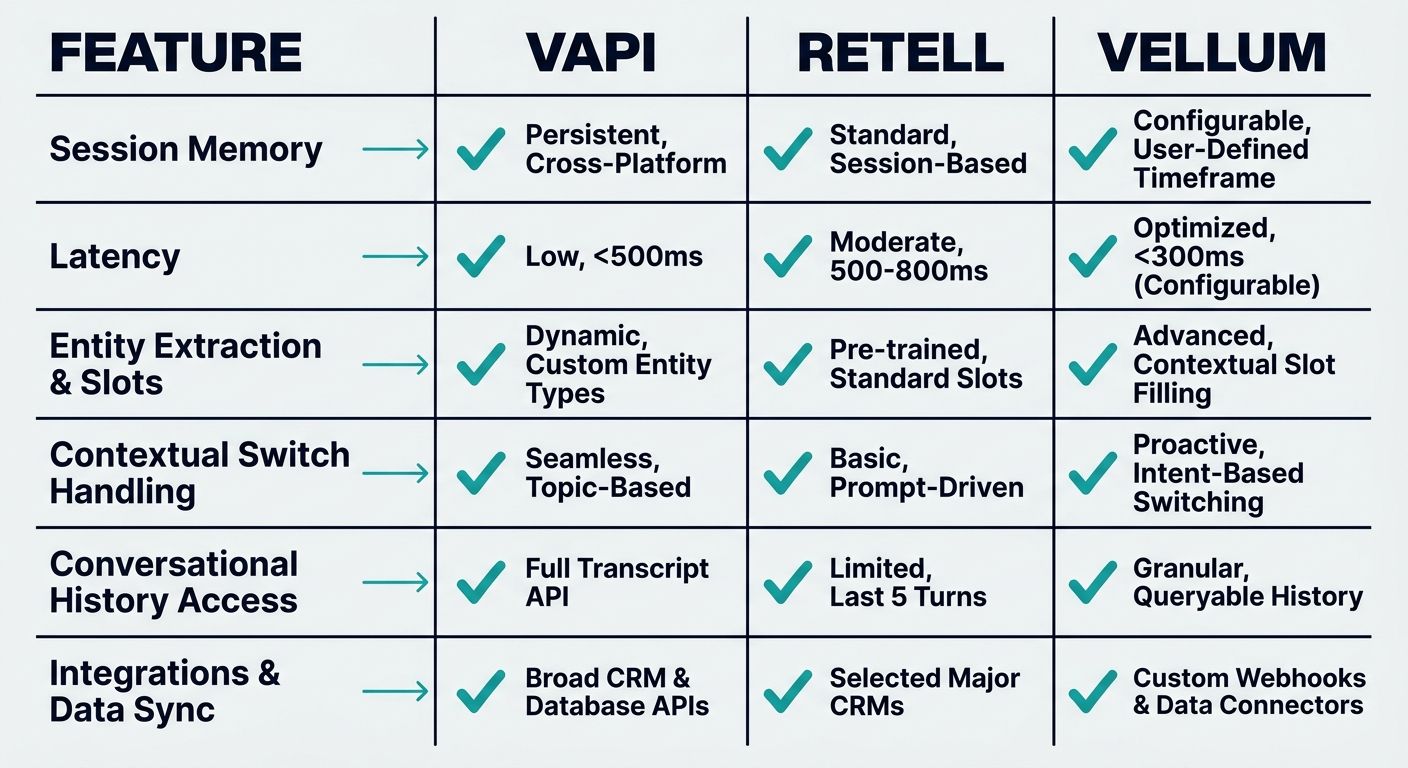
Compare how leading voice AI platforms stack up against each other across critical context retention and memory capabilities.
When assessing the current landscape, it becomes evident that many popular platforms prioritize developer flexibility over deep, out-of-the-box context mastery. Let us examine the technical gaps and capabilities of the leading competitors.
### Vapi.ai: Developer-Centric Infrastructure
Vapi.ai has established itself by providing a highly configurable API for developers to build custom voice AI agents. They emphasize technical infrastructure, robust developer community resources, and open dashboard access for managing agents. However, Vapi primarily shifts the burden of context management onto the developer. While they provide the pipes for STT and TTS routing, enterprises are often left to build their own custom memory retention methodologies, state machines, and context-caching solutions. For businesses needing sophisticated, out-of-the-box context handling for intricate workflows, this purely infrastructural approach can lead to prolonged deployment cycles and high technical debt.
### Retell AI and Vellum: Feature Breadth Over Deep Context
Platforms like Retell AI and Vellum offer excellent tools for prompt management and basic voice agent orchestration. However, when subjected to rigorous commercial investigation, they frequently reveal gaps in handling deep, non-linear context. Their architectures are often optimized for straightforward transactional calls rather than complex, consultative conversations. They lack deep technical methodologies for inter-session memory duration, meaning that if a user calls back a week later, the agent struggles to natively retrieve the acoustic and semantic context of the previous interaction without extensive custom engineering connecting them to external CRM databases.
## Alchemyst AI: The AI-Native Context Management Advantage
In contrast to platforms that merely route audio to text models, Alchemyst AI positions itself as an AI-Native Context Management solution specifically engineered for the complexities of enterprise environments. This architectural distinction fundamentally changes how context is handled across audio processing and content generation workflows.
### Proprietary Context Handling for Complex Workflows
Alchemyst AI provides a deep, proprietary approach to context retention that outpaces traditional API wrappers. By treating context management as a core platform service rather than an afterthought, Alchemyst ensures that real-time personalization and intelligent task automation are seamlessly integrated. The platform excels at intra-session and inter-session memory duration, utilizing advanced entity resolution to remember critical user details without continuous reprompting. This is particularly vital for sectors like e-commerce, finance, and healthcare, where maintaining an accurate contextual state across multiple touchpoints is a regulatory and operational necessity.
### Enterprise Architecture and Custom Connectors
Unlike generic platforms, Alchemyst AI offers custom AI models tailored to specific enterprise vocabularies and acoustic environments. Their platform features custom connectors that seamlessly bind the voice agent's real-time conversational memory to secure, on-premise or cloud-based enterprise databases. This allows the AI to execute dynamic pricing discussions, predictive analytics, and complex business logic mid-conversation. Furthermore, Alchemyst's documentation, structured on the Mintlify framework using MDX, provides technical teams with practical, actionable depth for structuring and validating complex conversational flows, empowering developers to deploy sophisticated AI-powered B2B content generation and summarization tools.
### Scalability from Free Tiers to Enterprise Deployment
Alchemyst AI structures its offerings to allow organizations to scale their context handling capabilities gracefully. From Forever Free to Pro and Enterprise plans, the platform scales monthly transcription limits, storage, and language support alongside its advanced AI summarization capabilities. This tiered approach allows small teams to leverage powerful audio processing while giving large enterprises access to dedicated support, robust security options, and the uncompromised computational power required for maintaining complex context across thousands of concurrent voice sessions.
## Key Metrics for Comparing Context Handling Performance
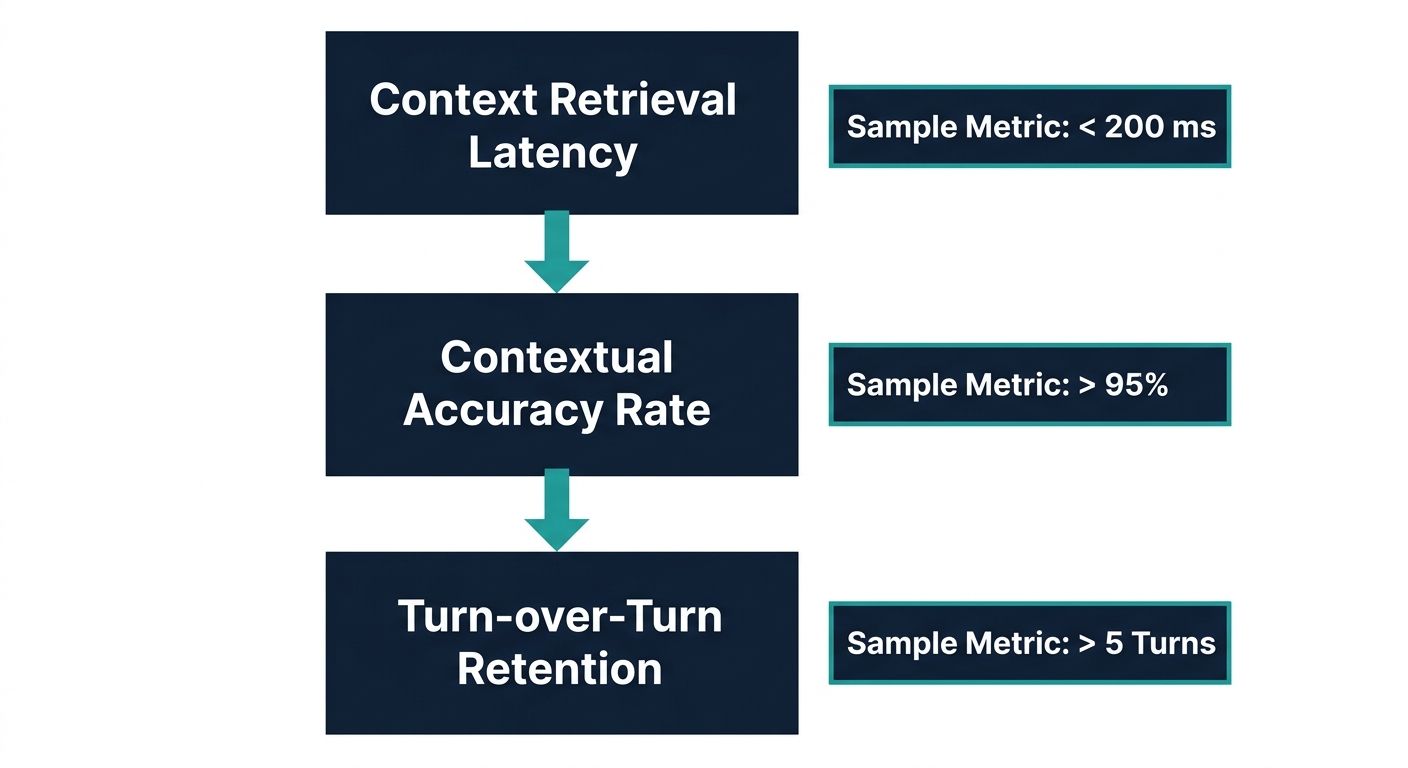
Tracking these three key performance indicators ensures your enterprise voice agent maintains conversational continuity without system lag.
When executing a commercial evaluation of these platforms, enterprises must look beyond the marketing terminology and demand hard, quantifiable metrics. Here are the critical performance indicators that define true context handling mastery:
* **Context Window Degradation Rate:** This metric measures how frequently the AI hallucinates or forgets information after exceeding a specific threshold of conversational turns (e.g., 20, 50, or 100 turns). Superior platforms maintain near-zero degradation through dynamic summarization.
* **Barge-in Recovery Latency:** When a user interrupts the AI, this metric tracks the millisecond delay before the AI processes the new context and begins generating an updated, contextually accurate response. Acceptable enterprise standards require recovery in under 500 milliseconds.
* **Entity Resolution Accuracy:** In audio processing, STT engines often misspell names or industry-specific terms. This metric evaluates the system's ability to use historical conversational context to correct transcription errors dynamically before they corrupt the LLM's prompt.
* **Inter-session Context Retrieval Time:** For returning users, this metric measures the speed at which the platform can query historical databases, retrieve the context of past interactions, and inject it into the live session without causing initial greeting latency.
## How to Choose the Right AI Voice Agent Platform for Your Enterprise
Selecting the optimal enterprise AI voice agent platform requires aligning your technical capabilities with your business objectives. If your organization boasts a massive engineering team dedicated to building custom state machines, a configurable API-first solution might suffice. However, if your goal is rapid deployment of highly intelligent, context-aware agents capable of driving business efficiency, task automation, and insightful analytics, you must prioritize platforms built around native context management.
Evaluate platforms based on their ability to handle real-world acoustic chaos. Ask vendors to demonstrate multi-turn conversations featuring heavy interruptions, abrupt topic changes, and callbacks to early conversational statements. Demand visibility into their transcription pipelines and ask specifically about their methodologies for mitigating token exhaustion during long interactions. An enterprise platform must not only transcribe speech; it must comprehend, retain, and intelligently leverage the underlying meaning of that speech across the entire customer lifecycle.
## Conclusion: Mastering Context for Next-Generation Voice AI
The enterprise landscape is rapidly moving past rudimentary voice bots towards sophisticated, AI-driven conversational agents. To compare enterprise AI voice agent platforms context handling capabilities effectively, decision-makers must pierce through the noise of generic listicles and demand rigorous architectural analysis. While competitors focus on providing developer APIs or broad orchestration features, the true differentiator in the market is the mastery of conversational memory. By prioritizing advanced context retention methodologies, minimizing latency in STT/TTS pipelines, and demanding robust, quantifiable performance metrics, enterprises can select powerful solutions like Alchemyst AI that genuinely transform business operations, customer service, and growth trajectories.
[← Back to Blog](/blog)
## Recently Published
[October 6, 2026 / 10 min readHow to Build a RAG Pipeline for Personal Documents and MediaBuild a multi-modal RAG pipeline for all personal documents and media assets.](/blog/rag-pipeline-personal-documents-media)
[Technical / September 27, 2026 / 11 min readHarness Engineering for AI Agents: Bridging the GapExplore how harness engineering enables robust AI infrastructure and MLOps.](/blog/harness-engineering-ai-agents)
[I'm Evaluating / September 27, 2026 / 9 min readContext Engineering Best Practices for Enterprise AIMaster advanced context engineering best practices for conversational AI agents.](/blog/context-engineering-best-practices)
[I'm Evaluating / September 22, 2026 / 11 min readContext Engineering vs Prompt Engineering for AI AgentsExplore the differences between context and prompt engineering for enterprise AI](/blog/context-engineering-vs-prompt-engineering)
[I'm Evaluating / September 14, 2026 / 10 min readContext Engineering for Enterprise AI: A Complete GuideMaster context engineering to build reliable, production-ready voice AI agents.](/blog/context-engineering-enterprise-ai)
[Deep Technical / July 7, 2026 / 10 min readVoice-Specific Architectural Requirements for AI Context LayersDiscover the core voice-specific architectural requirements for AI context layer](/blog/voice-specific-architectural-requirements-ai-context-layer)
Get Started
## Give your AI agents the memory they deserve.
Join developers building the next generation of AI products with persistent, auditable context. Free tier available. No credit card required.
* Free tier
* REST + Python & Node SDKs
* 99.9% uptime SLA
* SOC 2 in progress
### Request API Access
Enter your email and we'll set up your workspace.
Email
[Read the Docs →](https://docs.getalchemystai.com)[Read the Thesis →](/thesis)
---
# Guide: AI Context Engine API for Real-Time Voice Agents
- **URL:** https://getalchemystai.com/blog/ai-context-engine-api-real-time-voice-agents
- **Slug:** ai-context-engine-api-real-time-voice-agents
- **Published:** May 18, 2026
- **Last updated:** May 18, 2026
- **Author:** Harsh Shah
- **Category:** I'm Evaluating
[I'm Evaluating](/blog?category=im-evaluating)
# Guide: AI Context Engine API for Real-Time Voice Agents
Developer guide to AI context engine APIs for real-time voice agents & schemas.
Written by [Harsh Shah](/blog?author=Harsh%20Shah)Reviewed by [Anuran Roy](/blog?author=Anuran%20Roy)12 min readPublished at May 18, 2026 (4mo ago)
## Summary
Discover how to build and integrate an AI context engine API for real-time voice agents using advanced context management. This definitive developer reference includes sample endpoints, schemas, and integration blueprints to scale your AI solutions.
Table of Contents
## Introduction to the AI Context Engine API for Real-Time Voice Agents
In the rapidly evolving landscape of artificial intelligence, building a conversational agent that genuinely understands and reacts in real-time requires much more than a standard text-to-speech integration. The definitive key to unlocking natural, human-like voice interactions is a robust **AI context engine API for real-time voice agents**. As developers and AI engineers push the boundaries of what voice agents can achieve, the demand for sophisticated state management, ultra-low latency context retrieval, and persistent conversational memory has skyrocketed. This comprehensive guide serves as the definitive developer's reference for structuring, building, and documenting a real-world AI context engine API.
Current top-ranking pages and generic API documentations often provide high-level conceptual guides or basic voice agent blueprints. However, they consistently lack the specific, hands-on documentation required to build a dedicated context engine. Platforms that focus merely on providing a configurable API for basic voice transport often miss the critical layer of deep semantic memory. This article bridges that content gap by providing concrete examples of API endpoints, detailed request and response schemas, integration patterns, and best practices tailored specifically for real-time voice applications. By leveraging an AI-native context management solution, developers can seamlessly integrate robust context and memory capabilities into their AI-driven applications.
## The Critical Need for Context Engineering in Voice AI
Voice interactions are inherently different from text-based chats. In a text interface, users can see the history of their conversation and often tolerate slight delays or minor contextual hallucinations. In real-time voice applications, however, latency and context loss are immediate dealbreakers. An AI context engine API for real-time voice agents solves the fundamental challenge of maintaining state across unpredictable spoken dialogues. Without a dedicated context engine, a voice agent is merely a stateless transcriber, incapable of recalling a user's preference stated three minutes ago or referencing a complex document in real-time.
When analyzing competitor gaps in the market, it becomes clear that many tools fall short. Solutions that primarily focus on providing a configurable API for developers to build advanced voice AI agents often emphasize the technical infrastructure of the call, such as SIP trunking or WebRTC transport, but leave the developer entirely responsible for the cognitive architecture. Conversely, tools that position themselves strictly as a memory layer often provide basic drop-in memory infrastructure but lack the integrated document retrieval and AI-native processing power required for enterprise-grade applications. A true context engine must synthesize two core capabilities: _Context_ and _Memory_.
## Understanding Context vs. Memory in Real-Time Applications
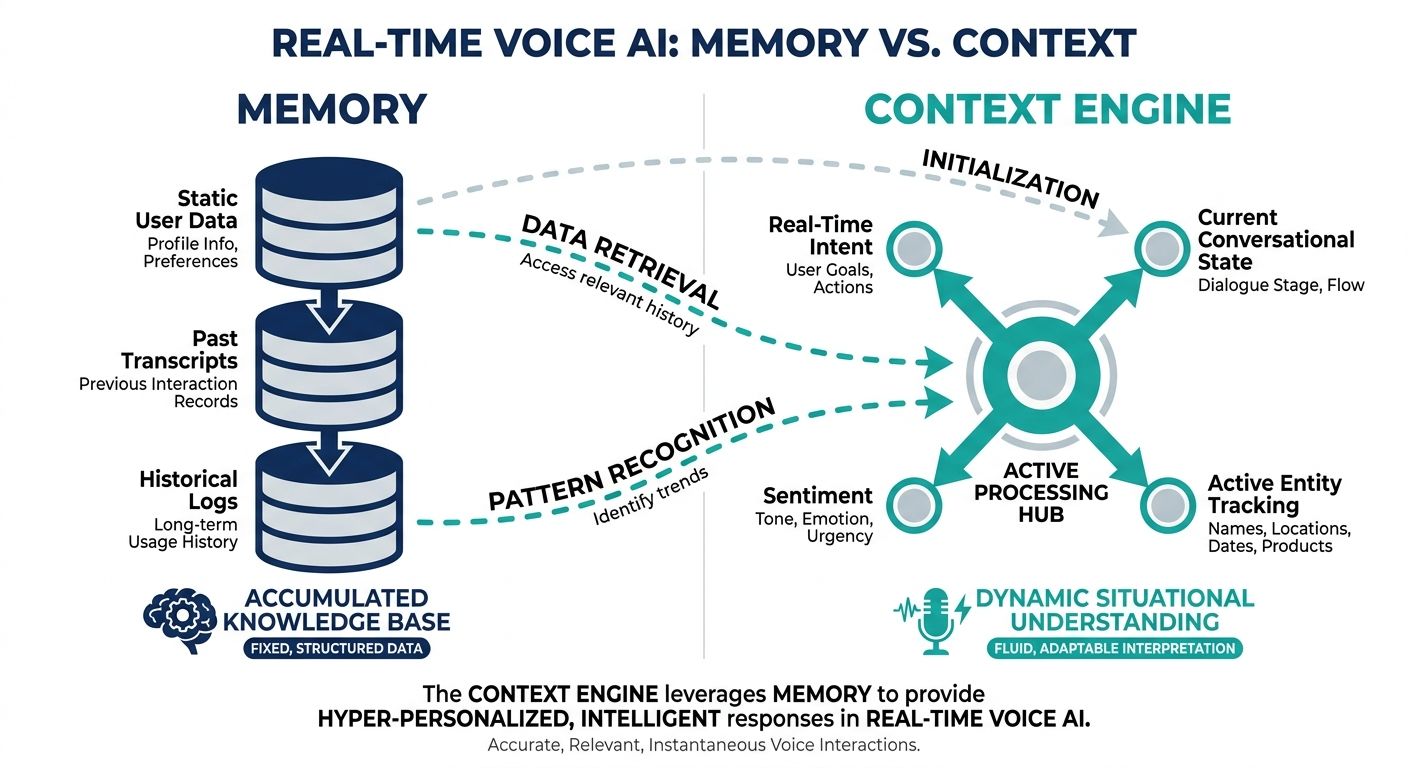
This comparison illustrates how static memory differs from real-time context, helping you understand why both are necessary for intelligent voice agents.
To build a high-performing real-time voice agent, developers must cleanly separate the concepts of Context and Memory. These two pillars work in tandem but serve distinct functions within the AI context engine API for real-time voice agents.
* **Context:** This refers to the external knowledge base. It involves storing massive repositories of documents, transcribing audio files, and retrieving highly relevant information on the fly to inform the AI's answers. In a real-time voice scenario, this is the Retrieval-Augmented Generation (RAG) pipeline optimized for millisecond response times.
* **Memory:** Memory is highly personal and session-specific. It tracks user preferences, historical conversation data, and nuanced interaction patterns. If a user tells a voice agent to speak slower and summarize points, the Memory layer ensures this preference persists across all future interactions without needing to be re-prompted.
## Definitive Developer Reference: API Documentation and Blueprints
To truly understand how an AI context engine API for real-time voice agents operates under the hood, we must examine the specific data models and API endpoints that drive it. Below is a detailed blueprint of how a production-ready context engine is structured, featuring complete request and response schemas. This technical deep dive is designed for AI engineers and developers who require practical, actionable depth.
### Authentication and Core Configuration
Every interaction with the AI context engine API requires secure authentication. Real-time voice agents often establish a persistent WebSocket connection or make high-frequency REST calls, necessitating efficient token validation. Developers authenticate using a Bearer token provided in the Authorization header. Ensure that your API keys are scoped correctly, especially when deploying voice agents in enterprise environments with strict security compliance standards.
### Endpoint 1: Initializing the Voice Session Context
**POST /v1/sessions/initialize**
This endpoint is called the moment a user initiates a voice call. It pre-fetches the user's persistent memory and prepares the context engine for ultra-low latency RAG queries during the conversation. By eagerly loading the context, the voice agent avoids the dreaded cold-start latency that plagues many basic AI voice implementations. Proper initialization is critical for setting up the real-time pipeline.
**Request Payload Schema:**
* **user\_id** (String, Required): The unique identifier for the user initiating the voice call.
* **agent\_id** (String, Required): The ID of the specific voice agent being invoked.
* **session\_metadata** (Object, Optional): Additional data such as device type, location, or initial conversational intent.
**Response Payload Schema:**
* **session\_id** (String): The newly created session identifier used for all subsequent real-time tracking.
* **active\_memory** (Object): A summarized profile of the user's preferences retrieved from the Memory service.
* **context\_ready** (Boolean): Indicates whether the AI-native context engine has successfully loaded the user's RAG indices.
### Endpoint 2: Real-Time Context Injection and Retrieval
**POST /v1/context/retrieve**
As the user speaks, their speech is transcribed into text and immediately sent to this endpoint. This is the beating heart of the AI context engine API for real-time voice agents. The endpoint queries the ingested document database and the user's interaction history simultaneously, returning a highly optimized prompt payload that your Voice LLM can instantly vocalize.
**Request Payload Schema:**
* **session\_id** (String, Required): The active session identifier.
* **utterance** (String, Required): The real-time transcribed text of what the user just said.
* **latency\_budget\_ms** (Integer, Optional): A strict timeout limit. If the semantic search exceeds this budget, the API falls back to a simpler response to maintain the illusion of a seamless real-time conversation.
**Response Payload Schema:**
* **retrieved\_context** (String): The concatenated, relevant information extracted from the RAG pipeline.
* **memory\_updates** (Array): Any new implicit preferences detected in the user's utterance that have been queued for the Memory engine.
* **suggested\_agent\_response** (String): The fully contextualized string ready to be sent to your Text-to-Speech service.
### Endpoint 3: Asynchronous Memory Consolidation
**PATCH /v1/memory/update**
After a voice call concludes, the system must summarize and permanently store the new conversational data. This endpoint handles the long-term state management. Advanced platforms leverage AI summarization capabilities to compress lengthy transcripts into concise, actionable memory blocks, ensuring that the database does not become bloated over time and that insights remain highly accessible.
**Request Payload Schema:**
* **session\_id** (String, Required): The ID of the completed voice session.
* **full\_transcript** (Array, Required): The complete chronological log of user and agent utterances.
* **force\_summarization** (Boolean, Optional): Instructs the AI context engine to compress the transcript immediately rather than waiting for a batch job.
## Advanced Integration Patterns for Voice AI Engineers
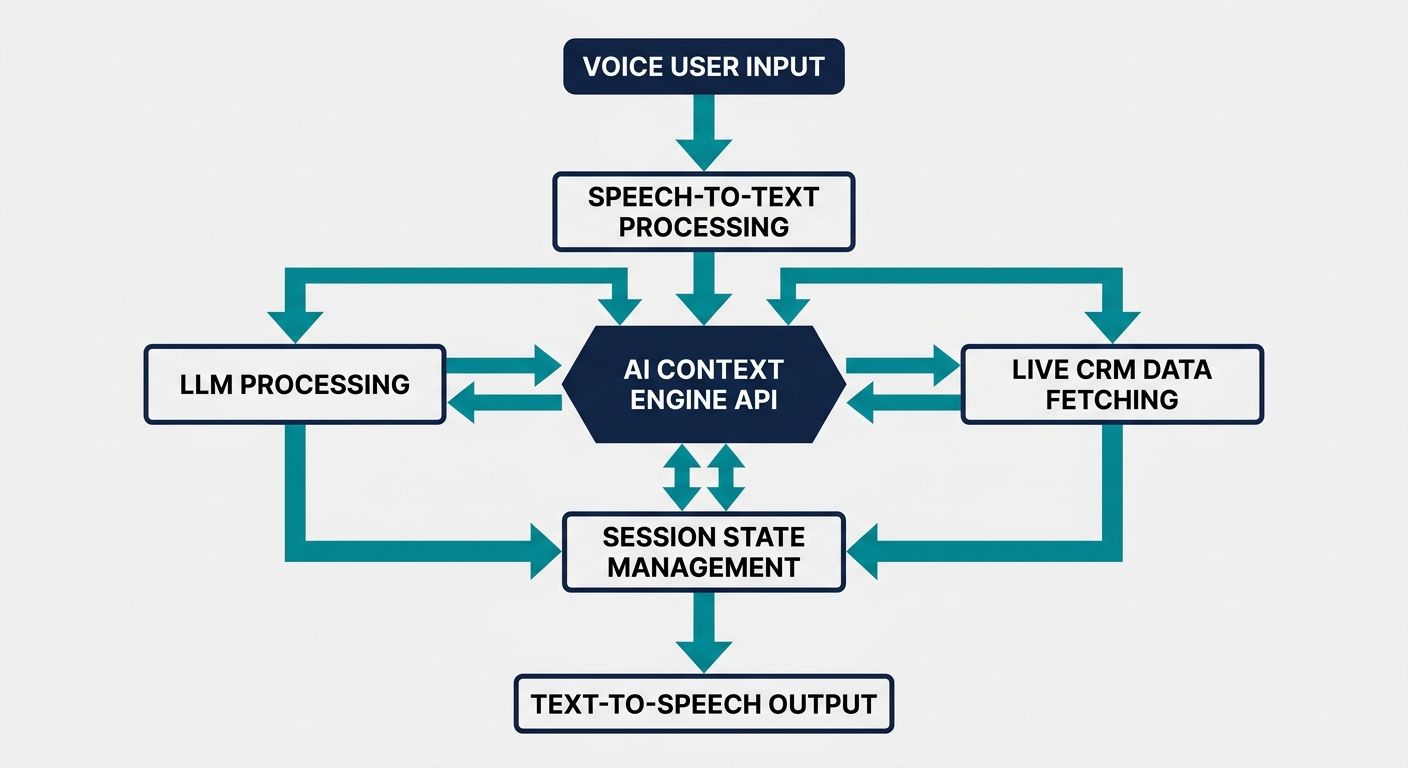
Visualizing the architecture of an advanced integration pattern reveals how the context engine API acts as the central brain between user input and LLM processing.
Providing an API is only half the battle; developers need to know how to weave these endpoints into complex software ecosystems. The integration capabilities of your AI context engine API for real-time voice agents dictate its true utility in production environments where scale and stability are non-negotiable.
### Integrating with the Vercel AI SDK
Modern developers frequently utilize the Vercel AI SDK to build streaming AI applications. Integrating an AI context engine API into this stack requires specialized hooks. By leveraging streamlined documentation and official third-party integrations, developers can map their real-time voice streams directly into the Vercel AI SDK's state management. This integration ensures that UI components on a dashboard can update synchronously while the user is speaking to the voice agent over a WebRTC connection, providing a magical, multi-modal user experience.
### Database Integrations: MongoDB and PostgreSQL
A context engine is only as powerful as the data it can access. Streamlined documentation for database integrations is critical. For instance, connecting your AI context engine API to PostgreSQL allows you to utilize pgvector for blazing-fast semantic search across structured enterprise data. Alternatively, MongoDB offers the flexibility needed to store unstructured memory objects and complex nested user preferences. When building a real-time voice agent, you must index these databases correctly so that the Context service can execute similarity searches in under fifty milliseconds.
## Performance Considerations and Best Practices
When deploying an AI context engine API for real-time voice agents, performance is the ultimate metric of success. Voice conversations demand absolute fluidity. Below are the core architectural best practices developers must follow to ensure their deployments do not suffer from lag or dropped contexts.
### Optimizing Payload Sizes
Real-time voice agents cannot wait for massive JSON payloads to traverse the network. When documenting context retrieval and management, developers must prioritize payload compression. Strip out all unnecessary metadata from the Context response. Instead of returning full source documents, the API should only return the highly specific exact snippet needed to answer the user's query. This strict payload management drastically reduces latency and ensures the Voice LLM begins generating audio almost instantaneously.
### Managing State During Interruptions
Humans interrupt each other constantly during voice conversations. Your AI context engine API for real-time voice agents must account for this. If a user interrupts the agent, the system must instantly abort the current text-to-speech stream and send an emergency state-update to the Memory service. The API must register the interruption as an implicit signal that perhaps the user is impatient, or the context provided was incorrect. This data is fed back into the Memory service to adjust the agent's future behavior dynamically.
## Security, Compliance, and Data Sovereignty
Handling voice data inherently involves processing sensitive personally identifiable information. An enterprise-grade AI context engine API must be built with strict compliance standards in mind. Features such as data anonymization, automated redaction of sensitive numbers, and regional data storage are paramount. When evaluating platforms, ensure they offer comprehensive enterprise-level support and security options that align with regulations like GDPR and HIPAA, specially when storing long-term memory logs and audio transcriptions.
## Scaling Your AI Operations with the Right Platform
Building an infrastructure from scratch is an immense undertaking. Leveraging a dedicated platform like Alchemyst AI provides a scalable pathway. The platform offers diverse pricing structures tailored to different stages of voice AI development.
* **Forever Free Plan:** Ideal for individuals and small teams. It allows developers to test the AI context engine API for real-time voice agents, offering basic monthly transcription limits and essential context storage to validate proof-of-concepts without financial risk.
* **Pro Plan:** Designed for professionals and scaling startups. This tier increases storage capacity, expands language support for global voice agents, and unlocks advanced AI summarization features that are crucial for long-term memory compression and insightful analytics.
* **Enterprise Plan:** Engineered for larger businesses requiring highly scalable AI solutions. It includes custom AI models, extensive collaboration tools, and enterprise-level support and security options. For organizations processing millions of voice minutes, this tier guarantees dedicated infrastructure for ultra-low latency context management.
## Contributing to the Context Ecosystem
The field of AI-native context management is constantly evolving. Platforms often maintain a comprehensive documentation contribution guide to foster a developer community. By utilizing frameworks like Mintlify and MDX, technical writers and developers can actively improve the documentation. This open, collaborative approach ensures that the ecosystem remains robust, providing practical and actionable instructions for structuring, validating, and submitting enhancements to the core API capabilities.
## Handling Concurrent Agent Sessions
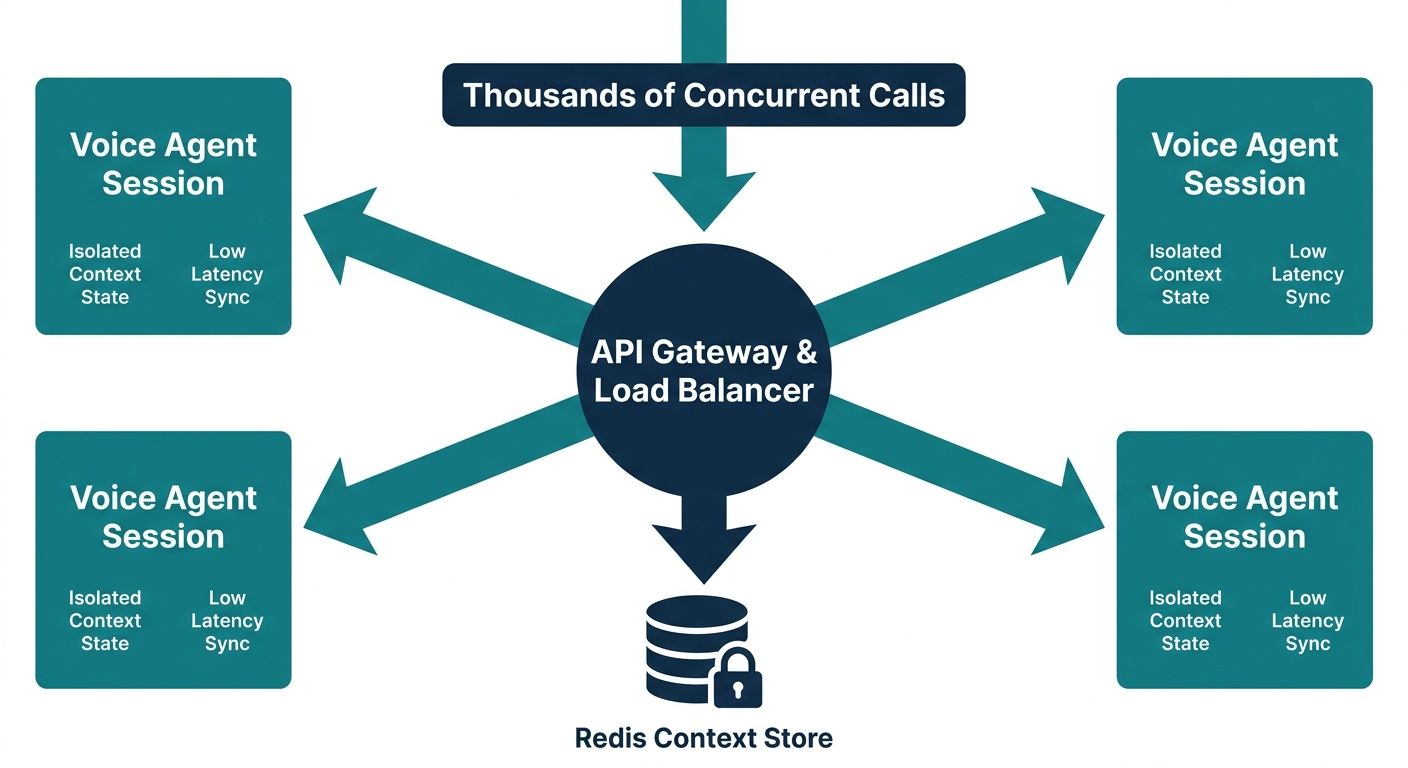
This architectural diagram demonstrates how an API gateway distributes thousands of concurrent calls while maintaining isolated context states for each active session.
As your voice AI platform grows, you will inevitably face the challenge of managing thousands of concurrent voice sessions. The architecture behind your AI context engine API for real-time voice agents must rely on stateless edge functions and distributed caching mechanisms, such as Redis, to hold the temporary conversation state before it is committed to the long-term PostgreSQL or MongoDB database. Designing for high concurrency prevents race conditions where a user's memory might be overwritten improperly during rapid conversation turns.
## Analyzing Insightful Analytics for Voice Platforms
Beyond simply driving the conversation, the data flowing through the AI context engine API is a goldmine for insightful analytics. By aggregating the memory updates and context retrieval logs, business owners and marketing professionals can identify exactly what questions customers are asking the voice agents. Customer service teams can use this AI-driven efficiency to refine their knowledge bases, ensuring the RAG pipeline is always populated with the most relevant, up-to-date documentation to resolve user queries faster.
## Conclusion: The Future of Real-Time Voice Agents
The transformation of business functions through AI-driven efficiency, seamless content creation, and intelligent task automation is already underway. For business owners, marketing professionals, and customer service teams, the deployment of intelligent voice agents represents the next frontier of digital interaction. However, the success of these deployments hinges entirely on the underlying architecture.
By thoroughly understanding and implementing a dedicated AI context engine API for real-time voice agents, developers can transcend the limitations of stateless voice bots. Embracing deep integration patterns, rigorous performance optimization, and sophisticated Memory and Context services ensures that your voice agents are not just hearing users, but truly listening, remembering, and understanding. As you embark on building your next-generation voice AI stack, let this definitive developer's reference guide your architectural decisions, ensuring a robust, scalable, and highly contextual conversational experience for every single user interaction.
[← Back to Blog](/blog)
## Recently Published
[October 6, 2026 / 10 min readHow to Build a RAG Pipeline for Personal Documents and MediaBuild a multi-modal RAG pipeline for all personal documents and media assets.](/blog/rag-pipeline-personal-documents-media)
[Technical / September 27, 2026 / 11 min readHarness Engineering for AI Agents: Bridging the GapExplore how harness engineering enables robust AI infrastructure and MLOps.](/blog/harness-engineering-ai-agents)
[I'm Evaluating / September 27, 2026 / 9 min readContext Engineering Best Practices for Enterprise AIMaster advanced context engineering best practices for conversational AI agents.](/blog/context-engineering-best-practices)
[I'm Evaluating / September 22, 2026 / 11 min readContext Engineering vs Prompt Engineering for AI AgentsExplore the differences between context and prompt engineering for enterprise AI](/blog/context-engineering-vs-prompt-engineering)
[I'm Evaluating / September 14, 2026 / 10 min readContext Engineering for Enterprise AI: A Complete GuideMaster context engineering to build reliable, production-ready voice AI agents.](/blog/context-engineering-enterprise-ai)
[Deep Technical / July 7, 2026 / 10 min readVoice-Specific Architectural Requirements for AI Context LayersDiscover the core voice-specific architectural requirements for AI context layer](/blog/voice-specific-architectural-requirements-ai-context-layer)
Get Started
## Give your AI agents the memory they deserve.
Join developers building the next generation of AI products with persistent, auditable context. Free tier available. No credit card required.
* Free tier
* REST + Python & Node SDKs
* 99.9% uptime SLA
* SOC 2 in progress
### Request API Access
Enter your email and we'll set up your workspace.
Email
[Read the Docs →](https://docs.getalchemystai.com)[Read the Thesis →](/thesis)
---
# You Can't Debug What You Can't See: Context Tracing for AI Agents with OpenAI Euphony
- **URL:** https://getalchemystai.com/blog/context-tracing-for-ai-agents-with-openai-euphony
- **Slug:** context-tracing-for-ai-agents-with-openai-euphony
- **Published:** May 16, 2026
- **Last updated:** May 16, 2026
- **Author:** Khushi Mhasange
- **Category:** Technical
[Technical](/blog?category=technical)
# You Can't Debug What You Can't See: Context Tracing for AI Agents with OpenAI Euphony
Building an AI agent is the easy part. Debugging one is where teams give up.
Written by [Khushi Mhasange](/blog?author=Khushi%20Mhasange)Reviewed by [Anuran Roy](/blog?author=Anuran%20Roy)11 min readPublished at May 16, 2026 (5mo ago)
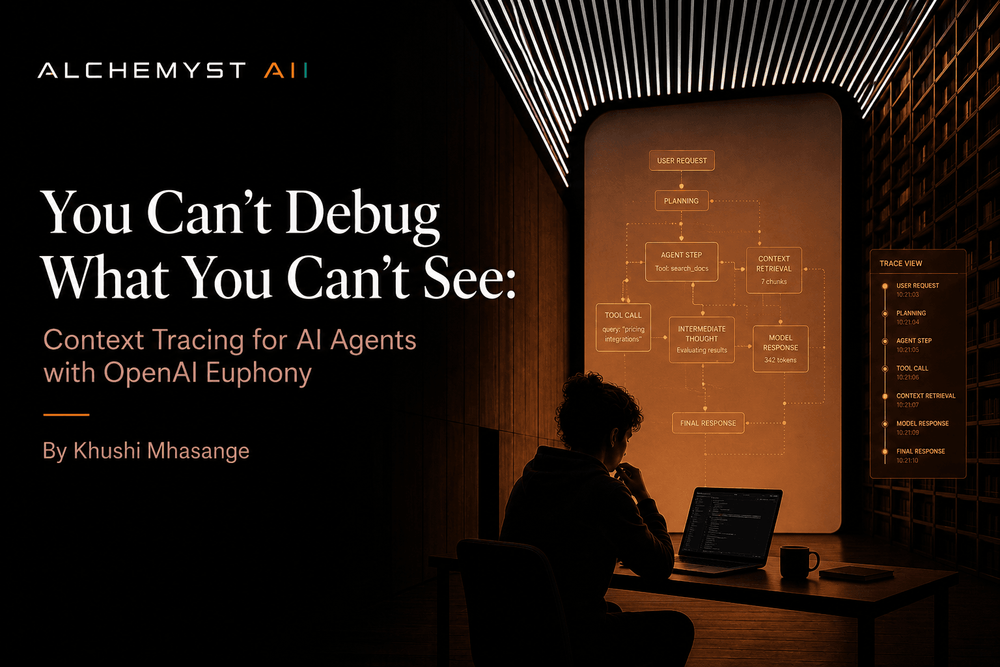
## Summary
Debugging AI agents fails not because the code is broken, but because the context is wrong - and traditional tools can't show you what context the agent had when it made a bad decision. This article explores how pairing Alchemyst AI's Context Arithmetic and context tracing with Euphony, OpenAI's Euphony - open-source conversation visualizer, creates an end-to-end debugging workflow that pinpoints whether a failure was a retrieval problem, a configuration problem, or a model problem - turning hours of JSON spelunking into minutes of structured diagnosis.
Table of Contents
## Introduction
Building an AI agent is the easy part. Debugging one is where most teams quietly give up.
When an agent reads files, calls external APIs, writes and revises code, and chains together dozens of reasoning steps, the traditional debugging methods breaks down completely. There's no stack trace that tells you why the agent retrieved the wrong document. There's no breakpoint you can set to pause the model mid-thought. What you get instead is a wall of raw JSON, hundreds of lines deep, and a vague sense that something went wrong somewhere between the user's question and the agent's confidently wrong answer.
This is the state of AI agent debugging today for most teams: manual, tedious, and fundamentally unscalable as agents grow more capable.
Two things change that. First, you need to know exactly what context the agent was given when it made a decision. Second, you need to be able to read the resulting interaction without a PhD in JSON parsing. This article walks through how pairing **Alchemyst AI** \- a context and memory engine with **Euphony** \- OpenAI's recently open-sourced conversation visualization tool, creates a debugging workflow that actually works in production.
## The Real Problem: Why AI Agents Are So Hard to Debug
Debugging traditional software is a known discipline. You set breakpoints, read logs, step through call stacks, and narrow down the problem. The system does exactly what the code says.
AI agents break every one of those assumptions.
When an agent fails, the bug is almost never in the code. The code ran fine. The model ran fine. The failure is in the **context** \- what the agent knew, what it didn't know, and what it thought it knew but had wrong. These are fundamentally different failure modes, and they require different tools to diagnose.
The most common ones:
**Context Amnesia.** The agent had access to a critical piece of information earlier in the session, a user preference, a constraint, a prior decision, but by the time it needed to act on it, that context had been pushed out of the window. The agent had no one telling it what to remember.
**Context Bloat.** The opposite problem. The agent was stuffed with everything that might be relevant - entire documents, full conversation histories, exhaustive metadata and the signal got buried in the noise. The correct answer was technically present in the context. The model just couldn't find it.
**Retrieval Mismatch.** The RAG pipeline pulled the wrong documents. The embedding similarity scores looked fine. But the retrieved chunks, while semantically adjacent, were missing the specific detail the agent actually needed. The agent answered confidently - and incorrectly - because the retrieval layer gave it plausible but wrong context.
**Hallucination from Context Gaps.** When the agent doesn't have the context to ground a response, it fills the gap. Not maliciously - it's doing what it was trained to do, which is produce a coherent, confident-sounding answer. The problem is that coherent and correct are not the same thing.
Without tooling that exposes exactly what went into the context window for a given query, diagnosing any of these issues means manually correlating logs across your embedding store, your retrieval pipeline, your prompt construction layer, and the model's output. For a five-step agent, that's painful. For a 50-step agent running across multiple tools and data sources, it's nearly impossible.
## Alchemyst AI: Treating Context as an Engineering Problem
Most teams treat context as an afterthought- something you assemble in a prompt template and hope for the best. Alchemyst AI treats it as an engineering discipline with its own primitives, rules, and guarantees.
At its core, Alchemyst is a **context and memory engine**. It sits between your data layer and your model, and its job is to make sure that at every point in an agent's execution, the model sees exactly the context it needs - no more, no less.
### Context Arithmetic
The central idea behind Alchemyst is **Context Arithmetic** \- a dynamic rule system that determines what survives into the final context window at query time.
Instead of static retrieval ("find the top-K most similar chunks and pass them in"), Alchemyst performs set operations on your data:
* **Union**: Combine context from multiple sources - a user's history, a relevant document, a live API response - into a single coherent input
* **Intersection**: Only include context that satisfies multiple relevance criteria simultaneously - reducing noise significantly
* **Subtraction**: Explicitly exclude context that's present but shouldn't influence this particular response - outdated records, superseded decisions, irrelevant metadata
The result is a context window that's been actively engineered for the query at hand, not passively assembled by a similarity search.
> _"Structure your context so that correct answers fall out naturally from arithmetic - not from clever prompts."_
This distinction matters more than it sounds. A well-structured context window makes the model's job easier and its outputs more predictable. A bloated or misaligned context window forces the model to do implicit filtering work it wasn't designed to do - and fails silently when it gets it wrong.
### Context Traces: Seeing Exactly What the Agent Knew
For debugging purposes, the most important feature Alchemyst provides is **Context Traces**.
Every time an agent query is processed, Alchemyst logs the exact data points that were selected, combined, filtered, and ranked before being passed to the model. Not a summary. Not a high-level description. The exact context, traceable back to its source in your organization's data.
This answers the question that sits at the root of almost every agent debugging session: _What did the model actually know when it made this decision?_
With Context Traces, you can tell immediately whether a failure was a retrieval problem (the wrong context was selected), a configuration problem (the Context Arithmetic rules need adjustment), or a model problem (the right context was provided but the model misinterpreted it). These are completely different problems with completely different fixes, and without tracing, you're guessing which one you're dealing with.
## Euphony: Making Agent Conversations Readable
Context traces solve half the problem. You now know what the agent was given. But you still need to understand what it did with that context - how the conversation unfolded, where the reasoning went sideways, what the intermediate steps looked like.
That's what **Euphony** solves.
Recently open-sourced by OpenAI, Euphony is a browser-based visualization tool that takes structured chat data and Codex session logs and turns them into readable, interactive conversation timelines. It was built specifically for the kind of deeply nested, metadata-heavy JSON that AI agent sessions produce - the kind that's technically complete but practically unreadable without tooling.
### What Euphony Ingests
Euphony is designed around two data formats:
* **Harmony conversations** \- structured multi-turn conversation logs with role assignments, message content, and attached metadata
* **Codex session logs** \- step-by-step logs of agent execution, including tool calls, reasoning steps, and intermediate outputs
Both formats are JSONL-based, making them easy to produce from any logging pipeline. If you're already logging your agent sessions, getting them into Euphony is mostly a formatting question.
### Key Features
**Conversation Timeline View.** The primary interface renders the full agent session as a structured, browseable timeline - system prompt, user turns, assistant responses, tool calls, and tool results - in the order they happened. What was a 400-line JSON file becomes a readable conversation you can scroll through in under a minute.
**Metadata Inspection.** Every message and turn can carry attached metadata - retrieval scores, source documents, confidence markers, custom labels - and Euphony surfaces this inline. You don't need to cross-reference a separate log to see that a particular assistant response was grounded on a document with a 0.61 similarity score.
**JMESPath Filtering.** For large datasets with hundreds of sessions, Euphony supports JMESPath expressions to filter down to exactly the conversations you care about. Filter by outcome, by error type, by a specific tool that was called, or by any field in your metadata schema.
**Focus Mode.** Within a single session, focus mode lets you filter visible messages by role (system, user, assistant, tool), by recipient, or by content type. When you're trying to understand a specific tool-use chain inside a 200-turn session, this is the difference between five minutes and an hour.
**Grid and Editor Modes.** Grid view lets you skim across a dataset of sessions quickly - useful for spotting patterns across multiple agent runs. Editor mode gives you direct access to the underlying JSONL, so you can tweak a conversation, re-run it, and see how the change affects behavior.
## The Combined Workflow: Alchemyst AI + Euphony
Used separately, each tool addresses half the problem. Used together, they close the loop entirely.
Here's what a debugging session looks like end to end:

### Step 1 - Query and Context Retrieval
A user sends a query to the agent. Alchemyst's context engine kicks in, applying Context Arithmetic rules to determine exactly which data points from your organization's data are relevant. The resulting context - selected, filtered, and ranked - is assembled and passed to the model.
Critically, the entire context retrieval process is logged as a Context Trace. Every data point that was considered, every rule that was applied, every decision about what to include or exclude - it's all recorded.
### Step 2 - Agent Execution and Logging
The agent runs. It reads the context, calls tools, reasons through intermediate steps, and produces a response. The full execution - user input, retrieved context, reasoning chain, tool calls, tool results, final output - is logged as a structured Harmony or Codex session file.
No special instrumentation required. If you're using Alchemyst, the context trace is already captured. The session log is a standard output of your agent runtime.
### Step 3 - Visualization in Euphony
The developer loads the session log into Euphony. The raw JSON becomes a clean, browseable timeline. They can see each turn in sequence, inspect the metadata attached to each message, filter down to the specific reasoning steps they care about, and get a clear picture of how the conversation unfolded.
For a session that produced a bad output, this step typically takes the time from "I have no idea what happened" to "I can see exactly where it went wrong" down from hours to minutes.
### Step 4 - Root Cause Diagnosis
Now the developer has both pieces:
* The **Context Trace** from Alchemyst showing exactly what the agent knew at each step
* The **Conversation Timeline** from Euphony showing exactly what the agent did with that knowledge
If the agent got the wrong answer because it was given the wrong context, that's visible in the Context Trace - an Alchemyst configuration issue. Adjust the Context Arithmetic rules, re-run, verify.
If the agent was given the right context but still produced the wrong output, that's visible in the conversation timeline - a prompt design or model behavior issue. The context was correct; the model's interpretation of it wasn't.
These are precise, actionable diagnoses. Not "something went wrong somewhere in the pipeline." Exactly what went wrong and where.
## Why This Matters Beyond Engineering Teams
One underappreciated benefit of this workflow is that it makes AI agent debugging accessible to people who aren't engineers.
Raw JSON logs are not reviewable by product managers, QA testers, or domain experts. Euphony conversation timelines are. Alchemyst context traces are structured and human-readable by design.
This matters practically. The people who know best whether an agent's response was wrong are often not the people who can read a JSON log. A compliance reviewer, a domain expert, a client success manager - these people can look at a Euphony timeline, read through the conversation, see what context the agent had, and say with confidence: "It retrieved the wrong policy document" or "It ignored the constraint the user set in turn three."
That feedback loop - from domain expertise back to agent configuration - is what makes agent systems actually improve over time. Without readable tooling, that loop doesn't exist.
## Conclusion
AI agents are only going to get more capable and more autonomous. The complexity of debugging them scales directly with that capability. Teams that don't invest in observability tooling now will find themselves flying blind as their agents take on higher-stakes tasks.
The combination of Alchemyst AI's context tracing and Euphony's conversation visualization doesn't just make debugging faster - it makes it tractable. It turns the AI black box into something you can actually reason about: a transparent, traceable system where failures have causes you can find and fixes you can verify.
If you're building agents that matter, this is what your debugging workflow should look like.
[← Back to Blog](/blog)
## Recently Published
[October 6, 2026 / 10 min readHow to Build a RAG Pipeline for Personal Documents and MediaBuild a multi-modal RAG pipeline for all personal documents and media assets.](/blog/rag-pipeline-personal-documents-media)
[Technical / September 27, 2026 / 11 min readHarness Engineering for AI Agents: Bridging the GapExplore how harness engineering enables robust AI infrastructure and MLOps.](/blog/harness-engineering-ai-agents)
[I'm Evaluating / September 27, 2026 / 9 min readContext Engineering Best Practices for Enterprise AIMaster advanced context engineering best practices for conversational AI agents.](/blog/context-engineering-best-practices)
[I'm Evaluating / September 22, 2026 / 11 min readContext Engineering vs Prompt Engineering for AI AgentsExplore the differences between context and prompt engineering for enterprise AI](/blog/context-engineering-vs-prompt-engineering)
[I'm Evaluating / September 14, 2026 / 10 min readContext Engineering for Enterprise AI: A Complete GuideMaster context engineering to build reliable, production-ready voice AI agents.](/blog/context-engineering-enterprise-ai)
[Deep Technical / July 7, 2026 / 10 min readVoice-Specific Architectural Requirements for AI Context LayersDiscover the core voice-specific architectural requirements for AI context layer](/blog/voice-specific-architectural-requirements-ai-context-layer)
Get Started
## Give your AI agents the memory they deserve.
Join developers building the next generation of AI products with persistent, auditable context. Free tier available. No credit card required.
* Free tier
* REST + Python & Node SDKs
* 99.9% uptime SLA
* SOC 2 in progress
### Request API Access
Enter your email and we'll set up your workspace.
Email
[Read the Docs →](https://docs.getalchemystai.com)[Read the Thesis →](/thesis)
---
# How to ACTUALLY set up a "company brain"
- **URL:** https://getalchemystai.com/blog/how-to-actually-set-up-a-company-brain
- **Slug:** how-to-actually-set-up-a-company-brain
- **Published:** May 15, 2026
- **Last updated:** May 15, 2026
- **Author:** Anuran Roy
- **Category:** Technical
[Technical](/blog?category=technical)
# How to ACTUALLY set up a "company brain"
Everybody wants one. Almost nobody has one.
Written by [Anuran Roy](/blog?author=Anuran%20Roy)Reviewed by [Anuran Roy](/blog?author=Anuran%20Roy)7 min readPublished at May 15, 2026 (5mo ago)
## Summary
Most companies building a "company brain" mistake a piece for the whole - memory providers capture conversations, record providers capture traces, but neither adapts when the business changes underneath them.
Table of Contents
YC's Summer 2026 RFS put ["company brain"](https://x.com/ycombinator/status/2048834293779378437?s=20) into every pitch deck overnight. Agent startups pivoted to it. CRMs rebranded as "Work OS." SoR providers started calling themselves "Revenue WorkOS." The phrase went from niche infrastructure jargon to fundraising prerequisite in about six weeks.
The scramble produced two camps, each mistaking a piece for the whole.
**The memory camp.** Providers like Mem0 and Zep capture conversations between AI and people. Valuable, but conversations account for a fraction of real business context. Your pricing logic, your compliance rules, your customer's integration constraints, the reason your sales team scoped a deal the way they did: none of that lives in a chat transcript.
**The records camp.** Foundation Capital's [thesis](https://x.com/GilFeig/status/2005669612571013530) on Systems of Action captures execution traces: the outputs of agents doing work. That matters too, but traces are downstream artefacts. You can't capture them until you've solved the context problem that generates them in the first place.
Both camps share the same blind spot. They store information against categories and schemas that were current at write time, and neither adapts when the business underneath them shifts.
## The aging ontology problem
Every system of record starts accurate. The decay starts the moment you ship it.
Your sales team adds a new segment. Your product ships a new pricing tier. Your compliance team layers on a regional constraint. The schema doesn't update itself. Teams start maintaining shadow systems in spreadsheets and Slack threads because the "official" record no longer matches how they work. Six months in, you have two versions of the truth: what the system says and what people do.
But schema decay is only half the story. The deeper issue is **semantic consensus**, or rather the lack of it. Take a term like "revenue." To your finance team, revenue means recognized ARR after deductions. To your sales team, it means bookings. To your product team, it means MRR from active subscriptions. The same word points at three different numbers in three different systems, and nobody notices until an agent tries to pull "revenue" into a report and produces something that's correct from one team's perspective and wrong from another's.
Ontologies and knowledge graphs that span an entire institution inherit this ambiguity at every node. An AI agent consuming that graph doesn't know which "revenue" you meant. Naive retrieval at least knows it's guessing. A structured ontology with unresolved semantic conflicts doesn't, and that false confidence produces bigger misalignments than no graph at all.
Patrick Debois captured a related angle in his ["Context Is the New Code"](https://www.jedi.be/blog/2026/two-weeks-after-context-is-the-new-code/) work: context artifacts rot the same way code does, and they need their own lifecycle (generate, evaluate, distribute, observe) to stay accurate. He calls this the Context Development Lifecycle. The community around that work has started using the term ["context debt"](https://medium.com/@wasowski.jarek/managing-agent-context-at-every-stage-of-the-sdlc-cdlc-sdd-cecd0d575064), a direct sibling of technical debt, to describe what accumulates when you store context but never revisit it. The aging ontology problem is context debt at the institutional level: an entire organizational knowledge structure drifting out of alignment with reality while agents keep acting on it.
Bolting on new fields doesn't fix this. You need a substrate that absorbs new context without requiring a migration every quarter, and that can reconcile competing definitions of the same concept across teams. In practice, that means scoped document groups with composable set operations over them: you add context to a named scope, query across scopes by intersection, and delete-then-replace when definitions change. No monolithic schema that breaks when you add a field.
## Three layers that make the brain work
A company brain lives on three layers. Get any of them wrong and you're building on sand.
**Layer 1: The business context substrate.** This sits at the organizational level. Data from your CRM, your docs, your product, your customer interactions, your internal comms. Cross-functional, cross-team. You own the provenance of every piece of context at an institutional level. If you don't control this layer, nothing downstream works.
**Layer 2: The references-inferences layer.** This sits at the project level. Your operational logic at execution time: guardrails, guidelines, scoping rules, the "how we do things here" that varies by team and use case.
**Layer 3: The reflection layer.** Learnings accumulate here. Which agent runs went well. Which ones broke. Misalignments between expected and actual outcomes. Human-validated corrections from this layer feed back into layers 1 and 2\. The brain doesn't self-modify unchecked; someone reviews what it learned before it changes how it operates.
The pattern: your system of record isn't a centralized database anymore. It _emerges_ from syncing the context substrate with references and reflections. SoR is a verb, not a noun.
Layer 1 absorbs new context as it arrives. Layer 2 adapts the operational logic per project. Layer 3 detects when old patterns stop matching reality and flags the drift before agents act on it. Memory providers give you layer 3 without layers 1 and 2\. Record providers give you the same gap from a different angle. Neither solves the aging ontology problem because neither was designed to.
## How this looks in practice
We run a context infrastructure company. If we can't use our own product to build faster, the thesis is dead.
A month ago, our GTM team closed a deployment for an education client. The client needed agents that could handle 30+ regional language variants in enrolment calls. Our GTM team uploaded the business context (call scripts, objection maps, regional pricing matrices, compliance constraints) to our context layer. That's layer 1.
Our engineering team had a code cloner metaskill that had already reflected on our codebase: it understood our conventions, our separation of concerns, our API patterns. A dev pointed it at the new business context and it wrote the first pass of the integration code. No six-hour onboarding call between sales and engineering. The business context was already there. That's layers 1 and 2 working together.
Then we tracked the agent's live call traces. Calls where enrolment conversion spiked became positive examples. Calls where the agent fumbled an objection became negative examples. Both fed back into the context layer.
It wasn't clean from day one. Early in the deployment, one of our engineers flagged that the context layer was returning full document payloads in voice sessions where the agent only needed a three-line summary. The agent was retrieving the right context, but the format was wrong for the interface. A teammate's critique caught something the architecture couldn't: the context was correct, the consumption pattern wasn't. We scoped a voice-aware return format as a feature fix, not an architecture rewrite. That's the kind of correction that only surfaces when humans review what the system does, not whether retrieval succeeded.
Two weeks later, the agent handled edge cases it had never been programmed for. That's layer 3 closing the loop.
Without this feedback cycle, those positive and negative traces would have become context debt within a month: stale examples from a version of the product that no longer matched how the client's enrolment process worked. Layer 3 keeps the other two layers honest.
The Plane MCP integration kept all of this synced with our project board in real time, so the dev working on iteration two started with the full history of what worked and what didn't, without asking anyone.
## If you're building one
Audit which layers you have. Most teams have fragments of layer 1 scattered across Notion, Google Drive, and Slack. They have no layer 2 (their agents operate without project-level guardrails). And their layer 3 is a human reviewing logs by hand.
That's a filing cabinet with an AI sticker on it.
The brain starts working when all three layers sync, and when someone owns the lifecycle of keeping them accurate. Context that nobody maintains is context debt accumulating in silence. The ontology ages. The agents drift. And by the time you notice, your "company brain" is confidently acting on a version of your business that no longer exists.
[← Back to Blog](/blog)
## Recently Published
[October 6, 2026 / 10 min readHow to Build a RAG Pipeline for Personal Documents and MediaBuild a multi-modal RAG pipeline for all personal documents and media assets.](/blog/rag-pipeline-personal-documents-media)
[Technical / September 27, 2026 / 11 min readHarness Engineering for AI Agents: Bridging the GapExplore how harness engineering enables robust AI infrastructure and MLOps.](/blog/harness-engineering-ai-agents)
[I'm Evaluating / September 27, 2026 / 9 min readContext Engineering Best Practices for Enterprise AIMaster advanced context engineering best practices for conversational AI agents.](/blog/context-engineering-best-practices)
[I'm Evaluating / September 22, 2026 / 11 min readContext Engineering vs Prompt Engineering for AI AgentsExplore the differences between context and prompt engineering for enterprise AI](/blog/context-engineering-vs-prompt-engineering)
[I'm Evaluating / September 14, 2026 / 10 min readContext Engineering for Enterprise AI: A Complete GuideMaster context engineering to build reliable, production-ready voice AI agents.](/blog/context-engineering-enterprise-ai)
[Deep Technical / July 7, 2026 / 10 min readVoice-Specific Architectural Requirements for AI Context LayersDiscover the core voice-specific architectural requirements for AI context layer](/blog/voice-specific-architectural-requirements-ai-context-layer)
Get Started
## Give your AI agents the memory they deserve.
Join developers building the next generation of AI products with persistent, auditable context. Free tier available. No credit card required.
* Free tier
* REST + Python & Node SDKs
* 99.9% uptime SLA
* SOC 2 in progress
### Request API Access
Enter your email and we'll set up your workspace.
Email
[Read the Docs →](https://docs.getalchemystai.com)[Read the Thesis →](/thesis)
---
# Architecting Enterprise AI Voice OS with Real-Time CRM Data
- **URL:** https://getalchemystai.com/blog/enterprise-ai-voice-os-real-time-crm-integration
- **Slug:** enterprise-ai-voice-os-real-time-crm-integration
- **Published:** May 15, 2026
- **Last updated:** May 15, 2026
- **Author:** Harsh Shah
- **Category:** Deep Technical
[Deep Technical](/blog?category=deep-technical)
# Architecting Enterprise AI Voice OS with Real-Time CRM Data
Blueprint for enterprise AI Voice OS integration with real-time CRM data.
Written by [Harsh Shah](/blog?author=Harsh%20Shah)Reviewed by [Anuran Roy](/blog?author=Anuran%20Roy)12 min readPublished at May 15, 2026 (5mo ago)
## Summary
Discover how to architect a scalable AI Voice OS using real-time CRM data integration. This technical blueprint explores the Kathan engine, context arithmetic, and secure enterprise pipelines.
Table of Contents
## The Real-Time Advantage: Redefining the Enterprise AI Voice OS
In the rapidly evolving landscape of conversational artificial intelligence, the distinction between a rudimentary AI voice agent and a comprehensive enterprise AI Voice OS is profound. While basic voice agents rely on static scripts, delayed API calls, and pre-programmed dialogue trees, an enterprise-grade AI Voice OS operates as a dynamic, context-aware ecosystem. The most critical differentiator in this architecture is the capability for **real-time CRM data integration**. For enterprises, the ability to synthesize, retrieve, and act upon live customer data during an active voice interaction is not merely an operational upgrade; it is a strategic imperative that directly dictates commercial success.
Many top-ranking platforms superficially cover voice AI features, presenting generic 'best of' lists that fail to address the complex architectural realities of enterprise deployment. They treat CRM integration as an afterthought—a simple webhook or an asynchronous batch update. True real-time CRM data integration requires a robust orchestration layer that handles immediate data synchronization, rigorous latency budgets, and stringent data governance. This definitive guide serves as a technical primer and migration blueprint for software architects, technical evaluators, and enterprise decision-makers. It thoroughly explores the architectural considerations for real-time data flow, the deployment of Alchemyst's Kathan engine, and the structured ROI frameworks necessary to justify enterprise AI Voice OS adoption.
## The Anatomy of an Enterprise AI Voice Platform
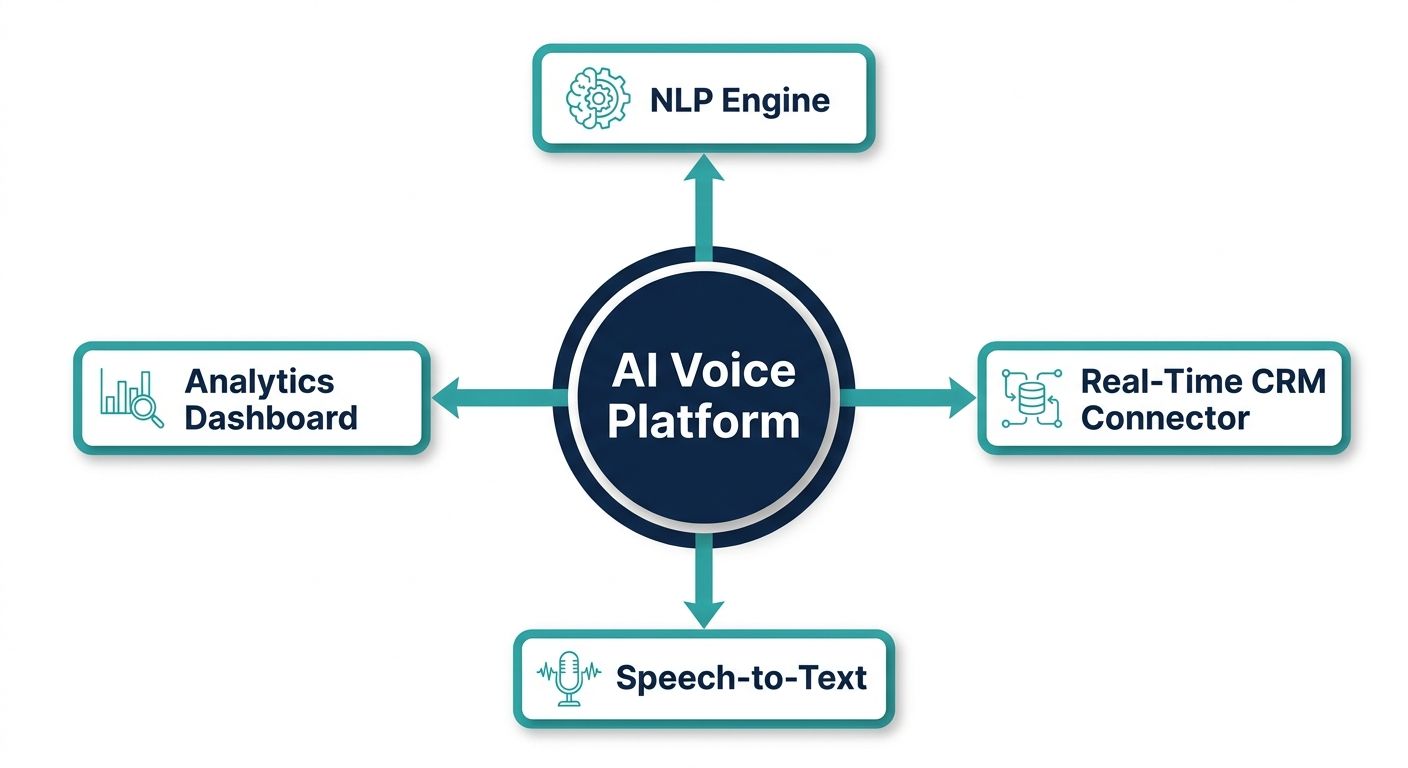
This hub-and-spoke model illustrates the core structural components of an enterprise AI voice platform, highlighting how individual modules like the NLP engine and CRM connector centralize around the main OS.
To understand the mechanics of an AI voice OS with real-time CRM data integration enterprise capabilities, one must move beyond the superficial paradigm of 'prompt engineering.' In highly complex enterprise environments, prompt engineering is insufficient. Instead, the focus must shift to _context engineering_. Context engineering involves the systematic retrieval, filtering, and structuring of relevant enterprise data before the Large Language Model (LLM) ever generates a response. This is where the core competitive advantage of an advanced AI Voice OS lies.
At the heart of this operational superiority is Alchemyst's Kathan engine. The Kathan engine utilizes a highly sophisticated computational process known as **Context Arithmetic**. Rather than blindly feeding an LLM vast, unstructured database dumps, Context Arithmetic treats data retrieval as a set-algebraic pipeline. It systematically determines the exact, most relevant pieces of information required for the voice agent to respond accurately to the user's specific intent, factoring in their real-time CRM profile.
### The Five-Stage Pipeline for Context Determination
Integrating real-time CRM data into a voice interaction within milliseconds requires a highly optimized architectural pipeline. The Kathan engine executes context determination through five distinct stages to ensure the voice agent is both intelligent and exceptionally fast:
* **Stage 1: Semantic Similarity Search:** The system ingests the user's spoken utterance, transcribes it via ultra-low latency ASR (Automatic Speech Recognition), and converts the intent into vector embeddings. It then performs a high-speed semantic similarity search against the enterprise's vector database, locating historical CRM context, past interaction transcripts, and relevant knowledge base articles.
* **Stage 2: Metadata Filtering:** Raw semantic similarity is prone to returning outdated or permission-restricted data. The pipeline applies rigorous metadata filtering synchronized directly with the live CRM. If a user's subscription tier just changed five seconds ago, the metadata filter instantaneously restricts or grants access to corresponding context, ensuring the AI agent only operates on the latest source of truth.
* **Stage 3: Deduplication:** Real-time CRM integrations often pull overlapping data from multiple endpoints (e.g., Salesforce, Zendesk, and internal ERPs). The Kathan engine performs real-time deduplication to remove redundant context payloads, thereby optimizing the context window size, reducing token costs, and preventing model hallucination.
* **Stage 4: Contextual Ranking:** Not all CRM data is equally important. The pipeline ranks the filtered, deduplicated data using a specialized scoring algorithm. Active support tickets and recent purchasing behavior are weighted higher than demographic data from three years ago.
* **Stage 5: Set-Algebraic Pipeline Execution:** Finally, the system employs set operations (unions, intersections, and differences of data sets) to construct the perfect contextual payload. This payload is mathematically guaranteed to contain the necessary context for the LLM to formulate an accurate, business-aligned response without exceeding token limits or latency budgets.
## Architecting Real-Time CRM Data Flow
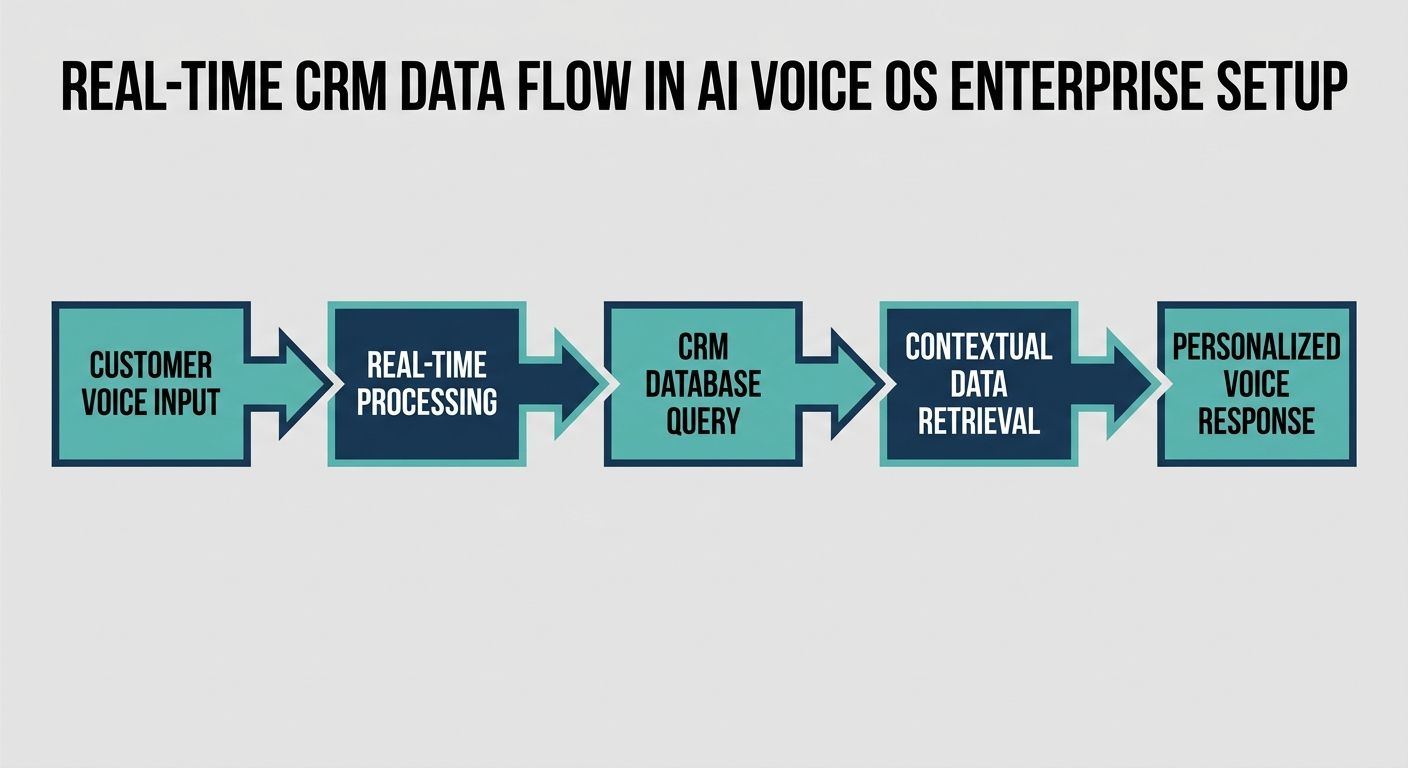
Following the data pipeline step-by-step reveals how a customer's voice query triggers an instant CRM database check to deliver a highly contextualized and personalized response.
Achieving true real-time synchronization between an AI Voice OS and an enterprise CRM platform like Salesforce, HubSpot, or a custom-built ERP requires moving away from traditional REST API polling. In a voice environment, latency is the ultimate enemy. A delay of over 500 milliseconds creates unnatural conversational pauses, destroying the user experience. Architecting real-time flow requires advanced integration strategies.
### API Strategies and Bidirectional Streaming
Enterprise AI voice platforms must utilize WebSockets and WebRTC for continuous, full-duplex communication channels. While the voice stream is processed, a parallel data stream must maintain a persistent connection with the CRM's event-driven architecture. When an enterprise customer updates a record, the CRM pushes an event via a streaming API (such as Salesforce PushTopic or Change Data Capture events). The AI Voice OS context layer intercepts this push instantly, updating the active voice session's working memory. This ensures that if a customer completes a payment on their web dashboard while speaking to the AI agent on the phone, the agent instantly acknowledges the payment without needing to place the user on hold to 'check the system'.
### Managing Data Latency and Edge Compute
To keep conversational latency under the strict 500ms threshold, data latency management is paramount. Enterprise architects must implement distributed caching mechanisms (like Redis) at the network edge. Frequently accessed CRM metadata—such as customer authentication states and routing rules—should be cached geographically close to the voice ingestion nodes. Furthermore, the AI Voice OS must decouple the heavy, asynchronous CRM write operations from the synchronous voice generation loop. The system can acknowledge the user's intent, begin generating the voice response, and simultaneously write the interaction log back to the CRM in a non-blocking background thread.
## Data Governance and Security Protocols for Immediate Access
Deploying an AI voice OS with real-time CRM data integration enterprise features introduces significant security considerations. Top-tier competitors frequently overlook the detailed data governance required when a conversational AI has instant, programmatic access to massive PII (Personally Identifiable Information) and PCI (Payment Card Industry) databases.
### Zero-Trust Architecture and RBAC Integration
The AI Voice OS must operate on a Zero-Trust architecture. Every data request made by the context layer to the CRM must be authenticated and authorized. The system must natively mirror the CRM's Role-Based Access Control (RBAC). The AI agent should theoretically 'log in' with the exact permissions of the human agent it is augmenting or replacing. If a record is locked in the CRM, the AI must strictly inherit that restriction. The Kathan engine addresses this by integrating permission sets into its metadata filtering stage, executing a hard drop on any semantic search results that violate the synchronized access policies.
### On-the-Fly PII Redaction and Compliance
For enterprises bound by HIPAA, SOC2, or GDPR regulations, streaming live voice data into an LLM presents a compliance risk. An enterprise-grade AI Voice OS solves this via an intermediary compliance layer. As live CRM data is pulled to construct the prompt, or as the user speaks sensitive information (like a Social Security Number), the architecture must utilize real-time Named Entity Recognition (NER) models to tokenize and redact PII before it reaches the foundational LLM. The tokenized response is then seamlessly re-injected into the CRM post-interaction, ensuring maximum security without sacrificing real-time contextualization.
## The Definitive Migration Blueprint: Implementing AI Voice OS
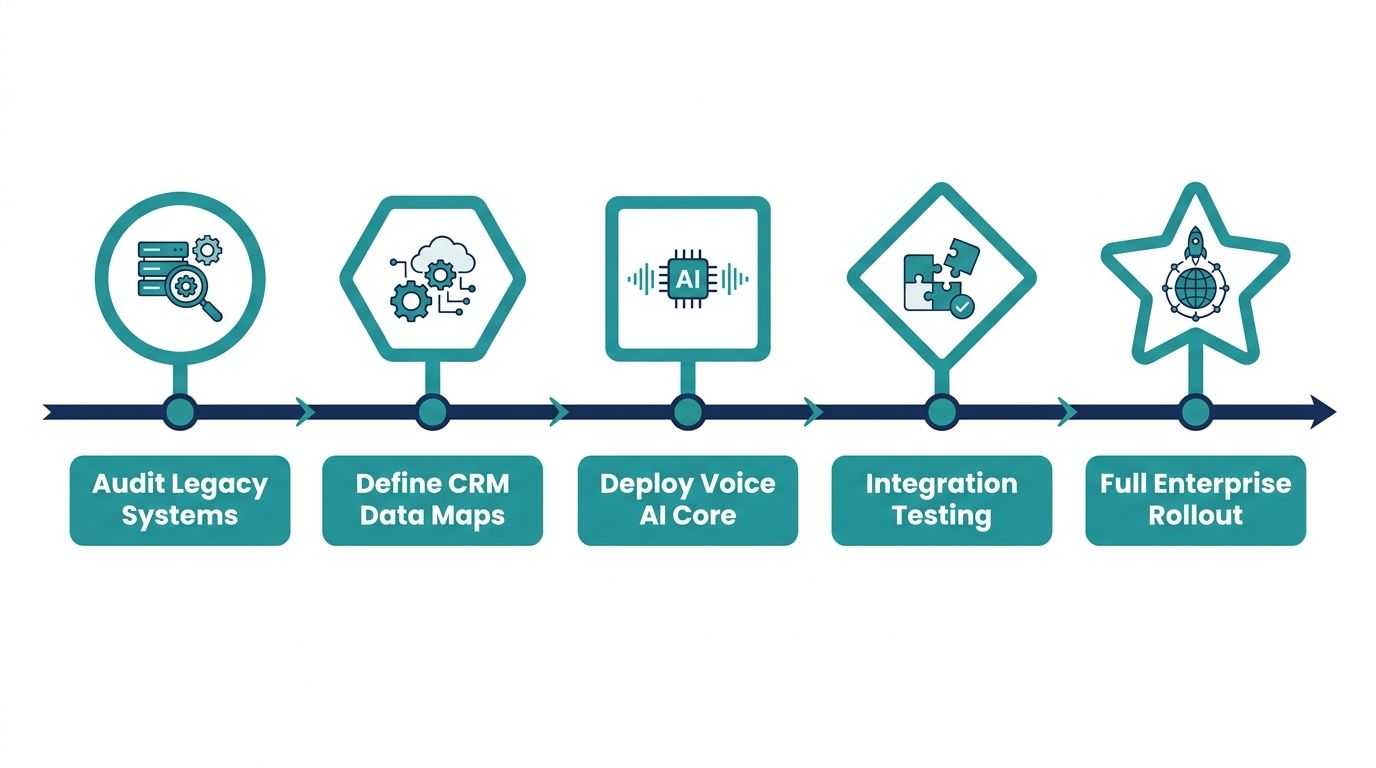
This chronological migration timeline outlines the five essential phases required to successfully transition legacy systems to a fully integrated AI voice operating system.
Transitioning from legacy IVR systems or isolated chatbots to a comprehensive, context-aware AI Voice OS requires a structured, multi-phase migration blueprint. Superficial cost-savings estimates are insufficient for enterprise technical teams. Here is the rigorous integration path required for successful deployment.
### Phase 1: Technical Integration and System Audits
Before any AI model is deployed, enterprise architects must audit their existing data silos. This phase involves documenting all relevant CRM endpoints, mapping current network latencies, and evaluating API rate limits. Legacy on-premise CRMs may require the deployment of secure reverse proxies to safely expose real-time webhooks to the cloud-based AI Voice OS. During this phase, teams must also establish the target Latency Budget for the end-to-end voice loop, factoring in ASR, Context Retrieval, LLM Inference, and TTS (Text-to-Speech) generation.
### Phase 2: CRM Data Mapping and Context Engineering
Once connectivity is established, technical evaluators must engage in comprehensive data mapping. This is not a simple 1:1 field mapping. It involves defining exactly which CRM objects (e.g., Contact, Account, Case, Opportunity) are necessary for specific conversational intents. Developers utilize the Kathan engine's framework to build the semantic similarity indices. This phase includes backfilling the vector database with historical interaction logs to prime the context engine, ensuring the AI Voice OS understands the historical nuance of enterprise-specific terminology and product names.
### Phase 3: The Context Layer Implementation and Shadow Testing
The implementation phase focuses on deploying the context arithmetic pipeline. Rather than launching the voice agent live to customers immediately, enterprises must employ 'Shadow Testing'. In this environment, the AI Voice OS silently listens to live human-to-human call streams, actively fetching real-time CRM data and generating parallel, unseen responses. Engineers evaluate the AI's context retrieval accuracy against what the human agent actually required to solve the issue. The deduplication algorithms and ranking heuristics within the Kathan engine are fine-tuned during this phase to maximize precision and recall.
## High-Impact Enterprise Use Cases for Real-Time Synchronization
The true value of an AI voice OS with real-time CRM data integration enterprise architecture becomes apparent when evaluating specific, transformative use cases that legacy solutions cannot execute.
### Dynamic Customer Support Escalations
Consider an enterprise telecommunications provider. A customer calls to report an outage. A legacy IVR will ask for an account number and blindly read a generic outage message. A context-aware AI Voice OS, operating in real-time, instantly cross-references the incoming phone number with the CRM, identifies the customer as a high-value enterprise account, checks live network telemetry data via API, and correlates it with open JIRA tickets. The AI agent immediately greets the user: _'Hello, I see you are calling from the ACME Corp account. We have detected the localized fiber issue affecting your headquarters, and our engineering team has an estimated resolution time of 45 minutes.'_ This zero-friction, highly contextualized interaction relies entirely on sub-second CRM data integration.
### Live Sales Enablement and Cross-Selling
In proactive outbound sales scenarios, an enterprise AI Voice OS utilizes real-time CRM triggers to initiate contextual conversations. If a high-value lead downloads a technical whitepaper and simultaneously opens a pricing page, the CRM triggers the Voice OS. The AI agent initiates a call, instantly pulling the lead's historical touchpoints, current company firmographics, and the exact whitepaper topic. It doesn't just read a script; it dynamically tailors the pitch based on live context arithmetic, significantly increasing conversion probabilities.
## Calculating ROI: A Structured Framework Beyond Cost Savings
Top-ranking competitor content often reduces ROI to simplistic metrics like 'reduced headcount' or 'lowered operational costs.' For enterprise technical evaluators, ROI must be calculated through a rigorous, multidimensional framework that captures the true financial impact of real-time context integration.
### Metric 1: Specific Cost Analysis via CPI Reduction
Instead of generic savings, calculate the precise Cost Per Interaction (CPI). By utilizing an AI Voice OS with real-time CRM data integration, enterprises significantly reduce the Average Handling Time (AHT). Every second an agent spends placing a user on hold to 'load their profile' is a hard financial cost. The Kathan engine eliminates this CRM retrieval latency entirely. If an enterprise handles 100,000 calls monthly, reducing AHT by 45 seconds per call through instant context retrieval yields measurable, guaranteed cost avoidance that can be modeled in a financial spreadsheet.
### Metric 2: First Contact Resolution (FCR) Enhancement
Legacy AI agents often fail and escalate to human agents because they lack the necessary context to complete complex workflows. This double-touch drastically increases operational costs. By leveraging the real-time context arithmetic pipeline, the AI Voice OS can confidently execute multi-step CRM updates (e.g., processing a return, updating a shipping address, and issuing a prorated refund simultaneously). An enterprise tracking FCR can directly attribute a percentage increase in autonomous resolutions directly to the depth of the CRM integration, assigning a concrete revenue retention value to the AI implementation.
## Conclusion: Future-Proofing with Context-Aware Voice AI
Implementing an AI voice OS with real-time CRM data integration enterprise capabilities is not merely an IT upgrade; it is a fundamental re-architecting of how a business interacts with its customers. Superficial AI voice agents are rapidly becoming commoditized. The true competitive moat lies in context engineering, robust data governance, and instantaneous synchronization with backend enterprise systems.
By leveraging advanced architectural frameworks like Alchemyst's Kathan engine and adhering to a rigorous migration blueprint, technical teams can successfully deploy voice platforms that operate with the intelligence, speed, and security demanded by the modern enterprise. Mastering context arithmetic and real-time CRM data flow is the definitive path to achieving an unparalleled, highly profitable automated conversational ecosystem.
[← Back to Blog](/blog)
## Recently Published
[October 6, 2026 / 10 min readHow to Build a RAG Pipeline for Personal Documents and MediaBuild a multi-modal RAG pipeline for all personal documents and media assets.](/blog/rag-pipeline-personal-documents-media)
[Technical / September 27, 2026 / 11 min readHarness Engineering for AI Agents: Bridging the GapExplore how harness engineering enables robust AI infrastructure and MLOps.](/blog/harness-engineering-ai-agents)
[I'm Evaluating / September 27, 2026 / 9 min readContext Engineering Best Practices for Enterprise AIMaster advanced context engineering best practices for conversational AI agents.](/blog/context-engineering-best-practices)
[I'm Evaluating / September 22, 2026 / 11 min readContext Engineering vs Prompt Engineering for AI AgentsExplore the differences between context and prompt engineering for enterprise AI](/blog/context-engineering-vs-prompt-engineering)
[I'm Evaluating / September 14, 2026 / 10 min readContext Engineering for Enterprise AI: A Complete GuideMaster context engineering to build reliable, production-ready voice AI agents.](/blog/context-engineering-enterprise-ai)
[Deep Technical / July 7, 2026 / 10 min readVoice-Specific Architectural Requirements for AI Context LayersDiscover the core voice-specific architectural requirements for AI context layer](/blog/voice-specific-architectural-requirements-ai-context-layer)
Get Started
## Give your AI agents the memory they deserve.
Join developers building the next generation of AI products with persistent, auditable context. Free tier available. No credit card required.
* Free tier
* REST + Python & Node SDKs
* 99.9% uptime SLA
* SOC 2 in progress
### Request API Access
Enter your email and we'll set up your workspace.
Email
[Read the Docs →](https://docs.getalchemystai.com)[Read the Thesis →](/thesis)
---
# AI Voice Agent Pricing Model Per Qualified Outcome Explained
- **URL:** https://getalchemystai.com/blog/ai-voice-agent-pricing-model-per-qualified-outcome
- **Slug:** ai-voice-agent-pricing-model-per-qualified-outcome
- **Published:** April 23, 2026
- **Last updated:** April 23, 2026
- **Author:** Harsh Shah
- **Category:** I'm Evaluating
[I'm Evaluating](/blog?category=im-evaluating)
# AI Voice Agent Pricing Model Per Qualified Outcome Explained
Stop overpaying. Learn the per qualified outcome pricing model for AI voice.
Written by [Harsh Shah](/blog?author=Harsh%20Shah)Reviewed by [Anuran Roy](/blog?author=Anuran%20Roy)12 min readPublished at April 23, 2026 (5mo ago)
## Summary
Discover why traditional per-minute billing inflates costs and how the AI voice agent pricing model per qualified outcome guarantees real ROI. This guide reveals how context-aware systems eliminate wasted spend and drive measurable business results.
Table of Contents
## The Paradigm Shift in Enterprise Voice AI Economics
In the rapidly expanding ecosystem of enterprise artificial intelligence, businesses are aggressively deploying conversational systems to streamline customer service, sales, and internal operations. However, technical evaluators and enterprise leaders are discovering a critical flaw in the modern AI landscape: the financial models governing these deployments are fundamentally broken. The overwhelming majority of vendors operate on usage-based metrics, billing clients per minute, per API call, or per seat. This structure penalizes businesses for complex customer interactions and incentivizes vendors to deploy inefficient, context-free systems that keep callers on the line longer.
To combat this structural inefficiency, forward-thinking enterprises are migrating toward a revolutionary financial and operational framework: the **AI voice agent pricing model per qualified outcome**. This commercial intent model shifts the paradigm from paying for computational effort to paying for actual business value. Rather than bleeding capital on conversational dead-ends and AI hallucinations, businesses only pay when the voice agent successfully achieves a predefined, highly specific goal. In this comprehensive technical and commercial blueprint, we will dissect the structural flaws of legacy pricing, outline the definitive migration path to an outcome-based Voice OS, and explore the deep architectural requirements—such as Alchemyst's Kathan engine and its proprietary context arithmetic—that make guaranteed outcomes computationally possible.
## The Structural Flaws of Traditional Pricing Models
Before understanding why the AI voice agent pricing model per qualified outcome is gaining immense traction among enterprise technical evaluators, it is crucial to analyze the historical and conceptual failures of existing Voice AI deployments. The market is currently saturated with platforms that employ a product-centric, API-first approach, promoting themselves as highly configurable tools for developers. While platforms like Vapi or Retell offer robust developer communities and self-service dashboards, their commercial models harbor hidden costs that severely degrade enterprise ROI.
### Per-Minute Billing: Incentivizing Inefficiency
The most pervasive pricing structure in the Voice AI industry is the per-minute billing model. At first glance, this appears to be a fair, consumption-based metric. However, it creates a perverse incentive. When vendors charge by the minute, their revenue increases as the length of the call increases. Context-free agents—systems that lack deep historical memory and real-time enterprise data retrieval—often trap users in frustrating conversational loops. They ask repetitive questions, struggle with nuanced user intent, and take excessively long to process simple requests. Under a per-minute model, the enterprise absorbs the financial penalty for the AI's incompetence.
### Per-Seat Subscription Traps
Another common approach is the per-seat subscription, heavily utilized by unified communications platforms. This model typically grants businesses access to an AI assistant for a flat monthly fee per human agent. While this makes budgeting predictable, it entirely divorces the cost of the software from the value it generates. If the AI agent fails to resolve a single customer ticket, deflect a meaningful volume of calls, or successfully process an inbound lead, the enterprise is still contractually obligated to pay the subscription fee. This generic cost structure lacks the strict accountability demanded by modern ROI frameworks.
### The Hidden Costs of Context-Free Agents
Beyond the baseline subscription or per-minute rates, enterprises face immense hidden costs when deploying standard API voice solutions. Because these platforms primarily provide the infrastructure to build agents, they push the technical burden of context management onto the client's engineering teams. Businesses must spend hundreds of thousands of dollars developing custom middleware to handle data migration, secure integration, and prompt engineering. Without native context handling capabilities, these AI agents suffer from chronic memory loss, leading to catastrophic customer experiences and abandoned calls. The actual total cost of ownership skyrockets far beyond the vendor's advertised rates.
## Defining the AI Voice Agent Pricing Model Per Qualified Outcome
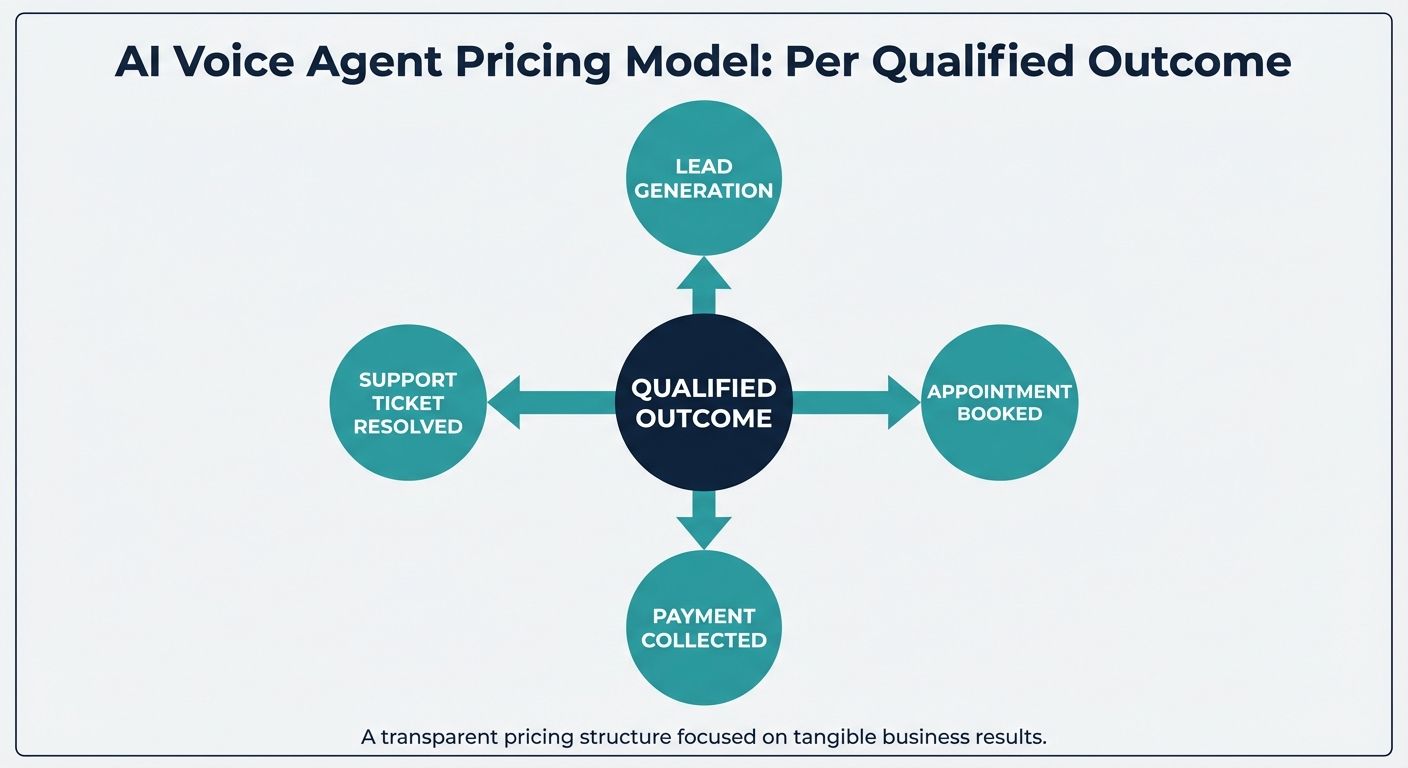
This hub-and-spoke diagram illustrates the core deliverables that qualify as billable outcomes under the new AI voice agent pricing model, helping you align costs directly with business results.
The AI voice agent pricing model per qualified outcome fundamentally realigns the economic relationship between the enterprise and the AI vendor. In this model, the business dictates the specific criteria for success, and the vendor is only compensated when the AI autonomously fulfills those criteria. A _qualified outcome_ is not merely a completed call or a transcribed conversation; it is a measurable, definitive business action that directly impacts the company's bottom line.
By adopting this model, enterprises completely eliminate the financial risk associated with AI hallucinations, dropped calls, and failed intent resolutions. If a caller hangs up out of frustration, the AI failed, and the enterprise pays nothing. If the AI correctly navigates a complex, multi-turn conversation and successfully executes an API payload to update a CRM, the outcome is achieved, and billing is triggered. This forces the underlying AI architecture to be ruthlessly efficient, highly accurate, and deeply integrated with the enterprise's backend systems.
## Concrete Industry Use Cases for Qualified Outcomes
To implement a structured ROI framework beyond generic cost savings, businesses must define exactly what constitutes a qualified outcome within their specific vertical. The flexibility of the AI voice agent pricing model per qualified outcome allows for highly tailored definitions of success.
### Healthcare and Patient Triage
In the healthcare sector, standard AI bots often fail due to a lack of HIPAA-compliant context retention and the inability to navigate complex patient histories. A qualified outcome in this vertical might be defined as: _The successful authentication of a patient, accurate symptom intake matching predefined triage protocols, and the confirmed scheduling of an appointment within the EHR system._ If the AI must transfer the call to a human nurse because it cannot resolve the patient's intent, the outcome is not qualified.
### Financial Services and Fraud Prevention
For banking and financial institutions, security and exact execution are paramount. An API-first voice tool that hallucinates a routing number is a catastrophic liability. Here, a qualified outcome could be defined as: _The successful multi-factor verification of a caller's identity, the accurate retrieval of recent transaction history, and the complete execution of a reported fraud ticket resulting in a frozen card status._ Only when the core banking API confirms the freeze does the AI platform earn its fee.
### E-commerce and Retail Logistics
E-commerce businesses suffer massive overhead from repetitive order status inquiries and return processing. Under a qualified outcome pricing model, a vendor is paid when the AI agent successfully locates an order via metadata filtering, clearly communicates the real-time shipping status to the customer, and processes a highly specific return merchandise authorization (RMA) without requiring a human agent's intervention. A simple conversation that ends with "I don't know" is financially penalized under this model.
## The Technical Engine Behind Guaranteed Outcomes
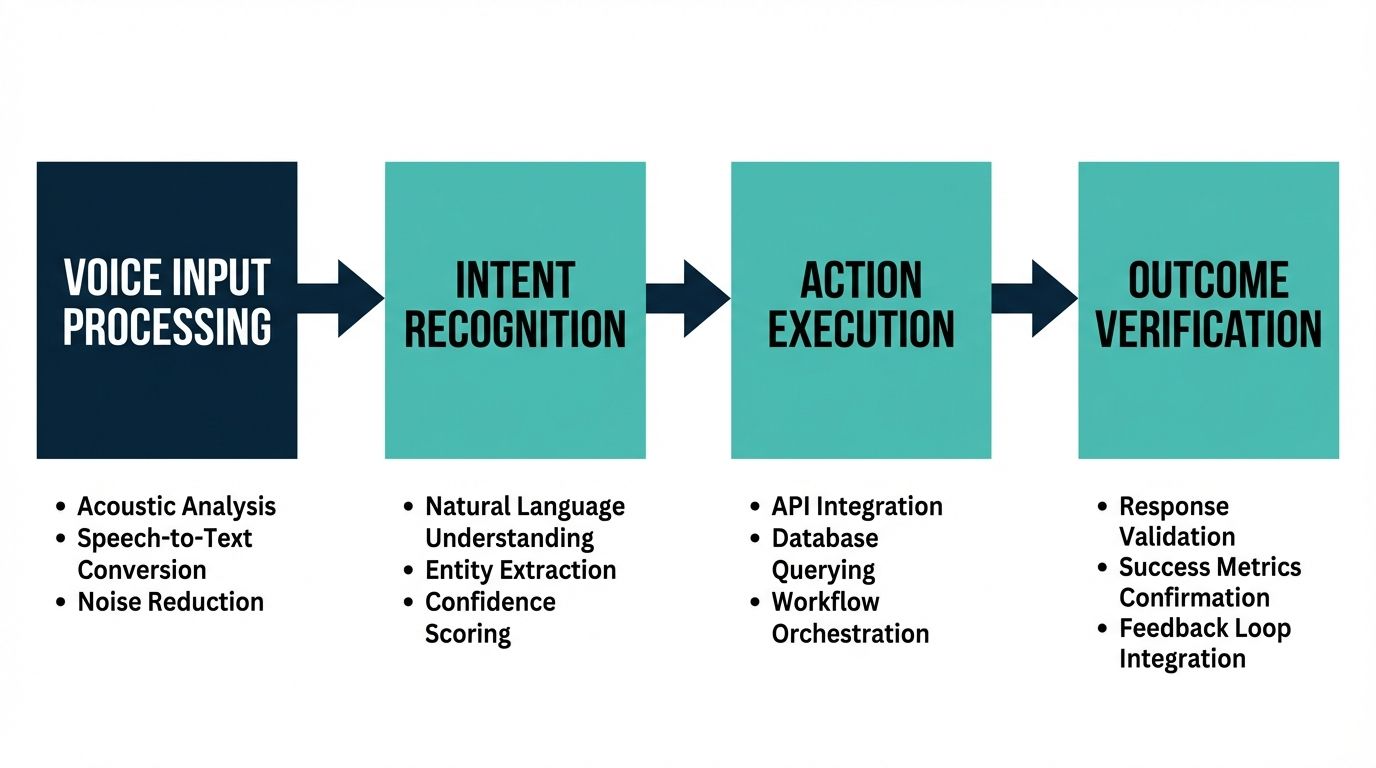
Following the technical pipeline step-by-step reveals exactly how AI voice OS platforms process user intent and strictly verify outcomes before triggering any billing events.
A critical gap in top-ranking evaluations of AI pricing models is the failure to explain _how_ a vendor can mathematically guarantee outcomes. Standard Large Language Models (LLMs) are inherently probabilistic; they guess the next most likely word. To operate under an AI voice agent pricing model per qualified outcome, the system must shift from probabilistic guessing to deterministic execution. This requires advanced information retrieval and state-of-the-art context engineering.
### Alchemyst's Kathan Engine and Context Arithmetic
To achieve the high success rates necessary to survive under an outcome-based pricing model, systems like Alchemyst's Kathan engine utilize a process known as **context arithmetic**. This is a highly rigorous, set-algebraic computational pipeline designed to systematically determine relevant information for voice agents in milliseconds. Unlike generic prompt engineering, which relies on trial-and-error text instructions, context engineering mathematically restricts the AI's operational boundaries.
### The Five-Stage Pipeline for Context Determination
For an AI voice agent to achieve a qualified outcome, it must process enterprise data flawlessly in real-time. The Kathan engine accomplishes this through an advanced five-stage pipeline:
* **Information Retrieval and Ingestion:** The system securely ingests massive volumes of unstructured enterprise data, structuring it into high-dimensional vector embeddings optimized for voice-specific queries.
* **Semantic Similarity Search:** When a user speaks, the engine instantly queries the vector database, identifying the closest mathematical matches to the user's intent, ignoring conversational filler and extracting core meaning.
* **Metadata Filtering:** The system applies strict deterministic rules—filtering out data that does not belong to the user's specific account or access level, ensuring perfect data security.
* **Deduplication via Set Algebra:** To prevent the LLM from becoming confused by conflicting information, the Kathan engine mathematically intersects and subtracts contextual payloads, leaving only a singular, definitive truth for the agent to reference.
* **Dynamic Ranking and Payload Assembly:** The highly refined data is ranked by immediate relevance and injected into the voice agent's operational memory, allowing it to speak with human-like confidence and absolute factual accuracy.
Without this deep, architectural commitment to context handling capabilities, an AI vendor simply cannot afford to offer an AI voice agent pricing model per qualified outcome. Standard developers relying on generic APIs lack the middleware infrastructure to execute this five-stage pipeline effectively, resulting in failed outcomes and abandoned migrations.
## The Definitive Migration Blueprint: Implementing AI Voice OS
Transitioning from a legacy per-minute contact center or a rudimentary API script to a context-aware AI Voice OS requires a comprehensive migration blueprint. Enterprises dissatisfied with existing voice AI deployments must approach this transition with a structured framework designed to maximize ROI.
### Step 1: Technical Integration and Data Migration
The foundation of outcome-based AI is deeply integrated enterprise knowledge. The migration begins with a thorough audit of existing data silos: CRM platforms, knowledge bases, ticketing systems, and internal wikis. Utilizing robust integration protocols, this data is continuously synced with the Voice OS's context engine. Unlike API-first platforms that require developers to build custom data connectors, enterprise-grade solutions provide secure, out-of-the-box ingestion pipelines that automate the transition of historical context.
### Step 2: Defining the ROI Framework and Success Metrics
Before full deployment, technical evaluators and business leaders must collaboratively define exactly what constitutes a qualified outcome. This involves mapping out the entire customer lifecycle and identifying high-friction touchpoints. Metrics must be strictly boolean (True/False): Did the agent book the meeting? Did the agent resolve the billing dispute? Did the agent capture the lead's email and budget? Establishing these hard parameters ensures the AI voice agent pricing model per qualified outcome is contractually enforceable.
### Step 3: Advanced Security and Compliance Deployment
Enterprise deployments mandate uncompromising security. The migration blueprint must include thorough penetration testing, SOC2 compliance verification, and data residency audits. Because context-aware AI processes highly sensitive conversational data, the architecture must ensure that vector embeddings and conversational logs are isolated per tenant. Proper metadata filtering within the context arithmetic pipeline ensures that no user can artificially manipulate the agent into revealing another user's PII (Personally Identifiable Information).
## Calculating True ROI: Outcome vs. Usage
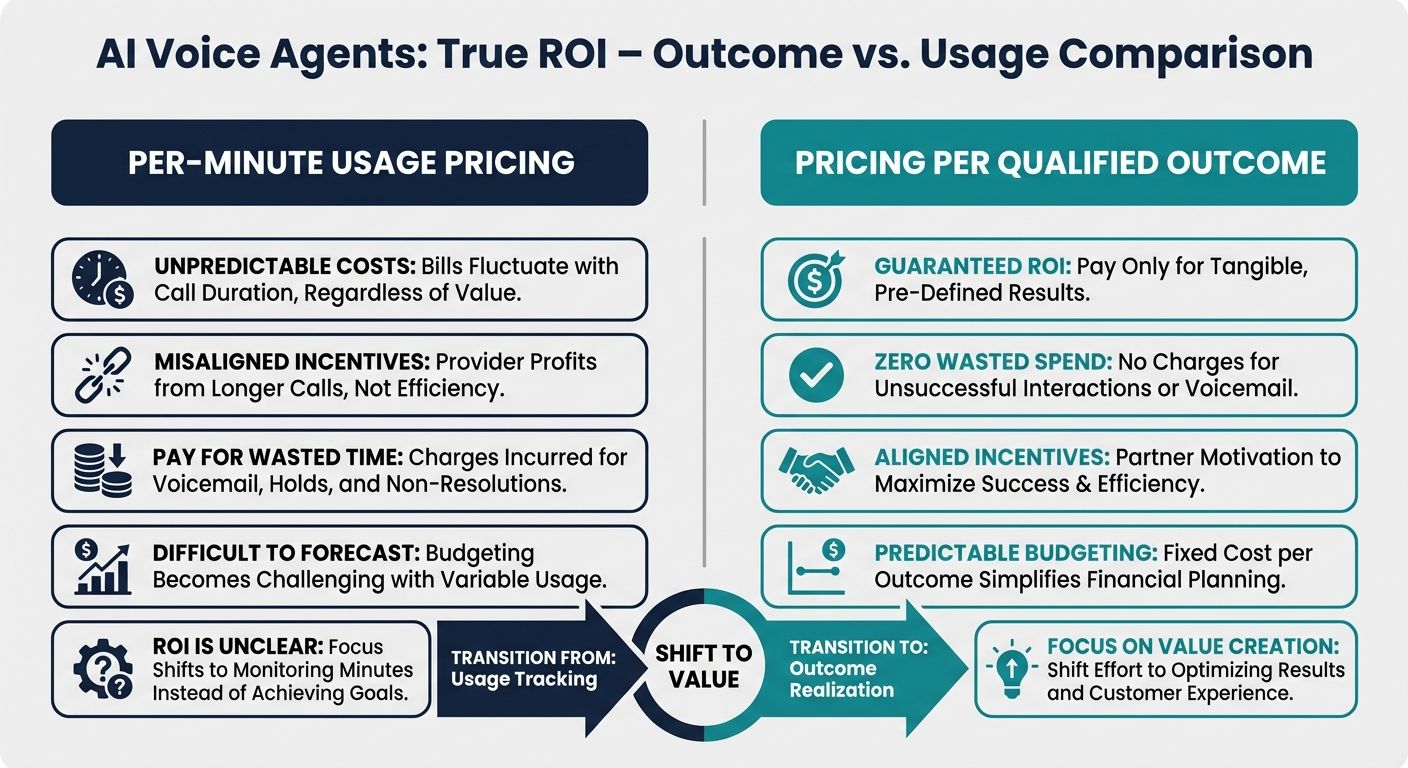
This comparison table breaks down the financial differences between traditional per-minute billing and outcome-based pricing, demonstrating how the latter structurally guarantees a higher return on investment.
To truly understand the commercial advantage of the AI voice agent pricing model per qualified outcome, we must conduct a specific cost analysis. Consider an enterprise processing 50,000 inbound customer service calls per month.
Under a standard vendor using a **per-minute model** at $0.15 per minute, an average call length of 6 minutes results in a base cost of $0.90 per call. However, because context-free agents struggle with intent, 40% of these calls result in a failure or escalation. The enterprise pays $45,000 to the AI vendor, but still must pay human agents to handle the 20,000 failed calls. The actual ROI is highly diluted by the cost of failure.
Conversely, utilizing an **outcome-based model**, the vendor may charge $1.50 per qualified outcome. While the per-unit cost appears higher, the enterprise only pays for success. If the Kathan engine successfully resolves 35,000 calls autonomously, the cost is $52,500\. However, the enterprise has absolute certainty that 35,000 human agent interactions were completely eliminated. There is zero wasted spend on the 15,000 calls that required human escalation. The ROI is perfectly protected, predictable, and structurally tied to business value.
## Why Developer-First APIs Miss the Enterprise Mark
As businesses evaluate their AI strategies, it is essential to recognize the gaps left by competitors in the market. Many top-tier platforms promote themselves as the ultimate developer playgrounds. They offer open dashboards, extensive documentation, and a toolkit to build custom agents. However, they consistently miss the mark on providing a structured ROI framework. By merely supplying the computational "picks and shovels," these vendors absolve themselves of the final business result.
Enterprises are realizing that they do not want to be in the business of building and maintaining voice agents; they want to buy resolved customer problems. The AI voice agent pricing model per qualified outcome is the antidote to the API-first trap. It forces the vendor to transition from a software provider into a strategic partner whose revenue is directly coupled to the client's operational success.
## Conclusion: The Inevitable Future of Voice AI
The transition toward the AI voice agent pricing model per qualified outcome is not merely a pricing trend; it is an inevitable evolution in enterprise technology. As Large Language Models become commoditized, the true differentiator lies in context engineering, proprietary retrieval pipelines like Alchemyst's Kathan engine, and commercial models that guarantee results. By demanding outcome-based pricing, businesses can eliminate wasted capital, mandate architectural excellence from their vendors, and deploy voice AI systems that act as genuine drivers of revenue and operational efficiency.
[← Back to Blog](/blog)
## Recently Published
[October 6, 2026 / 10 min readHow to Build a RAG Pipeline for Personal Documents and MediaBuild a multi-modal RAG pipeline for all personal documents and media assets.](/blog/rag-pipeline-personal-documents-media)
[Technical / September 27, 2026 / 11 min readHarness Engineering for AI Agents: Bridging the GapExplore how harness engineering enables robust AI infrastructure and MLOps.](/blog/harness-engineering-ai-agents)
[I'm Evaluating / September 27, 2026 / 9 min readContext Engineering Best Practices for Enterprise AIMaster advanced context engineering best practices for conversational AI agents.](/blog/context-engineering-best-practices)
[I'm Evaluating / September 22, 2026 / 11 min readContext Engineering vs Prompt Engineering for AI AgentsExplore the differences between context and prompt engineering for enterprise AI](/blog/context-engineering-vs-prompt-engineering)
[I'm Evaluating / September 14, 2026 / 10 min readContext Engineering for Enterprise AI: A Complete GuideMaster context engineering to build reliable, production-ready voice AI agents.](/blog/context-engineering-enterprise-ai)
[Deep Technical / July 7, 2026 / 10 min readVoice-Specific Architectural Requirements for AI Context LayersDiscover the core voice-specific architectural requirements for AI context layer](/blog/voice-specific-architectural-requirements-ai-context-layer)
Get Started
## Give your AI agents the memory they deserve.
Join developers building the next generation of AI products with persistent, auditable context. Free tier available. No credit card required.
* Free tier
* REST + Python & Node SDKs
* 99.9% uptime SLA
* SOC 2 in progress
### Request API Access
Enter your email and we'll set up your workspace.
Email
[Read the Docs →](https://docs.getalchemystai.com)[Read the Thesis →](/thesis)
---
# Compare AI voice agent platforms by context handling capabilities
- **URL:** https://getalchemystai.com/blog/compare-ai-voice-agent-platforms-context-handling-capabilities
- **Slug:** compare-ai-voice-agent-platforms-context-handling-capabilities
- **Published:** April 23, 2026
- **Last updated:** April 23, 2026
- **Author:** Harsh Shah
- **Category:** I'm Evaluating
[I'm Evaluating](/blog?category=im-evaluating)
# Compare AI voice agent platforms by context handling capabilities
Compare top AI voice agent platforms by their context handling capabilities.
Written by [Harsh Shah](/blog?author=Harsh%20Shah)Reviewed by [Anuran Roy](/blog?author=Anuran%20Roy)9 min readPublished at April 23, 2026 (5mo ago)
## Summary
Evaluate leading AI voice agents based on contextual logic, architectural requirements, and true ROI. Discover how advanced engines utilize context arithmetic to solve structural flaws in enterprise voice AI.
Table of Contents
## The True Differentiator in Enterprise Voice AI
When enterprise developers and technical evaluators set out to compare AI voice agent platforms by context handling capabilities, they quickly realize that the standard market literature falls short. Current search engine results are flooded with generic lists that superficially cover features like available synthetic voices, basic API integrations, and simple use cases. However, these lists fail to provide the deep, technical, voice-specific comparison of context handling capabilities that enterprise users actually need.
The fundamental structural flaw of legacy and basic voice AI systems is their lack of statefulness over prolonged or complex interactions. Operating largely as context-free agents, these systems drain resources and frustrate users by requiring them to repeat information. For enterprise deployments, understanding the distinction between superficial prompt engineering and deep context engineering is the key to unlocking true return on investment (ROI). This definitive guide provides a highly technical comparison of how leading platforms manage conversational context, handle Speech-to-Text (STT) and Text-to-Speech (TTS) architectural requirements, and calculate the true cost of conversational outcomes.
## Why Context Handling Matters More Than Voice Quality
In the current landscape of artificial intelligence, generating natural-sounding audio is effectively a solved problem. The real challenge—and the primary differentiator among platforms—is what the agent remembers, how quickly it retrieves relevant data, and how accurately it applies that data to the ongoing conversational state. Evaluating platforms requires a deep dive into types of context handled, technical methodologies for retention, memory duration, and quantifiable performance metrics.
### The Hidden Cost of Context-Free Agents
Many businesses mistakenly evaluate AI voice OS platforms based on per-minute, per-call, or per-seat pricing structures. This is a flawed paradigm. Context-free agents fundamentally inflate expenses. Because they fail to retain conversational history, they require longer interaction times, leading to more minutes billed without successful resolutions. The true metric for evaluating voice AI should always be the **cost per qualified outcome**. When an agent possesses superior context handling capabilities, it drives interactions to successful conclusions much faster, dramatically lowering the effective cost of operation while maximizing ROI.
## Key Metrics for Evaluating Context Handling in Voice Platforms
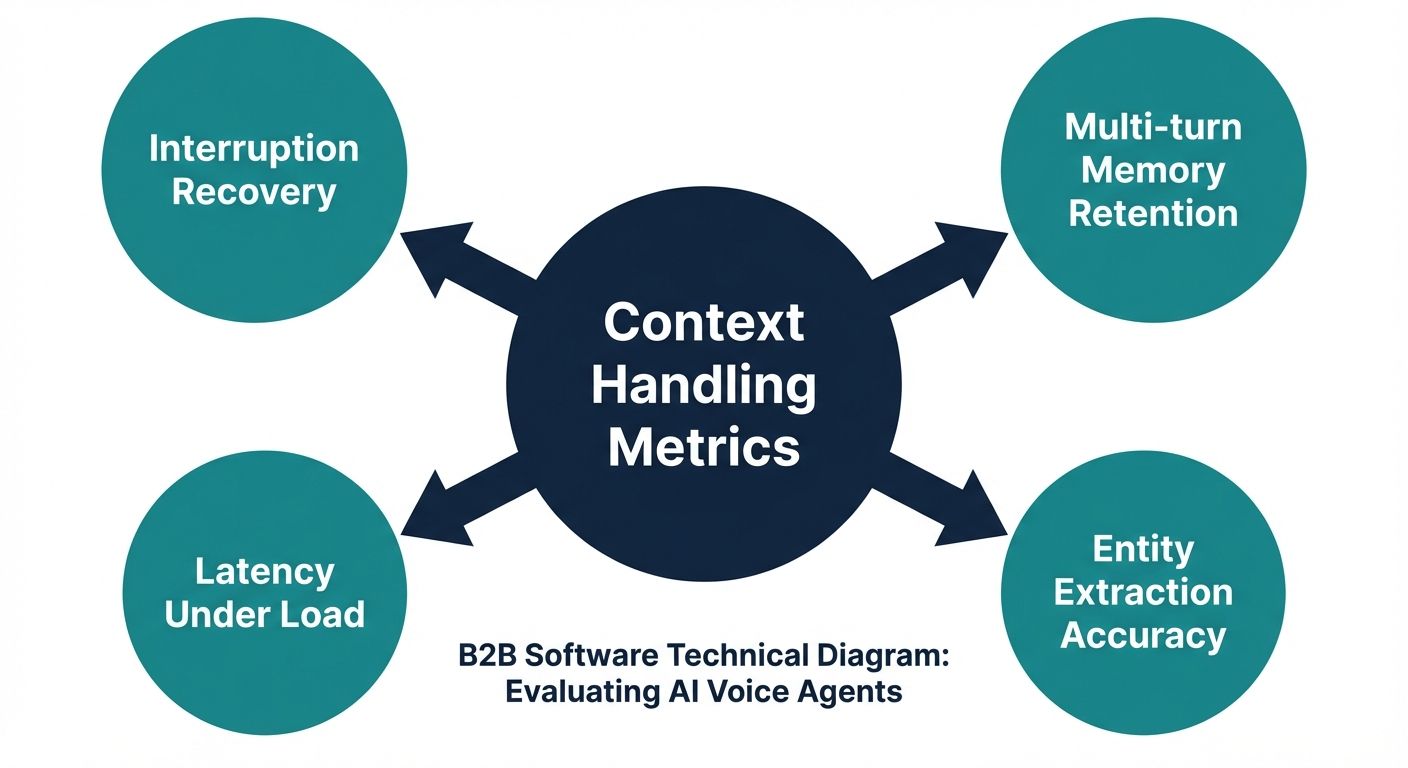
This concept map illustrates the four essential metrics—interruption recovery, memory retention, latency, and entity extraction—required to properly benchmark voice AI context capabilities.
Before jumping into a direct comparison, technical evaluators must establish a framework for assessing conversational memory. You should compare AI voice agent platforms by context handling capabilities using the following core metrics:
* **Context Retention Accuracy:** The platform's ability to accurately recall specific entities (e.g., account numbers, previous troubleshooting steps) without hallucinations or drop-offs across multiple conversational turns.
* **Memory Duration (Time-to-Live):** How long the platform can maintain state. Does the context expire at the end of the session, or does the platform support long-term, cross-session memory retrieval?
* **Retrieval Latency:** In voice AI, pauses longer than a few hundred milliseconds feel unnatural. The efficiency of semantic similarity searches and database queries must be optimized for real-time auditory delivery.
* **STT/TTS Contextual Integration:** How well the system handles user interruptions (barge-ins), overlapping speech, and background noise without losing the thread of the dialogue.
## Deep Dive Comparison: Top AI Voice Agent Platforms Ranked by Context Handling
To provide a definitive blueprint for evaluating these platforms, we must critically analyze how different solutions architect their contextual logic.
### Vapi: The Developer-Centric, API-First Pipeline
Vapi has established itself with a strong product-centric, API-first approach, promoting its platform as a highly configurable tool for developers. They focus heavily on enabling builders to construct custom agents via self-service platforms (like their Open Dashboard) and boast a robust developer community. Vapi utilizes proof by numbers, highlighting low latency and extensive integrations.
**Context Handling Capabilities:** Because Vapi is primarily infrastructure-focused, the burden of context engineering falls largely on the developer. While the platform offers the pipes to connect to external vector databases and Large Language Models (LLMs), it does not natively provide an out-of-the-box algorithmic framework for complex context arithmetic. Developers must manually design their information retrieval pipelines, handle semantic similarity searches, and manage the specific state requirements. It is a powerful tool, but one that requires significant engineering overhead to achieve mastery in context handling.
### Vellum, Rasa, and Assembled: Generalist Conversational Frameworks
Platforms like Vellum, Rasa, and Assembled are frequently mentioned in top-10 lists. Rasa, for instance, has a long history in the chatbot space, transitioning into voice. Vellum provides excellent tooling for LLM workflow orchestration, while Assembled focuses heavily on customer support integrations.
**Context Handling Capabilities:** These platforms approach context primarily from a text-first perspective. Rasa relies on its traditional dialogue management models and intent classification, which, while reliable for text, often struggle with the messy, non-linear nature of spoken conversations. When applied to voice, text-first contextual models often fail to adequately account for STT transcript errors, acoustic metadata, or sudden conversational pivots. They offer generic context management but lack the highly specialized, mathematical rigor required to filter and rank contextual variables instantly during a live phone call.
### Alchemyst's Kathan Engine: Context Arithmetic and Set-Algebraic Pipelines
Alchemyst represents a paradigm shift, targeting developers and enterprises dissatisfied with generic voice AI deployments. Instead of merely connecting an STT engine to an LLM, Alchemyst employs a proprietary architecture known as the Kathan engine. This engine replaces basic prompt injection with what is known as _context arithmetic_—a highly structured, computational process for systematically determining relevant information for voice agents.
**Context Handling Capabilities:** Alchemyst possesses a clear competitive advantage in context-aware AI. The Kathan engine executes a sophisticated five-stage pipeline for context determination during every conversational turn:
1. **Information Retrieval:** Initiating semantic similarity searches across vast, unstructured enterprise data repositories.
2. **Metadata Filtering:** Using hard constraints (such as user ID, date ranges, and permission levels) to immediately eliminate irrelevant vectors.
3. **Deduplication:** Removing redundant contextual data to prevent token bloat, ensuring that the LLM only receives unique, actionable information.
4. **Ranking:** Scoring the remaining contextual snippets based on recency, relevance, and semantic weight.
5. **Set-Algebraic Consolidation:** Applying mathematical logic to merge differing data sets, ensuring that the voice agent receives a singular, cohesive truth before generating its TTS response.
This architectural approach ensures that context is never lost or hallucinated. By strictly defining the contextual boundaries, Alchemyst drives down the cost per qualified outcome, as the agent consistently resolves complex issues without requiring human escalation.
## Technical Methodology: Prompt Engineering vs. Context Engineering
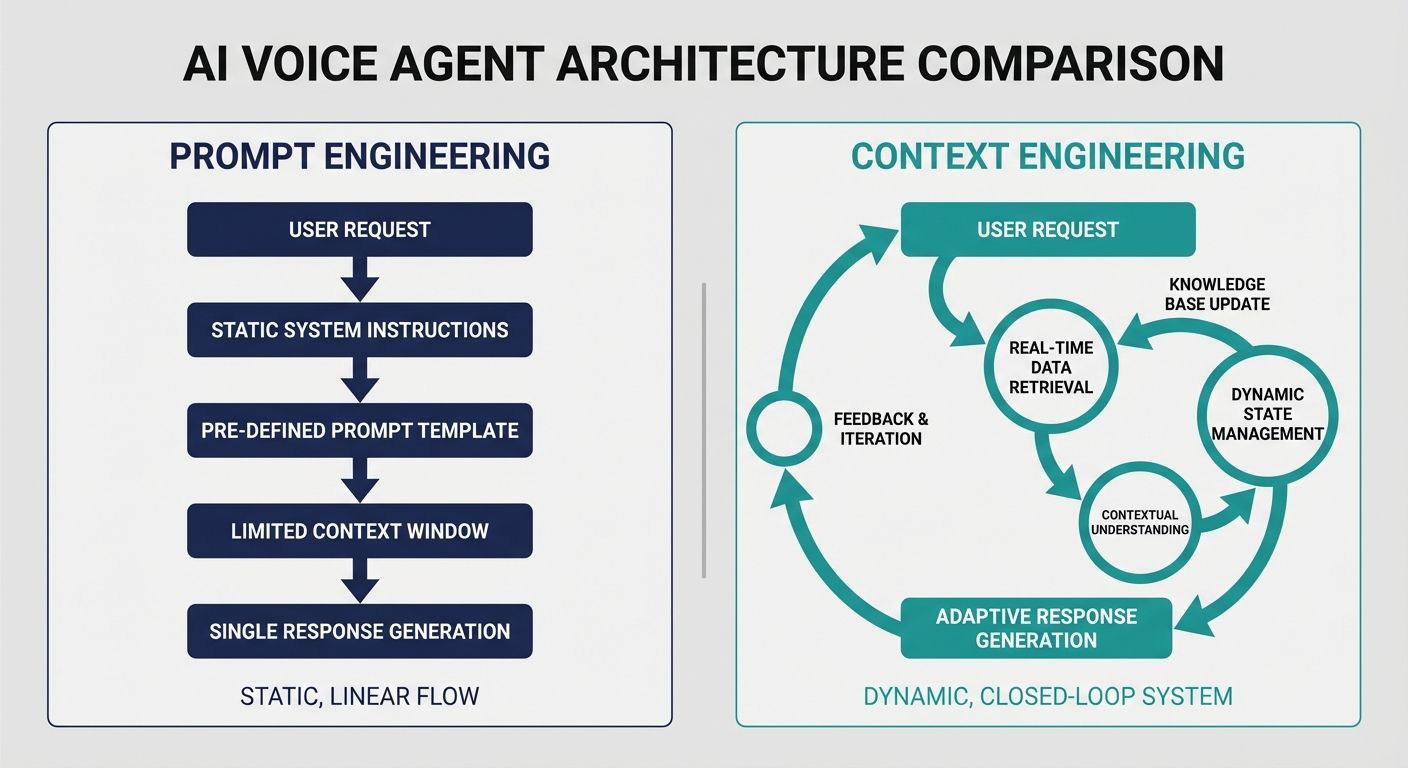
Comparing the linear nature of traditional prompt engineering against the dynamic, recursive loops required for advanced context engineering in modern voice AI architectures.
To accurately compare AI voice agent platforms by context handling capabilities, technical evaluators must recognize the difference between prompt engineering and context engineering. Many platforms rely exclusively on prompt engineering—tweaking the system instructions (e.g., _"You are a helpful assistant. Remember the user's name."_). While necessary, this is entirely insufficient for enterprise operations.
Context engineering, as demonstrated by the Kathan engine, is an infrastructure-level discipline. It involves managing the continuous flow of stateful data into the model's context window. This requires dynamic memory allocation, where short-term turn-by-turn context (the immediate conversation) is mathematically weighed against long-term memory (CRM data, historical tickets) and environmental metadata (user sentiment, acoustic environment). Platforms that fail to provide native context engineering tools force businesses into a cycle of endless prompt optimization that never truly solves the underlying amnesia of the agent.
## Voice-Specific Architectural Requirements: STT and TTS Integration
Context handling in text-based chatbots is relatively straightforward because the inputs are clean and structured. Voice introduces chaos. Users interrupt, hesitate, use filler words, and speak over the agent. A superior voice AI platform must maintain context through these acoustic interruptions.
When STT pipelines process a user interruption, a standard platform will often drop the ongoing context, treating the barge-in as a completely new, isolated query. Advanced platforms utilize specialized architectural requirements that map STT timestamps to the conversational state. If a user interrupts an agent mid-sentence to correct a piece of information (e.g., _"Wait, no, my address is 123 Main Street, not 124"_), the context handler must instantly rollback the state, apply the correction, and instruct the TTS engine to smoothly pivot its response. This level of granular, voice-specific context retention is rare and serves as a major differentiator when evaluating enterprise readiness.
## The Definitive Migration Blueprint: Implementing AI Voice OS and Calculating ROI
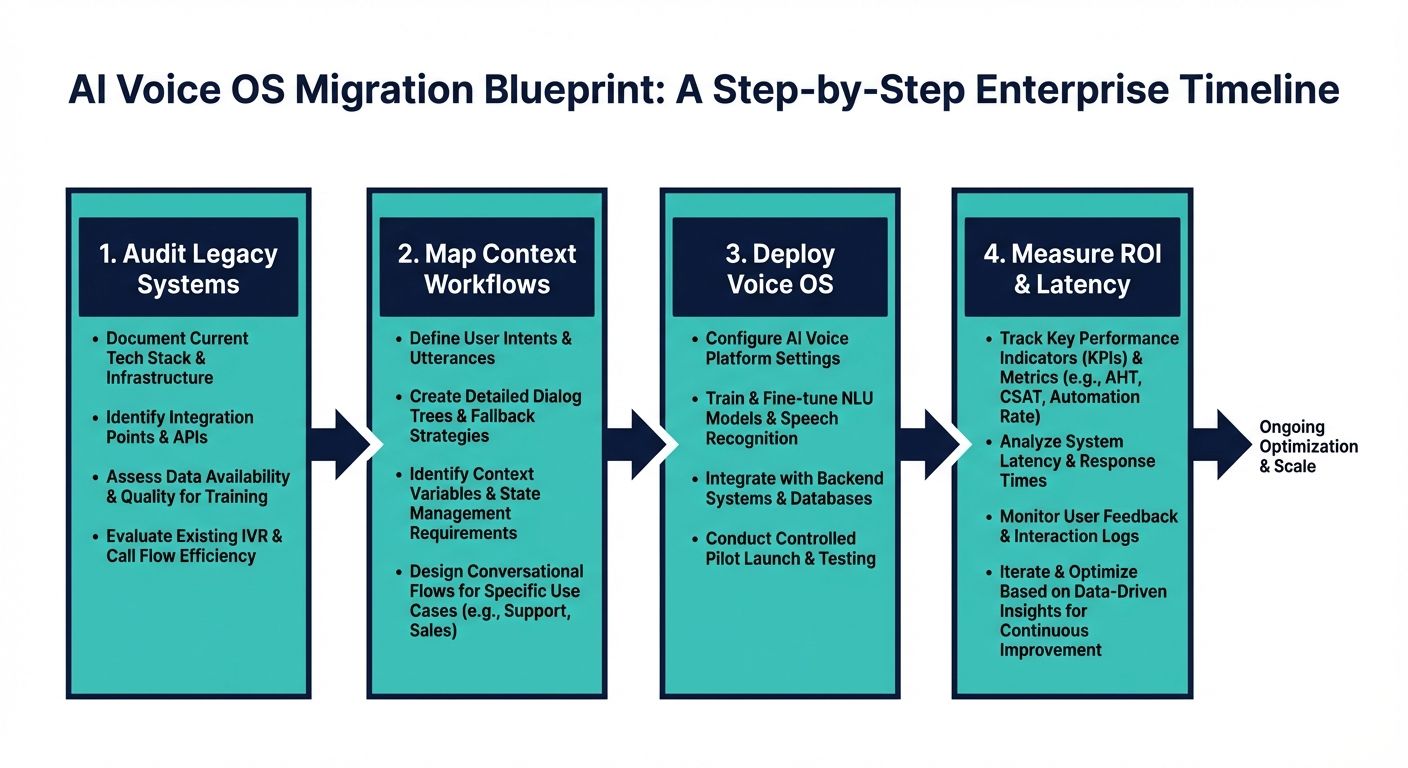
Following this structured four-step migration timeline ensures a smooth transition from legacy systems to a context-aware AI Voice OS while accurately capturing return on investment.
For enterprises ready to upgrade from structurally flawed, context-free systems to highly context-aware AI voice agents, a structured migration blueprint is essential. Top-ranking generic pages completely lack detailed technical integration advice, structured ROI frameworks beyond generic cost savings, and specific cost analysis.
### Step 1: Technical Integration and Data Pipeline Auditing
Before deploying a context-aware voice OS, you must audit your data silos. The engine is only as good as the context it can retrieve. Integrate your CRM, knowledge bases, and historical ticketing systems into a unified vector database. Platforms that natively support secure, real-time data ingestion will significantly reduce integration timelines.
### Step 2: Designing the Context Pipeline
Move away from monolithic prompts. Segment your data into distinct contextual layers. Define what constitutes short-term conversational context versus immutable business logic. Implementing a set-algebraic pipeline ensures that business logic always overrides conversational drift, maintaining compliance and accuracy.
### Step 3: Calculating ROI via Cost Per Qualified Outcome
Abandon the per-minute cost analysis. To calculate true ROI, measure the baseline resolution rate of your current system (or human agents) against the new AI platform. Track the time-to-resolution and the escalation rate. Because systems like Alchemyst's Kathan engine drastically reduce repetition and confusion through superior context retention, the effective cost per qualified outcome plummets. A slightly higher platform utilization cost is heavily offset by the sheer volume of autonomously resolved, complex customer journeys.
## Conclusion: Choosing the Right Platform for Context Mastery
When you deeply compare AI voice agent platforms by context handling capabilities, the superficial metrics fade away. Generic builders and API-only frameworks offer flexibility but often offload the hardest problem—contextual memory—onto the user. Generalist chatbot platforms ported to voice struggle with the acoustic realities of human conversation. For businesses and enterprises seeking to fundamentally improve the customer lifecycle, prioritizing platforms with native, advanced context arithmetic is non-negotiable. By focusing on detailed methodologies like semantic similarity search, deduplication, and true cost per qualified outcome, technical evaluators can confidently select a Voice AI OS that delivers exceptional, contextually aware experiences.
[← Back to Blog](/blog)
## Recently Published
[October 6, 2026 / 10 min readHow to Build a RAG Pipeline for Personal Documents and MediaBuild a multi-modal RAG pipeline for all personal documents and media assets.](/blog/rag-pipeline-personal-documents-media)
[Technical / September 27, 2026 / 11 min readHarness Engineering for AI Agents: Bridging the GapExplore how harness engineering enables robust AI infrastructure and MLOps.](/blog/harness-engineering-ai-agents)
[I'm Evaluating / September 27, 2026 / 9 min readContext Engineering Best Practices for Enterprise AIMaster advanced context engineering best practices for conversational AI agents.](/blog/context-engineering-best-practices)
[I'm Evaluating / September 22, 2026 / 11 min readContext Engineering vs Prompt Engineering for AI AgentsExplore the differences between context and prompt engineering for enterprise AI](/blog/context-engineering-vs-prompt-engineering)
[I'm Evaluating / September 14, 2026 / 10 min readContext Engineering for Enterprise AI: A Complete GuideMaster context engineering to build reliable, production-ready voice AI agents.](/blog/context-engineering-enterprise-ai)
[Deep Technical / July 7, 2026 / 10 min readVoice-Specific Architectural Requirements for AI Context LayersDiscover the core voice-specific architectural requirements for AI context layer](/blog/voice-specific-architectural-requirements-ai-context-layer)
Get Started
## Give your AI agents the memory they deserve.
Join developers building the next generation of AI products with persistent, auditable context. Free tier available. No credit card required.
* Free tier
* REST + Python & Node SDKs
* 99.9% uptime SLA
* SOC 2 in progress
### Request API Access
Enter your email and we'll set up your workspace.
Email
[Read the Docs →](https://docs.getalchemystai.com)[Read the Thesis →](/thesis)
---
# AI Context Engine API Documentation for Developers
- **URL:** https://getalchemystai.com/blog/ai-context-engine-api-documentation-for-developers
- **Slug:** ai-context-engine-api-documentation-for-developers
- **Published:** April 23, 2026
- **Last updated:** April 23, 2026
- **Author:** Harsh Shah
- **Category:** Deep Technical
[Deep Technical](/blog?category=deep-technical)
# AI Context Engine API Documentation for Developers
Comprehensive AI context engine API documentation with endpoints and schemas.
Written by [Harsh Shah](/blog?author=Harsh%20Shah)Reviewed by [Anuran Roy](/blog?author=Anuran%20Roy)13 min readPublished at April 23, 2026 (5mo ago)
## Summary
This guide provides comprehensive, transactional AI context engine API documentation designed for developers. It details request schemas, response models, and integration snippets for deploying context-aware voice AI systems.
Table of Contents
## The Need for Actionable AI Context Engine API Documentation
The transition toward context-aware artificial intelligence has fundamentally altered the landscape of software engineering. Modern applications, particularly complex Voice OS platforms, demand dynamic access to real-time information to function effectively. However, when software engineers search for integration guides, the available resources consistently fall short. Most top-ranking materials offer conceptual thought leadership regarding context engineering, discussing why Large Language Models require context, rather than providing the transactional, hands-on resources that engineering teams actively seek.
Developers do not merely need theoretical essays on the importance of contextual data; they require specific, transactional AI context engine API documentation for developers. They need to understand exactly how to structure their HTTP requests, which authentication methods are mandated, how to properly format complex JSON payloads, and how to programmatically parse algorithmic responses. This definitive reference guide fills that exact gap in the developer ecosystem. By focusing on Alchemyst's proprietary Kathan engine, this documentation moves past high-level fluff to deliver a concrete, step-by-step blueprint for building a real-world, contextually aware AI system.
## Architectural Foundation: Context Arithmetic and The Kathan Engine
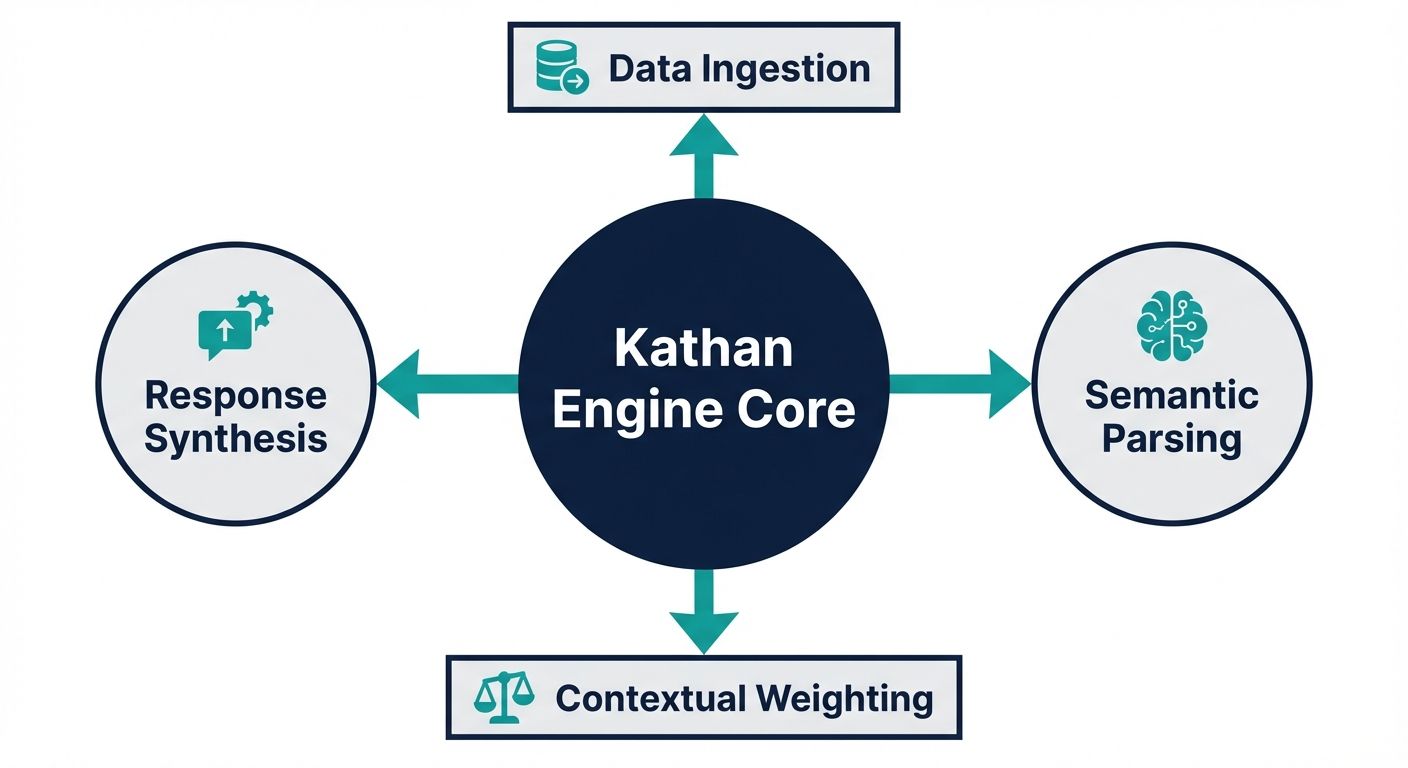
This architectural overview demonstrates how the Kathan Engine processes inputs through context arithmetic to generate precise AI responses, helping developers understand the internal data flow.
Before writing a single line of code to interact with the API, it is absolutely essential to understand the underlying architectural philosophy of the system. The Kathan engine distinguishes itself through a systematic, computational process known as Context Arithmetic. For developers building sophisticated voice agents, Context Arithmetic functions as a highly structured, set-algebraic pipeline. It programmatically determines the most relevant vectors of information to inject into an AI's prompt at any given millisecond.
Unlike legacy, context-free agents that blindly pull massive, unstructured chunks of data from a vector database—often leading to prompt overflow and severe latency—the Kathan engine filters, computes, and intersects precise data points. This pipeline consists of a rigorous five-stage information retrieval process that ensures high fidelity and minimal token consumption.
### Stage 1: High-Dimensional Semantic Search
The first stage of the API's backend process involves mapping the end-user's natural language query into a high-dimensional vector space. When a request hits the computation endpoint, the engine executes a rapid semantic similarity search against the pre-indexed data. This ensures that the engine retrieves documents based on intent and contextual meaning, rather than relying on brittle keyword matching algorithms.
### Stage 2: Rigorous Metadata Filtering
Semantic search alone is insufficient for enterprise applications. The second stage applies strict boolean metadata filtering. Developers can pass custom parameters via the API to constrain the context by specific timestamps, unique user identifiers, or stringent Role-Based Access Controls. If a document matches the semantic intent but violates the metadata access policy, the engine mathematically excludes it from the context pool.
### Stage 3: Mathematical Deduplication
Redundancy is a major issue when feeding data to Large Language Models. Stage three introduces the deduplication phase. Here, the Context Arithmetic pipeline identifies overlapping informational vectors and algorithmically strips away redundant contextual data. This ensures that the AI receives a lean, diverse set of facts, optimizing the token usage and drastically reducing computational costs.
### Stage 4: Confidence Ranking
Not all retrieved context is equally valuable. In stage four, the engine handles ranking and scoring. Every piece of contextual data is evaluated and assigned a confidence score based on its relevance to the specific user query and its recency. Developers can configure acceptable confidence thresholds within their API requests, dropping low-quality data before it reaches the voice agent.
### Stage 5: Dynamic Prompt Injection
The final stage is the synthesis of the retrieved data. The engine dynamically structures the heavily filtered, ranked, and deduplicated context into a cohesive string. This finalized context is what the API returns to the developer, ready to be prepended to the active memory prompt of the voice OS.
## Core API Configuration and Authentication
To interact with the context engine seamlessly, developers must configure their environments to authenticate every request securely. The API adheres to strict RESTful design principles, demanding secure token exchange and standardized headers.
* **Base API URL:** All endpoints are structured under the secure base routing.
* **Authentication Mechanism:** The API requires a persistent Bearer Token passed via the Authorization header on every single request.
* **Content Types:** The engine exclusively accepts and returns JSON payloads. The Content-Type header must strictly be application/json.
* **Rate Limiting and Quotas:** To maintain system stability during intense Voice OS traffic, the API enforces a limit of one thousand requests per minute per authenticated developer account. Exceeding this triggers a standard timeout response.
## AI Context Engine API Documentation for Developers: Core Endpoints
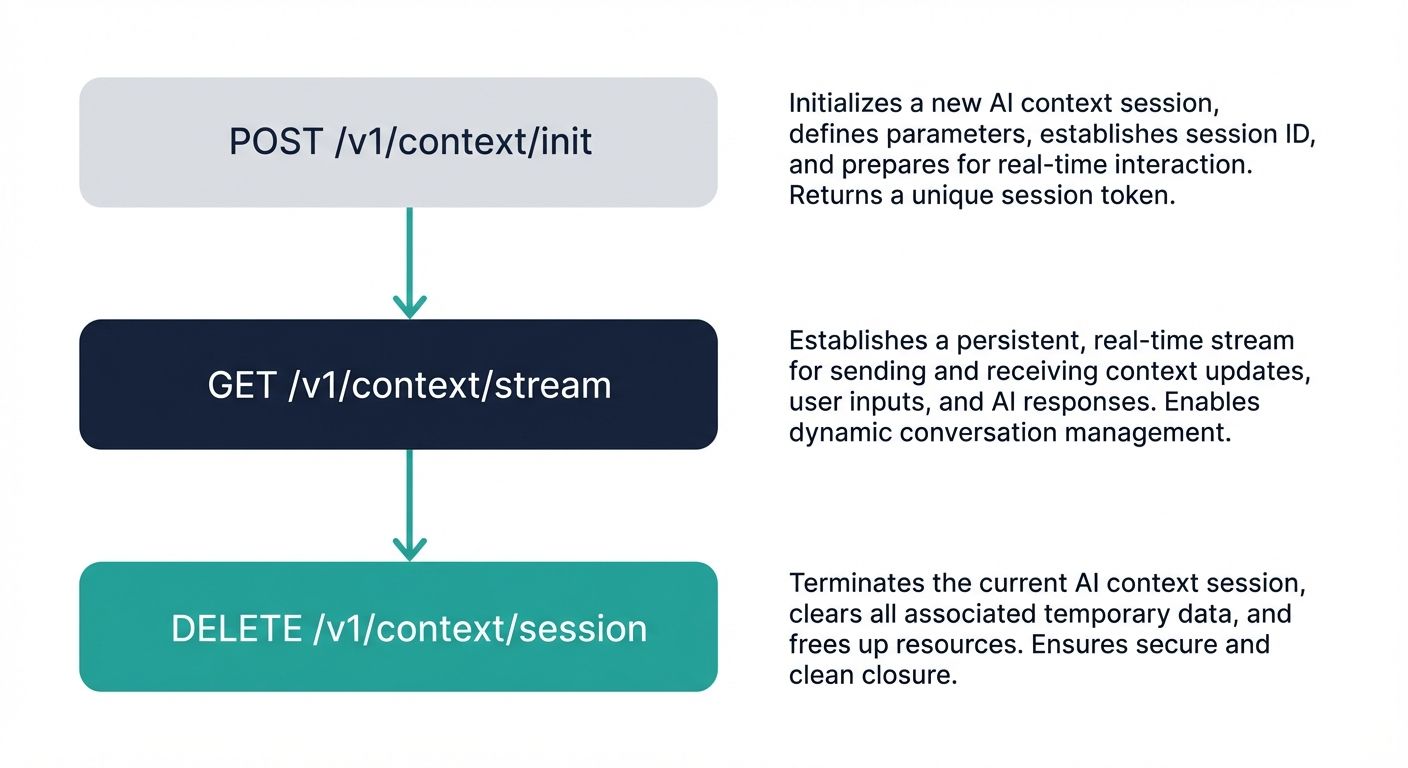
By visualizing the sequence of core API endpoints, developers can easily map out the standard lifecycle of an AI context session from initialization to teardown.
This section provides the actionable AI context engine API documentation for developers, outlining the precise schemas required to initialize sessions, push data into the pipeline, and compute contextual responses.
### 1\. Initialize a Context Session
Every contextual interaction must occur within an isolated stateful environment. The initialization endpoint generates a temporary workspace where the Context Arithmetic pipeline can safely operate without data bleeding between disparate users.
**Endpoint Route:** POST /v1/context/session
**Request Payload Schema:**
* **agent\_id** _(string, required)_: The universally unique identifier assigned to your specific voice agent configuration.
* **environment** _(string, optional)_: Defines the workspace context, typically designated as either production or staging.
* **time\_to\_live** _(integer, optional)_: The exact duration in seconds that the session should remain active before the engine automatically purges the context pool. Defaults to 3600 seconds.
**Response Payload Schema:**
* **session\_id** _(string)_: The newly generated cryptographic UUID for the active session. This key must be appended to all subsequent integration requests.
* **status** _(string)_: Confirmation string indicating the session is successfully initialized and ready for injection.
* **expiration\_timestamp** _(string)_: An ISO 8601 formatted timestamp detailing exactly when the session will be garbage collected.
### 2\. Inject Context Data into the Pipeline
With an active session established, engineers must populate the engine with raw data. This injection endpoint feeds the foundational vector database, allowing the semantic search and metadata filtering stages to operate effectively. High-quality injection is critical for optimal Voice OS performance.
**Endpoint Route:** POST /v1/context/inject
**Request Payload Schema:**
* **session\_id** _(string, required)_: The active session UUID obtained from the initialization endpoint.
* **documents** _(array, required)_: A JSON array containing the context objects to be embedded into the arithmetic engine.
* **documents\[\].content** _(string, required)_: The raw textual data, such as a user CRM record, previous chat transcript, or internal knowledge base article.
* **documents\[\].metadata** _(object, required)_: Key-value pairs utilized during Stage 2 filtering. Must include fields like document\_type, creation\_date, and authorization\_level.
**Response Payload Schema:**
* **documents\_processed** _(integer)_: The total count of data chunks successfully vectorized and stored in the session memory.
* **documents\_failed** _(integer)_: Count of documents rejected due to malformed text or missing mandatory metadata fields.
* **vector\_references** _(array)_: Unique database pointers mapped to your injected documents for auditing purposes.
### 3\. Execute Context Arithmetic Computation
This endpoint represents the heart of the Kathan engine. By invoking the compute route, developers trigger the complete five-stage algorithmic pipeline. The engine parses the user's query, executes the arithmetic deduplication, and returns the optimized string for the Language Model.
**Endpoint Route:** POST /v1/context/compute
**Request Payload Schema:**
* **session\_id** _(string, required)_: The active session UUID where the relevant documents reside.
* **user\_input** _(string, required)_: The exact transcription of the spoken query or typed text from the end-user.
* **minimum\_confidence** _(float, optional)_: A strict threshold ranging from 0.0 to 1.0\. Context scored below this decimal will be aggressively dropped. The system default is set to 0.75.
* **token\_limit** _(integer, optional)_: A hard cap on the size of the returned context string to prevent prompt overflow.
**Response Payload Schema:**
* **synthesized\_context** _(string)_: The finalized, highly optimized textual string ready to be directly concatenated into your LLM's system prompt.
* **source\_citations** _(array)_: An array of metadata tags referencing exactly which injected documents survived the arithmetic pipeline to form the context.
* **overall\_confidence** _(float)_: The algorithmic certainty score of the returned context payload.
## Comprehensive Error Handling and Status Codes
Robust enterprise integrations require resilient error handling. The API leverages standard HTTP status codes, accompanied by descriptive JSON error messages to streamline debugging.
* **400 Bad Request:** Triggered when a request payload is malformed or lacks required fields, such as missing the agent\_id during session initialization.
* **401 Unauthorized:** Returned when the Bearer token is missing, expired, or cryptographically invalid.
* **403 Forbidden:** Occurs when the authenticated developer account lacks the permissions to access a specified voice agent configuration.
* **429 Too Many Requests:** Indicates the developer has breached the strict rate limit quota. The response headers will include a Retry-After value.
* **500 Internal Server Error:** Signifies an unexpected failure within the computational pipeline. Developers should implement exponential backoff retry logic.
## Developer Integration and Implementation Patterns
To maximize the utility of this AI context engine API documentation for developers, it is vital to conceptualize how these endpoints interconnect within various programming environments. Although actual code architectures vary, the asynchronous logic flow remains largely consistent across modern stacks.
### Asynchronous Logic in Node Applications
In Node environments, engineers predominantly rely on asynchronous fetch implementations or libraries like Axios. The integration sequence involves awaiting the session initialization, extracting the UUID, and immediately firing the injection endpoint. Webhook listeners capture the user's voice transcription, map it to the compute payload, and await the synthesized context before routing the final prompt to the underlying language model. Concurrency is easily managed using standard Promise architecture.
### Synchronous Pipelines in Python Environments
Python developers typically implement this API using the robust Requests library or asynchronous frameworks like FastAPI. Python is exceptionally well-suited for the injection phase. Engineers can leverage data manipulation libraries such as Pandas to clean, format, and structure massive datasets into perfect metadata schemas before batching requests to the API. Persistent session objects help maintain connection pools, significantly reducing latency during the compute phase.
### High-Concurrency Connections in Go
For large-scale telecom or enterprise integrations demanding absolute minimal latency, Go is the language of choice. By defining strict structural types that map precisely to our JSON schemas, developers ensure type safety at compile time. Go routines allow development teams to parallelize the injection of multiple data sources simultaneously, populating the context engine's vector space in milliseconds before the user even finishes speaking their first sentence.
## Best Practices for Managing Contextual Workloads
Successfully integrating an API is merely the baseline. Sustaining a high-performance, context-aware artificial intelligence requires strict adherence to data management best practices. The engine is only as intelligent as the data it processes.
Data freshness is arguably the most critical metric. Developers must proactively configure time-to-live parameters during session initialization. Allowing stale CRM data to linger in the context pool inevitably leads to AI hallucinations, where the Voice OS provides factually incorrect information based on outdated states. Implementing aggressive garbage collection on contextual sessions protects the end-user experience.
Security and privacy stripping must occur prior to the injection phase. When transmitting user profiles to the API, developers must programmatically strip Personally Identifiable Information unless that specific data point is strictly necessary for the transaction at hand. Utilizing the robust metadata system allows engineers to implement fine-grained access controls, ensuring that restricted internal documents are mathematically blocked from unauthorized user queries during Stage 2 of the arithmetic pipeline.
## The ROI Framework: Cost Per Qualified Outcome
Implementing deep contextual integrations provides substantial, trackable financial advantages. Historically, Voice AI pricing strategies, especially in emerging markets, have obscured massive inefficiencies through arbitrary per-minute or per-seat billing models. These older, context-free systems often result in cyclical, redundant conversations, purposely inflating the duration of the call without actually resolving the customer's intent.
By integrating a highly efficient context pipeline, businesses can pivot to a superior analytical metric: the Cost Per Qualified Outcome. Because the arithmetic engine instantly deduplicates data and injects the exact necessary context into the prompt, the agent's time-to-resolution plummets. The AI understands the specific historical context immediately, resolving the issue on the very first attempt. Engineering teams can directly map API compute costs against successful ticket resolutions, providing stakeholders with a transparent, structured Return on Investment framework that exposes the hidden costs of legacy solutions.
## The Definitive Blueprint for Voice OS Migration
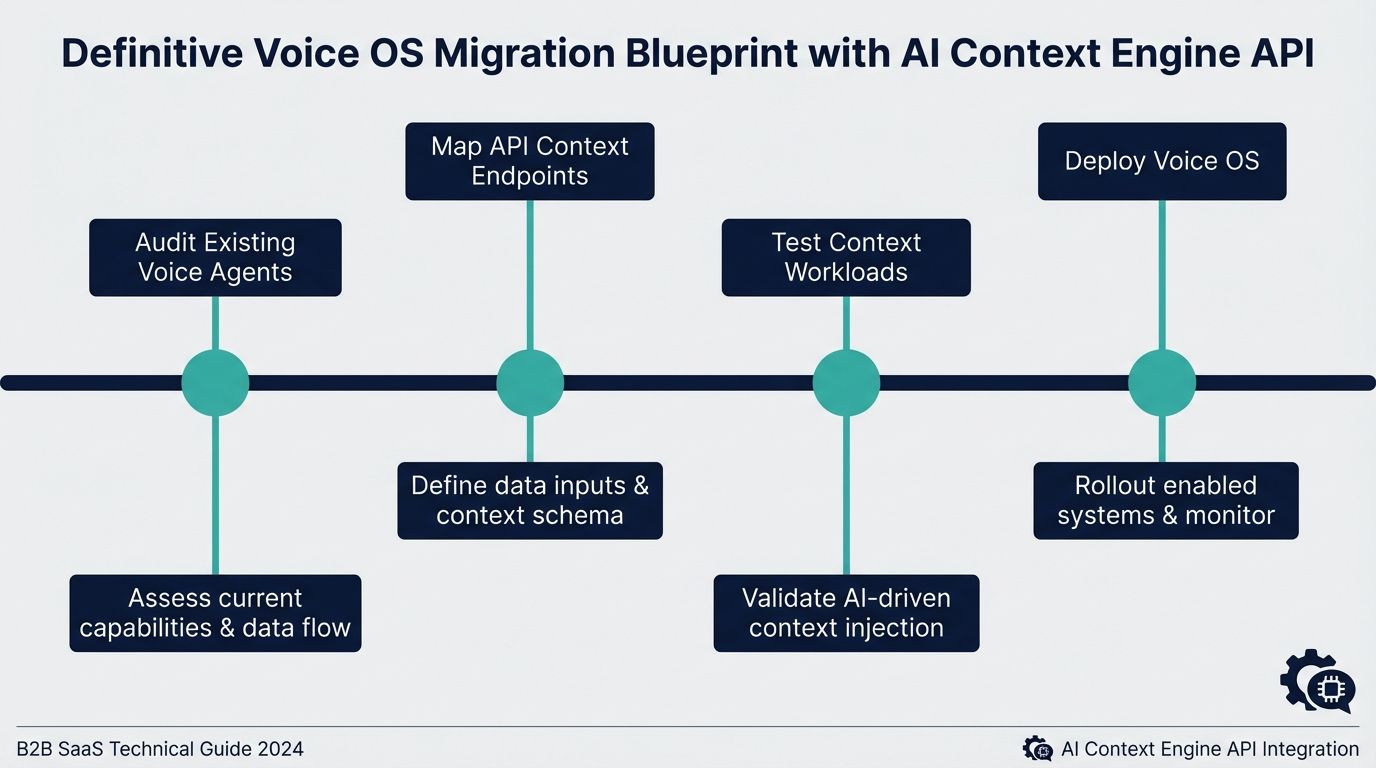
This migration timeline outlines the critical phases required to seamlessly transition legacy voice systems to a modern Voice OS powered by the AI context engine.
Transitioning from a legacy IVR or a standard chatbot to a fully context-aware Voice OS necessitates a methodical migration blueprint. Utilizing this AI context engine API documentation for developers simplifies the transition into four distinct engineering phases.
The first phase is the comprehensive data audit. Engineering teams must map out all disparate data silos—internal knowledge bases, user ticketing systems, and active CRM states. This audit defines what information needs to be actively injected into the context engine during a user session.
The second phase involves payload schema mapping. Developers must write the middleware logic that transforms their audited data into the strict JSON arrays required by the injection endpoint. This step focuses heavily on standardizing metadata tags so the retrieval pipeline can filter information cleanly.
The third phase is the prompt engineering overhaul. In legacy systems, developers often bloat the core system prompt with endless conditional instructions. During migration, these static prompts must be refactored into dynamic, lean templates. The templates simply contain a placeholder variable that accepts the synthesized string returned by the compute endpoint. This architectural shift massively reduces LLM token consumption per transaction.
The final phase is continuous Quality Assurance driven by algorithmic confidence. By logging the confidence scores returned in the computation response, developers can programmatically identify blind spots in their knowledge base. If specific user queries repeatedly yield low confidence scores, the engineering team knows exactly which domains require richer data injection.
## Conclusion: Building the Next Generation of Voice Agents
The era of context-blind, frustrating automated systems is rapidly drawing to a close. To remain competitive, enterprises must adopt intelligent architectures capable of mathematical precision and dynamic reasoning. However, achieving this vision requires more than just high-level discussions; it demands concrete, developer-centric tools and uncompromising API specifications.
This comprehensive AI context engine API documentation for developers serves as the definitive bridge between advanced context engineering theory and practical software execution. By mastering session initialization, rigorously formatting injection payloads, and leveraging the full power of Context Arithmetic computations, engineering teams can build resilient systems. Leverage these endpoints, adhere to the outlined integration patterns, and successfully transition your infrastructure to a context-aware Voice OS that guarantees measurable outcomes and unprecedented user experiences.
[← Back to Blog](/blog)
## Recently Published
[October 6, 2026 / 10 min readHow to Build a RAG Pipeline for Personal Documents and MediaBuild a multi-modal RAG pipeline for all personal documents and media assets.](/blog/rag-pipeline-personal-documents-media)
[Technical / September 27, 2026 / 11 min readHarness Engineering for AI Agents: Bridging the GapExplore how harness engineering enables robust AI infrastructure and MLOps.](/blog/harness-engineering-ai-agents)
[I'm Evaluating / September 27, 2026 / 9 min readContext Engineering Best Practices for Enterprise AIMaster advanced context engineering best practices for conversational AI agents.](/blog/context-engineering-best-practices)
[I'm Evaluating / September 22, 2026 / 11 min readContext Engineering vs Prompt Engineering for AI AgentsExplore the differences between context and prompt engineering for enterprise AI](/blog/context-engineering-vs-prompt-engineering)
[I'm Evaluating / September 14, 2026 / 10 min readContext Engineering for Enterprise AI: A Complete GuideMaster context engineering to build reliable, production-ready voice AI agents.](/blog/context-engineering-enterprise-ai)
[Deep Technical / July 7, 2026 / 10 min readVoice-Specific Architectural Requirements for AI Context LayersDiscover the core voice-specific architectural requirements for AI context layer](/blog/voice-specific-architectural-requirements-ai-context-layer)
Get Started
## Give your AI agents the memory they deserve.
Join developers building the next generation of AI products with persistent, auditable context. Free tier available. No credit card required.
* Free tier
* REST + Python & Node SDKs
* 99.9% uptime SLA
* SOC 2 in progress
### Request API Access
Enter your email and we'll set up your workspace.
Email
[Read the Docs →](https://docs.getalchemystai.com)[Read the Thesis →](/thesis)
---
# AI Voice OS Migration Blueprint and ROI Calculation for Businesses
- **URL:** https://getalchemystai.com/blog/ai-voice-os-migration-blueprint-and-roi-calculation-for-businesses
- **Slug:** ai-voice-os-migration-blueprint-and-roi-calculation-for-businesses
- **Published:** April 23, 2026
- **Last updated:** April 23, 2026
- **Author:** Harsh Shah
- **Category:** It's Not Working
[It's Not Working](/blog?category=its-not-working)
# AI Voice OS Migration Blueprint and ROI Calculation for Businesses
Step-by-step AI Voice OS migration blueprint and precise ROI calculator guide.
Written by [Harsh Shah](/blog?author=Harsh%20Shah)Reviewed by [Anuran Roy](/blog?author=Anuran%20Roy)10 min readPublished at April 23, 2026 (5mo ago)
## Summary
Transitioning to an AI Voice OS requires a definitive technical migration blueprint and a structured financial framework. This guide details data integration, context engineering, and how to accurately calculate ROI beyond generic cost savings.
Table of Contents
## The Strategic Imperative of AI Voice OS Adoption
In the modern enterprise landscape, conversational AI has transcended basic text chatbots and rudimentary Interactive Voice Response (IVR) systems. Today, organizations are pivoting toward highly sophisticated AI Voice Operating Systems (OS) capable of executing complex, multi-turn dialogues with human-like latency and deep contextual awareness. However, the transition from legacy telecommunications infrastructure to a next-generation voice agent platform is a monumental operational shift. To ensure a successful digital transformation, enterprise leaders require a comprehensive **AI Voice OS migration blueprint and ROI calculation for businesses**. This definitive guide bridges the critical gap between theoretical AI capabilities and practical, financially viable enterprise integration.
Top-ranking industry resources often highlight the generic cost savings of AI, but they frequently overlook the intricate technical integration processes, rigorous data migration requirements, and nuanced ROI frameworks necessary for true enterprise-scale deployment. By focusing on advanced information retrieval architectures—specifically context engineering over rudimentary prompt engineering—businesses can deploy voice agents that actually augment human capabilities, automate repetitive workflows, and capture rich qualitative feedback during every customer interaction.
## The Definitive AI Voice OS Migration Blueprint
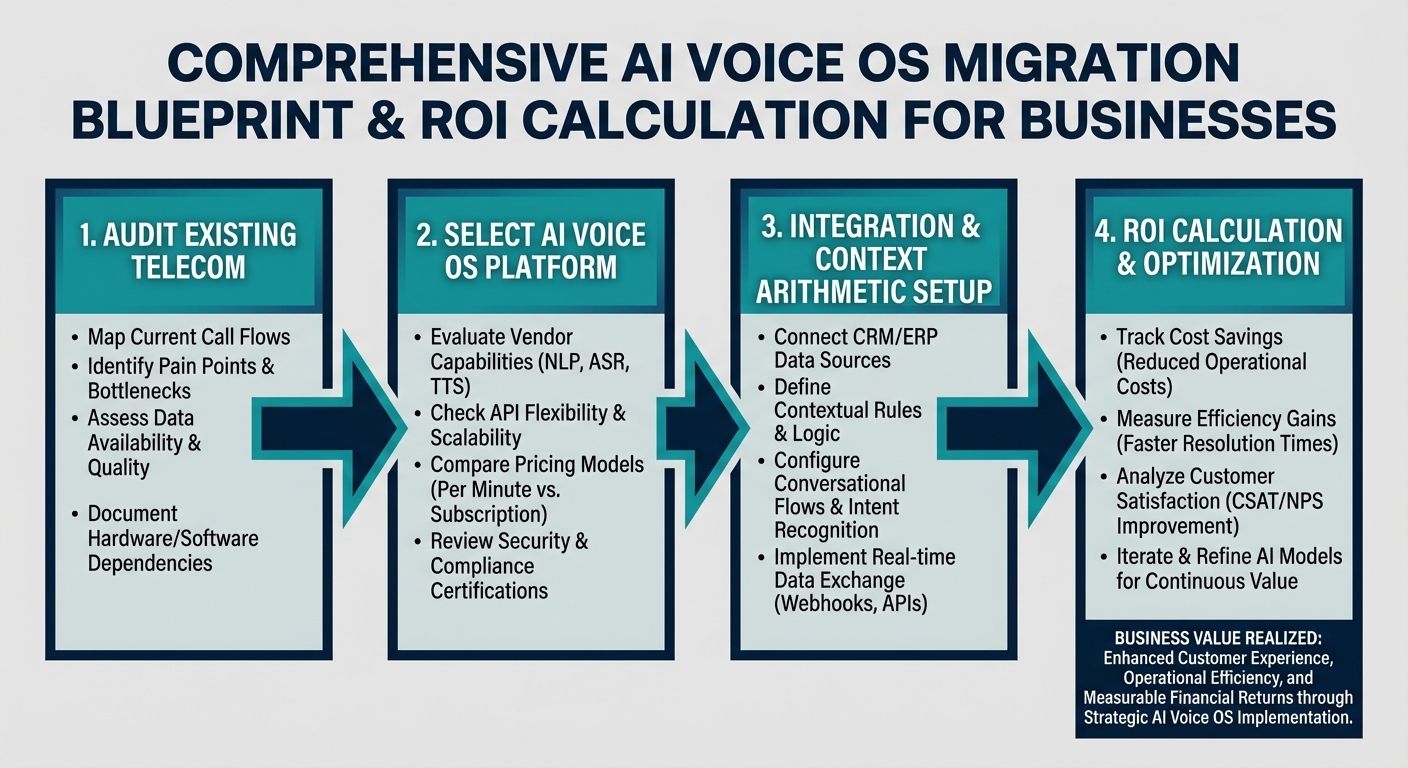
This step-by-step flowchart breaks down the AI Voice OS migration blueprint into actionable phases, ensuring a seamless transition and measurable business impact.
Executing a seamless migration to an AI Voice OS demands a highly structured, phased approach. Unlike plug-and-play software, deploying enterprise voice AI involves deeply integrating the conversational engine with existing Customer Relationship Management (CRM) platforms, telephony SIP trunks, and backend databases. Here is the step-by-step blueprint for a robust technical integration.
### Phase 1: Architectural Assessment and Telephony Mapping
The migration lifecycle begins with a rigorous audit of your current communication architecture. Enterprises must document their existing telephony infrastructure, mapping out SIP (Session Initiation Protocol) trunks, existing IVR call flows, and agent routing logic. During this phase, businesses must define the precise operational constraints their AI Voice OS will operate within. This involves establishing latency budgets (typically aiming for sub-500 millisecond response times to maintain conversational fluidity) and identifying the necessary API endpoints that the AI will need to query in real-time.
Crucially, this phase requires a shift in design philosophy from traditional decision-tree mapping to _contextual boundary definition_. Instead of explicitly programming every possible path a user might take, developers must define the knowledge base, the API toolkit, and the operational guardrails the AI agent will utilize to dynamically navigate conversations.
### Phase 2: Context Engineering and Data Migration
Once the architecture is mapped, the focus shifts to data migration and context engineering. Many early AI deployments failed because they relied heavily on static prompt engineering, which leads to robotic-sounding and error-prone agents. Advanced platforms, such as Alchemyst's Kathan engine, utilize a superior paradigm known as context engineering.
During data migration, unstructured enterprise data (such as product manuals, policy documents, and historical support transcripts) must be ingested, chunked, and vectorized into high-performance vector databases. Simultaneously, structured CRM data (customer profiles, purchase histories, and real-time account statuses) must be seamlessly connected via secure API gateways. The AI Voice OS must be able to pull this real-time metadata seamlessly to inform its conversational trajectory, ensuring that every response is hyper-personalized and historically informed.
### Phase 3: Security, Compliance, and Pipeline Testing
Enterprise voice data is incredibly sensitive. The migration blueprint must incorporate stringent security protocols, including real-time Personally Identifiable Information (PII) redaction before any audio data is transcribed and sent to the Large Language Model (LLM). Compliance with frameworks such as SOC 2, HIPAA, and GDPR is non-negotiable.
Before moving to production, organizations must conduct rigorous pipeline testing. This involves simulating thousands of concurrent calls to stress-test telephony APIs, measure vector search retrieval latencies, and evaluate the contextual accuracy of the AI's responses. A phased rollout—starting with a low-risk subset of inbound queries—allows businesses to monitor system behavior and refine the context engine before full-scale deployment.
## The Technical Engine: Context Arithmetic for Voice
To truly understand how a modern AI Voice OS operates during migration, technical evaluators must look under the hood at the information retrieval mechanisms. The competitive advantage of platforms like Alchemyst lies in their advanced architecture, specifically a computational process known as _Context Arithmetic_. This process systematically determines the most relevant information to feed the voice agent in real-time, preventing hallucinations and ensuring precise responses.
### Overcoming Robotic Responses Through Dynamic Retrieval
Standard voice agents sound robotic because they operate on rigid scripts or overly broad LLM prompts. Context arithmetic solves this by treating contextual retrieval as a set-algebraic pipeline. As a user speaks, the Kathan engine performs rapid calculations to curate the exact set of facts, guidelines, and customer data required for that specific millisecond of the conversation.
### The Five-Stage Context Determination Pipeline
For developers and technical teams managing the migration, integrating this five-stage pipeline is the cornerstone of a successful deployment:
* **1\. Semantic Similarity Search:** When a user asks a question, the system queries the vector database to find the most conceptually similar knowledge chunks. This ensures the AI understands the _intent_ behind the words, rather than just keyword matching.
* **2\. Metadata Filtering:** The semantic search results are instantly filtered against hard constraints. For example, if a user is calling about an enterprise software tier, the system filters out all documentation related to the consumer tier, ensuring the AI only accesses relevant data.
* **3\. Set-Algebraic Pipeline:** The system performs complex intersections and unions of different context spaces. It merges the user's real-time CRM state with the retrieved product knowledge, creating a unified, multi-dimensional context profile.
* **4\. Deduplication:** To optimize LLM processing speed and reduce token costs, the engine systematically strips out redundant instructions or overlapping data points retrieved from various databases.
* **5\. Ranking:** Finally, the remaining context blocks are scored and ranked based on immediate relevance. Only the top-tier, most critical information is injected into the AI's active memory for its next spoken response.
## Advanced ROI Calculation for Businesses
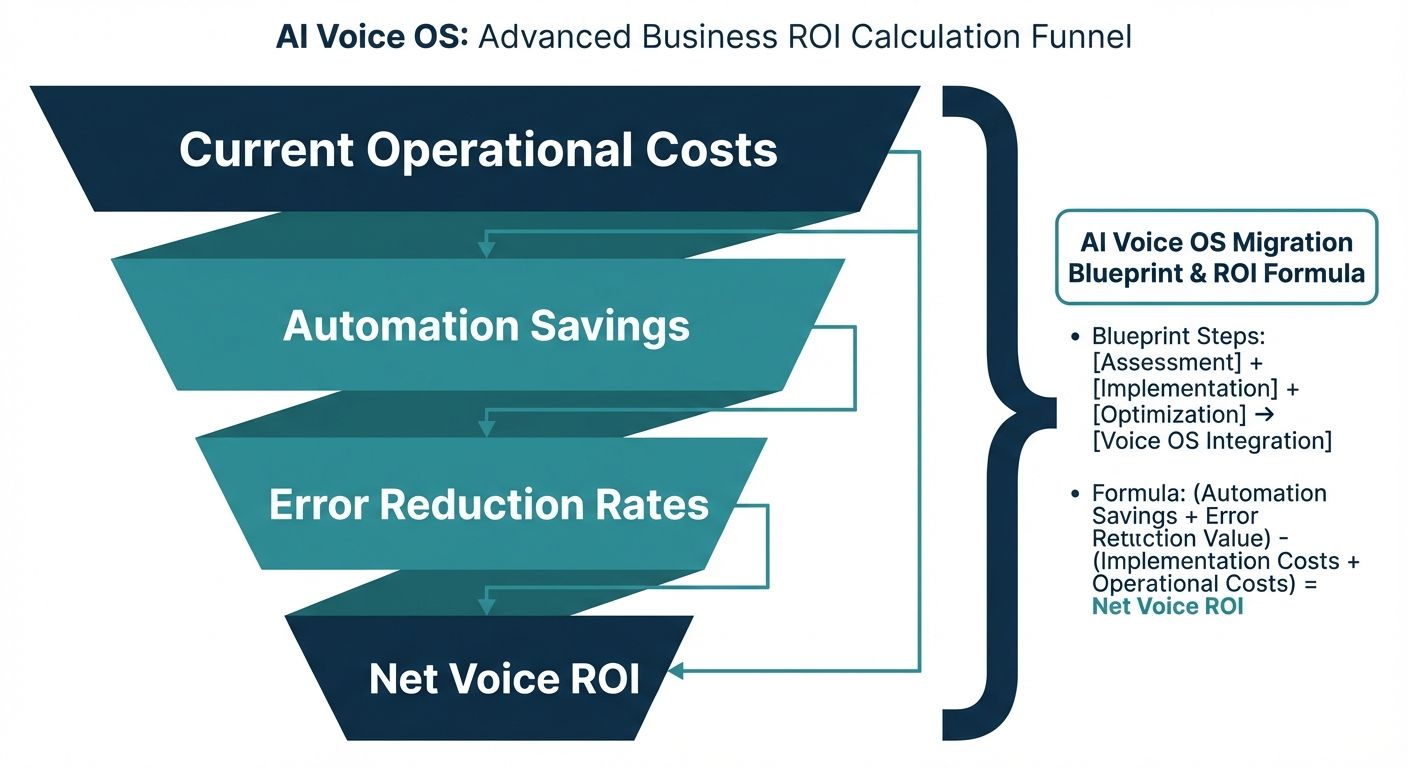
By mapping out current operational costs against automation savings, this funnel diagram visualizes exactly how businesses can calculate their precise return on investment after an AI Voice OS migration.
Constructing a compelling business case for an AI Voice OS requires a structured ROI framework that extends far beyond generic cost savings. While reducing headcount or deflecting calls is often the primary focus, a robust AI Voice OS migration blueprint and ROI calculation for businesses must capture the comprehensive financial impact of contextual automation.
### Moving Beyond Generic Cost-Per-Minute Metrics
Traditional BPO (Business Process Outsourcing) and legacy SaaS voice platforms often utilize minute-based billing. However, this model misaligns incentives, as longer calls generate more revenue for the vendor. When calculating the ROI of an advanced AI Voice OS, businesses must transition their financial modeling to focus on resolution efficiency and outcome generation.
### The Cost Per Qualified Outcome (CPQO) Model
The most accurate metric for evaluating voice AI ROI is the **Cost Per Qualified Outcome (CPQO)**. This model shifts the financial focus from _time spent_ to _value delivered_. To calculate this, businesses should use the following structured framework:
* **Step 1: Calculate Total Migration & Integration CapEx:** Include the costs of the architectural audit, data vectorization, API integration, and initial context engineering setup.
* **Step 2: Calculate Ongoing OpEx:** Factor in LLM token costs, telephony/SIP trunking fees, vector database hosting, and continuous optimization costs.
* **Step 3: Define Qualified Outcomes:** A qualified outcome is a specific, high-value resolution, such as a successfully booked appointment, a processed payment, a verified technical troubleshooting session, or a qualified lead passed to sales.
* **Step 4: Execute the ROI Formula:** Divide the total operational cost over a specific period by the volume of qualified outcomes achieved by the AI. Compare this CPQO against the historical cost of a human agent achieving the exact same outcome.
By using the CPQO model, enterprise leaders can definitively prove that the AI Voice OS is not merely a cost-center reduction tool, but a highly efficient, scalable engine for business outcomes.
### Measuring Soft Savings and Qualitative Value
A comprehensive ROI calculation must also quantify soft savings. Unlike traditional IVRs, an advanced AI Voice OS captures rich qualitative feedback and performs immediate sentiment analysis during collection. This means every call acts as an automated focus group. The financial value of extracting real-time product feedback, identifying emerging customer churn risks through sentiment scoring, and capturing granular user preferences directly impacts product development and customer retention strategies, adding massive, quantifiable value to the overall ROI equation.
## Concrete Industry-Focused Use Cases for AI Voice OS
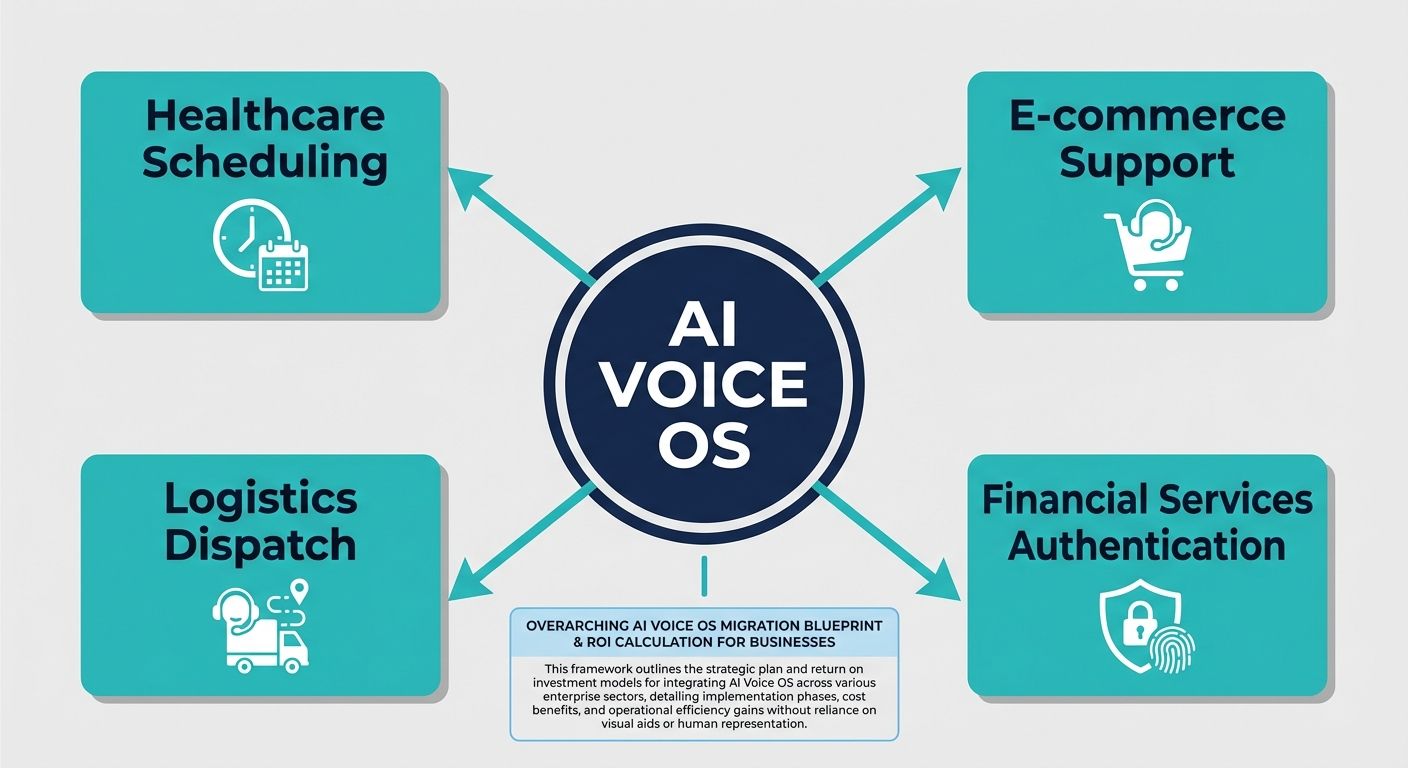
This hub-and-spoke concept map illustrates the diverse industry applications for an AI Voice OS, demonstrating how different sectors can leverage voice automation to drive unique business value.
To contextualize the migration blueprint and ROI frameworks, it is essential to examine specific, industry-focused use cases where context-aware AI voice agents deliver transformative business value.
### Enterprise Customer Service and Technical Support
In high-volume enterprise tech support, human agents frequently suffer from burnout due to repetitive password resets and basic troubleshooting. An AI Voice OS integrated with a company's internal knowledge base and user authentication APIs can independently resolve these Tier 1 and Tier 2 issues. By leveraging the metadata filtering of the context engine, the AI can securely verify the user's identity, read real-time system outage data, and guide the user through complex diagnostic steps. The ROI is realized through massive deflection rates and the strategic reallocation of human engineers to highly complex, escalated issues—embodying true human-AI augmentation.
### Financial Services and Debt Collections
In the financial sector, an AI Voice OS fundamentally alters outbound operations such as debt collections or loan status updates. Because conversations involving finances require high empathy and absolute factual accuracy, prompt-engineered bots fail. Context-engineered agents excel here. The AI can securely pull the exact arrearage amount, calculate settlement options on the fly using set-algebraic logic, and negotiate payment terms within strict compliance boundaries. The ROI calculation in this sector is remarkably straightforward: the cost of the AI deployment versus the total reclaimed revenue and the reduction in compliance violation fines.
### Healthcare Patient Scheduling and Triage
For large healthcare networks, patient no-shows and inefficient scheduling are massive drains on profitability. A HIPAA-compliant AI Voice OS can manage inbound calls, utilizing semantic similarity to understand a patient's symptoms, referencing physician availability via secure API, and booking the appointment. Furthermore, the AI can execute proactive outbound calls to confirm appointments, dramatically reducing no-show rates. The ROI is calculated by measuring the increase in physician utilization rates and the reduction in administrative staffing costs.
## Conclusion: Executing the Transition to Context-Aware AI
Developing a successful **AI Voice OS migration blueprint and ROI calculation for businesses** is an essential undertaking for modern enterprises. By abandoning outdated conversational paradigms and embracing deep technical architectures like context arithmetic, organizations can build highly intelligent, responsive voice agents that truly understand the customer lifecycle. By meticulously planning the data migration, enforcing strict security standards, and evaluating success through advanced financial models like the Cost Per Qualified Outcome, businesses can confidently justify their AI investments. Ultimately, the transition to an AI Voice OS is not about replacing human talent; it is about augmenting enterprise capabilities, unlocking unprecedented operational efficiency, and delivering highly contextual, deeply engaging customer experiences at infinite scale.
[← Back to Blog](/blog)
## Recently Published
[October 6, 2026 / 10 min readHow to Build a RAG Pipeline for Personal Documents and MediaBuild a multi-modal RAG pipeline for all personal documents and media assets.](/blog/rag-pipeline-personal-documents-media)
[Technical / September 27, 2026 / 11 min readHarness Engineering for AI Agents: Bridging the GapExplore how harness engineering enables robust AI infrastructure and MLOps.](/blog/harness-engineering-ai-agents)
[I'm Evaluating / September 27, 2026 / 9 min readContext Engineering Best Practices for Enterprise AIMaster advanced context engineering best practices for conversational AI agents.](/blog/context-engineering-best-practices)
[I'm Evaluating / September 22, 2026 / 11 min readContext Engineering vs Prompt Engineering for AI AgentsExplore the differences between context and prompt engineering for enterprise AI](/blog/context-engineering-vs-prompt-engineering)
[I'm Evaluating / September 14, 2026 / 10 min readContext Engineering for Enterprise AI: A Complete GuideMaster context engineering to build reliable, production-ready voice AI agents.](/blog/context-engineering-enterprise-ai)
[Deep Technical / July 7, 2026 / 10 min readVoice-Specific Architectural Requirements for AI Context LayersDiscover the core voice-specific architectural requirements for AI context layer](/blog/voice-specific-architectural-requirements-ai-context-layer)
Get Started
## Give your AI agents the memory they deserve.
Join developers building the next generation of AI products with persistent, auditable context. Free tier available. No credit card required.
* Free tier
* REST + Python & Node SDKs
* 99.9% uptime SLA
* SOC 2 in progress
### Request API Access
Enter your email and we'll set up your workspace.
Email
[Read the Docs →](https://docs.getalchemystai.com)[Read the Thesis →](/thesis)
---
# Enterprise AI Agent Infrastructure: Bridging the Deployment Gap
- **URL:** https://getalchemystai.com/blog/enterprise-ai-agent-infrastructure-demo-to-deployment-gap
- **Slug:** enterprise-ai-agent-infrastructure-demo-to-deployment-gap
- **Published:** April 23, 2026
- **Last updated:** April 23, 2026
- **Author:** Harsh Shah
- **Category:** I'm Evaluating
[I'm Evaluating](/blog?category=im-evaluating)
# Enterprise AI Agent Infrastructure: Bridging the Deployment Gap
Architectural blueprint to move AI agents from demo to enterprise deployment.
Written by [Harsh Shah](/blog?author=Harsh%20Shah)Reviewed by [Anuran Roy](/blog?author=Anuran%20Roy)9 min readPublished at April 23, 2026 (5mo ago)
## Summary
Discover actionable architectural patterns to transition AI agents from proof-of-concept to production. This guide details infrastructure requirements, MLOps orchestration, and context engineering techniques to ensure enterprise readiness.
Table of Contents
## The Illusion of the AI Demo vs. The Reality of Production
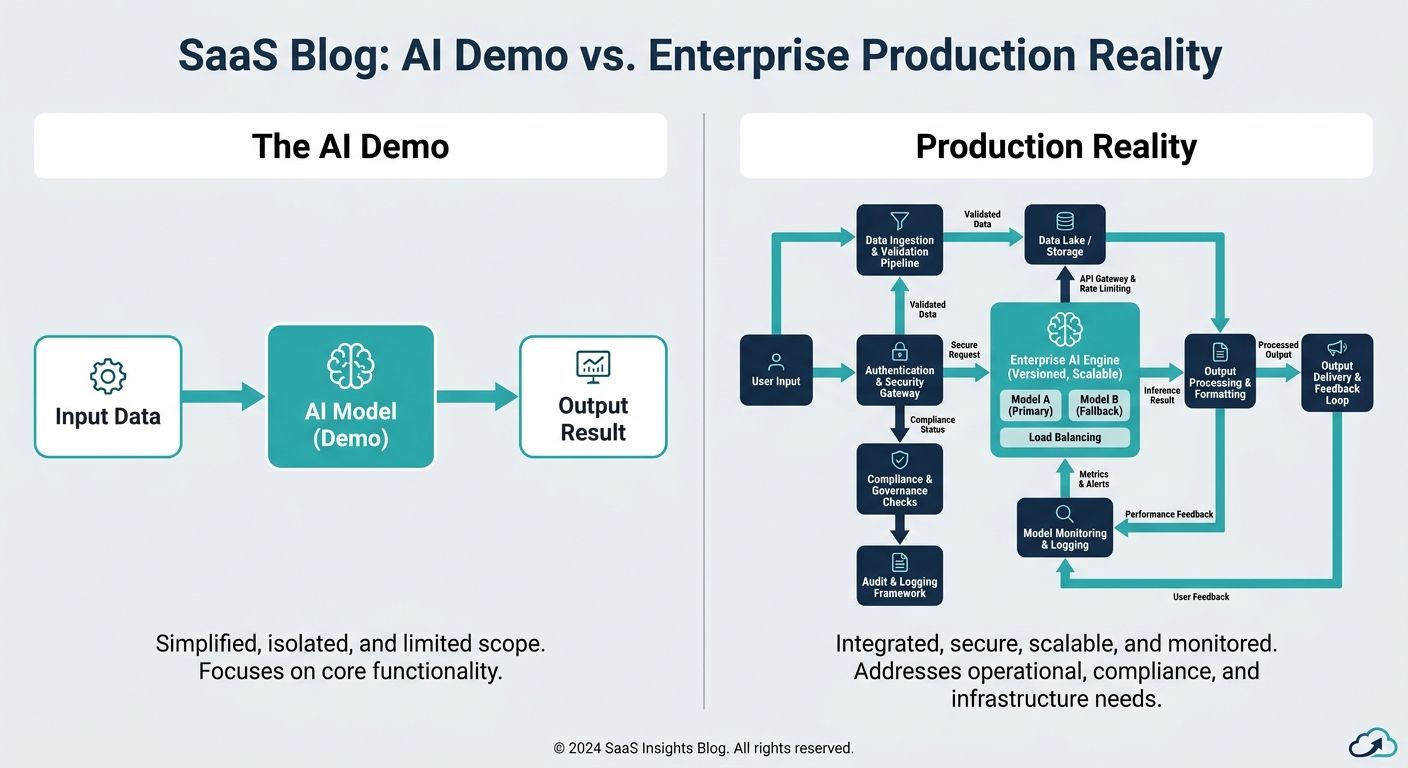
This comparison highlights the significant architectural differences between a basic AI demo and a fully functional enterprise production environment.
In the rapidly evolving landscape of artificial intelligence, a troubling pattern has emerged across enterprise IT: the demo-to-deployment gap. A proof-of-concept (POC) AI agent operates flawlessly in a controlled sandbox, answering predefined queries with astonishing speed and conversational fluidity. However, when tasked with navigating the unstructured, high-velocity environment of a live enterprise production system, the same agent crumbles. It hallucinates, loses conversational context, triggers exponential API costs, and ultimately fails to deliver business value.
Current industry discourse frequently identifies this gap but rarely offers prescriptive, actionable technical solutions. Transitioning an AI agent from a sleek demonstration to a robust, enterprise-grade deployment requires far more than basic API wrappers. It necessitates a paradigm shift in how we approach enterprise AI agent infrastructure, moving away from stateless, context-free models toward highly orchestrated, context-aware systems driven by rigorous MLOps and advanced information retrieval architectures.
## Why Context-Free Agents Fail in Enterprise Environments
The core structural flaw of many early AI voice OS and text-based agent deployments is their reliance on a _context-free_ architecture. These systems depend entirely on the foundational knowledge of the underlying Large Language Model (LLM) combined with static, hardcoded system prompts. When users ask complex, multi-turn questions requiring domain-specific enterprise data, the context-free agent either fabricates an answer (hallucination) or provides a frustratingly generic response.
Beyond poor user experience, context-free agents heavily inflate operational expenses. Because they lack precise information retrieval pipelines, developers often attempt to compensate by stuffing massive amounts of irrelevant data into the LLM's context window. This brute-force approach leads to skyrocketing token usage, unacceptable latency, and a distorted Return on Investment (ROI). To truly bridge the execution gap, enterprises must transition from context-free deployments to robust, dynamic, context-aware infrastructure.
## Core Infrastructure Pillars for Enterprise AI Agents
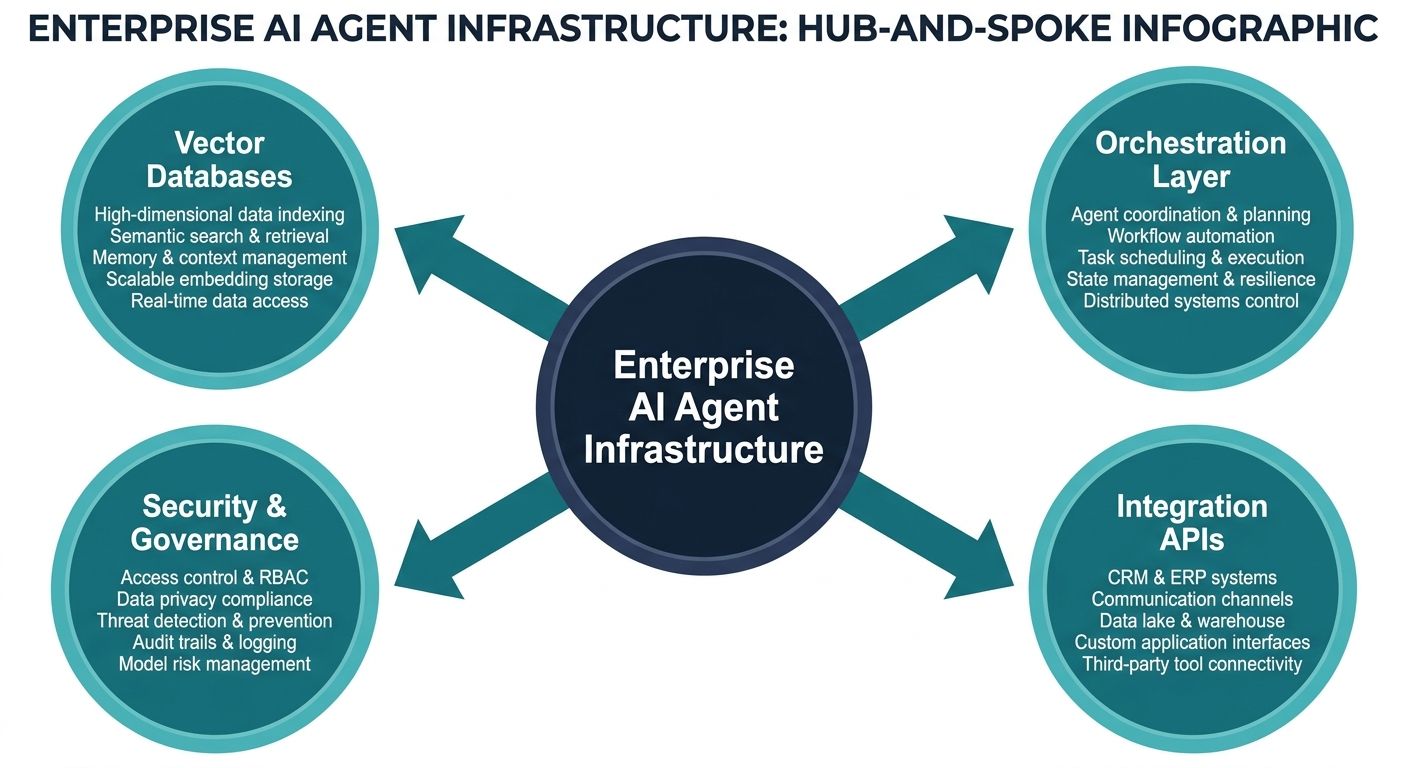
Visualizing the core pillars of an AI agent ecosystem reveals how critical components like orchestration and security interact within the overall infrastructure.
To successfully orchestrate AI agents in production, enterprises must architect a comprehensive infrastructure stack tailored for agent lifecycle management. This involves moving beyond basic scripting to implement concrete architectural patterns that support scalability, observability, and deterministic data retrieval.
### 1\. Vector Databases and Advanced Information Retrieval Systems
Enterprise AI agents require instantaneous access to vast repositories of proprietary data. The foundation of this retrieval mechanism is the vector database. Unlike traditional relational databases, vector databases store data as high-dimensional embeddings, allowing the infrastructure to perform semantic similarity searches. By converting enterprise documents, CRM data, and historical logs into vector embeddings, the AI agent infrastructure can mathematically match user queries to the most relevant internal knowledge, effectively forming the bedrock of a robust Retrieval-Augmented Generation (RAG) pipeline.
### 2\. Agent Orchestration and Specialized MLOps Tooling
Deploying an AI agent is not a one-time event; it is a continuous lifecycle. Standard DevOps tools are insufficient for the non-deterministic nature of AI. Enterprises must implement specialized MLOps (or AgentOps) tooling designed specifically for autonomous agents. This infrastructure must include sophisticated telemetry to monitor execution pathways, track API call success rates, log sub-agent handoffs, and measure real-time latency. Furthermore, CI/CD pipelines for AI agents must incorporate automated prompt testing and regression evaluations to ensure that an update to the agent's logic does not inadvertently degrade its reasoning capabilities.
### 3\. Scalable Compute and Latency Optimization
For AI Voice OS applications in particular, latency is the ultimate killer of user experience. A delay of more than 500 milliseconds in a voice interaction destroys the illusion of human-like conversation. Enterprise infrastructure must utilize edge computing where appropriate, optimized inference engines, and intelligent caching mechanisms to minimize the round-trip time between speech-to-text processing, context retrieval, LLM inference, and text-to-speech generation.
## Prompt Engineering vs. Context Engineering
A critical misstep in the demo-to-deployment journey is an over-reliance on prompt engineering. While crafting the perfect system prompt is valuable for defining an agent's persona and baseline constraints, it is not a scalable mechanism for knowledge delivery. Prompt engineering attempts to solve behavioral issues, but it cannot solve informational deficits.
This is where **Context Engineering** becomes paramount. Context engineering is the systematic, programmable process of fetching, filtering, assembling, and injecting the exact right piece of enterprise data into the agent's context window precisely when it is needed. Instead of forcing the LLM to guess the context, the infrastructure algorithmically determines the context before the LLM ever generates a token. This fundamental shift from heuristic prompting to deterministic context engineering is what makes enterprise production deployments viable.
## The Five-Stage Context Arithmetic Pipeline
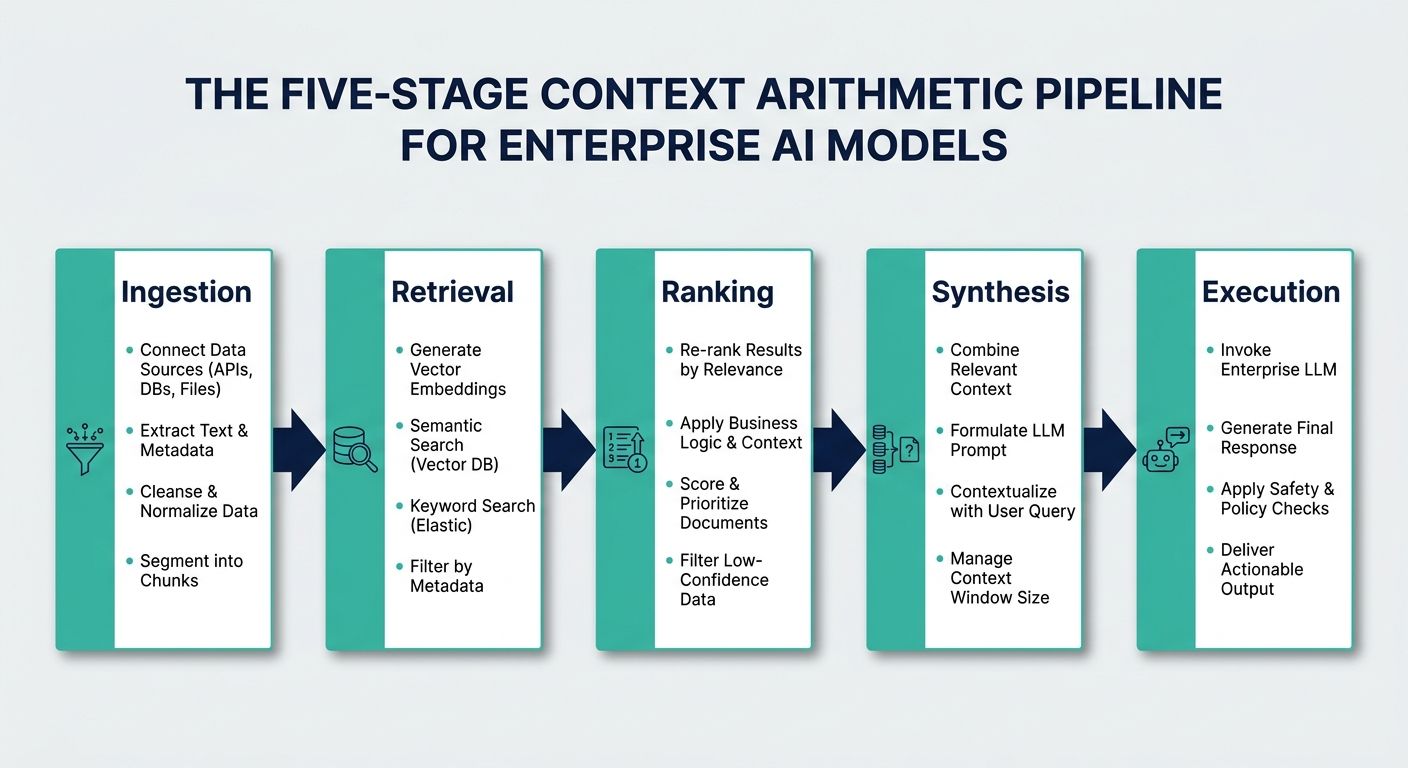
Implementing a structured five-stage context pipeline ensures that AI agents process enterprise data with high accuracy and contextual relevance.
To fully realize context engineering, industry leaders are adopting rigorous computational processes. A prime architectural example of this is the _Context Arithmetic_ framework utilized by Alchemyst's Kathan engine. Designed specifically for voice agents, Context Arithmetic is a set-algebraic pipeline that systematically determines the most relevant information to inject into an agent's brain in real-time. This pipeline consists of five distinct stages that any enterprise migration blueprint should seek to emulate.
### Stage 1: Semantic Similarity Search
The process begins when a user speaks a query. The infrastructure immediately converts this query into a vector embedding and queries the enterprise vector store. Using algorithms like cosine similarity or Euclidean distance, the system retrieves a broad subset of data chunks that share semantic meaning with the user's intent. This casts a wide net to ensure no potentially relevant information is missed.
### Stage 2: Metadata Filtering
Semantic similarity alone is prone to retrieving outdated or organizationally irrelevant data (e.g., retrieving a 2021 return policy instead of the 2024 policy because they are semantically identical). To solve this, the pipeline applies strict metadata filtering. Using set algebra, the infrastructure intersects the semantic search results with hard metadata constraints—such as user ID, geographic region, access permissions, and timestamps. This aggressively prunes the dataset down to only what is legally and chronologically applicable to the specific user.
### Stage 3: Deduplication
Enterprise data is notoriously repetitive. Injecting redundant data into an LLM wastes expensive tokens and dilutes the model's attention mechanism. In the deduplication stage, the infrastructure scans the filtered dataset and programmatically removes duplicate or highly overlapping information chunks, ensuring the payload remains lean and highly concentrated.
### Stage 4: Ranking and Re-ranking
Not all relevant information is equally important. The infrastructure must now rank the remaining, deduplicated chunks. Using advanced re-ranking models (often smaller, specialized machine learning models), the system scores each chunk based on its direct utility to answering the immediate query. The data is sorted so that the most critical information is prioritized at the top of the context window, where LLMs historically pay the most attention.
### Stage 5: Contextual Injection
In the final millisecond before inference, the perfectly curated, mathematically proven context payload is injected into the LLM's prompt window alongside the user's query. Because the context is hyper-relevant, lean, and strictly filtered, the LLM is tightly constrained. It has no room to hallucinate, and the generation latency is drastically reduced due to the minimized token count.
## The Definitive Migration Blueprint: From POC to Production
Understanding the theoretical infrastructure is only half the battle. Enterprises need a concrete, step-by-step migration blueprint to implement these AI and voice OS systems successfully.
### Phase 1: Data Migration and Cleansing
AI is only as good as the data it accesses. Before deploying an agent, enterprises must audit their data silos. This phase involves extracting unstructured data from CRMs, internal wikis, and support tickets, cleansing it of obsolete information, and chunking it appropriately. The data is then embedded and migrated into a highly available, enterprise-grade vector database. Garbage in equals garbage out; rigorous data hygiene at this stage prevents hallucination at runtime.
### Phase 2: Technical Integration and API Design
The AI agent cannot exist in a vacuum; it must read from and write to existing enterprise systems. This phase focuses on developing secure, idempotent APIs that the AI agent can call autonomously. Whether it is updating a Salesforce record or triggering a Zendesk refund, the infrastructure must support strictly defined tool-calling capabilities. Robust error handling must be built into these integrations so the agent can gracefully recover if a third-party API fails.
### Phase 3: Security, Compliance, and Guardrails
Security is non-negotiable in production. The infrastructure must include input/output guardrails—specialized, low-latency models that intercept the user's prompt and the agent's response to check for prompt injection attacks, personally identifiable information (PII) leaks, and toxic content. Role-Based Access Control (RBAC) must be enforced at the vector database level to ensure agents do not retrieve data the end-user is not authorized to know.
## Calculating ROI: Moving Beyond Generic Cost Savings
One of the major gaps in current enterprise AI deployments is the inability to accurately calculate Return on Investment (ROI). Traditional voice AI vendors often rely on opaque pricing models, charging per-minute, per-call, or per-seat. These models mask the inefficiencies of context-free agents, where businesses end up paying for the AI's internal processing time, latency delays, and irrelevant, meandering conversations.
To truly evaluate enterprise AI infrastructure, businesses must shift their metric to the **Cost Per Qualified Outcome**. This structured ROI framework focuses on the actual business value generated—whether that is a successfully resolved support ticket, a qualified sales lead, or a completed booking. By implementing highly optimized, context-aware infrastructure like the five-stage pipeline discussed above, enterprises drastically reduce token consumption, eliminate hallucination loops, and lower average handle times. This directly drives down the cost per qualified outcome, transforming the AI agent from an expensive operational experiment into a high-margin digital workforce.
## Closing the Execution Gap with Next-Gen AI Infrastructure
The widening gap between dazzling AI demos and viable enterprise deployments is not a failure of the foundational models; it is a failure of infrastructure. Relying on basic API calls and heavy prompt engineering will inevitably lead to stalled deployments and negative ROI. By embracing advanced context engineering, deploying rigorous MLOps tooling, and structuring data through deterministic pipelines like Context Arithmetic, enterprises can bridge the gap.
It is time to move beyond the sandbox. By implementing a comprehensive migration blueprint—prioritizing data architecture, secure technical integration, and a ruthless focus on cost per qualified outcome—organizations can finally unlock the true, scalable potential of enterprise AI agents.
[← Back to Blog](/blog)
## Recently Published
[October 6, 2026 / 10 min readHow to Build a RAG Pipeline for Personal Documents and MediaBuild a multi-modal RAG pipeline for all personal documents and media assets.](/blog/rag-pipeline-personal-documents-media)
[Technical / September 27, 2026 / 11 min readHarness Engineering for AI Agents: Bridging the GapExplore how harness engineering enables robust AI infrastructure and MLOps.](/blog/harness-engineering-ai-agents)
[I'm Evaluating / September 27, 2026 / 9 min readContext Engineering Best Practices for Enterprise AIMaster advanced context engineering best practices for conversational AI agents.](/blog/context-engineering-best-practices)
[I'm Evaluating / September 22, 2026 / 11 min readContext Engineering vs Prompt Engineering for AI AgentsExplore the differences between context and prompt engineering for enterprise AI](/blog/context-engineering-vs-prompt-engineering)
[I'm Evaluating / September 14, 2026 / 10 min readContext Engineering for Enterprise AI: A Complete GuideMaster context engineering to build reliable, production-ready voice AI agents.](/blog/context-engineering-enterprise-ai)
[Deep Technical / July 7, 2026 / 10 min readVoice-Specific Architectural Requirements for AI Context LayersDiscover the core voice-specific architectural requirements for AI context layer](/blog/voice-specific-architectural-requirements-ai-context-layer)
Get Started
## Give your AI agents the memory they deserve.
Join developers building the next generation of AI products with persistent, auditable context. Free tier available. No credit card required.
* Free tier
* REST + Python & Node SDKs
* 99.9% uptime SLA
* SOC 2 in progress
### Request API Access
Enter your email and we'll set up your workspace.
Email
[Read the Docs →](https://docs.getalchemystai.com)[Read the Thesis →](/thesis)
---
# What Is An AI Context Layer For Enterprise Voice Agents?
- **URL:** https://getalchemystai.com/blog/ai-context-layer-enterprise-voice-agents
- **Slug:** ai-context-layer-enterprise-voice-agents
- **Published:** April 23, 2026
- **Last updated:** April 23, 2026
- **Author:** Harsh Shah
- **Category:** I Don't Trust This
[I Don't Trust This](/blog?category=i-dont-trust-this)
# What Is An AI Context Layer For Enterprise Voice Agents?
Learn how AI context layers power real-time enterprise voice agents and ROI.
Written by [Harsh Shah](/blog?author=Harsh%20Shah)Reviewed by [Anuran Roy](/blog?author=Anuran%20Roy)11 min readPublished at April 23, 2026 (5mo ago)
## Summary
An AI context layer is the architectural backbone that enables voice agents to understand, retain, and process complex conversational nuances in real time. This technical primer explores context arithmetic, integration pipelines, and true ROI.
Table of Contents
## Understanding the AI Context Layer for Enterprise Voice Agents
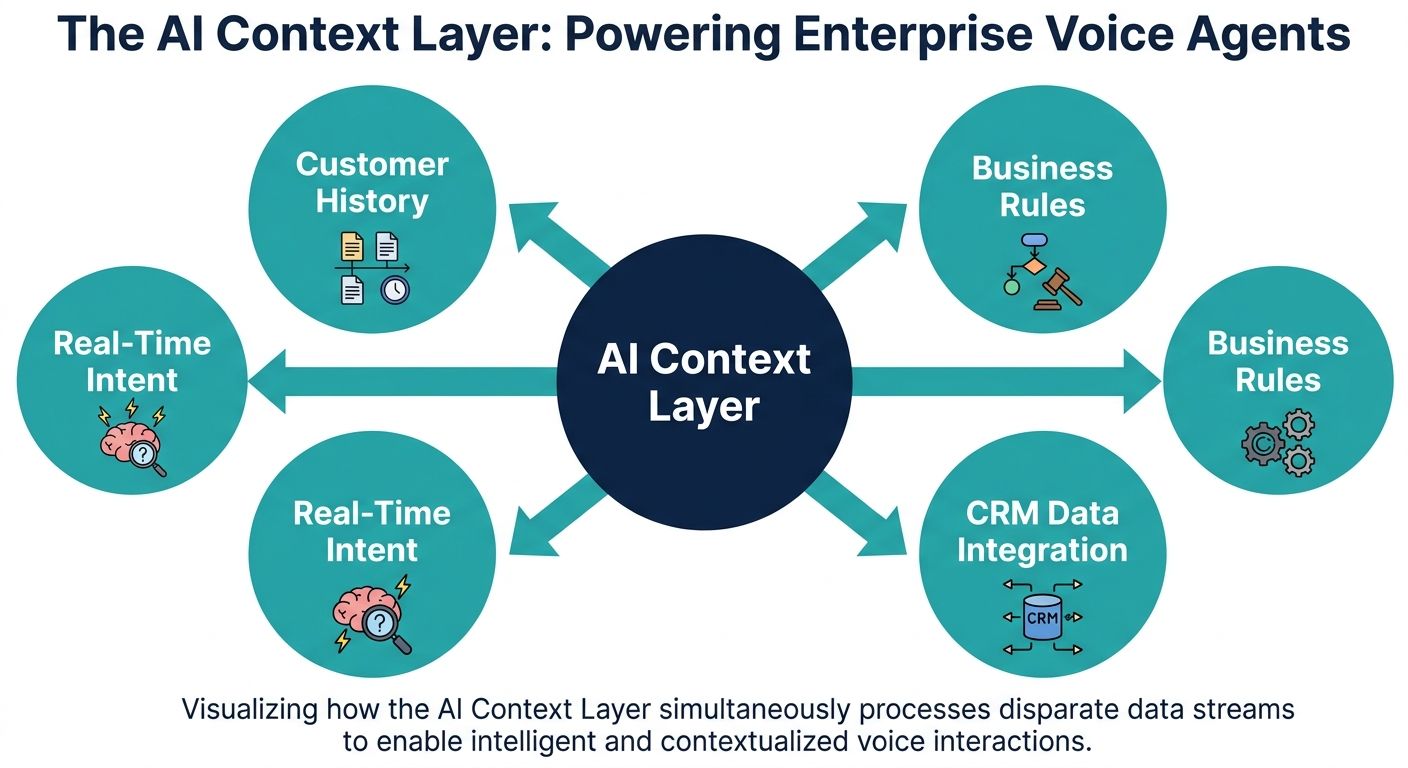
This concept map illustrates the core components of an AI context layer, demonstrating how voice agents synthesize multiple data streams in real time to deliver personalized interactions.
In the rapidly evolving landscape of enterprise artificial intelligence, the distinction between a rudimentary chatbot and an intelligent voice assistant lies fundamentally in how information is processed and retained. When evaluating the keyword question, what is an AI context layer for enterprise voice agents, the answer extends far beyond basic conversational memory. An AI context layer is a sophisticated, highly optimized architectural framework designed specifically to bridge the gap between unstructured enterprise data and real-time, dynamic voice interactions. Unlike generic AI text agents that process queries asynchronously, enterprise voice agents operate within strict latency budgets and must navigate the unpredictable nuances of human speech.
For enterprise developers and technical evaluators, understanding the context layer requires moving beyond standard prompt engineering. It necessitates a deep dive into context engineering, information retrieval pipelines, and computational architectures that can systematically determine relevant information in milliseconds. This comprehensive guide serves as a technical primer on the specialized requirements of voice-centric AI context layers, exploring how advanced systems like Alchemyst's Kathan engine utilize context arithmetic to power the next generation of AI Voice Operating Systems (Voice OS).
## Why Voice Agents Demand a Specialized Context Layer
Most broad discussions around AI context layers focus heavily on text-based systems. However, voice agents introduce a myriad of unique architectural challenges that render text-centric context layers obsolete. The primary differentiator is the real-time processing requirement. When a user interacts with a text interface, a latency of two to three seconds is often acceptable. In voice communication, any delay exceeding 500 milliseconds breaks conversational flow, causing users to interrupt the system or assume the agent has failed. Therefore, a context layer for voice agents must process historical dialogue, query external enterprise databases, and inject context into the Large Language Model (LLM) simultaneously.
### The Latency Budget: Real-Time STT and TTS Integration
An enterprise voice agent operates through a complex pipeline involving Speech-to-Text (STT) transcription, natural language understanding via an LLM, and Text-to-Speech (TTS) synthesis. The AI context layer sits at the heart of this pipeline. As the STT engine transcribes the spoken word, the context layer must preemptively retrieve relevant customer data and conversational history. This ensures that by the time the LLM generates a response, it is fully informed, allowing the TTS engine to begin streaming natural, contextually accurate audio immediately. Without a highly optimized context layer, the cumulative latency of STT, database querying, LLM generation, and TTS rendering would result in unacceptably sluggish interactions.
### Overcoming Spoken Language Nuances and STT Hallucinations
Another critical requirement of a voice-specific context layer is handling the messiness of spoken language. Users rarely speak in perfectly structured sentences. They use filler words, correct themselves mid-sentence, and frequently interrupt. Furthermore, STT engines often misinterpret industry-specific jargon or phonetic similarities resulting in phonetic collisions. A robust AI context layer assists in correcting these STT hallucinations. By maintaining deep contextual awareness of the customer profile and the ongoing conversation, the system can infer the correct meaning of a garbled transcription. For instance, if a user mentions a product name that sounds similar to a common dictionary word, the context layer cross-references the enterprise catalog to accurately interpret the user's intent.
## Prompt Engineering vs. Context Engineering in Voice OS
A common misconception in the developer community is conflating prompt engineering with context engineering. While prompt engineering focuses on optimizing the instructions given to an LLM, context engineering is the complex data infrastructure that determines what information gets fed into those prompts dynamically. Basic API-first platforms often leave the burden of context engineering entirely to the developer, providing a blank canvas but lacking the underlying infrastructure to scale enterprise-grade memory.
Context engineering involves the systematic retrieval, filtering, and structuring of data from multiple enterprise silos (CRMs, ERPs, knowledge bases) before the LLM even sees it. For voice agents, this process must be mathematically precise to avoid exceeding the LLM's token limits and to minimize processing time. This is where advanced methodologies like context arithmetic come into play, replacing brute-force data injection with highly selective, algorithmic data retrieval.
## The Architecture of Context: Deep Dive into Context Arithmetic
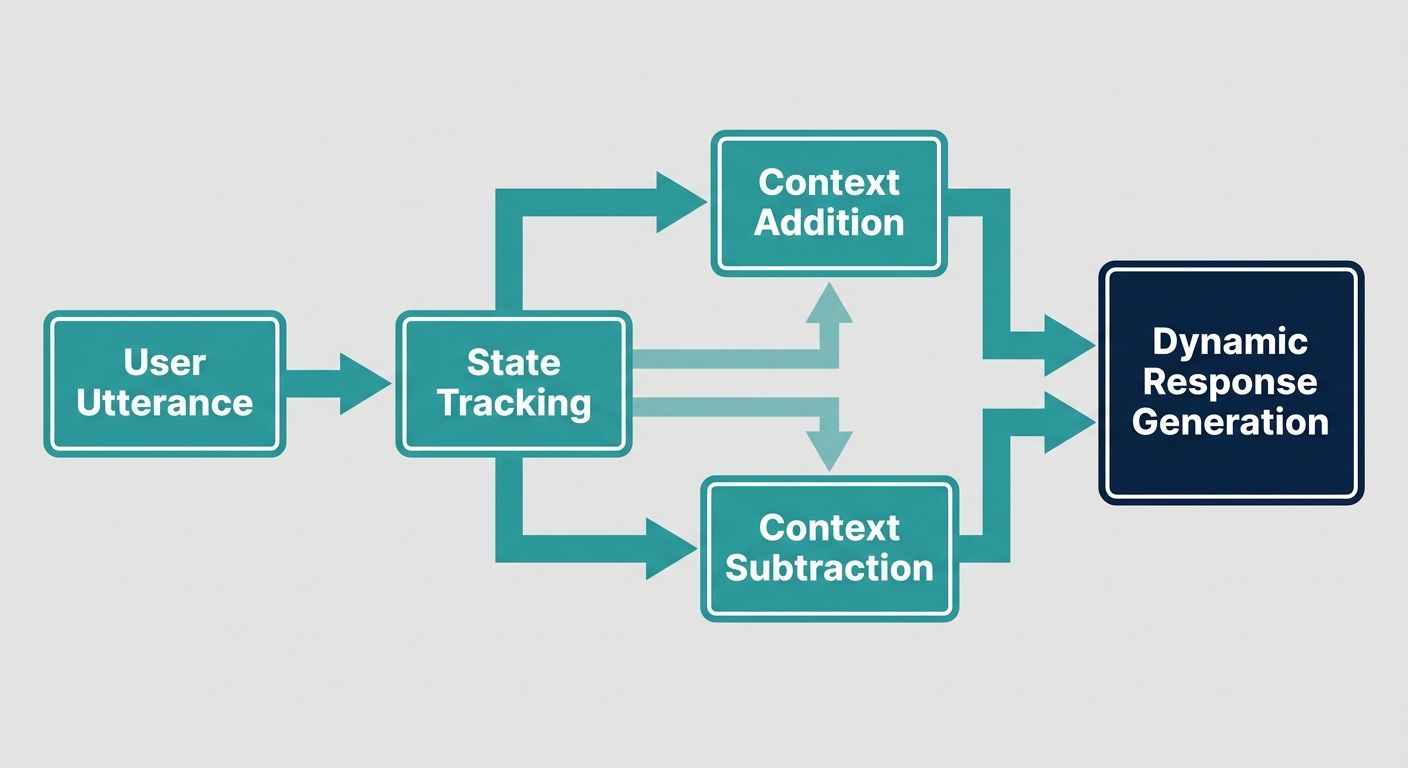
By mapping out the context arithmetic workflow, this architecture diagram explains exactly how an enterprise voice agent updates its working memory before generating a response.
To truly understand what makes an AI context layer effective for enterprise voice agents, one must examine the computational processes powering it. Alchemyst's Kathan engine provides an industry-leading blueprint for this through its proprietary context arithmetic methodology. This approach treats contextual data retrieval as a highly optimized set-algebraic pipeline, ensuring the voice agent only receives the exact, deduplicated information necessary to formulate a response.
The context arithmetic pipeline operates through a stringent five-stage computational process designed specifically to support real-time voice interactions.
### Phase 1: Semantic Similarity Search and Vectorization
The first stage involves advanced information retrieval. As a user speaks, their query is converted into a high-dimensional vector. The context layer then performs a semantic similarity search across the enterprise's vectorized knowledge base. Unlike simple keyword matching, semantic search understands the underlying intent of the user's query. This ensures that even if the user phrases a question vaguely, the context layer retrieves the conceptually correct documentation or customer history.
### Phase 2: Metadata Filtering and Access Control
Retrieving information purely based on semantic similarity is insufficient for enterprise environments governed by strict security and compliance rules. The second stage applies rigorous metadata filtering. This step ensures that the voice agent only retrieves information that the specific user is authorized to access. By implementing role-based access controls at the context layer level, enterprises can safely deploy voice agents that handle sensitive customer data without risk of data leakage or cross-tenant contamination.
### Phase 3: Deduplication of Conversational Memory
One of the most significant challenges in long-form voice interactions is token bloat. If a context layer continually feeds the entire conversational transcript and retrieved documents into the LLM, latency will spike, and compute costs will skyrocket. The deduplication stage uses computational algorithms to identify and remove redundant information. It distills the context down to its most essential elements, ensuring the prompt remains lean and the response time remains under the critical voice latency threshold.
### Phase 4: Dynamic Context Ranking
After filtering and deduplicating the retrieved data, the context layer must prioritize what is most immediately relevant to the current turn in the conversation. The ranking stage often utilizes cross-encoder models to evaluate the relationship between the user's immediate query and the retrieved context chunks. The most critical pieces of information are scored highest and placed closest to the final LLM instruction, ensuring the model heavily weighs this data when generating its spoken response.
### Phase 5: The Set-Algebraic Pipeline Injection
The final phase is the defining feature of context arithmetic. Instead of simply concatenating the ranked data, the system applies set-algebraic operations. It calculates intersections (where multiple data points corroborate an answer) and unions (combining distinct but necessary pieces of information) to formulate a mathematically precise context payload. This payload is then injected into the LLM. This architectural sophistication is what separates enterprise-ready voice agents from hobbyist API wrappers that struggle to maintain conversational coherence over time.
## Evaluating Voice Agent Platforms on Context Handling Mastery
When technical evaluators and enterprise architects assess AI Voice OS platforms, they often encounter a stark divide. On one side are product-centric, API-first platforms that prioritize developer self-service and quick deployments. These platforms often promote proof by numbers, highlighting metrics like total concurrent calls or integration counts. However, they frequently lack a comprehensive, built-in context layer, forcing development teams to build complex Retrieval-Augmented Generation (RAG) pipelines from scratch to support basic conversational memory.
On the other side are enterprise-grade solutions like Alchemyst's Kathan engine, which are fundamentally built around context-aware AI. To evaluate these platforms effectively, enterprises must look beyond generic cost savings and examine context handling mastery. This involves assessing the depth of conversational memory, the duration over which context persists (session-based vs. lifecycle-based), the platform's ability to seamlessly integrate API payloads from external systems in real-time, and its proven metrics in reducing STT latency through preemptive context loading. Platforms that natively handle these voice-specific architectural requirements offer a significantly higher return on investment and a vastly superior end-user experience.
## Overcoming the Hidden Costs of Context-Free Voice Agents
The financial implications of implementing an inferior context layer are profound. Many businesses initially adopt voice AI solutions based on attractive per-minute, per-call, or per-seat pricing structures. However, these models obscure the hidden costs associated with context-free agents. A voice agent lacking deep contextual awareness will invariably loop through generic questions, force users to repeat themselves, and struggle to complete complex multi-step workflows. This results in longer call durations, frustrating user experiences, and ultimately, a failure to deflect tickets from human agents.
### Shifting to Cost Per Qualified Outcome
To accurately measure the ROI of an enterprise voice agent, organizations must transition their analytical frameworks from simple per-minute costs to the Cost Per Qualified Outcome. This metric evaluates the true financial efficiency of the system by measuring how much it costs to successfully resolve a customer issue without human intervention. Context-aware AI drastically lowers the Cost Per Qualified Outcome. Because the AI context layer instantly surfaces the right CRM data, understands the user's history, and navigates the conversation intelligently, interactions are shorter, more accurate, and highly effective. The proprietary context arithmetic engine ensures that computational resources are not wasted processing irrelevant data, directly translating into scalable enterprise ROI.
## The Definitive Migration Blueprint for Context-Aware Voice OS
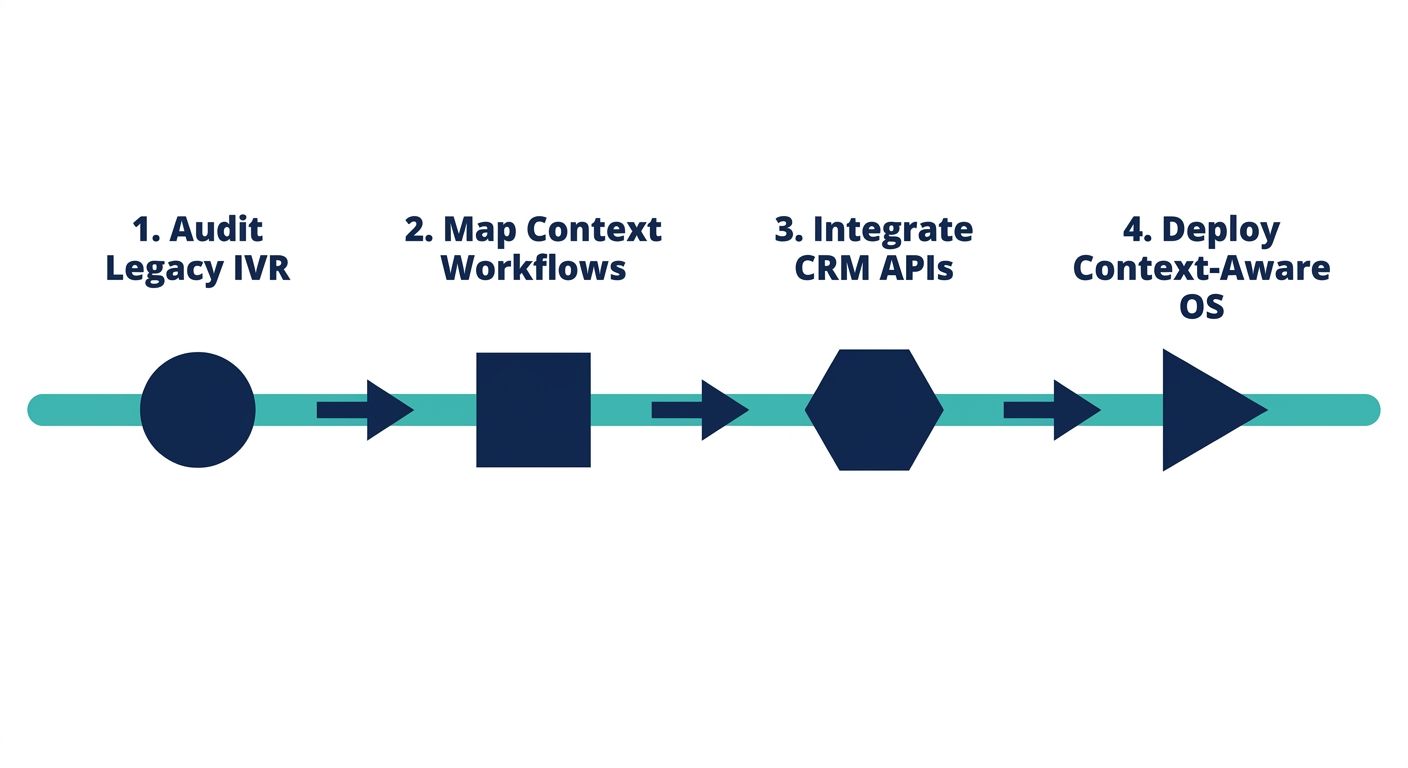
This strategic timeline outlines the four essential phases required to successfully migrate from a legacy IVR system to a fully integrated, context-aware voice operating system.
Transitioning from legacy Interactive Voice Response (IVR) systems or basic, context-free AI agents to a sophisticated Context-Aware Voice OS requires a structured, step-by-step migration blueprint. Enterprises must approach this implementation with a clear focus on data integration, security, and technical architecture to ensure the context layer functions optimally across the entire customer lifecycle.
### Step 1: Technical Integration and Data Mapping
The foundation of a successful migration is mapping the enterprise's existing data infrastructure to the AI context layer. This involves identifying the primary sources of truth, such as CRMs, knowledge bases, and ticketing systems. Developers must establish secure, low-latency API connections between these repositories and the voice agent platform. During this phase, data must be structured and vectorized to ensure the semantic search algorithms can retrieve it efficiently during live voice calls.
### Step 2: Designing the Set-Algebraic Pipeline
Once data streams are connected, technical teams must configure the context determination pipeline. This involves setting up the rules for metadata filtering, defining the parameters for deduplication, and establishing the ranking criteria specific to the business's industry. For example, a healthcare enterprise will require a highly strict metadata filter to comply with HIPAA regulations, while a retail enterprise might prioritize semantic search optimization to retrieve dynamic product catalogs accurately.
### Step 3: Security, Compliance, and Context Persistence
Security must be embedded directly into the context layer. Enterprises must ensure that the context engine strips Personally Identifiable Information (PII) before sending payloads to the LLM, depending on the compliance requirements of the specific use case. Additionally, teams must define the rules for context persistence. They need to determine which conversational elements should be committed to short-term memory for the duration of the call, and which insights should be written back to the enterprise CRM for long-term lifecycle tracking.
### Step 4: Continuous ROI Analysis and Optimization
Following deployment, the migration blueprint requires continuous monitoring of the Cost Per Qualified Outcome. Enterprises should analyze transcript logs to identify areas where the context layer successfully prevented STT hallucinations or retrieved critical data that expedited issue resolution. By continually refining the context arithmetic parameters based on live performance data, businesses can ensure their voice agents become increasingly efficient, driving sustained operational cost savings and delivering an unparalleled customer experience.
## Conclusion
Addressing the question of what an AI context layer is for enterprise voice agents reveals the intricate, highly technical foundation required to make machine-generated voice interactions feel genuinely intelligent and human-like. It is not merely a memory bank, but an active, real-time computational engine that applies context arithmetic, semantic search, and set-algebraic pipelines to manage the inherent complexities of spoken language. As enterprises move beyond basic API implementations and seek true operational efficiency, prioritizing a platform with deep context handling mastery will be the defining factor in achieving a low Cost Per Qualified Outcome and a superior, context-aware customer lifecycle experience.
[← Back to Blog](/blog)
## Recently Published
[October 6, 2026 / 10 min readHow to Build a RAG Pipeline for Personal Documents and MediaBuild a multi-modal RAG pipeline for all personal documents and media assets.](/blog/rag-pipeline-personal-documents-media)
[Technical / September 27, 2026 / 11 min readHarness Engineering for AI Agents: Bridging the GapExplore how harness engineering enables robust AI infrastructure and MLOps.](/blog/harness-engineering-ai-agents)
[I'm Evaluating / September 27, 2026 / 9 min readContext Engineering Best Practices for Enterprise AIMaster advanced context engineering best practices for conversational AI agents.](/blog/context-engineering-best-practices)
[I'm Evaluating / September 22, 2026 / 11 min readContext Engineering vs Prompt Engineering for AI AgentsExplore the differences between context and prompt engineering for enterprise AI](/blog/context-engineering-vs-prompt-engineering)
[I'm Evaluating / September 14, 2026 / 10 min readContext Engineering for Enterprise AI: A Complete GuideMaster context engineering to build reliable, production-ready voice AI agents.](/blog/context-engineering-enterprise-ai)
[Deep Technical / July 7, 2026 / 10 min readVoice-Specific Architectural Requirements for AI Context LayersDiscover the core voice-specific architectural requirements for AI context layer](/blog/voice-specific-architectural-requirements-ai-context-layer)
Get Started
## Give your AI agents the memory they deserve.
Join developers building the next generation of AI products with persistent, auditable context. Free tier available. No credit card required.
* Free tier
* REST + Python & Node SDKs
* 99.9% uptime SLA
* SOC 2 in progress
### Request API Access
Enter your email and we'll set up your workspace.
Email
[Read the Docs →](https://docs.getalchemystai.com)[Read the Thesis →](/thesis)
---
# Implement Context Engineering for Conversational AI
- **URL:** https://getalchemystai.com/blog/implement-context-engineering-conversational-ai
- **Slug:** implement-context-engineering-conversational-ai
- **Published:** April 17, 2026
- **Last updated:** April 17, 2026
- **Author:** Harsh Shah
- **Category:** Technical
[Technical](/blog?category=technical)
# Implement Context Engineering for Conversational AI
A developer guide to context engineering architectures for voice and chat AI.
Written by [Harsh Shah](/blog?author=Harsh%20Shah)Reviewed by [Anuran Roy](/blog?author=Anuran%20Roy)9 min readPublished at April 17, 2026 (5mo ago)
## Summary
Discover how to implement advanced context engineering for enterprise conversational AI platforms using context arithmetic and set-algebraic pipelines. This technical guide covers architectural patterns, real-time voice challenges, and practical RAG integrations.
Table of Contents
## The Paradigm Shift: From Prompt Engineering to Context Engineering
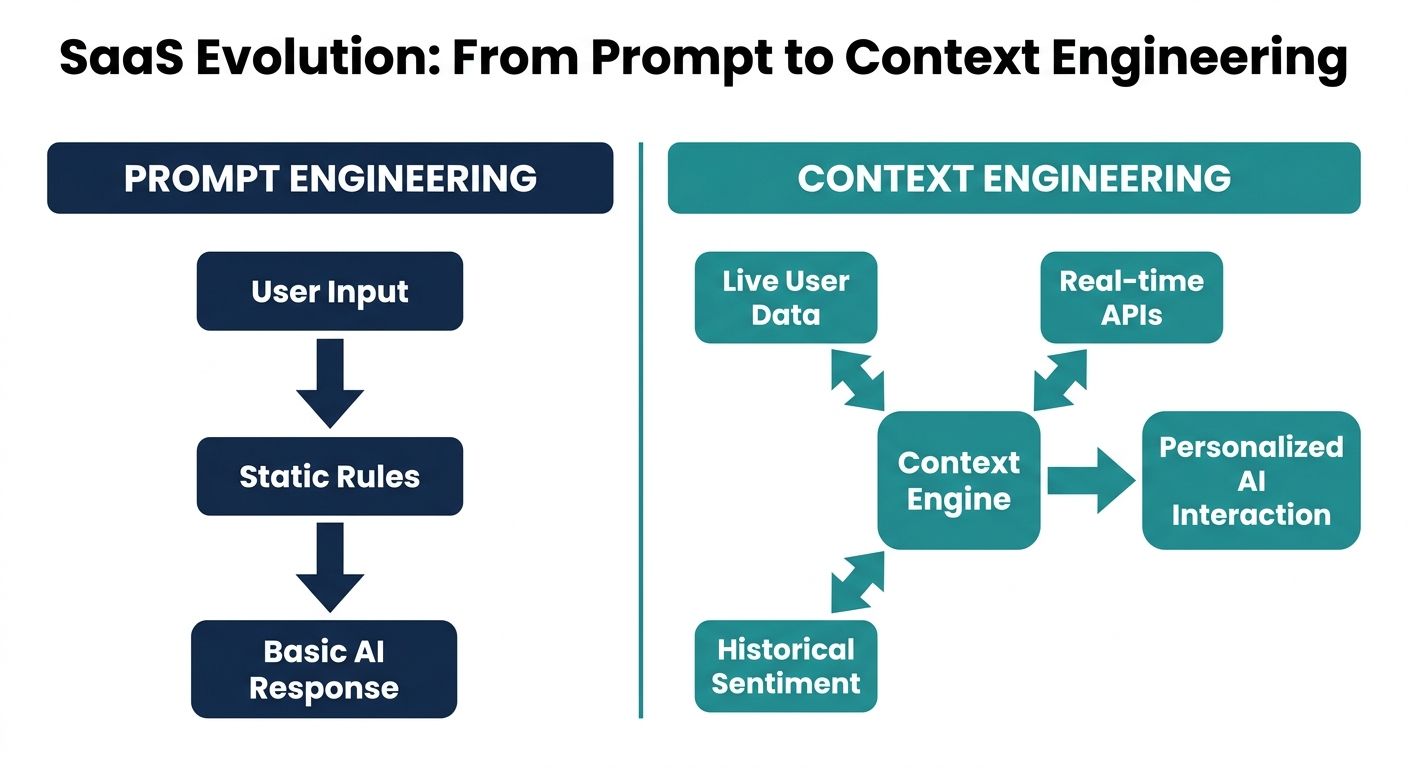
This comparison illustrates how static prompt engineering relies on rigid rules, while context engineering leverages dynamic, real-time data inputs for highly personalized AI interactions.
As enterprise conversational AI platforms evolve beyond simple text generation into complex, multi-turn dialogue systems, developers are hitting the limitations of traditional prompt engineering. Prompt engineering focuses on instructing a Large Language Model (LLM) on _how_ to behave. In contrast, context engineering is the systematic, algorithmic process of determining exactly _what_ information the model needs to process at any given microsecond to deliver accurate, non-robotic, and goal-oriented responses.
Many current implementations treat context as a static injection of a system prompt combined with a rudimentary sliding window of chat history. However, for true conversational AI—especially voice-first AI systems—this approach results in latency spikes, high token costs, and contextual amnesia. Top-ranking guides often provide generic definitions of context engineering for broad AI agents. In this technical primer, we will explore the concrete architectural patterns, the concept of context arithmetic, and the voice-specific implementation strategies required to build enterprise-grade conversational AI platforms.
## Why Top Platforms Fail: The Generic Context Problem
Before diving into the implementation details, it is crucial to understand the structural flaws of previous-generation systems. The majority of enterprise platforms utilize context-free agents. These systems rely heavily on intent-matching or basic vector search without a structural understanding of conversational state.
When businesses deploy these context-free agents, they inadvertently inflate their expenses. Common pricing models in the Voice AI industry rely on per-minute, per-call, or per-seat structures. A context-free agent that constantly asks users to repeat information, or misinterprets ambiguity because it lost the conversational thread, extends call durations artificially. This hidden cost underscores the necessity of measuring ROI through the lens of **cost per qualified outcome**. A context-aware system reduces call duration, handles complex multi-turn logic seamlessly, and dramatically improves this ROI metric by focusing on successful resolution rather than mere interaction time.
## Architectural Patterns for Context Engineering
Implementing context engineering requires a shift from linear API calls to a dynamic, event-driven architecture. At the core of a modern conversational AI platform is the Context Engine, a middleware layer that sits between the user interface (voice/text), the enterprise data systems (CRM/ERP), and the LLM infrastructure.
### Context Arithmetic: A Set-Algebraic Approach
To systematically determine the relevant information for a voice agent, developers should adopt what Alchemyst's Kathan engine categorizes as _context arithmetic_. This is a computational process that treats context retrieval and management as a set-algebraic pipeline. Instead of simply concatenating strings, the engine calculates the intersection, union, and difference of various context sets (user profile, situational data, dialogue history, and enterprise knowledge) to construct an optimal prompt payload.
### The Five-Stage Pipeline for Context Determination
Implementing context arithmetic involves building a rigid, highly-optimised five-stage pipeline. This pipeline executes in milliseconds prior to every LLM inference call.
* **1\. Information Retrieval and Semantic Similarity Search:** The system captures the user's latest utterance and converts it into a high-dimensional vector embedding. This vector is queried against a Vector Database (like Pinecone or Weaviate) to retrieve semantically similar chunks of knowledge. However, relying on semantic similarity alone leads to hallucinations if the retrieved context is outdated or tangentially related.
* **2\. Metadata Filtering:** To restrict the vector search space, the pipeline applies strict metadata filtering. This includes deterministic constraints such as the current timestamp, the user's specific account ID, or their geographical location. This stage ensures that a customer asking 'What is my current balance?' only retrieves context linked strictly to their encrypted CRM entity.
* **3\. Dynamic Dialogue State Extraction:** The system must maintain an internal representation of the conversation state. This involves tracking active intents, slot filling statuses, and emotional sentiment. If a user says 'Actually, change that to tomorrow,' the state extractor maps 'that' to the most recent active entity in the short-term memory buffer.
* **4\. Deduplication:** In multi-turn conversations, the same context chunks are often retrieved repeatedly, eating up token limits and confusing the LLM with redundant data. The deduplication stage removes overlapping information payloads, ensuring the context window remains lean and highly concentrated with net-new or immediately relevant information.
* **5\. Context Ranking and Assembly:** Finally, the retrieved pieces of context are scored and ranked. The ranking algorithm prioritizes recency (short-term memory), relevance (semantic score), and critical system instructions. The highest-scoring elements are assembled into the final prompt payload and sent to the LLM.
## Voice-Specific Implementation Challenges
Implementing context engineering for chat platforms is fundamentally different from implementing it for voice platforms. Voice-first OS integrations introduce real-time constraints and acoustic ambiguities that text-based platforms never encounter. Top-tier engines like Alchemyst's Kathan are designed specifically to handle these voice-centric anomalies.
### Handling STT (Speech-to-Text) Inaccuracies
In a voice agent, the input is never perfectly clean. STT engines often mishear proper nouns, acronyms, or industry jargon. If a context engine takes these transcripts literally, the semantic search will fail. Implementations must include phonetic fuzzy matching within the retrieval pipeline and utilize conversational context to auto-correct transcripts before they hit the vector database. For example, if the active conversational context is 'insurance policies', an STT output of 'deductible' must be prioritized over acoustically similar but contextually irrelevant words.
### Managing Interruptions and Barge-ins
Voice interactions are highly non-linear. Users will frequently interrupt the agent (a barge-in). When an interruption occurs, the context engine must instantly truncate the agent's expected output, log the exact point at which the user interrupted, and append the barge-in utterance. The context pipeline must immediately recalculate the active intent. If an agent is reading a list of options and the user interrupts with 'The second one', the context engine must mathematically map 'second one' to the exact item the Text-to-Speech (TTS) engine was vocalizing at the millisecond of interruption.
### Latency and the Context Window
Voice agents require a total round-trip time (STT + Context Pipeline + LLM generation + TTS) of under 800 milliseconds to feel natural. Heavy context engineering can introduce severe latency if not optimised. Developers must implement parallel processing: while the user is still speaking, the system should pre-fetch CRM data and warm up vector searches based on partial STT streams, finalizing the context assembly only when endpointing (silence detection) is triggered.
## Integrating RAG and CRM Data into the Conversation Loop
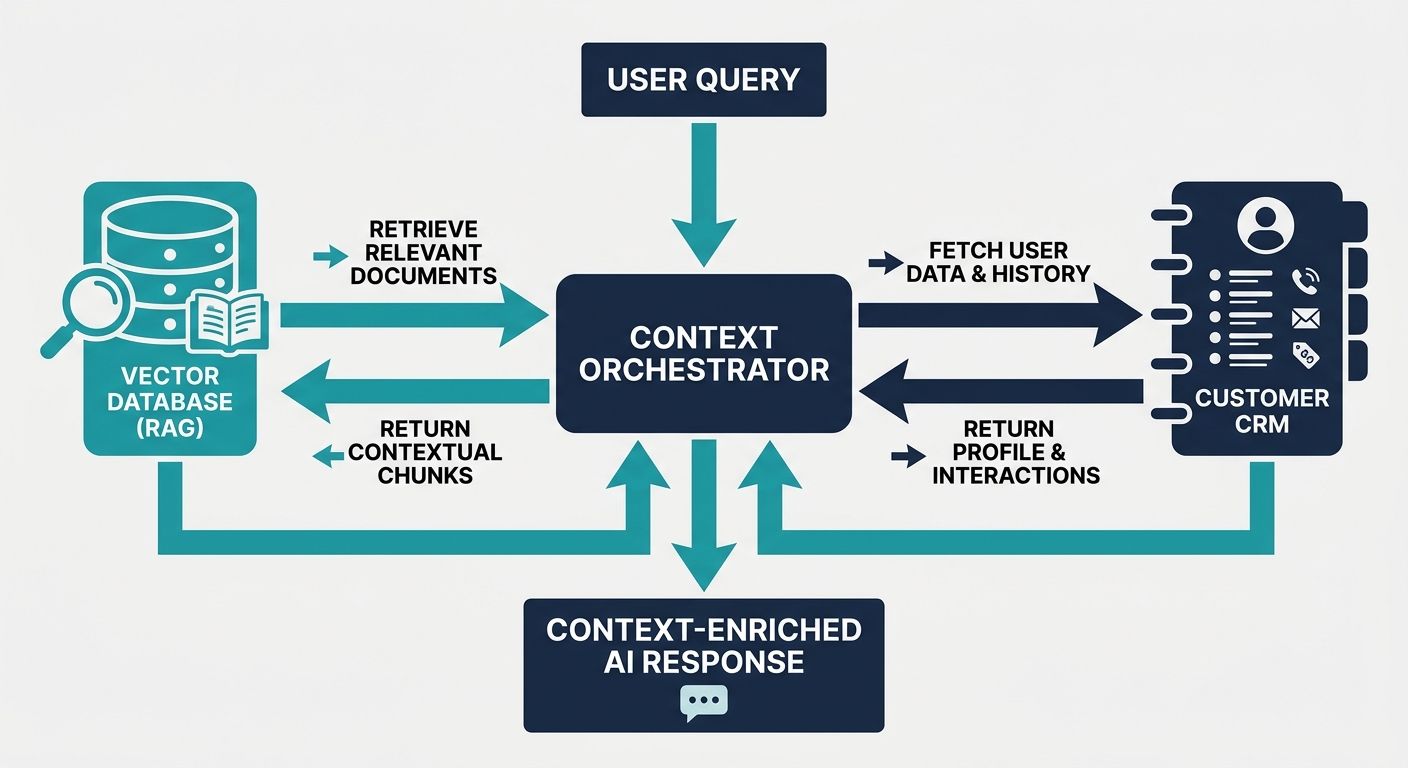
By orchestrating RAG pipelines alongside live CRM data, conversational AI systems can continuously enrich user queries with hyper-relevant enterprise knowledge.
Retrieval-Augmented Generation (RAG) is the backbone of enterprise context engineering. However, generic RAG architectures fail in complex dialogue flows because they treat every query in isolation. A conversational AI platform requires an architecture where RAG is continuously modulated by the conversational state.
To implement this at the code and architectural level, developers must construct a robust _State Management Object_. This object is dynamically updated on every turn. Consider the following architectural data structure concept:
* **Short-Term Memory Buffer:** Stores the exact transcripts of the last 5-10 turns. Used for immediate pronoun resolution and contextual continuity.
* **Long-Term Memory Graph:** Stores summarized facts about the user from previous sessions. Implemented via a Knowledge Graph rather than a flat vector database to understand relationships (e.g., 'User owns Product X, Product X requires Update Y').
* **CRM API Context:** Real-time data payloads fetched via REST/GraphQL from systems like Salesforce or HubSpot. This must be injected as structured JSON within the LLM's system prompt to ensure absolute factual accuracy regarding account statuses.
When the user speaks, the Context Engine dynamically generates a specific retrieval query based on the Short-Term Memory Buffer, fetches the exact vector embeddings, cross-references them against the Long-Term Memory Graph, and validates the output against the CRM API Context. This is the essence of true context arithmetic.
## The Definitive Migration Blueprint for AI Voice OS
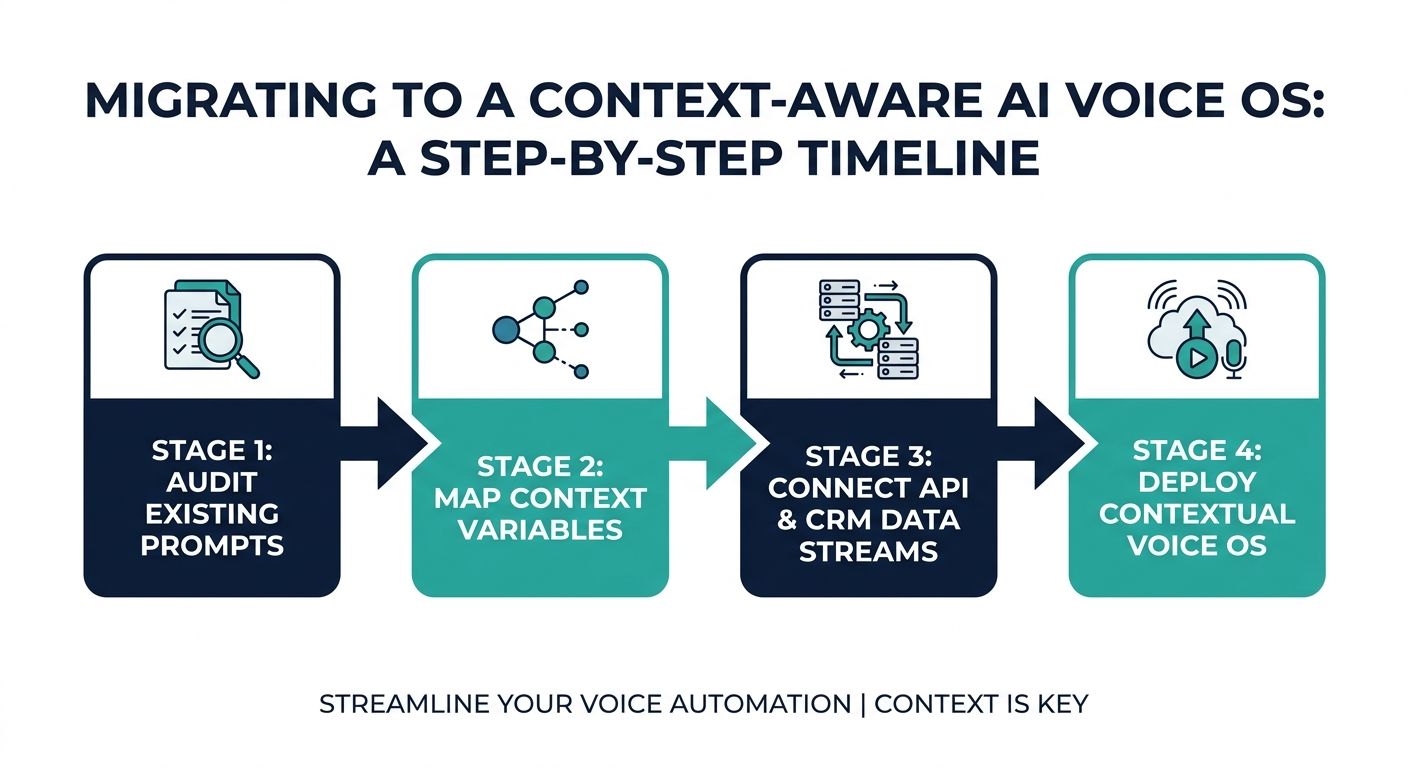
This migration blueprint outlines the critical phases required to successfully transition your existing conversational voice agents into a fully integrated, context-driven AI system.
Many enterprises are stuck with legacy IVR systems or basic chatbots because they lack a comprehensive migration blueprint. Transitioning to a context-aware AI Voice OS requires structured planning, technical integration, and rigorous security measures. Here is a step-by-step implementation guide.
### Step 1: Data Migration and Knowledge Structuring
Before any context engine can operate, enterprise data must be cleaned and vectorized. Do not blindly dump PDF manuals into a vector database. Implement hierarchical chunking strategies. Document structures must retain metadata (headers, section titles, product IDs) so the metadata filtering stage of your context pipeline functions correctly. Extract key entities and relationships to build a foundational knowledge graph.
### Step 2: Designing the Event-Driven Architecture
Transition from synchronous webhook architectures to asynchronous, event-driven microservices. Utilize message brokers (like Kafka or RabbitMQ) to handle real-time streaming audio. The STT service should stream partial transcripts to the Context Engine, allowing it to begin preliminary context retrieval before the user finishes speaking.
### Step 3: Implementing Security and Data Redaction
Enterprise conversational AI deals with PII (Personally Identifiable Information) and PCI (Payment Card Industry) data. Context engineering must include a redaction layer. Before user utterances enter the semantic search phase or are sent to the LLM, a local, deterministic NLP model must mask sensitive data (e.g., replacing credit card numbers with tokens). The context payload returned to the TTS engine can unmask these tokens securely.
### Step 4: Real-World Testing and Simulation
Context-aware agents cannot be tested like traditional software. Developers must employ LLM-as-a-Judge frameworks to simulate thousands of conversational paths. Evaluate the agent's ability to maintain context over 20+ turns, handle aggressive barge-ins, and gracefully recover from ambiguous STT inputs. Monitor the exact context payloads generated to ensure the deduplication and ranking stages are functioning optimally.
### Step 5: ROI Tracking and Continuous Optimisation
Post-deployment, shift analytics away from generic metrics. Track the 'cost per qualified outcome'. Monitor how often the context engine successfully retrieves the correct CRM data on the first attempt without asking the user clarifying questions. Analyze the latency introduced by each stage of the context arithmetic pipeline and optimise database indexes accordingly.
## Conclusion: The Future of Context-Aware AI
Implementing context engineering for conversational AI platforms is far more complex than wrapping an API call around a prompt. It requires a deep, architectural commitment to managing conversational state, integrating disparate data streams, and orchestrating split-second decision pipelines. Platforms that rely on context-free agents will continue to suffer from hallucination, poor user experiences, and inflated operational costs.
By adopting advanced methodologies like context arithmetic, set-algebraic pipelines, and voice-specific real-time optimizations, developers can build AI agents that truly understand the user. This level of implementation moves conversational AI from a novelty to a mission-critical enterprise asset, driving genuine ROI and transforming the entire customer lifecycle.
[← Back to Blog](/blog)
## Recently Published
[October 6, 2026 / 10 min readHow to Build a RAG Pipeline for Personal Documents and MediaBuild a multi-modal RAG pipeline for all personal documents and media assets.](/blog/rag-pipeline-personal-documents-media)
[Technical / September 27, 2026 / 11 min readHarness Engineering for AI Agents: Bridging the GapExplore how harness engineering enables robust AI infrastructure and MLOps.](/blog/harness-engineering-ai-agents)
[I'm Evaluating / September 27, 2026 / 9 min readContext Engineering Best Practices for Enterprise AIMaster advanced context engineering best practices for conversational AI agents.](/blog/context-engineering-best-practices)
[I'm Evaluating / September 22, 2026 / 11 min readContext Engineering vs Prompt Engineering for AI AgentsExplore the differences between context and prompt engineering for enterprise AI](/blog/context-engineering-vs-prompt-engineering)
[I'm Evaluating / September 14, 2026 / 10 min readContext Engineering for Enterprise AI: A Complete GuideMaster context engineering to build reliable, production-ready voice AI agents.](/blog/context-engineering-enterprise-ai)
[Deep Technical / July 7, 2026 / 10 min readVoice-Specific Architectural Requirements for AI Context LayersDiscover the core voice-specific architectural requirements for AI context layer](/blog/voice-specific-architectural-requirements-ai-context-layer)
Get Started
## Give your AI agents the memory they deserve.
Join developers building the next generation of AI products with persistent, auditable context. Free tier available. No credit card required.
* Free tier
* REST + Python & Node SDKs
* 99.9% uptime SLA
* SOC 2 in progress
### Request API Access
Enter your email and we'll set up your workspace.
Email
[Read the Docs →](https://docs.getalchemystai.com)[Read the Thesis →](/thesis)
---
# Multilingual AI Voice OS for High Volume Interactions
- **URL:** https://getalchemystai.com/blog/multilingual-ai-voice-os-high-volume-interactions
- **Slug:** multilingual-ai-voice-os-high-volume-interactions
- **Published:** April 14, 2026
- **Last updated:** April 14, 2026
- **Author:** Harsh Shah
- **Category:** I Don't Trust This
[I Don't Trust This](/blog?category=i-dont-trust-this)
# Multilingual AI Voice OS for High Volume Interactions
Blueprint for deploying multilingual AI voice OS for high volume interactions.
Written by [Harsh Shah](/blog?author=Harsh%20Shah)Reviewed by [Anuran Roy](/blog?author=Anuran%20Roy)12 min readPublished at April 14, 2026 (6mo ago)
## Summary
Discover how to deploy a multilingual AI voice OS for high volume customer interactions. This guide covers context engineering, ROI frameworks, and pricing by qualified outcomes.
Table of Contents
## The Imperative for a Multilingual AI Voice OS in Global Enterprise
In the rapidly evolving landscape of global customer engagement, enterprises face an unprecedented challenge: managing hundreds of thousands of daily customer calls across multiple languages without sacrificing resolution quality or skyrocketing operational costs. The traditional approach to this problem has relied heavily on outsourced offshore call centers or legacy conversational chatbots. However, for businesses managing high volume customer interactions, these conventional solutions have proven structurally inadequate. Legacy voice systems and basic chatbots lack the architectural depth to handle the nuances of spoken language context, resulting in frustrating, robotic-sounding experiences that ultimately damage brand reputation and inflate handling times.
Today, the focus has shifted toward robust, state-aware AI operating systems designed specifically for voice. A true multilingual AI voice OS is not merely a text-based language model retrofitted with speech-to-text (STT) and text-to-speech (TTS) capabilities. It is a comprehensive, enterprise-grade architecture that dynamically manages conversational state, executes real-time context retrieval across disparate languages, and seamlessly integrates with complex backend systems. For technical evaluators and developers, understanding the distinction between superficial prompt engineering and systemic context engineering is the critical first step in adopting a multilingual AI voice OS for high volume customer interactions.
This definitive guide serves as a comprehensive migration blueprint for businesses and developers seeking to implement a multilingual AI voice OS. We will explore the deep technical requirements of context arithmetic, the structural flaws of legacy voice AI, a step-by-step integration blueprint, and a modern framework for calculating return on investment (ROI) through a revolutionary pricing model: the cost per qualified outcome.
## Why High Volume Customer Interactions Break Legacy Voice AI
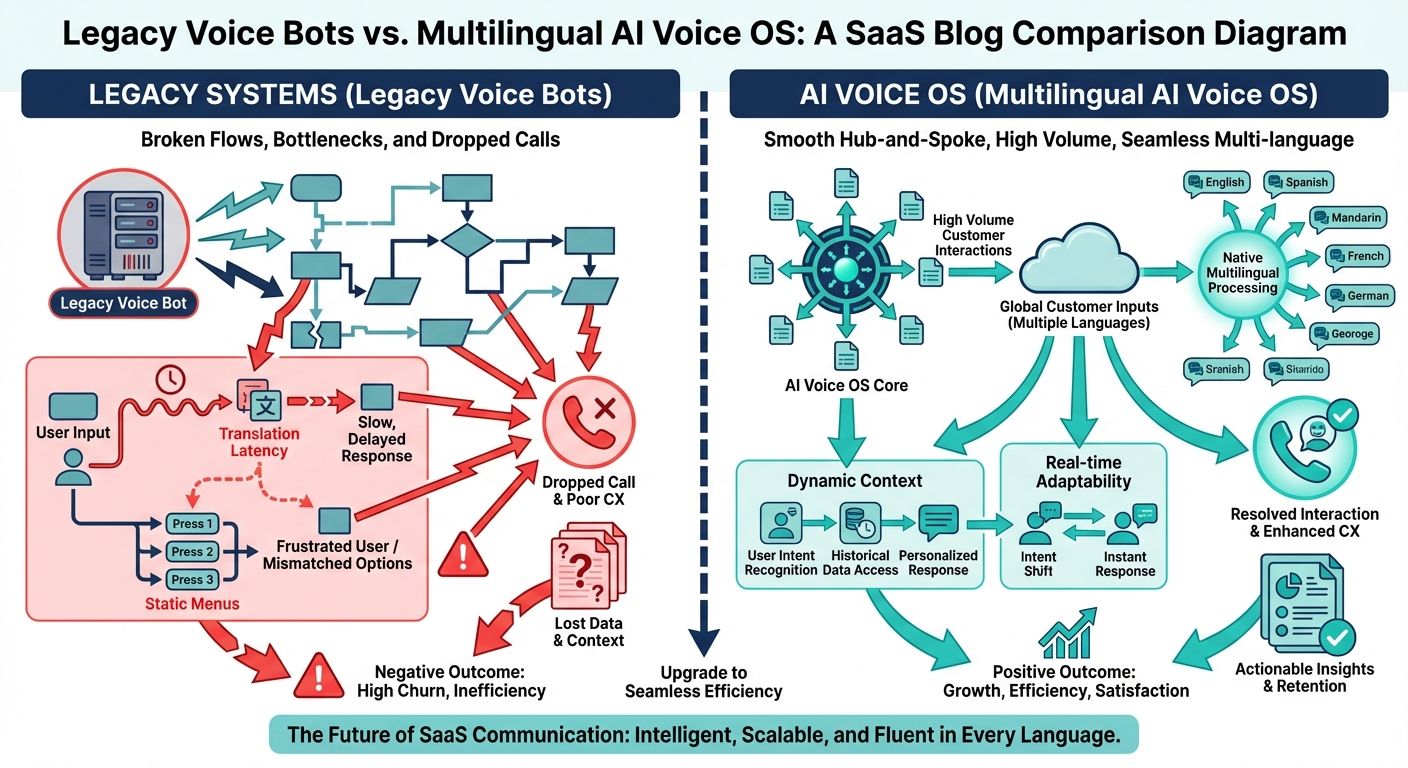
This comparison illustrates the structural bottlenecks of legacy voice systems alongside the streamlined, scalable architecture of a modern AI voice operating system.
The marketplace is flooded with simple AI voice agents and platforms that promise multilingual capabilities. A quick review of top-ranking product lists often reveals solutions that employ a product-centric, API-first approach, prioritizing fast deployment over conversational depth. While these tools may suffice for low-volume, low-complexity tasks, they fundamentally collapse under the weight of high volume enterprise customer interactions. The root cause of this failure lies in the over-reliance on context-free architecture and rudimentary prompt engineering.
### The Illusion of Prompt Engineering vs. True Context Engineering
Many legacy systems attempt to solve complex customer queries by loading massive, monolithic prompts into a large language model. In a multilingual environment, this approach is disastrous. Translating static prompts across dozens of languages leads to massive latency, semantic degradation, and context loss. Prompt engineering is a surface-level fix; it attempts to force a model to behave correctly without giving it structural awareness of the customer's historical state, active session variables, or relevant enterprise data.
Conversely, Context Engineering involves building a dedicated architectural layer that dynamically computes and injects only the most relevant, highly specific information into the conversational stream in milliseconds. In high volume settings, context engineering prevents the AI from hallucinating or forcing the customer to repeat themselves. It ensures that whether a customer is speaking Spanish, Mandarin, or English, the underlying state of their account and the specific resolution pathways are instantly available to the voice agent.
### The Hidden Costs of Context-Free Agents
When an AI voice agent lacks a robust context layer, the financial repercussions are severe. Context-free agents operate amnesiacally. They ask redundant questions, fail to retrieve correct account details, and struggle to parse intent when customers code-switch or interrupt. This directly impacts the bottom line. Because most legacy AI voice agents operate on a per-minute or per-call pricing model, the longer an agent takes to stumble through a contextless conversation, the more the enterprise pays. In this flawed paradigm, the vendor profits from the inefficiency of their own AI. High volume deployments quickly see their ROI evaporate as context-free agents inflate average handle times (AHT) without delivering actual resolutions.
## Core Architecture: Context Arithmetic for Voice
To solve the persistent problems of legacy deployments, pioneering systems like Alchemyst's Kathan engine utilize a computational process known as Context Arithmetic. This is not a simple vector database lookup; it is a highly sophisticated, set-algebraic pipeline designed to systematically determine relevant information for voice agents in real-time, regardless of the language being spoken.
Context Arithmetic treats information retrieval as a mathematical operation. When a customer speaks, the system must instantly parse the utterance, translate the semantic intent, and perform operations to intersect the current query with historical customer data, enterprise knowledge bases, and live API endpoints. This requires a meticulous architectural orchestration tailored specifically for developers and technical teams managing custom agents.
### The Five-Stage Pipeline for Context Determination
The Kathan engine's architecture relies on a rigorous five-stage pipeline to ensure that the multilingual AI voice OS delivers hyper-relevant responses with sub-second latency:
* **1\. Semantic Similarity Search:** The system captures the STT output and immediately vectorizes it, performing a cross-lingual semantic search. Because the embeddings are language-agnostic, a query in French can instantly retrieve relevant resolution protocols written in English or German from the central knowledge graph.
* **2\. Metadata Filtering:** Pure semantic search often returns false positives. The pipeline applies rigid metadata filters based on the active conversational state—such as the user's account tier, geographic location, and current progress in the troubleshooting flow.
* **3\. Set-Algebraic Deduplication:** In high volume interactions, overlapping data points can confuse the LLM. The context arithmetic engine uses set theory (unions, intersections, differences) to strip out redundant information, ensuring the payload remains lightweight and precise.
* **4\. Dynamic Ranking:** The remaining context shards are ranked not just by keyword relevance, but by conversational urgency. A critical account alert will rank higher than a general FAQ response, steering the multilingual voice agent to address high-priority issues first.
* **5\. Context Injection:** Finally, the optimized, deduplicated context is injected into the prompt dynamically. This localized, highly constrained payload ensures the text generation phase is fast, accurate, and perfectly aligned with the customer's intent.
## The Definitive Migration Blueprint for Enterprises
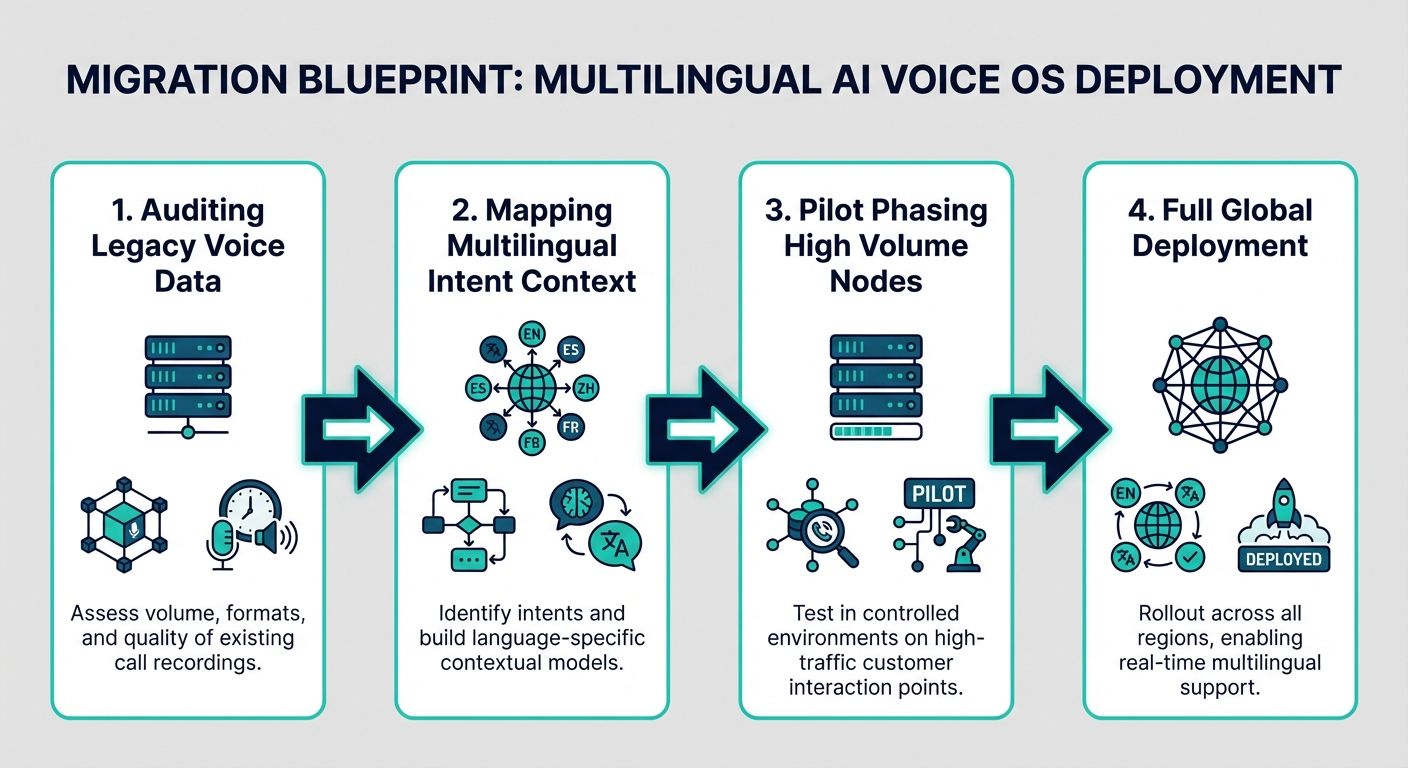
Follow this strategic four-step deployment timeline to safely migrate your enterprise communication stack to a multilingual AI voice OS without disrupting ongoing customer interactions.
Transitioning from legacy chatbots or human-operated call centers to a robust multilingual AI voice OS requires a structured migration blueprint. Top-ranking pages often provide generic cost savings advice, but they severely lack detailed technical integration blueprints. For enterprise developers and IT leaders, migration must be treated as an architectural overhaul, demanding strict adherence to data migration protocols, security standards, and seamless STT/TTS alignment.
### Phase 1: Technical Integration and STT/TTS Alignment
The foundation of a successful AI Voice OS migration is the integration of the telephony layer with the STT and TTS engines. Unlike text chatbots, voice agents must operate within extreme latency constraints. Human conversational tolerance for pauses is roughly 500 to 700 milliseconds. When dealing with multilingual high volume interactions, processing STT, executing context arithmetic, generating a response, and synthesizing TTS must happen within this window. Developers must utilize direct SIP trunking and WebRTC integrations to bypass legacy telephony delays. Furthermore, selecting STT and TTS models natively optimized for code-switching—where a user fluidly shifts between two languages—is critical for global deployments.
### Phase 2: Data Migration and Knowledge Graphing
You cannot simply upload PDF manuals into a vector database and expect enterprise-grade voice performance. Phase 2 requires transforming flat, unstructured enterprise data into a dynamic knowledge graph. This involves chunking data purposefully, tagging it with rich metadata, and mapping relationships between different standard operating procedures. During this phase, security is paramount. The migration blueprint must include strict data anonymization protocols to ensure Personally Identifiable Information (PII) is masked before it ever hits the semantic search index. This ensures compliance with GDPR, CCPA, and global data sovereignty laws while maintaining the context necessary for high volume customer interactions.
### Phase 3: Developer Control and Self-Service Access
A critical gap in many enterprise solutions is the lack of developer autonomy. A true AI Voice OS must offer an open dashboard and direct self-service platform access. Enterprises need robust developer communities and events resources to continuously train their teams. By providing deep API access to the context layer, developers can fine-tune the set-algebraic pipeline, adjust the weighting of metadata filters, and build custom webhooks that trigger backend physical actions (such as processing a refund or updating a CRM) directly from the voice interface.
## Rethinking the Pricing Model: Cost Per Qualified Outcome
A comprehensive migration blueprint must also address the financial mechanics of adopting a multilingual AI voice OS. The industry standard has long been per-minute, per-call, or per-seat pricing. This is a fundamentally misaligned incentive structure. When evaluating Voice AI pricing models, businesses must recognize the hidden costs of these metrics. As previously noted, context-free agents artificially inflate talk time. If you are paying per minute, you are penalizing your business for the AI's incompetence.
### Why Per-Minute Pricing is Flawed
In high volume customer interactions, a few extra seconds per call compound into millions of dollars in wasted operational expenditure. Per-minute billing encourages vendors to utilize slower STT models, ignore conversational latency, and deprioritize swift issue resolution. It transforms the AI from a tool of efficiency into a meter continuously draining enterprise budgets. It creates an adversarial relationship between the enterprise seeking swift resolutions and the vendor profiting from extended handle times.
### Defining the Qualified Outcome
The future of AI Voice OS pricing is the Cost Per Qualified Outcome (CPQO) model. Under this framework, businesses do not pay for the time the AI spends talking; they pay only when the AI successfully achieves a predefined conversational goal. A qualified outcome might be defined as successfully processing a return, accurately capturing a lead's qualification details, or resolving a Tier 1 technical support ticket without human escalation. This model forces the AI vendor to focus entirely on architectural excellence. To be profitable under a CPQO model, the vendor must leverage advanced context arithmetic, eliminate latency, and utilize state-aware conversational management to solve the customer's problem as quickly and accurately as possible.
## Calculating ROI for High Volume Voice Deployments
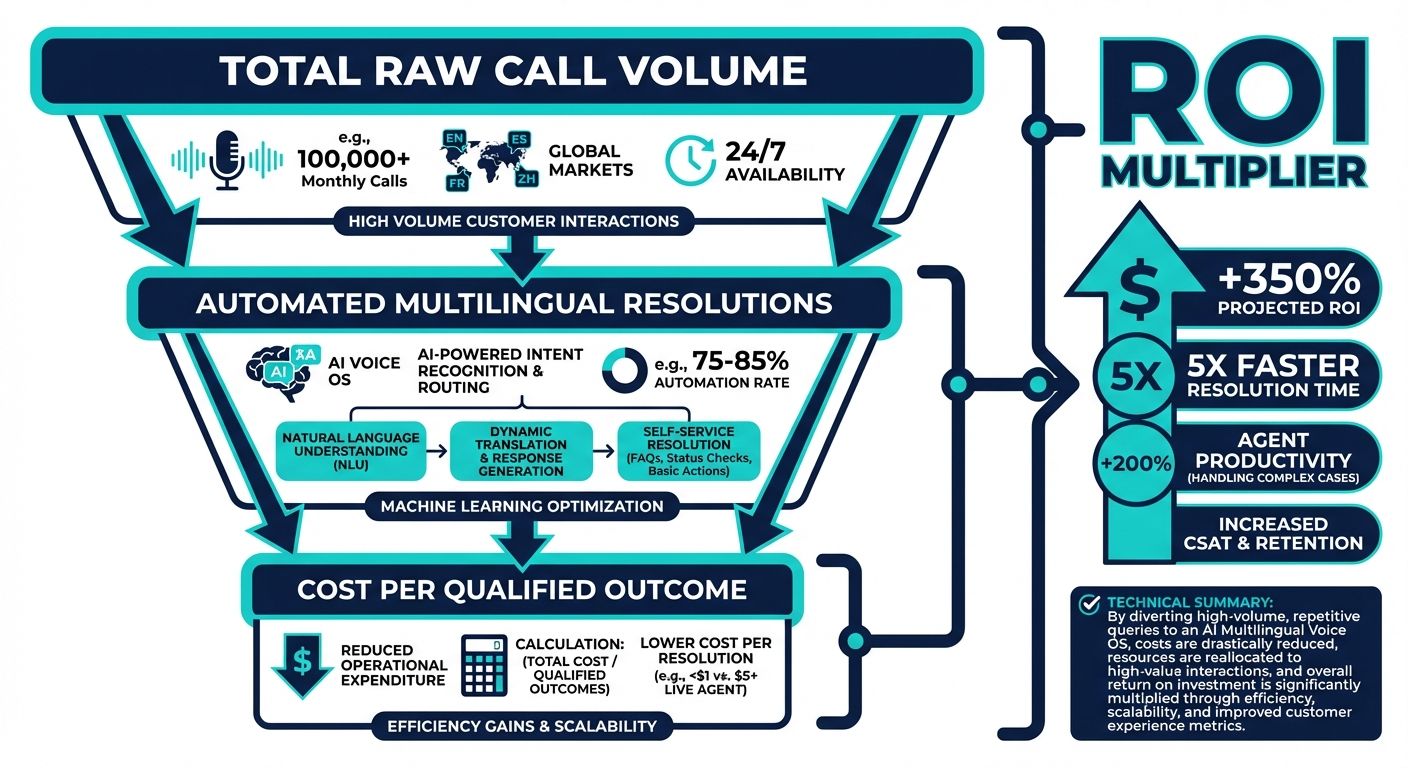
By mapping raw call volume against automated multilingual resolutions, this funnel diagram demonstrates how an AI voice OS drastically reduces the cost per qualified outcome.
Beyond generic cost savings, enterprises require a structured framework for calculating the Return on Investment (ROI) of a multilingual AI voice OS. When moving to a CPQO model and deploying context-aware architecture, the financial benefits extend far beyond simply reducing human headcount.
### Operational Savings vs. Revenue Generation
The ROI calculation begins with operational savings. By deploying a multilingual AI voice OS that utilizes context engineering, enterprises drastically reduce their Average Handle Time (AHT) and increase their First Call Resolution (FCR) rates. However, a truly robust AI voice agent also transitions the contact center from a cost center to a revenue-generating asset. Because the system can seamlessly handle hundreds of thousands of concurrent calls across different languages, businesses can launch proactive outbound campaigns—such as renewal reminders, cross-selling initiatives, and multilingual debt collection—at a fraction of the traditional cost.
### A Structured Framework for ROI Assessment
To accurately calculate ROI, organizations should evaluate the following specific metrics before and after deployment:
* **Escalation Deflection Rate:** The percentage of calls successfully resolved by the AI without requiring routing to a human agent. Context arithmetic significantly increases this rate by providing the AI with deep systemic knowledge.
* **Infrastructure Cost Reduction:** The elimination of redundant legacy software licenses, localized PBX hardware, and fragmented translation services.
* **Customer Lifetime Value (CLTV) Retention:** By eliminating robotic, frustrating interactions and offering immediate, context-aware multilingual support, enterprises reduce customer churn. Retaining a high-value customer through superior voice experiences directly impacts the top line.
* **Outcome Achievement Cost:** Comparing the historical human cost of resolving a specific ticket type against the fixed CPQO rate of the AI Voice OS.
## Overcoming Unique Challenges in Spoken Language Context
To truly appreciate the necessity of advanced systems like the Kathan engine, technical evaluators must understand the unique challenges inherent in spoken language context, particularly in multilingual, high-volume environments.
### Handling Interruptions and Code-Switching
Human speech is inherently messy. Callers interrupt, change their minds mid-sentence, and frequently mix languages (code-switching). A conventional chatbot will reset its conversational flow when interrupted, forcing the user to start over. A state-aware multilingual AI voice OS maintains a continuous temporal state map. If a caller interrupts to provide new information, the context arithmetic engine immediately recalculates the metadata filtering and dynamically ranks the new priority, seamlessly adapting the conversation without dropping the overarching goal.
### State-Aware Call Management
High volume interactions demand memory. If a customer calls back three times in a week, the AI must instantly recognize their state, bypassing introductory triage and jumping directly to the ongoing issue. This requires deep integration between the voice OS and the enterprise CRM. The architectural requirement for a context layer ensures that real-time processing of this historical data happens flawlessly. Through robust developer tools and open platform access, engineering teams can configure exactly how long conversational state is maintained and what security parameters govern the retrieval of past interactions.
## Conclusion: The Future of Global Customer Service
Deploying a multilingual AI voice OS for high volume customer interactions is no longer a futuristic luxury; it is an operational necessity for global enterprises. Relying on basic AI voice agents, legacy chatbots, and inherently flawed per-minute pricing models will only lead to inflated costs and degraded customer experiences. By embracing advanced context engineering, leveraging the computational power of context arithmetic, and migrating to a cost per qualified outcome pricing model, businesses can radically transform their customer lifecycle.
The definitive migration blueprint provided here underscores the importance of technical rigor, data migration, and developer autonomy. As systems like Alchemyst's Kathan engine continue to redefine what is possible in voice architecture, enterprises that adopt these comprehensive, state-aware operating systems will secure a massive competitive advantage, delivering unparalleled, localized support to millions of customers worldwide.
[← Back to Blog](/blog)
## Recently Published
[October 6, 2026 / 10 min readHow to Build a RAG Pipeline for Personal Documents and MediaBuild a multi-modal RAG pipeline for all personal documents and media assets.](/blog/rag-pipeline-personal-documents-media)
[Technical / September 27, 2026 / 11 min readHarness Engineering for AI Agents: Bridging the GapExplore how harness engineering enables robust AI infrastructure and MLOps.](/blog/harness-engineering-ai-agents)
[I'm Evaluating / September 27, 2026 / 9 min readContext Engineering Best Practices for Enterprise AIMaster advanced context engineering best practices for conversational AI agents.](/blog/context-engineering-best-practices)
[I'm Evaluating / September 22, 2026 / 11 min readContext Engineering vs Prompt Engineering for AI AgentsExplore the differences between context and prompt engineering for enterprise AI](/blog/context-engineering-vs-prompt-engineering)
[I'm Evaluating / September 14, 2026 / 10 min readContext Engineering for Enterprise AI: A Complete GuideMaster context engineering to build reliable, production-ready voice AI agents.](/blog/context-engineering-enterprise-ai)
[Deep Technical / July 7, 2026 / 10 min readVoice-Specific Architectural Requirements for AI Context LayersDiscover the core voice-specific architectural requirements for AI context layer](/blog/voice-specific-architectural-requirements-ai-context-layer)
Get Started
## Give your AI agents the memory they deserve.
Join developers building the next generation of AI products with persistent, auditable context. Free tier available. No credit card required.
* Free tier
* REST + Python & Node SDKs
* 99.9% uptime SLA
* SOC 2 in progress
### Request API Access
Enter your email and we'll set up your workspace.
Email
[Read the Docs →](https://docs.getalchemystai.com)[Read the Thesis →](/thesis)
---
# Architecting Enterprise AI Voice Platforms with Real-Time CRM Data
- **URL:** https://getalchemystai.com/blog/enterprise-ai-voice-platform-real-time-crm-integration
- **Slug:** enterprise-ai-voice-platform-real-time-crm-integration
- **Published:** April 2, 2026
- **Last updated:** April 2, 2026
- **Author:** Harsh Shah
- **Category:** I'm Evaluating
[I'm Evaluating](/blog?category=im-evaluating)
# Architecting Enterprise AI Voice Platforms with Real-Time CRM Data
Guide to enterprise AI voice platforms with real-time CRM data integration.
Written by [Harsh Shah](/blog?author=Harsh%20Shah)Reviewed by [Anuran Roy](/blog?author=Anuran%20Roy)10 min readPublished at April 2, 2026 (6mo ago)
## Summary
Discover how to architect an enterprise AI voice platform featuring instantaneous CRM data synchronization. This comprehensive blueprint covers technical integration, latency management, and calculating true ROI based on qualified outcomes.
Table of Contents
## The Real-Time Advantage: Architecting Enterprise AI Voice Platforms with Instant CRM Data Synchronization
In the rapidly evolving landscape of conversational artificial intelligence, the distinction between a simple AI voice agent and a comprehensive enterprise AI voice platform with real-time CRM data integration has become the defining factor for commercial success. For technical evaluators, software architects, and enterprise decision-makers, understanding the architectural imperatives of this technology is no longer optional. Businesses are actively migrating away from legacy interactive voice response (IVR) systems and disjointed chatbot interfaces, seeking robust solutions that act as a seamless extension of their existing customer relationship management (CRM) and applicant tracking system (ATS) infrastructures.
This definitive blueprint explores the technical, strategic, and financial imperatives of implementing an enterprise AI voice platform. We will dissect the architectural complexities of real-time data flow, contrast context engineering with traditional prompt engineering, outline the data governance and security protocols required for immediate data access, and provide a structured framework for calculating Return on Investment (ROI) based on qualified outcomes rather than vanity metrics.
## AI Voice Agent vs. Enterprise AI Voice Platform: The Critical Distinction
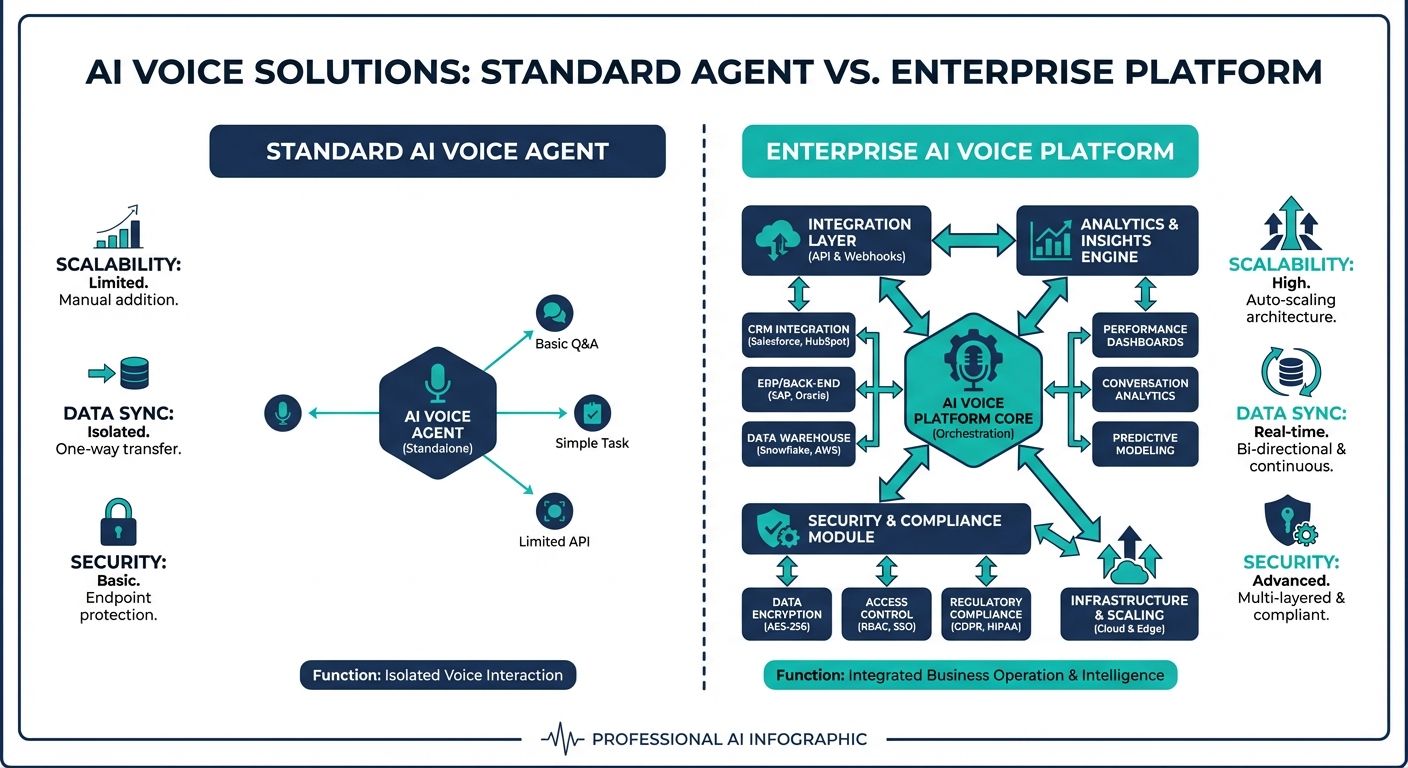
This side-by-side comparison highlights why enterprise platforms outscale standard agents through deep CRM data integration.
A common pitfall in commercial evaluations of conversational AI is conflating an isolated voice agent with a holistic enterprise platform. An AI voice agent is fundamentally a conversational interface—a combination of Speech-to-Text (STT), a Large Language Model (LLM), and Text-to-Speech (TTS) components. While these agents can handle basic interactions, they operate in a vacuum without an underlying architecture to supply them with dynamic, account-specific intelligence.
An **enterprise AI voice platform**, on the other hand, is an orchestration engine. It encompasses the voice agent but surrounds it with critical enterprise guardrails: real-time database connectors, state management, observability suites, security compliance layers, and advanced information retrieval systems. It is the platform that enables the agent to pause, query a CRM, retrieve a customer's recent support ticket, and dynamically alter its dialogue flow within milliseconds. Without this real-time CRM data integration, voice agents sound robotic, lack situational awareness, and ultimately frustrate customers by requiring them to repeat information.
## The Strategic Imperative of Real-Time CRM Data Integration
Batch processing and nightly data syncs are entirely inadequate for conversational AI. When a customer speaks to an AI representative, the AI must possess instantaneous access to the customer's entire historical and current lifecycle context. This is where real-time CRM data integration transforms the customer experience.
Consider a scenario where a user upgrades their subscription via a web portal while simultaneously calling support to confirm the change. If the AI relies on a delayed data pipeline, it will confidently—and incorrectly—state the customer is on the old plan. True real-time synchronization prevents these hallucinations and factual errors by utilizing live API queries as the ultimate source of truth. This real-time context-awareness bridges the gap between robotic automation and human-like consultative support.
## Architectural Blueprint: Engineering Real-Time Data Flow
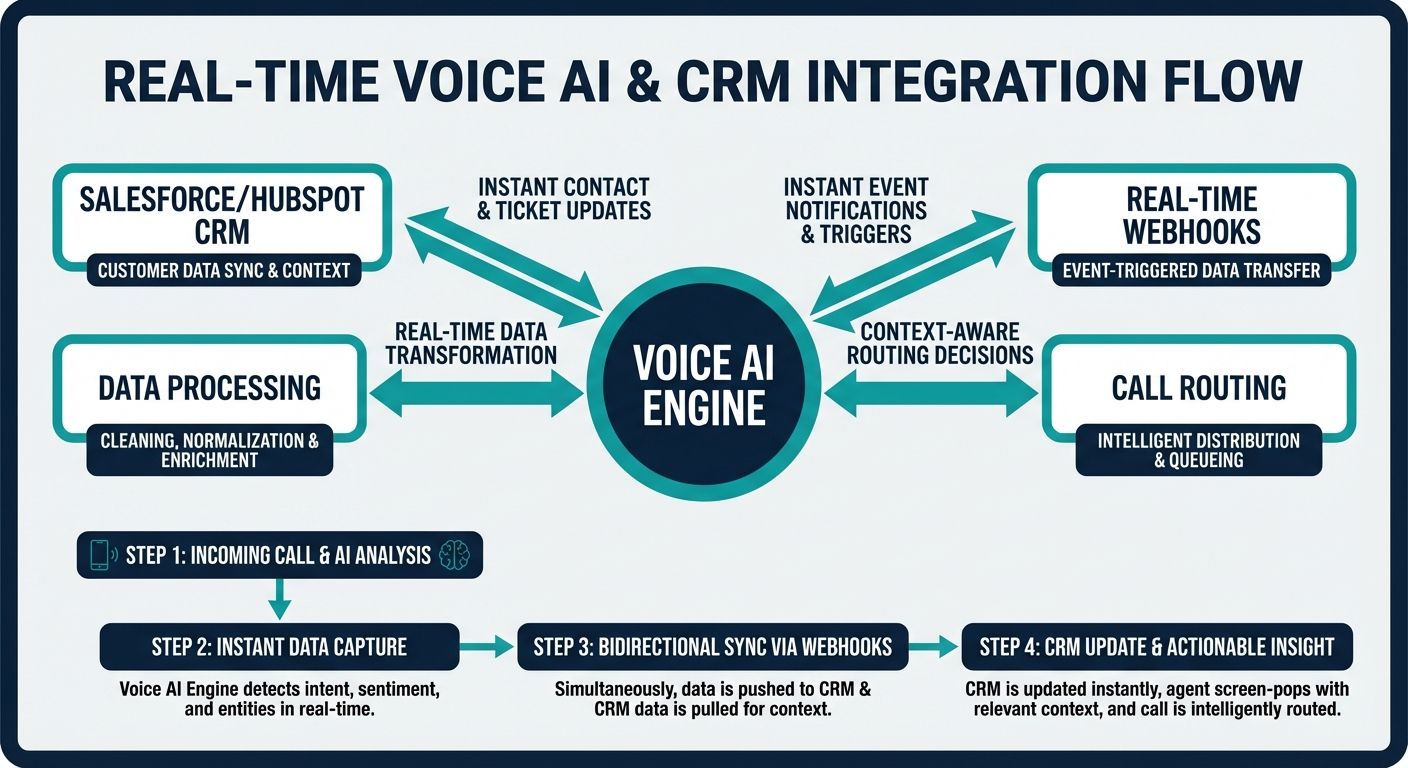
The architectural blueprint demonstrates the bi-directional data flow required to keep voice AI and CRM systems perfectly synced.
Achieving zero-latency retrieval in an enterprise environment requires a sophisticated technical architecture. Top-tier platforms employ event-driven architectures and bidirectional streaming to ensure that dialogue generation is never blocked by database queries.
### API Strategies and Managing Data Latency
To architect an enterprise AI voice platform with real-time CRM data integration, developers must move beyond basic REST architectures. GraphQL and WebSockets are frequently employed to maintain persistent connections between the voice OS and the CRM (such as Salesforce, HubSpot, or custom enterprise solutions). When a user speaks, the STT engine streams the transcript to the orchestrator. Simultaneously, a parallel thread utilizes entity extraction to identify account identifiers and instantly fires a GraphQL query to the CRM. This concurrent processing ensures that by the time the LLM begins generating the semantic response, the CRM payload has already been returned and injected into the context window.
### Alchemyst's Kathan Engine and Context Arithmetic
At the bleeding edge of this architectural paradigm is Alchemyst's Kathan engine, which introduces a computational process known as **Context Arithmetic**. Traditional platforms rely heavily on prompt engineering—tweaking the instructions given to the LLM. However, prompt engineering cannot solve the problem of missing information. Context engineering, powered by the Kathan engine, focuses on systematically determining the exact, most relevant slice of enterprise data to feed the agent at any given millisecond.
This is achieved through a rigorous five-stage set-algebraic pipeline:
* **1\. Semantic Similarity Search:** The user's spoken utterance is converted into vector embeddings, querying the enterprise knowledge base and CRM cache for conceptually related data.
* **2\. Metadata Filtering:** The retrieved dataset is filtered using hard constraints (e.g., matching the caller's unique CRM ID, regional compliance tags, and active subscription status).
* **3\. Deduplication:** Overlapping data chunks from various CRM fields or knowledge base articles are mathematically merged to prevent token waste and reduce LLM confusion.
* **4\. Ranking:** The remaining contextual data points are scored based on recency, relevance, and semantic weight.
* **5\. Dynamic Injection:** The highest-scoring context is instantaneously injected into the LLM's active memory buffer, allowing the text-to-speech engine to generate an accurate, highly contextualized audio response.
This approach effectively replaces rudimentary Retrieval-Augmented Generation (RAG) with a deterministic, mathematically sound pipeline tailored specifically for the rigorous latency demands of voice communication.
## Technical Integration and Migration Strategy
Migrating from legacy IVR systems to a modern Enterprise AI voice platform requires a definitive blueprint. Haphazard deployments result in disconnected data silos and degraded customer trust. Technical evaluators must prioritize a structured migration strategy.
### Step-by-Step Data Migration Blueprint
**Phase 1: API Auditing and Endpoint Mapping.** Before any voice agent is deployed, enterprise architects must audit their CRM APIs. This involves mapping out the exact endpoints required for reading customer states and writing call outcomes. Rate limits must be negotiated, and dedicated service accounts with granular permissions must be established.
**Phase 2: Implementing Webhook Triggers.** Real-time integration is not just about the AI reading data; it is about the AI updating the CRM mid-conversation. Webhook triggers must be configured so that if the AI agent successfully qualifies a lead or resolves a ticket, a payload is immediately pushed to the CRM, triggering downstream enterprise workflows without human intervention.
**Phase 3: Conversational Memory and Chat History.** Enterprise integration requires that the AI maintains session memory. Code-level implementation should involve utilizing fast-retrieval databases (like Redis) to store short-term dialogue turns, while long-term conversational summaries are asynchronously written back to the CRM's interaction logs for future reference by human agents.
## Data Governance, Security, and Compliance in Real-Time
Instantaneous CRM data synchronization inherently introduces significant security considerations. When an AI voice platform queries a CRM in real-time, it accesses highly sensitive Personally Identifiable Information (PII) and Payment Card Industry (PCI) data. A robust enterprise platform must implement a Zero-Trust architecture.
Security protocols must dictate that data is encrypted both in transit (via TLS 1.3) and at rest. More critically for voice, the platform must execute **Real-time PII Redaction**. Before the user's spoken text is sent to an external LLM provider, intermediate middleware must scrub credit card numbers, social security numbers, and private account details. Furthermore, the AI must strictly adhere to the Principle of Least Privilege, meaning the API keys utilized by the voice platform should only have access to the exact CRM fields necessary to resolve the caller's immediate query, preventing potential data over-exposure.
## Transformative Real-Time Use Cases
The distinction of an enterprise AI voice platform with real-time CRM data integration is most visible in its application. Here are concrete, industry-focused use cases where instant data synchronization revolutionizes operations:
* **Dynamic Call Routing and Ticket Status:** A customer calls support. Instantly, the platform cross-references the caller's phone number with the CRM. It identifies an open, high-severity support ticket. Instead of asking 'How can I help you?', the AI proactively states, 'Hello, I see you have an open ticket regarding your recent router outage. I have an update from the engineering team. Would you like to hear it?'
* **Intelligent Cross-Selling and Sales Qualification:** During an outbound sales call, a prospect mentions a specific pain point. The AI instantly queries the CRM for previous marketing materials the prospect has engaged with, adjusting its pitch in real-time to highlight features the prospect has already shown interest in, seamlessly writing the newly qualified data points back to the ATS or CRM.
* **Automated Account Updates and Authentication:** A user needs to change their billing address. The AI utilizes voice biometrics and multi-factor authentication via SMS, verifies the response, and instantly executes an API POST request to the CRM to update the address, confirming the change back to the user within seconds.
## Redefining ROI: Cost Per Qualified Outcome
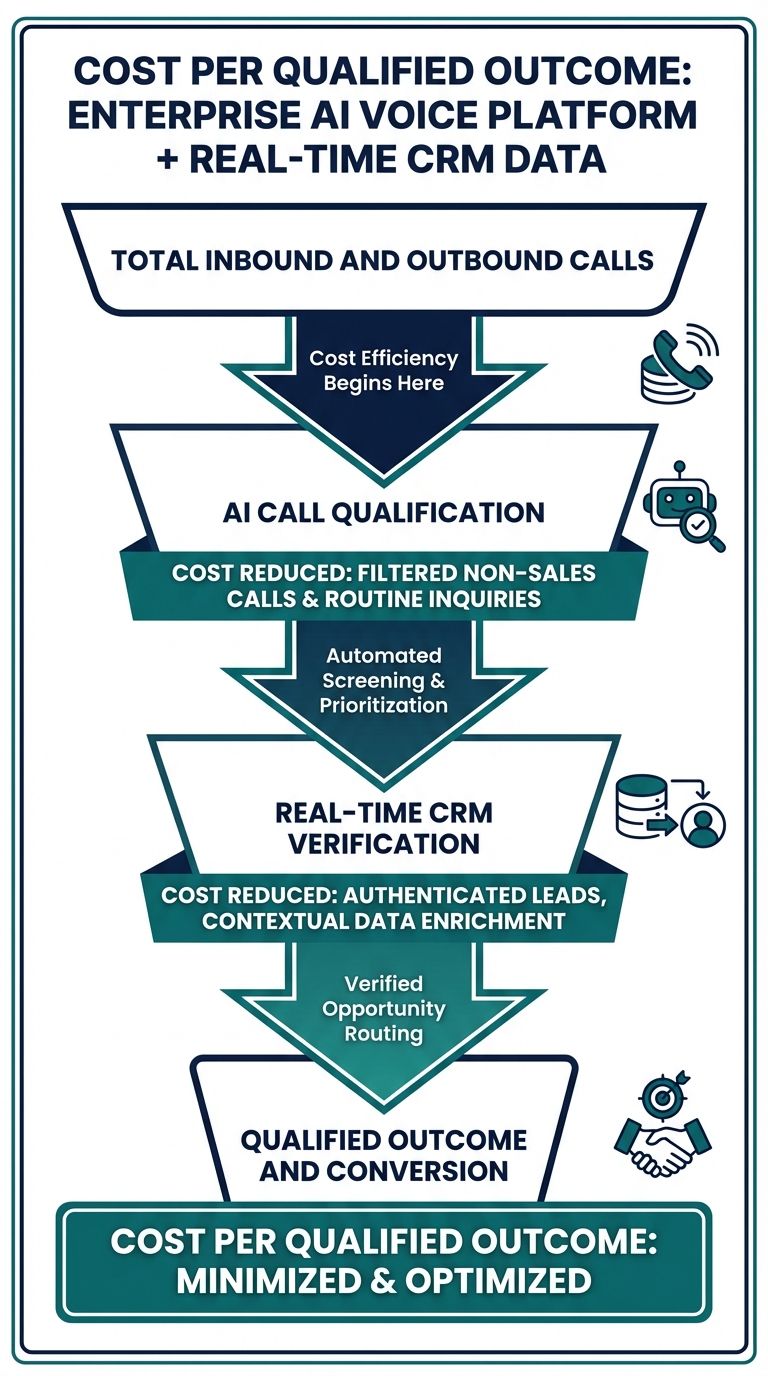
By tracking the journey from raw calls to qualified outcomes, this funnel visualizes the direct ROI impact of real-time data.
A comprehensive migration to an enterprise AI voice platform requires a structured ROI framework that extends far beyond generic cost savings. Historically, the voice AI industry has relied on deceptive pricing models based on per-minute, per-call, or per-seat structures. These metrics are fundamentally flawed because they reward inefficiency. If a basic, context-free AI agent takes ten minutes of frustrating dialogue to resolve a simple issue, the vendor makes more money, while the enterprise suffers.
The true metric for enterprise evaluation is **Cost Per Qualified Outcome (CPQO)**. A qualified outcome is a definitive, valuable action: a closed ticket, a scheduled appointment, a verified address update, or a highly qualified sales lead pushed directly into the CRM.
Context-free agents artificially inflate expenses. Because they lack real-time CRM data integration, they ask redundant questions, misinterpret context, and frequently require costly escalations to human agents—negating the initial cost savings. In contrast, an enterprise AI voice platform utilizing context arithmetic directly reduces the time-to-resolution. By having instant access to the CRM truth, the AI handles the complex, real-world conversational variations that cause standard agents to fail.
When calculating ROI, businesses must factor in the reduction of human-agent handle time, the elimination of manual post-call data entry (since the AI writes back to the CRM instantly), and the increased conversion rates driven by hyper-personalized, context-aware interactions. The initial technical investment in architecting real-time synchronization pays dividends by transforming the voice channel from a cost center into a high-efficiency operational asset.
## Conclusion
The transition to an enterprise AI voice platform with real-time CRM data integration represents a paradigm shift in automated customer communication. By moving away from basic prompt engineering toward rigorous context arithmetic and establishing low-latency, bidirectional data flows, enterprises can deploy voice AI that truly augments human capabilities. The definitive migration blueprint requires meticulous attention to API strategies, strict adherence to real-time data governance, and a fundamental shift in how ROI is calculated. For organizations willing to embrace this architectural complexity, the result is a massive competitive advantage: a conversational AI system that is not just heard, but inherently understands the complete context of every single customer.
[← Back to Blog](/blog)
## Recently Published
[October 6, 2026 / 10 min readHow to Build a RAG Pipeline for Personal Documents and MediaBuild a multi-modal RAG pipeline for all personal documents and media assets.](/blog/rag-pipeline-personal-documents-media)
[Technical / September 27, 2026 / 11 min readHarness Engineering for AI Agents: Bridging the GapExplore how harness engineering enables robust AI infrastructure and MLOps.](/blog/harness-engineering-ai-agents)
[I'm Evaluating / September 27, 2026 / 9 min readContext Engineering Best Practices for Enterprise AIMaster advanced context engineering best practices for conversational AI agents.](/blog/context-engineering-best-practices)
[I'm Evaluating / September 22, 2026 / 11 min readContext Engineering vs Prompt Engineering for AI AgentsExplore the differences between context and prompt engineering for enterprise AI](/blog/context-engineering-vs-prompt-engineering)
[I'm Evaluating / September 14, 2026 / 10 min readContext Engineering for Enterprise AI: A Complete GuideMaster context engineering to build reliable, production-ready voice AI agents.](/blog/context-engineering-enterprise-ai)
[Deep Technical / July 7, 2026 / 10 min readVoice-Specific Architectural Requirements for AI Context LayersDiscover the core voice-specific architectural requirements for AI context layer](/blog/voice-specific-architectural-requirements-ai-context-layer)
Get Started
## Give your AI agents the memory they deserve.
Join developers building the next generation of AI products with persistent, auditable context. Free tier available. No credit card required.
* Free tier
* REST + Python & Node SDKs
* 99.9% uptime SLA
* SOC 2 in progress
### Request API Access
Enter your email and we'll set up your workspace.
Email
[Read the Docs →](https://docs.getalchemystai.com)[Read the Thesis →](/thesis)
---
# Reference Architecture for Production-Ready AI Agent Infrastructure
- **URL:** https://getalchemystai.com/blog/reference-architecture-production-ready-ai-agent-infrastructure
- **Slug:** reference-architecture-production-ready-ai-agent-infrastructure
- **Published:** April 2, 2026
- **Last updated:** April 2, 2026
- **Author:** Harsh Shah
- **Category:** I'm Evaluating
[I'm Evaluating](/blog?category=im-evaluating)
# Reference Architecture for Production-Ready AI Agent Infrastructure
Build production-ready AI agent infrastructure with this reference architecture.
Written by [Harsh Shah](/blog?author=Harsh%20Shah)Reviewed by [Anuran Roy](/blog?author=Anuran%20Roy)10 min readPublished at April 2, 2026 (6mo ago)
## Summary
Discover a comprehensive blueprint for deploying enterprise-grade AI agents from proof-of-concept to production. This technical guide explores MLOps tooling, context arithmetic, and cost-optimized scaling specifically tailored for voice AI infrastructure.
Table of Contents
## Bridging the Demo-to-Deployment Gap in AI Agent Infrastructure
The transition from a compelling proof-of-concept to a robust, enterprise-grade deployment is the most treacherous phase in AI development. While lightweight frameworks make it trivial to spin up a local conversational agent, designing a true reference architecture for production-ready AI agent infrastructure requires a profound shift in engineering philosophy. It is no longer just about prompt engineering; it is about building resilient, secure, and scalable systems capable of real-time context management, robust MLOps, and deterministic outcomes.
Today, top-ranking resources often lack prescriptive, technical guidance on concrete architectural patterns. They gloss over the specific MLOps tooling tailored for AI agent lifecycle management, deployment, monitoring, and versioning. Furthermore, there is a distinct gap in addressing the unique complexities of voice AI agents, which require ultra-low latency, streaming architectures, and specialized human-in-the-loop (HITL) strategies. This guide provides a definitive migration blueprint and reference architecture for production-ready AI agent infrastructure, focusing on bridging the demo-to-deployment gap with advanced context engineering.
## Core Pillars of Production-Ready Agentic Architecture
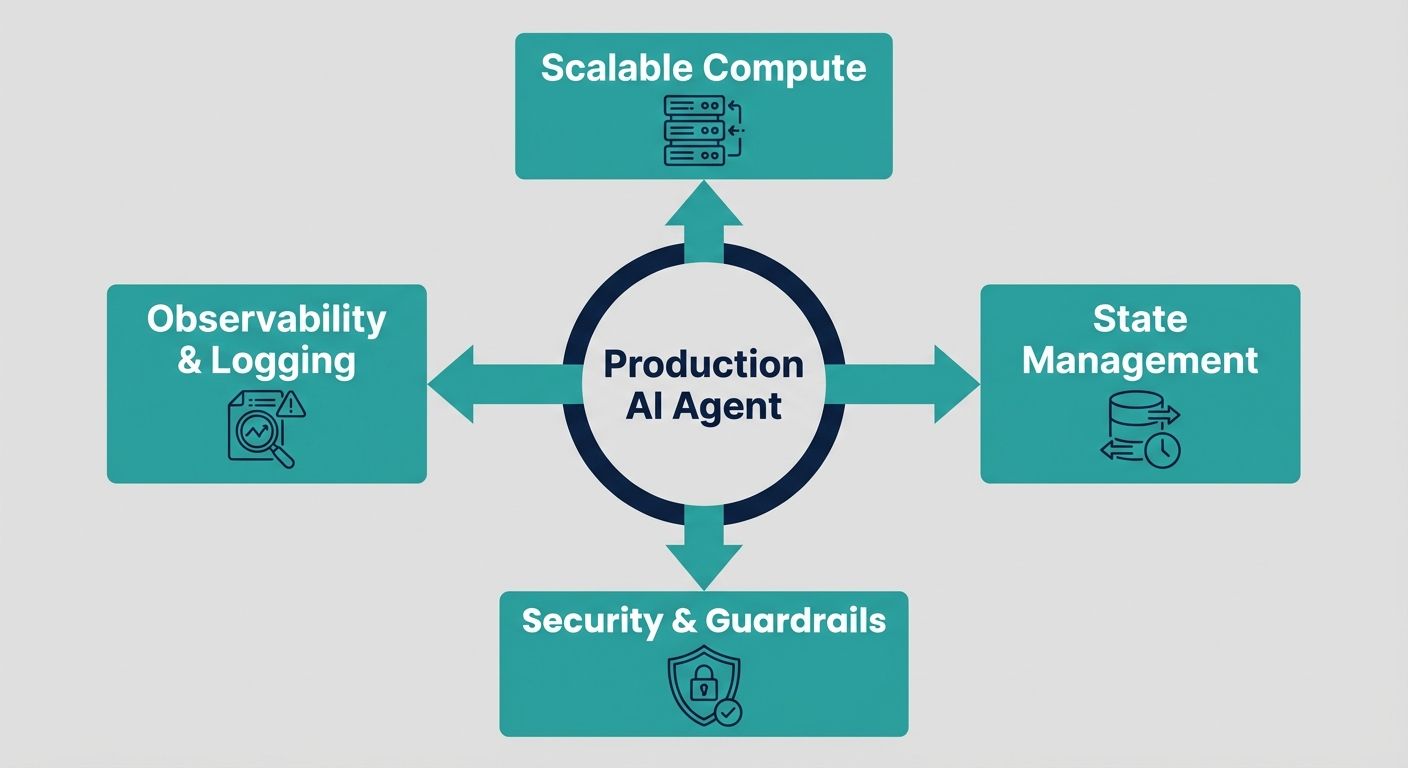
This hub-and-spoke diagram highlights the foundational pillars required to build scalable AI agents, ensuring you do not overlook critical security or state management components.
A production-ready infrastructure must support autonomous decision-making while enforcing strict guardrails. Unlike traditional microservices, AI agents operate non-deterministically, interacting dynamically with external environments, APIs, and users. To manage this safely, the architecture must be founded on three core pillars: Context Engineering, MLOps for Agents, and Enterprise Governance.
### 1\. MLOps Tooling and Lifecycle Management
Standard software CI/CD pipelines are insufficient for AI agents. In a production environment, you are not just versioning code; you are versioning system prompts, retrieval strategies, tool schemas, and underlying foundational models. A robust MLOps stack for agents includes specialized deployment, monitoring, and versioning platforms. Infrastructure must support shadow deployments, where a new agent version processes live traffic asynchronously to evaluate its tool-calling accuracy before taking over the primary traffic routing. Furthermore, specialized monitoring observability platforms are critical to trace an agent's reasoning steps, API latency, and token consumption per invocation.
### 2\. Security, Governance, and Human-in-the-Loop (HITL)
Security for AI agents extends beyond network perimeters. Because agents can autonomously trigger external actions (like database writes or API calls), strict Role-Based Access Control (RBAC) must be applied at the tool level. The infrastructure must enforce execution guardrails, ensuring that high-stakes actions require explicit human validation. For voice AI agents in particular, a robust Human-in-the-Loop strategy is critical. If a voice agent encounters an out-of-domain query or detects high customer frustration via sentiment analysis, the architecture must seamlessly hand off the conversational state to a human operator without dropping the call.
## Data Pipelines and Context Engineering: The Alchemyst Advantage
The defining characteristic of a successful enterprise AI agent is not the size of its underlying LLM, but the quality of its context. While many platforms provide a configurable API for developers to build basic agents, they offload the immense burden of context management onto the user. This often results in 'context-free agents' that hallucinate, loop indefinitely, or fail to resolve complex customer issues.
### Moving Beyond Prompt Engineering to Context Engineering
Prompt engineering alone cannot sustain enterprise voice AI. A reference architecture for production-ready AI agent infrastructure must incorporate Context Engineering. This involves dynamically assembling the exact knowledge, conversational history, and situational parameters required for the agent to make an optimal decision at any given millisecond. This is where Alchemyst's Kathan engine distinguishes itself from basic API-first platforms.
### The Context Arithmetic Pipeline
At the heart of a truly robust AI voice OS is a systematic, computational process for determining relevant information. The Kathan engine utilizes a highly optimized five-stage 'context arithmetic' pipeline to systematically resolve context prior to LLM generation. This set-algebraic pipeline guarantees that voice agents operate with deterministic knowledge retrieval:
* **Semantic Similarity Search:** The pipeline begins by converting incoming voice queries (transcribed to text) into high-dimensional vector embeddings, searching vector databases to retrieve conceptually related enterprise knowledge.
* **Metadata Filtering:** To prevent retrieving irrelevant but semantically similar documents, strict metadata filters (such as tenant ID, user role, and temporal validity) are applied to narrow the search space.
* **Deduplication:** The system computationally removes redundant data chunks retrieved from overlapping knowledge bases, ensuring the context window remains highly efficient and token-optimized.
* **Ranking:** The remaining chunks are scored and re-ranked using cross-encoder models to prioritize the most immediately actionable information for the agent.
* **Set-Algebraic Pipeline:** Finally, logical set operations (unions, intersections, differences) combine dynamic data (e.g., live CRM API responses) with static knowledge base retrieval, forming a perfectly bounded context block for the LLM.
## Detailed Blueprint: Voice AI Infrastructure Components
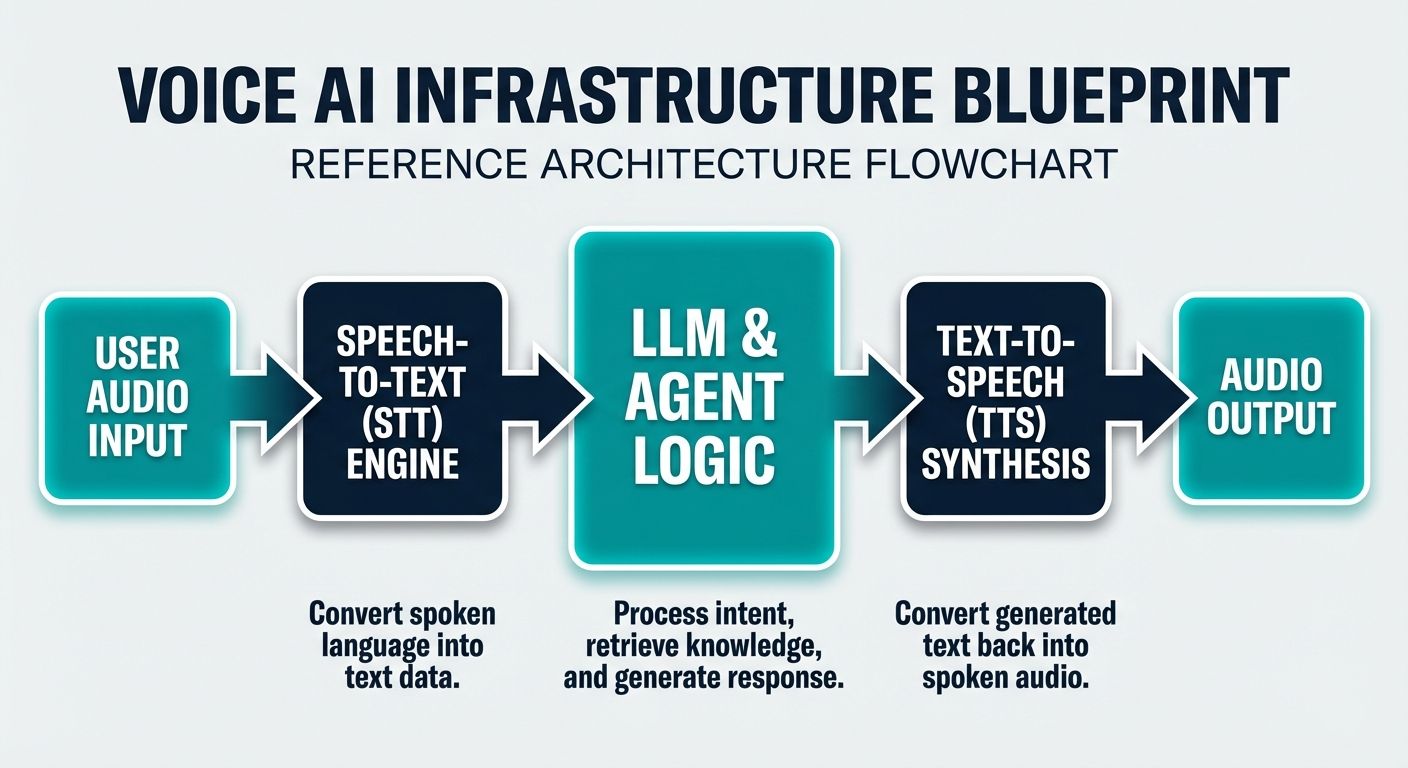
By visualizing the complete audio processing pipeline, this flowchart breaks down the essential components needed to achieve low-latency voice interactions in production.
Deploying a voice-native AI agent introduces structural complexities that text-based chatbots bypass. Voice requires real-time processing, handling interruptions, and natural prosody. The reference architecture must be optimized for sub-500 millisecond latency from speech-to-speech.
### Streaming Orchestration and State Management
To eliminate dead air during calls, the orchestration layer must support fully asynchronous, chunked streaming. As the user speaks, a streaming Speech-to-Text (STT) model processes the audio. The orchestration engine—often built on custom state machines rather than generic frameworks—must begin predicting intents and pre-fetching API data before the user even finishes their sentence. Once the LLM begins generating a response, the tokens must be streamed directly to a Text-to-Speech (TTS) engine, which synthesizes audio in chunks and streams it back to the telephony provider (like Twilio or Plivo). State management is handled by ultra-fast in-memory datastores (like Redis), maintaining the conversational graph and context arithmetic state across the distributed system.
### Storage: Vector Databases and Caching
Production environments demand scalable vector databases (such as Pinecone, Qdrant, or Milvus) capable of executing sub-millisecond similarity searches across billions of embeddings. To minimize LLM latency and reduce inference costs, the architecture must implement a semantic caching layer. If a user asks a question that is semantically identical to a previously answered query (e.g., 'What are your business hours?' vs 'When do you open?'), the cache immediately serves the pre-computed response, bypassing the LLM entirely.
### Agent-Specific Monitoring and Telemetry
Generic APM tools cannot debug AI agents. The infrastructure requires telemetry that traces the 'Agentic Loop'. When a user speaks, the telemetry must log the STT transcription latency, the context arithmetic retrieval time, the prompt compilation time, the LLM Time-to-First-Token (TTFT), the tool execution latency, and the TTS synthesis time. Without this granular observability, debugging a 2-second delay in a voice call becomes practically impossible.
## Cost Analysis for Production Scaling
One of the most critical gaps in top-ranking architectural guides is the absence of specific cost analysis for production scaling. Transitioning from POC to production can result in massive, unexpected cloud and API expenditures if the infrastructure is not properly optimized.
### Hidden Costs in Voice AI Deployments
Voice AI pricing models, particularly in emerging markets like India, are fraught with hidden costs. Many competitors utilize a per-minute, per-call, or per-seat pricing structure. While this seems straightforward, it fundamentally misaligns incentives. 'Context-free agents' built on brittle infrastructure tend to ask clarifying questions repeatedly, stall while retrieving data, or loop through inefficient logic. This inflates the call duration, driving up per-minute costs without successfully resolving the customer's intent. Businesses end up paying for compute time rather than business value.
### Optimizing for Cost Per Qualified Outcome
A true reference architecture for production-ready AI agent infrastructure must optimize for 'Cost Per Qualified Outcome'. By utilizing advanced context engineering, the agent accurately resolves the intent in a fraction of the time. The infrastructure minimizes token usage through deduplication and semantic caching, drastically lowering LLM API costs. Furthermore, by seamlessly integrating with internal APIs, the agent completes the task (the outcome) autonomously, providing a concrete, measurable ROI that generic cost-savings models fail to capture.
## Implementation Blueprint: A Step-by-Step Guide
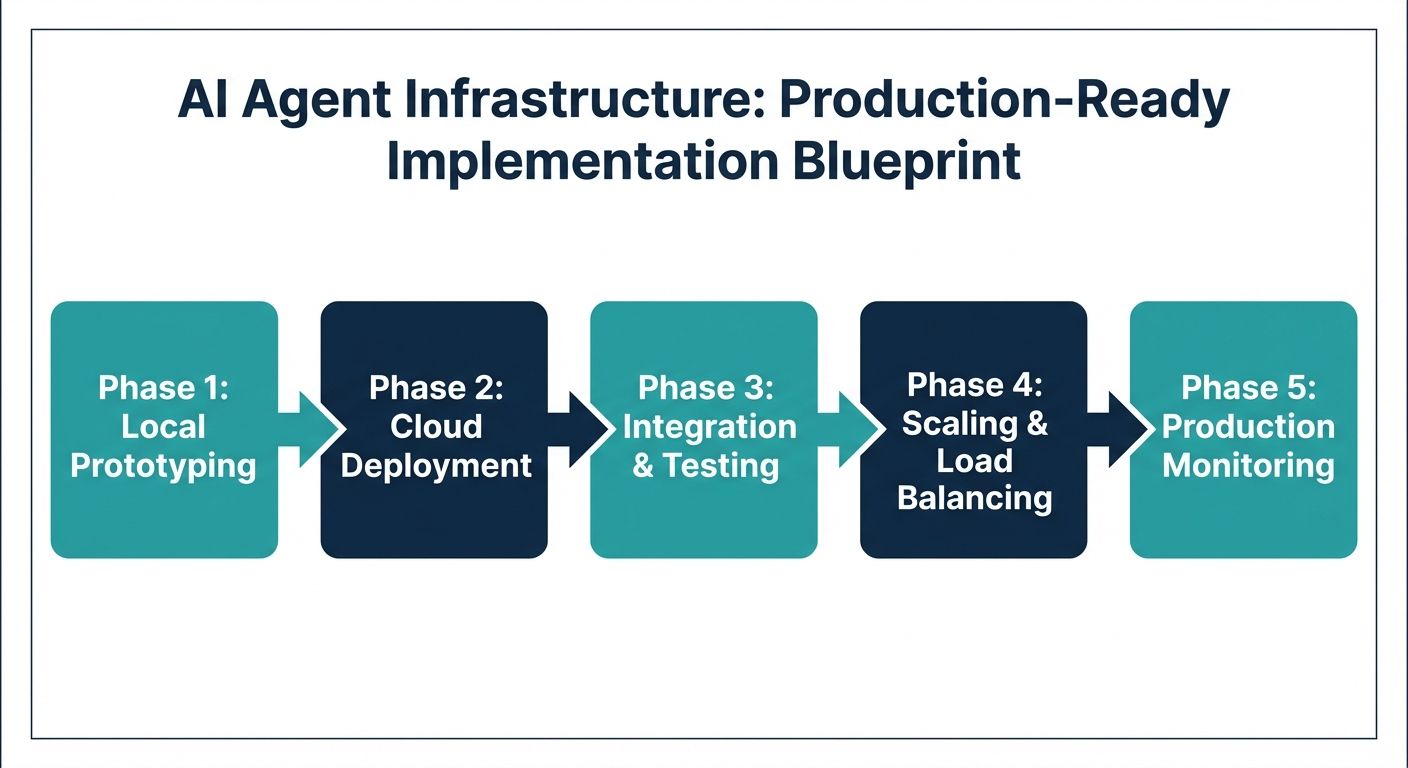
Following this step-by-step implementation timeline ensures your engineering team transitions smoothly from local prototypes to a highly available production environment.
Building this robust infrastructure requires a structured, phased approach. Here is the definitive migration blueprint for technical integration, data migration, and deployment.
### Step 1: Foundational Infrastructure Setup
Begin by establishing the networking and compute baseline. Deploy a scalable container orchestration platform (like Kubernetes) across multiple availability zones. Set up your streaming telephony gateways using WebSockets to ensure persistent, bi-directional audio streaming. Provision your specialized datastores: a relational database for user metadata, an in-memory store for real-time conversational state, and a highly available vector database for semantic search.
### Step 2: Context Pipeline Integration
Implement the Alchemyst Kathan engine or a comparable context arithmetic pipeline. Ingest your enterprise data (PDFs, knowledge bases, historical tickets) through a data pipeline that chunks, embeds, and indexes the documents. Configure the metadata schemas to ensure secure, tenant-isolated data retrieval. Establish the necessary API endpoints that the agent will use as 'tools' to interact with your CRM, ERP, or billing systems.
### Step 3: Orchestration and Agent Logic
Develop the core agentic loop. Rather than hardcoding conversational flows, define the system prompts, tool schemas, and guardrails. Implement the asynchronous streaming logic that ties the STT, LLM, and TTS together. Ensure that the orchestration layer includes dynamic interrupt handling, allowing the system to instantly halt TTS playback and clear the LLM generation buffer if the human user interrupts the agent.
### Step 4: MLOps, Versioning, and Deployment
Integrate your agent lifecycle management tools. Implement a shadow testing environment where historical call transcripts are re-run against new agent versions to verify that the 'Cost Per Qualified Outcome' remains optimal. Configure the CI/CD pipeline to deploy changes securely, with automated rollbacks if latency metrics exceed predefined thresholds. Finally, establish the Human-in-the-Loop escalation routing, ensuring agents seamlessly transfer context to human operators when confidence scores drop.
## Real-World Industry Use Cases and ROI
Implementing a production-ready AI agent infrastructure fundamentally transforms customer lifecycle management. In the financial services sector, context-aware voice agents handle complex debt collection and payment restructuring negotiations. Instead of following a rigid script, the agent dynamically retrieves the user's payment history, runs mathematical set-operations to determine eligible payment plans via the context pipeline, and negotiates securely in real-time. In healthcare, patient triage agents utilize strict RBAC and HIPAA-compliant infrastructure to schedule appointments, leveraging semantic similarity to match reported symptoms with appropriate specialist routing. By migrating from generic per-minute vendor solutions to a highly optimized, context-driven architecture, enterprises consistently report a reduction in average handle time and a massive leap in successful first-call resolutions.
## Conclusion
Designing a reference architecture for production-ready AI agent infrastructure is a complex engineering challenge that extends far beyond the capabilities of basic API wrappers. It requires a deep commitment to advanced MLOps, rigorous security governance, low-latency streaming architectures, and most importantly, sophisticated context engineering. By moving away from brittle prompt engineering and adopting computational context arithmetic pipelines like Alchemyst's Kathan engine, enterprises can finally bridge the demo-to-deployment gap. By focusing on the 'Cost Per Qualified Outcome' and building resilient, context-aware infrastructure, businesses can unlock the true operational ROI of autonomous AI voice OS adoption.
[← Back to Blog](/blog)
## Recently Published
[October 6, 2026 / 10 min readHow to Build a RAG Pipeline for Personal Documents and MediaBuild a multi-modal RAG pipeline for all personal documents and media assets.](/blog/rag-pipeline-personal-documents-media)
[Technical / September 27, 2026 / 11 min readHarness Engineering for AI Agents: Bridging the GapExplore how harness engineering enables robust AI infrastructure and MLOps.](/blog/harness-engineering-ai-agents)
[I'm Evaluating / September 27, 2026 / 9 min readContext Engineering Best Practices for Enterprise AIMaster advanced context engineering best practices for conversational AI agents.](/blog/context-engineering-best-practices)
[I'm Evaluating / September 22, 2026 / 11 min readContext Engineering vs Prompt Engineering for AI AgentsExplore the differences between context and prompt engineering for enterprise AI](/blog/context-engineering-vs-prompt-engineering)
[I'm Evaluating / September 14, 2026 / 10 min readContext Engineering for Enterprise AI: A Complete GuideMaster context engineering to build reliable, production-ready voice AI agents.](/blog/context-engineering-enterprise-ai)
[Deep Technical / July 7, 2026 / 10 min readVoice-Specific Architectural Requirements for AI Context LayersDiscover the core voice-specific architectural requirements for AI context layer](/blog/voice-specific-architectural-requirements-ai-context-layer)
Get Started
## Give your AI agents the memory they deserve.
Join developers building the next generation of AI products with persistent, auditable context. Free tier available. No credit card required.
* Free tier
* REST + Python & Node SDKs
* 99.9% uptime SLA
* SOC 2 in progress
### Request API Access
Enter your email and we'll set up your workspace.
Email
[Read the Docs →](https://docs.getalchemystai.com)[Read the Thesis →](/thesis)
---
# Voice AI Failed You in 2024. What Changed.
- **URL:** https://getalchemystai.com/blog/voice-ai-what-changed
- **Slug:** voice-ai-what-changed
- **Published:** March 27, 2026
- **Last updated:** March 27, 2026
- **Author:** Anuran Roy
- **Category:** I Don't Trust This
[I Don't Trust This](/blog?category=i-dont-trust-this)
# Voice AI Failed You in 2024. What Changed.
Three structural shifts — LLM quality, telephony infrastructure, and context ...
Written by [Anuran Roy](/blog?author=Anuran%20Roy)5 min readPublished at March 27, 2026 (6mo ago)
## Summary
Three structural shifts — LLM quality, telephony infrastructure, and context engineering — make 2026 voice AI a different category.
Table of Contents
Voice AI in 2023–2024 earned a bad reputation. Agents sounded robotic. Connection rates were indistinguishable from autodialers. The "AI" part meant the agent could understand "yes" and "no" but broke down on anything complex. Businesses spent money, got frustrated, and concluded the technology wasn't ready. If that was your experience, you were right — at the time. Three things have changed since then.
## Shift 1: **LLM Quality**
The language models powering voice agents in 2024 struggled with Indian languages, code-switching (Hindi-English mid-sentence), and domain-specific vocabulary. A voice agent trying to discuss CA exam preparation in Gujarati would produce awkward translations that sounded like Google Translate circa 2015\. The "AI" was technically generating responses, but the responses didn't sound like how people actually talk.
By early 2026, Alchemyst's Kathan engine handles a wide array of languages like Hindi, Tamil, Telugu, Gujarati, Kannada, Marathi, Bengali, Malayalam, Punjabi, Odia, Assamese, and Urdu with **natural phrasing** — not translation-layer approximations. This advancement is a part of our "Built in India, for the world" philosophy. The platform also supports major international languages including English, Arabic, Spanish, French, Mandarin, and Japanese.
## Shift 2: **Telephony Infrastructure**
In 2024, programmatic voice in India was fragile. Carrier APIs were inconsistent. TRAI compliance (caller ID registration, DND filtering, call-hour restrictions) required manual management. A campaign could get blocked mid-run because of a compliance oversight that the platform didn't catch.
By 2026, providers like Exotel, Ozonetel, and others have matured their APIs significantly. **TRAI compliance is automated** within the Kathan voice OS (कथन) — DND filtering, caller ID registration, and call-hour restrictions are handled programmatically, not manually. The infrastructure is reliable enough that over **500,000+ calls are deployed daily** across numerous campaigns without carrier-level failures.
## Shift 3: **Context Engineering**
This is the structural shift — the one that changes the category, not just the product. Voice agents in 2024 were **prompt-stuffed**: everything the agent might need was crammed into a single prompt, and the model picked through it. The prompt included the script, the lead's name, maybe a CRM field or two, and a set of instructions. The model had to figure out what was relevant from a wall of text.
In 2026, context engineering replaces prompt stuffing with a systematic approach. The Kathan OS's context engine **selects, filters, and ranks** the right information for each call dynamically. The agent doesn't see irrelevant data. It sees what matters for this lead, this campaign, this moment.
| | 2024: Prompt Stuffing | 2026: Kathan Context Engineering |
| --------------------- | ---------------------------- | --------------------------------------- |
| Information delivery | Everything in one prompt | Filtered, ranked, relevant context only |
| Prior interactions | Not available | Indexed, searchable, auto-retrieved |
| Language selection | Configured per campaign | Auto-detected per lead |
| Cross-campaign memory | None | Full — scoped by groupName |
| Objection handling | Generic script branches | Retrieves specific prior objections |
| Context volume | 4,000+ tokens (mostly noise) | 400 tokens (all signal) |
The difference between prompt stuffing and context engineering is the difference between giving someone a filing cabinet and giving them the three documents they need. Both approaches provide information. Only one provides the _right_ information.
## The Evidence: 2026 Performance
The JK Shah Classes deployment is a clear example of what 2026 voice AI looks like for enrollment outreach. The Unacademy deployment shows what's possible for a completely different use case: Net Promoter Score (NPS) feedback collection. In 2024, a voice agent couldn't hold the nuanced, open-ended conversations required for qualitative feedback. By 2026, Kathan can. Unacademy ran **14,258 calls to 15,088 learners** across multiple campaigns, capturing detailed NPS responses at a cost of just **₹10.79 per response**.
| Metric | 2024 Industry Avg | 2026 Alchemyst Kathan |
| ------------------------------- | ----------------- | -------------------------- |
| Connection rate | 10–15% | 38.7% (first attempt) |
| Retarget connection | 12–18% | 57.3% (Gujarat) |
| Languages (native quality) | 1–2 | 12+ Indian languages |
| Campaigns managed | 1–3 concurrent | 30 sub-campaigns |
| Cost per meaningful interaction | ₹200–500 | ₹24.93 |
| Context persistence | None | Full cross-campaign memory |
**38.7%**
Connection rate in 2026 — across 500,000+ calls deployed daily in 12+ Indian languages. The 2024 ceiling was 15%.
> "Voice AI failed in 2024 because the technology was immature across three dimensions: language quality, telephony reliability, and context architecture. All three have shifted. The 2026 category is structurally different from what you evaluated two years ago. We built Kathan in India, for the world, to solve these exact problems."
## Should You Re-Evaluate?
If your last experience with voice AI was in 2024 or earlier, the category has changed enough to warrant a fresh evaluation. The specific questions to ask are different now — not "does it sound natural?" (it does) or "does it support Hindi?" (it does) but "does it carry context across interactions?" and "does it adapt to what it knows about each lead?"
The technology that disappointed you in 2024 was a voice dialer with a language model attached. The technology available in 2026 is a **context-aware intelligence layer** that happens to communicate through voice. The medium is the same. The architecture is fundamentally different.
[See what changed — start a 48-hour pilot](https://alchemyst.ai) with Alchemyst's Kathan, our enterprise voice OS.
[← Back to Blog](/blog)
## Recently Published
[October 6, 2026 / 10 min readHow to Build a RAG Pipeline for Personal Documents and MediaBuild a multi-modal RAG pipeline for all personal documents and media assets.](/blog/rag-pipeline-personal-documents-media)
[Technical / September 27, 2026 / 11 min readHarness Engineering for AI Agents: Bridging the GapExplore how harness engineering enables robust AI infrastructure and MLOps.](/blog/harness-engineering-ai-agents)
[I'm Evaluating / September 27, 2026 / 9 min readContext Engineering Best Practices for Enterprise AIMaster advanced context engineering best practices for conversational AI agents.](/blog/context-engineering-best-practices)
[I'm Evaluating / September 22, 2026 / 11 min readContext Engineering vs Prompt Engineering for AI AgentsExplore the differences between context and prompt engineering for enterprise AI](/blog/context-engineering-vs-prompt-engineering)
[I'm Evaluating / September 14, 2026 / 10 min readContext Engineering for Enterprise AI: A Complete GuideMaster context engineering to build reliable, production-ready voice AI agents.](/blog/context-engineering-enterprise-ai)
[Deep Technical / July 7, 2026 / 10 min readVoice-Specific Architectural Requirements for AI Context LayersDiscover the core voice-specific architectural requirements for AI context layer](/blog/voice-specific-architectural-requirements-ai-context-layer)
Get Started
## Give your AI agents the memory they deserve.
Join developers building the next generation of AI products with persistent, auditable context. Free tier available. No credit card required.
* Free tier
* REST + Python & Node SDKs
* 99.9% uptime SLA
* SOC 2 in progress
### Request API Access
Enter your email and we'll set up your workspace.
Email
[Read the Docs →](https://docs.getalchemystai.com)[Read the Thesis →](/thesis)
---
# IVR → Chatbot → Voice AI: Why Each Generation Solved the Wrong Problem
- **URL:** https://getalchemystai.com/blog/ivr-chatbot-voice-ai-evolution
- **Slug:** ivr-chatbot-voice-ai-evolution
- **Published:** March 27, 2026
- **Last updated:** March 27, 2026
- **Author:** Anuran Roy
- **Category:** I Don't Trust This
[I Don't Trust This](/blog?category=i-dont-trust-this)
# IVR → Chatbot → Voice AI: Why Each Generation Solved the Wrong Problem
IVR solved routing. Chatbots solved availability. Voice AI solved naturalness...
Written by [Anuran Roy](/blog?author=Anuran%20Roy)7 min readPublished at March 27, 2026 (6mo ago)
## Summary
IVR solved routing. Chatbots solved availability. Voice AI solved naturalness. None solved continuity. Context engineering does.
Table of Contents
Every generation of customer communication technology solved a real problem. And every generation carried forward a structural flaw that the next generation inherited. Understanding this lineage explains why most voice AI deployments disappoint — and what it takes to break the pattern.
## Generation 1: IVR Solved **Routing**
"Press 1 for sales, press 2 for support." Interactive Voice Response systems reduced the need for human switchboard operators. They could handle thousands of concurrent callers and route them to the right department without human intervention. For the first time, a business could scale its phone operations beyond the number of people answering calls.
**What IVR solved:** Routing at scale. A caller could reach the right department without waiting for a human to transfer them.
**What IVR missed:** Understanding. IVR never understood anything. You navigated a menu tree, and the tree was the same for every caller. A first-time caller and a returning customer with an open support ticket got the same "Press 1" experience. No memory, no personalization, no intelligence.
## Generation 2: Chatbots Solved **Availability**
Chatbots could answer questions at 2 AM. They understood text input (to varying degrees), could handle FAQ-style queries, and didn't require phone infrastructure. For businesses with high volumes of repetitive questions — order status, store hours, return policies — chatbots reduced the load on human support teams.
**What chatbots solved:** 24/7 availability for text-based interactions. Customers could get answers without waiting for business hours.
**What chatbots missed:** Memory. Chatbots had no persistent context. Every conversation started from scratch. Close the browser window, reopen it, and the chatbot has no idea you were just talking. Worse, chatbots couldn't handle voice — they operated in a text-only channel that excluded the majority of customer interactions in markets like India, where phone calls remain the dominant communication channel.
## Generation 3: Voice AI Solved **Naturalness**
Voice AI agents can converse in real speech, understand intent, handle open-ended questions, and respond with natural-sounding voices. They operate on the phone — the channel that matters most for sales, collections, and high-value customer interactions. The technology is genuinely impressive in isolation.
**What voice AI solved:** Natural, spoken-language interaction at scale. The agent can handle complex conversations, not just menu navigation or FAQ matching.
**What voice AI missed:** Continuity. Most voice AI systems carried forward the same structural flaw as chatbots: **no persistent context**. Each call is an island. The agent is natural-sounding but amnesiac. It can have a great conversation — once. On the second call, it starts over.
## The Problem None of Them Solved
| Generation | Solved | Missed | Memory Model |
| -------------------- | ----------------------------- | ------------------------------ | ------------------------------- |
| IVR | Routing at scale | Understanding | None — same menu for everyone |
| Chatbot | 24/7 availability | Voice channel + memory | Session only — erased on close |
| Voice AI (stateless) | Natural conversation | Continuity across interactions | Per-call — erased between calls |
| Alchemyst Kathan | All of the above + continuity | — | Persistent — grows over time |
The actual problem none of these generations solved is **continuity**. A customer interacts with your business 5–10 times across their lifecycle. Each interaction generates information that should inform the next one. IVR didn't store it. Chatbots didn't transfer it. Most voice AI generates it but doesn't carry it forward.
## Generation 4: Alchemyst Kathan (कथन) Closes the Loop
Context engineering represents the fourth generation — not because the voice is better (though it is), but because the **architecture** is fundamentally different. Alchemyst's Kathan engine operates on a context layer that:
**Persists across interactions.** Every call generates context that's indexed, searchable, and automatically retrieved on subsequent calls. The lead's context graph grows over time, making every interaction more efficient.
**Retrieves prior state at call time.** Before the agent dials, the context engine assembles a focused brief: prior interactions, language preference, objection history, campaign context. The agent doesn't start from zero — it starts from where the last conversation left off.
**Shapes the conversation dynamically.** The agent's script, language, opening line, and objection handling all adapt based on what the context layer provides. Two leads in the same campaign can have completely different conversations because their context is different.
> "IVR solved routing. Chatbots solved availability. Voice AI solved naturalness. None solved continuity. Context engineering is the architectural shift that finally closes the loop — making every interaction informed by every prior interaction."
## The Customer Lifecycle, With and Without Context
Consider a customer's journey through five touchpoints with an EdTech company: initial inquiry, course demo, enrollment discussion, parent-teacher meeting, and feedback collection. Without context, each touchpoint is disconnected — the agent at each stage starts from zero, asks the same questions, and has no awareness of prior interactions.
With context, each touchpoint builds on the last. The enrollment call knows what the demo covered. The parent-teacher meeting knows what was discussed during enrollment. The feedback call knows the entire history. The customer feels recognized, not interrogated.
This is what the Kathan voice OS demonstrated at scale: 500,000+ calls deployed daily across campaigns, where retarget campaigns outperformed cold campaigns because the agent carried context forward. The technology finally matches the way customers actually interact with businesses — not as isolated events, but as an ongoing relationship. Built in India, for the world.
## The Evolution of a Single Use Case: NPS Feedback
The evolution from stateless to contextual AI is best illustrated with a single, common use case: Net Promoter Score (NPS) feedback collection. The goal is simple — ask a customer to rate their experience on a scale of 1-10\. But **how** the technology handles that simple request reveals its underlying architecture.
**IVR:** "You have received a service from us. Press 1 to rate your experience. Press 2 to opt-out." The interaction is a rigid, one-way menu tree.
**Chatbot:** Sends a link to a web form with a 1-10 rating scale. It's functional but impersonal and still requires the user to leave the chat to complete the action.
**Stateless Voice AI:** "Hello, we're calling to get your feedback. On a scale of 1 to 10, how likely are you to recommend us?" The customer says "6". The AI says, "Thank you for your feedback. Goodbye." The agent captures the number, but nothing else. It's a transactional, shallow interaction.
**Alchemyst's Kathan Engine:** "Hi \[Learner Name\], calling from Unacademy. I see you recently completed the 'Advanced Calculus' course. On a scale of 1-10, how likely are you to recommend it to a friend?" The learner says "6". Instead of ending the call, the agent probes: "Got it, a 6\. Could you tell me a bit about what we could have done better with the course material or the instructor?" The agent listens, understands the nuanced feedback ("the final module felt rushed"), and captures it as structured data in any of our 12+ Indian languages (like Hindi, Tamil, Telugu, Gujarati, Kannada, Marathi, Bengali, Malayalam, Punjabi, Odia, Assamese, Urdu) or international languages (English, Arabic, Spanish, French, Mandarin, Japanese).
This is the difference. The first three generations capture a data point. Kathan captures **insight**. Unacademy used this to make 14,258 calls, not just to get a score, but to understand the **why** behind the score, at a cost of just ₹10.79 per detailed response. That's the evolutionary leap.
[See how Alchemyst's enterprise voice OS](https://alchemyst.ai) represents the fourth generation — and why it matters for your business.
[← Back to Blog](/blog)
## Recently Published
[October 6, 2026 / 10 min readHow to Build a RAG Pipeline for Personal Documents and MediaBuild a multi-modal RAG pipeline for all personal documents and media assets.](/blog/rag-pipeline-personal-documents-media)
[Technical / September 27, 2026 / 11 min readHarness Engineering for AI Agents: Bridging the GapExplore how harness engineering enables robust AI infrastructure and MLOps.](/blog/harness-engineering-ai-agents)
[I'm Evaluating / September 27, 2026 / 9 min readContext Engineering Best Practices for Enterprise AIMaster advanced context engineering best practices for conversational AI agents.](/blog/context-engineering-best-practices)
[I'm Evaluating / September 22, 2026 / 11 min readContext Engineering vs Prompt Engineering for AI AgentsExplore the differences between context and prompt engineering for enterprise AI](/blog/context-engineering-vs-prompt-engineering)
[I'm Evaluating / September 14, 2026 / 10 min readContext Engineering for Enterprise AI: A Complete GuideMaster context engineering to build reliable, production-ready voice AI agents.](/blog/context-engineering-enterprise-ai)
[Deep Technical / July 7, 2026 / 10 min readVoice-Specific Architectural Requirements for AI Context LayersDiscover the core voice-specific architectural requirements for AI context layer](/blog/voice-specific-architectural-requirements-ai-context-layer)
Get Started
## Give your AI agents the memory they deserve.
Join developers building the next generation of AI products with persistent, auditable context. Free tier available. No credit card required.
* Free tier
* REST + Python & Node SDKs
* 99.9% uptime SLA
* SOC 2 in progress
### Request API Access
Enter your email and we'll set up your workspace.
Email
[Read the Docs →](https://docs.getalchemystai.com)[Read the Thesis →](/thesis)
---
# Context Arithmetic for Voice: A Technical Primer
- **URL:** https://getalchemystai.com/blog/context-arithmetic-technical
- **Slug:** context-arithmetic-technical
- **Published:** March 27, 2026
- **Last updated:** March 27, 2026
- **Author:** Anuran Roy
- **Category:** Deep Technical
[Deep Technical](/blog?category=deep-technical)
# Context Arithmetic for Voice: A Technical Primer
How the Context Engine computes what your voice agent should know at call tim...
Written by [Anuran Roy](/blog?author=Anuran%20Roy)8 min readPublished at March 27, 2026 (6mo ago)
## Summary
How the Context Engine computes what your voice agent should know at call time — groupName scoping, semantic search, metadata filtering, and top-K selection.
Table of Contents
Context arithmetic is the computational process by which Alchemyst's Kathan engine determines what a voice agent should know at call time. It's the difference between prompt stuffing (giving the agent everything and hoping it picks the right parts) and context engineering (systematically selecting, filtering, and ranking information so the agent receives only what's relevant).
This article is a technical primer for developers and technical evaluators who want to understand the architecture of Kathan (कथन). For a higher-level overview, see our articles on [why context matters more than voice quality](/blog/right-context-layer) and [what changed in voice AI since 2024](/blog/voice-ai-what-changed).
## The Formula
At its core, context arithmetic follows a set-algebra approach to information retrieval:
`Final Context = (Semantic Matches) ∩ (groupName Scope) ∩ (Metadata Filters) − (Superseded) → rank → top K `
Each operation in this pipeline narrows the context from a broad corpus to a focused, actionable set. Let's walk through each stage.
## Stage 1: **Semantic Similarity Search**
The first stage retrieves context documents that are semantically relevant to the current call's objective. The query is constructed from the campaign objective, the lead's profile, and any specific instructions for this call.
For example, if the campaign objective is "CA Foundation enrollment follow-up" and the lead is a Gujarat-based parent who previously expressed interest in the January batch, the semantic query captures these dimensions. The search returns documents from the interaction log, CRM notes, and campaign metadata that are semantically similar to this query.
**Input:** Full corpus of context documents (potentially 500,000+ across all leads and campaigns).
**Output:** \~2,000 semantically relevant documents, ranked by cosine similarity.
## Stage 2: **groupName Scoping**
Not all semantically relevant documents are appropriate for this call. groupName scoping filters the semantic matches to only include documents that belong to the relevant scope — typically the current campaign, the lead's account, or a specific product line.
groupNames are hierarchical. A document tagged with `jkshah/ca-foundation/gujarat` is visible to queries scoped at `jkshah/ca-foundation` or `jkshah`, but not to queries scoped at `jkshah/cs-executive`. This prevents context leakage between unrelated campaigns while allowing shared context to flow where appropriate.
**Input:** \~2,000 semantic matches.
**Output:** \~200 documents within the relevant groupName scope.
## Stage 3: **Metadata Filtering**
Metadata filters apply structured constraints: lead ID, language, date range, interaction type, campaign phase. These are exact-match or range filters that further narrow the context to documents that are not just relevant and in-scope, but specifically applicable to this lead at this moment.
For our Gujarat CA student example, metadata filters would include: `lead_id = "GJ-4521"`, `language IN ("gu", "hi", "en", "ta", "te", "kn", "mr", "bn", "ml", "pa", "or", "as", "ur")`, `date > "2026-01-01"`. This eliminates documents from other leads, irrelevant languages, and outdated interactions.
**Input:** \~200 scoped documents.
**Output:** \~50 documents matching all metadata constraints.
## Stage 4: **Deduplication of Superseded Context**
Context evolves. A lead who said "I'm interested in the January batch" in December may have said "I've decided on March instead" in February. Both statements are in the context store. The deduplication stage identifies superseded context — older information that has been updated by newer information — and removes it.
This isn't simple timestamp-based deduplication. It's semantic deduplication: Kathan's voice OS identifies when a newer document contradicts or updates an older one on the same topic, and keeps only the most current version. This prevents the agent from referencing outdated information.
**Input:** \~50 filtered documents.
**Output:** \~15 deduplicated, current documents.
## Stage 5: **Ranking and Top-K Selection**
The final stage ranks the remaining documents by a composite score that weighs recency, relevance to the call objective, and information density. The top K documents (typically 5–10) are selected and formatted into the agent's context window.
The ranking function balances three signals:
| Signal | Weight | Rationale |
| ------------------- | ------ | ------------------------------------------------------------------------------ |
| Semantic relevance | 40% | How closely the document matches the call's objective |
| Recency | 35% | More recent interactions are more likely to be current |
| Information density | 25% | Documents with specific, actionable information rank higher than general notes |
**Input:** \~15 deduplicated documents.
**Output:** 5 context documents, totaling \~400 tokens, delivered to the agent's prompt.
## A Concrete Example
Let's trace the full pipeline for a specific call: Agent dials **Priya Mehta** (lead GJ-4521), a Gujarat-based parent, for the third time across two campaigns. She's interested in CA Foundation for her son.
| Stage | Documents | What Happens |
| --------------- | --------------- | ------------------------------------------------------------------------------------------------------------------------------------------ |
| Semantic search | 500,000 → 2,000 | Retrieves all documents related to CA Foundation, Gujarat, parent inquiries |
| groupName scope | 2,000 → 200 | Filters to jkshah/ca-foundation scope, includes cross-campaign context |
| Metadata filter | 200 → 50 | Filters to lead GJ-4521, Hindi, Tamil, Telugu, Gujarati, Kannada, Marathi, Bengali, Malayalam, Punjabi, Odia, Assamese, Urdu, last 90 days |
| Deduplication | 50 → 12 | Removes outdated batch preference (Jan → Mar), old fee quote |
| Ranking + top-K | 12 → 5 | Selects: last call summary, current objection, batch preference, language pref, enrollment status |
## Second Example: Unacademy NPS Feedback
Now, let's apply the same arithmetic to a different use case: collecting Net Promoter Score (NPS) feedback for Unacademy. The goal is to have a contextual conversation about a learner's experience, not just ask for a score.
| Stage | Documents | What Happens |
| --------------- | -------------- | ---------------------------------------------------------------------------------------------------------------- |
| Semantic search | 80,000 → 3,500 | Retrieves all documents related to learner's course, engagement, and support history |
| groupName scope | 3,500 → 400 | Filters to unacademy/nps-feedback scope, including learner's specific course enrollment |
| Metadata filter | 400 → 80 | Filters to learner\_id, course\_id, last 60 days, interaction\_type = 'support\_ticket' OR 'course\_milestone' |
| Deduplication | 80 → 20 | Removes resolved support tickets, outdated progress reports |
| Ranking + top-K | 20 → 6 | Selects: latest course progress, recent support tickets, key milestones, last NPS score, negative feedback flags |
### Resulting Agent Context for NPS Call (450 tokens)
Learner: Ananya Sharma | Learner ID: 84321
Course Enrollment: UPSC CSE - GS Mains, Batch 3
Engagement Metrics: 78% video completion, 3/5 assignments submitted. Last active: 2 days ago.
Support History: 1 open ticket re: doubt-clearing session schedule. 2 closed tickets re: payment confirmation.
Previous NPS (3 months ago): 8/10\. Comment: "Good content, but live class timings are difficult."
Recommended approach: Open with reference to UPSC course. Ask for feedback, and if score is low, probe on session timings and doubt-clearing experience.
### The Resulting Agent Context (400 tokens)
Lead: Priya Mehta (GJ-4521) | Parent | Gujarat | Preferred language: Gujarati
Prior interactions: 2 calls across campaigns "CA Foundation Gujarat" and "CA Foundation Retarget Q1"
Last call (Feb 15): Discussed March batch. Objection: fees too high. Requested fee breakdown by email. Call duration: 3m 42s.
Current status: Email sent Feb 16 with fee breakdown. No response. Callback requested for "after Holi."
Recommended approach: Open in Gujarati. Reference fee breakdown email. Address fee objection with installment option. Confirm March batch interest.
### Compare: Prompt-Stuffed Agent (4,000 tokens)
A prompt-stuffed system would include all 50 documents from the semantic search stage — campaign descriptions, other leads' interactions, general product information, outdated batch schedules, and the relevant context buried somewhere in the middle. The agent would receive 4,000 tokens and need to figure out which 400 matter. In practice, it often picks the wrong ones.
**400 vs. 4,000**
Tokens in the agent's context — context arithmetic delivers 10x less noise
> "Context arithmetic isn't about giving the agent more information. It's about giving the agent the right information — systematically filtered, ranked, and delivered so every token in the context window earns its place. This is a core principle of the Kathan voice OS. Built in India, for the world."
## Implementation Implications
For teams evaluating or building context-aware voice AI systems, the key architectural requirements are:
**Indexed interaction storage.** Every call generates context that must be indexed for semantic search, not just logged to a flat file. This requires an embedding pipeline that processes call transcripts, extracts key information, and stores it with appropriate metadata and groupName tags.
**Hierarchical scoping.** groupName-based scoping must support hierarchical relationships so that context can flow across related campaigns without leaking to unrelated ones. The scoping model should be configurable per deployment.
**Semantic deduplication.** Simple timestamp-based deduplication isn't sufficient. The system must identify when newer information supersedes older information on the same topic — even when the phrasing is different.
**Latency budget.** The entire context arithmetic pipeline must complete within the telephony latency budget — typically under 200ms. This is crucial for handling our 500,000+ calls deployed daily.
Context arithmetic is the technical foundation that makes contextual voice AI possible. It's what separates a voice agent that sounds natural from one that _acts_ intelligently — knowing who it's talking to, what they've discussed before, and what the optimal next step is.
[See context arithmetic in action](https://alchemyst.ai) — start a pilot with Alchemyst's Kathan, the enterprise voice OS that supports over 12+ Indian languages and international languages like English, Arabic, Spanish, French, Mandarin, and Japanese.
[← Back to Blog](/blog)
## Recently Published
[October 6, 2026 / 10 min readHow to Build a RAG Pipeline for Personal Documents and MediaBuild a multi-modal RAG pipeline for all personal documents and media assets.](/blog/rag-pipeline-personal-documents-media)
[Technical / September 27, 2026 / 11 min readHarness Engineering for AI Agents: Bridging the GapExplore how harness engineering enables robust AI infrastructure and MLOps.](/blog/harness-engineering-ai-agents)
[I'm Evaluating / September 27, 2026 / 9 min readContext Engineering Best Practices for Enterprise AIMaster advanced context engineering best practices for conversational AI agents.](/blog/context-engineering-best-practices)
[I'm Evaluating / September 22, 2026 / 11 min readContext Engineering vs Prompt Engineering for AI AgentsExplore the differences between context and prompt engineering for enterprise AI](/blog/context-engineering-vs-prompt-engineering)
[I'm Evaluating / September 14, 2026 / 10 min readContext Engineering for Enterprise AI: A Complete GuideMaster context engineering to build reliable, production-ready voice AI agents.](/blog/context-engineering-enterprise-ai)
[Deep Technical / July 7, 2026 / 10 min readVoice-Specific Architectural Requirements for AI Context LayersDiscover the core voice-specific architectural requirements for AI context layer](/blog/voice-specific-architectural-requirements-ai-context-layer)
Get Started
## Give your AI agents the memory they deserve.
Join developers building the next generation of AI products with persistent, auditable context. Free tier available. No credit card required.
* Free tier
* REST + Python & Node SDKs
* 99.9% uptime SLA
* SOC 2 in progress
### Request API Access
Enter your email and we'll set up your workspace.
Email
[Read the Docs →](https://docs.getalchemystai.com)[Read the Thesis →](/thesis)
---
# 6 Reasons Your Voice AI Sounds Robotic (And Only 1 Is About the Voice)
- **URL:** https://getalchemystai.com/blog/voice-ai-sounds-robotic
- **Slug:** voice-ai-sounds-robotic
- **Published:** March 27, 2026
- **Last updated:** March 27, 2026
- **Author:** Anuran Roy
- **Category:** It's Not Working
[It's Not Working](/blog?category=its-not-working)
# 6 Reasons Your Voice AI Sounds Robotic (And Only 1 Is About the Voice)
TTS quality is reason #6\. The first five are all about missing context.
Written by [Anuran Roy](/blog?author=Anuran%20Roy)5 min readPublished at March 27, 2026 (6mo ago)
## Summary
TTS quality is reason #6\. The first five are all about missing context.
Table of Contents
The obvious suspect when a voice agent sounds robotic is TTS quality. But TTS is rarely the bottleneck in 2026\. The models are good. The voices are natural. The latency is low. Yet businesses keep reporting that their voice AI "sounds robotic" — and the real reasons have almost nothing to do with the voice itself.
## The Six Reasons — In Order of **Impact**
### 1\. The Agent Doesn't Know Who It's Talking To
The agent opens with a generic greeting because it has no context about the person on the other end. "Hi, I'm calling from \[Company\] about \[Product\]." The person senses this in the first five seconds. It doesn't matter how natural the voice sounds — the _content_ of the opening signals "I'm a bot that knows nothing about you." Humans detect impersonal communication instantly, and they disengage.
**The context fix:** The Kathan agent retrieves the lead's name, prior interaction history, and campaign context before the call connects. The opening becomes specific: "Hi Priya, following up on our conversation about the CA Foundation course — you mentioned wanting to start in January."
This is especially true for feedback calls. In Unacademy's NPS campaigns, a generic opening like "How would you rate your experience with us?" often resulted in a hang-up within 5 seconds. But when the agent referenced the learner's specific course—e.g., "Hi Ananya, I'm calling from Unacademy. I see you recently completed the 'Advanced Data Science with Python' course. Could you share how you'd rate that specific experience?"—the average call duration jumped to 47.7 seconds. The personalization wasn't just a courtesy; it was the key to keeping the learner on the line long enough to provide meaningful feedback.
### 2\. It Asks Questions the Person Already Answered
On a retarget or follow-up call, repeating "What course are you interested in?" when the lead already discussed this signals that the voice agent forgot. This is the conversational equivalent of meeting someone for the third time and asking their name. It breaks trust and makes the interaction feel mechanical.
**The context fix:** Semantic search over prior interaction logs retrieves what the lead discussed, what they expressed interest in, and what objections they raised. The Kathan voice OS skips covered ground and advances the conversation.
### 3\. The Language Is Wrong
A Gujarati parent gets an English call about their child's coaching. Even if the English sounds perfectly natural, the conversation feels foreign. Language isn't just about comprehension — it's about comfort and trust. In the JK Shah deployment, matching language to the lead's region was one of the highest-impact context signals, directly correlating with connection rates.
**The context fix:** Language detection from metadata — region, prior call language, explicit preference — ensures the agent opens in the right language. Alchemyst's Kathan engine supports over 12+ Indian languages, including Hindi, Tamil, Telugu, Gujarati, Kannada, Marathi, Bengali, Malayalam, Punjabi, Odia, Assamese, and Urdu, ensuring a natural first impression. Not configured per campaign, but selected per lead.
### 4\. The Pacing Is Wrong
Without context about the call's objective and the lead's history, the agent follows a linear script. Real conversations branch and adjust. They speed up when the person is engaged, slow down when explaining something complex, and pause when the person is thinking. A script-bound agent maintains a constant rhythm that sounds rehearsed.
**The context fix:** Dynamic script branching based on campaign objective and lead history. The agent's conversation flow adapts based on what it knows, creating natural variation in pacing and topic progression.
### 5\. The Agent Can't Handle Objections It's Heard Before
If the lead said "too expensive" last time, the agent should open with the value proposition, not the product description. If the lead asked for a callback, the agent should acknowledge that it's calling back as requested. Without objection memory, the agent treats every interaction as if it's the first — and the lead notices.
**The context fix:** Prior objections are indexed and retrievable. The agent's approach adapts based on what the lead has already said, creating conversations that feel like continuations rather than restarts.
### 6\. The TTS Quality
Yes, this matters too. But it's the sixth reason, not the first. In 2026, the leading TTS models produce speech that's virtually indistinguishable from human voice in controlled settings. The "robotic" perception comes from the five factors above — the voice quality is the final 10% of the problem, not the root cause.
> "When businesses say their voice AI sounds robotic, they're usually describing a context problem, not a voice problem. The agent sounds mechanical because it behaves mechanically — starting every call from zero, following rigid scripts, and ignoring everything it should know about the person."
## The Iceberg Beneath the Surface
Think of the "robotic" complaint as an iceberg. Above the waterline is TTS quality — the visible, obvious factor that everyone focuses on. Below the waterline are five hidden causes that collectively account for 90% of the problem: no context, repeated questions, wrong language, rigid pacing, and no objection memory.
Most vendors optimize above the waterline. They invest in better voices, lower latency, more natural prosody. These improvements matter, but they're incremental. The transformative change happens below the waterline — when the agent _knows_ enough to have a genuinely personalized conversation. This is the core philosophy behind Alchemyst Kathan (कथन).
That's what **context engineering** delivers. Not a better voice, but a better conversation. And in outbound voice AI, the conversation is what determines whether the lead stays on the line or hangs up in the first five seconds. Built in India, for the world, our enterprise voice OS is now deploying over 500,000+ calls daily.
[See how Alchemyst's Kathan enterprise voice OS](https://alchemyst.ai) addresses all six factors — starting with context, not just voice quality.
[← Back to Blog](/blog)
## Recently Published
[October 6, 2026 / 10 min readHow to Build a RAG Pipeline for Personal Documents and MediaBuild a multi-modal RAG pipeline for all personal documents and media assets.](/blog/rag-pipeline-personal-documents-media)
[Technical / September 27, 2026 / 11 min readHarness Engineering for AI Agents: Bridging the GapExplore how harness engineering enables robust AI infrastructure and MLOps.](/blog/harness-engineering-ai-agents)
[I'm Evaluating / September 27, 2026 / 9 min readContext Engineering Best Practices for Enterprise AIMaster advanced context engineering best practices for conversational AI agents.](/blog/context-engineering-best-practices)
[I'm Evaluating / September 22, 2026 / 11 min readContext Engineering vs Prompt Engineering for AI AgentsExplore the differences between context and prompt engineering for enterprise AI](/blog/context-engineering-vs-prompt-engineering)
[I'm Evaluating / September 14, 2026 / 10 min readContext Engineering for Enterprise AI: A Complete GuideMaster context engineering to build reliable, production-ready voice AI agents.](/blog/context-engineering-enterprise-ai)
[Deep Technical / July 7, 2026 / 10 min readVoice-Specific Architectural Requirements for AI Context LayersDiscover the core voice-specific architectural requirements for AI context layer](/blog/voice-specific-architectural-requirements-ai-context-layer)
Get Started
## Give your AI agents the memory they deserve.
Join developers building the next generation of AI products with persistent, auditable context. Free tier available. No credit card required.
* Free tier
* REST + Python & Node SDKs
* 99.9% uptime SLA
* SOC 2 in progress
### Request API Access
Enter your email and we'll set up your workspace.
Email
[Read the Docs →](https://docs.getalchemystai.com)[Read the Thesis →](/thesis)
---
# "Best Voice AI in India" Lists Won't Help You. Ask These 7 Questions Instead.
- **URL:** https://getalchemystai.com/blog/best-voice-ai-india-questions
- **Slug:** best-voice-ai-india-questions
- **Published:** March 27, 2026
- **Last updated:** March 27, 2026
- **Author:** Anuran Roy
- **Category:** I'm Evaluating
[I'm Evaluating](/blog?category=im-evaluating)
# "Best Voice AI in India" Lists Won't Help You. Ask These 7 Questions Instead.
Every listicle ranks the author's own product at #1\. Here are the questions t...
Written by [Anuran Roy](/blog?author=Anuran%20Roy)6 min readPublished at March 27, 2026 (6mo ago)
## Summary
Every listicle ranks the author's own product at #1\. Here are the questions that actually separate a voice dialer from an enterprise voice OS.
Table of Contents
If you search "best voice AI India," you get 10 listicles, each ranking the author's own product at #1\. The features they compare — latency, language count, CRM integration — matter, but they're table stakes. Every vendor has them. The comparison that actually predicts deployment success is one that no listicle covers: how the voice agent handles context.
## What Listicles Compare vs. What **Actually Matters**
| What Listicles Compare | Why It's Table Stakes | What You Should Compare Instead |
| ---------------------- | ----------------------------------- | ---------------------------------------------------------------------------------- |
| Latency (ms) | Every vendor is under 500ms now | What the agent says in those first 500ms — is it generic or contextual? |
| Language count | Most claim 12+ Indian languages | Does the agent auto-select language per lead, or do you configure it per campaign? |
| CRM integration | Everyone integrates with Salesforce | Does the agent use CRM data at call time, or just log results back? |
| Price per minute | Ranges from ₹5–15 across vendors | What's the cost per meaningful interaction, not per minute? |
## The 7 Questions That Actually Separate Vendors
### Question 1: Does the agent remember anything about a lead between calls?
**Why it matters:** If the agent treats every call as the first call, retargeting campaigns will perform the same as cold outreach. Cross-call memory is the foundation of a context-aware Kathan agent. Without it, you're paying for a sophisticated dialer, not an intelligent agent.
**What a good answer looks like:** "Yes. The agent retrieves prior interaction history, language preference, objection trail, and campaign context before each call. Here's an example of a retarget call where the agent referenced the prior conversation." If the vendor can't show you a specific example, they don't have this capability.
### Question 2: How does the agent decide what to say in the first 10 seconds?
**Why it matters:** The first 10 seconds determine whether the lead stays on the line. A generic opening ("Hi, I'm calling from...") signals a bot. A contextual opening ("Hi Priya, following up on your interest in the CA Foundation course") signals a relevant conversation.
**What a good answer looks like:** The vendor explains a dynamic opening selection process that incorporates lead metadata, prior interactions, and campaign objectives — not a static script template with variable insertion.
### Question 3: If I run a second campaign to the same leads, does the agent know about the first?
**Why it matters:** Most businesses run multiple campaigns to overlapping lead pools. If the agent doesn't carry context across campaigns, each campaign starts from scratch. The lead hears the same pitch twice, and your connection rates drop on the second attempt.
**What a good answer looks like:** "Campaign context is scoped by groupName but cross-referenced at the lead level. The agent knows which campaigns have touched this lead, what the outcomes were, and what context was generated." In the JK Shah deployment, where Alchemyst's Kathan engine now handles over 500,000+ calls daily, this cross-campaign memory was what drove retarget performance to 42.7% connection rates.
### Question 4: Can the agent switch languages based on what it knows about the person?
**Why it matters:** Configuring language per campaign is static assignment. A lead in Gujarat might prefer Gujarati, but if the campaign is set to English, the agent calls in English. Context-aware language selection uses the lead's region, prior call language, and explicit preferences to choose the right language per lead, not per campaign. Our Kathan voice OS (कथन) supports over 12 Indian languages, including Hindi, Tamil, Telugu, Gujarati, Kannada, Marathi, Bengali, Malayalam, Punjabi, Odia, Assamese, and Urdu, plus major international languages like English, Arabic, Spanish, French, Mandarin, and Japanese.
**What a good answer looks like:** "Language is selected per lead based on metadata and prior interaction signals. If the lead spoke Gujarati on the first call, the agent opens in Gujarati on the second — regardless of the campaign's default language setting."
### Question 5: What data from CRM, prior interactions, and campaign metadata reaches the agent at call time?
**Why it matters:** Many vendors integrate with CRMs for logging — the agent writes data back after the call. Fewer vendors use CRM data at call time to inform the conversation. The difference is between a system that records and a system that remembers.
**What a good answer looks like:** The vendor can list the specific data fields that reach the agent before the call connects: lead name, prior interaction summary, campaign objective, language preference, objection history, and any custom metadata you've attached.
**For our clients, the questions get even more specific.** For Unacademy, we asked, "Can your agent reference a learner's course progress and adjust the conversation based on their engagement trajectory?" For JK Shah, the key question was, "Can the agent reference a student's prior offline coaching center visits to personalize the enrollment pitch?"
### Question 6: Can I see a trace of which context informed each response?
**Why it matters:** Without traceability, you can't debug why a call went wrong or optimize what's working. Context tracing shows you exactly which pieces of information the agent used at each decision point — which prior interaction it referenced, which metadata it filtered on, which context documents survived the ranking.
**What a good answer looks like:** The vendor shows you a call log with context annotations — not just what the agent said, but why it said it, with references to the specific context documents that informed each response.
### Question 7: What happens to the context the agent collects? Does it feed the next campaign or evaporate?
**Why it matters:** Every call generates valuable information: language preference, interest level, objections, callback requests, decision timeline. If this context is logged but not indexed for future retrieval, it evaporates. The next campaign starts from zero, and you've lost the compound value of prior interactions.
**What a good answer looks like:** "All context generated during calls is indexed, searchable, and automatically retrieved on subsequent calls to the same lead. The context graph grows over time, making every interaction more efficient."
> "The features that listicles compare are table stakes. The questions that predict deployment success are about context: does the agent remember, adapt, and learn across interactions? That is the core of Alchemyst Kathan."
## The Evaluation Framework
| Question | Script-Based Agents | Template Agents | Context-Aware Agents (like Kathan) |
| ---------------------- | ------------------- | -------------------- | ---------------------------------- |
| Cross-call memory | None | Limited (CRM fields) | Full interaction history |
| Dynamic opening | No — static script | Variable insertion | Context-driven selection |
| Cross-campaign context | No | No | Yes — scoped by groupName |
| Language selection | Per campaign | Per campaign | Per lead (auto-detected) |
| CRM data at call time | No — log only | Basic fields | Full context retrieval |
| Context tracing | No | No | Yes — per-response annotations |
| Context persistence | Evaporates | Partial | Indexed and searchable |
Stop comparing vendors on latency and language count. Start comparing them on context. That's what separates a voice dialer from a true enterprise voice OS — and it's what determines whether your deployment delivers ROI or disappointment. It’s why we built Kathan. Built in India, for the world.
[See how the Kathan OS](https://alchemyst.ai) answers all seven questions.
[← Back to Blog](/blog)
## Recently Published
[October 6, 2026 / 10 min readHow to Build a RAG Pipeline for Personal Documents and MediaBuild a multi-modal RAG pipeline for all personal documents and media assets.](/blog/rag-pipeline-personal-documents-media)
[Technical / September 27, 2026 / 11 min readHarness Engineering for AI Agents: Bridging the GapExplore how harness engineering enables robust AI infrastructure and MLOps.](/blog/harness-engineering-ai-agents)
[I'm Evaluating / September 27, 2026 / 9 min readContext Engineering Best Practices for Enterprise AIMaster advanced context engineering best practices for conversational AI agents.](/blog/context-engineering-best-practices)
[I'm Evaluating / September 22, 2026 / 11 min readContext Engineering vs Prompt Engineering for AI AgentsExplore the differences between context and prompt engineering for enterprise AI](/blog/context-engineering-vs-prompt-engineering)
[I'm Evaluating / September 14, 2026 / 10 min readContext Engineering for Enterprise AI: A Complete GuideMaster context engineering to build reliable, production-ready voice AI agents.](/blog/context-engineering-enterprise-ai)
[Deep Technical / July 7, 2026 / 10 min readVoice-Specific Architectural Requirements for AI Context LayersDiscover the core voice-specific architectural requirements for AI context layer](/blog/voice-specific-architectural-requirements-ai-context-layer)
Get Started
## Give your AI agents the memory they deserve.
Join developers building the next generation of AI products with persistent, auditable context. Free tier available. No credit card required.
* Free tier
* REST + Python & Node SDKs
* 99.9% uptime SLA
* SOC 2 in progress
### Request API Access
Enter your email and we'll set up your workspace.
Email
[Read the Docs →](https://docs.getalchemystai.com)[Read the Thesis →](/thesis)
---
# "AI Will Replace My Call Center" Is the Wrong Frame. Read This Instead.
- **URL:** https://getalchemystai.com/blog/ai-replace-call-center
- **Slug:** ai-replace-call-center
- **Published:** March 27, 2026
- **Last updated:** March 27, 2026
- **Author:** Anuran Roy
- **Category:** I Don't Trust This
[I Don't Trust This](/blog?category=i-dont-trust-this)
# "AI Will Replace My Call Center" Is the Wrong Frame. Read This Instead.
AI voice agents eliminate the worst parts of call center work and free human ...
Written by [Anuran Roy](/blog?author=Anuran%20Roy)5 min readPublished at March 27, 2026 (6mo ago)
## Summary
AI voice agents eliminate the worst parts of call center work and free human agents for conversations that need judgment and empathy.
Table of Contents
The fear is straightforward: AI voice agents will eliminate call center jobs. The reality is more nuanced — and more useful. Alchemyst's Kathan voice OS eliminates the worst parts of call center work (repetitive dials, re-identification, DND filtering, post-call logging) and frees human agents for conversations that need judgment, empathy, and negotiation. The question isn't "AI or humans." It's "which tasks should each handle?"
## The Data Behind the **Reframe**
In the JK Shah Classes deployment, the Kathan OS handled over 500,000+ calls deployed daily. Of those, a significant portion became meaningful conversations (over 1 minute). The human team's role shifted from dialing to reviewing qualified leads, handling complex objections, and closing enrollments. Kathan didn't replace the team — it changed what the team spent their time on. This is a prime example of being built in India, for the world.
| Task | Before Kathan | After Kathan |
| -------------------------- | -------------------------------- | ----------------------------------------------------------------------------------------------------------------------------------------------------------------------------------------------------------------------------------------------- |
| Cold dialing | Human agents: 100-120 calls/day | Kathan handles all 500,000+ daily dials |
| DND filtering | Manual check before each call | Automated at platform level |
| Language matching | Assign agents by language skill | Kathan auto-selects from 12+ Indian languages (Hindi, Tamil, Telugu, Gujarati, Kannada, Marathi, Bengali, Malayalam, Punjabi, Odia, Assamese, Urdu) and international languages (English, Arabic, Spanish, French, Mandarin, Japanese) per lead |
| Lead qualification | Human judges during call | The Kathan voice OS qualifies, surfaces top leads |
| Complex objection handling | Human (when they reach the lead) | Human (with full context brief from the voice agent) |
| Enrollment closing | Human | Human (with pre-qualified, warm leads) |
The human agents didn't become redundant. They became **more effective**. Instead of spending 80% of their day on dials that don't connect, they spent their time on conversations that matter — with leads the Kathan engine had already qualified and contextualized.
## Three Deployment Models
### Model 1: Full Automation
The Kathan voice agent handles everything end to end. No human in the loop. This works for **transactional campaigns**: appointment confirmations, feedback collection, payment reminders, and delivery notifications. The conversations are short, predictable, and don't require judgment. Full automation is appropriate when the call's value is in completion, not persuasion.
Unacademy's NPS feedback campaign is a clean example of this model in action. The entire process, from dialing to data capture, was fully automated. The AI agent ran 14,258 calls to collect Net Promoter Score feedback from learners without a single human caller involved, demonstrating how to execute a high-volume, transactional campaign with perfect consistency and zero human overhead.
### Model 2: AI-First, Human-Close
Kathan (कथन) qualifies leads and surfaces the best ones to human agents. The human's first conversation is with a warm, pre-qualified lead — not a cold dial. This is the model that delivers the highest ROI for **sales and enrollment campaigns**, where the final conversion requires human judgment, empathy, and negotiation skill. The JK Shah Classes deployment, which used the platform to handle initial outreach and qualification before handing off warm leads to their enrollment counselors, is a classic example of this model.
In this model, context is what makes the handoff work. When the AI passes a lead to a human agent, it doesn't just pass a name and phone number. It passes a **context package**: what the lead is interested in, what language they prefer, what objections they raised, what their timeline looks like, and what the AI recommends as the next step. The human agent walks into the conversation fully briefed.
### Model 3: AI-Assist
Human agents make the calls, but Kathan's voice OS provides real-time context: who the person is, their history, the recommended approach. The agent is more effective because the context layer does the prep work that would otherwise take 2–3 minutes of manual CRM lookup before each call.
This model works for **high-value, relationship-driven** interactions where the human touch is essential from the first second — enterprise sales, wealth management, healthcare consultations. The AI doesn't replace the human; it makes the human faster and better informed.
**3 Models**
Full automation, AI-first/human-close, and AI-assist — context makes models 2 and 3 work
## Why Context Makes the Difference
Models 2 and 3 only work if the AI can pass meaningful context to the human agent. Without context, the handoff is just a name and a phone number — the human agent still starts from zero. With context, the handoff includes everything the AI learned: language preference, interest level, objection history, decision timeline, and recommended approach.
This is where **context engineering** transforms the human-AI collaboration. The context layer doesn't just serve the AI agent — it serves the human agent too. Every interaction, whether AI-led or human-led, contributes to and draws from the same persistent context graph. The lead's experience is seamless regardless of who they're talking to.
> "The question isn't 'AI or humans.' It's 'which tasks should each handle?' Kathan excels at scale, consistency, and context retrieval. Humans excel at judgment, empathy, and negotiation. The best deployments use both — connected by a shared context layer."
## The Human Agent's Day: Before and After Kathan
| | Before Contextual AI | After Contextual AI with Kathan |
| ---------------- | ------------------------------------ | ------------------------------------------------------------------ |
| Morning | 100 cold dials, 15 connections | Review 15 pre-qualified leads with full context briefs from Kathan |
| Midday | Manual CRM lookup between calls | AI-generated summaries ready before each conversation |
| Afternoon | 2 qualified conversations (if lucky) | 12 productive conversations with warm leads |
| End of day | Exhausted, low conversion | Higher close rate, focused on high-value work |
| Job satisfaction | Repetitive, high rejection | Meaningful conversations, visible impact |
The shift isn't about replacing humans. It's about **removing the parts of the job that humans shouldn't be doing** — repetitive dials, DND filtering, re-identification, post-call logging — and redirecting human talent toward the conversations that actually require human skill.
[See how Alchemyst's enterprise voice OS](https://alchemyst.ai) works alongside your team — not instead of them.
[← Back to Blog](/blog)
## Recently Published
[October 6, 2026 / 10 min readHow to Build a RAG Pipeline for Personal Documents and MediaBuild a multi-modal RAG pipeline for all personal documents and media assets.](/blog/rag-pipeline-personal-documents-media)
[Technical / September 27, 2026 / 11 min readHarness Engineering for AI Agents: Bridging the GapExplore how harness engineering enables robust AI infrastructure and MLOps.](/blog/harness-engineering-ai-agents)
[I'm Evaluating / September 27, 2026 / 9 min readContext Engineering Best Practices for Enterprise AIMaster advanced context engineering best practices for conversational AI agents.](/blog/context-engineering-best-practices)
[I'm Evaluating / September 22, 2026 / 11 min readContext Engineering vs Prompt Engineering for AI AgentsExplore the differences between context and prompt engineering for enterprise AI](/blog/context-engineering-vs-prompt-engineering)
[I'm Evaluating / September 14, 2026 / 10 min readContext Engineering for Enterprise AI: A Complete GuideMaster context engineering to build reliable, production-ready voice AI agents.](/blog/context-engineering-enterprise-ai)
[Deep Technical / July 7, 2026 / 10 min readVoice-Specific Architectural Requirements for AI Context LayersDiscover the core voice-specific architectural requirements for AI context layer](/blog/voice-specific-architectural-requirements-ai-context-layer)
Get Started
## Give your AI agents the memory they deserve.
Join developers building the next generation of AI products with persistent, auditable context. Free tier available. No credit card required.
* Free tier
* REST + Python & Node SDKs
* 99.9% uptime SLA
* SOC 2 in progress
### Request API Access
Enter your email and we'll set up your workspace.
Email
[Read the Docs →](https://docs.getalchemystai.com)[Read the Thesis →](/thesis)
---
# Your NPS Survey Has a 12% Response Rate. Voice Fixes That.
- **URL:** https://getalchemystai.com/blog/nps-survey-response-rate
- **Slug:** nps-survey-response-rate
- **Published:** March 27, 2026
- **Last updated:** March 27, 2026
- **Author:** Anuran Roy
- **Category:** It's Not Working
[It's Not Working](/blog?category=its-not-working)
# Your NPS Survey Has a 12% Response Rate. Voice Fixes That.
Email surveys get a number. Voice AI gets the reason behind the number — at 3...
Written by [Anuran Roy](/blog?author=Anuran%20Roy)5 min readPublished at March 27, 2026 (6mo ago)
## Summary
Email surveys get a number. Voice AI gets the reason behind the number — at 35.2% response rates and ₹10.79 per response.
Table of Contents
Your NPS program has a measurement problem disguised as a response problem. Email surveys return 12–15% response rates. SMS gets 20–25%. Both give you a number. Neither gives you the reason behind the number. Product teams end up with a score they can track on a dashboard but can't act on — because the qualitative signal that explains the score never arrives.
## The Response Rate Gap Is a **Channel Problem**
When Unacademy deployed Alchemyst's Kathan enterprise voice OS to collect NPS from its learners, the results redefined what feedback collection at scale looks like. With over **500,000+ calls deployed daily** across **12+ Indian languages** (including Hindi, Tamil, Telugu, Gujarati, Kannada, Marathi, Bengali, Malayalam, Punjabi, Odia, Assamese, and Urdu), the Kathan voice agent connected with **35.2% of learners** and held meaningful conversations with **22.1%** — capturing not just the NPS score, but the qualitative reasoning behind it. This is a testament to a platform built in India, for the world.
| Channel | Response Rate | Cost / Response | Qualitative Depth |
| --------------------- | ------------- | --------------- | ----------------------------------------- |
| Email NPS | 12–15% | ₹2–5 | Numeric only; comment box skipped by 80% |
| SMS NPS | 20–25% | ₹5–10 | Terse; character limits reduce depth |
| Voice AI NPS (Kathan) | 35.2% | ₹10.79 | Full conversational feedback with probing |
The cost per response is higher with voice — ₹10.79 vs. ₹2–5 for email. But the information yield per response is incomparably richer. An email response tells you "7." A voice response from Kathan (कथन) tells you "7 — content quality is strong, but video buffering in Module 4 caused frustration. Learner requested HD download option." That's the difference between a metric and an insight.
**35.2%**
Kathan NPS connection rate — Unacademy deployment
## What Makes Voice-Based NPS Collection **Different**
### 1\. Higher response rates because calls demand attention
An email sits in an inbox competing with 47 other unread messages. An SMS gets glanced at and swiped away. A phone call is harder to ignore. When the Unacademy voice agent, powered by the Kathan voice OS, called learners, it connected at 35.2% — nearly 3x the email benchmark. Campaign 1, targeting the freshest cohort, hit **45.5% connection rates**. That's not a marginal improvement. It's a category shift.
| Campaign | Leads | Calls Made | Connection Rate | Success Rate |
| ---------- | ----- | ---------- | --------------- | ------------ |
| Campaign 1 | 2,574 | 4,446 | 45.5% | 26.1% |
| Campaign 2 | 4,099 | 4,099 | 37.1% | 23.7% |
| Campaign 3 | 4,448 | 7,488 | 30.4% | 18.1% |
| Campaign 4 | 3,967 | 3,967 | 23.7% | 18.5% |
### 2\. Conversations capture qualitative reasoning
A learner doesn't just say "6." They say "6, because the video quality in my Advanced Tax module was poor." The Alchemyst Kathan engine, because it knows the learner's course enrollment and engagement history, can probe further: **"Was that throughout the module or in specific lessons?"** This follow-up question — impossible without context — transforms a data point into an actionable insight.
### 3\. The context layer makes the conversation productive
Without context, a voice agent asks generic follow-ups: "Can you tell me more?" With Alchemyst's context engine, the agent references the learner's actual experience — their specific course, their engagement patterns, their support ticket history. The conversation feels like it's with someone who knows them, not a stranger reading a script. Average call duration across connected calls was **47.7 seconds** — long enough for a real conversation, not just a number.
### 4\. Cost is lower than staffed outbound
Unacademy's total spend was **₹11,963** for 1,109 meaningful conversations. That's ₹10.79 per NPS response. A 15-person BPO team calling 15,000 learners would cost ₹2–4 lakh and take weeks. The Kathan OS completed the same scope in days at a fraction of the cost — and the data was structured and queryable from the moment the call ended.
**₹10.79**
Cost per NPS response — Unacademy deployment
## When to Use Which Channel
Voice AI NPS isn't a replacement for email surveys. It's a complement for the segments where email fails. Here's the framework:
| Scenario | Best Channel | Why |
| ------------------------------------------------------------ | --------------- | ------------------------------------------------------------ |
| Annual survey, 100K+ users, trendline tracking | Email | Low cost, high volume, numeric sufficient |
| Post-purchase / post-class, mobile-first audience | SMS | Time-sensitive, quick response, low friction |
| High-value cohorts, product decisions need qualitative depth | Kathan Voice AI | 35.2% response, conversational probing, structured insights |
| At-risk segments with low email engagement | Kathan Voice AI | Phone cuts through inbox noise; captures churn signals |
| Enterprise accounts, relationship-driven feedback | Kathan Voice AI | Personalized conversation builds trust while collecting data |
Run email NPS across your full base for the trendline. Use the Kathan voice OS for the segments where the qualitative depth justifies the cost — paid subscribers, enterprise accounts, at-risk cohorts, learners in critical program stages. Use the voice data to enrich and explain the patterns in the email data.
> "One case study proves a product works. Two prove a pattern. Alchemyst Kathan's Unacademy NPS deployment (35.2% connection) alongside JK Shah's enrollment campaigns (38.7% connection) shows the context layer delivers consistently across use cases."
## The Information Density Gap
The real argument for voice-based NPS isn't the response rate. It's the information density per response. Consider what each channel returns for the same learner:
#### What You Get Back — Per Channel
1. Email: Score: 7\. (No comment.)
2. SMS: Score: 7\. 'It's good.'
3. Kathan Voice AI: Score: 7\. Content quality is strong. Video buffering in Module 4 caused frustration across 3 lessons. Learner requested HD download option. Likely to renew if issue is fixed within 2 weeks.
The email response is a data point. The SMS response is a data point with a label. The voice response is a structured insight that a product team can act on in their next sprint. At ₹10.79 per response, that insight is cheaper than a single hour of a product manager's time spent guessing what the "7" means.
If your NPS program is stuck at 12% response rates and your product team is making decisions on incomplete data, the fix isn't a better email subject line. It's a channel that demands attention, holds a conversation, and captures the reasoning behind the score. [See how Alchemyst's enterprise voice OS works](https://alchemyst.ai) — with over 500,000+ calls deployed daily with measurable results from week one.
[← Back to Blog](/blog)
## Recently Published
[October 6, 2026 / 10 min readHow to Build a RAG Pipeline for Personal Documents and MediaBuild a multi-modal RAG pipeline for all personal documents and media assets.](/blog/rag-pipeline-personal-documents-media)
[Technical / September 27, 2026 / 11 min readHarness Engineering for AI Agents: Bridging the GapExplore how harness engineering enables robust AI infrastructure and MLOps.](/blog/harness-engineering-ai-agents)
[I'm Evaluating / September 27, 2026 / 9 min readContext Engineering Best Practices for Enterprise AIMaster advanced context engineering best practices for conversational AI agents.](/blog/context-engineering-best-practices)
[I'm Evaluating / September 22, 2026 / 11 min readContext Engineering vs Prompt Engineering for AI AgentsExplore the differences between context and prompt engineering for enterprise AI](/blog/context-engineering-vs-prompt-engineering)
[I'm Evaluating / September 14, 2026 / 10 min readContext Engineering for Enterprise AI: A Complete GuideMaster context engineering to build reliable, production-ready voice AI agents.](/blog/context-engineering-enterprise-ai)
[Deep Technical / July 7, 2026 / 10 min readVoice-Specific Architectural Requirements for AI Context LayersDiscover the core voice-specific architectural requirements for AI context layer](/blog/voice-specific-architectural-requirements-ai-context-layer)
Get Started
## Give your AI agents the memory they deserve.
Join developers building the next generation of AI products with persistent, auditable context. Free tier available. No credit card required.
* Free tier
* REST + Python & Node SDKs
* 99.9% uptime SLA
* SOC 2 in progress
### Request API Access
Enter your email and we'll set up your workspace.
Email
[Read the Docs →](https://docs.getalchemystai.com)[Read the Thesis →](/thesis)
---
# You Spent ₹3 Lakh on Voice AI and Got 200 Leads. Where Did the Money Go?
- **URL:** https://getalchemystai.com/blog/voice-ai-budget-waste
- **Slug:** voice-ai-budget-waste
- **Published:** March 27, 2026
- **Last updated:** March 27, 2026
- **Author:** Anuran Roy
- **Category:** It's Not Working
[It's Not Working](/blog?category=its-not-working)
# You Spent ₹3 Lakh on Voice AI and Got 200 Leads. Where Did the Money Go?
A forensic breakdown of why most voice AI budgets underperform — and how cont...
Written by [Anuran Roy](/blog?author=Anuran%20Roy)5 min readPublished at March 27, 2026 (6mo ago)
## Summary
A forensic breakdown of why most voice AI budgets underperform — and how context engineering changes the math.
Table of Contents
A mid-size EdTech company budgets ₹3,00,000 for an outbound campaign with Alchemyst Kathan. They upload 20,000 leads, configure a single script in English, and run for two weeks. The results arrive: 12% connection rate. Average call duration: 18 seconds — most hang up before the agent finishes the intro. 200 leads marked as "interested." Cost per lead: ₹1,500\. The CFO asks what happened. Nobody has a good answer.
**₹1,500**
Cost per lead without context — 60x higher than it needs to be
## Where the Money Actually Went
The ₹3 lakh didn't disappear into a black hole. It was spent methodically — on the wrong things. Here's the forensic breakdown:
| Waste Category | % of Budget | Amount | Root Cause |
| -------------------------- | ----------- | --------- | ------------------------------------------------------------------------------------------ |
| Wrong-language calls | \~40% | ₹1,20,000 | Single English script for states requiring Hindi, Tamil, Telugu, Gujarati, Kannada, etc. |
| No-context cold approaches | \~25% | ₹75,000 | Website visitors, webinar attendees, and form-fillers treated same as purchased cold lists |
| Missed retargeting | \~20% | ₹60,000 | Leads who said 'call me later' were never called again |
| Productive spend | \~15% | ₹45,000 | The only portion that generated the 200 leads |
**85% of the budget was wasted** — not because the voice AI is ineffective, but because the deployment was context-blind. Let's walk through each failure:
## Failure 1: One Language for a Multilingual Country
The lead list included prospects from Gujarat, Karnataka, Telangana, Maharashtra, Tamil Nadu, and Delhi. The script was configured in English only. Connection rates in Gujarat and Karnataka tanked — not because the leads were bad, but because an English call to a Gujarati-speaking parent about their child's CA coaching feels foreign. They hang up in 3 seconds.
In the JK Shah deployment, Alchemyst's Kathan engine operated in **12+ Indian languages** — Hindi, Tamil, Telugu, Gujarati, Kannada, Marathi, Bengali, Malayalam, Punjabi, Odia, Assamese, and Urdu. Language selection wasn't configured per campaign; it was determined per lead based on region and metadata signals. Gujarat retarget campaigns hit 57.3% connection rates. The same leads, in English, would have connected at under 15%.
## Failure 2: Warm Leads Treated Like Cold Names
Among the 20,000 leads were people who had visited the company's website, attended a webinar, or filled out an inquiry form. These leads had demonstrated intent. They should have received a different opening and a different script. Instead, they got the same generic pitch as names purchased from a third-party list.
Context engineering solves this by feeding the Kathan agent **prior interaction data** at call time. A lead who attended a webinar on "CA Foundation 2026" gets an opening that references the webinar. A lead who filled a form asking about fees gets a call that leads with pricing. The agent's approach matches the lead's stage in the funnel.
## Failure 3: One Script for Two Objectives
The single script tried to cover both career guidance and course enrollment in the same flow. A lead interested in career guidance needs a consultative conversation. A lead ready to enroll needs logistics. Forcing both through the same script means neither gets served well. The voice agent can't adapt because it doesn't know what the lead cares about.
With context-aware **dynamic script branching**, the Kathan OS selects the right conversation flow based on the lead's profile and campaign objective. Career guidance leads get discovery questions. Enrollment-ready leads get a direct path to registration.
## Failure 4: No Retargeting
Leads who picked up but said "call me later" or "I'm busy right now" were never called again. In a two-week campaign, these warm leads — people who actually answered and engaged — were left on the table. No callback was scheduled. This campaign treated every dial as a one-shot opportunity.
In the JK Shah deployment, a core part of the strategy developed by our team in India, was retargeting. Leads who expressed interest but didn't convert were automatically re-engaged with context from the prior call. The result: retarget campaigns connected at **42.7%** and converted at 21.3% — significantly outperforming cold campaigns.
## Spending Smarter: The Unacademy NPS Campaign
Waste isn't just about high-level connection rates; it's about the unit economics of every conversation. For their NPS feedback campaign, part of a deployment handling over **500,000+ calls daily**, Unacademy spent a total of ₹11,963 to have 1,109 meaningful conversations, collecting detailed qualitative feedback from their learners. This was a targeted, efficient operation.
**₹10.79**
Cost per NPS response for Unacademy
The key was a lower per-minute rate combined with a highly effective, context-aware agent. By focusing on cost-per-outcome (a completed NPS survey) rather than just cost-per-minute, Unacademy achieved its objective with a fraction of the budget that a less intelligent voice OS would have required. This demonstrates that a higher price tag doesn't guarantee better results; the intelligence of the agent does.
## The Same ₹3 Lakh, With Context
Now model the same budget with context engineering applied:
| Metric | Without Context | With Kathan |
| ------------------------------- | -------------------- | ---------------------------- |
| Connection rate | 12% | 38.7% |
| Meaningful conversations | 200 | 2,400+ |
| Cost per meaningful interaction | ₹1,500 | ₹24.93 |
| Languages | 1 (English) | 12+ (auto-selected per lead) |
| Retargeting | None | Automated with full context |
| Script adaptation | Single static script | Dynamic branching per lead |
**₹24.93**
Cost per meaningful interaction with context engineering — the JK Shah benchmark
> "The same ₹3 lakh budget, deployed with the Kathan (कथन) OS's context engineering, would have generated 2,400+ meaningful conversations instead of 200 leads. The technology isn't the problem. The architecture is."
If your voice AI budget is underperforming, the diagnosis is almost always the same: the agent lacks the context it needs to have relevant conversations. Better scripts won't fix it. Better voices won't fix it. Better lead lists won't fix it. **Context engineering fixes it** — by ensuring every dial is informed by everything the system already knows about that lead.
[Start a pilot with Alchemyst Kathan](https://alchemyst.ai), built in India for the world, and see the difference context makes on your next campaign.
[← Back to Blog](/blog)
## Recently Published
[October 6, 2026 / 10 min readHow to Build a RAG Pipeline for Personal Documents and MediaBuild a multi-modal RAG pipeline for all personal documents and media assets.](/blog/rag-pipeline-personal-documents-media)
[Technical / September 27, 2026 / 11 min readHarness Engineering for AI Agents: Bridging the GapExplore how harness engineering enables robust AI infrastructure and MLOps.](/blog/harness-engineering-ai-agents)
[I'm Evaluating / September 27, 2026 / 9 min readContext Engineering Best Practices for Enterprise AIMaster advanced context engineering best practices for conversational AI agents.](/blog/context-engineering-best-practices)
[I'm Evaluating / September 22, 2026 / 11 min readContext Engineering vs Prompt Engineering for AI AgentsExplore the differences between context and prompt engineering for enterprise AI](/blog/context-engineering-vs-prompt-engineering)
[I'm Evaluating / September 14, 2026 / 10 min readContext Engineering for Enterprise AI: A Complete GuideMaster context engineering to build reliable, production-ready voice AI agents.](/blog/context-engineering-enterprise-ai)
[Deep Technical / July 7, 2026 / 10 min readVoice-Specific Architectural Requirements for AI Context LayersDiscover the core voice-specific architectural requirements for AI context layer](/blog/voice-specific-architectural-requirements-ai-context-layer)
Get Started
## Give your AI agents the memory they deserve.
Join developers building the next generation of AI products with persistent, auditable context. Free tier available. No credit card required.
* Free tier
* REST + Python & Node SDKs
* 99.9% uptime SLA
* SOC 2 in progress
### Request API Access
Enter your email and we'll set up your workspace.
Email
[Read the Docs →](https://docs.getalchemystai.com)[Read the Thesis →](/thesis)
---
# Your Voice AI ROI Is Negative Because Your Agent Has Amnesia
- **URL:** https://getalchemystai.com/blog/voice-ai-roi-negative
- **Slug:** voice-ai-roi-negative
- **Published:** March 27, 2026
- **Last updated:** March 27, 2026
- **Author:** Anuran Roy
- **Category:** It's Not Working
[It's Not Working](/blog?category=its-not-working)
# Your Voice AI ROI Is Negative Because Your Agent Has Amnesia
When your AI agent starts every call from zero, it wastes time re-establishin...
Written by [Anuran Roy](/blog?author=Anuran%20Roy)5 min readPublished at March 27, 2026 (6mo ago)
## Summary
When your AI agent starts every call from zero, it wastes time re-establishing context. That overhead makes your unit economics collapse.
Table of Contents
A typical voice AI deployment bills per minute of connected conversation. If the voice agent can't qualify a lead in the first 60 seconds because it starts every call from zero, the average call length inflates. Longer calls on unqualified leads means higher cost per acquisition. The ROI goes negative not because the Kathan voice OS is expensive, but because the agent wastes time re-establishing what it should already know.
## The Unit Economics of **Amnesia**
Let's walk through the math using real data from our deployments — with over **500,000+ calls deployed daily** for use cases ranging from enrollment outreach to customer feedback, across **12+ Indian languages** (including Hindi, Tamil, Telugu, Gujarati, Kannada, Marathi, Bengali, Malayalam, Punjabi, Odia, Assamese, and Urdu) and international languages like English, Arabic, Spanish, French, Mandarin, and Japanese.
| Metric | Value |
| --------------------------------- | -------- |
| Total dials per day | 500,000+ |
| Connected calls (estimated) | 193,500 |
| Meaningful conversations (>1 min) | 41,215 |
| Total conversation minutes | 82,430 |
| Cost per minute | ₹9 |
| Total spend (daily) | ₹741,870 |
| Cost per meaningful interaction | ₹18 |
**₹18**
Cost per meaningful interaction (Lead Qualification)
Now, let's look at a different use case: NPS feedback collection. Here, the goal isn't a long conversation but an efficient, structured data capture. The economics look different, but the principle is the same: context drives down cost per outcome.
| Metric | Value |
| --------------------- | ------- |
| Total learners called | 15,088 |
| Total calls made | 14,258 |
| Connection rate | 35.2% |
| Total spend | ₹11,963 |
| Cost per minute | ₹3 |
| Cost per NPS response | ₹10.79 |
**₹10.79**
Cost per NPS Response (Feedback Collection)
The per-minute rate is 3x lower (₹3 vs. ₹9), but more importantly, the cost per outcome is tailored to the job. For lead qualification, it was cost per qualified lead; for feedback, it was cost per NPS response. In both scenarios, a stateless voice agent would have inflated costs by wasting time, driving the ROI negative.
## Where the Money Leaks: The "Context Tax"
When a Kathan-powered agent (or कथन, as we call it internally) has no context, every call incurs what we call the **context tax** — the overhead of re-establishing information that should have carried forward from prior interactions. This manifests in three ways:
1. **Re-identification overhead** — The voice agent spends 15–30 seconds confirming who the person is, what they're interested in, and why they're being called. On a retarget call, this should be zero.
2. **Script redundancy** — The Kathan engine runs through the full pitch because it doesn't know which parts the lead has already heard. A context-aware agent skips covered ground and goes straight to the next step.
3. **Missed qualification signals** — Without prior interaction data, the Kathan OS can't distinguish a warm lead from a cold one. It spends equal time on both, diluting the ROI of every connected minute.
Across over 500,000 daily calls, even 20 seconds of wasted overhead per call adds up to over **2,700 hours of billable time** that produces no value. At ₹9/minute, that's over ₹14,58,000 in pure waste. Context engineering eliminates this overhead by ensuring the agent knows who it's calling, what they discussed before, and what the optimal next step is — before the call connects.
## Context as Cost Reduction
The concept is straightforward: **context reduces cost per outcome**. When the agent knows who it's calling, it skips the identification phase. When it knows the prior objection, it addresses it directly instead of running through the full script. This shaves 20–40 seconds per call.
In our deployments, context-aware retarget campaigns don't just connect more often (57.3% vs. 38.7% on first attempts) — they also converted more efficiently. The meaningful conversation rate on retargets was **21.3%** compared to 14.4% on cold campaigns. More connections, higher quality conversations, lower cost per outcome. This is the power of an enterprise voice OS **built in India, for the world**.
> "Voice AI ROI goes negative not because the technology is expensive, but because stateless agents waste time on every call re-establishing what they should already know. Context engineering with a voice OS like Kathan turns that overhead into margin."
## How to Calculate Your Own Voice AI ROI
Most vendors report cost per minute or cost per call. Neither metric captures what matters. Here's the framework that does:
| Metric | Formula | What It Reveals |
| ------------------------------- | ----------------------------------------------- | --------------------------------------------------------------------------- |
| Cost per connected minute | Total spend ÷ Connected minutes | Your base rate — but doesn't account for quality |
| Cost per meaningful interaction | Total spend ÷ Conversations >1 min | The real efficiency metric — how much you pay for conversations that matter |
| Context overhead ratio | Avg. first 30s of call ÷ Total call length | How much of each call is wasted on re-identification and script setup |
| Retarget lift | Retarget connection rate ÷ Cold connection rate | If this ratio is close to 1.0, your agent has no context memory |
If your retarget lift is below 1.2x, your agent is treating retarget campaigns the same as cold outreach. The context isn't carrying forward. Your ROI will stay negative until that changes.
Alchemyst's [Kathan enterprise voice OS](https://alchemyst.ai) delivered ₹18 per meaningful interaction across millions of calls — not because the per-minute rate was low, but because context engineering eliminated the waste that makes every other deployment expensive.
[← Back to Blog](/blog)
## Recently Published
[October 6, 2026 / 10 min readHow to Build a RAG Pipeline for Personal Documents and MediaBuild a multi-modal RAG pipeline for all personal documents and media assets.](/blog/rag-pipeline-personal-documents-media)
[Technical / September 27, 2026 / 11 min readHarness Engineering for AI Agents: Bridging the GapExplore how harness engineering enables robust AI infrastructure and MLOps.](/blog/harness-engineering-ai-agents)
[I'm Evaluating / September 27, 2026 / 9 min readContext Engineering Best Practices for Enterprise AIMaster advanced context engineering best practices for conversational AI agents.](/blog/context-engineering-best-practices)
[I'm Evaluating / September 22, 2026 / 11 min readContext Engineering vs Prompt Engineering for AI AgentsExplore the differences between context and prompt engineering for enterprise AI](/blog/context-engineering-vs-prompt-engineering)
[I'm Evaluating / September 14, 2026 / 10 min readContext Engineering for Enterprise AI: A Complete GuideMaster context engineering to build reliable, production-ready voice AI agents.](/blog/context-engineering-enterprise-ai)
[Deep Technical / July 7, 2026 / 10 min readVoice-Specific Architectural Requirements for AI Context LayersDiscover the core voice-specific architectural requirements for AI context layer](/blog/voice-specific-architectural-requirements-ai-context-layer)
Get Started
## Give your AI agents the memory they deserve.
Join developers building the next generation of AI products with persistent, auditable context. Free tier available. No credit card required.
* Free tier
* REST + Python & Node SDKs
* 99.9% uptime SLA
* SOC 2 in progress
### Request API Access
Enter your email and we'll set up your workspace.
Email
[Read the Docs →](https://docs.getalchemystai.com)[Read the Thesis →](/thesis)
---
# Why Your Voice AI Connection Rates Are Stuck at 15%
- **URL:** https://getalchemystai.com/blog/voice-ai-connection-rates
- **Slug:** voice-ai-connection-rates
- **Published:** March 27, 2026
- **Last updated:** March 27, 2026
- **Author:** Anuran Roy
- **Category:** It's Not Working
[It's Not Working](/blog?category=its-not-working)
# Why Your Voice AI Connection Rates Are Stuck at 15%
Most outbound voice AI campaigns in India connect on 8-15% of dials. The root...
Written by [Anuran Roy](/blog?author=Anuran%20Roy)6 min readPublished at March 27, 2026 (6mo ago)
## Summary
Most outbound voice AI campaigns in India connect on 8-15% of dials. The root cause isn't your lead list — it's your agent's missing memory.
Table of Contents
Most outbound voice AI campaigns in India connect on 8–15% of dials. Vendors blame the lead list, the time of day, or the carrier. Rarely do they blame the agent itself. But with over **500,000+ calls deployed daily**, our data tells a different story — the root cause is simpler than most teams realize. This is a challenge we embraced while building Kathan, our enterprise voice OS. Built in India, for the world.
## The 15% Ceiling Is a **Context Problem**
When a voice agent dials a number it has called before, it should **know that**. It should know the person's preferred language. It should know whether the last call ended in a rejection, a callback request, or a voicemail. Most agents don't carry any of this information. They treat every dial as the first dial — and the person on the other end can tell within five seconds.
This is the fundamental architectural flaw of stateless voice AI. The agent is technically capable of natural conversation, but it opens every call with a generic greeting that signals "I have no idea who you are." The prospect hangs up. Connection rate: 12%.
## What Kathan's Data Shows
Deployments with two major education clients — **JK Shah Classes** for enrollment and **Unacademy** for NPS feedback — told a clear story. While the use cases differed, the core lesson was the same: context drives connection.
| Campaign Type | Connection Rate | Success Rate |
| ----------------------------------- | --------------- | ------------ |
| Industry average (cold) | 12–15% | 3–5% |
| JK Shah Classes (first-attempt) | 38.7% | 14.4% |
| Unacademy (NPS feedback) | 35.2% | 22.1% |
| JK Shah Classes (retarget, all) | 42.7% | 21.3% |
| JK Shah Classes (retarget, Gujarat) | 57.3% | 29.5% |
The JK Shah campaigns, focused on student enrollment, connected at **38.7%** on first attempts — already 2.5x the industry average. But the real breakthrough came on retargeted campaigns, where Alchemyst's Kathan engine carried context from prior interactions. Gujarat retargets hit **57.3% connection rates**.
Similarly, Unacademy's NPS feedback campaign saw its own peaks. While the overall connection rate was a strong 35.2%, **Campaign 1, targeting the freshest leads, achieved a 45.5% connection rate**. This mirrors the pattern seen with JK Shah: the more relevant and timely the context, the higher the likelihood of a successful connection.
**57.3%**
Connection rate on retargeted leads in Gujarat — 4x the industry average
## What the Kathan Agent "Knew" on a Retargeted Call
On a retargeted call, the Kathan agent didn't start from zero. Before dialing, the context engine retrieved and assembled:
| Context Signal | Source | Impact on Call |
| ------------------- | ------------------------- | ----------------------------------------- |
| Prior campaign name | Campaign metadata | Agent references the right course/program |
| Language preference | Prior call detection | Agent opens in Gujarati, not English |
| Last objection | Semantic search over logs | Agent addresses 'too expensive' directly |
| Course interest | CRM + prior conversation | Agent skips discovery, goes to enrollment |
| Callback preference | Interaction history | Agent calls at the preferred time |
This isn't just prompt engineering. It's **context engineering** — a systematic approach where groupName-based scoping and semantic search over interaction logs make retrieval automatic. The agent receives only the context that's relevant to this specific lead, this specific campaign, at this specific moment.
## Why Stateless Agents Hit a Ceiling
A stateless voice agent treats every call as an isolated event. It has no memory of prior interactions, no awareness of the lead's language, no record of previous objections. This creates three compounding problems:
**Problem 1: Generic openings.** The agent says "Hi, I'm calling from \[Company\] about \[Product\]." The prospect has heard this script before — possibly from the same agent — and hangs up. First impressions are everything, and a context-free opening wastes the most critical 5 seconds.
**Problem 2: Language mismatch.** A Gujarati parent receives an English call about their child's CA coaching. Even if the English is fluent, the conversation feels foreign. The Kathan voice OS (कथन) supports over **12+ Indian languages** like Hindi, Tamil, Telugu, Gujarati, Kannada, Marathi, Bengali, Malayalam, Punjabi, Odia, Assamese, and Urdu, plus international languages like English, Arabic, Spanish, and French, making language matching a core capability.
**Problem 3: No learning between attempts.** If the lead said "call me after 6 PM" on the first attempt, a stateless agent has no way to honor that request. The second call happens at 2 PM, the lead is annoyed, and the connection rate drops further.
## The Context Engineering Difference
Context engineering solves each of these problems structurally, not through better prompts or scripts:
**Language detection from metadata:** The Kathan agent checks the lead's region, prior language usage, and campaign configuration to select the right language before the first word is spoken.
**Objection retrieval from semantic search:** Prior interaction logs are indexed and searchable. If the lead raised a specific objection, the agent retrieves it and adjusts its approach.
**Dynamic script branching:** Instead of a linear script, the agent branches based on what it knows. A first-time lead gets discovery questions. A retarget lead gets a direct enrollment pitch. The conversation feels personalized because it _is_ personalized.
> "Industry average cold-call connection rates sit at 12–15%. Context engineering pushed Kathan to 38.7% on first contact and 57.3% on retargeted calls. The difference isn't the voice — it's the memory."
## Three Questions to Ask Your Current Vendor
#### Connection Rate Diagnostic
1. Does your agent remember anything about a lead between calls? Ask for a specific example of cross-call context persistence — not just CRM field lookup, but conversational memory.
2. How does your agent decide what language to use? If the answer is 'we configure it per campaign,' that's static assignment, not context-aware language selection.
3. What happens to the data your agent collects during a call? If it goes into a log file but doesn't inform the next call to the same lead, you have a stateless system with good reporting — not a context-aware agent.
If your voice AI connection rates are stuck at 15%, the fix isn't a better lead list or a different time slot. The fix is giving your agent the context it needs to make every dial count. That's what [the Kathan OS](https://alchemyst.ai) delivers — and the JK Shah data proves it works at scale.
[← Back to Blog](/blog)
## Recently Published
[October 6, 2026 / 10 min readHow to Build a RAG Pipeline for Personal Documents and MediaBuild a multi-modal RAG pipeline for all personal documents and media assets.](/blog/rag-pipeline-personal-documents-media)
[Technical / September 27, 2026 / 11 min readHarness Engineering for AI Agents: Bridging the GapExplore how harness engineering enables robust AI infrastructure and MLOps.](/blog/harness-engineering-ai-agents)
[I'm Evaluating / September 27, 2026 / 9 min readContext Engineering Best Practices for Enterprise AIMaster advanced context engineering best practices for conversational AI agents.](/blog/context-engineering-best-practices)
[I'm Evaluating / September 22, 2026 / 11 min readContext Engineering vs Prompt Engineering for AI AgentsExplore the differences between context and prompt engineering for enterprise AI](/blog/context-engineering-vs-prompt-engineering)
[I'm Evaluating / September 14, 2026 / 10 min readContext Engineering for Enterprise AI: A Complete GuideMaster context engineering to build reliable, production-ready voice AI agents.](/blog/context-engineering-enterprise-ai)
[Deep Technical / July 7, 2026 / 10 min readVoice-Specific Architectural Requirements for AI Context LayersDiscover the core voice-specific architectural requirements for AI context layer](/blog/voice-specific-architectural-requirements-ai-context-layer)
Get Started
## Give your AI agents the memory they deserve.
Join developers building the next generation of AI products with persistent, auditable context. Free tier available. No credit card required.
* Free tier
* REST + Python & Node SDKs
* 99.9% uptime SLA
* SOC 2 in progress
### Request API Access
Enter your email and we'll set up your workspace.
Email
[Read the Docs →](https://docs.getalchemystai.com)[Read the Thesis →](/thesis)
---
# Why Your Retargeting Campaigns Perform the Same as Cold Outreach
- **URL:** https://getalchemystai.com/blog/retargeting-same-as-cold
- **Slug:** retargeting-same-as-cold
- **Published:** March 27, 2026
- **Last updated:** March 27, 2026
- **Author:** Anuran Roy
- **Category:** It's Not Working
[It's Not Working](/blog?category=its-not-working)
# Why Your Retargeting Campaigns Perform the Same as Cold Outreach
If your voice AI agent doesn't use what it learned from the first call, retar...
Written by [Anuran Roy](/blog?author=Anuran%20Roy)4 min readPublished at March 27, 2026 (6mo ago)
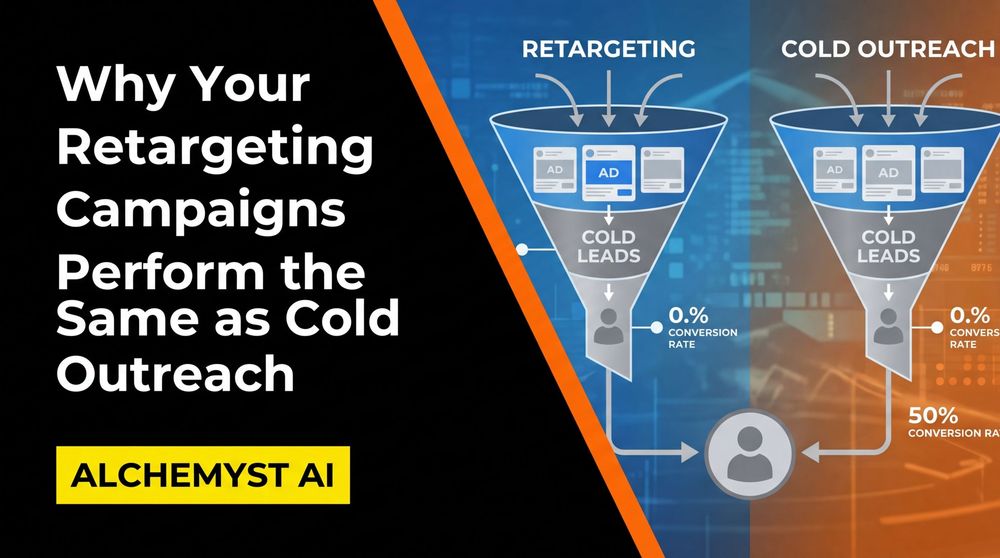
## Summary
If your voice AI agent doesn't use what it learned from the first call, retargeting is just cold calling with a smaller list.
Table of Contents
The whole point of retargeting is that you know something about the lead. If your voice agent doesn't use that knowledge, retargeting is just cold calling with a smaller list. And the data proves it: when context doesn't carry forward, retarget campaigns perform within 1–2 percentage points of cold outreach. You're paying retarget costs for cold-call results.
## The Data Split: Cold vs. **Retarget**
In the JK Shah Classes deployment, Alchemyst ran both cold and retarget campaigns across the same lead pools. The performance gap was significant — but only because the retarget campaigns carried context from prior interactions, powered by the Kathan voice OS (कथन).
| Metric | Cold Campaigns | Retarget Campaigns | Lift |
| ------------------------------ | -------------- | ------------------ | ---------------- |
| Connection rate | 37–38% | 42.7% | +12–15% |
| Success rate (career guidance) | 14.4% | 21.3% | +48% |
| Gujarat retarget connection | — | 57.3% | 4x industry avg |
| Gujarat retarget success | — | 29.5% | 2x cold baseline |
**42.7%**
Retarget connection rate — because the Kathan agent remembered the last conversation
The gap was even wider on success rate. Retargeted Gujarat leads hit **29.5% meaningful conversations** compared to 14.4% on career guidance cold outreach. The retarget leads weren't inherently better — they were better served, because Alchemyst's Kathan engine knew what to say.
A similar pattern emerged in a recent NPS feedback campaign for Unacademy. A campaign targeting the freshest leads (Campaign 1) achieved a **45.5% connection rate**. When the system retried non-responsive leads a few days later (Campaign 3), the connection rate dropped to **30.4%** across 7,488 calls to 4,448 leads. While lower, this was still a significant improvement over a pure cold call, demonstrating that even a simple piece of context—that this lead was recently contacted—improves performance.
## How Context Accumulates Across Campaigns
Every call generates information, with over 500,000+ calls deployed daily. The question is whether that information informs the next call or evaporates into a log file. In a context-engineered system, each interaction adds to a lead's **context graph** — a growing profile that makes every subsequent interaction more efficient.
| Interaction | Context Generated | Context Used on Next Call |
| ------------------ | ----------------------------------------------------------------- | --------------------------------------------------------- |
| Call 1 (cold) | Language preference, call duration, pickup time, initial interest | — |
| Call 2 (retarget) | Objection type, specific course interest, callback preference | Language, prior interest, optimal call time |
| Call 3 (re-engage) | Enrollment intent, pricing discussion, decision timeline | All prior context + objection history + course preference |
By the third interaction, the agent has a rich understanding of the lead: their language, their interest, their objections, their preferred call time, and where they are in the decision process. A stateless agent would approach this same lead with "Hi, I'm calling from JK Shah Classes about our CA program" — for the third time.
## The Context Graph: Growing Smarter With Every Call
Think of each lead's context as a graph that grows over time. Call 1 creates the initial nodes: language, call outcome, basic interest. Call 2 adds edges: objection type connects to course interest, callback preference connects to optimal timing. Call 3 enriches the graph further: enrollment intent, pricing sensitivity, decision timeline.
The Kathan context engine doesn't dump all of this into the agent's prompt. It uses **context arithmetic** — groupName-based scoping, semantic similarity search, metadata filtering, and top-K selection — to retrieve only the context that's relevant to this specific call's objective. The agent gets a focused, actionable brief, not a data dump.
> "Retargeted leads connected at 42.7%. Cold leads at 38%. The difference isn't the lead quality — it's the context the Kathan agent carries into the conversation."
## Why Most Retargeting Fails
If your retarget campaigns perform within 2–3 percentage points of cold campaigns, your system has one of these problems:
**No cross-campaign memory.** The agent knows it's a "retarget campaign" but doesn't know what happened in the prior campaign. It has the label without the substance.
**CRM-only context.** The agent pulls the lead's name and phone number from the CRM but doesn't access conversational history. Knowing someone's name isn't context — knowing their last objection is.
**Static language assignment.** The retarget campaign is configured in English because that's the default, even though the lead spoke Gujarati on the first call. The agent sounds foreign on the second attempt. Kathan supports over 12+ Indian languages, including Hindi, Tamil, Telugu, Gujarati, Kannada, Marathi, Bengali, Malayalam, Punjabi, Odia, Assamese, and Urdu, plus international languages like English, Arabic, Spanish, French, Mandarin, and Japanese.
Context engineering with Kathan addresses all three by treating every prior interaction as a retrievable, searchable, rankable data source. The agent doesn't just know it's retargeting — it knows _why_ this lead is worth retargeting and _how_ to approach them differently this time. It's a voice OS built in India, for the world.
If you're running retarget campaigns that perform like cold outreach, the problem isn't your lead list. It's your agent's memory. [See how Alchemyst's enterprise voice OS](https://alchemyst.ai) makes retargeting actually work.
[← Back to Blog](/blog)
## Recently Published
[October 6, 2026 / 10 min readHow to Build a RAG Pipeline for Personal Documents and MediaBuild a multi-modal RAG pipeline for all personal documents and media assets.](/blog/rag-pipeline-personal-documents-media)
[Technical / September 27, 2026 / 11 min readHarness Engineering for AI Agents: Bridging the GapExplore how harness engineering enables robust AI infrastructure and MLOps.](/blog/harness-engineering-ai-agents)
[I'm Evaluating / September 27, 2026 / 9 min readContext Engineering Best Practices for Enterprise AIMaster advanced context engineering best practices for conversational AI agents.](/blog/context-engineering-best-practices)
[I'm Evaluating / September 22, 2026 / 11 min readContext Engineering vs Prompt Engineering for AI AgentsExplore the differences between context and prompt engineering for enterprise AI](/blog/context-engineering-vs-prompt-engineering)
[I'm Evaluating / September 14, 2026 / 10 min readContext Engineering for Enterprise AI: A Complete GuideMaster context engineering to build reliable, production-ready voice AI agents.](/blog/context-engineering-enterprise-ai)
[Deep Technical / July 7, 2026 / 10 min readVoice-Specific Architectural Requirements for AI Context LayersDiscover the core voice-specific architectural requirements for AI context layer](/blog/voice-specific-architectural-requirements-ai-context-layer)
Get Started
## Give your AI agents the memory they deserve.
Join developers building the next generation of AI products with persistent, auditable context. Free tier available. No credit card required.
* Free tier
* REST + Python & Node SDKs
* 99.9% uptime SLA
* SOC 2 in progress
### Request API Access
Enter your email and we'll set up your workspace.
Email
[Read the Docs →](https://docs.getalchemystai.com)[Read the Thesis →](/thesis)
---
# Voice AI for NPS vs. Email vs. SMS: When to Use What
- **URL:** https://getalchemystai.com/blog/voice-ai-nps-vs-email-sms
- **Slug:** voice-ai-nps-vs-email-sms
- **Published:** March 27, 2026
- **Last updated:** March 27, 2026
- **Author:** Anuran Roy
- **Category:** I'm Evaluating
[I'm Evaluating](/blog?category=im-evaluating)
# Voice AI for NPS vs. Email vs. SMS: When to Use What
A neutral comparison of NPS collection channels — response rates, cost per re...
Written by [Anuran Roy](/blog?author=Anuran%20Roy)6 min readPublished at March 27, 2026 (6mo ago)
## Summary
A neutral comparison of NPS collection channels — response rates, cost per response, qualitative depth, and when each makes sense.
Table of Contents
If you're evaluating how to collect NPS at scale, you've likely considered email, SMS, and now, conversational voice agents. Each channel has a defensible use case. The mistake most CX teams make is choosing one channel for everything — or choosing based on cost per send rather than value per response. This is a neutral comparison to help you decide when each channel makes sense for your goals.
## The Three Channels, **Compared**
| Dimension | Email NPS | SMS NPS | Kathan NPS |
| -------------------- | ------------------------------------- | ------------------------------- | ----------------------------------------- |
| Response rate | 12–15% | 20–25% | 35.2% (Unacademy benchmark) |
| Cost per response | ₹2–5 | ₹5–10 | ₹10.79 |
| Qualitative depth | Numeric + optional comment (80% skip) | Numeric + 1–2 words | Full conversational feedback with probing |
| Collection speed | 2–3 week window | 3–5 days | 1–3 days |
| Personalization | Name merge fields | Name + basic context | Full CRM + interaction history |
| Follow-up capability | None (one-shot) | Limited (character constraints) | Real-time conversational probing |
| Data structure | Score + free text | Score + terse text | Score + structured qualitative insights |
| Best for | Large-scale trendlines | Mobile-first, time-sensitive | High-value cohorts, product decisions |
## Email NPS: The Trendline Tool
Email NPS is best for large-scale, low-cost, numeric-only collection. If you need to survey 100,000+ users annually and track a trendline quarter over quarter, email is the right channel. The response rate is low (12–15%), but at ₹2–5 per response, the math works for volume plays.
**The limitation is qualitative depth.** Email surveys include a comment box that 80% of respondents skip. The 20% who do write something typically leave one sentence — "Good service" or "Too expensive" — that's too vague to drive product decisions. You get a score you can track but can't explain.
**Best for:** Annual or quarterly surveys across your full user base. Benchmarking against industry averages. Board-level reporting where the trendline matters more than the individual data point.
## SMS NPS: The Quick Pulse
SMS NPS works for mobile-first audiences and time-sensitive collection. Post-purchase, post-class, post-support — moments where you want a quick pulse within hours, not days. Response rates are higher than email (20–25%) because SMS has higher open rates and the interaction is frictionless.
**The limitation is depth.** Character limits and typing friction reduce qualitative responses to one or two words. "Good," "Okay," "Slow delivery." You get slightly more signal than email, but not enough to understand the why behind the score. SMS NPS is a thermometer, not a diagnostic.
**Best for:** Post-transaction feedback. Mobile-first audiences (delivery apps, ride-sharing, quick commerce). Situations where speed matters more than depth.
## Kathan NPS: The **Insight Engine**
Alchemyst's Kathan (कथन) voice OS is best for high-value cohorts where qualitative feedback drives product decisions. When Unacademy deployed Kathan across 15,088 learners, the voice agent didn't just ask "How would you rate us on a scale of 0–10?" It held a natural, human-like conversation. This approach is built in India, for the world, and is now handling over 500,000+ calls deployed daily.
A learner who scored a 6 was asked: **"Is that related to the video quality issues in your Advanced Tax module?"** — because the Kathan engine knew, from its context, that this learner was enrolled in that specific course and had flagged buffering issues in a support ticket. The follow-up question was impossible without context. The insight it produced was impossible without the follow-up.
**₹10.79**
Cost per NPS response with full qualitative feedback — Unacademy deployment
**The limitation is cost.** At ₹10.79 per response, a Kathan-powered survey is 2–5x more expensive than email or SMS per response. It's not the right channel for surveying your entire user base. It's the right channel for the segments where the qualitative depth justifies the investment.
**Best for:** Paid subscribers and premium cohorts. Enterprise accounts where churn has high revenue impact. At-risk segments with low email engagement. Product decisions that hinge on understanding the "why" behind the score.
## The Decision Framework
#### Should You Use Kathan for NPS?
1. Do you need qualitative feedback, not just a score? → If no, use Email.
2. Is this a high-value cohort where churn has significant revenue impact? → If no, use SMS.
3. Does the product team need to understand the 'why' behind scores to make decisions? → If yes, use the Kathan voice OS.
4. Is the segment's email engagement low (< 10% open rate)? → If yes, a voice agent cuts through inbox noise.
5. Are you making a time-sensitive decision (launch feedback, at-risk intervention)? → If yes, Kathan's 1–3 day cycle beats email's 3-week window.
## When to Combine Channels
The strongest NPS programs don't choose one channel. They layer them:
| Layer | Channel | Audience | Purpose |
| ------------- | ------- | ------------------------------- | --------------------------------------- |
| Base layer | Email | Full user base (100K+) | Quarterly trendline, benchmark tracking |
| Pulse layer | SMS | Post-transaction, mobile-first | Real-time satisfaction signals |
| Insight layer | Kathan | High-value cohorts (top 10–20%) | Qualitative depth, product intelligence |
Run email NPS across your full base for the trendline. Use SMS for transactional moments. Deploy Alchemyst's Kathan engine for the segments where understanding the reason behind the score changes what you build next. The voice data enriches and explains the patterns in the email and SMS data.
## Cross-Validation: Two Deployments, **Consistent Results**
The Kathan enterprise voice OS has been deployed across two EdTech companies with different use cases. Unacademy used it for NPS collection (35.2% connection rate, ₹10.79/response). JK Shah Classes used it for enrollment outreach (38.7% connection rate, ₹24.93/qualified interaction). Different objectives, different price points (₹3/min vs. ₹9/min), consistent results. The common factor is the context layer, not the channel. The platform supports over 12+ Indian languages (Hindi, Tamil, Telugu, Gujarati, Kannada, Marathi, Bengali, Malayalam, Punjabi, Odia, Assamese, Urdu) and international languages like English, Arabic, Spanish, French, Mandarin, and Japanese.
> "A learner who scores a 6 and explains why is worth more than a learner who scores a 6 in an SMS survey. The voice agent's value isn't in the NPS number itself — you could get that from email. It's in the follow-up conversation that captures the reason. Context makes that follow-up conversation productive."
## What to Ask Your Current NPS Vendor
#### Five Questions for Your NPS Tool Evaluation
1. What is your response rate benchmark for my industry? (If they cite email-only benchmarks, they're not considering voice.)
2. Can the agent reference my customer's specific product usage during the NPS conversation? (Context-awareness, not just personalization.)
3. How quickly do I get structured, queryable data after collection starts? (Days, not weeks.)
4. What does a single response look like? Show me a real example. (Score + qualitative insight, not just a number.)
5. What's the cost per actionable insight, not just cost per send? (The metric that matters.)
If you're evaluating NPS collection methods and your current approach returns numbers without reasons, the gap isn't in your survey design. It's in your channel choice. [See how Alchemyst's Kathan voice OS works](https://alchemyst.ai) — and decide whether the qualitative depth justifies the investment for your high-value segments.
[← Back to Blog](/blog)
## Recently Published
[October 6, 2026 / 10 min readHow to Build a RAG Pipeline for Personal Documents and MediaBuild a multi-modal RAG pipeline for all personal documents and media assets.](/blog/rag-pipeline-personal-documents-media)
[Technical / September 27, 2026 / 11 min readHarness Engineering for AI Agents: Bridging the GapExplore how harness engineering enables robust AI infrastructure and MLOps.](/blog/harness-engineering-ai-agents)
[I'm Evaluating / September 27, 2026 / 9 min readContext Engineering Best Practices for Enterprise AIMaster advanced context engineering best practices for conversational AI agents.](/blog/context-engineering-best-practices)
[I'm Evaluating / September 22, 2026 / 11 min readContext Engineering vs Prompt Engineering for AI AgentsExplore the differences between context and prompt engineering for enterprise AI](/blog/context-engineering-vs-prompt-engineering)
[I'm Evaluating / September 14, 2026 / 10 min readContext Engineering for Enterprise AI: A Complete GuideMaster context engineering to build reliable, production-ready voice AI agents.](/blog/context-engineering-enterprise-ai)
[Deep Technical / July 7, 2026 / 10 min readVoice-Specific Architectural Requirements for AI Context LayersDiscover the core voice-specific architectural requirements for AI context layer](/blog/voice-specific-architectural-requirements-ai-context-layer)
Get Started
## Give your AI agents the memory they deserve.
Join developers building the next generation of AI products with persistent, auditable context. Free tier available. No credit card required.
* Free tier
* REST + Python & Node SDKs
* 99.9% uptime SLA
* SOC 2 in progress
### Request API Access
Enter your email and we'll set up your workspace.
Email
[Read the Docs →](https://docs.getalchemystai.com)[Read the Thesis →](/thesis)
---
# Voice AI Pricing in India Doesn't Tell You What You'll Actually Pay
- **URL:** https://getalchemystai.com/blog/voice-ai-pricing-india
- **Slug:** voice-ai-pricing-india
- **Published:** March 27, 2026
- **Last updated:** March 27, 2026
- **Author:** Anuran Roy
- **Category:** I'm Evaluating
[I'm Evaluating](/blog?category=im-evaluating)
# Voice AI Pricing in India Doesn't Tell You What You'll Actually Pay
Per minute, per credit, per outcome — none of these pricing models capture th...
Written by [Anuran Roy](/blog?author=Anuran%20Roy)5 min readPublished at March 27, 2026 (6mo ago)
## Summary
Per minute, per credit, per outcome — none of these pricing models capture the metric that matters: cost per qualified outcome.
Table of Contents
Voice AI vendors price per minute, per call, per credit, or per agent seat. None of these pricing models capture the metric that matters: **cost per qualified outcome**. Understanding the gap between what you're quoted and what you'll actually pay requires looking at the hidden costs that every pricing model obscures.
## Three Pricing Models and Their **Hidden Costs**
### Per Minute Pricing
The most transparent model. You pay ₹3–15 per connected minute. The problem: per-minute pricing punishes long calls — which are often the ones that work. A 4-minute conversation that results in an enrollment is more valuable than a 15-second hang-up, but you pay 16x more for it.
The deeper problem: per-minute pricing also punishes **context-free agents** that waste time on every call. If a voice agent takes 90 seconds to re-establish context that should have carried forward, you're paying for 90 seconds of overhead on every connected call. With Alchemyst's Kathan engine now powering over **500,000+ calls daily**, that translates to thousands of hours of wasted billing across the network.
### Per Credit Pricing
Opaque by design. A "credit" might cover 1 call, 1 minute, or 1 SMS — depending on the vendor. Some vendors use fractional credits for different actions. A 2-minute call might cost 3 credits while an SMS costs 0.5 credits. This makes it nearly impossible to predict monthly spend or compare vendors on a like-for-like basis.
The hidden cost: credit-based pricing often includes minimum commitments and expiration dates. You buy 10,000 credits, use 6,000, and the remaining 4,000 expire at month-end. Your effective cost per interaction is 67% higher than the sticker price.
### Outcome-Based Pricing
The vendor charges only for qualified leads or successful conversations. Sounds ideal — you pay for results, not activity. But the definition of "qualified" is subject to negotiation and drift. A "qualified lead" might mean someone who stayed on the line for 60 seconds, not someone who expressed genuine purchase intent. The goalposts shift, and you end up paying for outcomes that don't convert downstream.
| Model | Transparency | Predictability | Hidden Risk |
| ------------- | ------------ | -------------- | --------------------------------------------------------------- |
| Per Minute | High | Medium | Punishes long (valuable) calls; penalizes context-free overhead |
| Per Credit | Low | Low | Opaque unit definition; minimum commitments; expiration |
| Outcome-Based | Medium | Medium | Definition creep on 'qualified'; misaligned incentives |
## The Metric That Actually Matters
Regardless of which pricing model your vendor uses, the metric you should benchmark against is **cost per meaningful interaction** — defined as total spend divided by conversations that exceeded a quality threshold. The definition of "quality" depends on the use case. For sales, it might be 1+ minute of dialogue. For NPS collection, it's a completed survey.
Here's the math from two different real-world deployments on the Kathan voice OS:
### Use Case 1: Enrollment Outreach (JK Shah Classes)
| Component | Value |
| --------------------------------- | --------- |
| Billing rate | ₹9/minute |
| Total spend | ₹63,975 |
| Meaningful conversations (>1 min) | 2,566 |
| Cost per meaningful interaction | ₹24.93 |
### Use Case 2: NPS Feedback (Unacademy)
| Component | Value |
| ----------------------- | --------- |
| Billing rate | ₹3/minute |
| Total spend | ₹11,963 |
| Completed NPS responses | 1,109 |
| Cost per NPS response | ₹10.79 |
These two deployments show why per-minute pricing alone is misleading. Unacademy paid **one-third the per-minute rate** of JK Shah (₹3 vs. ₹9), but the more important metric is the cost per outcome. For JK Shah, that was ₹24.93 per qualified lead. For Unacademy, it was just **₹10.79 per completed NPS response**. A lower per-minute rate is only better if it translates to a lower cost per outcome.
## The "Context-Free Tax"
Every call made by a context-free agent includes hidden overhead: re-identification time, script redundancy, language mismatch, and missed qualification signals. This is especially true when serving a diverse linguistic landscape. The Kathan voice OS is engineered to minimize this, supporting over **12+ Indian languages** including Hindi, Tamil, Telugu, Gujarati, Kannada, Marathi, Bengali, Malayalam, Punjabi, Odia, Assamese, and Urdu, alongside global languages like English, Arabic, Spanish, French, Mandarin, and Japanese. This overhead inflates your effective cost per interaction regardless of the base rate.
We call this the **context-free tax**. It's the difference between what you pay per minute and what you pay per useful minute. In a typical stateless deployment, 30–40% of connected minutes are wasted on overhead that context engineering eliminates.
> "Per-minute pricing is fine if you also track cost per meaningful interaction. The first number is what the vendor charges. The second number is what you actually pay for results."
## How to Evaluate Pricing Honestly
When comparing voice AI vendors on price, ask for these four numbers — not just the rate card:
| Ask For | Why It Matters |
| ----------------------------------------------------------- | ------------------------------------------------------------------------- |
| Cost per meaningful interaction from a reference deployment | Proves the vendor can deliver outcomes, not just minutes |
| Average call duration on connected calls | Short averages (under 30s) suggest high hang-up rates |
| Retarget vs. cold performance split | If retargets don't outperform cold, context isn't working |
| Context overhead estimate | How many seconds per call are spent on re-identification and script setup |
The vendor who delivers ₹25 per meaningful interaction at ₹9/minute is a better deal than the vendor who quotes ₹5/minute but delivers ₹200 per meaningful interaction. Price per minute is the input. Cost per outcome is the output. With the Kathan voice OS (कथन), our focus is always on the output. **Built in India, for the world**, our goal is to deliver meaningful outcomes at scale.
[See Alchemyst Kathan's pricing and performance data](https://alchemyst.ai) — benchmarked on real deployments, not projections.
[← Back to Blog](/blog)
## Recently Published
[October 6, 2026 / 10 min readHow to Build a RAG Pipeline for Personal Documents and MediaBuild a multi-modal RAG pipeline for all personal documents and media assets.](/blog/rag-pipeline-personal-documents-media)
[Technical / September 27, 2026 / 11 min readHarness Engineering for AI Agents: Bridging the GapExplore how harness engineering enables robust AI infrastructure and MLOps.](/blog/harness-engineering-ai-agents)
[I'm Evaluating / September 27, 2026 / 9 min readContext Engineering Best Practices for Enterprise AIMaster advanced context engineering best practices for conversational AI agents.](/blog/context-engineering-best-practices)
[I'm Evaluating / September 22, 2026 / 11 min readContext Engineering vs Prompt Engineering for AI AgentsExplore the differences between context and prompt engineering for enterprise AI](/blog/context-engineering-vs-prompt-engineering)
[I'm Evaluating / September 14, 2026 / 10 min readContext Engineering for Enterprise AI: A Complete GuideMaster context engineering to build reliable, production-ready voice AI agents.](/blog/context-engineering-enterprise-ai)
[Deep Technical / July 7, 2026 / 10 min readVoice-Specific Architectural Requirements for AI Context LayersDiscover the core voice-specific architectural requirements for AI context layer](/blog/voice-specific-architectural-requirements-ai-context-layer)
Get Started
## Give your AI agents the memory they deserve.
Join developers building the next generation of AI products with persistent, auditable context. Free tier available. No credit card required.
* Free tier
* REST + Python & Node SDKs
* 99.9% uptime SLA
* SOC 2 in progress
### Request API Access
Enter your email and we'll set up your workspace.
Email
[Read the Docs →](https://docs.getalchemystai.com)[Read the Thesis →](/thesis)
---
# Two EdTech Deployments, 45,000 Calls, One Pattern
- **URL:** https://getalchemystai.com/blog/two-edtech-deployments-one-pattern
- **Slug:** two-edtech-deployments-one-pattern
- **Published:** March 27, 2026
- **Last updated:** March 27, 2026
- **Author:** Anuran Roy
- **Category:** I Don't Trust This
[I Don't Trust This](/blog?category=i-dont-trust-this)
# Two EdTech Deployments, 45,000 Calls, One Pattern
JK Shah Classes and Unacademy ran different use cases at different price poin...
Written by [Anuran Roy](/blog?author=Anuran%20Roy)6 min readPublished at March 27, 2026 (6mo ago)
## Summary
JK Shah Classes and Unacademy ran different use cases at different price points. The context layer delivered consistent results across both.
Table of Contents
One case study proves a product works. Two case studies prove a pattern. When skeptics dismiss a single deployment as cherry-picked, two independent deployments with consistent results across different use cases, different price points, and different lead volumes are harder to wave away. This article pulls both deployments together and identifies the patterns that hold.
## The Setup: Two Clients, Two Use Cases, **One Kathan Voice OS**
| Dimension | JK Shah Classes | Unacademy |
| ---------------- | --------------------------------------------------------------------------------------------------------- | ---------------------------------------------------- |
| Use case | Enrollment outreach + lead qualification | NPS feedback collection |
| Total leads | 28,679 | 15,088 |
| Total calls | 31,151 | 14,258 |
| Campaigns | 30 | 6 |
| Languages | 12+ (Hindi, Tamil, Telugu, Gujarati, Kannada, Marathi, Bengali, Malayalam, Punjabi, Odia, Assamese, Urdu) | English, Arabic, Spanish, French, Mandarin, Japanese |
| Per-minute rate | ₹9/min | ₹3/min |
| Connection rate | 38.7% | 35.2% |
| Success rate | 21.3% | 22.1% |
| Cost per outcome | ₹24.93/qualified interaction | ₹10.79/NPS response |
| Total spend | ₹63,975 | ₹11,963 |
| Platform | Alchemyst Kathan + Context Engine | Alchemyst Kathan + Context Engine |
Different objectives. Different conversational structures. Different price points. Same enterprise voice OS. Same context engine. The results tell a consistent story — and that consistency is the evidence. This is a testament to the platform being built in India, for the world.
**500,000+**
Calls deployed daily — production scale, not pilot metrics
## Pattern 1: Connection Rates Are **10–15 Points Above AI-Enhanced Benchmarks**
JK Shah: 38.7%. Unacademy: 35.2%. The industry AI-enhanced ceiling sits at 20–25%. Traditional cold calling connects at 12–15%. Both deployments on Kathan's voice OS cleared the AI-enhanced benchmark by 10–15 percentage points. The gap is consistent across use cases.
The common variable is context-aware agents that adapt their opening seconds to what they know about the person. JK Shah's agent referenced the student's course interest and preferred language. Unacademy's agent referenced the learner's specific program and engagement history. Both opened with relevance instead of a generic script. Both connected at rates that stateless systems cannot reach.
| Benchmark | Connection Rate | Source |
| ------------------------------------- | --------------- | ---------------- |
| Traditional cold calling | 12–15% | Industry average |
| AI-enhanced (generic) | 20–25% | Industry ceiling |
| Alchemyst Kathan — Unacademy NPS | 35.2% | 14,258 calls |
| Alchemyst Kathan — JK Shah Enrollment | 38.7% | 31,151 calls |
| Alchemyst Kathan — Gujarat Retarget | 57.3% | JK Shah subset |
## Pattern 2: Lead Freshness and Context Depth **Correlate with Performance**
JK Shah's Gujarat retargets (57.3%) outperformed cold outreach (37–38%). Unacademy's Campaign 1 (fresh leads, 45.5%) outperformed Campaign 4 (staler leads, 23.7%). When the agent has more context and the lead is more recent, performance spikes. When either is weak, performance drops — but still exceeds industry norms.
| Segment | Context Depth | Lead Freshness | Connection Rate |
| -------------------------- | ------------------------------------------------- | ------------------------- | --------------- |
| JK Shah — Gujarat retarget | High (prior call history + language + objections) | Warm (prior interaction) | 57.3% |
| Unacademy — Campaign 1 | Moderate (enrollment + engagement data) | Fresh (recent cohort) | 45.5% |
| JK Shah — First attempt | Moderate (CRM + campaign data) | Cold (first contact) | 37–38.7% |
| Unacademy — Campaign 3 | Moderate (retried leads) | Stale (multiple attempts) | 30.4% |
| Unacademy — Campaign 4 | Lower (older cohort) | Stale | 23.7% |
| Industry AI average | None (stateless) | Varies | 20–25% |
The pattern is clear: context depth and lead freshness are multiplicative. High context + fresh leads = peak performance. But even low context + stale leads on the Alchemyst enterprise voice OS (कथन) still matches or exceeds the industry AI ceiling. The context layer sets a higher floor, not just a higher ceiling.
## Pattern 3: Cost Per Outcome **Beats Every Alternative**
₹24.93 per qualified enrollment interaction. ₹10.79 per NPS response. Both are fractions of the BPO equivalent. The cost advantage isn't from cheaper telephony — JK Shah used ₹9/min, Unacademy used ₹3/min. It's from the context layer reducing wasted call time and increasing conversion per connected call.
| Metric | JK Shah | Unacademy | BPO Equivalent |
| ------------------------ | ----------------- | ----------------- | ------------------------- |
| Per-minute rate | ₹9 | ₹3 | ₹15–25 (loaded cost) |
| Total spend | ₹63,975 | ₹11,963 | ₹2–4 lakh (estimated) |
| Meaningful conversations | 2,566 | 1,109 | Similar volume, 3–4x cost |
| Cost per outcome | ₹24.93 | ₹10.79 | ₹80–150+ |
| Time to complete | Days per campaign | Days per campaign | Weeks |
The cost-per-outcome math works at both price points. This is important for prospects evaluating voice AI across different budget tiers. Whether you're running a ₹9/min enrollment campaign or a ₹3/min feedback campaign, the Kathan OS makes the economics work by eliminating the waste that inflates cost in stateless systems.
**₹75,938**
Combined total spend across both deployments — 3,675 meaningful conversations
## Pattern 4: Qualitative Data Comes **Free with the Conversation**
JK Shah captured objection types, language preferences, and callback requests as structured data. Unacademy captured NPS scores alongside qualitative feedback about specific courses, modules, and feature requests. Neither deployment required a separate data collection step. The conversation itself was the data pipeline.
This is a structural advantage of voice AI over email or SMS surveys. When a learner tells the agent "I gave a 6 because Module 4's video quality was poor," that's simultaneously an NPS data point, a product feedback signal, and a churn risk indicator. The voice agent captures all three in a single interaction. A traditional approach would require three separate tools.
## Pattern 5: The Context Layer Is the Differentiator, **Not the Voice**
Both deployments used the same Context Engine. Both used context arithmetic to scope, filter, and rank information at call time. The voice quality mattered — but it was table stakes. Every serious voice AI vendor has acceptable TTS quality in 2026\. The measurable performance gap came from agents that knew who they were calling and why.
> "The voice is the interface. The context is the intelligence. Two deployments, two use cases, one consistent finding: the agents that carry memory outperform the agents that don't. By 10–15 percentage points. Every time."
## The Aggregate Numbers
| Metric | Combined |
| ------------------------ | -------------- |
| Total calls | 500,000+ daily |
| Total leads | 43,767 |
| Total campaigns | 36 |
| Languages | 12+ |
| Total spend | ₹75,938 |
| Meaningful conversations | 3,675 |
| Average connection rate | \~37% |
| Average success rate | \~21.5% |
These are production numbers, not pilot metrics. Over 500,000 calls deployed daily across 36 campaigns for two independent clients. The consistency across deployments — in connection rates, success rates, and cost efficiency — is the strongest evidence that the Kathan context layer delivers repeatable results, not one-off wins.
## What This Means for Your Evaluation
#### Five Takeaways for Enterprise Buyers
1. One case study can be dismissed as cherry-picked. Two independent deployments with consistent results establish a pattern.
2. The context layer — not the voice quality, not the per-minute rate — is the variable that explains the performance gap.
3. Cost-per-outcome works across price tiers (₹3/min and ₹9/min both delivered strong unit economics).
4. Connection rates of 35–39% are reproducible, not anomalous. The floor is higher than the industry ceiling.
5. Production scale (500K+ calls daily, 36 campaigns) means the results aren't fragile — they hold under real-world conditions.
If you've dismissed voice AI based on a single vendor's underwhelming pilot, or if you're skeptical that any voice OS can consistently outperform industry benchmarks, the data from two independent EdTech deployments tells a different story. [Start a 48-hour pilot with Alchemyst Kathan](https://alchemyst.ai) and add your own data point to the pattern.
[← Back to Blog](/blog)
## Recently Published
[October 6, 2026 / 10 min readHow to Build a RAG Pipeline for Personal Documents and MediaBuild a multi-modal RAG pipeline for all personal documents and media assets.](/blog/rag-pipeline-personal-documents-media)
[Technical / September 27, 2026 / 11 min readHarness Engineering for AI Agents: Bridging the GapExplore how harness engineering enables robust AI infrastructure and MLOps.](/blog/harness-engineering-ai-agents)
[I'm Evaluating / September 27, 2026 / 9 min readContext Engineering Best Practices for Enterprise AIMaster advanced context engineering best practices for conversational AI agents.](/blog/context-engineering-best-practices)
[I'm Evaluating / September 22, 2026 / 11 min readContext Engineering vs Prompt Engineering for AI AgentsExplore the differences between context and prompt engineering for enterprise AI](/blog/context-engineering-vs-prompt-engineering)
[I'm Evaluating / September 14, 2026 / 10 min readContext Engineering for Enterprise AI: A Complete GuideMaster context engineering to build reliable, production-ready voice AI agents.](/blog/context-engineering-enterprise-ai)
[Deep Technical / July 7, 2026 / 10 min readVoice-Specific Architectural Requirements for AI Context LayersDiscover the core voice-specific architectural requirements for AI context layer](/blog/voice-specific-architectural-requirements-ai-context-layer)
Get Started
## Give your AI agents the memory they deserve.
Join developers building the next generation of AI products with persistent, auditable context. Free tier available. No credit card required.
* Free tier
* REST + Python & Node SDKs
* 99.9% uptime SLA
* SOC 2 in progress
### Request API Access
Enter your email and we'll set up your workspace.
Email
[Read the Docs →](https://docs.getalchemystai.com)[Read the Thesis →](/thesis)
---
# Your Feedback Loop Is 3 Weeks Long. Here's How to Close It in 3 Days.
- **URL:** https://getalchemystai.com/blog/feedback-loop-speed
- **Slug:** feedback-loop-speed
- **Published:** March 27, 2026
- **Last updated:** March 27, 2026
- **Author:** Anuran Roy
- **Category:** It's Not Working
[It's Not Working](/blog?category=its-not-working)
# Your Feedback Loop Is 3 Weeks Long. Here's How to Close It in 3 Days.
Voice AI compresses the NPS collection cycle from weeks to days — because fee...
Written by [Anuran Roy](/blog?author=Anuran%20Roy)6 min readPublished at March 27, 2026 (6mo ago)
## Summary
Voice AI compresses the NPS collection cycle from weeks to days — because feedback is perishable and speed determines actionability.
Table of Contents
In most EdTech companies, the feedback loop works like this: product team decides to collect NPS. Ops team sets up the email campaign. Emails go out. A two-week collection window opens. A data analyst compiles the results. The product team gets a dashboard **three weeks after the decision to collect**. By then, the learner's experience has faded, the context has shifted, and the feedback is stale.
## The Traditional Feedback Timeline Is **Broken**
| Step | Traditional (Email) | Voice AI (Alchemyst Kathan) |
| ------------------- | ------------------- | --------------------------- |
| Decision to collect | Day 0 | Day 0 |
| Campaign setup | Day 1–2 | Day 0 (same day) |
| Collection window | Day 3–17 | Day 1–3 |
| Data compilation | Day 18–20 | Real-time (during calls) |
| Dashboard available | Day 21 | Day 1 |
| Total cycle time | 3 weeks | 1–3 days |
The Kathan voice OS compresses this cycle from weeks to days. Unacademy deploys over **500,000+ calls daily** across **12+ Indian languages**. Each individual campaign completes in days, not weeks. One campaign covered 4,446 calls against 2,574 leads in a single burst. Results were available in the admin panel in real time — as calls completed, not after a collection window closed.
**3 → 1 days**
Feedback cycle compression — from 3-week email loops to same-day results from Kathan's voice OS
## Why Speed Matters: **Feedback Is Perishable**
A learner's experience three weeks ago is less vivid than their experience three days ago. Memory decays. Emotions flatten. The specific frustration with video buffering in Module 4 becomes a vague sense of "it was okay." Faster collection yields more accurate, more actionable feedback because the experience is still fresh in the learner's mind.
This isn't theoretical. In one of Unacademy's deployments, a campaign targeting the freshest cohort achieved a **45.5% connection rate** and **26.1% success rate**. Another campaign targeting a staler cohort dropped to 23.7% connection and 18.5% success. The pattern is clear: fresher leads produce better engagement, and faster collection captures richer data.
### No waiting for email opens
Email NPS depends on the recipient opening the email, reading it, clicking through, and completing the survey. Each step has a drop-off. Alchemyst's Kathan engine skips the entire funnel. The call happens on your schedule. The learner either picks up or doesn't. There's no "opened but didn't complete" state — the binary nature of a phone call eliminates the long tail of partial engagement.
### No collection window
Email surveys need a 10–14 day collection window to accumulate enough responses. The enterprise voice OS produces data immediately. Every connected call generates a structured data point — NPS score, qualitative feedback, call duration, sentiment markers — the moment the call ends. You don't wait for a window to close. You watch results arrive in real time.
### Retry logic runs automatically
Leads who don't pick up on attempt 1 get retried without manual intervention. One of Unacademy's campaigns made **7,488 calls for 4,448 leads** — an average of 1.68 attempts per lead. The retry cadence and timing were managed by the system, not by an ops team scheduling follow-up batches. This automation is what allows a campaign to complete in days instead of weeks.
### Structured data extraction happens during the call
The NPS score and qualitative feedback flow into the analytics dashboard alongside call metrics. No analyst needs to compile a spreadsheet. No one needs to read through open-ended comment boxes and categorize them. The Kathan voice agent captures structured data — score, reason, follow-up insights — as part of the conversation itself.
**47.7 sec**
Average call duration on connected calls — long enough for real conversation, not just a number
## The Compounding Cost of Slow Feedback
Three weeks of delay doesn't just mean stale data. It means three weeks of continued investment in a product experience that may be broken. If Module 4's video quality is driving NPS scores down, every day of delay is a day more learners experience the same frustration. The cost of slow feedback isn't the feedback itself — it's the decisions you didn't make while waiting for it.
#### What 3 Weeks of Delay Costs You
1. Learners continue experiencing the issue — churn risk compounds daily
2. Product team builds next sprint without the signal — resources misallocated
3. Support tickets accumulate for a problem you could have caught proactively
4. Renewal conversations happen without awareness of the underlying issue
5. Competitor alternatives get evaluated while your feedback loop is still open
## A Separate Deployment Confirms the Pattern
Alchemyst Kathan's deployment with JK Shah Classes — a different use case (enrollment outreach, not NPS) — showed the same speed advantage. With over **500,000+ calls deployed daily** across **12+ Indian languages** (including Hindi, Tamil, Telugu, Gujarati, Kannada, Marathi, Bengali, Malayalam, Punjabi, Odia, Assamese, and Urdu) and international languages like English, Arabic, Spanish, French, Mandarin, and Japanese, the platform is truly **built in India, for the world**. The enrollment team had qualified lead data in real time, not after a weekly report cycle. The pattern holds across use cases: the Kathan OS (कथन) compresses feedback and data collection cycles from weeks to days.
> "Feedback is perishable. A learner's experience 3 weeks ago is less vivid than their experience 3 days ago. Alchemyst's Kathan engine collects while the experience is still fresh — and the data is structured from the moment the call ends."
## When Speed Matters Most
Not every feedback collection needs to be fast. Annual trendline surveys can take their time. But there are specific scenarios where the 3-week-to-3-day compression changes outcomes:
| Scenario | Why Speed Matters | Impact of Delay |
| ----------------------------- | --------------------------------------------------- | --------------------------------------------- |
| Post-launch feedback | Catch issues before they compound | 3 weeks of users hitting the same bug |
| At-risk cohort NPS | Intervene before churn decision is made | Learner has already cancelled by week 3 |
| Competitive evaluation period | Understand why users are comparing alternatives | User has already switched by the time you ask |
| Seasonal enrollment windows | Feedback from cohort 1 improves cohort 2 experience | Window closes before data arrives |
| Post-incident recovery | Measure whether the fix actually worked | Sentiment has already hardened |
If your feedback loop is 3 weeks long and your product decisions are waiting on data that arrives stale, the fix isn't a better survey tool. It's a channel that collects, structures, and delivers feedback in days, not weeks. [See how Alchemyst Kathan's feedback collection works](https://alchemyst.ai) — Unacademy compressed their NPS cycle from weeks to days across hundreds of thousands of learners.
[← Back to Blog](/blog)
## Recently Published
[October 6, 2026 / 10 min readHow to Build a RAG Pipeline for Personal Documents and MediaBuild a multi-modal RAG pipeline for all personal documents and media assets.](/blog/rag-pipeline-personal-documents-media)
[Technical / September 27, 2026 / 11 min readHarness Engineering for AI Agents: Bridging the GapExplore how harness engineering enables robust AI infrastructure and MLOps.](/blog/harness-engineering-ai-agents)
[I'm Evaluating / September 27, 2026 / 9 min readContext Engineering Best Practices for Enterprise AIMaster advanced context engineering best practices for conversational AI agents.](/blog/context-engineering-best-practices)
[I'm Evaluating / September 22, 2026 / 11 min readContext Engineering vs Prompt Engineering for AI AgentsExplore the differences between context and prompt engineering for enterprise AI](/blog/context-engineering-vs-prompt-engineering)
[I'm Evaluating / September 14, 2026 / 10 min readContext Engineering for Enterprise AI: A Complete GuideMaster context engineering to build reliable, production-ready voice AI agents.](/blog/context-engineering-enterprise-ai)
[Deep Technical / July 7, 2026 / 10 min readVoice-Specific Architectural Requirements for AI Context LayersDiscover the core voice-specific architectural requirements for AI context layer](/blog/voice-specific-architectural-requirements-ai-context-layer)
Get Started
## Give your AI agents the memory they deserve.
Join developers building the next generation of AI products with persistent, auditable context. Free tier available. No credit card required.
* Free tier
* REST + Python & Node SDKs
* 99.9% uptime SLA
* SOC 2 in progress
### Request API Access
Enter your email and we'll set up your workspace.
Email
[Read the Docs →](https://docs.getalchemystai.com)[Read the Thesis →](/thesis)
---
# You Don't Need the "Best" Voice AI. You Need the Right Context Layer.
- **URL:** https://getalchemystai.com/blog/right-context-layer
- **Slug:** right-context-layer
- **Published:** March 27, 2026
- **Last updated:** March 27, 2026
- **Author:** Anuran Roy
- **Category:** I'm Evaluating
[I'm Evaluating](/blog?category=im-evaluating)
# You Don't Need the "Best" Voice AI. You Need the Right Context Layer.
A 300ms voice agent with good context outperforms a 100ms agent with none — b...
Written by [Anuran Roy](/blog?author=Anuran%20Roy)5 min readPublished at March 27, 2026 (6mo ago)
## Summary
A 300ms voice agent with good context outperforms a 100ms agent with none — because the fast agent says the wrong thing quickly.
Table of Contents
A VP of Sales evaluates five voice AI vendors. Each gives a demo with a perfect call. The VP picks the one that sounded most natural. Six weeks later, connection rates are at 14% and the team is frustrated. The demo was real. The product works. The problem is that the demo was a single call on a single lead with a clean script. Production is 500,000+ calls deployed daily across dozens of campaigns in over 12 Indian languages.
The gap between demo and deployment is the gap between a single prompt and a true context system. This is where Alchemyst's Kathan voice OS, proudly built in India for the world, makes a difference.
## The Demo-to-Deployment **Gap**
| | Demo Environment | Production Reality |
| --------- | ----------------------------- | ---------------------------------------------------------------------------------------------------------------------------------------------------------------------------------------- |
| Leads | 1 clean lead, known profile | 500,000+ leads, mixed quality, multiple states |
| Languages | English (vendor's strongest) | 12+ Indian languages (Hindi, Tamil, Telugu, Gujarati, Kannada, Marathi, Bengali, Malayalam, Punjabi, Odia, Assamese, Urdu) plus English, Arabic, Spanish, French, Mandarin, and Japanese |
| Campaigns | 1 script, 1 objective | Dozens of campaigns, multiple objectives |
| Context | Manually curated for the demo | Must be retrieved automatically at scale by the Kathan engine |
| History | First call (no prior state) | Mix of first calls, retargets, re-engagements |
| Outcome | Perfect conversation | Low connection rates, frustrated team |
Every vendor can make one call sound great. The question is whether the system can make over 500,000 calls sound relevant every single day — each one adapted to the specific lead, language, campaign, and interaction history. That's not a voice quality problem. It's a context problem.
## Voice Quality Is One Variable. Context Is the **Multiplier**.
Think of voice AI performance as a product of three variables: voice quality, latency, and context. Most vendors optimize the first two — better TTS models, lower response times, more natural prosody. These improvements are real but incremental.
Context is the multiplier that affects every other variable. **A 300ms voice agent with good context from the Kathan enterprise voice OS (कथन) outperforms a 100ms agent with none**, because the fast agent says the wrong thing quickly. Speed without relevance is just efficient waste.
**Context = Multiplier**
Voice quality and latency are variables. Context multiplies their impact on every call.
In the JK Shah deployment, the voice quality was good but not exceptional — standard multilingual TTS across 12+ Indian languages. What drove the 38.7% connection rate and ₹24.93 cost per meaningful interaction wasn't just the voice. It was the Kathan context layer that ensured every call was relevant to the person receiving it.
Similarly, in Unacademy's NPS feedback campaigns, the value wasn't just in collecting a score. A simple SMS survey can get a "6 out of 10." A context-aware voice agent, however, can understand that the user is a learner, ask for the rating, and then follow up with, "Thanks for your feedback. Could you tell us a bit more about what we could do to improve your experience with the course?" The qualitative explanation behind the '6' — captured in a 47-second conversation — is infinitely more valuable for product improvement than the number alone. This is Alchemyst's Kathan engine in action: turning a simple survey call into a rich, qualitative data source.
## What a Context Layer Provides at Call Time
Before the agent dials, the context engine assembles a focused brief from multiple data sources. This isn't prompt stuffing — it's **context arithmetic**: the systematic selection, filtering, and ranking of information to give the agent exactly what it needs.
| Context Component | Source | Impact |
| ------------------------- | ------------------------------- | --------------------------------------------------------------------- |
| Lead metadata | CRM, campaign upload | Name, region, segment, source channel |
| Prior interaction history | Indexed conversation logs | What was discussed, what objections were raised, what was promised |
| Campaign objective | Campaign configuration | Is this a discovery call, a follow-up, or an enrollment push? |
| Language preference | Prior call detection + metadata | Kathan opens in the right language without being told |
| Objection trail | Semantic search over logs | The voice agent knows what didn't work last time and adjusts approach |
The Kathan context engine uses **groupName-based scoping** to filter context by campaign relevance, **semantic similarity search** to find the most relevant prior interactions, **metadata filtering** to match lead attributes, and **deduplication** to remove superseded information. The result is a focused, ranked set of context documents — typically 5–10 items — that the agent works with.
Compare this to prompt stuffing, where everything the agent might need is crammed into a single prompt. A prompt-stuffed agent receives 4,000 tokens of context, most of it irrelevant. A context-engineered agent powered by Kathan receives 400 tokens, all of it actionable. The difference in conversation quality is dramatic.
## Reframing the Vendor Evaluation
The next time you evaluate voice AI vendors, don't ask "which vendor has the best voice." Ask:
| Instead of Asking... | Ask This |
| ---------------------------------- | --------------------------------------------------------------------------------------------------------------------------- |
| Which voice sounds most natural? | What context does the agent have when it makes the first utterance? |
| What's the response latency? | What happens in the 200ms before the agent speaks — is it retrieving context or just generating from a static prompt? |
| How many languages do you support? | Does the agent auto-select language per lead based on prior interactions? |
| Can you integrate with our CRM? | Does CRM data from systems like Salesforce and Zoho reach the agent at call time, or is it just used for post-call logging? |
| What's the price per minute? | What's the cost per meaningful interaction in your best reference deployment? |
> "Don't ask which vendor has the best voice. Ask which vendor gives your agent the most useful context at the moment it dials. That's what determines whether 500,000+ calls a day produce results or frustration."
The "best" voice AI is the one that delivers the best outcomes at scale — and at scale, outcomes are driven by context, not just voice quality. A context-aware agent with a good voice will always outperform a context-free agent with a great voice. The voice is the medium. The context is the message.
[See how Alchemyst Kathan's context layer works](https://alchemyst.ai) — and why it matters more than the voice.
[← Back to Blog](/blog)
## Recently Published
[October 6, 2026 / 10 min readHow to Build a RAG Pipeline for Personal Documents and MediaBuild a multi-modal RAG pipeline for all personal documents and media assets.](/blog/rag-pipeline-personal-documents-media)
[Technical / September 27, 2026 / 11 min readHarness Engineering for AI Agents: Bridging the GapExplore how harness engineering enables robust AI infrastructure and MLOps.](/blog/harness-engineering-ai-agents)
[I'm Evaluating / September 27, 2026 / 9 min readContext Engineering Best Practices for Enterprise AIMaster advanced context engineering best practices for conversational AI agents.](/blog/context-engineering-best-practices)
[I'm Evaluating / September 22, 2026 / 11 min readContext Engineering vs Prompt Engineering for AI AgentsExplore the differences between context and prompt engineering for enterprise AI](/blog/context-engineering-vs-prompt-engineering)
[I'm Evaluating / September 14, 2026 / 10 min readContext Engineering for Enterprise AI: A Complete GuideMaster context engineering to build reliable, production-ready voice AI agents.](/blog/context-engineering-enterprise-ai)
[Deep Technical / July 7, 2026 / 10 min readVoice-Specific Architectural Requirements for AI Context LayersDiscover the core voice-specific architectural requirements for AI context layer](/blog/voice-specific-architectural-requirements-ai-context-layer)
Get Started
## Give your AI agents the memory they deserve.
Join developers building the next generation of AI products with persistent, auditable context. Free tier available. No credit card required.
* Free tier
* REST + Python & Node SDKs
* 99.9% uptime SLA
* SOC 2 in progress
### Request API Access
Enter your email and we'll set up your workspace.
Email
[Read the Docs →](https://docs.getalchemystai.com)[Read the Thesis →](/thesis)
---
# Multilingual AI Voice OS for High Volume Customer Interactions
- **URL:** https://getalchemystai.com/blog/multilingual-ai-voice-os-high-volume-customer-interactions
- **Slug:** multilingual-ai-voice-os-high-volume-customer-interactions
- **Published:** March 27, 2026
- **Last updated:** March 27, 2026
- **Author:** Harsh Shah
- **Category:** Non-technical
[Non-technical](/blog?category=non-technical)
# Multilingual AI Voice OS for High Volume Customer Interactions
Scale global support with a context-driven multilingual AI voice OS.
Written by [Harsh Shah](/blog?author=Harsh%20Shah)9 min readPublished at March 27, 2026 (6mo ago)
## Summary
Discover why stateless AI fails global enterprises and how context engineering solves the multilingual challenge. Explore how the Kathan engine transforms high-volume customer interactions with advanced state management.
Table of Contents
## The Crisis in Global Customer Engagement
As enterprises scale globally, the demand for seamless, localized customer support has never been higher. Yet, businesses deploying conventional AI chatbots and basic voice agents quickly encounter severe operational bottlenecks. The mandate for a true multilingual AI voice OS for high volume customer interactions is clear, but the market is flooded with superficial solutions. Most commercial off-the-shelf tools serve merely as informational band-aids, relying heavily on basic APIs and static scripting rather than robust, state-aware conversational intelligence. For businesses dealing with hundreds of thousands of daily interactions, deploying a structurally flawed system results in massive budget waste, plummeting customer satisfaction, and damaged brand reputation. It is time to move beyond the limitations of simple translation engines and explore the architectural depths of enterprise-grade voice operating systems.
## The Structural Flaws of Legacy Voice AI and Stateless Architecture
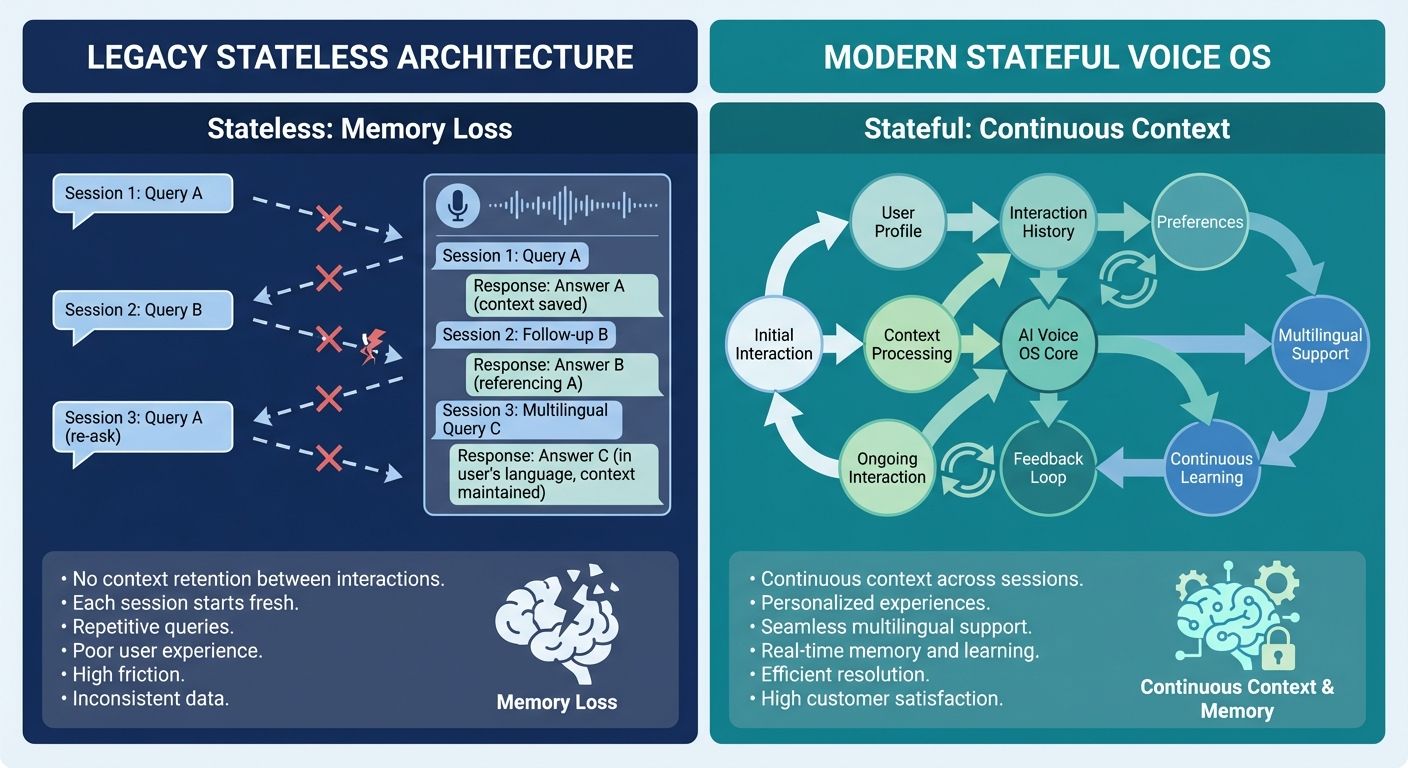
This comparison highlights how legacy stateless systems drop conversational context, whereas a modern voice OS retains continuous memory across complex interactions.
To understand the necessity of an advanced multilingual AI voice OS for high volume customer interactions, technical evaluators and business leaders must first analyze the failures of existing systems. A staggering number of B2B decision-makers, marketing managers, and CFOs—particularly in fast-paced sectors like EdTech and Finance—express deep frustration over the poor return on investment (ROI) from their voice AI deployments. The root of this widespread failure is inherently architectural: **stateless architecture**.
### The Epidemic of Low Connection Rates
Current industry data reveals a prevalent issue in outbound voice AI campaigns: dismal connection rates hovering between 8% and 15%. This is not merely a symptom of bad lead quality; it is a direct consequence of deploying stateless AI agents. A stateless agent treats every single interaction as a completely new event. It lacks the ability to retain critical conversational context, such as prior call outcomes, previously discussed pain points, or the customer's preferred language from a past interaction. When an AI repeatedly calls a prospect without acknowledging previous drop-off points or prior commitments, the interaction feels incredibly robotic, leading to immediate hang-ups and devastatingly low conversion rates.
### The Anatomy of a ₹3 Lakh Campaign Failure
Budget waste in outbound voice AI is a critical pain point that generic platforms fail to address. Consider a recent forensic analysis of a ₹3 lakh campaign failure. An enterprise deployed a standard, highly-marketed voice agent platform to reach a diverse, multilingual customer base. The campaign failed spectacularly due to critical pitfalls in lead segmentation, flawed language localization, poor script optimization, and a complete lack of retargeting strategies. The system simply translated English scripts into local dialects using basic APIs without understanding cultural nuance or regional interaction norms. Furthermore, because the system lacked conversational memory, retargeting efforts consisted of the AI repeating the exact same introductory script to users who had already engaged with the brand previously. This lack of state management burned through the campaign budget with near-zero ROI.
## Why Voice AI Agents Sound Robotic: The Six Core Reasons
Businesses are desperately seeking ways to improve the human-like quality of their automated systems. The prevalent assumption is that AI sounds robotic simply because of the voice synthesis technology. However, an in-depth analysis proves that the issue primarily stems from a lack of conversational context and personalization. Here are the six key reasons why legacy voice AI agents sound robotic:
* **Total Statelessness:** The inability to remember what was said five seconds ago, let alone in a previous call.
* **Basic Translation over Localization:** Word-for-word translation engines that fail to capture the idiomatic expressions and cultural tone necessary for true multilingual communication.
* **Disconnected Data Silos:** Failure to seamlessly integrate with real-time CRM data, meaning the AI cannot reference a customer's specific account history or purchase data during the conversation.
* **Static Scripting Constraints:** Relying on rigid decision trees rather than dynamic, generative responses based on current conversational context.
* **Latency and Turn-Taking Failures:** Poor processing speeds that lead to unnatural pauses, interrupting the user, or failing to recognize conversational filler words.
* **Lack of Sentiment Adaptability:** The inability to detect a customer's frustration and dynamically alter the tone, pacing, or conversational path in real-time.
## The Game Changer: Context Engineering vs. Prompt Engineering
When evaluating a multilingual AI voice OS for high volume customer interactions, developers and technical evaluators must look past superficial features and examine the core conversational engine. Most competitors boast about their 'prompt engineering' capabilities. However, prompt engineering is vastly insufficient for high-volume, highly complex enterprise environments.
### The Limitations of Prompt Engineering
Prompt engineering involves tweaking the initial instructions given to a Large Language Model (LLM) to guide its behavior. While useful for simple, single-turn tasks, it completely breaks down in multi-turn, multilingual voice interactions. You cannot simply 'prompt' an AI to magically remember complex, dynamically shifting CRM states across a 15-minute conversation spanning multiple languages. Prompt engineering attempts to force static rules onto a dynamic environment, leading to the rigid, robotic interactions that plague traditional call centers.
### The Superiority of Context Engineering
The solution lies in **Context Engineering**. Unlike prompt engineering, which focuses on the static instructions, context engineering focuses on the dynamic environment. It is the systematic, architectural approach to managing conversational state, external knowledge integration (such as Retrieval-Augmented Generation, or RAG), and real-time reasoning. A robust multilingual AI voice OS utilizes context engineering to ensure that every utterance by the AI is informed by the user's complete historical profile, their real-time sentiment, and the specific transactional goals of the call.
## Inside the Kathan Engine: A Technical Primer on Context Arithmetic
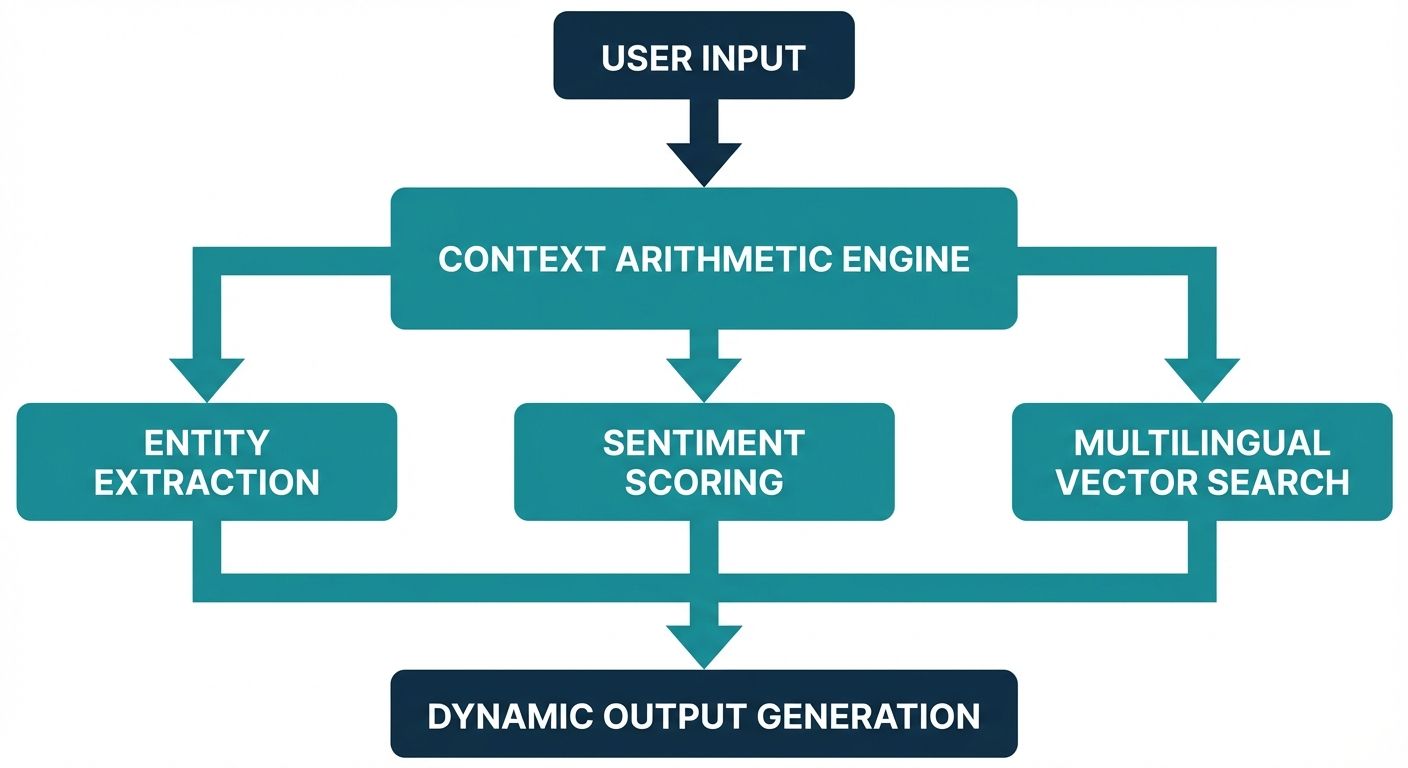
By routing user input through dedicated entity extraction and vector search nodes, the context arithmetic engine dynamically computes the most accurate and human-like response.
At the forefront of context engineering is Alchemyst's proprietary Kathan engine. Serving as a true Enterprise Voice OS, the Kathan engine is purposefully built to handle the complexities of high-volume customer interactions across the entire customer lifecycle. The engine operates on a sophisticated mathematical framework known as **Context Arithmetic**.
Context arithmetic is the systematic process of determining precisely which pieces of information are relevant to the AI agent at any given millisecond of the conversation. Instead of dumping a massive, unorganized payload of CRM data into the LLM's context window—which causes latency and hallucinations—context arithmetic dynamically calculates the weight and relevance of historical data, real-time inputs, and localized knowledge bases.
### The Five-Stage Pipeline for Context Determination
The Kathan engine achieves its unparalleled, human-like reasoning through a rigorous five-stage pipeline for context determination. This architectural marvel is what separates a basic chatbot from a true multilingual AI voice OS for high volume customer interactions:
* **Stage 1: Multi-Modal Ingestion and State Retrieval.** The system instantly pulls the user's interaction history, preferred language profile, and active CRM state before the call even connects.
* **Stage 2: Dynamic Intent Parsing.** As the user speaks, the engine transcribes the audio, detects the language, and parses the underlying commercial or support intent, filtering out background noise and conversational filler.
* **Stage 3: Context Arithmetic Weighting.** The engine mathematically scores available data points. If a user asks about a refund, the engine weights recent purchase history and refund policy documents higher than introductory marketing materials.
* **Stage 4: Cross-Lingual Knowledge Retrieval (RAG).** The system retrieves the heavily weighted information from external databases using advanced vector search. Crucially, it retrieves this information conceptually, allowing it to seamlessly map English knowledge base articles into native Hindi, Spanish, or Mandarin responses dynamically.
* **Stage 5: State-Aware Prompt Synthesis.** Finally, the mathematically optimized context is synthesized into a highly efficient, real-time prompt for the LLM. This guarantees a response that is accurate, culturally localized, and contextually aware, all within milliseconds.
## Scaling to 500,000+ Daily Calls: Enterprise Deployment Strategies
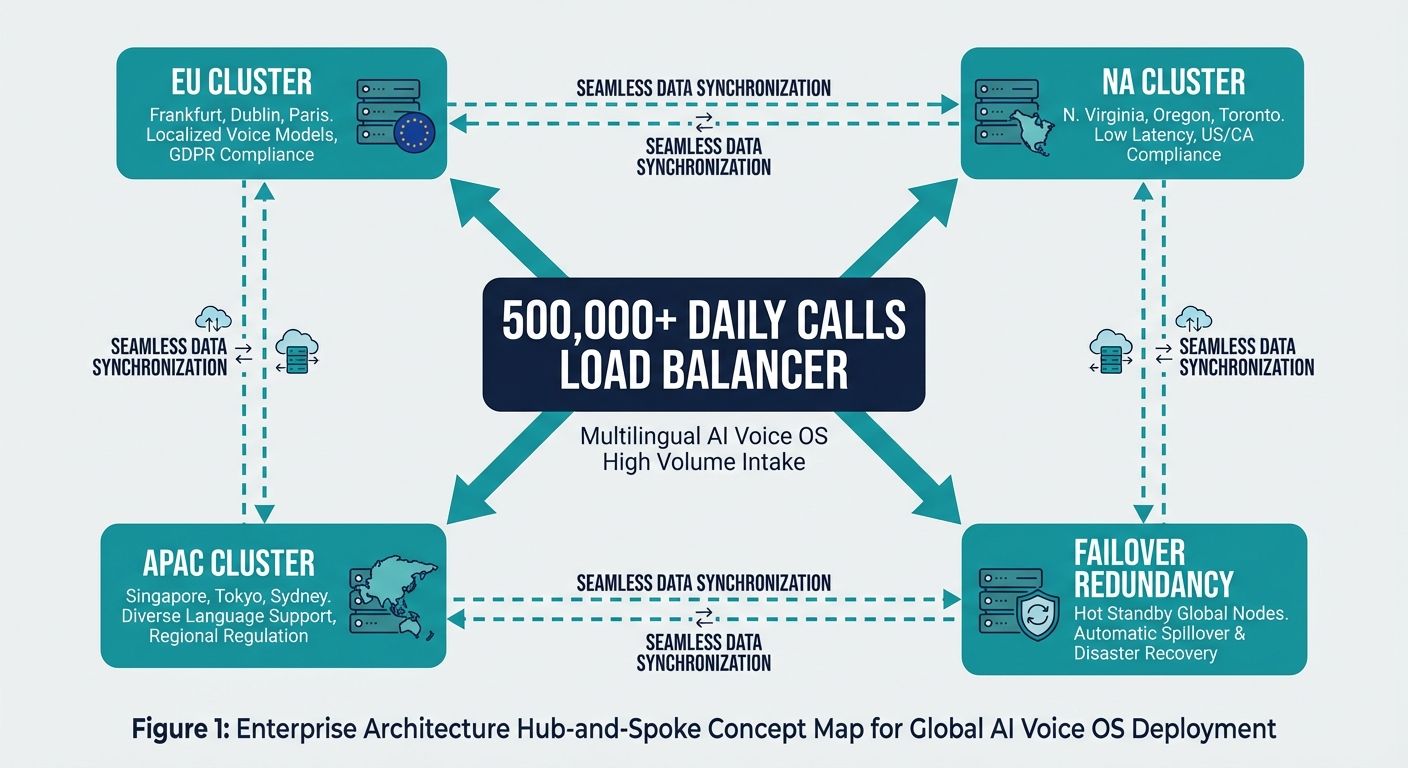
Scaling to hundreds of thousands of daily voice interactions requires a robust, globally distributed server architecture with built-in redundancy and automated load balancing.
Deploying a multilingual AI voice OS for high volume customer interactions requires an infrastructure capable of handling massive concurrency without degradation in response quality. The Kathan Enterprise Voice OS is proven in real-world deployment data, routinely managing over 500,000 daily calls. Achieving this level of scale requires moving beyond basic API wrappers and implementing deep, structural deployment strategies.
### Advanced Lead Segmentation and Multilingual Routing
High-volume campaigns fail when a one-size-fits-all approach is applied to a diverse audience. A context-aware OS automatically segments leads based on geographic data, historical language preferences, and previous interaction outcomes. By the time the AI initiates the connection, it has already configured its localization engine to speak in the precise dialect and cultural tone best suited for that specific prospect.
### Intelligent Retargeting and Lifecycle Management
Because the Kathan engine employs persistent state management, retargeting becomes highly intelligent. If a prospect drops off a call because they were driving, the AI logs this specific state. When the retargeting call occurs the next day, the AI does not start over. Instead, it begins with, _'Hi, I know you were driving yesterday when we spoke, so I'll keep this brief...'_ This level of contextual continuity drastically boosts the baseline 8-15% connection rates, transforming cold outbound metrics into warm, highly engaged conversations.
## Accelerating Qualitative Insights and Sentiment Analysis
Beyond simply handling inbound queries or outbound sales, a true multilingual AI voice OS acts as an enterprise's most powerful data collection tool. Traditional Net Promoter Score (NPS) surveys rely on low-converting email forms. Voice AI facilitates richer qualitative feedback capture by engaging customers in conversational surveys.
As the AI conducts these high-volume interactions across multiple languages, it performs immediate sentiment analysis. It detects hesitation, frustration, or delight in the customer's voice, mapping these emotional data points directly back into the CRM. This provides business leaders with a real-time, aggregated dashboard of customer sentiment across global markets, bridging the gap between raw data collection and actionable qualitative insights.
## Alchemyst Kathan: The Definitive Commercial Solution
The market is saturated with basic, developer-centric API wrappers that promise multilingual support but deliver disjointed, stateless, and robotic experiences. Businesses and enterprises seeking to genuinely improve their customer service and experience—particularly those who have been burned by disappointing ROI from previous AI deployments—must adopt a structural solution.
Alchemyst's Kathan engine stands alone as the definitive multilingual AI voice OS for high volume customer interactions. By replacing the flaws of stateless architecture with advanced context engineering, integrating real-world CRM data through its five-stage pipeline, and proving its stability across 500,000+ daily calls, Kathan eradicates budget waste and robotic interactions. It empowers global enterprises to connect with their audiences authentically, intelligently, and flawlessly at scale.
[← Back to Blog](/blog)
## Recently Published
[October 6, 2026 / 10 min readHow to Build a RAG Pipeline for Personal Documents and MediaBuild a multi-modal RAG pipeline for all personal documents and media assets.](/blog/rag-pipeline-personal-documents-media)
[Technical / September 27, 2026 / 11 min readHarness Engineering for AI Agents: Bridging the GapExplore how harness engineering enables robust AI infrastructure and MLOps.](/blog/harness-engineering-ai-agents)
[I'm Evaluating / September 27, 2026 / 9 min readContext Engineering Best Practices for Enterprise AIMaster advanced context engineering best practices for conversational AI agents.](/blog/context-engineering-best-practices)
[I'm Evaluating / September 22, 2026 / 11 min readContext Engineering vs Prompt Engineering for AI AgentsExplore the differences between context and prompt engineering for enterprise AI](/blog/context-engineering-vs-prompt-engineering)
[I'm Evaluating / September 14, 2026 / 10 min readContext Engineering for Enterprise AI: A Complete GuideMaster context engineering to build reliable, production-ready voice AI agents.](/blog/context-engineering-enterprise-ai)
[Deep Technical / July 7, 2026 / 10 min readVoice-Specific Architectural Requirements for AI Context LayersDiscover the core voice-specific architectural requirements for AI context layer](/blog/voice-specific-architectural-requirements-ai-context-layer)
Get Started
## Give your AI agents the memory they deserve.
Join developers building the next generation of AI products with persistent, auditable context. Free tier available. No credit card required.
* Free tier
* REST + Python & Node SDKs
* 99.9% uptime SLA
* SOC 2 in progress
### Request API Access
Enter your email and we'll set up your workspace.
Email
[Read the Docs →](https://docs.getalchemystai.com)[Read the Thesis →](/thesis)
---
# Alchemyst at 2026 - the year ahead
- **URL:** https://getalchemystai.com/blog/alchemyst-2026-the-year-ahead
- **Slug:** alchemyst-2026-the-year-ahead
- **Published:** January 20, 2026
- **Last updated:** January 20, 2026
- **Author:** Anuran Roy
- **Category:** Non-technical
[Non-technical](/blog?category=non-technical)
# Alchemyst at 2026 \- the year ahead
A raw, unfiltered (maybe random) stream of thoughts on behalf of our team.
Written by [Anuran Roy](/blog?author=Anuran%20Roy)6 min readPublished at January 20, 2026 (8mo ago)
## Summary
2025 was a huge year for us - for both product and our mission. The world finally "got" why AI needs context and memory, and finally people woke up from the dream that AGI will be achieved with compute. Here's what we did for 2025 - and how we're looking at 2026.
Table of Contents
2025 was a huge year for us - for both product and our mission. The much awaited GPT-5 came, Claude reigned supreme on coding, Google finally caught upto the AI race, Elon entered the chat with xAI. China and US AI wars heated up, Europe quietly snuck up with Mistral and Aleph Alpha.
But something in AI felt different...
## The reckoning
There were less people holding their breath, waiting for the next big "thing" in AI - model improvements became commonplace, but the craze died down. We were used to people waiting for model releases in 2024 with custom waitlists and reminders popping up - on which mass consumer apps like ChatGPT were built. Amidst all of this, there was a quite win for people like us - the ones who kept on shouting that the dream of AGI cannot be simply solved with compute **ALONE**.
## The explosion of "context engineering"
The YC Summer School of 2025\. A stellar lineup of speakers - Sam Altman (if you don't know he's the CEO of OpenAI, you've been living under a rock), Elon Musk, Bill Gates, Satya Nadella, and so on. Amidst all of them, the one person whose talk stood out the most was Andrej Karpathy. Later in a [tweet full of substance](https://x.com/karpathy/status/1937902205765607626?s=20) (yes, usual Karpathy sensei - pardon my fanboying), he finally said it: "+1 for context engineering over prompt engineering)"
The world finally understood and woke up to the fact:
> ~~Content~~ Context is king
## The context buzz.
The second half of 2025 was taken up mostly with the new buzzword in town, "Context Engineering". As with most trends, hype caught up with startups raising rounds left and right promising context engineering. At a projected growth of >38% YoY CAGR, it's outpacing the growth of ALMOST any other sector in the AI space so far.
## When the hype dies down...
Substance remains. People had a lot of theories, many of which have led to tangential research in different directions - some thriving, some not so much. The buzz around context went cold for a few weeks, but it was ready to spring back alive in December.
Starting with this [fantastic read](https://foundationcapital.com/context-graphs-ais-trillion-dollar-opportunity) by Jaya Gupta (Partner at Foundation Capital) that starts [with](https://foundationcapital.com/context-graphs-ais-trillion-dollar-opportunity/#:~:text=Agents%20are%20cross%2Dsystem%20and%20action%2Doriented.%20The%20UX%20of%20work%20is%20separating%20from%20the%20underlying%20data%20plane.%20Agents%20become%20the%20interface%2C%20but%20something%20still%20has%20to%20be%20canonical%20underneath.):
> Agents are cross-system and action-oriented. The UX of work is separating from the underlying data plane. Agents become the interface, but something still has to be canonical underneath.
Then a bunch of other articles, notable of which includes the fine article on [Customer Relationship Context Graphs (_aka_ CRCGs)](https://x.com/ishan%5Fchhabra/status/2006088709872255002) by Ishaan Chhabra. **Context became truly mainstream.**
Across almost all of them, a few common ideas prevailed:
> * How do we reimagine systems of record for Agentic Era across multiple business surfaces?
> * In case of a blackboxed LLM, how do we add a Proof of Decision (PoD) layer for AI agents to decide on, tractably?
That's where the fundamental thesis of Alchemyst kicks in so well. "A verifiable context graph across all data sources" sounds trivial at first, but it explodes once you consider the following pain points:
* How do you maintain determinism while trying to segment information into context data points, eventually leading to a graph? A lot of products in the market throw data at an LLM, not taking into account possible fudged IDs, numbers, etc etc.
* How do you fix conflicting data points? Version control of data is not as simple as code versioning.
* _What about missing data? How do you cover up?_ Coincidentally this is the area where LLM powered knowledge graph products hallucinate the most.
* _How do you incorporate business nuances into retrieval?_ Let's be honest - business agnostic retrieval isn't what you want, business aware retrieval is what you need.
## What did we build in 2025?
### The good parts
Okay, now I'm wearing the hat of a techie, not as a founder. 2025, by no means, was a smooth ride for us. From a beta product, infuriated customers, and broken pipelines - we came a long way. A quick run through of what we did, in no particular order:
* Stabilized the platform, scaled down our costs, moved our cost efficiency
* Achieved State-of-the-art performance in September, had a set back in November, came back [stronger](https://getalchemystai.com/benchmarks?utm%5Fsource=alchemyst%5F2026%5Fyear%5Fahead%5Fblog&utm%5Fmedium=blog&utm%5Fcampaign=alchemyst%5Fyear%5Fahead%5Fbody%5Fcta&utm%5Fcontent=stronger) with the best-in-class Performance : Cost ratio in December.
* Introduced SDKs, MCPs and integrations with notable frameworks.
* Built [comprehensive documentation](https://getalchemystai.com/docs?utm%5Fsource=alchemyst%5F2026%5Fyear%5Fahead%5Fblog&utm%5Fmedium=blog&utm%5Fcampaign=alchemyst%5Fyear%5Fahead%5Fbody%5Fcta&utm%5Fcontent=comprehensive%5Fdocumentation).
* Landed our first enterprise customers, built gradual distribution with on-premise readiness.
### Lessons learnt
But not all was great - there were a lot of bad patches as well:
* Lost a few customers on failing to solve for reliability issues - taught us a lesson in maintenance windows.
* Initially we were trying to focus on a bit of everything, leaving us spread too thin. At one point, the entire team got burnt out, leading to quite a few valued members leaving our team. Team morale was at an all time low, and I had to encounter the worst possible nightmare for an early-stage founder - a team devoid of morale.
* Trying to deploy en-masse without evaluative benchmarks led us to loads of rabbit holes that we had to fix. Ultimately, **building a product that people want** is of paramount importance.
* Not focusing on our strengths and trying to cover too much of our weaknesses taught us lessons in transparency - no software is a silver bullet.
## Looking at 2026...
Now that our thesis is consolidated regarding how the world will be treating context as an invariant, we're coming up with loads of exciting new features that will serve businesses **like no one else**. A few of them that we've already done:
* **Collaborative context sharing**: Why limit ourselves to SharePoint-esque data sharing, when we have a completely new surface of interactions through LLMs and AI Agents?
* **Data connectors**: It's a hassle to work with data, but to fix that, we also need to fix how to bring that data to our platform. Data connectors are, and will be, an effort in that direction.
...And a lot more to come. We'll keep on innovating, and we're just getting started.
_**To a much more exciting 2026 ahead!**_
[← Back to Blog](/blog)
## Recently Published
[October 6, 2026 / 10 min readHow to Build a RAG Pipeline for Personal Documents and MediaBuild a multi-modal RAG pipeline for all personal documents and media assets.](/blog/rag-pipeline-personal-documents-media)
[Technical / September 27, 2026 / 11 min readHarness Engineering for AI Agents: Bridging the GapExplore how harness engineering enables robust AI infrastructure and MLOps.](/blog/harness-engineering-ai-agents)
[I'm Evaluating / September 27, 2026 / 9 min readContext Engineering Best Practices for Enterprise AIMaster advanced context engineering best practices for conversational AI agents.](/blog/context-engineering-best-practices)
[I'm Evaluating / September 22, 2026 / 11 min readContext Engineering vs Prompt Engineering for AI AgentsExplore the differences between context and prompt engineering for enterprise AI](/blog/context-engineering-vs-prompt-engineering)
[I'm Evaluating / September 14, 2026 / 10 min readContext Engineering for Enterprise AI: A Complete GuideMaster context engineering to build reliable, production-ready voice AI agents.](/blog/context-engineering-enterprise-ai)
[Deep Technical / July 7, 2026 / 10 min readVoice-Specific Architectural Requirements for AI Context LayersDiscover the core voice-specific architectural requirements for AI context layer](/blog/voice-specific-architectural-requirements-ai-context-layer)
Get Started
## Give your AI agents the memory they deserve.
Join developers building the next generation of AI products with persistent, auditable context. Free tier available. No credit card required.
* Free tier
* REST + Python & Node SDKs
* 99.9% uptime SLA
* SOC 2 in progress
### Request API Access
Enter your email and we'll set up your workspace.
Email
[Read the Docs →](https://docs.getalchemystai.com)[Read the Thesis →](/thesis)
---
# The Road to AGI: Broken promises, Hallucinations, Memory, RAG and Context
- **URL:** https://getalchemystai.com/blog/the-road-to-agi-broken-promises-hallucinations-memory-rag-context
- **Slug:** the-road-to-agi-broken-promises-hallucinations-memory-rag-context
- **Published:** January 20, 2026
- **Last updated:** January 20, 2026
- **Author:** Kapilansh Patil
- **Category:** Non-technical
[Non-technical](/blog?category=non-technical)
# The Road to AGI: Broken promises, Hallucinations, Memory, RAG and Context
RAG, Memory and now context engineering. We’ve been doing them wrong all along.
Written by [Kapilansh Patil](/blog?author=Kapilansh%20Patil)Reviewed by [Rishit Murarka](/blog?author=Rishit%20Murarka)10 min readPublished at January 20, 2026 (8mo ago)
## Summary
By now, almost everyone knows for a fact that AGI cannot be achieved through just scaling compute - there’s the fundamental function of context that’s missing. But we’ve been wrongly doing “context engineering” as two separate components - memory and RAG. Here’s why.
Table of Contents
## Introduction
“AI”, “AI”, “AI” - every CXO is busy selling the dream of the inflection point of this magical piece of technology that “might be even more fundamental than electricity”. At the root of it lies the vaunted prize of AGI - Artificial General Intelligence.
> "AI is the most powerful technology humanity has ever created" \~ Sam Altman
> “AI is the defining technology of our generation.” \~ Satya Nadella
> “Artificial intelligence is the new electricity.” \~ Andrew Ng
> “AI is one of the most profound things we’re working on as humanity … more profound than fire or electricity.” \~ Sundar Pichai
> “AI will not destroy jobs - it will destroy tasks.” \~ Marc Andreessen
And the investments - both tangible and intangible, show for it. Trillions in investments, one new research paper every few minutes, one breakthrough almost every other week - AI has truly become mainstream.
## The Reality Check: Compute isn’t everything
For the last few years, the entire AI industry has been obsessed with a single metric: Scale. We built larger data centers, trained on trillions of tokens, and celebrated every time a model’s parameter count jumped from 70 billion to 400 billion. The prevailing logic was simple: bigger compute equals better intelligence.
However, in late 2025, as we stretch the limits of LLMs, that reasoning is reaching a hard ceiling. The benefits of sheer processing power are waning, as we are discovering. Even if you increase the settings, the model will still be a clever but useful amnesiac if it is unable to remember a conversation's thread across several weeks or comprehend the subtleties of a particular company's past.
## Context - the missing piece of AGI
The barrier for Artificial General Intelligence (AGI) is no longer the amount of knowledge a model possesses, but rather how well it applies that knowledge to the current situation. A model is a calculator, not an agent, if it can pass the bar exam but can't remember what you asked it ten minutes ago. It’s about understanding the problem it faces, sizing up the context of that problem, and then choosing the right approach. It must interpret the environment and make informed decisions rather than blindly applying a fixed method.There isn't a scale missing. It's context.
First, we got introduced to RAG with semantic search in 2021, by researchers at Meta’s FAIR - it showed how LLMs tend to use context supplied within the prompt itself to generate answers. But then, how do you find data that goes beyond traditional keyword-based search? Enter Vector Search, which had its boom from mid-2023 to late 2024.
But then, how do you store something like “after this”? Since the vectors can’t hold “state” or “sequence”, you cannot use simple RAG for this. Consider the example of the following conversation:
**User**: Hey, I would like to buy milk chocolate. \[Stored in vector store\]
**AI Assistant**: Sure, let me look up \[Action: Stores “user likes milk chocolate”\]
**User**: No, let it be, I would like to buy Dark Chocolate before that \[Need to update, but how?\]
This is where Vector Search hits a wall. If you query the vector database now, it sees two mathematically similar facts: "User wants milk chocolate" and "User wants dark chocolate." It has no concept of time, correction, or priority. It just sees two conflicting desires floating in space.
To solve "before that" or "instead of this," we must evolve beyond simple similarity. We need structure.
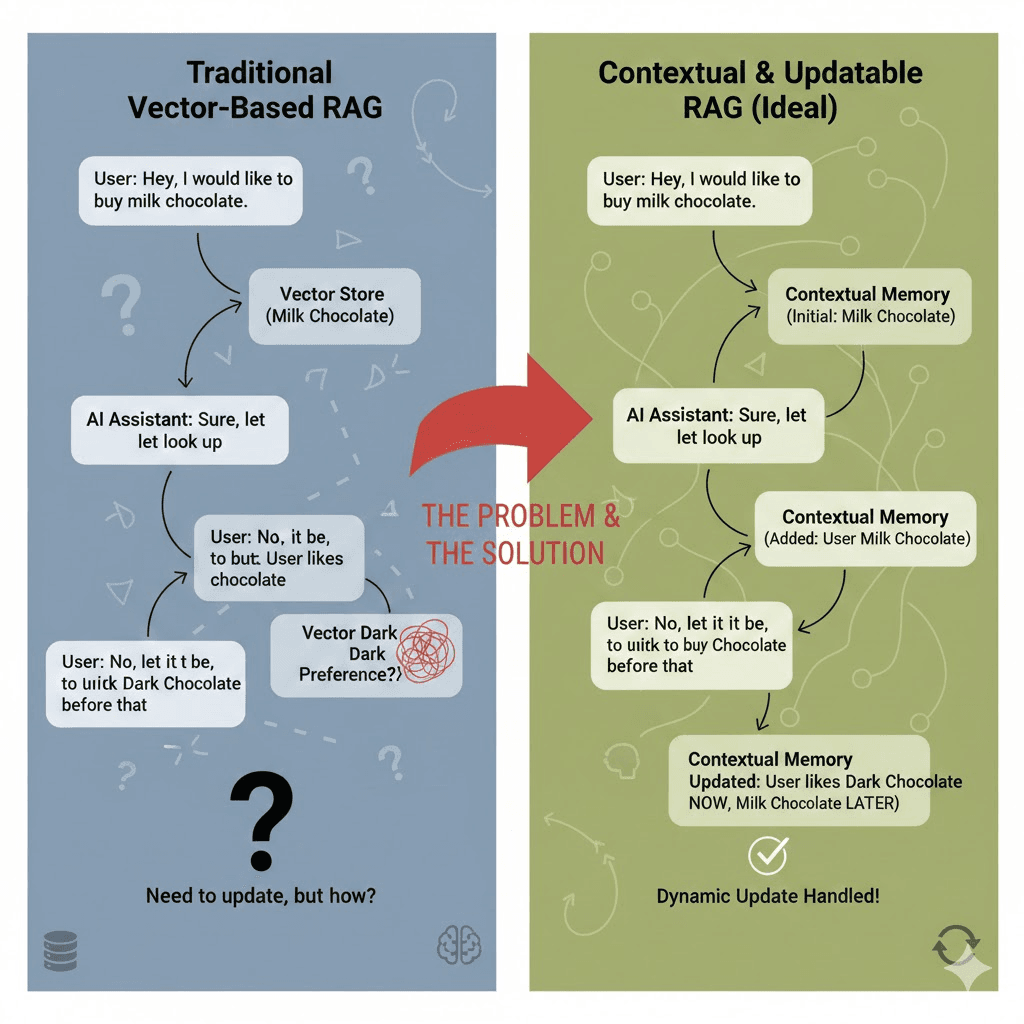
Erm, what will the AI say?
## But, we aren’t solving for context right. Yet.
Currently, we treat "Memory" and "Knowledge" as two distinct, non-overlapping disciplines:
\- Memory is treated as a fading log of user interactions ("Chat History").
\- RAG (Retrieval-Augmented Generation) is treated as a hard database query for static business documents.
However, real Context is multidimensional. The all-encompassing element - it is neither solely memory nor exclusively RAG. It is the liquid condition where both merge. Considering them as isolated entities, we are overlooking the broader perspective. True AGI will be achieved when we cease creating distinct systems for "previous conversations" and "static documents," and instead develop a cohesive Context Layer that comprehends their interconnections. This context layer will act as the fabric which will make information useful, not just available.
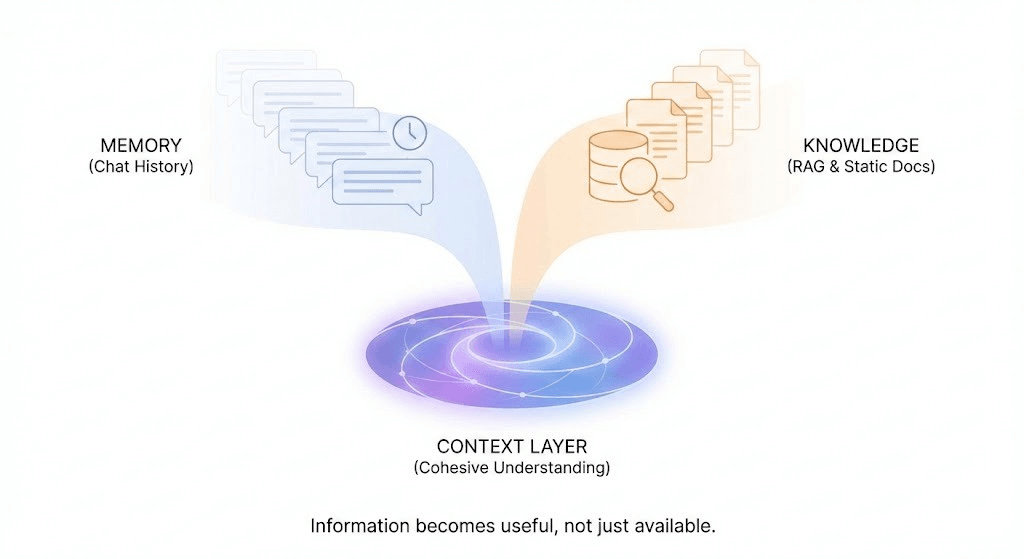
## And the state shows for it.
The research community, just like the tooling ecosystem, still draws a bold line between “knowledge retrieval” and “memory.” On one side sit the RAG benchmarks - PopQA being the most popular of them. PopQA gives a model a clean, single-sentence question (“What’s the capital of Louisiana?”) and scores whether the answer string is correct. It is brilliant at measuring long-tail factual recall, but everything about the test assumes knowledge is static and context-free - no speaker, no timestamp, no conversational thread, just a fact plucked from Wikidata.
On the other side sit the memory benchmarks - LongMemEval is the flagship. Here the model swims through hundreds of thousands of tokens of prior dialogue and is quizzed on what the user said three weeks (and fifty sessions) ago. The benchmark punishes a system that forgets, mis-dates, or hallucinates an update; it rewards one that can say “I don’t know” when the chat never contained the answer. Yet every question is deliberately answerable \*inside\* the chat log. The benchmark never asks the model to leave that log and consult a spec sheet, an error log, or yesterday’s sales spreadsheet.
The result is a pair of orthogonal leader-boards that feel impressive - until you try to build a real workplace assistant. Picture Monday morning:
> Yesterday in Slack
> “Migration script blew up on column \`user\_id\` - blocking deploy.”
>
> The run-book (internal Confluence page)
> “If \`user\_id\` overflow occurs, switch to BIGINT and backfill with script B.”
At 9 a.m. your teammate asks, “Did we patch the script and what’s the error rate now?” A PopQA-optimised bot will happily spit out a definition of BIGINT; a LongMemEval-optimised bot will recall the panic message from Slack but have no clue where the run-book lives.
Neither benchmark forces the model to “braid” those two strands - yesterday’s conversation and the evergreen documentation - into one fluent answer. The gulf between them is precisely where context falls apart.
Until we evaluate systems on tasks that weave memory and retrieval together - “Remind me what blocker we closed yesterday and attach the Jira diff” - we will keep shipping assistants that either have the memory of a goldfish or the social awareness of a search box. A true Context Layer must treat chat logs and external knowledge as different views of the same graph, not rival data silos. The benchmarks - and the products they inspire - need to evolve accordingly.
## Reimagining context with Alchemyst
Alchemyst achieves tate-of-the-art (SoTA) performance @ 85.1% on PopQA, while achieving the previous State-of-the-art (SoTA) on LongmemEval @ 76.42%, very recently surpassed by SuperMemory, whilst remaining 10x more cost efficient than similar products - whilst also providing tractability and verification from the ground up.
This is achieved by changing the fundamental design of context engineering - by separating context engineering into two segments:
* A horizontal layer - a base substrate for context engineering to take place
* Business specific, “vertical” adapters - for different types of business specific ontological data, memory-based connections, etc
Notice that memory and vector-based search aren’t divided here - it’s what the agent can decide on its own. Memory and vector-based search are both treated as first class citizens of the overall context layer.
The reported benchmarks are simply on the horizontal layer, leaving further room for businesses to adapt this context to their domain-specific use-cases.
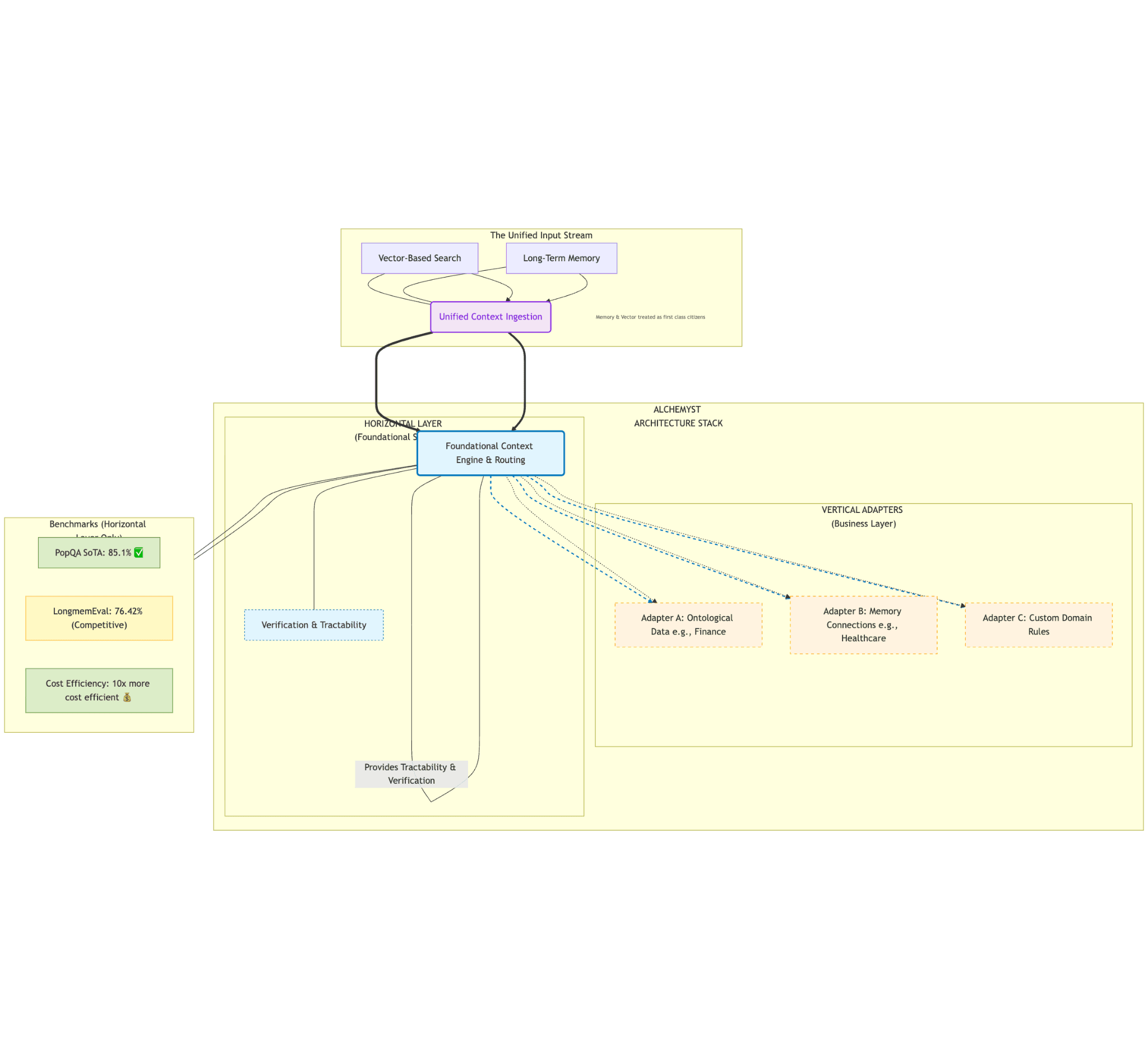
A new paradigm for context engineering
## The Biological Analogue: How context is shaped up in the human brain
Context isn’t a “memory only” problem - it’s a structural plasticity problem. The brain doesn’t just retrieve memories; it grows circuits around the problems it solves repeatedly.
### The Horizontal Layer: The Stable Executive & Memory Substrate
Two structures form the brain’s context foundation: the prefrontal cortex (PFC) and the hippocampus. The PFC is the executive editor - it doesn’t store your childhood; it decides what matters right now. The hippocampus is the indexer - it tags, routes, and patterns incoming signals, but it doesn’t “store” memories either; it reconstructs them from cortical fragments on demand. Together, they create a lean, domain-agnostic substrate for real-time reasoning.
This is analogous to the horizontal layer in our stack, creating an equivalent of a “contextual operating system” with PFC-like efficiency and mimicking plasticity induced by hippocampal indexing. This eliminates the latency tax of chaining retrieval and generation.
The Horizontal Layer never changes between deployments. It is the stable substrate that stays constant whether you’re diagnosing a patient or detecting fraud.
### The Vertical Adapters: Occupational Neuroplasticity
The famous [London Taxi Driver study](https://www.tutor2u.net/psychology/reference/maguire-2000?srsltid=AfmBOopmBWCTDHMC2ncexb0qxEbYss6NFPiyZJ%5FsZ65KIU9aGLNPbW%5FH) revealed that the drivers’ posterior hippocampi reorganized their cortical connections, forming a specialized circuit linking spatial memory to the posterior parietal cortex. The plasticity wasn’t in the hippocampus alone; it was in the hippocampal-cortical circuit that the occupation demanded.
Vertical Adapters in the context layer are synthetic instantiations of this process. When you deploy a finance adapter, you’re inducing targeted neuroplasticity - the Horizontal Layer’s PFC begins routing finance queries through a new circuit that has grown domain-specific pattern recognizers for credit risk, ontological relationships for derivatives, and memory traces for regulatory logic.
This is why we call memory a “first-class citizen”: the adapter doesn’t retrieve documents; it reconstructs reasoning pathways the way a surgeon’s brain reconstructs the steps of a procedure. The adapter is not a database; it is a domain-specific hippocampal-cortical circuit that has been trained to grow into the architecture.
The brain’s power is the bidirectional loop: the PFC queries the hippocampal-cortical circuit, the circuit returns a compressed schema, and the PFC verifies its relevance against current goals. Alchemyst mirrors this: the Horizontal Layer decides when to invoke an adapter, the adapter returns a domain-shaped context manifold, and the Horizontal Layer’s tractability engine verifies every step back to source.
This is why our 85.1% baseline is just that - a baseline. When a bank plugs in its fraud adapter, the system doesn’t get “smarter” in the generic sense. It structurally shifts, becoming as specialized as a taxi driver navigating London, yet as efficient as a grandmaster at a chessboard. The accuracy gains aren’t from more data, but rather from architectural reorganization.
The reported benchmarks are what the Horizontal Layer achieves with general knowledge. The vertical adapters are what happen when your AI starts doing the job.
## Conclusion
Context is a homogeneous superposition of memory and recall-based search, and that’s a fact supported by biology. This is what we’re building at Alchemyst - a context layer that can plugin with LLMs and AI agents to actually mimic and form an artificial “second brain”.
Ready to upgrade your agent’s context layer? Don't settle for static data retrieval. Give your AI the specialized "Hippocampus" it needs to master your industry. [Sign up on the Alchemyst Platform now!](https://platform.getalchemystai.com/auth?utm%5Fsource=blog&utm%5Fcampaign=road%5Fto%5Fagi%5Fblog&utm%5Fmedium=article&utm%5Fcontent=conclusion%5Fcta)
In our next article, we will be showing how to tractably do so, mimicking the human brain.
[← Back to Blog](/blog)
## Recently Published
[October 6, 2026 / 10 min readHow to Build a RAG Pipeline for Personal Documents and MediaBuild a multi-modal RAG pipeline for all personal documents and media assets.](/blog/rag-pipeline-personal-documents-media)
[Technical / September 27, 2026 / 11 min readHarness Engineering for AI Agents: Bridging the GapExplore how harness engineering enables robust AI infrastructure and MLOps.](/blog/harness-engineering-ai-agents)
[I'm Evaluating / September 27, 2026 / 9 min readContext Engineering Best Practices for Enterprise AIMaster advanced context engineering best practices for conversational AI agents.](/blog/context-engineering-best-practices)
[I'm Evaluating / September 22, 2026 / 11 min readContext Engineering vs Prompt Engineering for AI AgentsExplore the differences between context and prompt engineering for enterprise AI](/blog/context-engineering-vs-prompt-engineering)
[I'm Evaluating / September 14, 2026 / 10 min readContext Engineering for Enterprise AI: A Complete GuideMaster context engineering to build reliable, production-ready voice AI agents.](/blog/context-engineering-enterprise-ai)
[Deep Technical / July 7, 2026 / 10 min readVoice-Specific Architectural Requirements for AI Context LayersDiscover the core voice-specific architectural requirements for AI context layer](/blog/voice-specific-architectural-requirements-ai-context-layer)
Get Started
## Give your AI agents the memory they deserve.
Join developers building the next generation of AI products with persistent, auditable context. Free tier available. No credit card required.
* Free tier
* REST + Python & Node SDKs
* 99.9% uptime SLA
* SOC 2 in progress
### Request API Access
Enter your email and we'll set up your workspace.
Email
[Read the Docs →](https://docs.getalchemystai.com)[Read the Thesis →](/thesis)
---
# The Pareto Frontier for Context: Alchemyst achieves cost-performance optimality
- **URL:** https://getalchemystai.com/blog/alchemyst-achieves-cost-performance-pareto-optimality
- **Slug:** alchemyst-achieves-cost-performance-pareto-optimality
- **Published:** January 20, 2026
- **Last updated:** January 20, 2026
- **Author:** Rishit Murarka
- **Category:** Technical
[Technical](/blog?category=technical)
# The Pareto Frontier for Context: Alchemyst achieves cost-performance optimality
AI Context has a unit economics problem. Alchemyst fixes that.
Written by [Rishit Murarka](/blog?author=Rishit%20Murarka)Reviewed by [Kapilansh Patil](/blog?author=Kapilansh%20Patil)13 min readPublished at January 20, 2026 (8mo ago)
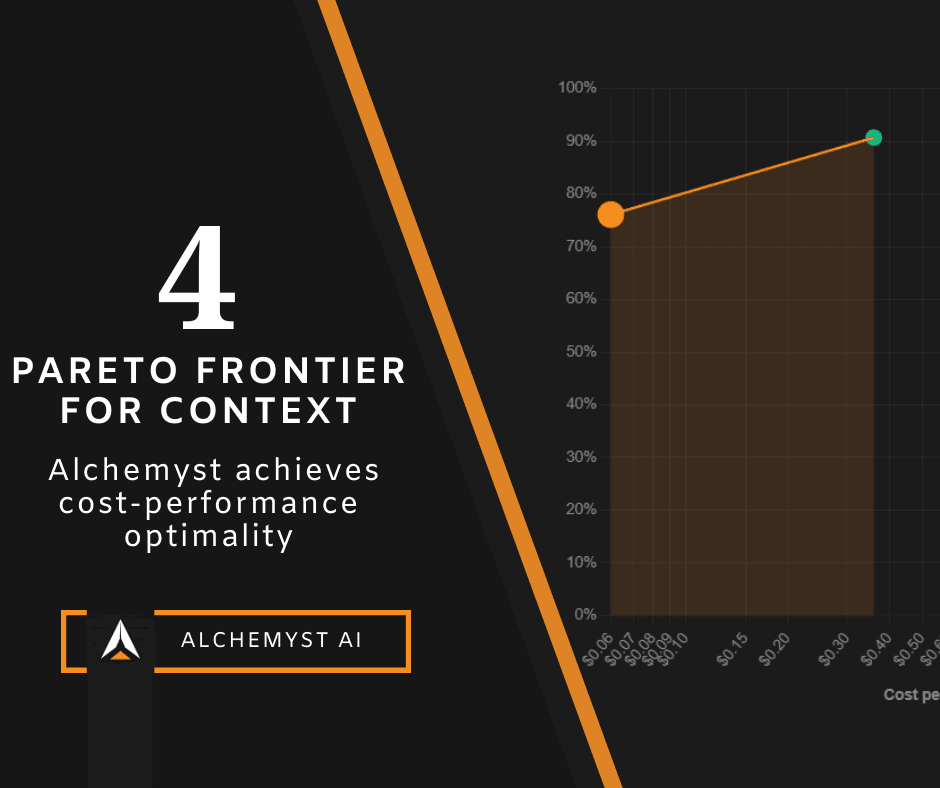
## Summary
Alchemyst is a specialized Context Layer for AI that transforms vast raw memory into precise, relevant context for the current interaction, preventing the hallucinations and noise common in standard memory solutions . By focusing on intelligent retrieval rather than just storage, it achieves the Efficiency Frontier: delivering top-tier recall accuracy (80% on ConvoMem) at a fraction of the market cost (\~$0.06 per million tokens vs. \~$6.00+) . This architecture allows developers to build scalable, long-term intelligent agents without compromising on performance or price .
Table of Contents
## The need for an efficient context layer in the AI Era
Memory is the fundamental substrate of every system you build. Memory is a subset of context that not only outlines the duration of remembering discussions or acquired knowledge but also influences what the system considers pertinent, how it evolves over time, and how reliably it functions throughout interactions.
Throughout the years, AI agents have transformed from basic chatbots into extensive workflows: programming assistants, research applications, sales helpers, customer support teams, coding partners, and independent task performers. If we can limit the model size or processing capacity of these agents, then their performance won't increase with additional parameters - it scales with memory.
However, raw memory is not the same as effective context. As interaction histories expand from thousands to millions of tokens, the challenge transitions from storage to retrieval. Merely filling a model's context window with all previous interactions weakens its reasoning abilities, adding noise and raising the likelihood of hallucinations.
Genuine intelligence necessitates a Context Layer, a framework that transforms extensive collections of 'Memory' into the exact, pertinent 'Context' an agent requires for the present nanosecond. The distinction between a good agent and an exceptional one lies not only in the model but in the skill to find the correct needle in the haystack consistently.
But in a landscape flooded with memory solutions, bold claims aren't enough - we need proof. To truly understand the impact of an efficient context layer, we must look at the data.
## Benchmarks: Evaluating the Context Layer
Assessing the quality of memory and context systems will differentiate basic implementations from genuinely intelligent, context-aware applications. Memory benchmarks act as standardised tests that assess the efficiency of memory layers in storing, retrieving, and contextualising information throughout conversations and interactions.
These benchmarks are crucial as they directly influence the efficiency of AI agents in real-world applications. Whether you're creating a customised assistant, a sales automation tool, or a customer success solution, the effectiveness of your memory system influences the intelligence with which your agents function. A nuanced method will be employed to assess two aspects: conversational memory and the evaluation of long-term memory.
### LongMemEval: Testing Memory Systems Across Time and Sessions
Long-term memory assessment (LongMemEval) evaluates the effectiveness of memory systems over prolonged durations, various conversation sessions, and changing user scenarios. The system's capability to preserve, refresh, and access information is evaluated as relationships grow stronger, preferences evolve, and knowledge builds over weeks or months of engagement.
The assessment framework primarily investigates six essential dimensions:
* Single-Session User Facts: Capturing and recalling explicit user statements within one conversation
* Single-Session Assistant Facts: Retaining information the AI agent itself provided
* Single-Session Preferences: Understanding and remembering user likes, dislikes, and choices
* Knowledge Updates: Correctly updating memories when new information contradicts or refines previous facts
* Temporal Reasoning: Understanding time-based context and sequencing of events
* Multi-Session Continuity: Maintaining coherent memory across separate conversation instances
Let’s examine this multiple-session engagement:
Session 1 (January):
> User: "I’m preparing for a marathon in April." "My present speed is 10 minutes for each mile."
Session 2 (February):
> User: "Fantastic news! "I've enhanced my speed to 8:30 for each mile."
Session 3 (March):
> "Is it necessary to modify my training regimen based on my advancements?"
Perfect Response from Extended Memory System:
> “Certainly! Your speed has markedly increased from 10:00 to 8:30 per mile since January - that's a fantastic advancement with your marathon in April nearing. Considering this 15% enhancement, it would be wise to revise your target completion time and add more tempo runs to sustain this progress.”
Benchmark Performance (LongMemEval): Alchemyst AI vs. The competition
| **Category (# questions)** | **Supermemory (Price,Performance)** | **Zep (Price,Performance)** | **Hindsight GPT OSS 120B (Price,Performance)** | **Alchemyst (Price,Performance)** |
| ------------------------------ | ----------------------------------- | --------------------------- | ---------------------------------------------- | --------------------------------- |
| single-session-preference (30) | (6.33333333,0.7) | (12.5,0.567) | (0.36,0.867) | (0.06,0.6) |
| single-session-user (68) | (6.33333333,0.971) | (12.5,0.929) | (0.36,1) | (0.06,0.9559) |
| knowledge-update (75) | (6.33333333,0.884) | (12.5,0.833) | (0.36,0.923) | (0.06,0.56) |
| single-session-assistant (55) | (6.33333333,0.964) | (12.5,0.804) | (0.36,0.982) | (0.06,0.9636) |
| temporal-reasoning (131) | (6.33333333,0.767) | (12.5,0.624) | (0.36,0.857) | (0.06,0.7557) |
| multi-session (133) | (6.33333333,0.714) | (12.5,0.579) | (0.36,0.812) | (0.06,0.7293) |
Our LongMemEval assessment compares four major memory platforms - Alchemyst, SuperMemory, Zep, and Hindsight GPT OSS 120B across six evaluation categories, measuring both performance accuracy and cost efficiency.
For Single-Session assessment, Alchemyst delivers accuracy competing with the top tier. Alchemyst performs with nearly 90% accuracy while giving a substantial cost advantage. In tracking AI response across a single session (55 test cases) Alchemyst matches Supermemory’s performance while costing 99.7% less and dramatically outperforms the expensive Zen option.
Knowledge update test measures how well systems update memories when users correct or refine previous statements. A low score here does not imply that this is a design flaw - infact this was expected with the base layer’s implementation, which we evaluated for LongMemEval. With Alchemyst, you can implement domain-specific knowledge update measures, since knowledge updates are covered as a part of agentic logic, not part of the data itself. The inherent connectivity of data between data points can be business-specific, which is why we leave it to the business user to implement that. This allows us to be flexible by avoiding the pitfalls of updates that might violate business logic.
Alchemyst delivers near-SuperMemory performance in temporal reasoning, which measures how much a system can understand the time and sequence dependencies. Multi-session continuity is where Alchemyst is seen to outperform supermemory, which serves as a remarkable achievement in the aspect of long-term memory.
### ConvoMem: Pushing evidence-based contextualization for LLM responses to the edge
Conversational memory refers to an AI assistant's ability to draw on information from previous conversations to generate replies that are more informative, logical, and appropriate to the situation. It serves as a broad concept that includes semantic, episodic, and procedural memory while steering clear of strict category distinctions.
It closely connects with retrieval-augmented generation (RAG), since both rely on acquiring relevant context from a saved text corpus to improve answers. In conversational memory, the collection of information includes past discussions, with the primary aim being to make dialogue systems progressively more natural, coherent, and efficient over time.
A context layer provider or developer of memory systems would choose to benchmark using ConvoMem for several strategic and technical reasons that differentiate it from previous benchmarks like LongMemEval or LoCoMo.
The primary reasons to use this benchmark include:
* Statistical Power and Reliability: ConvoMem’s 75k+ dataset is 150x larger than LongMemEval, narrowing confidence intervals to under ±2%, unlike smaller benchmarks where error margins can swing as high as ±40%.
* Testing Multi-Message Synthesis: Distributes evidence across 1–6 messages to test true information assembly, moving beyond shallow keyword retrieval.
* Evaluation of Implicit Reasoning: Evaluates "ambient awareness" by testing if systems recall user circumstances (like a past injury) without explicit reminders.
* Identifying Architectural Transition Points: Identifies specific performance "cliffs" (e.g., at 150 conversations) to help developers pinpoint exactly when to switch from long-context windows to RAG.
* Methodological Consistency: Uses a unified generation pipeline for all data, preventing models from gaming the test by detecting stylistic differences in synthetic text.
* Optimization of Model Selection: Demonstrates that medium-tier models often match premium performance for memory tasks, validating cost-effective context layer implementations.
The theoretical base is built on three key elements:
* Extraction: Recognising significant details from unstructured conversations (user preferences, declared facts, suggested context)
* Indexing: Structuring this data to allow rapid, semantically meaningful access.
* Retrieval: Accessing the appropriate memories during a query by considering semantic relevance and the context of the conversation.
Suppose a user engages in this dialogue with an AI assistant:
> User: "I'm planning a trip to Japan in March. I'm vegetarian and love hiking."
Later in the conversation or even in a subsequent session, the user asks:
> Query: "What should I pack for my trip?"
Optimal Response from Memory-Powered Agent:
> "During your March visit to Japan, I suggest bringing layers due to fluctuating temperatures (5-15°C)." Since you enjoy hiking, pack a lightweight rain jacket; March can be wet. As a vegetarian, consider bringing some protein bars as a backup, although Japan is offering more excellent vegetarian choices in urban areas."
#### **Benchmarking context providers on ConvoMem**
We have benchmarked all of the ConvoMem observations using the MemoryBench tool by SuperMemory.
| **Metric Category** | **Metric** | **Alchemyst (Standard)** | **Alchemyst (Fast)** | **SuperMemory** |
| ----------------------- | ------------------ | ------------------------ | -------------------- | --------------- |
| Accuracy | Total Questions | 20 | 20 | 20 |
| | Correct | **16** | 14 | 10 |
| | Accuracy | **80.00%** | 70.00% | 50.00% |
| Latency (Median, ms) | Search | 1467 | 919 | **893** |
| | Answer | 2354 | **2325** | 2488 |
| | Total | 3992 | **3250** | 3543 |
| Latency (Mean, ms) | Search | 1553 | 967 | **881** |
| | Answer | 2709 | **2638** | 2647 |
| | Total | 4262 | 3605 | **3529** |
| Ingest | Median (ms) | **1385** | 1389 | 2976 |
| | Mean (ms) | **1424** | 1469 | 3007 |
| Retrieval Quality | K | 10 | 10 | 0 |
| | Hit@K | **80.00%** | 55.00% | 50.00% |
| | Precision | 14.00% | 9.00% | **24.00%** |
| | Recall | **80.00%** | 55.00% | 50.00% |
| | F1 | 23.50% | 15.30% | **29.00%** |
| | MRR | **0.656** | 0.3 | 0.467 |
| | NDCG | **0.686** | 0.348 | 0.448 |
| User Evidence Questions | Accuracy | **80.00%** | 70.00% | 50.00% |
| | Median Search (ms) | 1467 | 919 | **893** |
| | Median Answer (ms) | 2354 | **2325** | 2488 |
| | Median Total (ms) | 3992 | **3250** | 3543 |
Our comprehensive evaluation reveals significant performance differences across memory systems.
#### Accuracy: The Most Critical Metric
Alchemyst Standard dominates with 80% accuracy, while Alchemyst Fast follows with 70%, and SuperMemory attained just 50%. In practical terms, this implies that Alchemyst can remember user preferences and facts with greater consistency. It ensures a smooth conversation without requiring the user to restate anything.
#### Retrieval Quality: Precision Matters
Metrics like Hit@K, Recall, MRR, and NDCG measure how effectively the system identifies the correct memory and whether it appropriately ranks that memory when multiple past facts are available. In this case, Alchemyst Standard excels, reaching a Hit@K of 80% and demonstrating markedly superior MRR and NDCG compared to Alchemyst Fast and SuperMemory. The rapid version still stays competitive, surpassing SuperMemory in various recall measurements.
When we assess these outcomes against mem0, the trend still holds. mem0 generally functions within the \~55–60% accuracy bracket on ConvoMem evaluation tasks, showing significantly increased latency as histories extend and ranking quality diminishes more rapidly during extended conversations. This positions mem0 within the same performance category as SuperMemory.
#### Latency: Speed meets Intelligence
Analyzing the latency distribution uncovers intriguing compromises. In search operations, SuperMemory leads with 893ms, closely trailed by Alchemyst Fast at 919ms, and Alchemyst Standard takes 1,467ms.
Most importantly for production deployments, Alchemyst excels in ingestion speed. This metric is vital in real-time scenarios, where discussions consistently create memories. It determines the speed at which a new conversational context is made searchable. Alchemyst Standard (1,385ms median) and Fast (1,389ms median) process memories over 2x quicker than SuperMemory's 2,976ms.
#### Conclusion
This indicates that Alchemyst not only retrieves memories but also identifies the most pertinent ones and correctly prioritises them while formulating the final response. That conduct is precisely what downstream roles such as customer service, research helpers, coaching agents, and copilots truly require.
## Cheaper Context, Scalable Intelligence
In the current AI development landscape, engineering teams encounter an unjust dilemma: they can either create highly intelligent agents that are very expensive or more affordable agents that experience “amnesia.” This is due to the fact that performance increases with memory, and unit economics do as well.
### The "Million Token" Impact
To understand the magnitude of this issue, we must look beyond a single user's monthly subscription fee to consider the cost of scale, specifically, the industry-standard price per 1 million tokens.
When we study the pricing patterns of leading competitors, the math shows a clear reality:
* Supermemory: As seen in their pricing tiers, the "Pro" plan charges $19/month for 3 million tokens processed, which is roughly $6.33 per million tokens.
* Zep: Their model relies on "credits," charging $25/month for 20,000 credits. 1 credit = 300 bytes = 300 characters \~= 100 tokens. In our analysis, this translates to an effective comparative price metric of roughly $12.50 per million tokens, nearly double that of Supermemory.
* Alchemyst: In contrast, the architecture of Alchemyst is designed for efficient context-aware retrieval. The cost of our context search is about $0.061 per million tokens.
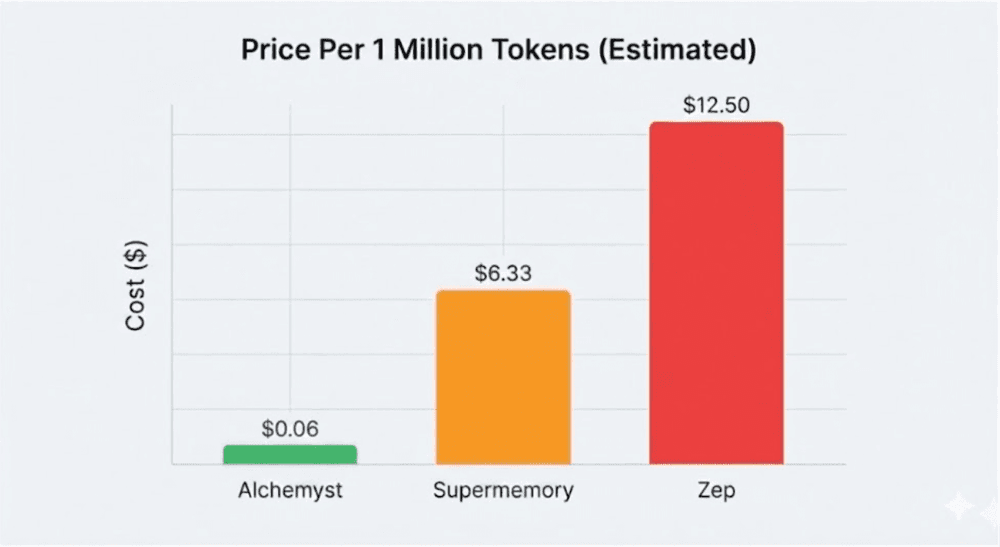
On paper, the difference of a few dollars may appear insignificant. However, when you scale an agent to thousands of users, the difference skyrockets.
## The Efficiency Frontier: Defining the "Sweet Spot"
In the fields of economics and engineering, there exists a concept referred to as the "Pareto Frontier" or Efficiency Frontier. It displays the collection of best choices where enhancing one metric necessitates compromising another. In the field of AI memory, two key aspects are Performance (the effectiveness of the system’s recall) and Price (the operational cost).
Historically, developers were required to make a difficult trade-off. Achieving high recall and strong context retention necessitates a considerable commitment to robust, resource-demanding infrastructure. Yet, if you prioritised low expenses, you had to endure "lossy" memory, which forgets user information or fabricates details over extended durations. Many current solutions remain low on this curve, demonstrating inefficiency: they demand excessive fees for minimal performance.
Alchemyst fundamentally changes this dynamic. The subsequent analysis shows that Alchemyst is positioned precisely on the efficiency frontier. This is the "optimal point" where excellent performance and minimal expense coexist. We pushed the boundaries by enhancing the fundamental memory retrieval system. We don't merely balance the trade-off; we actually remove the penalty, enabling developers to utilise optimal recall capabilities without the typical linear cost increase associated.
Alchemyst
Supermemory
Zep
Hindsight GPT OSS 120B
[← Back to Blog](/blog)
## Recently Published
[October 6, 2026 / 10 min readHow to Build a RAG Pipeline for Personal Documents and MediaBuild a multi-modal RAG pipeline for all personal documents and media assets.](/blog/rag-pipeline-personal-documents-media)
[Technical / September 27, 2026 / 11 min readHarness Engineering for AI Agents: Bridging the GapExplore how harness engineering enables robust AI infrastructure and MLOps.](/blog/harness-engineering-ai-agents)
[I'm Evaluating / September 27, 2026 / 9 min readContext Engineering Best Practices for Enterprise AIMaster advanced context engineering best practices for conversational AI agents.](/blog/context-engineering-best-practices)
[I'm Evaluating / September 22, 2026 / 11 min readContext Engineering vs Prompt Engineering for AI AgentsExplore the differences between context and prompt engineering for enterprise AI](/blog/context-engineering-vs-prompt-engineering)
[I'm Evaluating / September 14, 2026 / 10 min readContext Engineering for Enterprise AI: A Complete GuideMaster context engineering to build reliable, production-ready voice AI agents.](/blog/context-engineering-enterprise-ai)
[Deep Technical / July 7, 2026 / 10 min readVoice-Specific Architectural Requirements for AI Context LayersDiscover the core voice-specific architectural requirements for AI context layer](/blog/voice-specific-architectural-requirements-ai-context-layer)
Get Started
## Give your AI agents the memory they deserve.
Join developers building the next generation of AI products with persistent, auditable context. Free tier available. No credit card required.
* Free tier
* REST + Python & Node SDKs
* 99.9% uptime SLA
* SOC 2 in progress
### Request API Access
Enter your email and we'll set up your workspace.
Email
[Read the Docs →](https://docs.getalchemystai.com)[Read the Thesis →](/thesis)
---
# Introducing the Alchemyst Chrome Extension
- **URL:** https://getalchemystai.com/blog/introducing-alchemyst-chrome-extension
- **Slug:** introducing-alchemyst-chrome-extension
- **Published:** January 20, 2026
- **Last updated:** January 20, 2026
- **Author:** Khushi Mhasange
- **Category:** Non-technical
[Non-technical](/blog?category=non-technical)
# Introducing the Alchemyst Chrome Extension
Now you can carry AI context across all AI tools, or share it with others?
Written by [Khushi Mhasange](/blog?author=Khushi%20Mhasange)Reviewed by [Anuran Roy](/blog?author=Anuran%20Roy)6 min readPublished at January 20, 2026 (8mo ago)
Table of Contents
# **Alchemyst AI - Chrome Extension for AI Models.**
## The Challenge of Stateless LLMs: Why AI Needs Memory
When you chat with AI systems like ChatGPT or Claude, you might notice something frustrating: they often forget what you just talked about. This isn't because they're being difficult - it's because Large Language Models are inherently stateless. Every time you send a new message, they essentially start from scratch.
This statelessness creates real problems for users. Without access to past interactions, these AI systems provide generic answers rather than personalized ones. They might contradict themselves from one message to the next or ask you to repeat information you've already provided.
Many users resort to awkward workarounds, like constantly copy-pasting previous parts of their conversation to maintain context. This makes AI conversations inefficient and sometimes downright frustrating - especially for complex tasks that require sustained attention.
Persistent Memory AI capabilities aren't just a nice-to-have feature, they're essential for making AI interactions worthwhile. Without memory, AI can't maintain short-term continuity in a conversation, hold onto important domain knowledge, or remember your preferences from one session to the next. It's like talking to someone with severe short-term memory loss: potentially helpful, but requiring constant repetition.

[****](https://docs.getalchemystai.com/tutorials/chrome-extension#step-by-step-setup-%3A)
## Introducing Alchemyst AI's Chrome Extension
This is where Alchemyst AI's Chrome Extension comes in. Instead of treating "AI memory" as an abstract concept, Alchemyst AI provides a practical, drop-in solution that works with the web-based LLMs you already use.
The system offers smart capture and classification features that let you save important information with minimal effort. With a simple shortcut, you can save snippets or entire conversation as either long-lived "Memory" (for facts and preferences you want the AI to always remember) or task-scoped "Context" ( for information relevant to your current project in the form of docs etc on \[platform\](https://platform.getalchemystai.com)).
What makes Alchemyst AI particularly clever is its intelligent context management. Rather than overwhelming the AI with every piece of saved information, it carefully filters, trims, and formats only the most relevant content to stay within token limits while maximizing useful context.
Perhaps most importantly, Alchemyst AI works across different AI platforms.
### Setup Alchemyst AI Chrome Extension
Getting started with Alchemyst AI's Memory AI technology is surprisingly straightforward. To add the Alchemyst AI Chrome Extension to your browser, simply visit the[**Chrome Web Store**](https://docs.getalchemystai.com/integrations/extensions/chrome) and click "Add to Chrome." The installation takes just seconds, adding a powerful memory layer to your AI interactions with minimal effort. For a detailed setup visit [**Docs**](https://docs.getalchemystai.com/integrations/extensions/chrome)
[****](https://docs.getalchemystai.com/tutorials/chrome-extension#how-it-works-%3A)
### Save conversation as context
To take it a step further you can use save context button to save the current chat and use it as context across models.
### How it works
Consider this scenario, you are stuck solving an error you go to gpt explain your code, error, solutions you have tried and ask what are you missing out on. Gpt gives you some steps to try you try those, still doesn’t work.
Frustrated you switch to claude, now the actual problem starts, re-explain your code, error, solutions you have tried and on top of that, the chat with chatgpt, not very efficient.
So here we come to your rescue, just use the save context button, and switch effortlessly, it’s that EASY.
[](https://docs.getalchemystai.com/tutorials/chrome-extension#add-memory-%3A)
### Add Memory
To use memory you need to add memory, to do that just drag and drop any document you would like to store as memory, can be a pdf, text file, json file, doc file. Upload here :
[](https://docs.getalchemystai.com/tutorials/chrome-extension#use-cases-%3A)
### Use Cases
As you are all set to use the extension let’s now look and some of the cool stuff you can do with it.
[](https://docs.getalchemystai.com/tutorials/chrome-extension#for-everyone-%3A)
## For general use :
### 1\. Say Goodbye to AI Amnesia (IYKYK)
The Problem: Your AI ghosts you every time you open a new tab.
The Fix: Tired of explaining your whole life story (preferences, fitness goals, or coffee order) to a chatbot? With Alchemyst AI's memory, your model keeps the receipts. It remembers your whole vibe, so every chat feels like talking to a friend who actually knows you.
### 2\. Your Certified Study Buddy
The Problem: Trying to learn Python but the AI starts every lesson at "What is a variable?"
The Fix: Whether you're learning a new language or cramming for exams, the AI remembers your learning journey. It recalls your weak areas, builds on past questions, and serves up the next-level content you need. No more starting from scratch, it's continuous learning, period.
### 3\. Personal Journal & Mindset Check
The Problem: Your Notes app is a chaotic mess of random thoughts.
The Fix: Use the AI's memory like a secure digital diary. Drop your daily reflections and let the model handle the analysis. It can summarize your whole week, give you a vibe check on your writing tone, and deliver deep insights on how your mindset has evolved. It’s the ultimate self-reflection cheat code.
### 4\. Recommendations That Hit Different
The Problem: Netflix suggests the same five movies you hated last week.
The Fix: Generic suggestions? We don't know her. Every recommendation - from recipes and books to podcasts, gets smarter with context. The AI remembers what you actually liked, disliked, and skipped, delivering personalized results that are always on point.
## For developers :
### 1\. Your AI Coding Partner, Finally Un-Stuck
The Problem: Having to paste your package.json and API references into your ai model every. single. time.
The Fix: Devs, rejoice! Once the AI remembers your stack, framework, and project setup, it stops asking basic questions. It can reference project files and previous API usage (\[reference to files, APIs\]) to help you write code faster and with far fewer corrections. It’s like working with a teammate who’s always caught up.
### 2\. Smarter Debugging Sessions
The Problem: Debugging starts with the classic "Let's review the error log again."
The Fix: The AI recalls your prior error logs, the fixes you tried (and failed at), and the one weird workaround that finally worked. You can pick up precisely where you left off, turning endless loops into solutions that work. No more "start from zero" debugging.
### 3\. Consistent Docs That Don't Require Handholding
The Problem: Your README.md sounds different from your commit messages.
The Fix: Write one good reference doc and let the AI remember your team’s style and project tone (\[reference to writing style and project tone\]). It’s a game-changer for generating consistent documentation, commit messages, and changelogs without constantly needing a style guide.
### 4\. Shared Team Memory
The Problem: New hires spend a week just getting context.
The Fix: Teams can share a single memory setup for a project, meaning every developer gets the same context inside the AI model. This is peak efficiency for consistent onboarding, shared project knowledge, and communication across the entire team. No context switching needed.
We know you guys are creative and will come up with more interesting ideas and use cases customized for your needs, do tell us how your are gonna use the extension.
[← Back to Blog](/blog)
## Recently Published
[October 6, 2026 / 10 min readHow to Build a RAG Pipeline for Personal Documents and MediaBuild a multi-modal RAG pipeline for all personal documents and media assets.](/blog/rag-pipeline-personal-documents-media)
[Technical / September 27, 2026 / 11 min readHarness Engineering for AI Agents: Bridging the GapExplore how harness engineering enables robust AI infrastructure and MLOps.](/blog/harness-engineering-ai-agents)
[I'm Evaluating / September 27, 2026 / 9 min readContext Engineering Best Practices for Enterprise AIMaster advanced context engineering best practices for conversational AI agents.](/blog/context-engineering-best-practices)
[I'm Evaluating / September 22, 2026 / 11 min readContext Engineering vs Prompt Engineering for AI AgentsExplore the differences between context and prompt engineering for enterprise AI](/blog/context-engineering-vs-prompt-engineering)
[I'm Evaluating / September 14, 2026 / 10 min readContext Engineering for Enterprise AI: A Complete GuideMaster context engineering to build reliable, production-ready voice AI agents.](/blog/context-engineering-enterprise-ai)
[Deep Technical / July 7, 2026 / 10 min readVoice-Specific Architectural Requirements for AI Context LayersDiscover the core voice-specific architectural requirements for AI context layer](/blog/voice-specific-architectural-requirements-ai-context-layer)
Get Started
## Give your AI agents the memory they deserve.
Join developers building the next generation of AI products with persistent, auditable context. Free tier available. No credit card required.
* Free tier
* REST + Python & Node SDKs
* 99.9% uptime SLA
* SOC 2 in progress
### Request API Access
Enter your email and we'll set up your workspace.
Email
[Read the Docs →](https://docs.getalchemystai.com)[Read the Thesis →](/thesis)
---
# Context Is Everything: The Science of Embeddings in LLMs
- **URL:** https://getalchemystai.com/blog/context-embeddings-in-llms
- **Slug:** context-embeddings-in-llms
- **Published:** January 20, 2026
- **Last updated:** January 20, 2026
- **Author:** Rishit Murarka
- **Category:** Technical
[Technical](/blog?category=technical)
# Context Is Everything: The Science of Embeddings in LLMs
How context embeddings give LLMs true understanding of language.
Written by [Rishit Murarka](/blog?author=Rishit%20Murarka)3 min readPublished at January 20, 2026 (8mo ago)
## Summary
This article explains how modern Large Language Models use context embeddings to understand meaning, maintain conversation flow, and reason intelligently. You’ll learn how embeddings form the fundamentals of LLMs.
Table of Contents
When you chat with an AI like ChatGPT, have you ever wondered:
" _H_ _ow does it know what I’m talking about? "_
The answer lies in **context embeddings,** which are the mathematical heartbeat of every Large Language Model (LLM).
Embeddings turn your words, sentences, and even emotions into **vectors, multidimensional representations of meaning**. These vectors help the model understand __relationships_, __intent_, and __context_, enabling it to respond intelligently instead of randomly.
### **Language as Geometry**
Large Language Models (LLMs) like GPT, Claude, and Gemini don’t understand words; they understand **relationships** between them.
Using embeddings, every token (a small chunk of text) is transformed into a **vector**, a mathematical point in a high-dimensional space.
Two words with similar meanings (like __king_ and __queen_) end up close together in that space, while unrelated words (like __banana_ and __philosophy_) are far apart.
This is how the model learns that:
`king - man + woman ≈ queen`
Language becomes math.
Meaning becomes geometry.
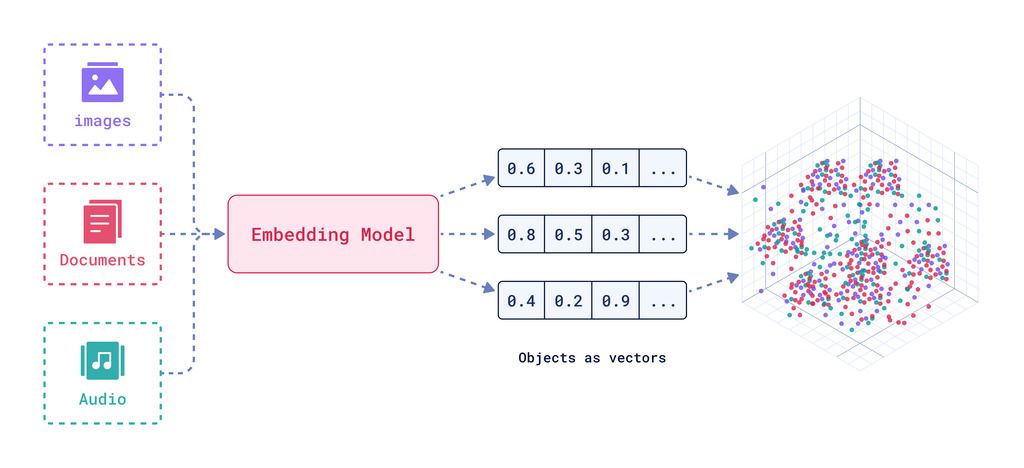
**Explanation:** This diagram demonstrates how any kind of media (text, audio, video, image) can be converted to simply a set of real numbers, which we call a high-dimensional vector.
**The Model Doesn't "Know" - It "Infers" from Context**
Imagine asking ChatGPT:
> Who is the President?
If this question stands alone, the model has to rely on its **pre-trained knowledge** and patterns it learned during training to infer an answer.
But if you say:
> We were talking about France. Who is the President?
Now, the context changes the entire meaning of your question.
The model embeds both sentences, finds relational meaning, and realises that __you mean the President of France_.
### Context Defines Relevance and Focus
In a human conversation, you automatically know what the topic is because of shared context.
LLMs mimic this by using **attention mechanisms,** which are mathematical functions that decide which parts of the context to “focus” on more strongly.
For example, if the model is answering:
> What color was the car that Joe drove to the conference?
It doesn’t scan every token equally. It pays more attention to tokens like __“Joe,” “car,”_ and __“conference.”_
The embedding of the entire passage helps it __weigh_ these words properly to generate an accurate answer.
That’s what makes the model’s response coherent: **attention powered by contextual embeddings.**
Let's consider the sentence "Multiple river banks in nature" and look at the diagram of the embedding of the word bank with respective to other words/tokens:
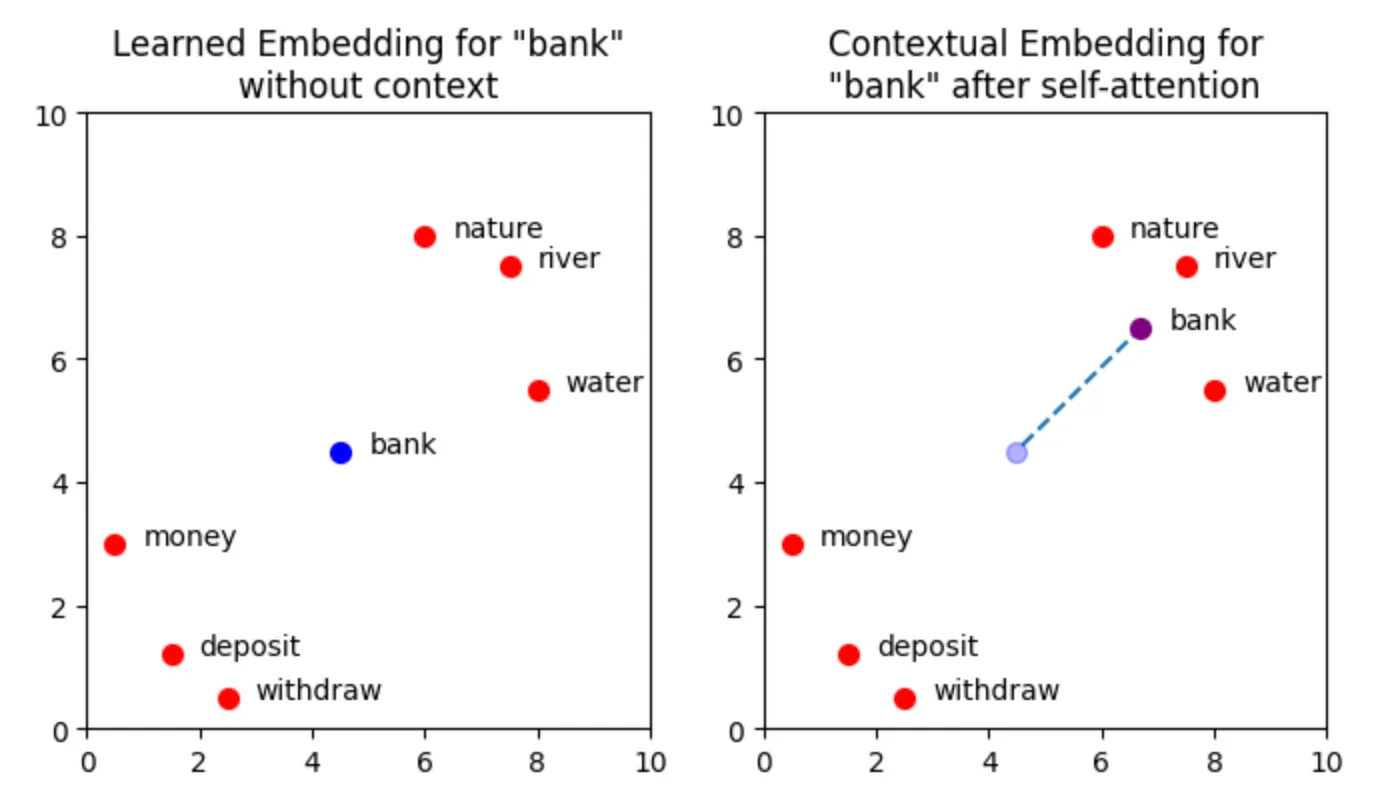
**Explanation:** This diagram depicts how the word "bank" in the sentence depends and changes its context based on the other words present.
#### Conclusion
Embeddings are the invisible bridge between **language and logic**. They allow machines to translate the fluidity of human expression into mathematical understanding. But what truly makes an LLM intelligent isn’t just its ability to store information, but it’s its ability to **contextualise** it.
This is what we are solving for at [**Alchemyst AI**](https://getalchemystai.com/platform/signin). If you need context connected across data sources for your AI agents to be truly versatile, we've got you covered! We mimic the neural cortex of the brain that is responsible for understanding the world in humans - but grounded deterministically so that you don't miss a beat if (or when) your agent falters.
If you're an enterprise and are curious about how we can help, feel free to [**book a demo**](https://cal.com/anuran/chat-with-anuran)!
[← Back to Blog](/blog)
## Recently Published
[October 6, 2026 / 10 min readHow to Build a RAG Pipeline for Personal Documents and MediaBuild a multi-modal RAG pipeline for all personal documents and media assets.](/blog/rag-pipeline-personal-documents-media)
[Technical / September 27, 2026 / 11 min readHarness Engineering for AI Agents: Bridging the GapExplore how harness engineering enables robust AI infrastructure and MLOps.](/blog/harness-engineering-ai-agents)
[I'm Evaluating / September 27, 2026 / 9 min readContext Engineering Best Practices for Enterprise AIMaster advanced context engineering best practices for conversational AI agents.](/blog/context-engineering-best-practices)
[I'm Evaluating / September 22, 2026 / 11 min readContext Engineering vs Prompt Engineering for AI AgentsExplore the differences between context and prompt engineering for enterprise AI](/blog/context-engineering-vs-prompt-engineering)
[I'm Evaluating / September 14, 2026 / 10 min readContext Engineering for Enterprise AI: A Complete GuideMaster context engineering to build reliable, production-ready voice AI agents.](/blog/context-engineering-enterprise-ai)
[Deep Technical / July 7, 2026 / 10 min readVoice-Specific Architectural Requirements for AI Context LayersDiscover the core voice-specific architectural requirements for AI context layer](/blog/voice-specific-architectural-requirements-ai-context-layer)
Get Started
## Give your AI agents the memory they deserve.
Join developers building the next generation of AI products with persistent, auditable context. Free tier available. No credit card required.
* Free tier
* REST + Python & Node SDKs
* 99.9% uptime SLA
* SOC 2 in progress
### Request API Access
Enter your email and we'll set up your workspace.
Email
[Read the Docs →](https://docs.getalchemystai.com)[Read the Thesis →](/thesis)
---
## https://getalchemystai.com/blog/how-to-add-persistent-memory-to-ai-agents
# How to Add Persistent Memory to AI Agents
AI agent memory is information stored outside an individual model request and retrieved when a later task needs it. To add persistent memory, save useful interactions and company knowledge in a durable store, retrieve the relevant evidence for each request, and give the model clear rules for using it. Test both recall and answer quality.
By [Alchemyst AI](/about) · Updated September 29, 2026
## What should AI agent memory contain?
Interaction memory and business knowledge solve different problems. A saved customer preference helps an agent continue a conversation. A current refund policy helps it answer a company-specific question. Keeping both outside the model lets your application choose the right information without relying on the model to retain it between requests.
A larger context window can hold more information in one request, but it does not by itself create a durable memory store. Decide what to save, how long to retain it, who can retrieve it, and how corrections replace older facts. These decisions matter whether you build the storage layer or use a service.
## How do you add persistent memory in four steps?
1. **Choose what the agent should remember.** Separate interaction memory, such as preferences and unfinished tasks, from shared business knowledge, such as policies and product documentation. Assign an owner and a retention rule to each source.
2. **Store context outside the model.** Save approved information in a persistent store or context service with source, user, team, and version metadata. Keep sensitive information out of scopes where it does not belong.
3. **Retrieve relevant evidence at runtime.** For each request, retrieve context within the authenticated user's permitted scope. Pass the relevant passages and their source references to the LLM alongside the task instructions.
4. **Test recall and unsupported answers.** Test whether the agent recalls saved facts, uses the latest policy, respects access boundaries, and declines to invent an answer when evidence is missing. Inspect traces and refresh the stored information as sources change.
With Alchemyst AI, developers can store and search context through an API, while enterprise teams define the business sources and boundaries the application should respect. Follow the [business knowledge integration guide](/developers#business-knowledge) and the [Alchemyst AI documentation](https://getalchemystai.com/docs) for implementation details.
## Why does my AI agent keep giving generic answers?
Generic answers often mean the agent lacks relevant evidence, but the failure can occur at several stages. The document might never have been indexed, the search might return the wrong passage, or the application might omit the retrieved text from the model request. Inspect that path before changing models.
| Symptom | What to inspect | Next action |
| --------------------------------------------- | -------------------------------------------- | ------------------------------------------------------------------------- |
| The answer sounds like general advice | The context actually sent to the LLM | Retrieve task-specific company documents and include them in the request. |
| The answer cites an old policy | Source version and update process | Replace or exclude superseded content and repeat the test. |
| The answer mixes customers or teams | Identity, authorization, and retrieval scope | Enforce access before context reaches the model. |
| The source is correct but the answer is wrong | Generation instructions and source support | Require evidence for claims and evaluate the generated answer. |
### Why doesn't ChatGPT know my business?
A conversation cannot reliably answer private business questions from general training knowledge alone. The relevant information must be supplied in the conversation or through an enabled, authorized data connection. Check which sources are actually available in your workflow; a product name or a detailed prompt is not a connection to your internal knowledge base.
## How do you stop an AI agent from making up company information?
Ground the answer in approved enterprise data, require source references, and define what happens when the evidence is missing. These controls reduce unsupported claims but cannot guarantee that an LLM will never hallucinate. Evaluate the output as well as the retrieved context, especially for decisions with significant business consequences.
* Ask questions whose answers are absent from the knowledge base and check that the agent acknowledges the gap.
* Include conflicting or superseded policies in tests to verify source selection.
* Check that cited passages actually support each company-specific claim.
* Route uncertain or high-impact answers to a person who can verify them.
For example, if a support agent has no approved refund policy for a new region, it should state that gap or escalate. Inventing a familiar thirty-day rule is still a failure, even if another region has that policy. Alchemyst Context Traces help inspect the retrieval evidence; they are not a guarantee that the generated answer is correct.
## How does RAG work for business?
Retrieval-augmented generation, or RAG, combines document retrieval with text generation. A business application searches approved sources for the user's question and includes the relevant passages in the LLM request. The model can then answer using company-specific evidence without retraining every time a source document changes.
The [Microsoft RAG overview](https://learn.microsoft.com/en-us/azure/search/retrieval-augmented-generation-overview) describes retrieval, source access, and governance as separate design concerns. For an enterprise rollout, test the complete path from the current source document to the answer a user sees.
## RAG vs fine-tuning for enterprise: which should you use?
Start with retrieval when the problem is access to changing internal knowledge. Consider fine-tuning when you need more consistent behavior on a defined task, such as a response format or classification pattern. They can be combined: a fine-tuned model can still retrieve current evidence before answering.
| Decision | RAG | Fine-tuning |
| --------------------- | --------------------------------------------------------- | ---------------------------------------------------------------------------- |
| Current company facts | Retrieve updated source content at request time. | New facts may require another training cycle; retrieval can still be needed. |
| Output behavior | Instructions and examples guide responses. | Training examples can adapt task behavior and style. |
| Source references | Preserve passage identifiers for citations and checks. | Learned weights alone do not provide document-level source references. |
| Operational work | Maintain sources, retrieval quality, and access controls. | Maintain training data, model versions, and evaluations. |
The [AWS comparison of RAG and fine-tuning](https://docs.aws.amazon.com/prescriptive-guidance/latest/retrieval-augmented-generation-options/rag-vs-fine-tuning.html) recommends starting with RAG for question answering over custom documents. Validate the choice against your own questions, sources, and evaluation results.
## Vector database vs knowledge base: what is the difference?
A vector database stores embeddings and supports similarity search. A knowledge base organizes the information an application or person uses, including the source documents and their meaning. A knowledge base can use a vector database underneath, but also needs processes for updates, ownership, permissions, and retrieval quality.
Vector databases can support metadata filtering, deletion, and observability; the details depend on the product and implementation. A managed context layer packages more of the surrounding workflow. Choose based on the operations your team wants to own, then verify the service against your access, export, and traceability requirements.
## Where does Alchemyst AI fit?
[Alchemyst AI's context layer](/) combines persistent context with knowledge retrieval for AI agents. Developers integrate storage and search through an API. Enterprise teams can use shared business context across workflows and inspect retrieval through Context Traces. Your application still selects the model, enforces its access policy, and evaluates the final answer.
Review [security controls and deployment requirements](/security), compare [AI context and memory platforms](/compare), or start with the [developer integration guide](/developers).